How Much Does It Cost to Build a Money Transfer App Like Wise?
164 Views 12 min August 25, 2026

Arohi Singh is a technology content strategist at Apptunix, where she writes about software and app development across industries, from on-demand and logistics to fintech, healthcare, and applied AI. With over 5 years of experience, she works closely with Apptunix’s engineers, product managers, and solution architects to turn real project insights into clear, decision-ready guidance for founders and business leaders. Her writing focuses on what matters before you build: market context, feature trade-offs, realistic costs, and compliance considerations
Every shopping app starts with a simple question over coffee: “What if we had our own?” Then the second question arrives, and it’s the one that decides everything. How much will it cost to create an ecommerce app in Saudi Arabia?
The cost to build an ecommerce app in Saudi Arabia typically runs from $15,000 to $120,000+. In riyals, the range is roughly SAR 56,000 to SAR 450,000+. At Apptunix, the final figure entirely relies on features, design, integrations, and platform choice.
Sounds like a wide gap, right? It is. And here’s why.
The ecommerce app development cost in Saudi Arabia isn’t just screens and a payment gateway. A serious app must fit Saudi buying habits, Arabic and English users, local payments, and logistics.
Take a Riyadh retailer planning expansion. A basic app works today. Next year, that same business may need multi-vendor selling, loyalty programs, or omnichannel commerce.
So the right budget starts with your business model, not the app.
Stay with us. Next, we’ll cover costs, features, process, hidden expenses, and ways to protect your investment.
But before we talk budgets, let’s see why the Kingdom has become the GCC’s most exciting ecommerce market.
So why are founders betting big on this market? Here are four reasons that make ecommerce app development one of the top business opportunities in Saudi Arabia.
For a Saudi investor, these figures tell a fairly practical story. Customer adoption is growing, and ecommerce businesses are rising like anything in the entire kingdom.
Building an ecommerce app in Saudi Arabia can cost around SAR 56,000 to SAR 450,000+. So, why does one quote say SAR 56,000 and another say SAR 70,000 or even more? Seven factors decide your ecommerce app development cost in Saudi Arabia, and each one moves the ecommerce app cost up or down.
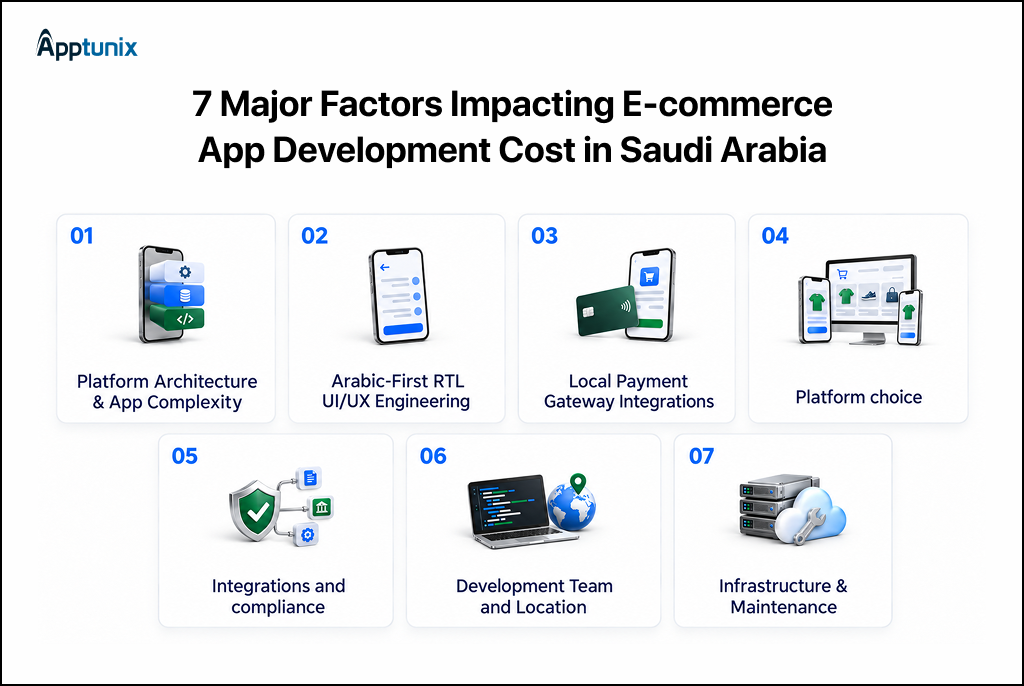
1. Platform Architecture and App ComplexityComplexity is the biggest budget driver. Every extra feature, user role, and integration adds design, coding, and testing hours. A single-vendor store and a multi-vendor ecommerce app development project are very different builds.
Architecture matters too. Headless ecommerce app development separates the storefront from the backend. It increases upfront cost but expedites future changes.
2. Arabic-First RTL UI/UX EngineeringArabic isn’t a translation layer. Right-to-left layouts mirror navigation, icons, forms, and animations. Designers rebuild screens, and developers test every flow twice. Skipping this saves money now. It costs you shoppers later.
3. Local Payment GatewaysCustomers in Saudi Arabia pay in specific ways, and your app has to support them. Mada, Apple Pay, and STC Pay are the basics. If you also want buy-now-pay-later through Tabby or Tamara, that’s more integration work and more cost. Each gateway you add pushes up what you’ll spend on an e-commerce app in KSA.
4. Platform ChoiceWill you build for iOS, Android, or both? Mobile ecommerce app development with a cross-platform framework usually costs less than two native apps. Native builds suit performance-heavy apps. Also ask whether a hosted tool like Salla or Zid covers your needs. Custom builds cost more but remove platform limits.
5. Integrations and ComplianceZATCA’s Phase Two e-invoicing connects your system to its Fatoora platform. Each wave comes with at least six months’ notice, so you won’t be caught off guard. Refunds, promo codes, COD, and BNPL orders are where things usually trip up. Add ERP, warehouse, and courier integrations, and the scope grows again.
6. Development Team and LocationWho builds your app changes the bill. A Saudi-based team usually charges more, but you get face-to-face meetings. An offshore team costs less, though it needs clearer communication. So don’t just compare hourly rates. Ask each ecommerce app development services provider how many Saudi projects it has shipped.
7. Infrastructure and MaintenanceLaunch day is just the baseline of any project. Cloud hosting, security patches, OS updates, and bug fixes continue every month. Peak sales like White Friday or Ramadan strain servers, so scaling costs matter. We’ll cover these in the hidden-costs section.
Now that you know what moves the price, let’s walk through how an app actually gets built, step by step.
Ready to see how an idea becomes a live app? Here are the seven steps, with what each phase typically costs. Your cost to build an ecommerce app in Saudi Arabia depends on where you spend the most.
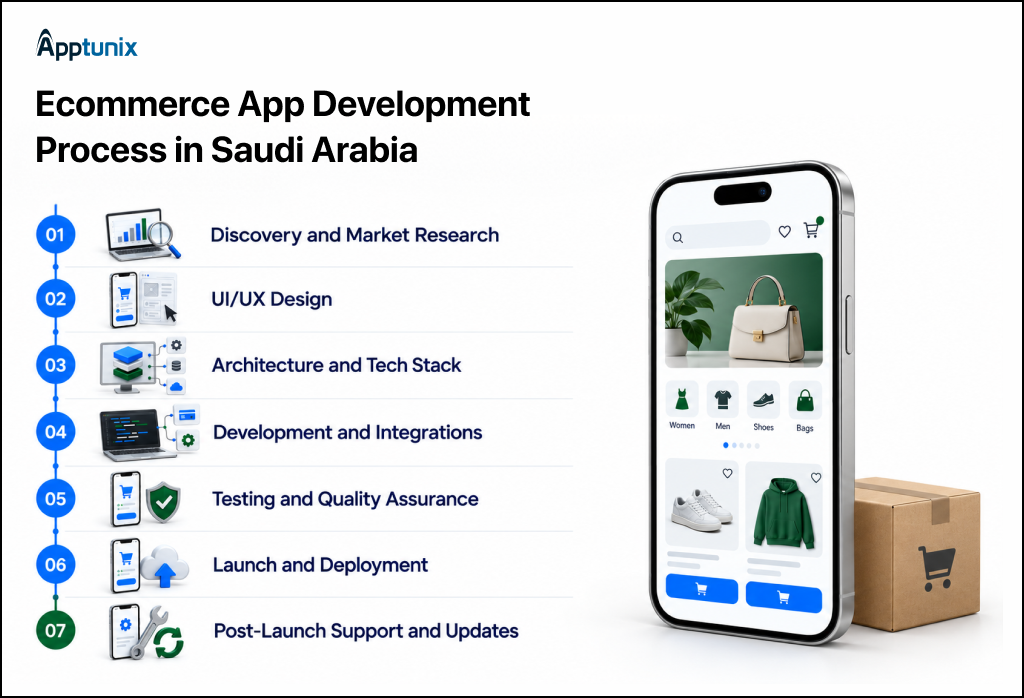
Step 1. Discovery and Market ResearchEstimated cost: SAR 3,750 – SAR 30,000 ($1,000 – $8,000)
Every good shopping app development company in Saudi Arabia starts with questions, not code. Your team studies competitors, shopper habits, and your business model. Then it locks the scope, feature list, and success metrics. Skip this step, and the budget drifts later.
Step 2. UI/UX DesignEstimated cost: SAR 9,500 to SAR 67,500 ($2,500 – $18,000)
Designers take the scope and turn it into wireframes and clickable prototypes. Look at the top e-commerce apps in the Middle East in your category and use them as a benchmark. Design the Arabic right-to-left screens from the start, not as an afterthought. And before anyone writes code, put the prototype in front of real shoppers and see where they get stuck.
Step 3. Architecture and Tech StackEstimated cost: SAR 5,750 to SAR 45,000 ($1,500 – $12,000)
Engineers pick the backend, database, hosting, and app framework. Planning to build an ecommerce app like Noon? Add seller onboarding, commission rules, and vendor dashboards now. Changing architecture mid-build is expensive.
Step 4. Development and IntegrationsEstimated cost: SAR 24,500 to SAR 195,000 ($6,500 – $52,000)
This is the biggest phase. Developers put together the storefront, cart, checkout, admin panel, and APIs. Then they plug in Mada, Apple Pay, BNPL, couriers, your ERP, and ZATCA e-invoicing. Work ships in short sprints. You’ll see progress every two weeks, so nothing comes as a surprise.
Step 5. Testing and Quality AssuranceEstimated cost: SAR 5,750 to SAR 52,500 ($1,500 – $14,000)
Testers check every flow on real Android and iOS devices. They simulate failed payments. Check the weak networks and Arabic layouts very meticulously. They also push peak-load traffic through it. Security checks come next, to protect customer data.
Step 6. Launch and DeploymentEstimated cost: SAR 3,750 to SAR 22,500 ($1,000 – $6,000)
Your team submits the app to the Apple App Store and Google Play, puts the backend servers live, and turns on monitoring so you hear about problems before customers do. Many brands launch in one city first. Real shoppers will find bugs your testers missed, so fix those, then go nationwide.
Step 7. Post-Launch Support and UpdatesEstimated cost: SAR 3,000 to SAR 37,500 ($1,000 – $10,000)
Launch day is when the actual test begins. Developers track crashes, cart abandonment, and reviews. Then they ship fixes and new features. Reliable ecommerce app development service providers in KSA include this phase in the plan.
An ecommerce app in Saudi Arabia takes 3 to 12+ months to develop. Complexity, platform choice, and compliance work move these numbers.
Planning your budget? Time and money rise together, so here’s how the timeline splits:
Platform matters too. A cross-platform build with Flutter or React Native usually lands near the shorter end. Native iOS and Android apps need two separate builds, so expect them toward the longer end.
So what stretches a schedule? Watch these four:
Want to move faster? Launch a lean version in one city first, such as Riyadh. Then scale feature by feature while expanding to cities like Makkah or Eastern Province.
Timelines are clear. Now, which features will your shoppers expect inside the app?
Saudi shoppers are spending more, and they’re doing it online. In April 2026, consumer spending rose about 17.5% year on year to SAR 133.9 billion. E-commerce drove much of that jump and made up roughly a quarter of all spending.
So what keeps those shoppers coming back? Mainly the Features. They make or break your app, and each one adds to your ecommerce app cost. Here are the 12 must-have features Saudi shoppers expect, and what each does to your online store app cost.
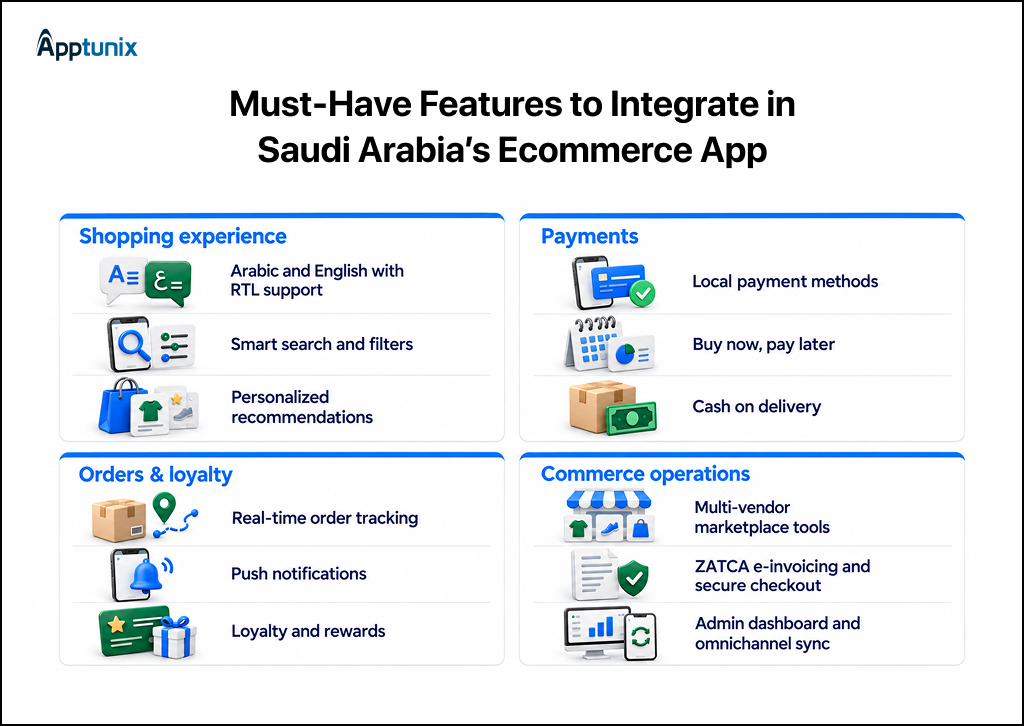
1. Arabic and English with RTL supportShoppers want to browse in their own language. A proper right-to-left layout feels natural, not translated. It builds trust fast, and trust is what turns a first visit into a first order.
2. Local payment methodsMada, Apple Pay, and STC Pay are an absolute must. International cards alone leave gaps, and a missing trusted method is an easy reason to abandon a cart. Offering these trusted local payment methods drastically cuts checkout abandonment and converts high-intent buyers instantly.
3. Buy now, pay laterTabby and Tamara let shoppers split purchases into instalments. Big baskets feel lighter at checkout. For high-ticket items like electronics, that small nudge can tip the decision. Add them early, because the integration touches invoicing too.
4. Cash on deliveryMany Saudi shoppers still like paying when the parcel arrives. Offering cash on delivery removes the fear of paying first. Just plan for refused orders at the door, since they happen, and track them in your admin panel.
5. Smart search and filtersShoppers rarely scroll forever. Smart search with Arabic spelling tolerance, filters, and sorting helps them find the right product in seconds. Fewer dead ends mean fewer exits, and more orders from the traffic you already paid for.
6. Personalized recommendationsPicture a shop assistant who remembers every customer. Smart recommendations do exactly that. They learn what each shopper browses and buys, then show products that fit.
7. Real-time order trackingNobody likes wondering where their parcel is. Live tracking, from warehouse to doorstep, cuts anxious support calls and builds confidence. Tracking also gives your team one clear view of every delivery in progress. Courier integrations make it work.
8. Push notificationsPush notifications can announce order updates, flash sales, and restocks. Keep them relevant and personal. Segment by city and language. Spam gets muted, and a muted shopper is a lost shopper.
9. Loyalty and rewardsKeeping a customer is more economical than finding a new one. Points, tiers, and referral rewards give shoppers a reason to come back. Tie them to moments like Ramadan and Eid al-Fitr, when spending peaks and the pull is stronger.
10. Multi-vendor marketplace toolsWant to build an ecommerce app like Temu? You need seller onboarding, commission rules, vendor dashboards, and payouts.
Multi-vendor ecommerce app development demands extra effort, but it lets your catalogue grow without you holding the stock.
11. ZATCA e-invoicing and secure checkoutZATCA’s Phase Two requires your e-invoicing to connect with the Fatoora platform, and secure checkout protects customer data. Bake both in from day one. Retrofitting later costs more and delays launch. Do it once, do it properly.
12. Admin dashboard and omnichannel syncBehind every smooth app sits a strong admin panel. Track sales, stock, returns, and campaigns in one place. Omnichannel ecommerce development also syncs inventory across your app, website, and stores. Shoppers never buy what you cannot ship.
Not sure which features to launch with? Book a free 30-minute scoping call and leave with a prioritized, costed feature list.
Features are the fun part. Now let’s look at the costs that arrive after launch.
Here’s the part most quotes skip. The build price is only the start. These six expenses keep arriving after launch, and they shape your real ecommerce app development cost in KSA.
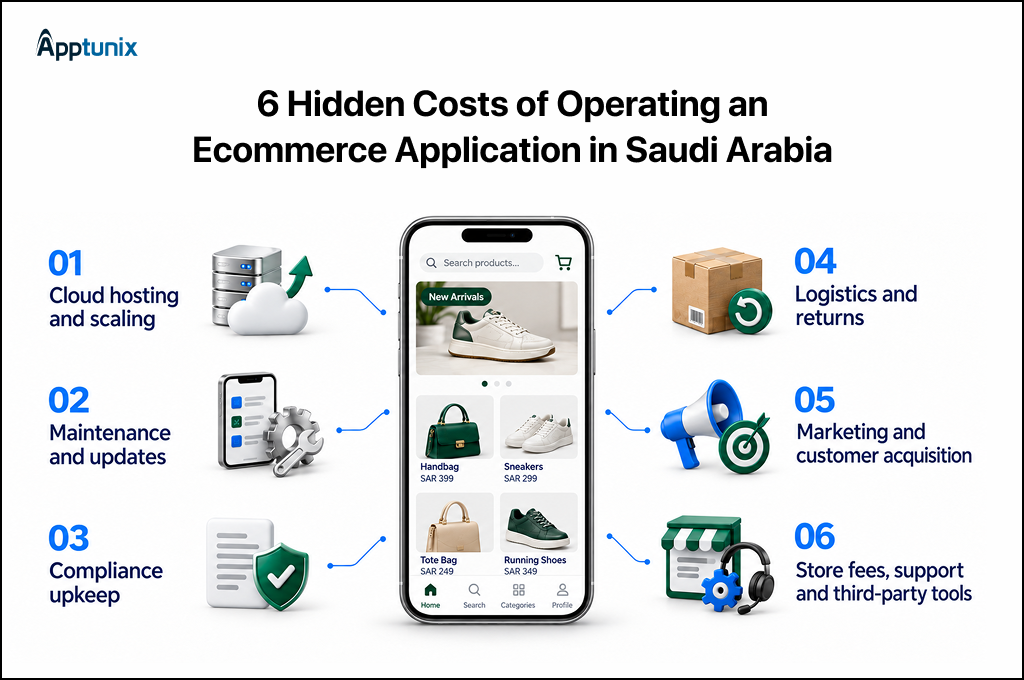
1. Cloud hosting and scalingServers cost money every month. Traffic spikes during sales like White Friday can push bills up fast. Plan for auto-scaling, because a crashed app on your biggest sales day costs far more than extra capacity.
2. Maintenance and updatesApple and Google release new operating systems every year. Your app needs updates to keep working. Budget for bug fixes, security patches, and library upgrades. Neglected apps break quietly, then lose reviews loudly.
3. Compliance upkeepRules keep moving. ZATCA rolls out Phase Two e-invoicing in waves and notifies each group at least six months’ notice. Your team may need to update as regulations shift.
4. Logistics and returnsDelivery is a cost center, not a footnote. Mordor Intelligence notes that sparse-population routes can double per-package costs versus city drops. Cash on delivery adds refused-order risk too, so build return handling into your plan.
5. Marketing and customer acquisitionA live app isn’t a found app. You still need ads, influencer partnerships, and App Store optimization to earn downloads. Many first-time owners underfund this line, then wonder why a great app sits quiet.
6. Store fees, support and third-party toolsApple charges a Developer Program fee each year, and Google Play charges a one-time registration fee. Add customer support staff, analytics, SMS and email tools, and the small subscriptions pile up.
A quick reality check: Marketplaces feel these costs more. Ecommerce marketplace app development cost includes seller support, payout handling, and dispute resolution on top of the above. Even a basic online store app cost grows once real shoppers arrive.
So what should you do? Ask your ecommerce development company for a clear first-year running-cost estimate, not only a build quote. A partner that offers ecommerce app development Riyadh support on-site or on call can help you spot these costs early.
Hidden costs are real, but they’re manageable. Let’s look at how to keep your budget under control.
You can’t control every cost. But you can control where your money goes. Smart owners cut waste, not quality. Here are four moves that protect your budget.
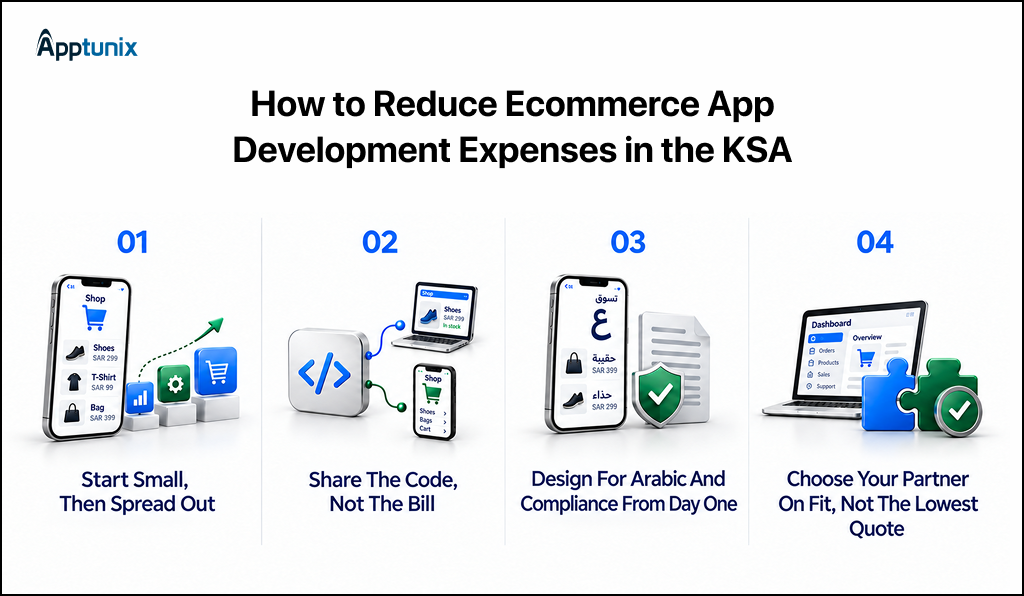
1. Start small, then spread outResist the urge to launch everything at once. Build a lean version with what shoppers need on day one. Then test it in one market. Many brands begin with shopping app development in Riyadh, learn from real orders, and then move into Jeddah and Eastern Province.
Each region can show different delivery and demand patterns. Your later budget then follows proof, not guesses.
2. Share the code, not the billTwo native apps double part of the work. A cross-platform framework like Flutter or React Native lets one codebase serve both iOS and Android. And don’t reinvent the wheel. Payment SDKs, ZATCA-ready invoicing tools, and courier APIs already exist. Custom-build only what makes your store different.
3. Design for Arabic and compliance from day oneFixing RTL layouts or e-invoicing after launch means reworking finished screens and code. Doing it upfront feels slower, but it costs less. Rework is the most avoidable line on any invoice.
4. Choose your partner on fit, not the lowest quoteCheap quotes often hide gaps, like missing QA, vague scope, and no support plan. Ask ecommerce app developers in Saudi Arabia for a fixed scope, milestone-based payments, and a written maintenance plan. Request a first-year running-cost estimate too. A clear contract protects you more than a discount.
So the pattern is simple. Build lean, share what you can, plan for the rules early, and pick a partner who’s open about numbers. Do that, and your cost to build an ecommerce app in Saudi Arabia stays predictable.
Budget sorted. But who should build it? Here’s why businesses choose Apptunix.
Anyone can send you a quote. Fewer can show you what happens after the contract is signed. So look at the proof.
1. We’ve built at GCC scale.Take Namshi, the leading online fashion and lifestyle platform serving the GCC. Apptunix built its native iOS and Android apps, plus vendor and admin portals on a microservices backend. You can check our Namshi shopping app case study; revenue rose 54% after the app redesign. Downloads grew 36% and crossed 10 million installs.
2. We build with Saudi rules in mind.Compliance is where many projects get stuck. Apptunix announced an upgraded security framework aligned with Saudi Arabia’s PDPL. It handles user consent, keeps data stored in-country where required, and covers encryption, role-based access, and what to do if a breach happens. We plan for compliance from day one of the project instead of fixing it at the last minute.
3. One team carries the whole journey.Discovery, design, development, testing, launch, and support all sit under one roof. Planning a marketplace, or a store that syncs with your app? That’s covered too. Curious how we work with Kingdom-based businesses? See our mobile app development company in Saudi Arabia page.
4. We’ll tell you when custom isn’t the answer.Not every business needs a custom app. With a small catalogue, a hosted platform like Salla may be enough. Outgrowing it? That’s when a custom build starts paying for itself.
Ready when you are.
You now know what drives the price, how long it takes, and what to watch for. Budgets typically run from $15,000 to $120,000+, or roughly SAR 56,000 to SAR 450,000+. Let’s pin down yours. Share your scope, and our ecommerce app development services team will map out a clear estimate.

Q 1.How Much Does It Cost To Create An Ecommerce App In Saudi Arabia?
Building an ecommerce app in Saudi Arabia typically costs $15,000 to $120,000+, or roughly SAR 56,000 to SAR 450,000+. A basic single-vendor app sits at the low end. An advanced marketplace with AI recommendations and omnichannel sync sits at the top.
Q 2.How Long Does It Take To Develop An Ecommerce App In Saudi Arabia?
Most Saudi ecommerce apps take 3 to 12+ months. A basic app needs 3 to 6 months. A mid-level app takes 6 to 9 months. An advanced marketplace takes 9 to 12 months or more. Arabic RTL design, ZATCA e-invoicing, payment onboarding, and multi-vendor logic stretch the schedule.
Q 3.Which Payment Methods Should A Saudi Ecommerce App Support?
Saudi shoppers expect Mada, Apple Pay, and STC Pay at checkout. Buy-now-pay-later options like Tabby and Tamara help with big baskets. Cash on delivery still matters for many buyers. Each method needs integration, testing, and certification time, which adds to your budget.
Q 4.Do Saudi Ecommerce Apps Need ZATCA e-invoicing?
Businesses in ZATCA’s Phase Two waves must connect their e-invoicing systems to the Fatoora platform. ZATCA notifies each wave at least six months ahead. Building e-invoicing in from day one costs less than retrofitting it after launch.
Q 5.Should I Use Salla or Zid, or Build a Custom App?
A hosted platform like Salla or Zid can work for a small catalogue. Custom builds cost more but remove platform limits. They suit brands that need multi-vendor selling, ERP sync or a distinctive shopping experience. Outgrowing a hosted tool is usually when custom pays for itself.
(2 ratings, average: 5.00 out of 5)
Get the weekly updates on the newest brand stories, business models and technology right in your inbox.
Arohi Singh is a technology content strategist at Apptunix, where she writes about software and app development across industries, from on-demand and logistics to fintech, healthcare, and applied AI. With over 5 years of experience, she works closely with Apptunix’s engineers, product managers, and solution architects to turn real project insights into clear, decision-ready guidance for founders and business leaders. Her writing focuses on what matters before you build: market context, feature trade-offs, realistic costs, and compliance considerations
Book your consultation with us.
Book your consultation with us.


One Central, The offices 3, Level 3, DWTC, Sheikh Zayed Road, Dubai
+971 50 782 1690