
Food Delivery App Development: Cost, Features, and Investment Guide
615 Views 26 min September 26, 2025

You might’ve ticked all the boxes for your mobile app development project, but you're now stuck at the most-asked question: How much does it cost to build an app? It can be a daunting task to find the accurate answer, isn’t it?
Well, of course, that happens due to obvious reasons - it’s not just one factor that you need to consider for app development cost, the list can go on and on. That’s why it's essential to understand all the basics that can impact your overall budget for app development costs.
No worries, you don’t have to look for the answers anywhere else. In today’s detailed guide, let's discuss a complete mobile app development cost breakdown: factors affecting app development cost, app development cost by app type, and much more. You’ll get all the answers that will help you plan your mobile app development budget accordingly.
Without any further ado, let’s get started!
On average, the mobile app development costs start from $10,000 and can go up to or beyond $300,000. Now, it all depends on how basic or complex you want your app to be, what features & functionality you wish to integrate, how intuitive & seamless you want your UX UI design to be, and many other such factors.
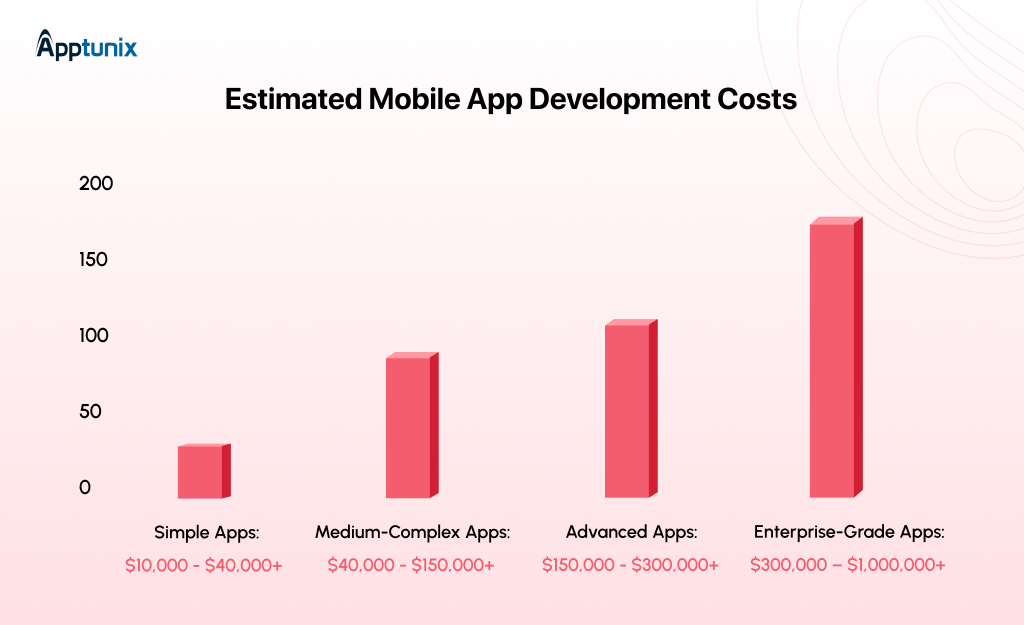
Once you’ve figured out all aspects of your mobile app development plan, you can move ahead with your budget plan. Now, to understand this, you need to delve deeper into the subject – otherwise, you’ll never know how you exceeded your budget (mainly due to hidden app development costs, which we’ll discuss later on).
Most people believe that mobile app development cost is a one-size-fits-all figure – but that’s not the case. Each factor offers something different, and that directly impacts the overall development cost. Let’s dive into key cost-influencing factors for mobile app development:
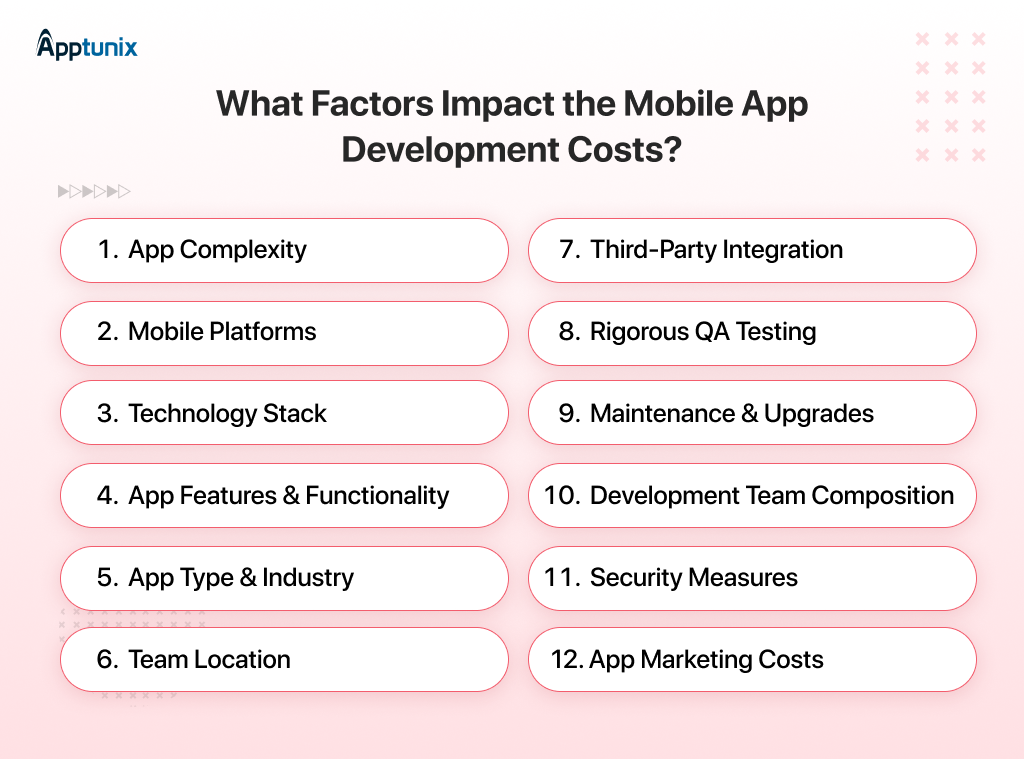
1. App ComplexitySimply stated, the more complex your mobile app development, the more effort, time, and development costs it will require. The complexity here encompasses features, functionality, design, third-party integrations, technologies, and more.
For instance, if you want to build a basic mobile app like a calculator, a to-do list, or a basic habit tracker app, it will cost you less. Why? Because it doesn’t require complex coding, integrations, or other factors.
Now, on the flip side, suppose you want to build a complex app like a social media, healthcare app, or sports-betting app – the cost will definitely go on the higher side. Simply because it will require mobile app development experts specialized in complex coding, design, and the latest technologies, among other skills. That’s why app development cost depending on mobile app complexity is one of the most critical factors you need to consider while budgeting your project.
| App Complexity = (Development Time ↑) + (Design Effort ↑) + (QA Testing ↑) → Higher Cost |
Let’s take a look at the estimated cost based on mobile app complexity:
| App Complexity Type | Includes | Examples | Estimated Cost |
|---|---|---|---|
| Simple App | Basic UI, limited screens, simple login, minimal features | Calculators, flashcard apps, habit tracker apps, to-do list apps, etc. | $10,000 - $30,000+ |
| Mid-Complex App | Custom UI/UX, API integrations, payment gateway, real-time chat, push notifications | eCommerce apps, event platforms, task management apps, etc. | $30,000 - $120,000+ |
| Advanced Complex App | Advanced features, AI/ML integration, AR/VR, video streaming, multiple third-party integrations, scalability | Ride-hailing apps, healthcare apps, social media apps, sports-betting apps, etc. | $120,000 - $250,000+ |
| Enterprise-Grade Level App | Large-scale solutions, high security, cloud integration, big data, multiple user roles, ERP/CRM, robust backend | ERP, CRM, Point of Sale (POS) software, etc. | $250,000 - $500,000+ |
2. Mobile PlatformsiPhone or Android app development directly impacts the app development cost. If you opt for a single platform (iOS or Android), it will cost you less than developing for both. iPhone or Android app development cost
However, if you want your app to operate on both iOS and Android without doubling the app development effort, cross-platform development (using Flutter, React Native, etc.) is your go-to option compared to building two separate native apps.
Here are a few statistical data points that you must know:
Let’s dive into mobile platform cost comparison:
| Development Approach | Description | Estimated Cost Range | Cost Impact |
|---|---|---|---|
| Single Platform (iOS or Android) | Build only for one platform. Suitable for MVPs or startups testing the market. | $20,000 - $60,000+ | Baseline |
| Native for both (iOS + Android) | Separate apps built for iOS and Android, offering the best performance and user experience, but doubling development effort. | $40,000 - $150,000+ | +80%–100% over single platform |
| Cross-Platform (Flutter, React Native, etc.) | One codebase runs on both iOS and Android. Faster and more cost-efficient than separate native apps. | $20,000 - $120,000+ | +30%–60% over one platform (shared code), but savings drop if heavy native features are required |
3. Technology StackNow, when we’re talking about a tech stack, we aren’t just talking about a single thing. It’s about a combination of elements such as:
Well, it may seem tempting to simply choose the most popular app development tech stack or the latest cutting-edge technologies, doesn’t it? But that’s not the right approach. It can lead to technical issues, scalability issues, Vendor lock-ins, bottlenecks, and maintenance concerns (if you choose the wrong tech stack).
Therefore, it is crucial to make the right decisions with leading app developer company, as the tech stack has a significant impact on the overall mobile app development cost estimate. Before choosing your tech stack, assess your project requirements, future scalability needs, team expertise, security requirements, and long-term maintenance costs.
Here’s how tech stack impacts the app development costs:
| Tech Stack Choice | Details | Cost Impact |
|---|---|---|
| Native (Swift for iOS, Kotlin for Android) | Offers the best performance and full access to device features, but requires two separate codebases. | High (more dev time, more maintenance) |
| Cross-Platform (Flutter, React Native) | Shared codebase for iOS & Android, faster development, but some native features may need extra effort. | Medium (saves ~30–40% vs fully native) |
| Backend Framework (Node.js, Django, Ruby on Rails) | Impacts scalability, API performance, and security. Choosing a weaker backend can lead to costly fixes. | Variable (depends on complexity & scalability needs) |
| Databases (Firebase, MongoDB, MySQL, PostgreSQL) | A wrong choice can cause performance or scaling issues. Cloud-hosted solutions (like Firebase) may have recurring costs. | Medium to High |
| Third-party Integrations (Payment gateways, Maps, AI APIs, Push Notifications) | Add-ons improve functionality but increase licensing/API usage costs. | Adds $1,000–$10,000+ depending on features |
| Licensing & Tools (SDKs, Development Environments, Paid Libraries) | Premium SDKs, licensed APIs, or development tools may come with annual or per-user fees. | $500–$5,000+ yearly depending on tools |

4. App Features & FunctionalityNow, let’s discuss the major cost-driving factor: features & functionality that influence the overall app development cost.
The formula here is simple: the more features you integrate, the higher the cost. It’s because new features add more complexity, require more development time, and involve additional testing & maintenance.
For instance, you can build a basic taxi booking app, which can be developed in months with a basic UX/UI design & tech stack at a minimal cost.
Now, if you want to build a ride-hailing app like Uber with advanced features & functionalities (real-time GPS tracking, surge pricing, AI-based route optimization, loyalty programs, and digital wallet integration) – the cost multiplies quickly.
Let’s take a look at features impacting development cost:
| Feature Category | Examples | Development Complexity | Estimated Cost Impact |
|---|---|---|---|
| Basic Features | User Registration, Profile Setup, Search, Listings, Notifications | Low | $5,000 - $20,000 |
| Core Functional Features | Real-time Tracking, In-app Payments, Chat/Messaging, Reviews & Ratings | Medium | $20,000 - $60,000+ |
| Advanced Features | AI-based Recommendations, AR/VR Features, Multi-language, Voice Search, Dynamic Pricing | High | $60,000 - $150,000+ |
| Enterprise-Grade Features | Advanced Analytics Dashboard, Machine Learning Models, Blockchain Security, IoT Integrations | Very High | $150,000 - $250,000+ |
Pro Tip: Start with an MVP (Minimum Viable Product) with only essential features. Once the app gains traction, you can roll out advanced and enterprise-level features in phases. This way, you avoid burning your budget upfront and still test market demand.
5. App Type & IndustryAnother element of your app development costs includes your app category & industry. Different industries require different levels of security, compliance, scalability, and feature complexity.
For instance, a FinTech app development demands robust-grade security and regulatory compliance, while a gaming app may need advanced graphics and real-time multiplayer functionality.
Here’s a breakdown of different industries and their estimated app development costs:
| Industry/App Type | Key Considerations | Estimated Development Cost |
|---|---|---|
| Basic Mobile App | Simple UI, few screens, limited functionality | $20,000 - $40,000 |
| iPhone App (iOS) | Built for Apple ecosystem, strict UI/UX guidelines, high-quality testing | $25,000 - $60,000+ |
| Android App | Wide device compatibility, fragmentation handling, Google Play compliance | $20,000 - $50,000+ |
| Web App | Browser-based, responsive design, less hardware dependency | $15,000 - $40,000+ |
| FinTech App | High security, compliance (PCI DSS, KYC), complex APIs, payment gateway integration | $50,000 - $200,000+ |
| Gaming App | Graphics-heavy, animations, multiplayer setup, AR/VR, or 3D engines | $50,000 - $200,000+ |
| Healthcare App | HIPAA compliance, patient data security, integrations with wearables | $40,000 - $250,000+ |
| Dating App (like Tinder) | Geo-location, real-time chat, push notifications, matching algorithm | $30,000 - $120,000+ |
| eCommerce App | Product catalog, cart, payment, order tracking, inventory integration | $40,000 - $250,000+ |
| Educational App (EdTech) | Interactive content, video streaming, progress tracking, gamification | $15,000 - $100,000+ |
| Video Streaming App (like Netflix) | High storage, CDN, real-time streaming, subscription module, DRM | $50,000 - $250,000+ |
| Social Media App (like Snapchat) | Messaging, feeds, AR filters, push notifications, scalable backend | $30,000 - $200,000+ |
| On-Demand Food Delivery App | Real-time tracking, restaurant/vendor dashboard, payments, notifications | $25,000 - $120,000+ |
| Real Estate App | Property listings, 3D tours, map integration, filters, chat | $40,000 - $250,000+ |
6. Third-Party IntegrationSimply stated, third-party integrations are the gateway to seamless operations. And they’re not optional, but necessary.
At its core, third-party integration works as a bridge between your organization systems and external applications via APIs. This enables faster payments, fraud detection, real-time analytics, and overall higher productivity.
Additionally, it helps unlock new features or access valuable data without requiring the need to build it from scratch. Instead of developing complex features in-house, businesses can plug into proven tools, saving time, cost, and effort.
The main driver behind this growing adoption is user retention. Studies show that 63% of companies invest in integrations to keep users engaged. But that’s not all — integrations also open doors to new monetization models, upselling opportunities, and faster scalability.
| Integration Type | Purpose / Use Case | Estimated Cost |
|---|---|---|
| Payment Gateway (Stripe, PayPal, Razorpay) | Secure and seamless transactions | $2,000 - $5,000+ |
| Maps & Geolocation (Google Maps, Mapbox) | Real-time navigation, delivery tracking | $1,500 - $4,000+ |
| Social Media Login (Facebook, Google, Apple) | Faster sign-ups & improved UX | $1,000 - $3,000+ |
| Analytics Tools (Firebase, Mixpanel) | Track user behavior & insights | $1,500 - $4,000+ |
| Chat & Messaging (Twilio, SendBird) | In-app communication features | $3,000 - $7,000+ |
| Push Notifications (OneSignal, Firebase) | Boost engagement with real-time updates | $800 - $2,000+ |
| CRM Integration (Salesforce, HubSpot) | Manage customer lifecycle | $3,000 - $8,000+ |
| Video Streaming (Agora, AWS IVS) | Live streaming / video calls | $4,000 - $10,000+ |
7. Rigorous QA TestingNearly 90% of mobile app users abandon an app because of bugs or performance issues. This makes rigorous QA testing a non-negotiable part of the app development process.
It is crucial to note that QA testing has a direct impact on the mobile app development cost. Various types of mobile app testing include:
| Testing Type | Purpose | Estimated Cost |
|---|---|---|
| Usability Testing | Validates ease of navigation, intuitive design, and overall user experience. | $1,000 - $3,000 |
| Security Testing | Identifies vulnerabilities, ensures data protection, and prevents breaches. | $2,000 - $5,000 |
| Accessibility Testing | Checks compliance with accessibility standards (e.g., WCAG), screen readers, color contrasts. | $800 - $2,000 |
| Performance Testing | Assesses app speed, responsiveness, and load handling under different conditions. | $1,500 - $4,000 |
| Functional Testing | Ensures all app features work as intended across different devices and OS versions. | $2,000 - $6,000 |
| Compatibility Testing | Validates app performance across devices, OS versions, screen sizes, and networks. | $1,000 - $3,000 |
| Regression Testing | Ensures new updates or features don’t break existing functionality. | $1,000 - $2,500 |
| Beta Testing | Involves real users testing the app before the official launch to gather feedback. | $500 - $1,500 |
Pro Tip: The total QA testing phase may range from 300 to 500 hours, depending on app complexity, translating to an average cost of $10,000 to $25,000.
8. Maintenance & UpgradesOnce your mobile app is live, the work doesn’t just end there – the next step is highly crucial to keep it running smoothly and effectively. This step is continuous maintenance & upgrades that keep your app bug-free, compatible, and integrated with the latest features & updates.
Additionally, regular updates enhance your app’s performance, fix crashes, and upgrade it to new versions, keeping users engaged and staying ahead in the competition. According to industry benchmarks, 20–25% of the original app development cost is spent annually on maintenance.
Let’s take a look at maintenance & estimated cost:
| Maintenance Task | Description | Estimated Cost |
|---|---|---|
| Bug Fixes & Patch Updates | Resolving post-launch bugs and ensuring smooth functionality | $2,000 - $8,000+ |
| OS & Device Compatibility | Updating app to work with new iOS/Android versions and devices | $3,000 - $10,000+ |
| Feature Enhancements | Adding new features or functionalities based on user feedback | $5,000 - $15,000+ |
| Performance Optimization | Improving speed, memory usage, and responsiveness | $2,000 - $6,000+ |
| Security Updates | Fixing vulnerabilities and compliance upgrades | $2,500 - $7,000+ |
9. Development Team CompositionThe composition of your development team will also impact the overall cost of mobile app development. It depends on several key factors, including team size, expertise level, experience, talent acquisition model, and location. Plus, every app project requires different expertise, including developers, designers, testers, project managers, and business strategists.
Now, for instance, if you’ve a small team (like 2-3 developers & designers), it will cost you less but may take longer to deliver. On the other hand, an entire team specialized in their fields will speed up the development but increase costs.
Let’s check the team role and their estimated hiring cost in detail:
| Role | Responsibility | Estimated Cost (Monthly) |
|---|---|---|
| Project Manager | Oversees project, timelines, and communication | $4,000 - $8,000+ |
| UI UX Manager | Creates wireframes, user flows, and polished app design | $3,000 - $7,000+ |
| Front-End Developer | Build user-facing components (iOS/Android apps) | $5,000 - $12,000+ |
| Back-End Developer | Handles APIs, databases, and server-side logic | $6,000 - $15,000+ |
| QA Engineer | Tests and ensures a bug-free, secure app | $3,000 - $6,000+ |
| DevOps Engineer | Manages deployment, CI/CD pipelines, scaling, and cloud hosting | $5,000 - $10,000+ |
| Business Analyst | Define app requirements, competitor analysis, and market research | $3,500 - $7,000+ |
10. Security MeasuresSecurity is non-negotiable as it builds trust and transparency between your business and customers. And it’s evident because customers are sharing their personal data and information while using your app. If your app isn’t secure or safeguards information, it can lead to severe data leaks, fraud, and even legal troubles.
Now, integrating robust security features definitely adds to your development cost. You need to incorporate security features such as end-to-end encryption, penetration testing, custom & secure payment gateways, compliance with relevant standards (e.g., GDPR, HIPAA, PCI DSS), and multi-factor authentication. These not only protect sensitive data but also give users confidence when using your app.
In short, strong security = stronger customer trust, which directly impacts the growth and success of your app.
Let’s get into details:
| Security Measure | Purpose | Estimated Cost |
|---|---|---|
| Data Encryption (AES-256) | Protects sensitive data from being intercepted | $1,500 - $4,000+ |
| Multi-Factor Authentication | Adds extra login security for users | $2,000 - $5,000+ |
| Secure APIs & Tokens | Prevents unauthorized access to data | $3,000 - $7,000+ |
| Regular Penetration Testing | Identifies vulnerabilities before hackers exploit them | $4,000 - $10,000/test |
| GDPR & HIPAA Compliance | Ensures legal compliance for data handling | $3,500 - $8,000+ |
11. Location of Mobile App Development TeamThe location of your mobile app development team has a direct impact on the overall development cost. This is due to various factors, including the cost of living, availability of expertise and skills, infrastructure quality, taxation policies, and labor market competition.
For example, hiring developers in North America or Western Europe can be significantly more expensive than in regions such as Eastern Europe, Asia, or Latin America.
Developers in high-cost regions often charge more per hour, but they may bring extensive experience and advanced technical expertise. On the other hand, developers in lower-cost areas can offer more affordable rates. Still, you may need to carefully assess their communication skills, time zone differences, and consistency in quality.
Let’s take a look at more details:
Mobile App Development Cost by Location
| Location | Average Hourly Rate | Key Insights |
|---|---|---|
| North America (USA, Canada) | $80 - $150+ | The highest cost is due to high living standards, substantial expertise, and advanced infrastructure. |
| Western Europe (UK, Germany, France) | $60 - $120+ | Skilled developers, strong regulations, slightly lower than the US, but still expensive. |
| Eastern Europe (Ukraine, Poland, Romania) | $30 - $60+ | A great balance of cost & quality, this is a popular offshore destination. |
| South Asia (India, Pakistan, Bangladesh) | $20 - $50+ | Most affordable, large talent pool, and experience in offshore projects. |
| Southeast Asia (Vietnam, Philippines) | $25 - $50+ | Emerging outsourcing hub with competitive pricing. |
| Latin America (Brazil, Mexico, Argentina) | $30 - $65+ | A growing market and nearshore advantage for US businesses. |
12. App Marketing CostsSome mobile app development companies spend a few hundred dollars, whereas others spend millions of dollars. Now this all depends on your marketing budget and goals.
Experts suggest allocating approximately 12–20% of your total revenue to marketing when your app is new. Once it grows and attracts regular users, you can reduce it to 6–12% to continue promoting without incurring excessive costs.
Even the best app fails without proper marketing. Post-launch, you’ll need a plan for your marketing budget to acquire users, retain them, and scale visibility in app stores.
Take a look at marketing channels and their estimated costs:
| Marketing Channels | Description | Estimated Monthly Cost |
|---|---|---|
| App Store Optimization (ASO) | Improving app ranking with keywords, reviews, and screenshots | $1,000 - $3,000+ |
| Paid Ads (Google, Facebook, Instagram, TikTok) | Running campaigns to attract installs & conversions | $5,000 - $20,000+ |
| Influencer Marketing | Partnering with niche influencers for app promotions | $3,000 - $10,000+ |
| Content Marketing & SEO | Blogs, PR articles & long-term organic growth | $2,000 - $6,000+ |
| Social Media Campaigns | Engaging users on Instagram, Twitter, LinkedIn, etc. | $2,000 - $8,000+ |
| Referral Programs | Rewards for users bringing new customers | $1,000 - $4,000+ |
When building a mobile app, each step involves factors that contribute to the overall mobile app development costs. Here, we’ve discussed a step-by-step mobile app development process with estimated costs:
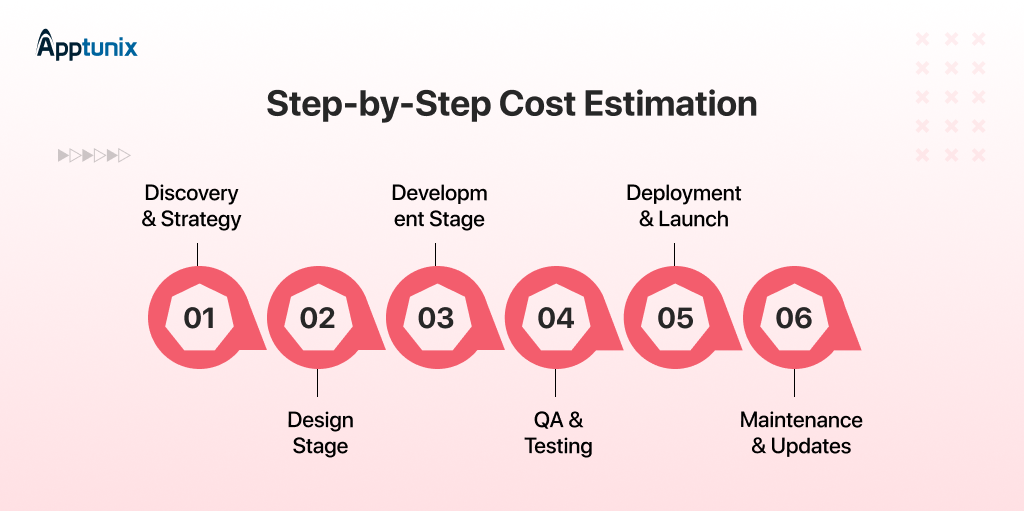
Step 1: Discovery & StrategyAlright, think of this stage as setting the blueprint for your app’s success. Here, business strategists delve deeply into market research, analyze competitors, identify user pain points, and finalize the feature list. They also craft a clear business plan to keep everything on track and within your budget.
While it may feel like a small step, rushing or overlooking it often leads to costly mistakes later on. On average, the discovery & strategy stage costs around $4,000 to $15,000.
Step 2: UX UI Design StageFirst impressions matter, and this is precisely the stage where your mobile app begins to take shape visually. UX/UI designers create wireframes, prototypes, and user-friendly interfaces that encourage users to stay.
A clean, appealing, and intuitive UX UI design directly impacts engagement and retention. The estimated cost of the UX UI design stage ranges from $5,000 to $20,000 or above, depending on your project’s complexity.
Step 3: Development StageAt this stage, your idea transforms into reality, and most of your budget is allocated to it. Android & iOS app developers work on programming languages and other technical aspects for frontend and backend development.
On average, the development stage can range from $15,000 to $150,000 or more, depending on the project’s complexity, features, integrations, tech stack, and other factors.
Step 4: QA & Testing StageOnce your mobile app is developed, it’s time to test it thoroughly. If you launch your app without testing (full of bugs, errors, or performance issues) – users won’t return. And that’s why quality assurance and testing are so crucial.
Testing ensures that your mobile app is performing smoothly across multiple devices and operating systems. For combined automated and manual testing, the estimated cost ranges from $5,000 to $15,000 or more. Remember that testing can save you from costly fixes post-launch.
Step 5: Deployment & LaunchFinally, your app is available in the stores (Google Play and Apple App Store). But it’s not just about uploading. You’ll pay app store listing fees ($25 one-time for Google Play, $99/year for Apple Developer Program), plus deployment assistance costs, which may add up to $1,000 – $5,000 depending on the complexity.
Step 6: Maintenance & UpdatesApp development doesn’t end after launch. You’ll need regular updates, bug fixes, server costs, and feature enhancements to keep your app relevant. On average, businesses spend 15–20% of their initial development cost per year on maintenance. So, if your app costs $100,000 to build, expect to pay around $15,000 to $20,000 annually on maintenance.

Know your project type before you begin the mobile app development process or plan your budget. It will help you understand in which category your app falls. Once you’ve identified your type, you can proceed to explore the app’s other features. Below, we’ve provided a breakdown of the typical cost ranges businesses can expect:
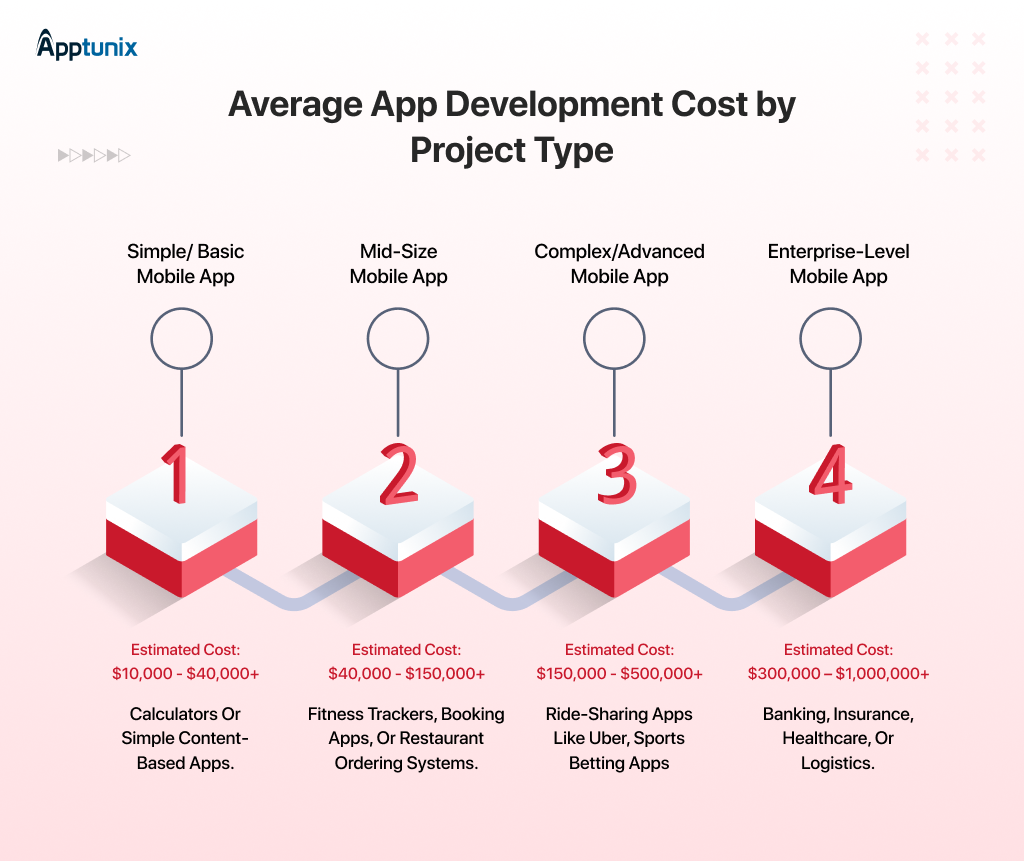
1. Simple/ Basic Mobile App Development CostIf you want to build a basic mobile app – you can get limited features & functionalities, minimal backend requirements, single platform deployment, and basic UX UI design—for example, calculators or simple content-based apps.
Estimated Cost: $10,000 - $40,000+
2. Mid-Size Mobile App Development CostHere, you can upgrade your mobile app with more features & functionalities, integrations, and design. You can include features such as third-party services, push notifications, payment gateway integration, enhanced backend infrastructure, and improved UI/UX design—for instance, mid-level apps such as fitness trackers, booking apps, or restaurant apps equipped with top features.
Estimated cost: $40,000 - $150,000+
3. Complex/Advanced Mobile App Development CostHere, you can upgrade your mobile app with highly advanced and feature-rich integrations. It includes AI-driven personalization, multi-device compatibility, complex backend, real-time features, and robust security. Examples include ride-sharing apps like Uber, sports betting apps, and so on.
Estimated Cost: $150,000 - $300,000+
4. Enterprise-Level Mobile App Development CostEnterprise-level solutions are custom-tailored to large organizations with complex workflows. These solutions often integrate advanced systems, such as ERP, CRM, HRM, supply chain management, and advanced analytics. They require a highly scalable architecture, strict compliance with security standards, and robust infrastructure to handle massive data loads. Examples include banking, insurance, healthcare, or logistics.
Estimated Cost: $300,000 – $1,000,000+
Let’s thoroughly dive into mobile app development cost region-wise and check their average hourly rate as well:
1. Mobile App Development Cost USAThe US remains one of the most expensive regions for mobile app development. It’s mainly because of the top-notch quality, direct communication, and premium skills & expertise. So, it will definitely come with a higher price tag.
The estimated cost to build a mobile app in the USA ranges from $15,000 to $300,000 or above, depending on your project’s complexity and other factors. Note that developing a mobile app in the USA can cost roughly two to three times more than in most offshore locations.
| Region | Estimated App Development Cost in the USA | Avg. Hourly Rate (USD) | Notes |
|---|---|---|---|
| USA (North America) | $15,000 - $300,000+ | $80 - $150+ | High due to cost of living, strong tech infrastructure, and expertise. |
2. Mobile App Development Cost in the Middle East (UAE)Most businesses prefer the Middle East, especially Dubai, to start their mobile app development journey. Why? Due to the city’s strategic location, the UAE government's support for startups, and technological advancements. But, the question is: how much does it cost to build a mobile app in Dubai, UAE?
Here's the cost estimation: The estimated cost to build a basic app with limited functionality ranges from 25,000 Dirhams to 120,000 Dirhams. And if you want to develop a highly complex AI-powered mobile app, the cost can exceed 250,000 Dirhams.
| Region | Estimated App Development Cost in the USA | Avg. Hourly Rate (USD) | Notes |
|---|---|---|---|
| UAE (Dubai) | AED 25,000 - AED 200,000+ | AED 100 - AED 200+ | Moderate to high, reflecting strong tech demand and regional expertise. |
3. Mobile App Development Cost in AustraliaIf you want to build a mobile app in Australia, especially in prime cities like Sydney and Melbourne) – You’ll find it a bit expensive. For complex app development in Australia, the cost ranges can reach up to AUD 350,000 or more.
| Region | Estimated App Development Cost in the USA | Avg. Hourly Rate (USD) | Notes |
|---|---|---|---|
| Australia (Sydney/Melbourne) | AUD 20,000 - AUD 350,000+ | AUD 100 - AUD 250+ | Highest in the region, top-tier agencies drive rates. |
4. Mobile App Development Cost in Saudi ArabiaApp development costs in Saudi Arabia are similar to those in the UAE. Project budgets for complex applications (such as healthcare, fintech, or on-demand services) can range from SAR 30,000 to SAR 200,000+, depending on the features and regulatory requirements.
| Region | Estimated App Development Cost in the USA | Avg. Hourly Rate (USD) | Notes |
|---|---|---|---|
| Saudi Arabia | SAR 30,000 - SAR 200,000+ | SAR 100 - SAR 150+ | Reflects local demand and regional development standards. |
Let’s thoroughly learn about industry-specific mobile app development costs:
1. Healthcare App Development CostHealthcare apps often require features such as telemedicine, appointment booking, and data security, which can increase costs. Depending on complexity, prices usually range from $20,000 to $500,000+.
| Complexity Level | Estimated Cost Range | Key Features |
|---|---|---|
| Basic | $20,000 - $50,000+ | Appointment booking, reminders |
| Mid-Level | $50,000 - $150,000+ | Telemedicine, e-prescriptions, patient records |
| Advanced | $150,000 - $500,000+ | AI diagnostics, IoT device integration, HIPAA compliance |
2. eCommerce App Development CostWith global eCommerce sales expected to reach $8.1 trillion by 2026, investing in advanced features like AR try-ons or AI recommendations can boost conversion rates significantly.
| Complexity Level | Estimated Cost Range | Key Features |
|---|---|---|
| Basic | $20,000 - $60,000+ | Product catalog, user accounts, cart, payment gateway |
| Mid-Level | $60,000 - $150,000+ | Personalized recommendations, reviews, and multi-vendor support |
| Advanced | $150,000 - $300,000+ | AI-driven suggestions, AR product previews, and advanced analytics |
3. Education App Development CostEdTech market is forecasted to cross $348B by 2030, driven by AI-powered personalized learning. eLearning apps with live classes, quizzes, and interactive content typically cost $30,000 to $200,000+, depending on features.
| Complexity Level | Estimated Cost Range | Key Features |
|---|---|---|
| Basic | $12,000 - $30,000+ | Video lessons, quizzes |
| Mid-Level | $30,000 - $80,000+ | Live classes, progress tracking, and gamification |
| Advanced | $80,000 - $200,000+ | AI tutors, AR/VR learning modules, adaptive learning paths |
4. On-Demand App Development Cost (Uber-like)On-demand apps with real-time tracking, payment integration, and scheduling features range between $15,000 to $300,000+.
| Complexity Level | Estimated Cost Range | Key Features |
|---|---|---|
| Basic | $15,000 - $50,000+ | User registration, simple booking, payment gateway integration. |
| Mid-Level | $50,000 - $120,000+ | Real-time GPS tracking, multi-service options, in-app chat, push notifications. |
| Advanced | $120,000 - $300,000+ | AI-based recommendations, dynamic pricing, route optimization, advanced analytics dashboard, multi-language & currency support, subscription & loyalty programs. |
5. Finance & Banking App Development CostSince 73% of global consumers use digital wallets, fintech apps need advanced security and scalability. Fintech apps demand high-end security, compliance, and transaction features, making costs fall between $20,000 to $300,000+.
| Complexity Level | Estimated Cost Range | Key Features |
|---|---|---|
| Basic | $20,000 - $70,000+ | User registration & authentication, basic transaction functionality, simple UI, basic notifications. |
| Mid-Level | $70,000 - $150,000+ | Multiple payment methods, digital wallet integration, two-factor authentication, transaction history, budgeting tools, push notifications. |
| Advanced | $150,000 - $300,000+ | AI-powered fraud detection, real-time analytics, advanced compliance & encryption, multi-currency support, blockchain integration, personalized financial insights. |
6. Travel & Hospitality App DevelopmentWith travel apps like Airbnb & Booking.com dominating, AI and AR features can make your app stand out. Travel apps with booking, reviews, and geolocation tracking can cost around $20,000 to $200,000+.
| Complexity Level | Estimated Cost Range | Key Features |
|---|---|---|
| Basic | $20,000 - $50,000+ | Hotel/flight search, booking system, basic reviews, payment gateway integration. |
| Mid-Level | $50,000 - $120,000+ | Advanced filters, maps & geolocation, itinerary planner, push notifications, multi-currency payments. |
| Advanced | $120,000 - $200,000+ | AI-based recommendations, AR-based hotel/room previews, dynamic pricing, loyalty programs, multi-language & regional support. |
7. Social Media App Development CostWith 4.9B+ social media users globally, apps that leverage AI-driven engagement see better retention. Social networking apps with feeds, messaging, and video features typically cost $60,000 to $300,000+.
| Complexity Level | Estimated Cost Range | Key Features |
|---|---|---|
| Basic | $25,000 - $60,000+ | Profiles, posts, likes/comments |
| Mid-Level | $60,000 - $150,000+ | Stories, messaging, live video |
| Advanced | $150,000 - $350,000+ | AI content curation, AR filters, and advanced moderation tools |
8. Real Estate App Development CostReal estate apps with 3D virtual tours have 300% higher engagement rates. Moreover, real estate apps with property listings, 3D tours, and chat integrations can cost between $25,000 to $300,000+.
| Complexity Level | Estimated Cost Range | Key Features |
|---|---|---|
| Basic | $25,000 - $60,000+ | Listings, property search |
| Mid-Level | $60,000 - $150,000+ | Virtual tours, mortgage calculators |
| Advanced | $150,000 - $300,000+ | AI-driven property suggestions, AR property visualization |
9. Food Delivery App Development CostThe food delivery industry is expected to reach $500 billion by 2030, with personalization as a key driver. Food delivery apps, which utilize GPS tracking, restaurant dashboards, and payment integration, range from $12,000 to $ 200,000 or more.
| Complexity Level | Estimated Cost Range | Key Features |
|---|---|---|
| Basic | $12,000 - $30,000+ | User registration, restaurant listings, simple menu browsing, basic order placement, payment gateway integration. |
| Mid-Level | $30,000 - $80,000+ | Real-time GPS tracking, multiple payment options, push notifications, restaurant dashboard, review system. |
| Advanced | $80,000 - $200,000+ | AI-based recommendations, route optimization, loyalty programs, multilingual support, delivery partner tracking, and an advanced analytics dashboard. |
10. Fitness App Development CostFitness apps with workout tracking, wearable device integration, and AI coaching typically cost $40,000 to $150,000+.
| Complexity Level | Estimated Cost Range | Key Features |
|---|---|---|
| Basic | $15,000 - $30,000+ | Simple workout tracker, user registration, basic exercise library, simple UI, basic notifications. |
| Mid-Level | $30,000 - $100,000+ | Wearable integration, nutrition tracking, personalized workout plans, social sharing, progress tracking, reminders. |
| Advanced | $100,000 - $300,000+ | AI-driven coaching, advanced analytics, gamification, live streaming workouts, personalized health insights, cross-device sync. |
11. AI App Development CostAI in the app market is growing at a 38% CAGR, meaning AI-first apps bring higher ROI but also higher upfront costs. Fitness apps with workout tracking, wearable device integration, and AI coaching typically cost between $40,000 and $300,000+.
| Complexity Level | Estimated Cost Range | Key Features |
|---|---|---|
| Basic | $40,000 - $80,000+ | Chatbots, predictive analytics |
| Mid-Level | $80,000 - $150,000+ | Chatbots, predictive analytics |
| Advanced | $150,000 - $300,000+ | Generative AI, AI copilots, real-time decision-making |
12. Logistics App Development CostCompanies that utilize AI in logistics can reduce operational costs by up to 15%, making investments in advanced features a worthwhile endeavor. Logistics apps with fleet management, GPS tracking, and route optimization can range from $25,000 to $ 300,000 or more.
| Complexity Level | Estimated Cost Range | Key Features |
|---|---|---|
| Basic | $25,000 - $60,000+ | Fleet tracking, order management |
| Mid-Level | $60,000 - $120,000+ | Route optimization, driver apps, analytics |
| Advanced | $120,000 - $200,000+ | AI-powered demand forecasting, IoT integration, real-time tracking |

Mobile apps are evolving due to emerging technologies and trends, which you definitely must consider. Following, we’ve listed the top trends that you should know and consider:
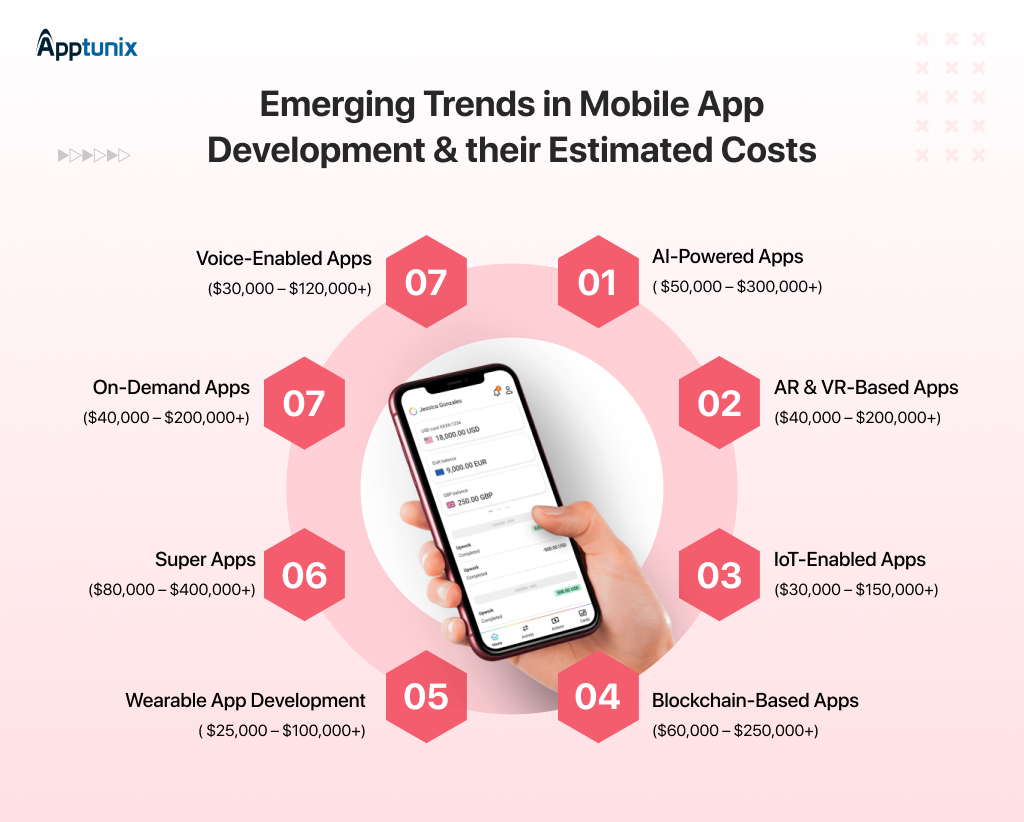
1. AI-Powered AppsAI is everywhere — from chatbots in eCommerce to predictive analytics in healthcare. Businesses want smarter apps that personalize experiences and automate tasks. But here’s the catch: AI app development isn’t cheap because it involves machine learning models, natural language processing, and ongoing training of algorithms.
Estimated Cost: $50,000 – $300,000+ (depending on complexity and AI model integration).
2. AR & VR-Based AppsThink IKEA’s AR/VR app letting you place furniture in your living room before buying — that’s the power of Augmented Reality. VR, on the other hand, is redefining gaming, education, and real estate. These apps need 3D modeling, immersive UI, and high-end graphics, which drive up costs.
Estimated Cost: $40,000 – $200,000+.
3. IoT-Enabled AppsFrom smart homes to connected cars, IoT apps are on the rise. But IoT development isn’t just about mobile; it involves hardware integration, sensor data handling, and secure cloud connectivity. That means businesses need to invest extra in security and backend infrastructure.
Estimated Cost: $30,000 – $150,000+.
4. Blockchain-Based AppsBlockchain isn’t just about crypto anymore. Companies are using it for supply chain transparency, secure payments, and digital identity management. Since blockchain requires specialized expertise and secure architecture, it comes with higher upfront costs.
Estimated Cost: $60,000 – $250,000+.
5. Wearable App DevelopmentSmartwatches and fitness bands are gaining popularity, and businesses are seeking apps that sync seamlessly with them. These apps often need real-time health tracking, activity monitoring, and integration with medical APIs, which add complexity.
Estimated Cost: $25,000 – $100,000+.
6. Super AppsThe trend started in Asia with apps like WeChat and is now spreading worldwide. Super apps combine multiple services (messaging, payments, shopping, booking) into one. But because they’re feature-heavy, the development, testing, and scaling requirements are massive.
Estimated Cost: $80,000 – $400,000+.
7. On-Demand AppsFood delivery, taxi booking, and healthcare on demand — these apps are still booming. What makes them expensive is the need for real-time tracking, multiple user roles (customer, provider, and admin), and the integration with payment gateways.
Estimated Cost: $40,000 – $200,000+.
8. Voice-Enabled AppsWith Alexa and Siri shaping habits, more apps are going voice-first. Businesses want apps that enable users to book, shop, or search using voice commands. Building this requires voice recognition APIs and NLP models, which add to the cost.
Estimated Cost: $30,000 – $120,000+.
Artificial intelligence in mobile apps is no longer just an add-on; it has become a key component. Now, it’s a symbol of innovation that will help you stand out from competitors. Adopting AI trends has a significant impact on app development, serving as a game-changer in today’s competitive landscape.
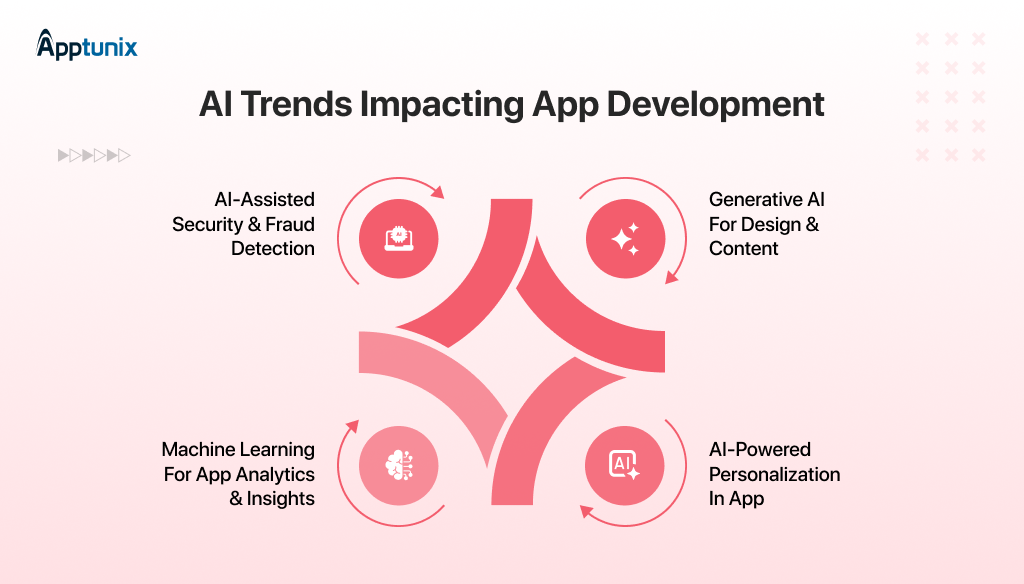
1. Generative AI for Design & ContentGenerative AI is reshaping the way apps are designed. With the help of Gen-AI, you can design app screens, create marketing content, and even write code. This saves a significant amount of time, enabling businesses to move more quickly. With tools like ChatGPT, Midjourney, and Figma AI, both startups and large companies can reduce design costs, build prototypes quickly, and launch their apps more efficiently.
Impact on Cost: Incorporating generative AI can reduce design and content creation expenses by up to 20–30%. However, implementing advanced AI features may add $10,000–$ 50,000, depending on the scope.
2. AI-Powered Personalization in AppHow about analyzing user behavior in real time? You can do that with AI-powered personalization in your app. It will help to deliver customized experiences that boost engagement and revenue.
Impact on Cost: Developing AI-driven personalization engines typically requires investments of $15,000–$80,000+, depending on the depth of algorithms, data infrastructure, and real-time analytics required.
3. Machine Learning for App Analytics & InsightsIt’s essential to stay ahead of your competitors – and machine learning will help you with precisely that. With ML, you can go beyond tracking clicks and downloads – you can predict user behaviour, identify churn, and optimise monetization strategies. With predictive analytics, businesses can make informed and smart decisions to boost ROI.
Impact on Cost: Integrating ML models for analytics can range from $20,000 to $100,000+, influenced by the complexity of the datasets, cloud integrations, and the sophistication of the predictive features.
4. AI-Assisted Security & Fraud DetectionSecurity – this cannot be overlooked at any cost. Industries such as FinTech, logistics, and healthcare – customers want a secure and robust system where their personal data & information stay safe and locked.
With the help of AI-powered fraud detection systems, you can analyze thousands of transactions per second, flag suspicious activity, and safeguard your sensitive data and information.
Impact on Cost: Adding AI-driven security layers generally increases app development costs by $25,000–$150,000+, but this investment drastically reduces risks of breaches, fraud, and compliance penalties.
Of course, building a mobile app is a major investment, but with the right approach, you can keep your project aligned with your budget. Here, we’ve discussed proven strategies to optimize your mobile app development budget:
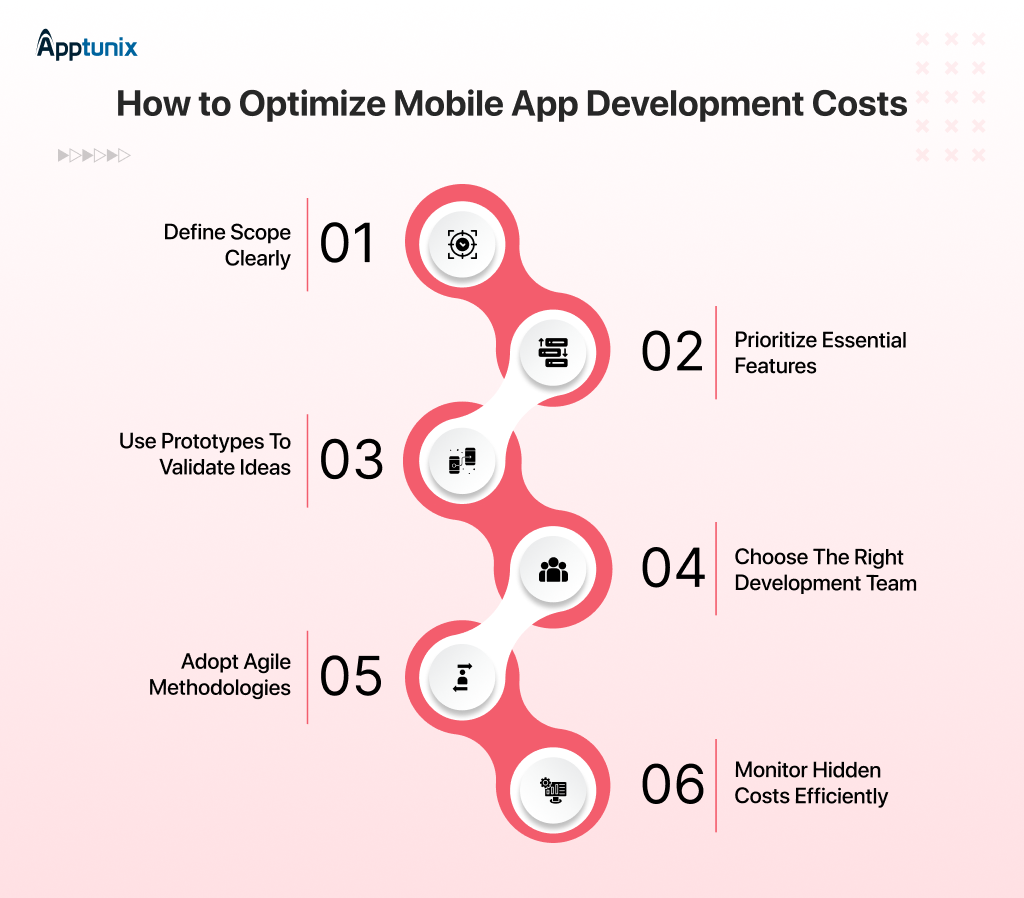
1. Define Scope ClearlyOne of the top reasons why your app budget spirals out of control is because of an unclear scope. Before Android & iOS app developers start working on coding and development, it's crucial to map out the must-have features of your app.
For that, you must have your project’s scope clearly defined and avoid any potential risks or mistakes later on. Ultimately, this step helps you to avoid any confusion, rework, and inflated costs.
2. Prioritize Essential FeaturesWe clearly understand that it's tempting to pack your app with every advanced feature to attract users. But that’s the fastest way to burn your budget. Instead, you must focus on an affordable mobile app development approach – Minimum Viable Product (MVP) – a version that allows you to build your mobile app with basic features & functionality.
Once you’ve launched your app in the market and tested rigorously – then you can go for fully-advanced app development with the help of investors. It is an affordable option that many businesses overlook.
3. Use Prototypes to Validate IdeasNow, it is crucial to build a prototype early as it will help you visualize your app’s flow, design, and user experience (without any heavy development costs). Note that it is much cheaper to modify a prototype than to recode a feature later on. Additionally, prototypes can help attract investors and early adopters. So, prototypes will be a win-win in all situations.
4. Choose the Right Mobile App Development TeamNow it’s time for the most crucial decision – choosing the right mobile app development team. And not just a development team, but also their technologies, tech stack, team expertise, and experience – you’re choosing everything. This decision also plays a crucial role in the success of your mobile app. So, don’t go for the cheapest option – go for the right mobile app development company that understands your vision and goals.
5. Adopt Agile MethodologiesAgile development breaks the massive project into smaller, manageable sprints. This way, you can easily test, refine, and improve features at each step, rather than spending money upfront on assumptions that may not be accurate. Agile also ensures flexibility to adapt to changing business needs without blowing up the budget.
6. Monitor Hidden Cost EfficientlyMany app owners overlook ongoing costs, including app store fees, cloud hosting, third-party integrations, and regular maintenance. By planning for these early, you avoid unexpected expenses later. Think of it as budgeting not just for launch, but also for long-term growth and sustainability.
Most businesses create a mobile app development budget in advance, but still end up overspending. Reason? Due to hidden costs that they are unaware of. Therefore, it’s crucial to be aware of the hidden factors that can influence your overall app development cost. Let’s dive in:
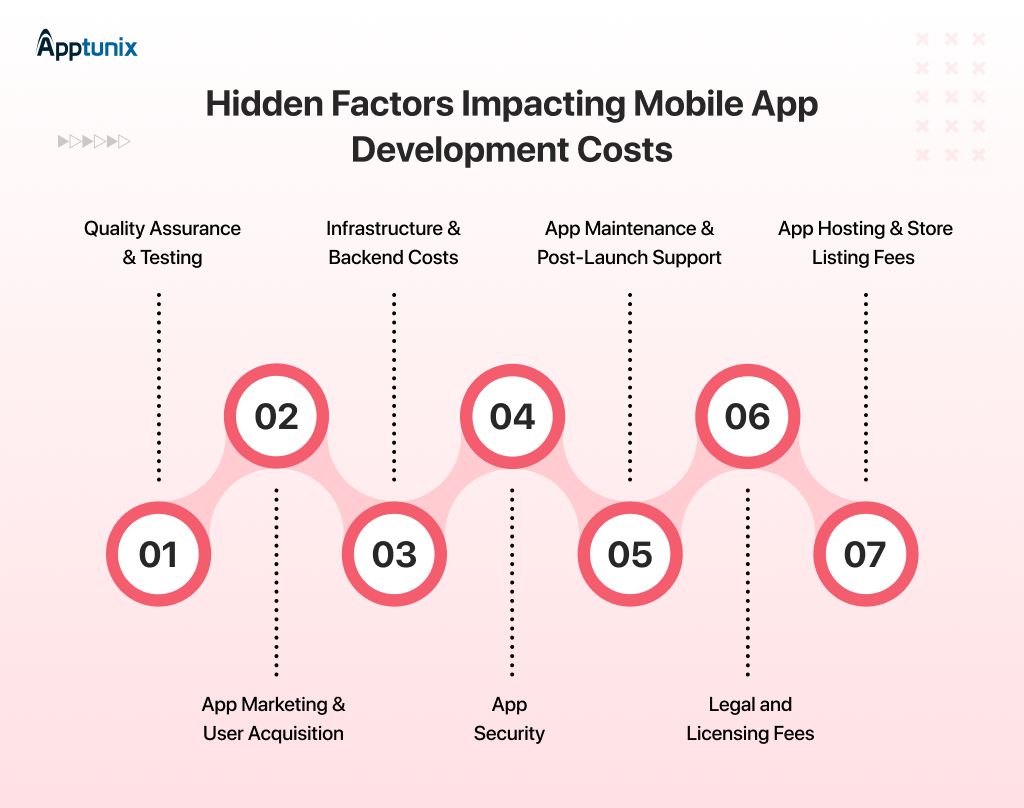
1. Quality Assurance & TestingStudies show that 88% of users won’t return to an app after facing performance issues. That’s why QA & testing are crucial for your mobile app. It ensures that your app operates smoothly across devices, operating systems, and screen sizes.
Note: The more complex your app is, the higher the testing costs will be. For instance, testing on both Android and iOS with different screen sizes can add 15–25% extra to your budget. Many businesses overlook this until bugs drastically impact user experience.
2. Infrastructure & Backend CostsYour app requires a solid backend infrastructure – servers, APIs, databases, and cloud services to function. Cloud services like AWS or Firebase can scale with your app, but also add to development costs. A mid-sized app can easily require $1,000 to $5,000/month just for backend hosting and SaaS tools, such as chat APIs, push notifications, or analytics SDKs. Businesses must also consider these costs when developing their budgets.
3. App Maintenance & Post-Launch SupportLaunching your app is not the finish line; instead, it’s just the start. Regular updates, bug fixes, new feature rollouts, and compatibility upgrades typically cost 15-20% of the initial development cost per year.
For instance, if your app costs $60,000, expect to spend $7,000 to $12,000 annually on maintenance & upgrades. If you overlook the maintenance aspect, your app will become outdated quickly, especially with Apple & Google rolling out new OS versions every year.
4. App Store Compliance & Listing FeesLaunching your app on Apple and Google Play also costs money. Apple charges $99/year for a developer license, while Google Play takes a one-time $25 fee (non-refundable).
Additionally, both stores charge a commission of 15-30% on in-app purchases. If you’re running a subscription-based model, this is a significant ongoing cost. Although they are small numbers, they add up and are not factored into your budget plan. Small numbers, but they add up if you’re not prepared.
5. Security & Data PrivacyA strong app security builds trust with customers. Compliance with standards like GDPR or CCPA may require extra development hours and tools for encryption. A single data breach can cost a business an average of $4.45 million globally (IBM report).
Adding features like data encryption, two-factor authentication, and GDPR compliance adds to the budget, but it’s an investment in trust and reputation. Studies show companies spend up to 7–10% of their total IT budget on cybersecurity. Skipping here may save in the short run, but could cost millions if a breach occurs.
6. Marketing & User AcquisitionMarketing often takes up a significant portion of the budget; however, it requires a strategic plan to ensure your app's success. Note that marketing & user acquisition can take up to 30-50% of your total budget.
According to Statista, the average cost to acquire a user is around $3.52 for iOS and $1.22 for Android. Think about app store ads, social media campaigns, influencer collaborations — all of these are essential if you want people to download and actually use your app.
7. Legal and Licensing FeesFinally, the hidden legal side. You may need licenses for third-party tools, APIs, or compliance certifications, depending on your app’s industry (such as fintech, healthcare, or e-commerce).
Additionally, legal contracts, intellectual property protection, and GDPR/CCPA compliance can easily add $1,000–$ 10,000 or more to your expenses. Businesses often overlook this until they are faced with lawsuits or compliance issues.
Many mobile apps generate more revenue than any other industry. Below, we’ve discussed several proven monetization models that apps implement to generate revenue. Let’s discuss:
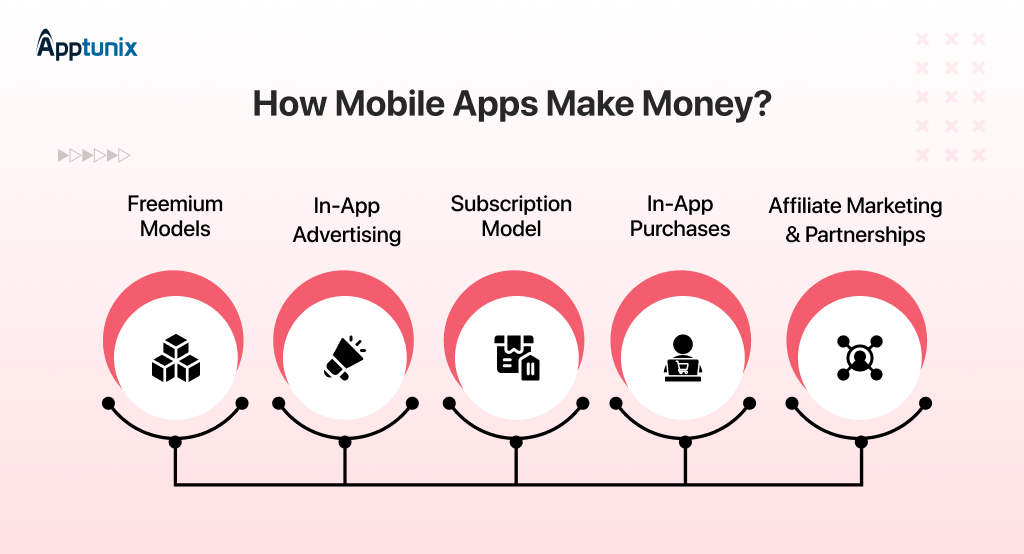
1. Freemium ModelsThis monetization model combines ‘free’ and ‘premium’ options to attract and retain users. Here, users can access the features for free, but this comes with ads and limited functionality. However, there’s always the option to upgrade their account (for a small fee), which gives them access to advanced features – free of ads and with unlimited resources.
2. In-App AdvertisingWith in-app advertising, you can turn free customers into paying customers. Here, you can showcase paid ads within your mobile app. You can display ads in various formats, including banners, interstitials, rewarded, and video. The in-app advertising monetization strategy is particularly effective for businesses, as it generates a continuous stream of revenue.
3. Subscription ModelIf you want a steady stream of revenue, the subscription model is your go-to option. It keeps users engaged for a longer time because they can access advanced features in exchange for a recurring fee. Popular apps, such as Tinder, Snapchat, Instagram, YouTube, Netflix, and many more, have adopted this monetization strategy. If you want a fixed revenue stream, this is the perfect option for your mobile app.
4. In-App PurchasesImplementing an effective monetization strategy allows you to make money from both free and paid apps (such as gaming, entertainment, or lifestyle).
Here’s how it works: Users download the app for free and pay for additional or premium features in the application. In-app purchases are a flexible and effective way to generate revenue without hindering the user experience.
5. Affiliate Marketing & PartnershipsIn this monetization strategy, mobile apps make money by promoting third-party products or services within your app. You can earn commission for every purchase or lead generated through your referrals. Strategic brand collaborations and partnerships not only help in generating income but also enhance user value by offering relevant recommendations.
Let’s take a look at top mobile app examples and the estimated cost to build an app like them:
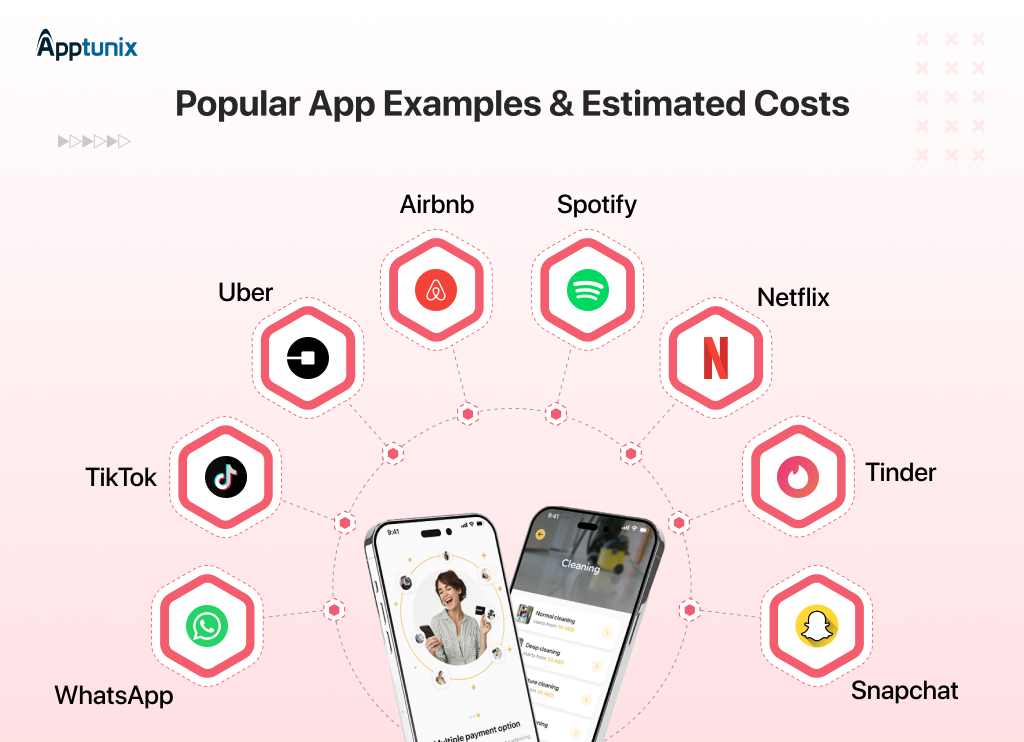
1. WhatsAppWhatsApp is a globally popular messaging app with end-to-end encryption, voice/video calls, and media sharing. Building an app like WhatsApp requires a real-time messaging architecture, strong security, and the ability to scale to millions of users, which significantly impacts the cost.
Estimated Cost: $30,000 – $70,000+
2. TikTokTikTok dominates short-form video content with features like advanced video editing, AI-driven recommendations, and live streaming. Developing an app like TikTok requires robust video infrastructure, cloud storage, and recommendation algorithms powered by AI/ML.
Estimated Cost: $60,000 – $150,000+
3.UberUber disrupted the transportation industry with GPS navigation, real-time ride tracking, driver and rider matching, and secure payments. Uber Clone app development cost complexity lies in integrating geolocation, mapping APIs, and separate apps for drivers and riders.
Estimated Cost: $80,000 – $200,000+
4. AirbnbAirbnb connects travelers with hosts, offering booking management, payment gateways, and review systems. Moreover, Airbnb-like app development involves complex listing management, map integration, and secure hosting infrastructure.
Estimated Cost: $70,000 – $150,000+
5. SpotifySpotify offers seamless music streaming, featuring personalized playlists, offline mode, and social sharing capabilities. Building a Spotify-like app involves licensing, streaming servers, recommendation algorithms, and cross-device compatibility.
Estimated Cost: $60,000 – $120,000+
6. NetflixNetflix leads OTT platforms with personalized recommendations, adaptive streaming, and multi-device support. The challenge in development is content delivery networks (CDNs), AI-driven recommendations, and video rights management.
Estimated Cost: $70,000 – $200,000+
7. TinderCustom dating apps like Tinder popularized swipe-based dating with geolocation, real-time chat, and AI-driven match suggestions. Developing such an app requires high-end security, real-time messaging, and scalable architecture.
Estimated Cost: $50,000 – $120,000+
8. SnapchatSnapchat is renowned for its disappearing messages, AR-powered filters, and multimedia sharing capabilities. Building a similar app involves integrating advanced camera APIs, real-time multimedia processing, augmented reality (AR) features, and scalable cloud infrastructure.
Estimated Cost: $70,000 – $180,000+
When it comes to mobile app development, cost estimation can make or break your project. At Apptunix, the #1 mobile app development company, we don’t just throw random numbers — we provide clear, detailed, and reliable cost breakdowns tailored to your app’s features, technology stack, and scalability needs.
With over a decade of experience building more than 2,000 successful apps across various enterprise-grade level industries, our team knows how to balance quality with cost efficiency. We use the latest tools and proven frameworks to reduce development hours without compromising performance.
By partnering with Apptunix, you get more than just an estimate — you gain a strategic roadmap that helps you plan budgets, avoid hidden costs, and maximize ROI.
Whether you’re a startup or an enterprise, Apptunix ensures your investment is optimized for long-term growth.

Get the weekly updates on the newest brand stories, business models and technology right in your inbox.



Apptunix is issuing an important public safety notice regarding the fraudulent misuse of our brand name across certain online trading and cryptocurrency platforms. Over the past few weeks, we have…
Book your free consultation with us.
Book your free consultation with us.

One Central, The offices 3, Level 3, DWTC, Sheikh Zayed Road, Dubai, United Arab Emirates
+971 50 782 1690