Top Mobile App Development Trends Shaping Digital Future and Saudi Arabia Vision 2030
39 Views 15 min February 9, 2026

Hardeep Singh is a seasoned B2B technical writer at Apptunix with a sharp eye for strategy and a mind wired for innovation. With over a decade of experience in technical and SEO writing, and a Master’s degree in Wireless Communication, he’s written across domains including AI, Blockchain, IoT, Cybersecurity, and beyond. At Apptunix, Hardeep drives content that bridges business goals with future-ready mobile and web solutions, thus helping startups and enterprises make smarter digital decisions.

Developing an AI trip planner app requires integrating AI models (NLP, machine learning) with travel APIs for personalized, dynamic itineraries, real-time booking, and smart recommendations.
Core Components and Features
AI Trip Planner App Development Process
Estimated AI Trip Planner App Development Cost (2026)
A young traveler sits in a crowded airport lounge. Her hotel booking gets canceled at the last minute. Her connecting flight changes without warning. Stress begins to take over. She opens an AI trip planner app on her phone, hoping to fix everything before panic sets in.
The app scans her entire itinerary and adjusts the plan in seconds. A new hotel appears on her screen. A better flight option pops up. A local transport route gets added to her schedule. Her trip is back on track.
Well, moments like these explain why people now rely on smarter digital tools that think for them.
Needless to say, the travel industry is booming again. People are exploring more places than ever. Mobile use is at its peak. Travelers want quick answers, safe routes, and reliable support during every step of the journey. They prefer simple tools that plan, compare, book, and organize every detail in one place. This shift has created massive demand for smart travel planner app solutions.
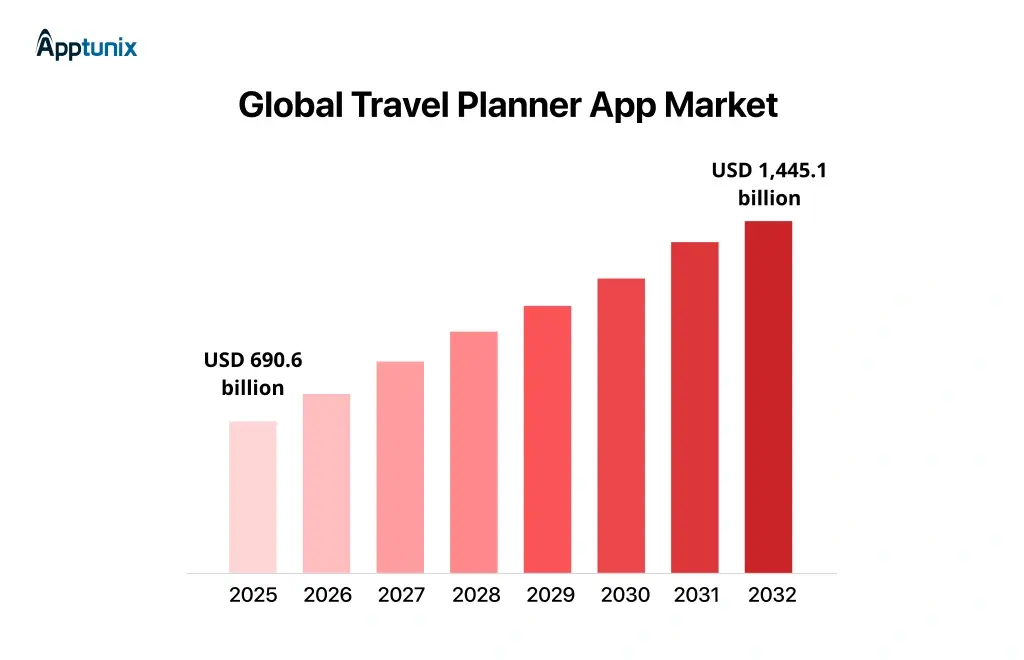
Trusted reports show how strong this market has become. The global travel planner app market is on track to reach around USD 1,445.1 billion by 2032 from USD 690.6 billion in 2025.
Undoubtedly, all of this is becoming possible because of an AI trip planner app. It uses machine learning, predictive analytics, user preferences, and real-time data to plan trips in a smarter way. These apps help travelers discover destinations, build custom itineraries, control budgets, and receive live updates during the entire journey.
Businesses across the world now consider AI travel app development an essential investment because travelers expect more accuracy and less effort.
So, if you have finally made up your mind to invest in this booming industry, this guide is for you. You will understand the complete journey of the AI trip planner app development. We will go through the development process, core features, advanced AI modules, cost to build the app, monetization models, and the latest trends shaping the travel industry. Apart from this, we will also learn why businesses are rushing toward modern digital solutions that deliver unforgettable experiences.
Let’s begin!
A trip planner app helps users organize every part of a journey in one place. It brings flights, hotels, transport options, and activities together in a clean and simple interface. A smart trip planner app takes this idea further. It studies user behavior and creates better suggestions for each stage of the trip. An AI trip planner app goes even deeper by learning from patterns, preferences, budgets, and real-time data. It thinks like a digital travel expert that assists users automatically.
AI enhances traditional apps through intelligent insights.
Modern brands now consider trip planner app development essential because travelers expect more accuracy and less effort from digital tools.
Reports show strong growth in mobile-led travel planning. Travel And Tour World highlights the steady rise in mobile-first travel journeys. EIN Presswire reports sharp growth in digital adoption among global travelers. These insights show why demand for a smart travel planner app continues to increase worldwide.
Furthermore, smartphone use is rising everywhere. People want convenience. They want tools that take care of both small and major planning tasks. Business travelers need accuracy and speed. Leisure travelers want freedom and inspiration. Both groups now prefer AI-driven trip planning solutions because they offer more control and less confusion.
AI-driven trip planning apps meet these needs in a powerful way. They deliver instant support, live updates, and personalized plans. Companies see these behavior shifts as a strong reason to invest in AI travel app development for long-term value. In short, interest in trip planner mobile app development continues to rise because travelers trust technology that reduces planning time and improves the overall experience.
A modern traveler expects more than just a simple booking tool. People want a smart companion that plans their trip, guides them, and adjusts to every change. Brands now invest in an AI trip planner app because users trust solutions that reduce stress and save time. This part highlights the features that shape a high-quality product and shows what strong trip planner application development looks like.
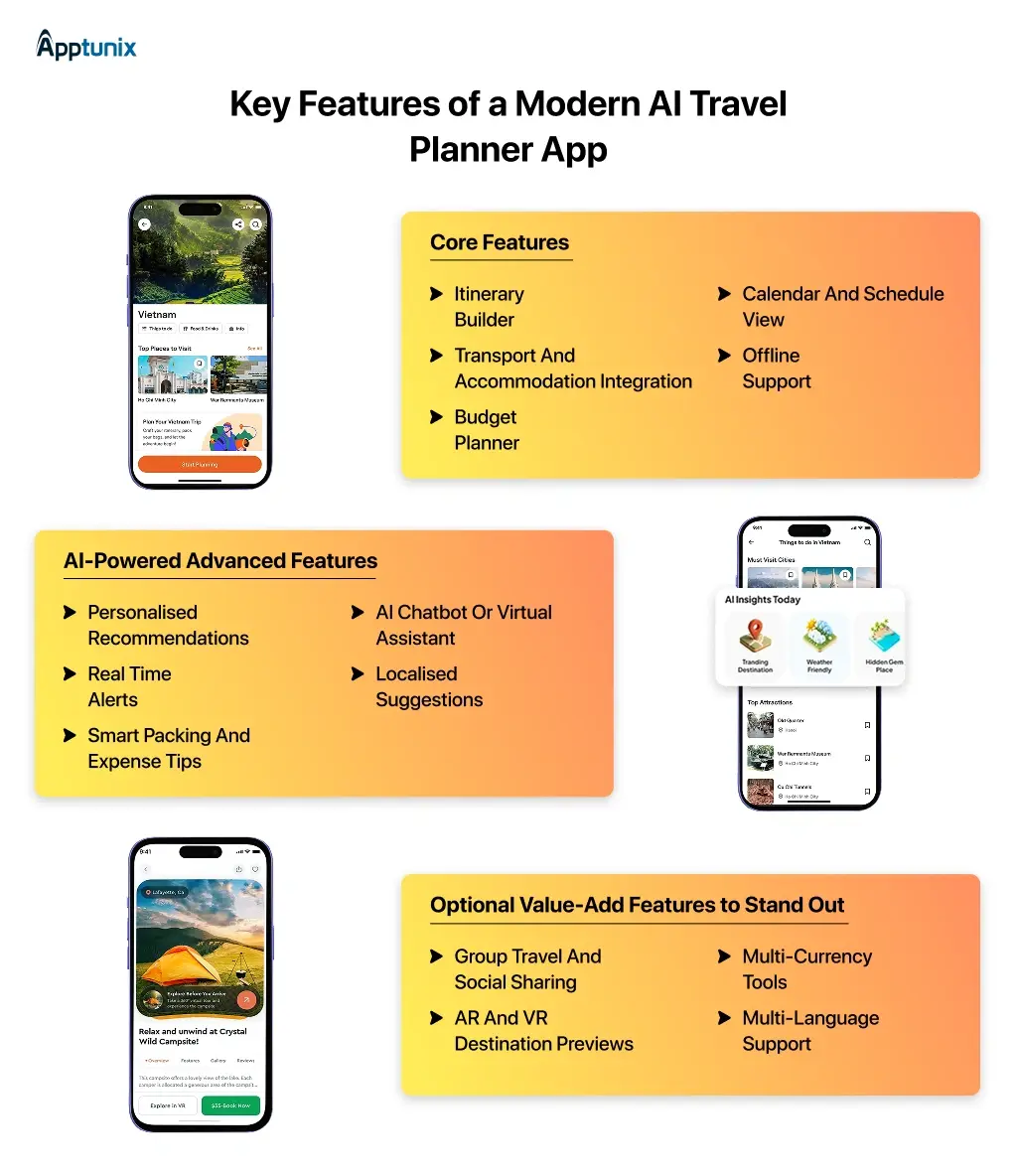
These features form the base of strong trip planner software development and help businesses deliver a reliable experience.
These intelligent features turn a simple app into a smart travel planner app that adapts to every user.
These features help companies position their product above competitors and strengthen the value of trip planner application development for long-term growth. Clients often choose advanced options because they enhance user satisfaction and build trust.
Every feature presented here reinforces the real potential of modern AI trip planner app creation and also helps identify what expert trip planner software development delivers.
Building an AI-powered travel planner app requires a structured and full-cycle approach. Below is a clear breakdown of the development workflow that today’s top trip planner app development companies follow. It will also help you understand how agencies like ours build and deliver end-to-end AI trip planner apps with predictable quality and timelines.
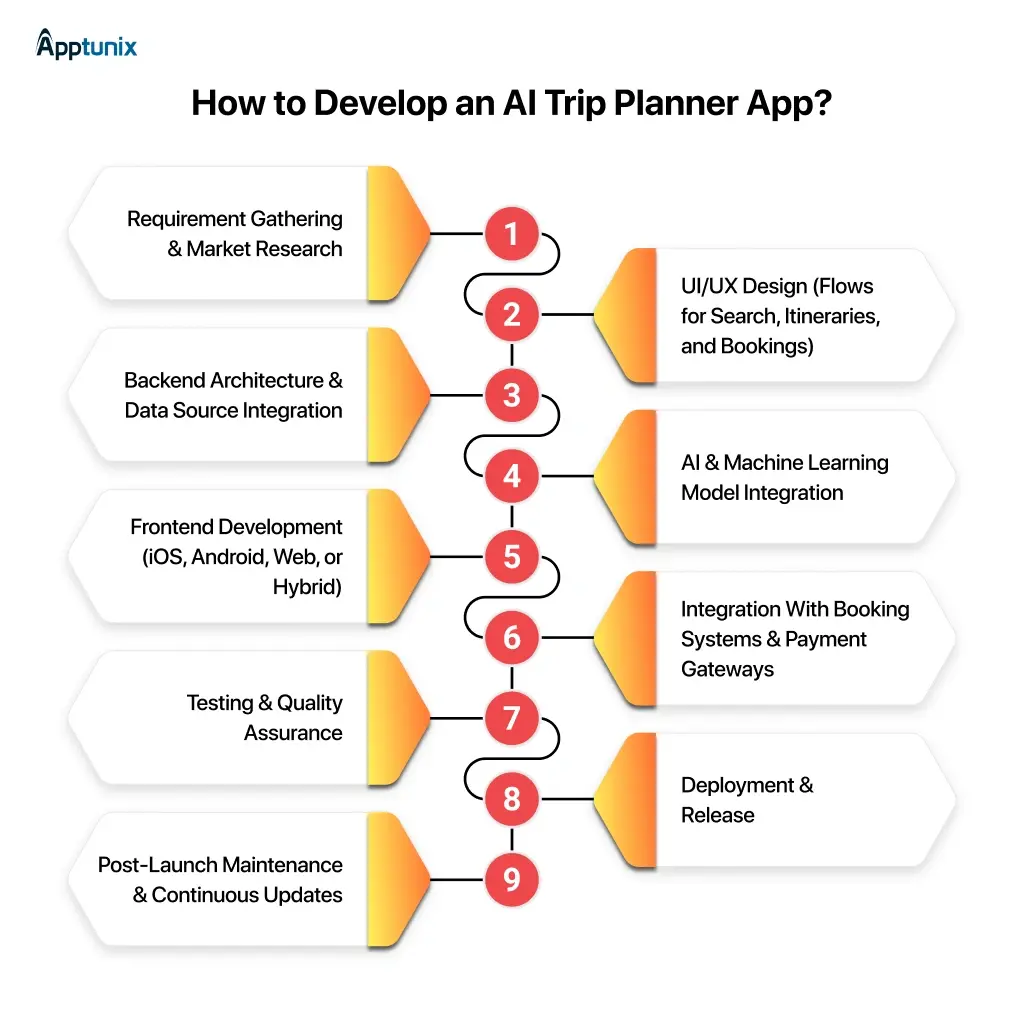
Every successful trip planner software development project starts with in-depth discovery. This includes:
This phase also sets the foundation for AI travel app development cost estimation, ensuring a realistic roadmap from day one.
A top-performing AI travel app must feel effortless. The design team builds:
The goal is to produce a delightful and frictionless visual system that elevates your trip planner mobile app development from good to world-class.
The backend is the engine room of the app. It powers the AI systems, manages data, and connects with travel suppliers.
Key components include:
This stage determines how fast and reliable your AI trip planner app development will be at scale.
Also Read: Your Ultimate Guide To Building a Hotel Booking App Like Booking.com
This is where the real innovation happens. The AI modules enable:
These models are trained on user behavior, historical travel data, and third-party datasets. Strong ML pipelines differentiate average travel planner app development from true next-gen platforms.
The frontend team converts UI/UX designs into:
Here, speed, responsiveness, and accessibility create the real feel of your product. This phase shapes the day-to-day user experience.
Also Read: iOS App Development Cost
Needless to say, integrations are essential for full-fledged trip planner mobile app development:
These integrations enable instant confirmations and automated itinerary updates.
To ensure the app performs flawlessly, QA teams run:
A well-tested platform ensures reliability and prevents costly post-launch issues.
Once stable, the app is:
Smooth deployment builds trust and readiness for scale.
AI-powered travel planning apps evolve constantly. After launch, the team works on:
This long-term support is where our full-cycle trip planner mobile app development services stand out. It also ensures your product remains ahead of competitors and continues growing with your users.

Every business wants a clear idea of the AI travel app development cost before starting the project. And why not, when a well-planned budget helps you move confidently and avoid surprises later. Well, the cost to build an AI travel app ranges from about US$20,000 to US$150,000+, depending on the design, features, AI complexity, backend setup, and long-term updates.
Here is a simple and accurate breakdown that helps decision-makers understand what to expect during AI-backed trip planner application development or trip planner software development.
AI Trip Planner App Development Cost Breakdown Table
| App Version | Estimated Cost (USD) | Description |
|---|---|---|
| MVP Trip Planner App (Basic) | US$20,000 – US$40,000+ | Simple itinerary builder, login, search, basic screens, standard backend, light AI suggestions. Ideal for early validation. |
| Mid-Level Travel Planner App | US$40,000 – US$80,000+ | Better UI, booking APIs, payments, maps, notifications, multi-day itineraries, improved AI, etc. Suitable for commercial use. |
| Advanced AI Travel Planner App | US$80,000 – US$150,000+ | Predictive AI engine, personalization, real-time alerts, multi-platform support, cloud backend, premium features. |
The final travel planner app development cost depends on several factors. Each one plays a direct role in shaping the total investment.
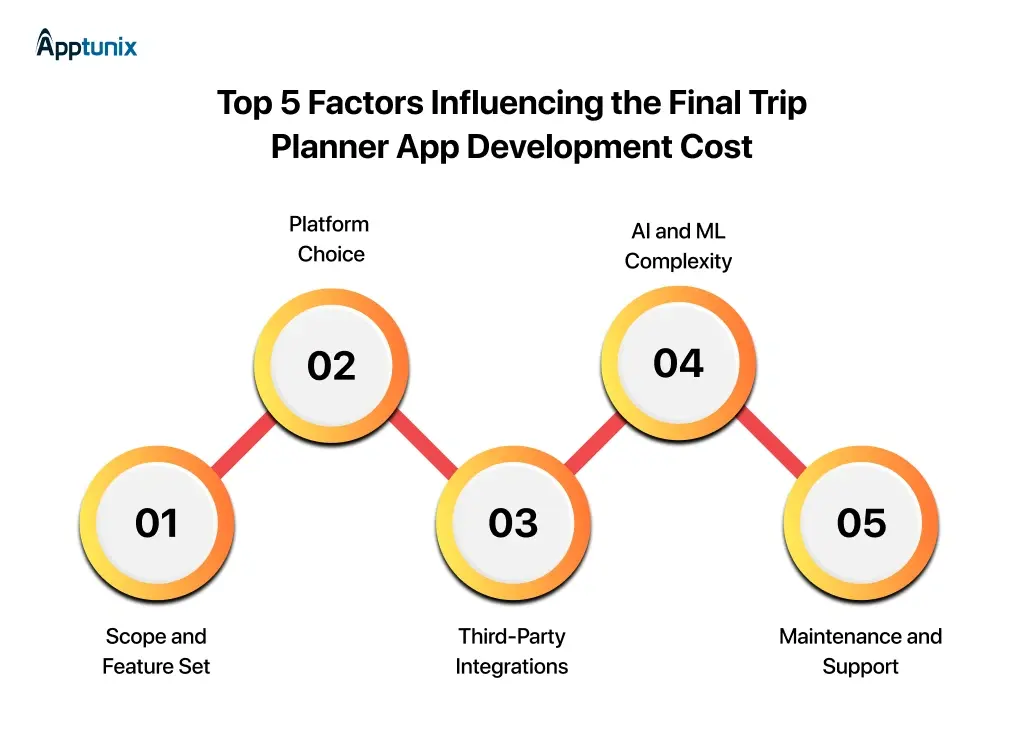
1.Scope and Feature Set
A basic app costs less because it has limited features. A full product offers advanced AI, booking systems, and multi-city planning. This increases hours and overall cost.
2.Platform Choice
iOS and Android need different development efforts. On the other hand, a hybrid build reduces cost but may not fit every project.
3.Third-Party Integrations
Travel apps rely on APIs. Flights, hotels, cabs, maps, and payments add extra development work and increase the travel planner app development cost.
4.AI and ML Complexity
AI is the core of an advanced travel planning app. A simple model costs less. A predictive engine that auto-optimizes trips costs more. This is the main reason many businesses see variations in AI travel app development cost.
5.Maintenance and Support
Each AI-powered trip planner app development project needs updates, bug fixes, server checks, security patches, and new feature releases. Maintenance usually costs around 15 to 25 percent of the total yearly budget.
The cost to build an AI travel app depends on your business model, target users, and the level of innovation you want. A clean discussion during the discovery phase ensures you get the right estimate and avoid any unnecessary spending.
Your development partner should help you choose the right tech stack, streamline features, and reduce long-term costs. This is where expert guidance becomes more valuable than the code itself.
When estimating your trip planning app development budget, it’s important to discuss:
A transparent discussion ensures you get accurate pricing and a realistic roadmap for your AI travel app project.

A well-built AI trip planner app isn’t just useful for travelers, but can also become a powerful revenue generator when backed by the right business model. Today’s most successful travel platforms earn through a mix of commissions, premium features, partnerships, and subscription tiers. When planned correctly during travel planning app development, you can turn your platform into a long-term, scalable revenue engine.
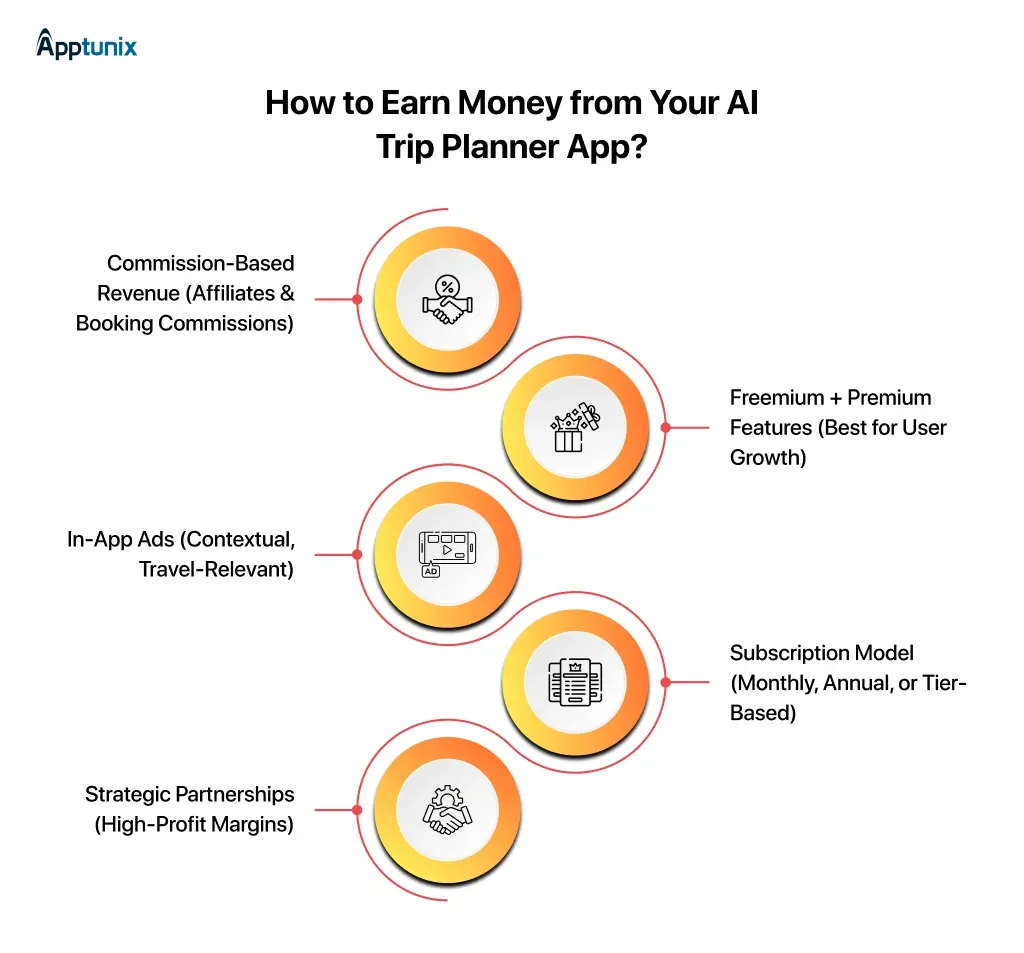
Below are the most effective monetization models for a modern smart travel planner app.
1.Commission-Based Revenue (Affiliates & Booking Commissions)This is the most popular monetization model used by major travel brands.
You earn a commission every time a user books:
APIs from Booking.com, Expedia, Skyscanner, and other partners allow seamless integration during trip planner application development. This model scales beautifully as your user base grows.
2.Freemium + Premium Features (Best for User Growth)A freemium model helps you onboard a large audience while generating recurring revenue from power users.
Free version may include:
This allows you to monetize added-value features while keeping entry barriers low.
3.In-App Ads (Contextual, Travel-Relevant)Ads can be added thoughtfully without harming user experience.
Examples:
Proper implementation during AI travel app development ensures ads do not interrupt the planning flow.
4.Subscription Model (Monthly, Annual, or Tier-Based)This model works exceptionally well for:
Recurring revenue creates long-term financial stability.
5.Strategic Partnerships (High-Profit Margins)Partnering with travel ecosystem players amplifies revenue potential.
Possible partners:
These partnerships can bring in fixed payments, listing fees, or promotional revenue—an excellent complement to standard commissions.
Once the app gains users, aggregated and anonymous analytics become valuable assets.
Examples of insights you can sell:
This model must be implemented ethically during the trip planner application development with strict data privacy compliance.
The travel industry is entering a new era where automation, personalization, and mobile-first convenience are becoming standard expectations. For businesses investing in AI-based trip planner app development, these trends reveal exactly where the market is headed and what users will demand next. Below is a concise breakdown of the forces shaping the future of modern travel technology.
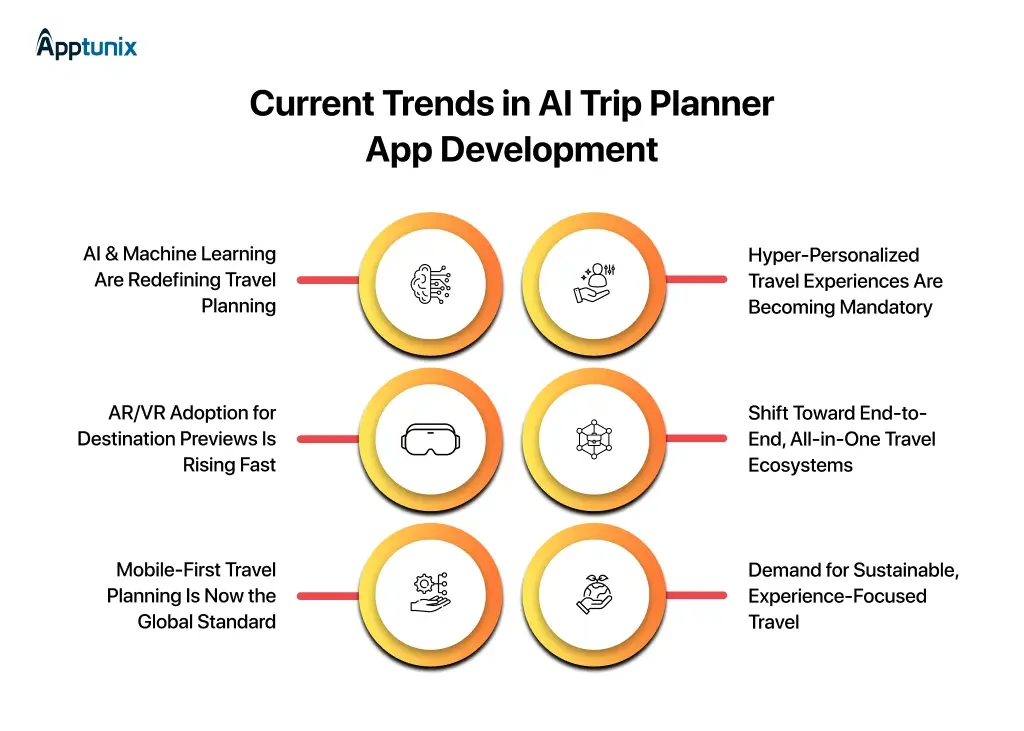
1.AI & Machine Learning Are Redefining Travel PlanningAccording to Market.us, AI-driven travel solutions are rapidly becoming mainstream as travelers increasingly expect smarter itineraries, real-time personalization, and predictive recommendations.
During modern AI travel planner app development, AI now powers:
This is exactly why businesses are rushing toward an AI-powered travel planning app. It delivers superior user satisfaction with less manual input.
Also Read: AI in Travel and Hospitality Industry: Factors, Benefits & Applications
2.AR/VR Adoption for Destination Previews Is Rising FastAs reported by GlobeNewswire, AR and VR are transforming pre-trip planning by letting users visualize destinations before booking.
This includes:
During trip planner mobile app development, integrating AR/VR is becoming a competitive advantage for delivering immersive travel experiences.
3.Mobile-First Travel Planning Is Now the Global StandardTravel And Tour World highlights that smartphone-driven travel planning has exploded, especially in emerging markets across Asia, MENA, and Africa.
What this means for businesses:
This reinforces why travel planner app development today focuses on lightweight architecture, superior UI, and instant responsiveness.
4.Hyper-Personalized Travel Experiences Are Becoming MandatoryTravelers no longer want generic itineraries. They want:
This shift makes AI trip planning app development essential, as AI can process behavioral data to deliver highly individualized travel paths.
5.Shift Toward End-to-End, All-in-One Travel EcosystemsUsers prefer one app that can handle:
This ecosystem approach influences how companies approach trip planner mobile app development, thus pushing them to build multi-layered platforms instead of standalone planners.
6.Demand for Sustainable, Experience-Focused TravelAccording to leading tourism trend reports, users increasingly prefer:
A modern travel planning app using AI can score high user engagement by surfacing sustainable routes, green accommodations, and low-impact travel ideas.

The global travel industry is moving toward intelligent, mobile-first experiences, and this shift has opened a massive opportunity for businesses ready to innovate. Users today expect convenience, personalization, and real-time planning support, which is exactly why companies are investing in AI travel app development and modern trip planner app development.
A smart travel planner app gives businesses an edge because generic platforms rarely address specific audience needs. AI now allows complete customization, from personalized itineraries to dynamic suggestions, thus giving brands the power to deliver experiences users actually remember. This demand is the core reason why travel planner app development is surging across global markets.
Another major advantage is monetization. A single AI trip planner app can earn through bookings, commissions, premium upgrades, ads, subscriptions, and strategic partnerships. That means every feature you build becomes a potential revenue stream. Something that makes AI trip planner application development a long-term business asset, and not just a digital product.
Scalability adds even more value. Modern platforms can expand into web dashboards, multi-city planning tools, enterprise solutions, and AI-powered analytics. Businesses that start early gain the flexibility to grow their trip planner mobile app development into a complete travel ecosystem over time.
As a seasoned AI trip planner app development company, our approach covers everything: research, UI/UX, backend architecture, API integrations, cloud engineering, and advanced AI modules. The goal is always to build an enterprise-grade AI trip planner app that feels effortless for users and powerful for businesses. Each project goes through a full-cycle development process that ensures stability, performance, and future-ready scalability.
Our team understands the nuances of AI trip planning app development better than most because we have delivered AI-driven products across travel, hospitality, logistics, and lifestyle domains. Clients choose us for our ability to blend creative thinking, technical depth, and reliable execution – all while aligning with their long-term vision.
So, if you are planning to build a modern travel platform, we can help you turn that idea into a product users trust and love, because we have done it in the past, and we are ready to do it again.
Q 1.What is an AI trip planner app, and how does it work?
An AI trip planner app uses machine learning, real-time data, and user preferences to create personalized travel itineraries. It studies interests, budgets, travel styles, and location data to recommend flights, hotels, attractions, and routes. Businesses choose AI trip planner app development to offer travelers a smarter, faster, and more intuitive way to plan every part of their journey in one place.
Q 2.How much does AI travel app development cost in 2026?
The cost to build an AI travel app ranges from US$20,000 to US$150,000+, depending on features, platforms, integrations, and AI complexity. A basic version starts at the lower range, while advanced features like predictive recommendations, real-time alerts, and multi-city planning increase the price.
Q 3.How long does trip planner software development take?
The timeline usually ranges from 3 – 5 months for a basic app to 6 – 9+ months for advanced platforms. Factors include design needs, backend architecture, booking APIs, and the level of AI automation. Companies invest in trip planner software development to build scalable and dependable travel solutions that evolve with user needs.
Q 4.What features should a modern travel planner app include?
A strong platform includes itinerary planning, bookings, maps, budgeting tools, notifications, offline access, and AI-driven personalized suggestions. Businesses aiming for competitive advantage often add AR/VR previews, multi-currency tools, group travel features, and real-time updates during travel planner app development.
Q 5.Can I monetize a trip planner mobile app effectively?
Yes. Popular monetization methods include affiliate commissions, ads, subscriptions, in-app upgrades, and partnerships with hotels, airlines, and tour companies. This is one of the main reasons brands invest in trip planner mobile app development – the revenue models are diverse and highly scalable.
Q 6.Why do businesses prefer AI-powered travel planning apps today?
Travelers want personalized plans, quicker decisions, and real-time information. Traditional apps cannot offer this level of customization. Companies choose AI-based travel planning apps because AI processes huge amounts of data instantly, thus delivering hyper-personalized results that improve user satisfaction and retention.
Q 7.Is custom trip planner application development better than going for a white label trip planner app?
Custom trip planner application development gives businesses full control over branding, features, integrations, and user experience. On the other hand, white-label trip planner apps limit innovation, personalization, and scalability. Custom-built platforms also integrate advanced AI features more efficiently, creating better long-term value.
Q 8.Can you integrate booking engines and third-party APIs into an AI trip planner app?
Yes. Modern platforms easily integrate flights, hotels, car rentals, activities, payment gateways, maps, and local experiences. These integrations enhance the functionality and revenue potential of a smart travel planner app.
Q 9.Why should businesses build their AI trip planner app now?
Demand for mobile-first, AI-driven travel tools is at an all-time high. Users expect end-to-end planning in one app, and businesses that invest early secure stronger positioning. This is why so many brands are moving toward AI trip planner app development to stay relevant and competitive.
Q 10.Why choose Apptunix as an AI trip planner app development company?
When it comes to choosing Apptunix, it specializes in full-cycle trip planner software development, covering UI/UX, backend engineering, AI/ML modules, API integrations, testing, deployment, and ongoing support. Businesses trust us because we build scalable and high-performance products tailored to growth. Our expertise ensures your AI trip planner app stands out, stays future-ready, and wins user trust from day one.
Get the weekly updates on the newest brand stories, business models and technology right in your inbox.
Hardeep Singh is a seasoned B2B technical writer at Apptunix with a sharp eye for strategy and a mind wired for innovation. With over a decade of experience in technical and SEO writing, and a Master’s degree in Wireless Communication, he’s written across domains including AI, Blockchain, IoT, Cybersecurity, and beyond. At Apptunix, Hardeep drives content that bridges business goals with future-ready mobile and web solutions, thus helping startups and enterprises make smarter digital decisions.
Book your free consultation with us.
Book your free consultation with us.

One Central, The offices 3, Level 3, DWTC, Sheikh Zayed Road, Dubai, United Arab Emirates
+971 50 782 1690