How Much Does It Cost to Build an AI Agent in 2026?
6 Views 13 min March 17, 2026

Blending strategic thinking with a deep understanding of digital ecosystems, Arohi helps shape Apptunix’s voice across the tech and mobility space. With 5+ years of experience in SEO-driven content, B2B storytelling, and product-focused writing, she creates high-impact blogs, compelling product narratives, and pitch-ready content that aligns with both user intent and business goals. At Apptunix, she crafts data-backed content strategies that blend storytelling, search intent, and brand positioning—helping businesses build trust, authority, and measurable growth through high-impact digital content.
Businesses had been struggling to bring AI into their chat systems for years. Many used simple rule-based bots. They often confused visitors more than they helped them.
Now, conversational AI for business has revolutionized the way we work. It is part of the customer journey, not just an add-on.
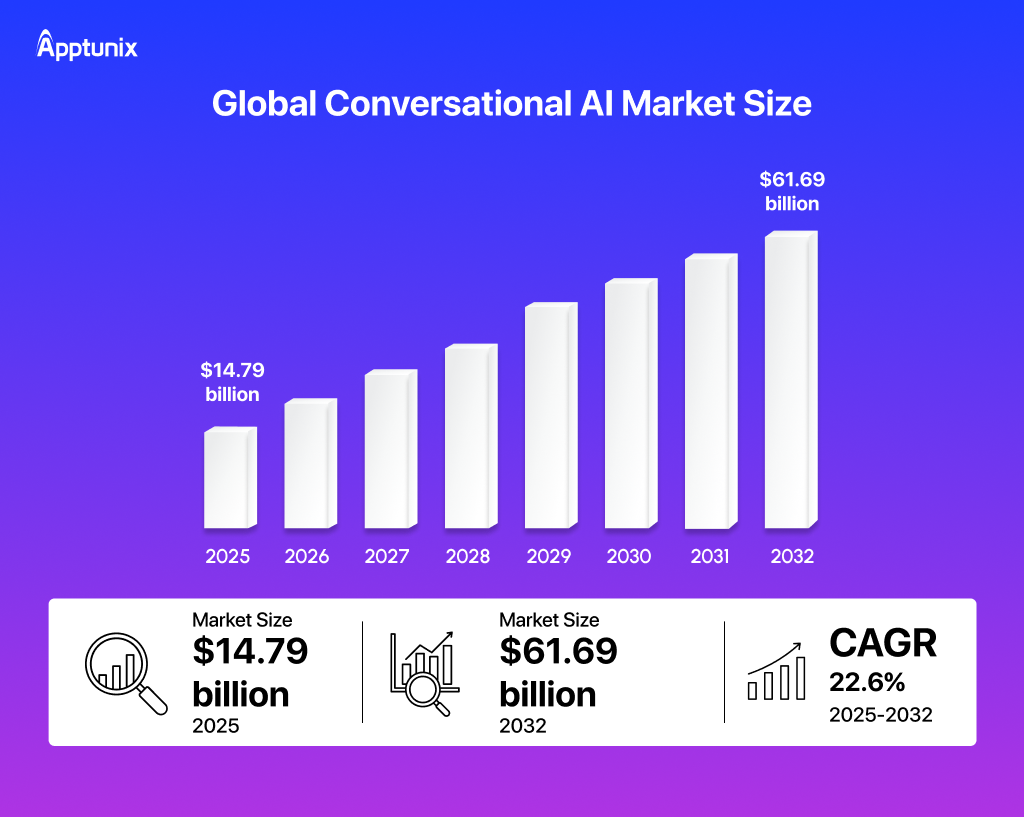
In 2026, the global conversational AI market reached around $17.97 billion. And is expected to grow to $61.69 billion by 2032, at a CAGR of 22.6%. This shows just how vital business AI solutions have become. Companies invest in AI chatbots for business to meet demand and drive growth.
Now, businesses want something more human, more helpful. They want AI that feels like a conversation, not a dead-end.
And they’re getting it.
Conversational AI in business now powers support, sales, and marketing across industries and borders.
In this blog, you’ll discover why conversational AI matters for business today. You’ll come to know how it works, its costs, and how it wins over the old chatbots.
Okay, so if you have ever asked yourself how conversational AI can power business development, you are in the right place. Let’s jump in together.

Conversational AI is an advanced technology through which computers and humans can have natural, human-like interactions. It’s way beyond rule-based chatbots; it’s business AI chatbots that understand context, intent, and follow-up questions.
It interprets and responds like a human. By utilizing machine learning, natural language processing (NLP), and natural language understanding (NLU).
It influences business AI solutions that upgrade customer interaction across chat, voice, and messaging platforms.
A good example of this is Google Dialogflow. A platform that enables companies to create conversational experiences through text or voice within apps, websites, and devices. It provides key tools like speech recognition and NLU to develop complex conversational flows.
Platforms like India’s Haptik also illustrate how conversational AI in business delivers enterprise-grade virtual assistants. They serve sectors like finance, insurance, and healthcare with natural, free-style language capabilities.
This technology can simulate real conversations, not just pre‐programmed responses. It’s no longer just “AI chatbots for business”; it’s a critical part of business AI solutions.
“A technology used to generate interactive, human-like conversation within a web application, app, or device is a conversational AI.”
Even leading tech providers are shaping this space. For example, Google Cloud’s Conversational AI
demonstrates how businesses can build smarter, more natural interactions powered by AI
After understanding what conversational AI is, let’s discuss why conversational AI matters for modern business.
[Check Out This: How to Build Janitor AI Like Chatbot]
Clear communication is the root of all business. All marketing touchpoints, all service requests, and all sales begin with words. Faster, smarter, and more intimate conversations are guaranteed with conversational AI for business.
These are the top benefits of conversational AI for businesses:
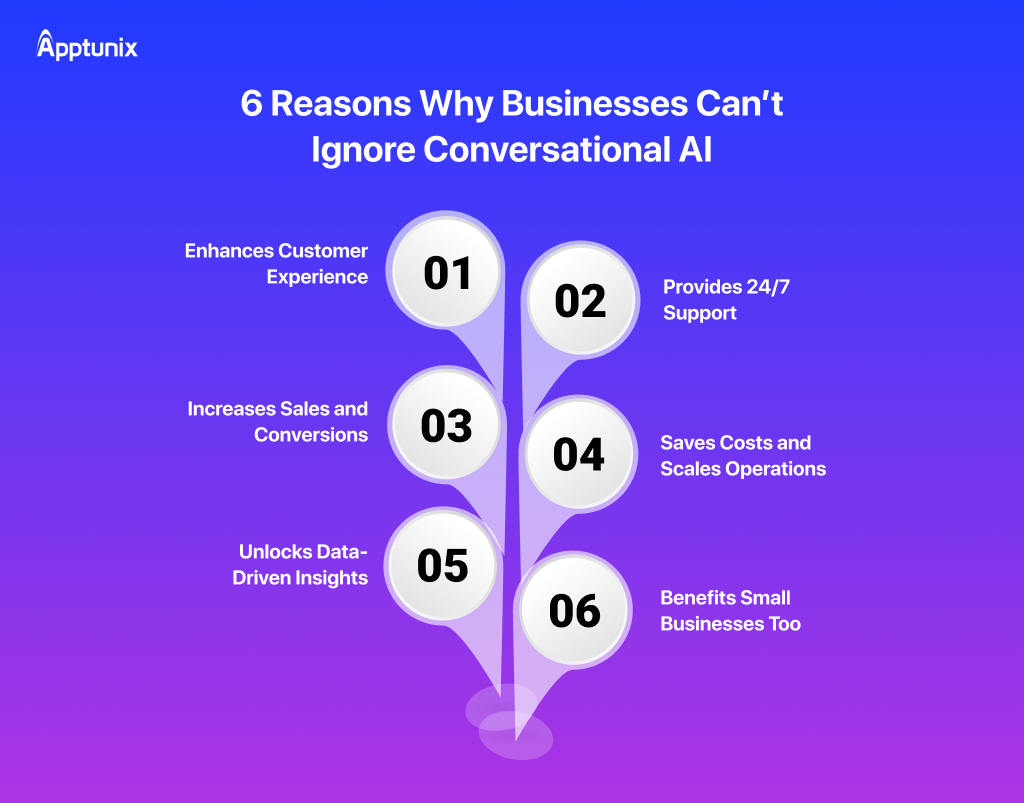
1. Enhances Customer ExperienceThrough the provision of consistent, natural, and tailored help across all channels, conversational AI enhances the customer experience. Unlike basic chatbots, it understands intent and context. Customers don’t need to repeat themselves, which reduces frustration.
According to Salesforce, 66% of customers expect companies to understand their needs, and conversational AI makes this possible in real time.
2. Provides 24/7 SupportCustomers now expect instant answers anytime. With AI chatbots for business, you can get support day and night, without a wait time. They utilize AI chatbots to drive customer care automation, handling bookings, amendments, and common questions effortlessly.
This ensures that consumers feel listened to, even at 3 AM, and allows human agents to focus on more complex tasks.
3. Increases Sales and ConversionsRevenue growth is one of the remarkable benefits of conversational AI for businesses. It is possible to amplify sales with conversational AI. Because it offers real-time product recommendations, upselling, and personalized deals.
Juniper Research forecasted that AI chatbots will save businesses $11 billion annually by 2025, much of it connected to sales enablement.
4. Saves Costs and Scales OperationsHiring large teams for customer support is expensive. With business AI solutions, one conversational AI can manage thousands of conversations at once. This reduces operating costs while scaling operations efficiently. Both large and small companies enjoy higher efficiency and reduced costs in staffing without compromising the quality of services.
5. Unlocks Data-Driven InsightsEvery customer interaction provides valuable data. Conversational AI in business gathers these insights in real-time without manual work, such as intent, complaints, and purchase behavior. This data can be utilized by companies to conduct conversational marketing and tailored outreach.
The result?
Smarter campaigns, greater customer loyalty, and continuous upgrading of services.
6. Benefits Small Businesses TooConversational AI benefits small businesses by offering enterprise-level support at a fraction of the cost. AI chatbots for business make startups look larger, more reputable, and always available. This is a great equalizer for small brands to compete with corporate giants without a fortune’s investment.
We’ve seen the benefits. But how does conversational AI differ from generative AI? Let’s break it down next.
Generative AI and conversational AI, although intertwined but play very different roles in business.
Conversational AI for business deals with the management of natural two-way interactions. It fuels AI chatbots for business, automates support, and boosts customer experiences.
Generative AI, on the other hand, generates new content like text, images, or product descriptions. It can be helpful in terms of conversational marketing and creative activities.
The key difference is that conversational AI enhances direct customer experience, while generative AI facilitates creativity and automation in background processes. Both technologies go well together, but businesses must understand where each fits to augment growth and client satisfaction.
With the differences clear, let’s now uncover how conversational AI actually works in the real world.
At its core, conversational AI in business leverages a combination of technologies to replicate human-like conversations. It integrates Natural Language Processing, machine learning, and speech recognition to interpret the intent behind customers’ requests and respond with the right answers.
Unlike the more conventional bots, business AI chatbots can learn, adapt, and get better with every interaction.
Here’s a simplified process of how it works:
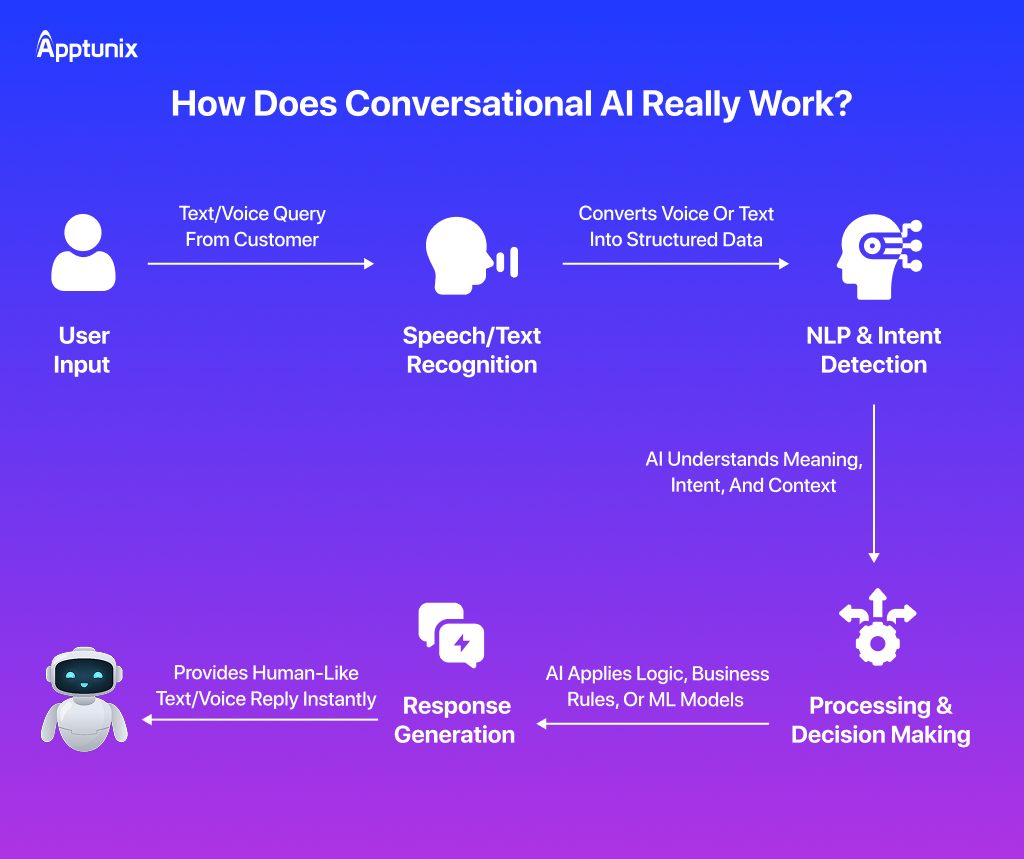
Input Capture: Customers interact with websites, apps, or e-commerce platforms via chat, text, or voice interfaces.
↓
Natural Language Processing (NLP): Conversational AI analyzes the input, breaks it into intent and entities, and instantly interprets meaning.
↓
Intent Recognition: The system identifies what the customer wants, like checking order status, booking a service, or seeking assistance.
↓
Dialogue Management: Using predefined workflows and contextual memory, the system decides the optimal response to carry on the discussion smoothly.
↓
Machine Learning Feedback Loop: The AI improves accuracy with each interaction, enabling smarter responses and personalization.
↓
Output Generation: The system replies in natural, human-like language, guaranteeing a seamless customer experience.
By learning how it works, businesses can craft AI solutions that not only support automation but also enhance engagement. The ability to increase sales with conversational AI lies in its capacity to deliver instant, personalized, and consistent responses across customer journeys.
Now that you know how it functions, let’s explore the cost of conversational AI implementation and the factors that affect it.
The implementation cost of conversational AI differs depending on the business need, scale, and level of customization.
The average cost of small-business conversational AI development services would be between $5,000-$15,000. Whereas enterprise-level top AI development services would cost between $50,000-$150,000+.
Depending on the features and usage, AI chatbot subscription services range from $500 to $ 5,000 a month.
These figures are used as a benchmark by businesses all over the world, but the practical implementation varies depending on a multiplicity of factors.
Key Factors That Affect Conversational AI Costs
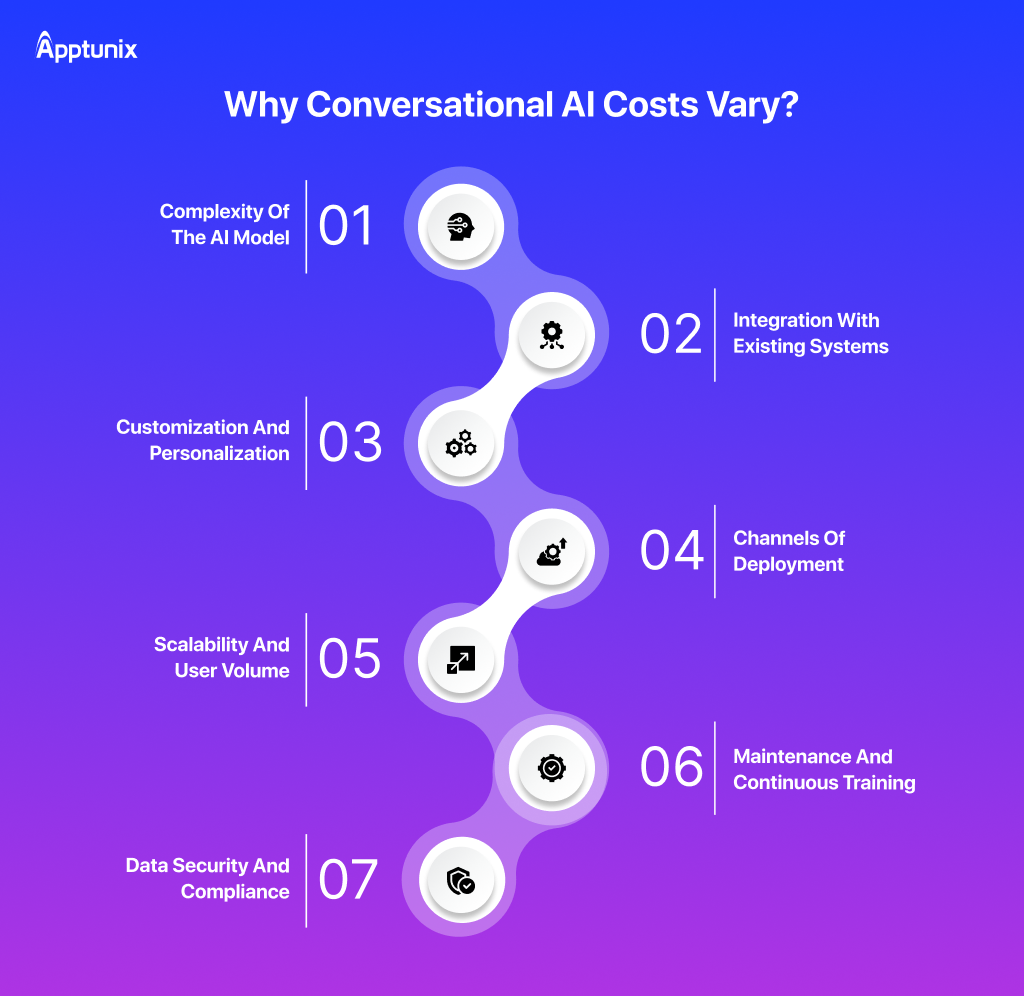
1. Complexity of the AI Model2. Integration with Existing Systems3. Customization and Personalization4. Channels of Deployment5. Scalability and User Volume6. Maintenance and Continuous Training7. Data Security and ComplianceWhile costs may seem high, the benefits of conversational AI for businesses far outweigh the expenses.
Okay, you’re familiar with the costs and factors; let’s dive into the top use cases of conversational AI in business and explore how companies are utilizing it.
[Want deeper insights into the investment side? Explore our guide on AI chatbot development cost for a clearer picture.]
The implementation of conversational AI in business is transforming the way companies interact with customers, automate workflows, and generate profits. From AI chatbots for business to conversational marketing, the applications are enormous and impactful across industries.
Below are the most powerful conversational AI business use cases that validate its usefulness.
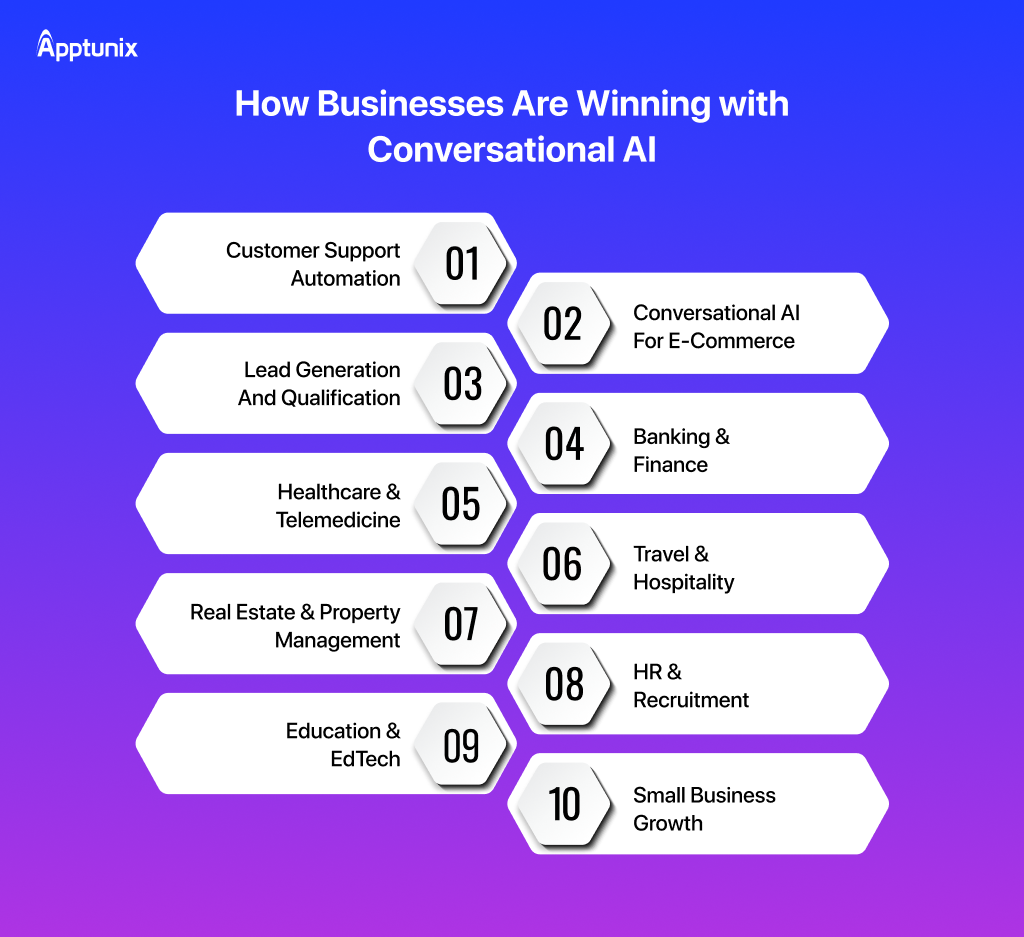
1. Customer Support AutomationExample: Customer service expenses for a retail business decreased by 30% after implementing AI-driven chat support.
2. Conversational AI for E-CommerceExample: Shopify merchants using conversational AI for e-commerce show improved conversion rates.
3. Lead Generation and QualificationExample: B2B SaaS companies utilizing conversational AI for lead generation saw 40% higher-quality leads.
4. Banking & FinanceExample: Bank of America’s Erica, a conversational AI solution, assists millions of customers every day.
Banking is one of the fastest adopters of AI-powered chatbots. Learn why building chatbots for banking is crucial and what it really costs.
5. Healthcare & TelemedicineExample: Telemedicine apps that include conversational AI experienced rapid global adoption after 2020.
6. Travel & HospitalityExample: Marriott’s AI assistant eases guests’ last-minute bookings anywhere globally.
7. Real Estate & Property ManagementExample: Real estate companies utilizing conversational AI for lead generation finalize deals quickly.
8. HR & RecruitmentExample: Multinationals decreased hiring cycles by 25% using AI-driven recruitment chatbots.
9. Education & EdTechExample: EdTech companies that used AI chatbots enhanced student retention rates globally.
10. Small Business GrowthExample: Local shops using AI assistants have expanded their digital presence effectively.
We have outlined the most popular business use cases of conversational AI, yet not everything is roses. Let us find out the problems that are faced by businesses in adopting AI and how to overcome them.
Although conversational AI business applications are increasing in every industry, there are roadblocks that companies go through while adopting them.
Understanding these challenges of conversational AI and their solutions helps businesses make better plans and avoid costly pitfalls.
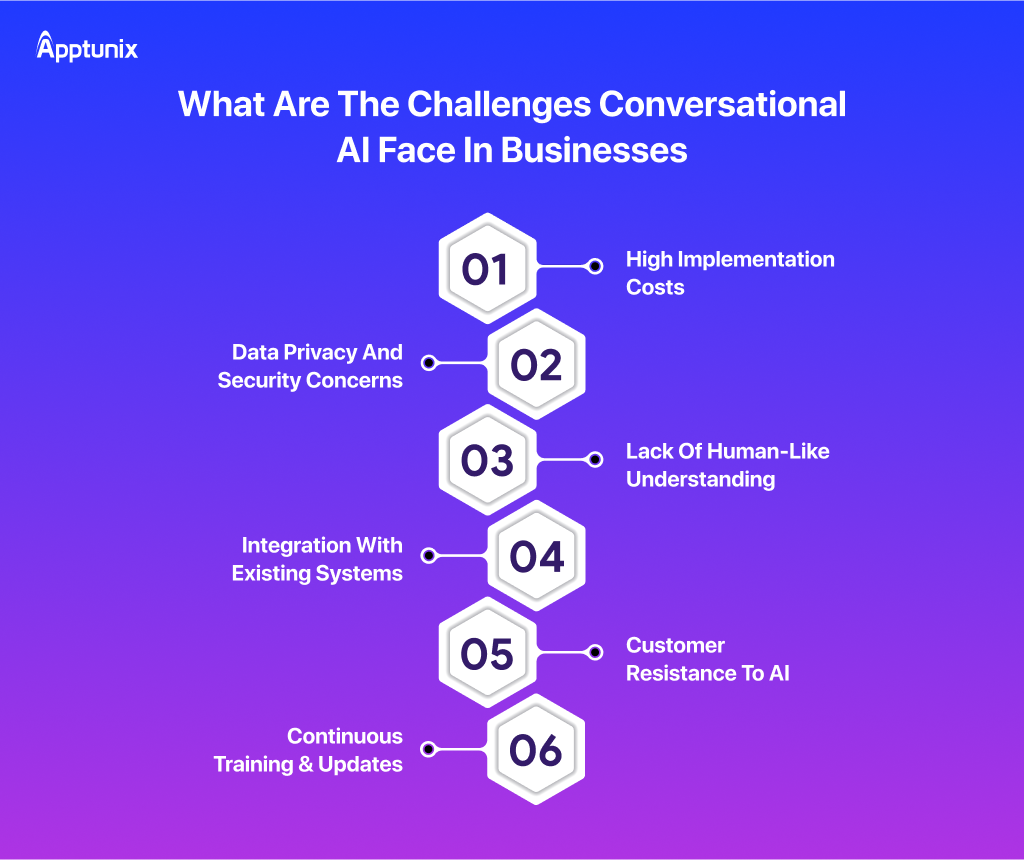
1. High Implementation CostsOne of the most common barriers to conversational AI adoption in business is the high upfront cost. Custom solutions, NLP-powered engines, and integration with business systems often appear expensive. Most decision-makers fear making an investment, wondering if the conversational AI app development cost will yield a good enough return.
The key is to begin small and grow progressively. Companies can start with low-cost AI chatbots to automate common questions and grow as ROI shows itself. Cloud-based solutions also decrease infrastructure costs.
2. Data Privacy and Security ConcernsAnother significant conversational AI business challenge is data security. As AI systems have access to sensitive customer data, any data breach can hurt both reputation and trust. Regulations like GDPR, HIPAA, and CCPA complicate the process of compliance, making businesses reluctant to proceed.
This can be surmounted through teaming up with trustworthy conversational AI development services. Those who are keen on encryption, cloud secure storage, and regulatory compliance. Having HIPAA-compliant conversational AI solutions and openness with customers regarding data usage maintains trust while abiding by global standards.
3. Lack of Human-Like UnderstandingThe next major issue with conversational AI is the failure to comprehend context, emotions, or complex questions. It leads to the loss of users and credibility in chatbots.
The answer lies in investing in conversational AI solutions fueled by NLP that leverage machine learning to get smarter over time. AI + human agent hybrid models provide smooth escalation when necessary.
4. Integration with Existing SystemsSeveral businesses do not integrate AI chatbots with CRM, ERP, or third-party applications. Without integration, conversational AI business applications fall short of their potential.
To curb this, companies should implement business AI applications that are scalable and provide APIs and pre-configured connectors to facilitate integration. Using skilled developers in conversational AI development services guarantees compatibility between systems, minimizing friction and enhancing efficiency.
5. Customer Resistance to AINot all clients embrace automation. Certain users prefer human agents and resist dealing with bots, particularly in sectors such as healthcare or high-end services. This resistance inhibits conversational AI adoption in business and lessens its overall effect.
The most effective way to counter this is by creating business AI chatbots that are more natural, empathetic, and humanized. Making it easy to switch over to human agents helps establish trust. Informing customers about the benefits of AI also helps.
6. Continuous Training & UpdatesUnlike static systems, conversational AI requires consistent training in order to remain effective. When companies do not refresh datasets and retrain models, AI bots are rendered outdated and are unable to provide value. This is perhaps the most underappreciated business challenge of conversational AI.
The solution is adopting AI chatbot platforms with self-learning capabilities and pairing them with regular data updates. Businesses must track performance through analytics and refine conversational flows to keep the AI relevant. This will mean that conversational AI solutions continue to deliver long-term benefits.
The real power of AI can be attained by overcoming these challenges. So, now we are going to discuss the future of conversational AI in business and the trends that are transforming global industries.
The future of conversational AI in business is evolving at a tremendous rate, thanks to AI, voice technologies, and automation. By 2030, conversational AI will be doing more than customer support; it will also provide sales, marketing, and business process automation.
Here are five trends that are defining its future:
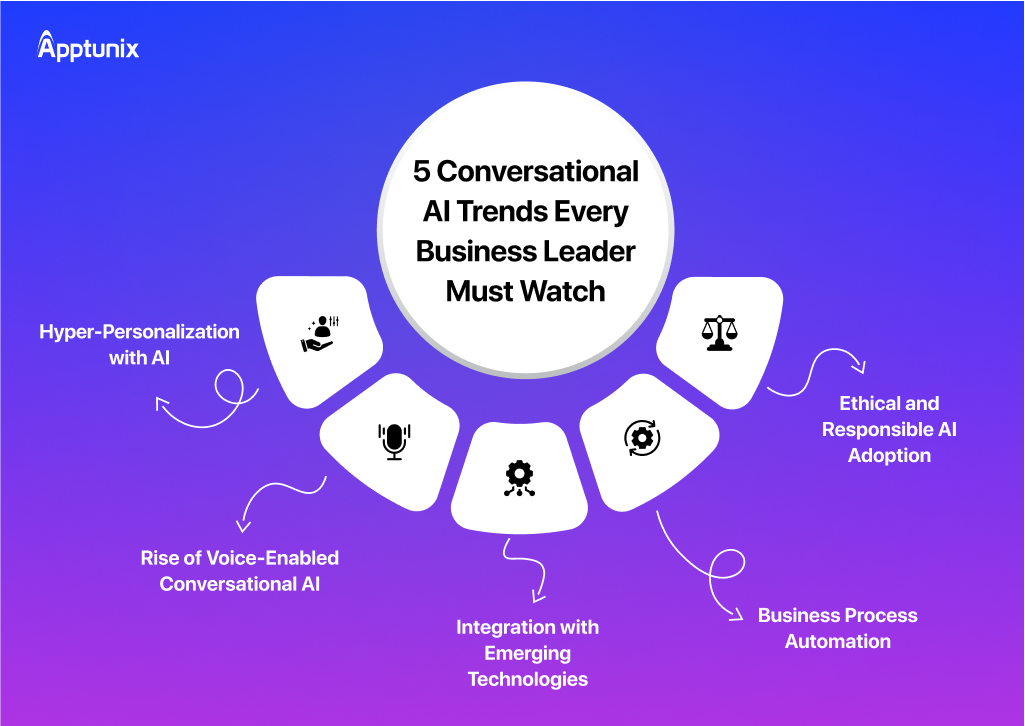
1. Hyper-Personalization with AIThe future of AI chatbots for business will exceed pre-programmed responses. This will be done by using customer purchase history, behavioral data, and predictive analytics to deliver personalized interactions.
Customers will feel more loyal to businesses, and conversion rates will be higher due to these extremely personalized conversations.
2. Rise of Voice-Enabled Conversational AIVoice technology is emerging as the centre of engagement with customers.
Voice-powered assistants will take over, whether it be e-commerce purchases or booking an appointment. For businesses, adopting voice-based AI solutions will create smoother, hands-free interactions that align with consumer expectations.
Voice-enabled CX only works when latency is imperceptible. Teams rolling out phone-based assistants should prioritize ultra-low-latency (sub-300 ms) audio, streaming ASR/TTS, barge-in, and programmable call control. With custom voice AI integrations, product teams can build, test, and launch real-time voice agents in minutes, complete with carrier-grade telephony, SIP/PSTN connectivity, and APIs for intent routing, recordings, and analytics. This makes voice bots feel human, supports 24/7 sales and support, and scales globally without sacrificing call quality.
3. Integration with Emerging TechnologiesThe future of conversational AI in business is not standalone. It will incorporate with IoT, blockchain, and AR/VR. Imagine retail assistants guiding shoppers through virtual stores, or healthcare bots monitoring patients in real time through wearable devices.
These integrations will revamp industries.
4. Business Process AutomationConversational AI will not be limited to the customer-facing roles.
Companies will use AI chatbots for HR, IT support, and finance, automating repetitive queries and simplifying workflows. Such a shift will save costs and leave employees free to work on strategic, value-added tasks.
5. Ethical and Responsible AI AdoptionDue to the increased concern about data privacy, organizations will implement responsible AI. Clear data processing, adherence to international standards, and bias-free systems will be a must. Ethical AI will turn into a competitive advantage, developing consumer trust.
The future of business growth is conversational, and the moment to act is here and now. As customers expect instant, personalized interactions, conversational AI for business is not a nice-to-have anymore but a game-changer.
As a trusted AI app development company, Apptunix blends deep technical expertise with customer-first innovation. We develop smart, human-like business chatbots that augment customer experiences, automate service, and result in measurable revenue growth. With highly sophisticated NLP, machine learning, and automation, we develop solutions to support your specific business requirements.
Technology is just one aspect of our conversational AI development services expertise. To guarantee that your investment yields a long-term return on investment, we collaborate with you at every stage: strategy, design, implementation, and optimization. Our solutions, which range from lead generation tools and customer care automation to conversational AI in e-commerce, are designed to grow with your company.
At Apptunix, we’ve helped global brands achieve:
If you’re ready to leverage the power of conversational AI for businesses, Apptunix is your go-to partner. With our established record and cutting-edge business AI solutions, we assist you in leading the pack in an AI-driven competitive world.
Let’s make conversations turn into conversions. Talk to our experts today!

Q 1.Is ChatGPT a conversational AI?
Yes, ChatGPT is a conversational AI. It employs the use of natural language processing (NLP) and machine learning to interpret user requests and give humanistic responses which makes it more sophisticated than rule based chatbots.
Q 2.What is the difference between chatbot and conversation AI?
The key difference is intelligence and adaptability:
Q 3.What are the benefits of conversational AI for businesses?
Conversational AI benefits businesses by:
Q 4.Is conversational AI the same as generative AI?
Not exactly. Conversational AI is aimed at building natural dialogues between humans and machines. Generative AI, on the contrary, is able to generate something new such as text, graphics, or even code. Generative AI is commonly used as a layer of technology used in conversational AI to make it smarter and more natural to communicate.
Q 5.What are the challenges of conversational AI?
The main challenges include:
Q 6.How can conversational AI improve customer experience in small businesses?
Conversational AI improves small business CX by:
Q 7.How much does conversational AI implementation cost for a startup?
Conversational AI implementation for startups usually costs between $20,000 to $50,000. Pricing is based on features, complexity, integrations, and scalability requirements. Advanced functions like multilingual support or predictive analytics increase costs.
Q 8.What is the future of conversational AI in business?
The future of conversational AI is about hyper-personalization, voice-enabled interactions, multilingual support, and deeper integration with business tools. By 2034, the market is projected to reach $61.9 billion, showing its strong role in driving efficiency and customer engagement.
Q 9.What industries benefit the most from conversational AI?
Industries seeing the biggest impact include:
(2 ratings, average: 5.00 out of 5)
Get the weekly updates on the newest brand stories, business models and technology right in your inbox.
Blending strategic thinking with a deep understanding of digital ecosystems, Arohi helps shape Apptunix’s voice across the tech and mobility space. With 5+ years of experience in SEO-driven content, B2B storytelling, and product-focused writing, she creates high-impact blogs, compelling product narratives, and pitch-ready content that aligns with both user intent and business goals. At Apptunix, she crafts data-backed content strategies that blend storytelling, search intent, and brand positioning—helping businesses build trust, authority, and measurable growth through high-impact digital content.
Book your free consultation with us.
Book your free consultation with us.

One Central, The offices 3, Level 3, DWTC, Sheikh Zayed Road, Dubai, United Arab Emirates
+971 50 782 1690