How to Build a Travel Platform Like Expedia?
11 Views 15 min July 31, 2026

Five years ago, delivery was a nice add-on. Today, it decides who wins and who quietly disappears.
Customers expect groceries within hours, packages by evening, and local orders tracked down to the last mile. If a business cannot deliver fast and predictably, customers move on without a second thought.
Once people get used to real-time tracking, instant confirmations, and flexible delivery windows, there is no going back. Recent data shows that more than 65% of consumers are willing to switch brands for faster delivery. That single statistic explains why pickup and delivery app development is now part of core business planning across retail, healthcare, logistics, and local services.
For founders, the long-term value is clear. A delivery platform becomes a revenue engine, a data asset, and a competitive moat. Businesses that build now gain operational leverage. Those who wait often end up paying more to catch up.
Profitability is achievable, but only for businesses that treat delivery as a system, not a shortcut. Operational pressure is another major driver. Manual dispatch systems struggle the moment order volume increases. Phone calls get missed. Drivers waste time on inefficient routes. Customer support teams drown in “Where is my order?” queries. Digital delivery platforms replace that chaos with visibility and control.
Two businesses can target the same market. One becomes profitable. The other burns cash.
The difference often comes down to who they choose as an on-demand pickup and delivery app development company. Teams that understand scale design systems that protect margins. Teams that focus only on features create platforms that struggle under real-world demand.
When businesses hire developers for pickup and delivery app development with long-term cost control in mind, profitability becomes a matter of timing.
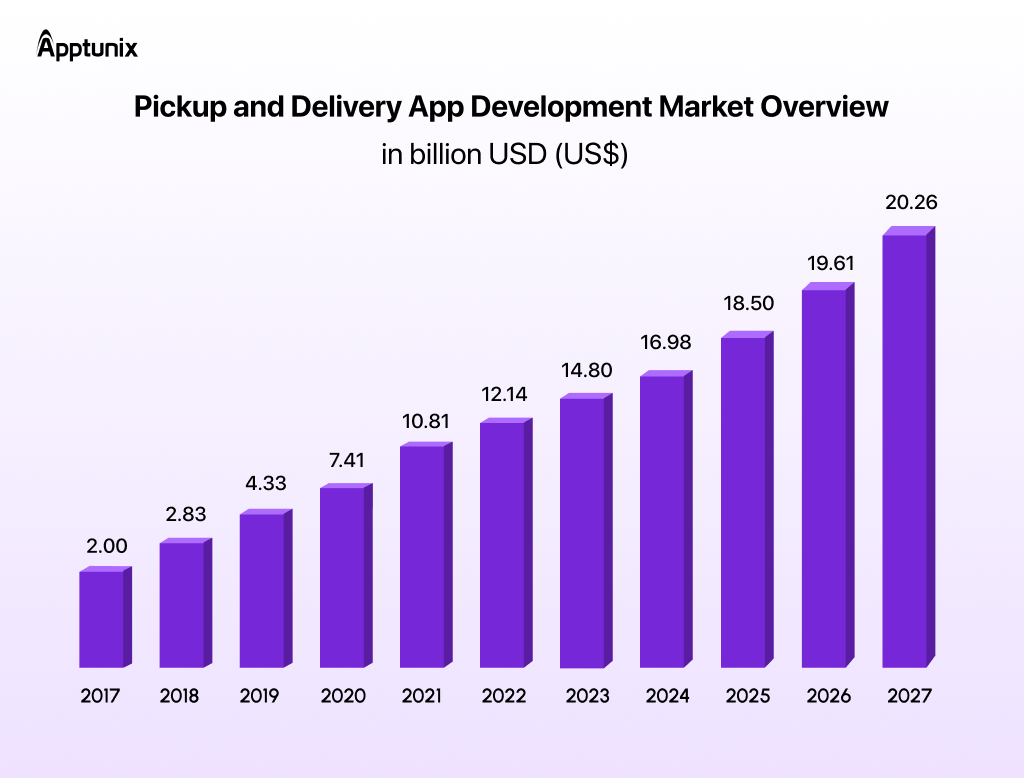
The pickup and delivery app market has evolved rapidly in the last few years. Earlier, most platforms focused on city-wide logistics, where orders could take hours—or even a full day—to reach the customer. Today, consumer expectations are dramatically different.
Modern pickup and delivery apps are moving toward Hyperlocal Delivery 2.0, where orders are fulfilled within minutes rather than hours.
A key driver behind this shift is the adoption of dark stores and micro-fulfillment centers. These are small, strategically located warehouses designed exclusively for online orders. Unlike traditional retail stores, dark stores are optimized for fast picking, packing, and dispatching.
For businesses building a pickup and delivery app, integrating dark stores into the logistics workflow allows:
This model is already powering quick-commerce platforms that promise 10-minute grocery or essentials delivery. As customer expectations continue to shift toward instant convenience, dark store integration is becoming a standard feature in modern hyperlocal delivery platforms.
Real-time GPS tracking is now a basic requirement for delivery applications. However, advanced pickup and delivery apps are going far beyond simple location tracking.
Modern platforms are using AI-powered route optimization and predictive navigation to improve delivery efficiency and reduce delays.
Instead of reacting to traffic conditions after they occur, predictive navigation systems analyze historical data, weather forecasts, and real-time traffic signals to anticipate road conditions before a driver even starts the trip.
This allows delivery apps to:
For businesses managing large fleets, AI route optimization can significantly reduce operational costs while improving delivery speed and reliability.
As on-demand logistics platforms scale, predictive navigation is quickly becoming a competitive advantage for delivery app development.
Not every business needs its own delivery platform. But for the right models, investing early creates long-term leverage that third-party services cannot match.
Below is a clear breakdown of industries where pickup and delivery app development consistently delivers ROI.
Grocery app development remains one of the highest-frequency delivery categories in the US. Customers reorder weekly, sometimes multiple times per week. High order frequency improves route density and lowers per-order delivery costs. Grocery platforms that own their delivery stack build loyalty faster and protect margins.
What drives demand
Courier platforms serve both B2B and B2C logistics. From legal documents to medical supplies, speed and accountability are non-negotiable. Courier-focused pickup and delivery app solutions benefit from premium pricing due to urgency and compliance requirements.
Key opportunities
Local delivery app development has expanded far beyond food. Pharmacies, florists, hardware stores, and specialty retailers now compete on speed. This category benefits greatly from hyperlocal routing and real-time inventory visibility.
Why local delivery scales
Same-day delivery serves high-urgency business models where waiting is not an option. The challenge lies in balancing speed with profitability. Same-day models demand precise dispatch logic and accurate cost forecasting. This is where enterprise delivery app development becomes essential.
Common use cases
Hyperlocal platforms focus on tight geographic zones instead of city-wide coverage. Founders who hire pickup and delivery app developers with experience in zone-based logistics gain a strong advantage here. Scaling becomes controlled instead of chaotic.
Why hyperlocal works
Choosing the right business model is essential when building a pickup and delivery platform. Different revenue strategies allow companies to monetize their logistics services effectively.
Commission-Based Model
In this model, the platform charges businesses a commission for every completed delivery. It is one of the most common monetization strategies used by on-demand delivery apps.
Subscription-Based Model
Businesses or vendors pay a monthly subscription fee to access the delivery platform and its services. This model ensures recurring revenue for the platform.
Delivery Fee Model
Customers pay a delivery charge for each order. The fee may vary based on distance, delivery speed, or order value.
Hybrid Model
Many successful delivery platforms combine multiple revenue streams. For example, they may charge vendors a commission while also applying delivery fees to customers.
Founders often expect a single number. The reality is more layered. The cost to build a pickup and delivery app depends on how operationally serious the platform is meant to be. A simple dispatch tool and a revenue-ready delivery business are two very different products.
Pickup and delivery app development costs are shaped by scope, scale, and execution quality. The more the platform is expected to automate and handle in real time, the higher the investment required.
Several technical elements influence the final development budget.
Number of user panels
Most delivery platforms require separate apps or dashboards for customers, delivery partners, and administrators.
Real-time tracking integration
GPS tracking, route updates, and order status synchronization require additional backend infrastructure.
Payment gateway integration
Secure online payments, wallets, and multiple payment options increase development complexity.
Push notifications
Order updates, delivery alerts, and promotional notifications require real-time messaging services.
Route optimization algorithms
Advanced delivery platforms use algorithms to determine the fastest and most efficient routes.
AI-based delivery optimization
AI tools can analyze demand patterns and optimize delivery scheduling.
Cloud infrastructure and scalability
High-volume delivery apps require scalable infrastructure to support thousands of concurrent users.
Timelines depend on scope and execution discipline. Rushing development rarely saves time. It usually creates delays later.
Below is a realistic timeline breakdown.
What Influences the Timeline
When businesses hire developers to build pickup and delivery app platforms with long-term plans in mind, timelines stay predictable and costs remain under control.
A delivery app is not just a product. It is an operational system. Building it with the right technology and realistic timelines is what separates scalable platforms from short-lived experiments.
When businesses plan pickup and delivery app development, one of the first decisions is whether to launch fast with a ready-made solution or invest in a custom platform built around their operations. White-label solution providers like Quickworks look tempting on paper and start at just $4,000.
Many teams start with a white-label pickup and delivery app solution and later discover they are paying more in workarounds than they would have spent building a system correctly from day one.
Custom platforms are designed around your business, not the other way around.
Benefits include:
When businesses decide to develop a pickup and delivery app, features are not about adding everything at once. They are about removing friction at every step of the delivery flow. The goal is simple. Customers place orders easily. Drivers complete jobs without confusion. Admin teams stay in control without manual work.
Strong pickup and delivery app features form the backbone of delivery management software development. Without them, scaling becomes expensive fast.
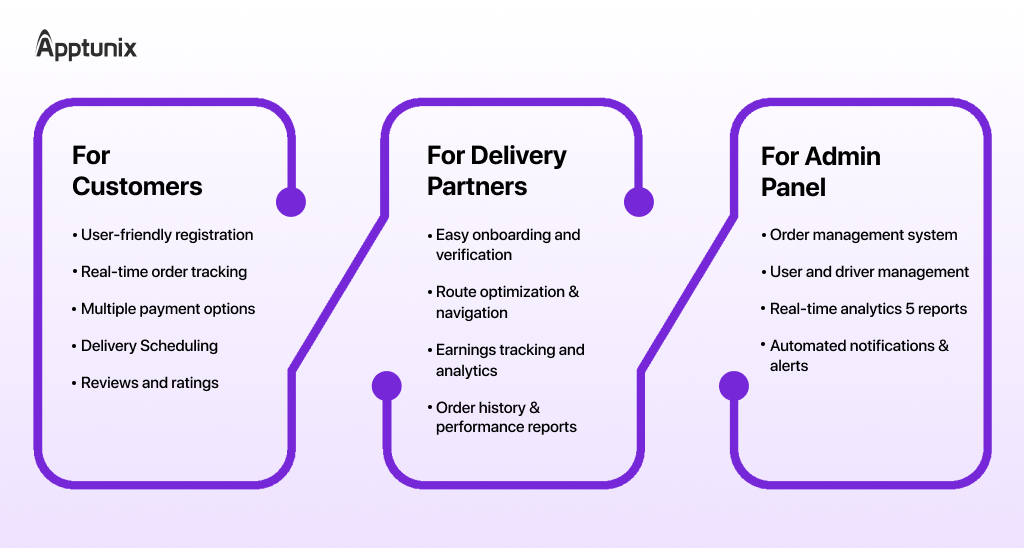
A.Customer App FeaturesThis is where demand is created. If the customer experience feels slow or unclear, orders drop no matter how strong the backend is. A clean customer app directly impacts conversion rates and retention, which ultimately lowers the cost to build a pickup and delivery app over time by improving lifetime value.
B.Driver App FeaturesDrivers are your execution layer. If their tools are confusing, delivery times slip and costs rise. Businesses that hire developers to build pickup and delivery app systems often underestimate the driver experience. That mistake usually shows up later as higher operational costs.
C.Admin Dashboard FeaturesThe admin dashboard is where control lives. This is the most important layer for enterprise-scale operations. This layer is the foundation of custom pickup and delivery app development services designed for long-term growth.
Once the core system is stable, advanced features become the difference between breaking even and building a profitable operation. This is why businesses investing in custom pickup and delivery app development services outperform those relying on basic or ready-made tools.
Delivery platforms depend heavily on driver availability and performance. As the gig economy continues to grow, businesses need better tools to attract and retain delivery partners. Modern pickup and delivery apps are evolving toward Gig Economy 2.0, where the driver dashboard includes advanced engagement features. These features may include:
Modern delivery platforms are increasingly using artificial intelligence to predict order demand across different locations and time periods. By analyzing historical order data, seasonal trends, and local events, AI can forecast delivery demand in advance.
This helps businesses allocate drivers efficiently, avoid delivery delays during peak hours, and maintain faster service levels. Predictive demand forecasting also improves driver earnings by ensuring consistent order availability.
AI-driven dispatch systems automatically assign orders to the most suitable driver based on location, traffic conditions, delivery urgency, and vehicle type.
Smart batching groups multiple nearby deliveries into a single route, reducing travel time and improving fleet productivity. This feature helps businesses handle higher delivery volumes without increasing operational costs.
Blockchain technology can bring transparency and security to delivery platforms by creating a tamper-proof record of every delivery event.
Each step of the delivery journey—from package pickup to final drop-off—is recorded on an immutable ledger. This chain of custody ensures that businesses and customers can verify who handled the package and when.
Blockchain verification is especially useful for high-value shipments, legal documents, pharmaceuticals, and sensitive packages.
Eco-friendly delivery is becoming an important factor for both businesses and customers. Modern pickup and delivery apps are starting to include sustainability-focused features that reduce environmental impact.
Electric vehicle (EV) routing
Delivery apps can prioritize drivers using electric vehicles and suggest routes that minimize energy consumption.
Carbon footprint tracking
Customers can see the estimated carbon emissions generated by their delivery and choose greener delivery options when available.
Eco-delivery incentives
Drivers using electric vehicles or bicycles can receive additional rewards for supporting sustainable logistics.
Delivery platforms handle large volumes of transactions and sensitive customer data. AI-powered fraud detection systems monitor patterns across orders, payments, and driver behavior.
If suspicious activities are detected—such as fake orders, location spoofing, or unusual payment activity—the system can flag them instantly for review.
This improves platform security and protects both customers and delivery partners.
Voice AI assistants can help delivery drivers interact with the app without touching their phones while driving. Voice-enabled interfaces improve driver safety and productivity during deliveries.
Drivers can use voice commands to:
Fleet-based delivery businesses can use AI-powered predictive maintenance systems to monitor vehicle health and performance.
Sensors and telematics data can identify potential mechanical issues before they become serious problems. This helps reduce vehicle downtime and ensures deliveries are not disrupted.
Some advanced pickup and delivery platforms are preparing for the future by integrating support for autonomous delivery technologies such as drones and delivery robots.
While still emerging, these technologies have the potential to reduce delivery costs and enable faster last-mile logistics in urban areas.
Modern delivery apps collect valuable user behavior data that can be analyzed using AI.
Businesses can gain insights such as:
These insights help companies continuously optimize their logistics operations and improve the overall delivery experience.
Strong delivery platforms are built through structure, not speed. Teams that rush to launch often pay later through outages, rework, and rising operational costs. The goal is not just to release an app. The goal is to build a system that can support real demand without breaking.
Here is how experienced teams develop a pickup and delivery app that is designed to scale.
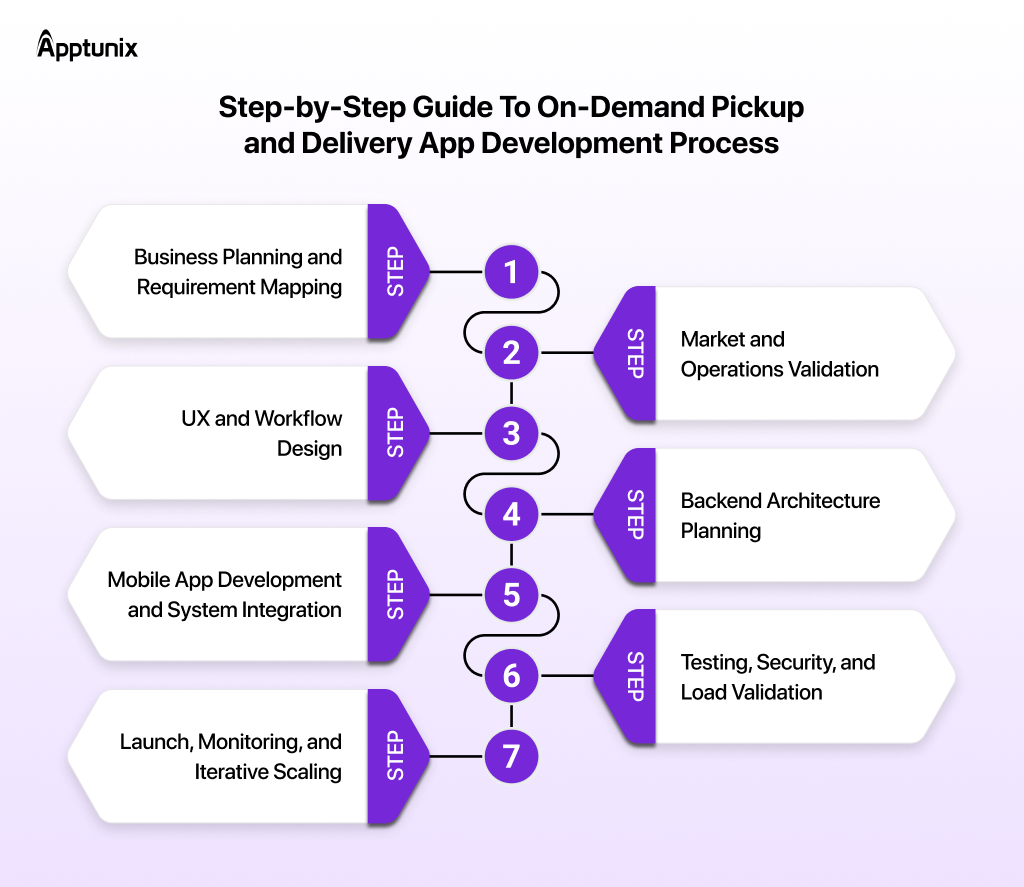
Everything starts with clarity. Delivery model, service coverage, pricing logic, driver incentives, and expansion plans are defined before development begins. This step keeps teams aligned and sets realistic expectations around pickup and delivery app development cost. It also prevents feature overload and last-minute changes that inflate budgets.
Before design or code, assumptions are tested. Order frequency, delivery windows, peak hours, and operational constraints are validated against real use cases. This step ensures the app is built for how the business will actually operate, not how it looks on paper.
Customers, drivers, and admins have very different needs. Each workflow is designed to remove friction and reduce manual effort. Good UX reduces support requests, speeds up onboarding, and improves adoption across all roles. These gains compound as order volume grows.
This is where scale is decided. Data models, dispatch logic, payment handling, and system integrations are designed to handle growth. Enterprise delivery app development teams focus heavily on this step because backend limitations are expensive to fix after launch.
Customer apps, driver apps, and admin dashboards are built and connected to the backend. Real-time tracking, notifications, and payment flows are implemented and tested together. At this stage, the platform starts behaving like a real operational system, not just a collection of screens.
Every edge case is tested. Payment failures, driver drop-offs, delayed pickups, and traffic spikes are simulated. Security reviews protect user data and transactions. Load testing ensures the system holds up during peak demand.
Launch is not the finish line. Performance is monitored closely. Data is used to fine-tune dispatch logic, improve delivery times, and plan feature upgrades. This step ensures the platform grows without instability or surprise costs.
Technology decisions shape everything that follows. Performance, stability, upgrade flexibility, and even the long-term cost to build a pickup and delivery app are all tied to the stack you choose early on. This is why experienced teams treat the pickup and delivery app tech stack as a business decision, not just a technical one.
Below is a clear breakdown of what is commonly used and why it matters.
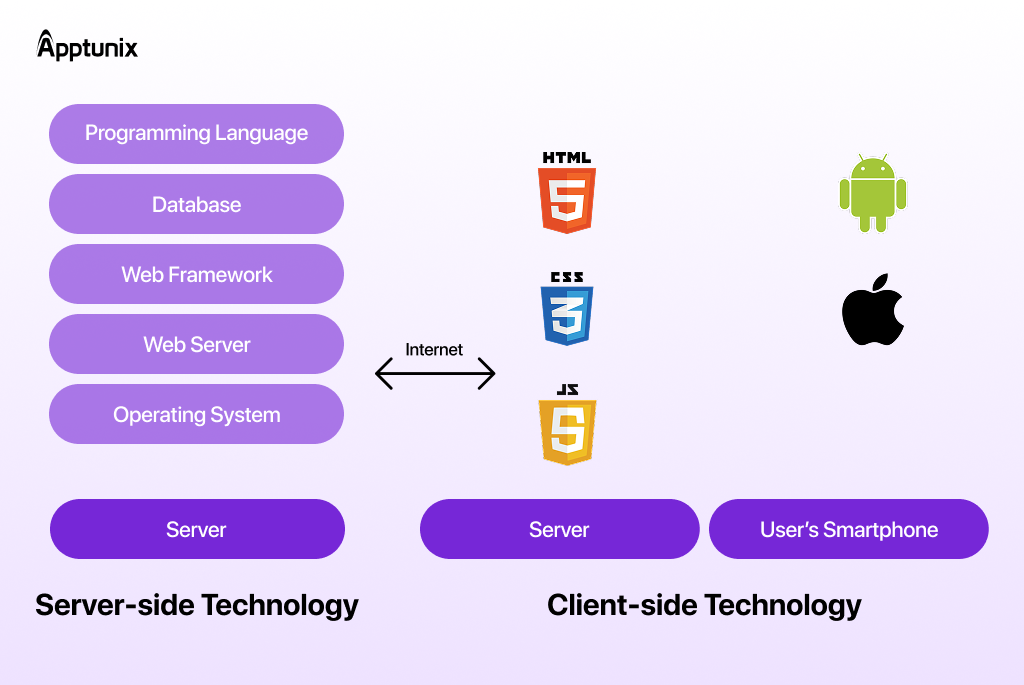
iOS Development – Swift
Swift is used for iOS apps because it delivers strong performance, better memory handling, and smoother background location tracking. This is critical for live delivery updates and route visibility.
Android Development – Kotlin
Kotlin offers stability, reduced boilerplate code, and reliable background services. It performs well for driver apps that need constant location updates.
Cross-Platform Options – Flutter or React Native
These frameworks reduce development time and cost. They are often used for MVPs or early-stage platforms. However, for complex delivery workflows, native development offers more control.
Node.js or Java
Node.js is widely used for real-time delivery systems because it handles concurrent requests efficiently. Java is chosen for enterprise-level reliability and long-term system stability. The backend controls orders, dispatch logic, payments, and system communication. A weak backend is the most common reason delivery platforms fail under load.
PostgreSQL
Used for structured data like orders, users, and payments. It ensures consistency and accuracy.
MongoDB or Redis
Used for real-time data such as live tracking and session handling.
Maps and Navigation – Google Maps or Mapbox
Used for distance calculation, route optimization, and ETA prediction.
Payments – Stripe, PayPal, Apple Pay, Google Pay
Secure payment handling with refund and reconciliation support.
Notifications – Firebase and Twilio
Power push notifications, SMS alerts, and status updates.
Cloud Platforms – AWS, Google Cloud, Azure
Used for hosting, scaling, and monitoring delivery platforms.
Scalability Tools
Auto-scaling, load balancers, and real-time monitoring ensure uptime during peak demand.
Most delivery apps don’t fail because of demand. They fail because the system underneath cannot handle real-world pressure. That line separates founders experimenting from those building enterprise delivery app development solutions that truly scale.

Apptunix is the partner founders choose when they want to develop a pickup and delivery app that works under pressure and drives revenue. This is not just about building an app—it’s about creating an operational engine that moves goods, money, and data in real time.
With over 12 years of experience, Apptunix has delivered pickup and delivery app development services across logistics, retail, marketplaces, and on-demand services. Every design decision—from dispatch logic to driver utilization—is tied to reducing cost per delivery and improving operational efficiency.
This mindset ensures that your platform performs reliably when order volumes spike, avoiding the rework and downtime that often inflate on-demand pickup and delivery app development cost.
Delivery apps rarely fail on the customer-facing side. They fail when orders spike, drivers go offline, or cities are added too fast. Apptunix focuses on enterprise delivery app development from the backend first. Order engines, delivery workflows, pricing logic, and reporting systems are built to scale without costly rewrites.
This is why enterprises trust Apptunix for delivery management software development that remains stable even under real-world demand.
As order volume grows, inefficiencies can erode margins. Apptunix develops intelligent dispatch systems that consider zones, delivery windows, driver availability, batching, and surge scenarios. This reduces manual intervention, keeps operational costs under control, and ensures scalability.
For founders planning pickup and delivery app development, this level of system intelligence is the difference between smooth growth and operational chaos.
Apptunix has successfully partnered with startups and enterprises across multiple sectors:
This deep exposure to real-world pressure tests shortens decision cycles and prevents avoidable mistakes. When founders hire developers to build a pickup and delivery app, they choose teams that already know what breaks and how to prevent it.
Apptunix handles the entire platform lifecycle: product planning, pickup and delivery app solution design, UX flows for customers, drivers, and admins, mobile app and backend development, testing, deployment, and post-launch scaling.
No handoffs. No fragmented accountability. This full-service approach is why businesses investing in custom pickup and delivery app development services stick with Apptunix beyond launch.
Apptunix operates as a long-term technology partner, focused on stability, scalability, and ROI—not just coding screens.
Success depends on execution, not the idea. Platforms fail when spikes, driver shortages, or rapid expansion overwhelm the system.
Founders who win understand that shortcuts increase the cost to build a pickup and delivery app over time through rework, downtime, and lost customers.
Timing matters. Architecture matters. Your development partner matters most.
If delivery drives your business, you cannot afford to experiment with freelancers or fragmented teams. Partnering with Apptunix means you develop a pickup and delivery app that scales seamlessly, protects margins, and stays compliant.
Every day you wait, competitors capture market share. Build it right once, dominate your region, and scale without friction with Apptunix.
Q 1.How long does it take to develop a pickup and delivery app?
An MVP typically takes 3 to 5 weeks. Growth-stage platforms take 4 to 6 months, while enterprise delivery systems can take 2 to 4 months depending on complexity.
Q 2.What is the cost to build a pickup and delivery app?
The cost to build a pickup and delivery app usually starts around $15,000 for a basic MVP and can exceed $60,000 for enterprise-grade platforms with advanced dispatch and analytics.
Q 3.What factors increase delivery app development cost the most?
Real-time tracking, smart dispatch logic, third-party integrations, multi-city scaling, and backend architecture decisions have the biggest impact on cost.
Q 4.Can a pickup and delivery app scale nationwide later?
Yes, but only if the backend is designed for scale from the beginning. Retrofitting scalability later significantly increases cost and downtime.
Q 5.Do I need a custom pickup and delivery app or a ready-made solution?
If delivery is core to your operations, custom pickup and delivery app development services provide better flexibility, performance, and long-term ROI.
Q 6.Why do many delivery apps fail after launch?
Most failures happen due to weak backend systems, poor dispatch logic, and underestimating operational complexity, not lack of demand.
Q 7.What makes Apptunix different from other delivery app development companies?
Apptunix prioritizes enterprise-ready architecture, scalable delivery systems, and long-term stability over quick, fragile launches.
Q 8.Does Apptunix handle delivery management software development for enterprises?
Yes. Apptunix builds advanced delivery management systems with automation, reporting, and integration capabilities for large operations.
Q 9.Can Apptunix support post-launch scaling and optimization?
Absolutely. Apptunix supports feature expansion, performance optimization, and geographic scaling as demand grows.
Get the weekly updates on the newest brand stories, business models and technology right in your inbox.
Book your consultation with us.
Book your consultation with us.


One Central, The offices 3, Level 3, DWTC, Sheikh Zayed Road, Dubai
+971 50 782 1690


Offer Ends Soon
Get a quick expert response in under 5 minutes.