How to Build a Grubhub Clone App? Readymade vs Custom Solutions
120 Views 14 min November 19, 2025

Blending strategic thinking with a deep understanding of digital ecosystems, Arohi helps shape Apptunix’s voice across the tech and mobility space. With 3+ years of experience in SEO-driven content, B2B storytelling, and product-focused writing, she creates high-impact blogs, compelling product narratives, and pitch-ready content that aligns with both user intent and business goals. At Apptunix, Arohi leads the charge in crafting content that supports lead generation, showcases product value, and positions the brand as a trusted tech partner for startups and enterprises alike.
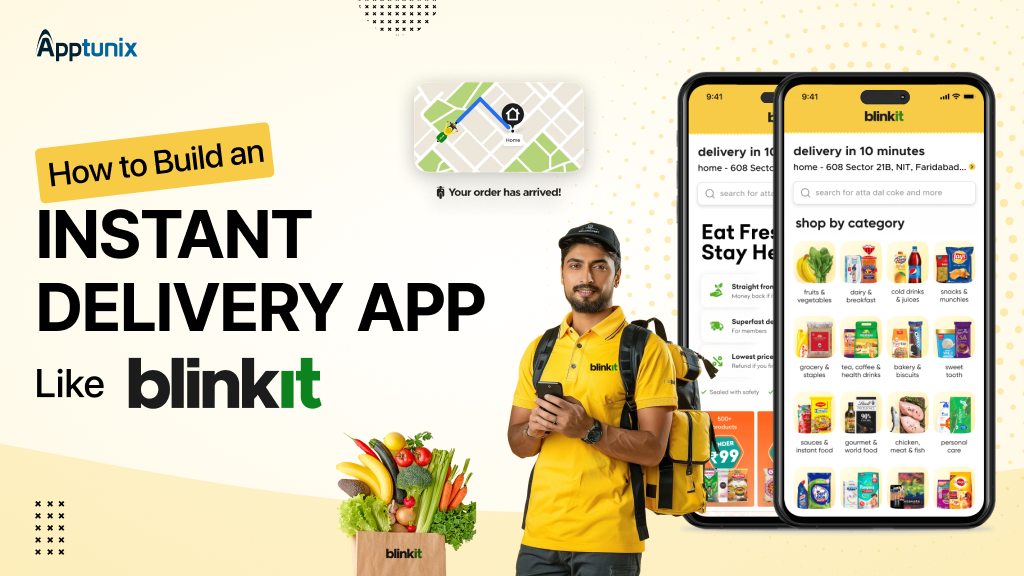
Success in 2025 belongs to businesses that move faster than customer expectations. Blinkit proved that speed is not just convenience. It is a competitive advantage.
The demand for instant delivery has transformed consumer behaviour forever. Today’s customers want groceries in minutes, not hours. Urban shoppers are willing to switch loyalty instantly for faster fulfillment. That’s why more founders and investors are exploring how to build an app like Blinkit and claim their share of the fast-growing market.
According to Research, the global quick-commerce and instant grocery delivery market is projected to exceed $60 billion by 2032.
That level of scale doesn’t describe a passing trend. It represents a structural transformation in the way consumers purchase essentials. Instant grocery app development is now a strategic move for businesses looking to unlock new revenue streams across hyperlocal markets worldwide.
Blinkit’s success wasn’t luck. It was the result of smart technology, logistics precision, and a business model rewritten for the “need-it-now” economy. And if executed right, the next success story could be yours.
In this article, we’ll walk you through every aspect of creating a successful instant grocery delivery solution.
Let’s get started!
The question is no longer if you should adopt quick commerce, but how fast you can execute. Here are three solid reasons that’ll make you want to build an app like Blinkit today:
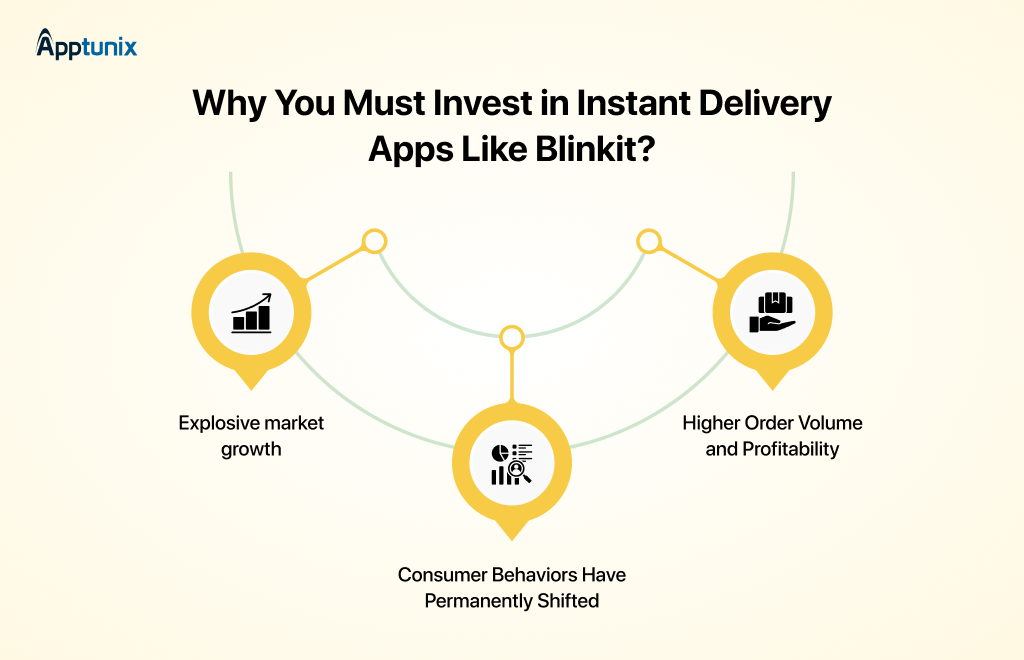
1. Explosive market growthQuick commerce is transforming the way the world shops. From New York to Dubai and from London to Mumbai, people no longer wait even hours for essentials. They expect 10-minute delivery, and hyperlocal delivery apps are making it a reality.
The global instant grocery market was valued at about $126.4 billion in 2021 and is forecast to reach $588 billion by 2030.
This dramatic expansion shows that instant grocery app development taps into an accelerating consumer trend of a “get it now” lifestyle.
2. Consumer Behaviours Have Permanently ShiftedSpeed has become a decisive buying factor. According to NielsenIQ, 68% of urban shoppers prefer 10-minute grocery delivery over physical supermarkets. Usage of hyperlocal grocery delivery app development solutions has increased by more than 40% year-on-year in the USA and UK. This proves that Instant Delivery is not an India-only trend. Customers are now trained to expect immediate fulfillment.
3. Higher Order Volume and ProfitabilityApps offering real-time delivery see stronger unit economics. Research shows that platforms like Blinkit receive 3–4x more orders per customer than traditional grocery apps, and average order values are up by 25%. That means faster cash flow, higher retention, and lower acquisition costs, the magic mix investors crave.
Now that the opportunity is clear, let’s break down what Blinkit really is and how its business model reshaped the market.
Blinkit is an Indian rapid delivery service known as Grofers until 2021. Founded in 2013 by Albinder Dhindsa and Saurabh Kumar, the instant delivery provider operates across India, covering 23 major cities that include Bengaluru, Chandigarh, Delhi, Gurugram, Hyderabad, Jaipur, Kolkata, Mumbai, Pune, and Vadodara.
In addition to groceries, it delivers fruits and vegetables, household supplies, personal care, and other items in its vast catalogue of 7000+ items.
During its early days as Grofers, the on-demand delivery service started providing services across Delhi NCR and later expanded to cover other regions of the country. Today, it serves 20+ major cities across the most populous country in the world.
Staying justified in its cause of making fast online delivery possible, Grofers reorganized itself as Blinkit and adopted an inventory-based business model.
The Indian food delivery giant Zomato announced an all-stock acquisition of Blinkit on 24th June 2022. It was completed on 10th August 2022 for a whopping $568 million.
Consumers can make purchases by visiting the Blinkit website or using the web app on their mobile devices. They can also order from Blinkit via the Zomato app.

Owning similar businesses to give a run for money to competitors isn’t something new in the corporate world. All major business conglomerates like Apple, Google, and Microsoft do it all the time.
Both Zomato and Swiggy are neck-to-neck competitors in the Indian food delivery market segment. These 2 are the prime competitors in the Indian grocery delivery market wars.
Also Read: Develop Your Own Delivery Super Gojek Clone App
While Swiggy took over Instamart (10th August 2020) to cover the grocery delivery business, Zomato purchased Blinkit (completed the acquisition on 11th August 2022) to keep up with its archrival.
While Blinkit focuses more on under-10-minute delivery, Instamart focuses more on quality product packaging. Blinkit has a dedicated website while Instamart doesn’t. Nonetheless, Instamart provides services in more areas than its competitor.
Unlike other business models, the Blinkit business model comes with a twist. The original business model didn’t perform too well for the online delivery business and as such, the instant delivery service has to come up with a better alternative, which turns out to be an inventory-based business model. Let’s know about each one of the two, one at a time:
Starting out as Grofers, Blinkit was initially an on-demand delivery service focusing on daily-use items. It was a hyperlocal delivery service that prioritised convenience all the while bridging the gap between local retailers and buyers. The three important parts of Blinkit’s business model are:
1.BuyersThe company started to make it convenient for customers who don’t want to actually visit a marketplace for purchasing everyday items. This includes users of all age groups and types, including employed professionals, elderly people, the sick, and students.
2.Local SellersBlinkit works with local vendors, mainly with sellers that have little to no marketing available. The on-demand delivery service helps them to expand their reach and allows them to make doorstep deliveries without any dedicated delivery staff.
In exchange for their efforts, the local vendor pays a commission fee that is anywhere between 8 to 15% of their product value to Blinkit.
3.The Delivery TeamThe instant delivery service divides regions covered into neighbourhoods, with each neighbourhood having assigned specific delivery agents and marked vendors.
These delivery teams ensure that the stores partnered with Blinkit are able to deliver day-to-day articles to clients in the shortest time possible.

The original business model of Blinkit, as Grofers, gained less popularity than what it was meant to. It was successful, but not as per the expectations. Consequently, it shifted its business model to an inventory-based model.
Interestingly, the two business models aren’t completely different. In fact, the inventory-based model is an extension of the original model with the introduction of an inventory system, and therefore, the name.
Unlike the original plan, where the ordered items are delivered straight from the store, the items are first moved to a local warehouse, where they are scrutinized for quality. The items are packed and sent to the customer only after the items successfully passed the quality checks.
Now, let’s break down the core feature set you must include to develop an app similar to blnkit.
As of March 2025, Blinkit operated in approximately 153 cities across India. In these cities, Blinkit has store partners almost every 2 kilometres.
The quick online delivery service lets customers order from a wide catalogue of 7k products and guarantees a 10-minute delivery, although it might take a little longer in certain cases, like when it’s raining or during peak traffic hours. Nonetheless, it is fast.
It claims to prepare an order for dispatch in less than two minutes to ensure rapid delivery of ordered items. Blinkit has worked extensively on upgrading its tech and enhancing the efficiency of its in-store planning, which helped them to hasten its packaging and delivery times.
The journey of a product from a warehouse to a consumer’s desk is extensive. It involves suppliers, vendors, logistics, delivery partners, and more. This is where Blinkit comes in and makes money by providing services required for small vendors.
When customers place orders on Blinkit, via its mobile app or website, it presents them with different brands and stores available. The instant delivery service charges 8% to 15% to the vendors in exchange for their services.
To diversify its revenue streams, the online grocery delivery business has been investing in new and established brands.

Okay, you’ve decided to build an app like Blinkit – awesome! But what actually turns a regular grocery app into a 10-minute grocery delivery beast? Here are the 12 non-negotiable features every instant grocery delivery app must include:
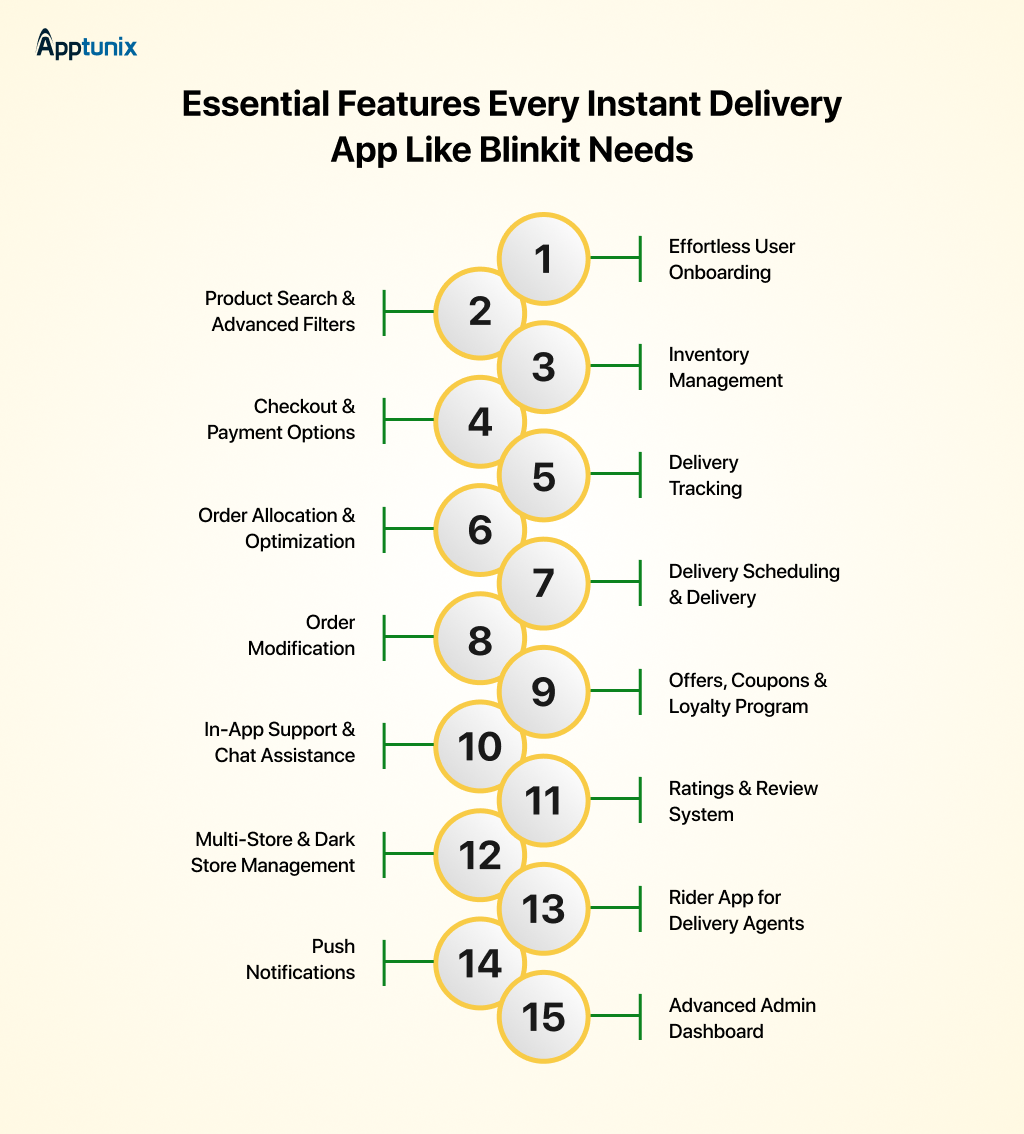
1. Effortless User OnboardingA frictionless signup process using phone number, email, or social logins helps users get started within seconds. In instant delivery, every second matters: the faster users enter, the quicker they convert.
2. Smart Product Search & Advanced FiltersUsers must be able to find items instantly using AI-based predictive search, voice search, and personalized filters. This reduces time spent browsing and increases chances of immediate checkout.
3. Real-Time Inventory ManagementLive product availability prevents order failures and improves fulfillment accuracy. It syncs stock across dark stores and warehouses, ensuring users never encounter “out of stock” after checkout.
4. Ultra-Fast Checkout & Diverse Payment OptionsOne-tap checkout with cards, wallets, Apple Pay, Google Pay, UPI, and COD reduces cart abandonment. The smoother the payment flow, the higher the conversion rate in instant delivery apps.
5. Real-Time Delivery TrackingUsers expect real-time visibility of the rider’s location and estimated delivery time. Live tracking builds trust, lowers customer anxiety, and enhances overall transparency.
6. Smart Order Allocation & Route OptimizationAutomatically assigns orders to the nearest rider and identifies the quickest route to ensure 10–15 minute deliveries. This reduces operational costs while maximizing delivery speed.
7. Delivery Scheduling & Priority DeliveryLet users choose between instant or scheduled delivery for convenience. Priority delivery options also allow premium revenue generation.
8. Order Modification & Smart SubstitutionIf an item is unavailable, users can approve alternative recommendations or replacements in real time. This improves fulfillment rates and avoids unnecessary cancellations.
9. Offers, Coupons & Loyalty ProgramReward points, membership plans, and personalized deals increase repeat orders and customer lifetime value. Loyalty programs are proven to drive stronger retention for hyperlocal delivery apps.
10. In-App Support & Chat Assistance24/7 chat, call support, and automated chatbot FAQs enable instant problem resolution. Quick responses enhance user satisfaction and improve app ratings.
11. Ratings & Review SystemUsers can rate delivery experience, products, and service quality. This helps brands optimize performance and maintain service excellence.
12. Multi-Store & Dark Store ManagementSupports multiple fulfillment hubs for operational scalability. Dark stores placed strategically reduce the delivery radius and enable true 10-minute delivery.
13. Rider App for Delivery AgentsA dedicated delivery partner app with navigation, earnings history, status updates, and task management. It ensures smooth delivery workflows and better productivity.
14. Push NotificationsTimely notifications for order updates, deals, restocks, and delivery alerts keep engagement high. Smart reminders also drive re-orders and customer retention.
15. Advanced Admin DashboardA powerful control panel to manage inventory levels, orders, riders, payments, and analytics. It enables data-driven decision-making and helps optimize business performance.
Developing an app like Blinkit requires you to leverage the latest mobile app development technologies. Here is the step-by-step process for creating an app like Blinkit:
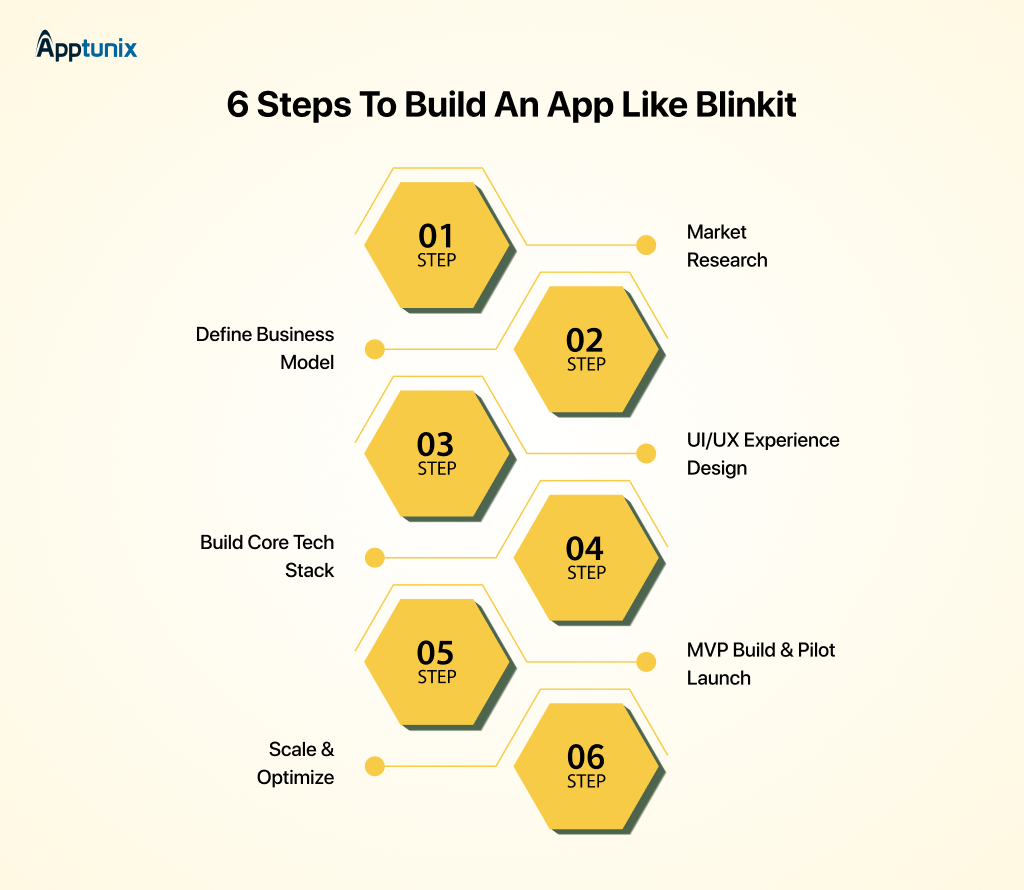
Step 1: Market ResearchStart by analyzing demand, competition, delivery expectations, and scalability potential across target regions. Identify high-density zones and buying behaviors to validate feasibility for instant grocery app development. Strong research ensures differentiation and reduces risk before major investment.
Step 2: Define Business ModelSelect the right structure: dark-store, marketplace, or hybrid based on capital capacity and delivery promise. Blinkit thrives with a dark-store model enabling 10-minute fulfillment and better margins. Your model influences technology, operations, and future monetization for quick commerce app development.
Step 3: UI/UX Experience DesignCreate fast, intuitive workflows that enable customers to order within seconds. Prioritize clean navigation, smart search, quick reorder, and a seamless checkout. UI/UX should encourage repeat purchases, which is crucial for high-frequency on-demand grocery app development.
Step 4: Build Core Tech StackDevelop a scalable, real-time architecture supporting live inventory, intelligent routing, and instant order updates. Use modern frameworks, secure payments, and geo-tracking integrations essential for a hyperlocal grocery delivery app development ecosystem. Reliability and speed are your competitive weapons.
Step 5: MVP Build & Pilot LaunchLaunch an MVP in a controlled region with essential modules, including the customer app, delivery partner app, admin panel, and tracking. Test fulfillment flow, delivery SLAs, and customer feedback. Pilots validate unit economics before expanding Blinkit clone app development at scale.
Step 6: Scale & OptimizeExpand city-by-city, improving performance through automation, AI forecasting, and data-driven routing. Add revenue channels such as subscriptions, delivery fees, promotions, and ads to strengthen profitability. Smart scaling ensures global market entry, including USA and UK regions.
The cost to build an app like Blinkit depends on various factors; there is no one-size-fits-all answer. For a realistic market benchmark, building an instant grocery app development solution typically ranges from $15,000 to $120,000+. It depends on whether you’re creating an MVP or a full-scale enterprise product comparable to Blinkit’s capabilities.
A basic version covers essential ordering, catalogue management, delivery tracking, payments, and admin features. However, advanced systems with real-time inventory automation, AI-driven routing, dark-store integration, and subscription models involve higher engineering, testing, and operational architecture. This raises the overall investment.
Whether you want to launch in emerging markets or expand globally into the USA or UK, the development approach and complexity will define the pricing. The ROI potential is remarkably higher due to repeat order frequency, predictable unit economics, and endless scaling capacity. That’s why enterprises strategically allocate capital to quick commerce app development.
Let’s check the complete breakdown!
Here are the five core factors that determine your total instant delivery app investment:
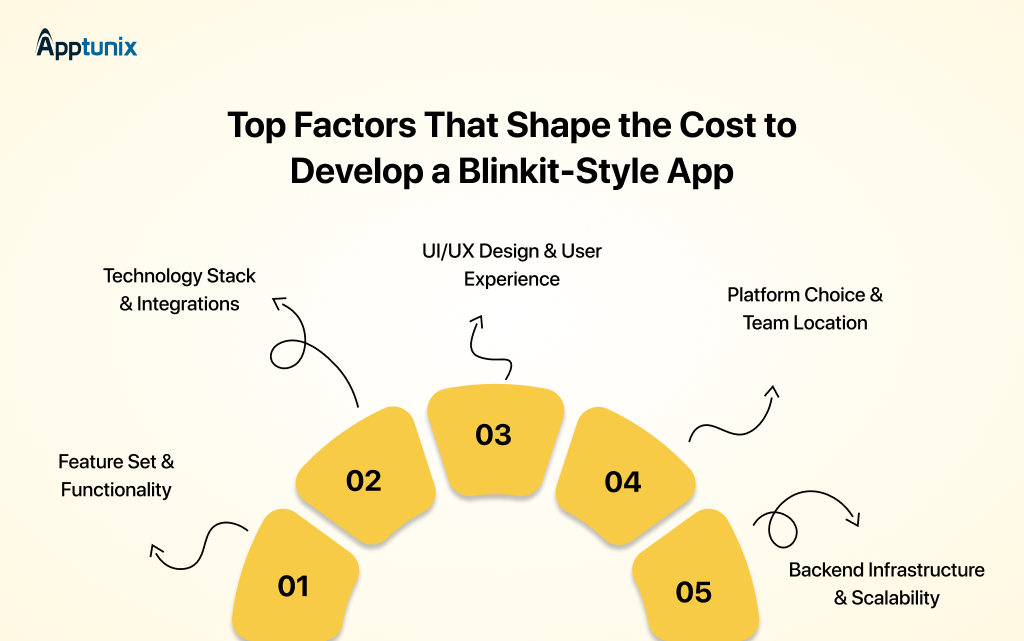
1. Feature Set & FunctionalityThe total number of features included significantly impacts development cost. Basic features like product listing, search, cart, payments, and order tracking are affordable. But advanced features like AI-powered demand prediction, dynamic pricing, multi-store logistics, and loyalty program systems add layers of engineering complexity. The deeper the functionality, the higher the investment required for an instant delivery app like Blinkit.
2. Technology Stack & IntegrationsChoosing a modern tech stack impacts speed, stability, and scalability. Real-time systems using microservices, geolocation APIs, and payment gateways require experienced engineers, increasing development time. Strong infrastructure is essential for reliable hyperlocal grocery delivery app development.
3. UI/UX Design & User ExperiencePremium design is critical for high conversion and repeat usage. A clean and intuitive interface costs more than generic templates because it requires thoughtful workflows, usability testing, micro-interactions, and custom animations. For a 10-minute grocery model, customers expect frictionless ordering and instant clarity. Investing in powerful UI/UX improves stickiness, brand trust, and overall ROI for on-demand grocery app development.
4. Platform Choice & Team LocationThe decision to build for Android, iOS, or both dramatically affects the budget. Native apps cost more than cross-platform builds due to separate codebases.
Similarly, hiring development teams in North America or Europe costs more than hiring teams in India or Southeast Asia. For enterprises planning to scale into USA or UK markets, hybrid rollout strategies often optimize the overall on-demand delivery app development cost.
5. Backend Infrastructure & ScalabilityApps like Blinkit process thousands of real-time orders, routing decisions, and stock updates every minute. To support this load, a strong backend architecture with microservices, cloud hosting, database clustering, and monitoring tools is essential.
Advanced infrastructure drives long-term stability and performance but raises initial cost.
Monetization is the engine that keeps a 10-minute grocery delivery app profitable and scalable. If you’re planning to build an app like Blinkit, designing a strong revenue strategy from day one is just as important as technology or operations.
Below are the most effective monetization models used globally in instant grocery app development and quick commerce app development:
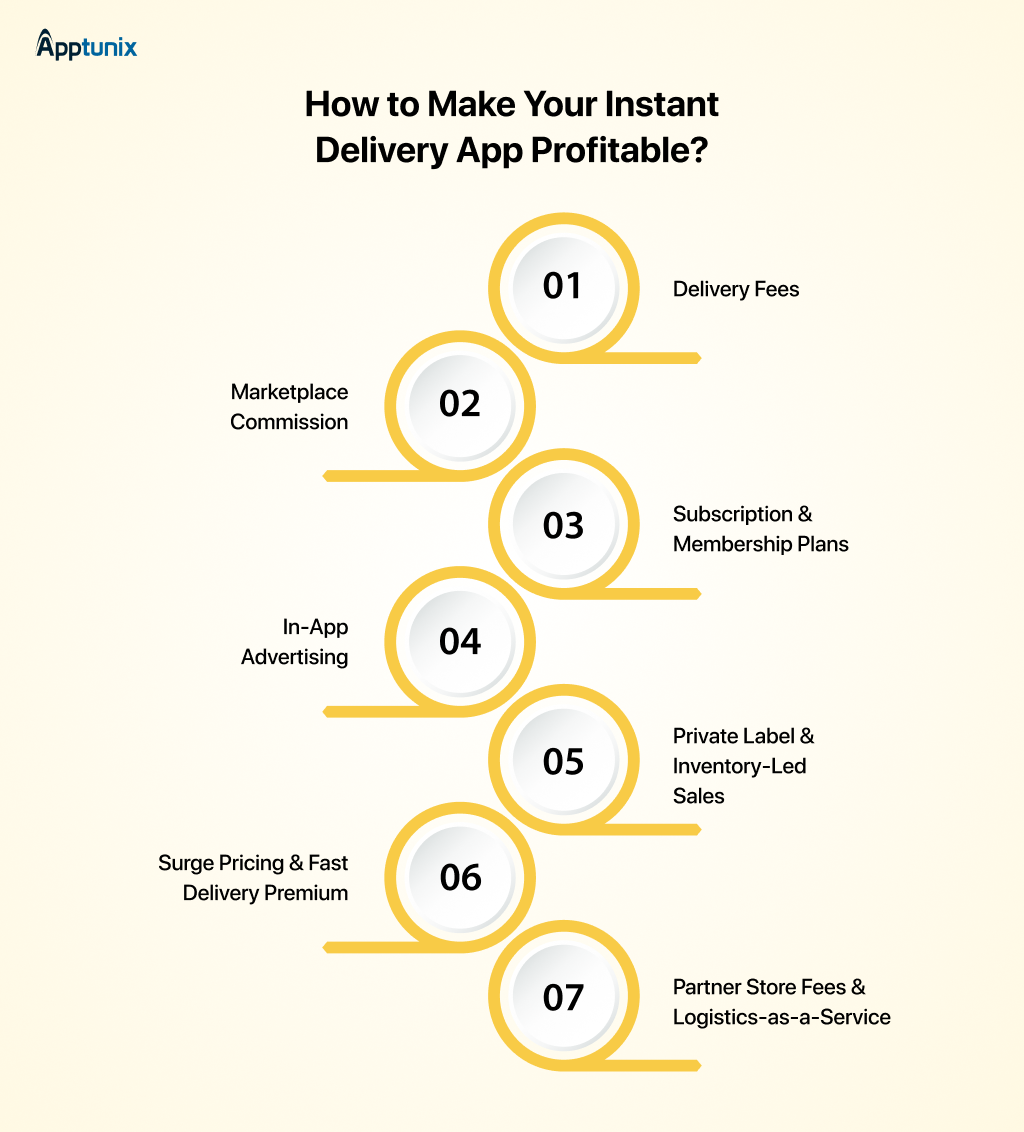
1. Delivery FeesCharging variable delivery fees based on distance, order value, time of day, or surge demand helps maintain strong unit economics. For example, GoPuff in the USA earns a major share of its revenue by charging small delivery fees on every order. This model ensures predictable recurring income while keeping prices acceptable for users.
2. Marketplace CommissionThis model allows the platform to collect commission from partner stores and brands for each order processed through the app. It’s a primary revenue channel for both Blinkit and Germany-based Flink. For entrepreneurs launching multi-vendor grocery app development, commissions become a stable, long-term profit driver.
3. Subscription & Membership PlansSubscription programs like Blinkit Gold, Instacart+, and GoPuff Fam offer free deliveries, discounts, and exclusive deals in exchange for recurring monthly fees. These subscriptions significantly boost retention and increase the average order frequency. This model is proven to strengthen profitability for on-demand grocery app development companies.
4. In-App AdvertisingBrands pay to appear in sponsored product placements, banner ads, or high-visibility positions within search results. Blinkit and Getir generate significant advertising revenue by promoting FMCG brands onsite. It’s a powerful channel because brands are willing to pay premium rates to influence high-purchase-intent customers.
5. Private Label & Inventory-Led SalesMany global players, including Getir and GoPuff, now offer private-label products with higher margins. Owning a small portion of the supply chain increases profitability and reduces reliance on partners. For entrepreneurs considering hyperlocal grocery delivery app development, private labels can dramatically improve revenue structure.
6. Surge Pricing & Fast Delivery PremiumPlatforms sometimes charge extra for peak-hour deliveries or ultra-fast fulfillment. Customers seeking convenience happily pay more when urgency matters. This model strengthens revenue without affecting brand loyalty.
7. Packaging, Partner Store Fees & Logistics-as-a-ServiceSome quick-commerce companies charge packaging or service fees to vendor partners, or even license their delivery networks to other retailers. It’s an emerging model used by platforms like DoorDash in the US to drive incremental growth beyond orders.
Now, let’s break down how Apptunix helps you build and scale an instant delivery app like Blinkit with enterprise speed.
Building a platform like Blinkit demands deep industry expertise, operational intelligence, and strong engineering discipline. And that’s exactly where Apptunix stands out. As an experienced AI enterprise digital transformation development company, we help businesses turn ambitious ideas into profitable and market-ready products.
Our team designs, engineers, and optimizes end-to-end solutions for instant grocery app development. From tech stack selection to AI-powered demand forecasting, inventory optimization, and route intelligence, we focus on the real drivers of profitability.
With 2,500+ digital products delivered globally and active clients in the USA, UK, Middle East, Europe, and APAC, we understand regional compliance, customer behaviour, and operational challenges better than anyone. Whether you’re launching from scratch or looking for Blinkit clone app development, we offer tailored solutions, from MVP to full-scale enterprise deployments.
We also provide post-launch support, growth analytics, and continuous optimization services to help you scale sustainably and achieve positive unit economics. Because success isn’t just about launching an app. It’s about staying competitive, profitable, and future-ready in the fast-moving world of quick commerce app development.
Blinkit is a huge success in the rapid delivery market. Being acquired by Zomato is a testament to its success. The Indian grocery market wars are not going to cease anytime soon, as it is estimated to grow even bigger in the coming years.
Regardless of your geographical location, you can start an instant delivery business or something similar by following in the footsteps of Blinkit or other quick commerce businesses.
You can enlist an experienced mobile app development company like Apptunix to help you develop a relevant mobile app and release it quickly to start business operations.
Q 1.What is Blinkit?
Blinkit is an Indian instant online delivery service. It is headquartered in Gurgaon, India and Singapore, and is owned by Zomato since 2022.
Q 2.What is a 10-minute grocery delivery app, and how does it work?
A 10-minute grocery delivery app delivers essential items to customers within minutes through a network of micro-warehouses or dark stores placed near residential zones. When a user places an order, the nearest dark store processes and packs items instantly, and the system assigns the closest delivery agent using real-time routing. This rapid-fulfillment model reduces travel distance, speeds order processing, and ensures almost instant delivery.
Q 3.What is the cost to develop an instant grocery app like Blinkit?
The cost to create an instant grocery app like Blinkit generally ranges between $15,000 – $120,000+. It directly depends on features, app complexity, tech stack, and development location. A basic MVP version is more affordable, while an advanced quick-commerce app route optimization and warehouse management costs more.
Q 4.Which tech stack is best for quick commerce app development?
The best tech stack for quick commerce app development includes:
Q 5.How long does it take to launch a hyperlocal grocery delivery app like Blinkit?
Launching a hyperlocal grocery delivery app development project takes 3–6 months. A basic Blinkit clone app development needs 2–3 months, while a robust 10-minute grocery delivery app with AI and multi-vendor support hits 5–8 months. Testing and scaling for grocery delivery app development USA/UK add time but ensure polish.
Q 6.What operational challenges affect the profitability of a 10-minute grocery delivery app?
Profitability in a 10-minute grocery delivery app hinges on logistics and scale. Challenges include:
Q 7.Can a startup scale globally if they build an app like Blinkit?
Yes, a startup can scale globally to markets like the USA or UK with a strong business model, reliable tech infrastructure, and efficient supply chain strategy. Success requires understanding local regulations, delivery logistics, consumer behavior, and competition. Hyperlocal partnerships, dark store placement, and real-time data automation are essential for operational efficiency. Many brands, including Getir, Gopuff, and JOKR, prove the scalability of quick commerce internationally.
Q 8.How to evaluate the right company for grocery delivery app development?
To choose the right company for grocery delivery app development, look for:
Q 9.How do instant delivery apps like Blinkit make money?
Instant delivery apps like Blinkit earn revenue through multiple monetization channels, including:
Get the weekly updates on the newest brand stories, business models and technology right in your inbox.
Blending strategic thinking with a deep understanding of digital ecosystems, Arohi helps shape Apptunix’s voice across the tech and mobility space. With 3+ years of experience in SEO-driven content, B2B storytelling, and product-focused writing, she creates high-impact blogs, compelling product narratives, and pitch-ready content that aligns with both user intent and business goals. At Apptunix, Arohi leads the charge in crafting content that supports lead generation, showcases product value, and positions the brand as a trusted tech partner for startups and enterprises alike.
120 Views 14 min November 19, 2025
7291 Views 14 min November 10, 2025
193 Views 14 min November 6, 2025
Book your free consultation with us.
Book your free consultation with us.

One Central, The offices 3, Level 3, DWTC, Sheikh Zayed Road, Dubai, United Arab Emirates
+971 50 782 1690