
How to Build an AI Copilot for Automation Productivity and Intelligent Assistance?
22 Views 11 min June 4, 2026

Why food delivery is a habit-driven market in the UAE & GCC. Market size, growth stats, and future opportunity in the GCC
Talabat’s business model explained (customers, restaurants, riders). How Talabat cracked scale, logistics, and customer loyalty
Step-by-step tech and architecture to build an app like Talabat. Revenue streams that actually make food delivery profitable
Cost and timeline breakdown from MVP to full-scale ecosystem
How Apptunix builds and scales Talabat-style food delivery platforms
Nobody is debating whether to order food online anymore. That question disappeared years ago. The real conversation now is simple: which app gives the best deals today, gets food to the door faster, and actually solves issues when they happen.
Once convenience becomes a habit, consumers do not go back.
Talabat played a huge role in shaping it. It was not the first mover, but it was the one that cracked scale, rider networks, restaurant partnerships, and customer loyalty in the GCC before the rest of the market caught up.
So if you are exploring how to build an app like Talabat, you are not chasing a trend. You are building in one of the most proven digital sectors in the Middle East.
This guide breaks down what it really takes to build a scalable food delivery marketplace platform. We start with business logic, then move to product and technology. Talabat clone app development is about understanding the economics, user psychology, and the systems that help you scale restaurant onboarding, fleet management, payments, support, and expansion.
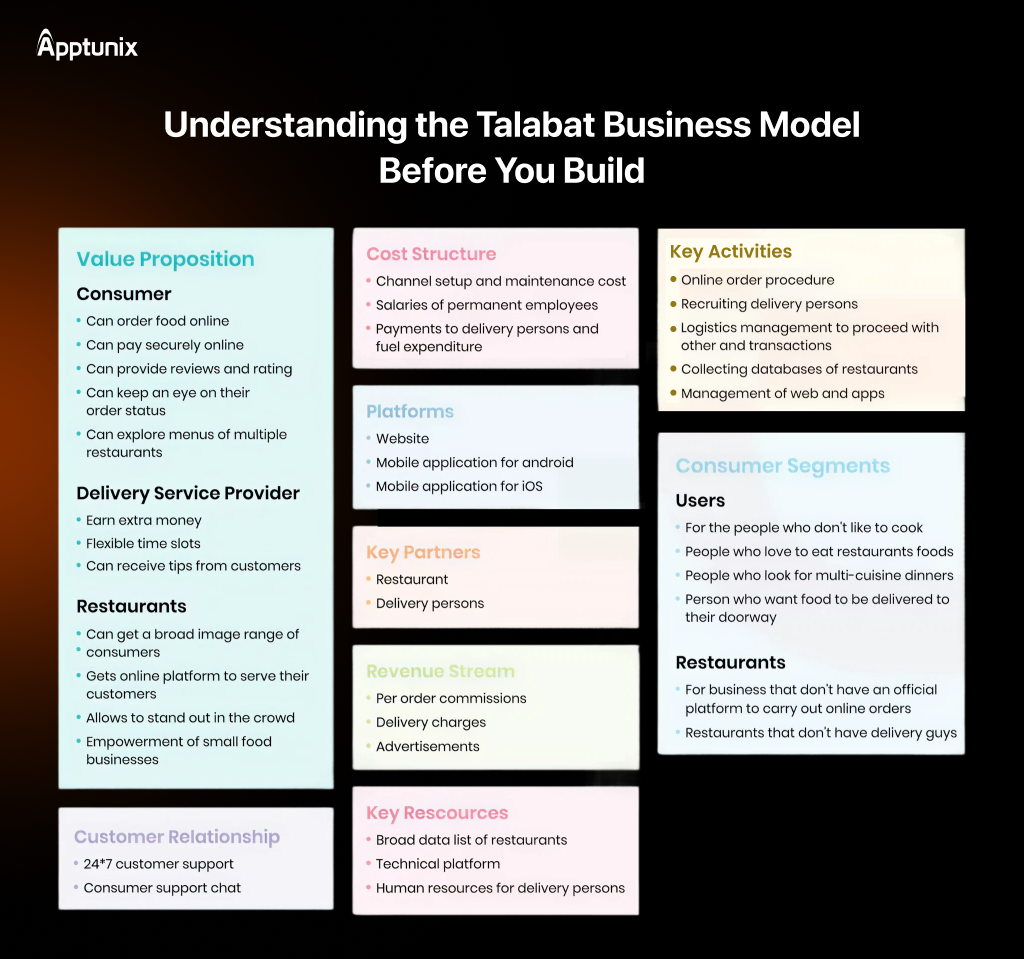
If you plan to make an app like Talabat, start by understanding what made the Talabat business model work. Talabat is a multi-sided marketplace that balances customer experience, merchant growth, and delivery logistics. When founders overlook that balance, the product becomes expensive to run and hard to scale. The smart move is to learn how the engine works before trying to replicate the dashboard.
Talabat brings three sides of the market together:
This balance is the foundation of every successful food delivery marketplace platform.
How Talabat Makes Money
The UAE food delivery market is not “getting crowded.” It’s maturing and widening. More users, more transactions, more categories.
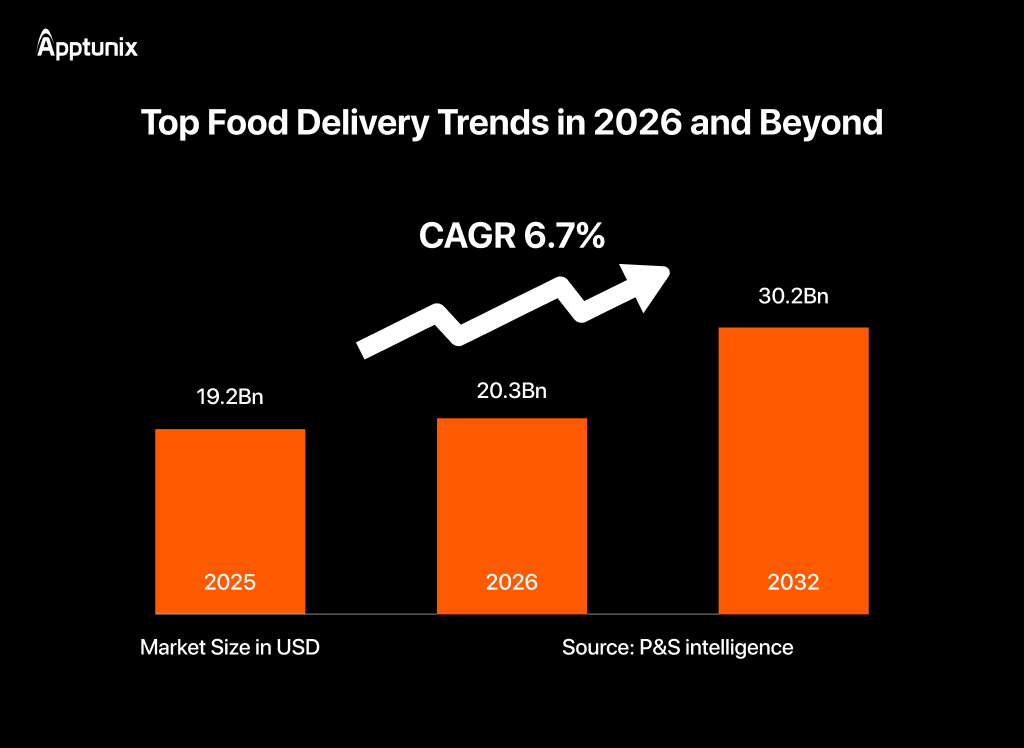
A recent Statista forecast shows the online food delivery market in the UAE reaching USD 2.7B by 2028, driven by rising disposable income, the expat community, and the region’s “convenience first” mindset. Meanwhile, Saudi Arabia is pushing toward 85% smartphone penetration by 2026, opening up significant room for digital ordering across Riyadh, Jeddah, and Dammam.
So if you’re planning to explore Talabat clone app development, you’re entering one of the strongest consumer internet categories in the region. The market is already educated. What they want now is better relevancy, faster ETAs, transparent pricing, personalised menus, and loyalty that actually feels rewarding.

1. Intuitive Food BrowsingPeople decide in seconds. Clean menus, cuisine filters, delivery time indicators, and ratings help users land on the right meal fast — which drives repeat orders and lowers drop-offs.
2. Intelligent SearchWhen users type shawarma JLT, veg biryani, or late-night meals, your system should fetch relevant results instantly. Smart search is a core user expectation when you choose a food delivery app solution.
3. Live Menu & Stock UpdatesNothing kills trust like “Sorry, item unavailable.” Real-time stock and menu controls help restaurants avoid cancellations and keep the customer journey smooth.
4. Smooth Cart & Add-Ons FlowExtra cheese, double sauce, large fries — upsells should be one-tap and frictionless. Good cart UX helps increase AOV without annoying users.
5. Flexible PaymentsUAE users demand options: card, Apple Pay, COD, wallet, BNPL, and loyalty credits. The wider your checkout flexibility, the faster you scale.
6. Clear Pricing & Delivery TermsShow delivery fee, surge, VAT, packaging fee, and estimated time upfront. Transparency builds trust, especially when entering a competitive market like Talabat.
7. Live GPS Order TrackingReal-time driver tracking keeps users reassured. This isn’t a luxury feature anymore — if you build an app like Talabat, tracking accuracy matters as much as speed.
8. One-Tap ReorderFood habits repeat. Make reordering previous favorites instant to fuel daily retention and convenience.
9. Deals, Cashback & LoyaltyUsers return where they feel rewarded. Offer wallet cashback, points, exclusive partner deals, and subscription perks instead of random discounts.
10. Restaurant Management PanelVendors should update menus, adjust timings, manage availability, and place orders independently. Restaurant freedom = marketplace stability.
Quick Insight: Everyone talks UI. The real moat is:
Know the model first. Then build the product.
That discipline saves money and accelerates scaling!
If you want to make a food delivery app like Talabat and scale across UAE cities, your tech stack can’t be guesswork. A food delivery app looks simple on the surface, but under the hood, it’s a live logistics engine, a payments platform, and a real-time communications system all working together. Get the foundation right and your operations hum. Miss it and you’ll spend the first year firefighting.
A. Front-end: native or hybrid — Pick with purposeUsers open the app dozens of times a week. Performance and snappiness matter more than clever UI tricks. Native development (Swift for iOS, Kotlin for Android) gives you the best performance and fewer surprises as you scale into groceries, pharmacy, and dark stores. Hybrid frameworks like Flutter or React Native speed up initial development and cut costs for an MVP, but expect trade-offs later. If your roadmap includes expanding your marketplace platform, pick a front-end path that minimizes future rewrites.
B. Backend architecture: Build an operational engine, not a monolithThe backbone of any serious food delivery app development in UAE is a modular backend. Use microservices or a well-structured modular monolith so order processing, payments, rider allocation, and notifications can scale independently. REST or GraphQL APIs should be clean and documented. Use PostgreSQL or MongoDB for persistent data, Redis for fast caches, and a message queue like Kafka or RabbitMQ to handle bursts during peak hours.
C. Real-time tracking and routing: Trust is built on accurate ETAsReal-time tracking is the single most significant trust signal for users. Integrate a reliable maps SDK (Google Maps or Mapbox), a traffic-aware routing layer, and an ETA engine that factors kitchen prep time and rider speed. Event-driven updates (order accepted, food ready, rider assigned, rider nearby) should flow through WebSockets or socket-based services so the UI updates without lag. In short: let the map tell the truth.
D. Payments and wallet: Turn checkout into an advantagePayments are both a technical and a business challenge. Support cards, wallets, Apple Pay / Google Pay, COD where needed, and BNPL for higher-ticket orders. Integrate PCI-compliant processors such as Stripe, Checkout.com, or PayTabs, with tokenization and fraud checks. Build an in-app wallet and loyalty credit system to increase LTV. Keep settlement and reconciliation transparent so restaurants trust your platform, and your Talabat clone app development cost assumptions in the UAE remain realistic.
E. Restaurant partner systems: Give vendors control and clarityIf you plan to build a food delivery marketplace platform, restaurants must be able to manage menus, set prep times, pause availability, and view payout reports without calling support. A straightforward vendor dashboard reduces errors and speeds onboarding. Analytics for top dishes, peak hours, and order failure reasons help restaurants improve and lower your operational load.
F. Rider app and logistics intelligence: The delivery brainDelivery operations break or make your product. The rider app needs instant assignment, turn-by-turn navigation, earnings tracking, and simple status flows. On the backend, implement batching logic, dynamic assignment rules, and heat maps for demand prediction. Combine incentives and real-time performance data to keep riders engaged and delivery times predictable.
G. Security and compliance: Non-negotiable in UAE marketsProtect card data and personal info with encryption, role-based access, device binding for rider apps, and regular audits. Ensure your platform complies with UAE data residency or payment rules where applicable. Security protects your customers, restaurants, and business valuation.
H. Admin and analytics: The growth cockpitYour admin dashboard should let you manage cities, commissions, promos, support SLAs, and fleet health. Surface the metrics that matter: order success rate, average delivery time, repeat rate, CAC, and GMV. That intelligence lets you iterate faster and scale the business reliably. Release in small increments, test heavy flows (peak orders, failed payments, mass refunds), and maintain runbooks for common incidents. Repeatable processes keep launches smooth and protect the reputation.
Anyone planning to build an app like Talabat eventually hits the same two questions: How much does it cost? How long will it take?
Here’s the straight answer — it depends on how big you want to go.
Launching a food delivery platform is not just “an app.” You’re building a real-time logistics engine, payment ecosystem, partner marketplace, rider fleet management system, and customer-grade UI all in one. So, your budget shifts based on where you want to start and how fast you want to scale across the UAE.
Goal: Prove demand in one area before scaling across UAE.
This stage focuses on core delivery flow:
Think of this as your launch + learn phase. Many founders prefer a Talabat clone MVP here — not because they want to “copy,” but because it saves build time and reduces cost while validating market fit.
Why it works:
Fast launch. Lower burn. Real traction data before scaling.
Once orders start rolling and onboarding restaurants becomes consistent, you expand features:
This is where the business turns from idea → operations machine.
Goal: Retain customers, empower restaurants, streamline rider performance.
This is where you compete with players like Talabat, Deliveroo, and Zomato.
At this level, budgets can exceed AED 1.5M when scaling across the GCC with deep data engineering.
Check Out The Complete PDF on Food Delivery App Development Cost Guide
Building a food delivery marketplace platform sounds exciting until reality hits: logistics, regulations, user expectations, and restaurant alignment. The Talabat business model works in the UAE because it blends technology and local operations discipline. Anyone aiming to build an app like Talabat has to prepare for the same ground truth.
Let’s break down the most common hurdles and how smart founders handle them.
1. Delivery and logistics frictionThis is where startups struggle most. Riders get delayed, traffic piles up around city hotspots, orders spike at meal times, and suddenly user ratings fall.
Solution: Start with a focused delivery zone, build a rider performance model early, and use route optimization technology from day one. Talabat-like app development succeeds when logistics becomes predictable, not lucky.
2. Restaurant partner reliabilityA food delivery app business model is only as strong as its vendors. Late prep times, inconsistent menu updates, and slow order response times can ruin the customer experience.
Solution: Offer onboarding support, provide a clean vendor dashboard, and track prep-time accuracy. When vendors win, the platform grows.
3. Regulatory and licensing in UAEUAE food delivery regulations are strict for a reason. You need proper trade licenses, data compliance, VAT knowledge, and delivery partner agreements.
Solution: Consult a UAE-based business setup expert and complete compliance before thinking about marketing. Nothing stalls growth faster than legal restraints.
4. Meeting high customer expectationsThe UAE user base is tech-savvy and impatient. They expect fast delivery, transparent pricing, and real support. If you skip quality control to save time, users leave.
Solution: Prioritize customer support from day one. Build refund rules, assign escalation managers, and monitor delivery outcomes obsessively.
5. Balancing burn rate and monetisationAggressive discounts attract users but destroy margin. Smart founders test revenue streams early: commissions, delivery fees, subscriptions, and promotions.
Solution: Build a scalable monetization plan. Talabat clone app development only pays off when retention matches acquisition.
Bonus Read- How to Build a Food Delivery App Like Keeta?
Great food delivery platforms are engineered, not improvised. Let’s break down a real project we built in this category. A growing marketplace brand wanted to build an on-demand food delivery app like Talabat that could support multi-vendor ordering, real-time delivery tracking, digital payments, driver assignments, and loyalty features. They wanted fast rollout but also long-term scalability. Their business needed a platform that would later evolve into grocery and convenience delivery.
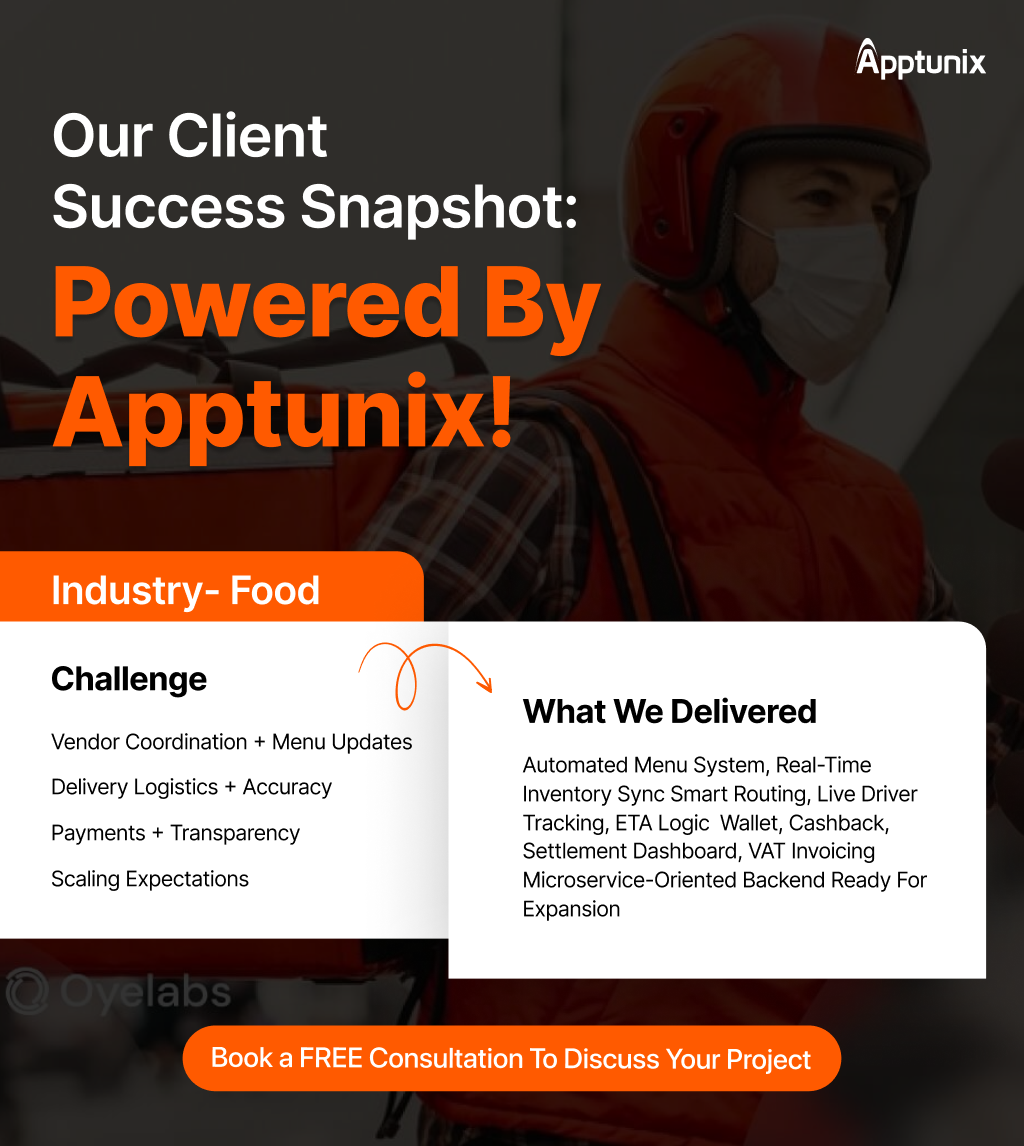
And here is the part clients care about most: The launch wasn’t the finish line. It was the starting point.
The platform evolved with user data, scaling smoothly and improving as adoption grew. No outages. When you partner with us to build an app like Talabat, you’re not just getting features. You’re getting a delivery ecosystem engineered to perform, grow, and compete in a crowded food delivery market.
We build products that work on launch day and get stronger every week. If that’s the kind of food delivery startup you’re planning to build, we should talk.
When founders talk to us about building an app like Talabat, they’re not just buying development hours. They want a team that understands logistics, marketplaces, vendor ops, rider allocation algorithms, payment flows, and UAE compliance. They want a build plan, clarity on monetisation, and a tech stack that can scale without firefighting.
Wondering how to build Talabat clone app step by step? 👉 Talabat clone script
But if your goal is to build a successful business that performs like Talabat, earns user trust, and inspires investor confidence, you need a team that builds operationally strong platforms, not just clickable screens. That’s where we fit perfectly.
How We Build High-Performance Food Delivery Platforms-
We have shipped multi-vendor delivery solutions for food, groceries, pharmacy, cloud kitchens, and hyperlocal delivery across the GCC, India, and the US. These platforms handle thousands of users, real-time geo-routing, rider fleet coordination, vendor onboarding, automated restaurant payouts, and order prediction logic. In short, we don’t study the Talabat business model — we’ve engineered similar ecosystems end-to-end.
With Apptunix, you get senior product strategists, backend and mobile engineers, UI designers, QA automation experts, DevOps, and dedicated support. Our dedicated development team has deep experience with UAE-preferred payment gateways, VAT compliance, bilingual UX, fleet optimisation, and marketplace revenue models. You don’t gamble with experiments; you work with a team that has already solved these challenges and can move you from MVP to scale with confidence.
The market still has room for new players. People eat every day. Convenience habits continue to grow. Local flavors, niche categories, quick-commerce and last-mile innovation are still evolving in the UAE.
So yes, building an app like Talabat is a smart move, but only when you treat it as a real business, not a side project.
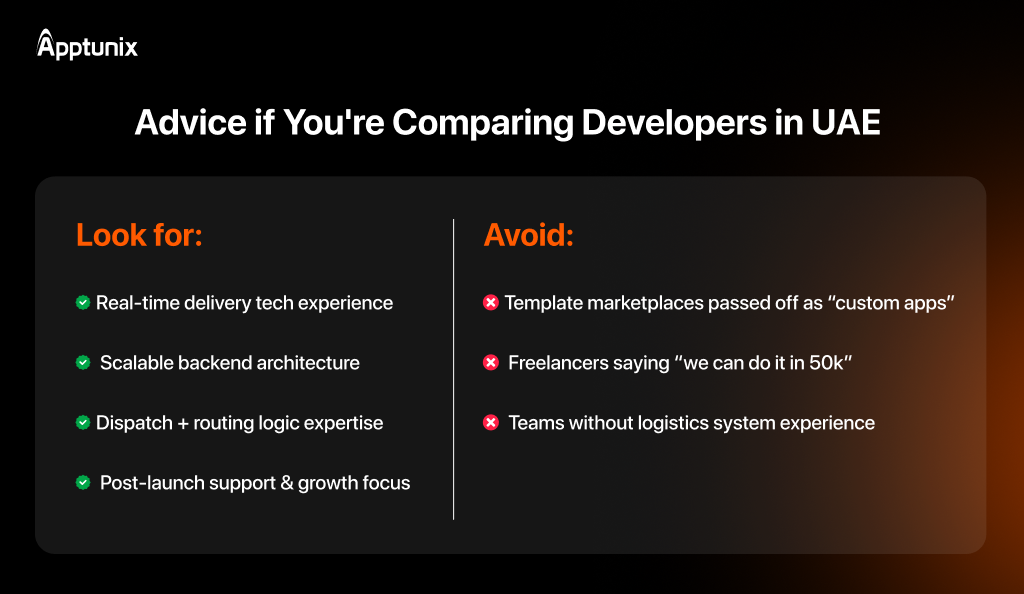
If you’re serious about entering this market, generic scripts and low-cost freelancers won’t cut it. You are building live logistics, money movement, order accuracy, and a trust-driven consumer brand. That deserves proper engineering and a seasoned partner.
Apptunix will help you plan, build, launch and grow the platform the right way.
We help founders plan, architect, launch, and scale food delivery platforms the right way. We bring cross-market experience, supply-chain logic, and product depth so you don’t have to figure everything out alone. You focus on market strategy. We build the engine that runs it.

Q 1.What do you need to create a Talabat-type food app?
To create a Talabat-style platform, you need more than a customer app. You need a structured build an app like Talabat roadmap, merchant dashboards, rider apps, payment integrations for UAE, real-time delivery tracking, and admin controls. Strong logistics logic, optimized delivery zones, and reliable ops workflows are essential to scale fast.
Q 2.How much does Talabat-like app development cost?
The Talabat clone app development cost UAE varies based on scope. Startup MVPs typically range from AED 50,000 to 250,000. Cost depends on features, tech stack, team experience, and expansion plans.
Q 3.How to develop a food delivery app like Talabat?
To make an app like Talabat, start by mapping the Talabat business model, choosing your first delivery zones, onboarding restaurants early, planning logistics workflows, and build a modular architecture. Follow structured Talabat-style app development steps including product strategy, UI, backend logistics engine, rider system, and phased rollout.
Q 4.What tech stack is best for real-time delivery apps?
A proven stack includes Swift and Kotlin (or Flutter), Node.js or Python backend, PostgreSQL or MongoDB, Redis for caching, Kafka queues, and cloud hosting with monitoring tools. This stack handles real-time delivery, load spikes, and growth across cities.
Q 5.Can I launch with MVP first?
A focused MVP takes around 12–20 weeks.
A feature-rich, multi-city rollout takes 6–10 months.
Timeline depends on customization, integrations, and operational readiness.
Q 6.How much does it cost to build an app like Talabat with Apptunix?
Costs follow structured packages: MVP launch, mid-market expansion, or full enterprise build. Pricing depends on feature depth, fleet model, delivery automation level, and scalability requirements. We give transparent estimates after understanding your market and scope.
Q 7.How long will it take to build?
A focused MVP takes around 12–20 weeks.
A feature-rich, multi-city rollout takes 6–10 months.
Timeline depends on customization, integrations, and operations readiness.
Q 8.What features are must-haves for a food delivery app in the UAE?
Core must-haves include real-time tracking, fast checkout, Apple Pay & card payments, multi-language support (Arabic/English), heat-zone delivery logic, restaurant dashboards, rider app, and VAT-ready invoice system. Without these, you won’t compete in UAE markets.
Q 9.How do I retain customers in a competitive market?
Consistent delivery speed, accurate ETAs, strong restaurant mix, loyalty rewards, and smooth refunds make a huge difference.
Q 10.Why choose Apptunix to build a Talabat-style platform?
We’ve built high-volume delivery platforms across GCC and North America with real logistics intelligence, multi-vendor automation, and UAE-ready payment flows.
Q 11.Have you built apps like Talabat before?
Yes. We have built food delivery, hyperlocal delivery, cloud-kitchen platforms, and q-commerce solutions for startups and enterprise brands.
Q 12.Do you offer post-launch support?
Yes. We provide maintenance, performance monitoring, feature upgrades, and growth support.
Q 13.Will I own the source code?
Yes. With Apptunix, you get ownership of the source code and IP rights. We guide onboarding workflows, restaurant dashboards, menu management, payouts, and the setup of restaurant partner support.
(1 ratings, average: 1.00 out of 5)
Get the weekly updates on the newest brand stories, business models and technology right in your inbox.
22 Views 11 min June 4, 2026
17 Views 11 min June 1, 2026
43 Views 11 min May 27, 2026
Book your consultation with us.
Book your consultation with us.


One Central, The offices 3, Level 3, DWTC, Sheikh Zayed Road, Dubai
+971 50 782 1690