Cost to Build an App Like Eventbrite: Complete Development & Pricing Guide (2026)
20 Views 15 min September 16, 2026

Gaurav Singh is the Lead of Growth & Marketing at Apptunix, where he focuses on scaling digital products through data-led marketing strategies and growth hacking. Gaurav excels at app store optimization, AI- powered SEO, user acquisition, market penetration, and lifecycle marketing. He bridges the gap between product development and market traction, helping brands maximize their ROI and expand their digital footprint. His strategic approach ensures that every product not only enters the market but dominates it through sustainable growth models.

Let’s talk facts: One industry that is not only high in demand but also offers a profitable opportunity: its eCommerce market. And if you’re new to this and looking for the right inspiration, it could be no other than the Temu shopping app.
But why Temu and not Amazon?
Well, it’s because Amazon is a huge giant, in order to beat that: you need more than just a clone app. However, you surely can step into ecommerce landscape by building shopping app like Temu.
And even if we talk about Temu, it has rapidly gained global traffic often exceeding 700 million to over 1 billion visits. Moreover, Temu again named to USA TODAY’s 2026 America’s Best Customer Service List for Second Consecutive Year.
Now if you’re planning to build app like Temu– You’re in the right place. In today’s guide, we will cover the process of Temu-like app development, tech stack, features, associated costs, and other factors.
Following, we’ve listed a step-by-step guide to building a shopping app like Temu. Let’s learn:
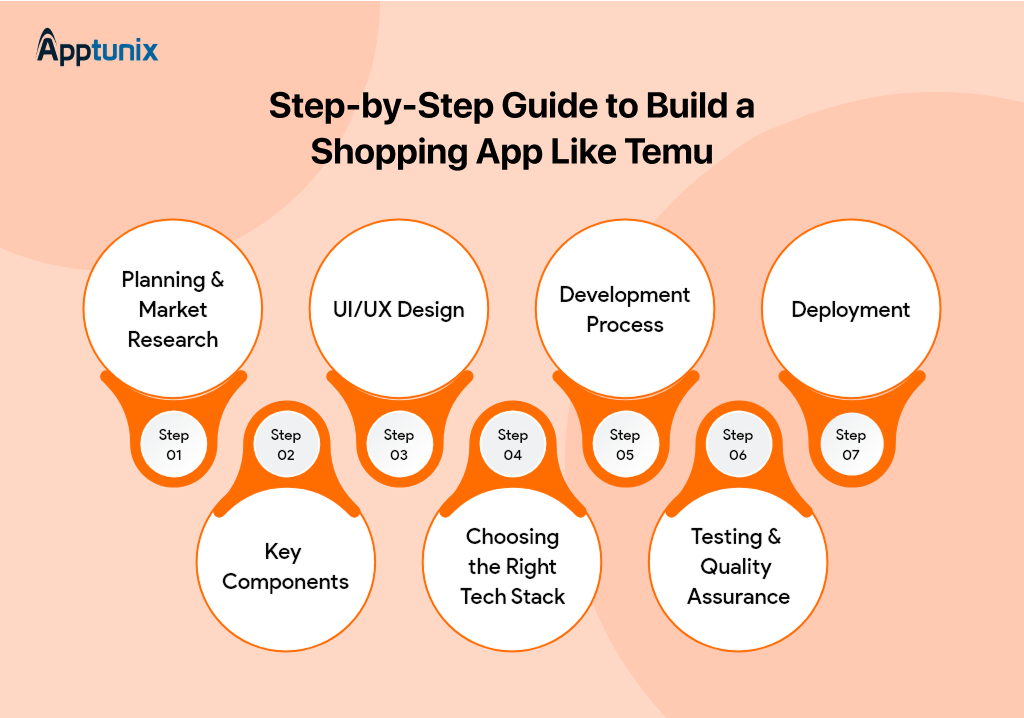
Step 1: Planning & Market ResearchThe first and most critical step in eCommerce app development is strategic planning paired with in-depth market research. Define the purpose, goals, and vision of your online shopping app. Identify the problems your app solves and the value it offers to users.
Conduct a thorough competitive analysis to understand the strengths and weaknesses of leading apps like Temu, Shein, and Amazon. Analyze your target audience’s shopping behavior, preferences, and pain points.
Key actions:
Identify your target audience segments (budget buyers, luxury shoppers, niche categories).
Research trending product categories.
Analyze competitors’ features, tech stacks, and user reviews.
Step 2: Key ComponentsBefore jumping into Temu like app development, outline the core components of your shopping app. These elements will serve as the foundation of your product.
Core components include:
Domain Name: Choose a short, memorable, and brand-relevant domain for your eCommerce store.
Shopping Cart System: Select a reliable shopping cart that supports multiple products, variations, and payment methods.
Payment Gateway Integration: Integrate popular gateways like PayPal, Stripe, or Razorpay to handle secure transactions efficiently.
Inventory Management: Include tools to track stock levels, restocks, and sales performance.
Step 3: UI/UX DesignDesign plays a key role in the success of any mobile eCommerce app. A seamless, visually appealing UI/UX enhances customer experience and increases conversion rates.
Key design tips:
Use consistent branding (color, fonts, tone).
Implement easy navigation with categorized menus and a sticky search bar.
Showcase high-quality product images with zoom and multiple angles.
Integrate user reviews, trust badges, and social proof to increase credibility.
Prioritize mobile-first responsive design and fast loading speeds.
Step 4: Choosing the Right Tech StackThe most crucial step in the development of eCommerce app like Temu is choosing the right tech stack. Select the right technologies and frameworks for developing your app based on scalability, performance, and compatibility requirements.
Selecting the right tech stack is crucial for app performance, scalability, and future growth.
Recommended technologies:
Frontend: Flutter, React Native (for cross-platform mobile development)
Backend: Node.js, Laravel, Django (for logic, authentication, APIs)
Database: MongoDB, PostgreSQL, MySQL
Cloud & Hosting: AWS, Google Cloud, Firebase
Push Notifications & Analytics: Firebase, OneSignal, Mixpanel
Choose based on your team’s expertise, app complexity, and the need for future updates or scaling.
Step 5: Development ProcessHere, developers integrate all the features and functionality with other components while working on the front-end and back-end code.
The development of the shopping app like Temu depends on various elements, including complexity, functionality, and design. Also, the development phase can take longer depending on the project’s complexity.
This is where eCommerce app developers bring the app to life. The front-end and back-end systems are built, and all features are integrated.
Key focus areas:
User registration/login
Product catalog and filters
Real-time inventory updates
Order management system
Secure checkout and payment processing
Note:
You can opt for an MVP (Minimum Viable Product) to develop your shopping app with basic features. You can opt for this option if you want to create a shopping app on a low budget.
Once you have tested your app in the market and get a clear idea about trends, audience, and market – you can go for a fully-developed shopping app with advanced features. You can secure funding from investors and establish a strong market presence.
Step 6: Testing & Quality AssuranceBefore launching your Temu like marketplace app, conduct extensive testing to ensure performance, usability, and security.
Types of testing:
Functional testing: Ensures each feature works as expected.
Usability testing: Measures ease of use and user satisfaction.
Security testing: Verifies that transactions and user data are protected.
Compatibility testing: Checks how the app performs across devices and OS versions.
Bug fixes and optimizations based on testing feedback are critical for a smooth user experience.
Step 7: DeploymentOnce testing is complete, you’re ready to launch your shopping app like Temu on the Google Play Store and Apple App Store.
Important steps before deployment:
Ensure your app complies with the platform’s policies.
Prepare App Store/Play Store assets (screenshots, descriptions, keywords).
Use ASO (App Store Optimization) to boost visibility.
Plan a go-to-market strategy—leverage social media, influencers, and paid ads to drive installs.
After launching your eCommerce app, continuously track KPIs like downloads, retention rate, user feedback, and sales to make ongoing improvements.
Incorporating essential features in your shopping mobile app like Temu, is crucial if you want to make it a success. Here’s a list of core features that you should consider:

1. Registration and LoginThe onboarding process sets the tone for your eCommerce app. A quick, secure, and frictionless registration and login system ensures users don’t abandon your app early. Key elements include:
Multiple login options (email, phone number, or social media login).
Two-factor authentication for enhanced security.
Profile setup where users can save shipping addresses, payment details, and preferences.
Guest checkout option to reduce friction.
A smooth onboarding flow not only improves user experience (UX) but also boosts conversion rates by making it easy for customers to start shopping.
2. Product ListingThe product listing is the heart of a shopping app. In case of apps like Temu, millions of products are displayed daily, so listings must be clean, structured, and engaging. Essential features include:
High-quality product thumbnails and multiple-angle images.
Comprehensive product descriptions with specifications, materials, and usage.
Filters and sorting options (price, ratings, category, latest arrivals).
Responsive UI/UX design for both iOS and Android devices.
Infinite scroll or pagination for smooth browsing.
Prominent Call-to-Action (CTA) like “Buy Now” or “Add to Cart.”
Breadcrumb navigation to prevent confusion in large catalogs.
A clutter-free and intuitive product listing improves customer retention and ensures buyers find products quickly, leading to higher sales conversions.
3. Shopping CartA smart shopping cart is a must for any eCommerce app development solution. It helps users save selected products in one place, review their selections, and proceed with purchases without hassle. Key features include:
Add/remove items easily.
Save products for later.
Auto-update pricing (with discounts, offers, or shipping costs).
Multi-device synchronization (so cart items are not lost when switching devices).
In a shopping app like Temu, the cart also acts as a cross-selling and upselling tool, suggesting related products, which increases the average order value (AOV).
4. Payment Gateway IntegrationSecure and diverse payment options are critical for winning customer trust. Payment gateway integration must ensure frictionless checkout and support multiple payment modes:
Credit/Debit cards, UPI, and net banking.
Digital wallets like PayPal, Apple Pay, and Google Pay.
Third-party processors such as Stripe, Braintree, and Razorpay.
“Buy Now, Pay Later” (BNPL) or installment options.
In Temu clone app development, smooth checkout experiences with multiple payment gateways not only boost customer satisfaction but also reduce cart abandonment rates.
5. Order ManagementA robust order management system (OMS) ensures end-to-end tracking for both sellers and buyers. Essential components include:
Real-time inventory tracking.
Automated order confirmation and status updates.
Packaging and shipping management.
Delivery tracking with GPS integration.
Post-purchase notifications and follow-ups.
With a strong OMS, businesses can streamline logistics, reduce delivery delays, and enhance customer satisfaction and brand loyalty.
6. Personalized RecommendationPersonalization is a game-changer in eCommerce app development. By analyzing customer behavior, browsing history, and purchase patterns, AI-powered recommendations can:
Suggest products most relevant to the user.
Enhance cross-selling and upselling opportunities.
Improve customer engagement by making shopping feel tailored.
In a shopping app like Temu, personalization is one of the strongest revenue drivers, boosting conversion rates and driving repeat purchases.
7. Push Notifications“Your order is out for delivery” – Such push notifications allow customers to keep track of their orders. Integrating push notification features lets customers get all the updates on their orders or new sales.
Push notifications are crucial for keeping customers engaged. These real-time alerts can cover:
Order updates (“Your order is shipped”).
Exclusive deals and flash sales.
Personalized promotions and abandoned cart reminders.
In mobile eCommerce apps, push notifications increase user retention by up to 88% when used strategically, making them one of the most effective engagement tools.
8. Analytics and ReportingAnalytics and reporting dashboards provide merchants and business owners with actionable insights. Features include:
Sales reports and revenue breakdowns.
Inventory performance tracking.
Customer behavior analytics (search terms, clicks, abandoned carts).
Conversion funnel insights to identify drop-off points.
These insights allow businesses to refine their marketing strategies, optimize product listings, and reduce operational costs, making analytics indispensable in AI based eCommerce app development.
9. Customer ServiceExceptional customer service features can set your shopping app apart. Users must have multiple support options such as:
Live chat support for instant query resolution.
AI chatbots for 24/7 assistance.
Support tickets and email helpdesk.
FAQ sections and self-help knowledge base.
Integration with social media customer support channels.
Providing quick and efficient customer support builds trust and long-term brand loyalty, ensuring users choose your app over competitors.
The cost to build app like Temu largely depends on several factors, including the app’s features, technology stack, platform choice (iOS, Android, or cross-platform), and overall app complexity. For a basic eCommerce app, the estimated cost can range from $15,000–$50,000.
However, if you’re aiming to integrate advanced features such as AI-powered analytics, biometric authentication, real-time fraud detection, or blockchain integration, costs can reach $300,000 or more.
It’s also important to understand that app development is only a part of the total investment. Long-term success requires additional budget for customer support, user acquisition, regulatory compliance, and ongoing app maintenance and updates. These elements are crucial to ensure the app remains secure, scalable, and aligned with the evolving FinTech landscape—especially in competitive markets like the UAE, USA, and the Middle East.
Check the comparison cost table for shopping app development based on the eCommerce project’s complexity below:
| Feature | Basic App | Mid-Level App | Advanced App |
|---|---|---|---|
| Estimated Cost | $15K – $50K | $50K – $80K | $80K – $300K |
| User Registration & Login | Basic | Email + Social Login | OTP + Biometrics |
| Product Listings & Filters | Basic Listing | With Category Filters | Smart Filters + Sorting |
| Cart & Checkout | One-Step Checkout | With Promo Codes | Multi-step, Saved Cards |
| Payment Integration | Basic (1–2 gateways) | Multiple Gateways | Multi-currency Support |
| Order Tracking | Basic Status Update | Progress Bar | Real-time Tracking |
| AI Recommendations | – | Basic (Trending) | Smart Suggestions |
| Customer Support | Email Only | Email + FAQ | In-App Chat |
| Loyalty & Referral | – | Referral Only | Points & Rewards |
| Admin Panel | Basic Controls | Analytics & Product Mgmt | Multi-role Access |
Building an online shopping app like Temu involves several variables that directly affect development cost, timeline, and overall functionality. Here are the most critical factors to consider:
1. App Complexity & FeaturesThe number and type of features you want to include will heavily impact the cost and timeline.
Basic features: Registration, product listing, cart, payment integration.
Advanced features: AI-powered recommendations, push notifications, order tracking, loyalty programs, multi-vendor support.
High-end features: AR-based try-ons, voice search, real-time analytics, AI-driven personalization.
The more complex your app, the higher the Temu clone app development cost.
2. Platform Choice (Android, iOS, or Both)Developing a Temu-like app for a single platform is cheaper than building for both. If you want wider reach, you’ll need cross-platform development (React Native, Flutter), which saves cost compared to building two separate native apps.
3. UI/UX DesignAn eCommerce app’s success depends on intuitive navigation, modern layouts, and responsive design. A user-friendly design with smooth checkout, filters, and personalized suggestions requires more effort and thus increases development cost.
4. Technology StackChoosing the right tech stack (frameworks, databases, backend, APIs, and payment gateways) determines the app’s performance and scalability. For example:
Frontend: React Native, Flutter
Backend: Node.js, Python, Java
Database: MySQL, MongoDB, Firebase
More advanced tech stacks may increase shopping application development costs but ensure better security and scalability.
5. Third-Party IntegrationsIntegrating external tools like payment gateways, push notification services, maps, CRM, and analytics tools can add to the cost. Each third-party integration has licensing or usage fees, which must be factored into your budget.
6. Development Team Location & ExpertiseThe hourly rates of developers vary across regions:
USA/Canada: $80 – $150/hour
Europe: $50 – $100/hour
India/Asia: $25 – $50/hour
Hiring an experienced eCommerce app development company with domain expertise ensures faster delivery but may increase initial investment.
7. Security & ComplianceA Temu-like app deals with user data, payment info, and transactions. Implementing robust data encryption, GDPR compliance, and fraud prevention features will add complexity and increase cost.
8. Scalability & Performance OptimizationIf you want your app to handle millions of users and transactions (like Temu), you must invest in cloud infrastructure, load balancing, and caching mechanisms. Scalability requirements significantly impact the overall development budget.
9. Testing & Quality AssuranceA high-performing shopping app like Temu requires extensive manual and automated testing for functionality, security, performance, and user experience. QA adds to both timeline and cost but ensures bug-free app deployment.
10. Post-Launch Maintenance & UpdatesDevelopment doesn’t stop at launch. Regular bug fixes, security patches, feature upgrades, and UI improvements are ongoing costs that impact the overall budget of a Temu clone app.
Following, we’ve listed monetization techniques for an eCommerce app like Temu:
Developing a shopping app like Temu is not just about offering a smooth shopping experience—it’s about building a profitable business model. Here are the most effective ways to generate revenue from a Temu-like marketplace app:
1. Commission on SalesThe most common revenue stream for marketplace apps like Temu is charging sellers a commission on every transaction.
Sellers list their products on your app.
You earn a percentage (e.g., 5–20%) of each successful sale.
The more vendors you onboard, the higher your revenue.
Example: Temu’s cross-border eCommerce model relies on seller commissions to sustain its low-price ecosystem.
2. Subscription & Membership PlansOffer premium subscriptions for both sellers and buyers.
Sellers can pay monthly or yearly fees to access advanced features like priority product placement, analytics, or lower commission rates.
Buyers can subscribe for perks like free shipping, exclusive discounts, or early access to sales.
Example: Amazon Prime generates massive recurring revenue through its subscription model.
3. Featured Listings & AdvertisementsVendors can pay to have their products listed at the top of search results or homepages.
Sponsored ads and featured product placements boost seller visibility.
This model works well for highly competitive categories like fashion, electronics, or home goods.
Example: Just like Etsy and eBay, Temu could benefit from in-app advertising revenue.
4. In-App Advertising (Third-Party Ads)Apart from seller promotions, you can also integrate third-party ad networks like Google Ads or Facebook Ads.
Display ads, banners, or video ads to users.
Earn revenue based on impressions (CPM) or clicks (CPC).
This is especially effective when your app gains high traffic volumes.
5. Logistics & Fulfillment ServicesIf you manage warehousing, packaging, or shipping for sellers, you can charge them for logistics.
Temu leverages bulk shipping and optimized supply chains to keep costs low while still profiting from logistics management.
Sellers pay you for faster delivery and efficient fulfillment.
6. Transaction Fees & Payment Gateway ChargesCharge a small transaction fee for every order placed through your platform.
Example: Adding a 1%–2% fee on top of seller commissions.
If you integrate your own wallet system, you can earn interest on balances held in-app.
7. Data Monetization & AnalyticsE-commerce apps generate tons of user behavior data (shopping patterns, browsing history, preferences).
You can provide premium analytics dashboards to sellers.
Businesses can pay to access insights on customer trends, helping them optimize sales strategies.
8. Cross-Selling & Affiliate PartnershipsPromote partner brands or services inside your online shopping app.
Example: Insurance for high-value products, buy-now-pay-later (BNPL) services, or loyalty cards.
Earn commission through affiliate marketing programs.
9. Flash Sales & Gamification RevenueIntroduce limited-time deals, coupons, and gamified shopping experiences.
Charge sellers for participating in flash sales.
Encourage bulk buying by offering discounts funded partially by vendors.
This increases engagement, conversions, and overall revenue.
10. International Expansion & Cross-Border TradeLike Temu, you can expand globally and earn revenue from cross-border logistics, taxes, and international seller onboarding fees.
Offering affordable global shipping attracts more users.
Sellers pay higher fees for reaching overseas customers.
While Temu has quickly become one of the fastest-growing shopping apps, it’s not the only player in the global eCommerce marketplace. Several platforms offer similar (or even better) experiences in terms of pricing, product variety, shipping, and customer service. If you’re exploring apps like Temu, here are 10 strong alternatives worth considering:
1. AmazonThe world’s largest eCommerce marketplace app, Amazon offers everything from electronics to groceries with fast delivery options like Amazon Prime. Unlike Temu, Amazon emphasizes quick shipping, authentic products, and strong customer protection policies.
Best for: Fast delivery and reliable global shopping.
2.SheinKnown as a fashion-first shopping app, Shein specializes in affordable clothing, accessories, and lifestyle items. Similar to Temu, Shein follows a direct-to-consumer model and is extremely popular among Gen Z shoppers.
Best for: Trendy and budget-friendly fashion.
3.AliExpressA cross-border eCommerce app owned by Alibaba, AliExpress connects international buyers with Chinese manufacturers and sellers. Like Temu, it offers low-cost products, but delivery times can sometimes be longer.
Best for: Bargain shopping across multiple categories.
4. WishWish focuses on budget-friendly deals, offering millions of products at discounted prices. It uses a gamified shopping experience, much like Temu, but with a longer delivery timeline.
Best for: Ultra-cheap products and surprise deals.
5.eBayeBay is a global online marketplace where customers can buy both new and second-hand products. It also allows bidding, making it unique compared to Temu’s fixed-price model.
Best for: Auctions and rare product finds.
6.WalmartWalmart’s eCommerce platform competes strongly with Amazon and Temu, offering competitive pricing, groceries, and same-day delivery in many locations.
Best for: Affordable groceries and everyday essentials.
7.ZulilyZulily is a flash-sale shopping app offering limited-time deals on fashion, toys, home goods, and more. Like Temu, it focuses on discount-driven shopping with big savings.
Best for: Limited-time flash deals and discounts.
8.LightInTheBoxA global retail app that sells apparel, gadgets, and lifestyle products directly from manufacturers at low prices. Similar to Temu, it follows a cross-border model with affordable shipping.
Best for: Affordable international shopping.
9.BanggoodBanggood is another Chinese eCommerce platform known for electronics, gadgets, and DIY tools at wholesale prices. It competes with Temu in terms of product variety and global delivery.
Best for: Low-cost gadgets and electronics.
10.EtsyEtsy stands apart from Temu by focusing on handmade, unique, and vintage products. While Temu is about affordability and scale, Etsy appeals to customers looking for personalized or artisanal shopping experiences.
Best for: Unique, creative, and handmade products.
Developing a shopping app like Temu requires strategic planning and the right eCommerce app development company like Apptunix.
We specialize in building customized shopping apps packed with advanced features such as secure payment gateways, AI-driven product recommendations, real-time order tracking, and seamless inventory management. Our expert team focuses on creating scalable backend solutions that can handle growing user bases and high transaction volumes without sacrificing performance. Combined with user-centric, intuitive UX/UI design, our apps ensure an engaging and smooth shopping experience that keeps customers coming back.
Beyond development, we provide ongoing support, regular updates, and feature enhancements to keep your shopping app competitive in the fast-changing market. Plus, we offer expert consultation to guide your growth strategy and help you capitalize on emerging trends. Don’t wait any longer—reach out to Apptunix today, and let’s start turning your Temu like shopping app vision into a thriving reality.
Don’t wait any longer—reach out to us today, and let’s get started with your dream project!

Q 1.How to create a shopping app like Temu?
To create a shopping app like Temu, you must plan thoroughly, design a user-friendly interface, develop essential features like product listings and payment processing, and ensure robust testing before launch.
Q 2.What features do I need in a Temu clone app?
A successful Temu clone app development must include core eCommerce features with advanced functionalities. Essential features include:
User registration & login
Product listing with images, filters, and descriptions
Shopping cart & checkout
Multiple payment gateways (PayPal, Stripe, Apple Pay, etc.)
Order management & real-time tracking
AI-powered product recommendations
Push notifications & flash sales
Seller dashboard & analytics
Ratings & reviews
24/7 customer support (chatbots, live chat, FAQs)
For a competitive edge, you can also add gamification features, referral programs, BNPL (Buy Now, Pay Later), and AR try-on tools.
Q 3.Why is Temu growing so fast?
Temu’s explosive growth is fueled by:
Ultra-low prices due to direct sourcing from manufacturers in China.
Aggressive marketing & influencer campaigns on TikTok, Instagram, and YouTube.
Gamification & referral programs that encourage group buying and social sharing.
AI-powered personalization to boost user engagement.
Global expansion strategy, leveraging cross-border eCommerce and bulk shipping.
Mobile-first shopping experience, catering to Gen Z and millennial shoppers.
Q 4.How much will it cost to develop a shopping app like Temu?
The cost to build a shopping app like Temu can vary. It significantly depends on features, complexity, platform (iOS, Android, or both), and development team rates. A rough estimate could range from $15,000 to $120,000 or more.
Q 5.Best tech stack for building an app like Temu
To build a shopping app like Temu, you need a modern and reliable tech stack:
Frontend (Mobile & Web):
Flutter / React Native (cross-platform)
Swift (iOS), Kotlin (Android)
React.js or Vue.js (web)
Backend:
Node.js, Django, or Ruby on Rails
Python for AI personalization
GraphQL / REST APIs
Database:
PostgreSQL, MongoDB, or MySQL
Redis (for caching)
Payment Gateways:
Stripe, PayPal, Braintree, Apple Pay, Google Pay
Cloud & Hosting:
AWS / Google Cloud / Microsoft Azure
CDN for faster global delivery
AI & Analytics:
TensorFlow / PyTorch for recommendation systems
Google Analytics / Mixpanel for user behavior insights
Logistics Integration:
ShipBob, EasyPost, DHL, or custom APIs
Pro Tip: Combining a mobile-first design, AI-driven recommendations, and aggressive marketing strategies is the real blueprint behind Temu’s success.
Q 6.How long does it take to build a shopping app like Temu?
Well, it really depends on the complexity of your app and the features you want to include. A basic version with core shopping features like product listings, cart, payment gateway, and user login can take around 3 to 4 months to develop.
But if you’re aiming to build something more robust—like Temu—with advanced features such as AI-based recommendations, multi-vendor support, real-time order tracking, loyalty programs, and scalable backend architecture, the timeline can extend to 6 to 9 months or more.
Here’s a general breakdown:
Planning & UI/UX Design – 3 to 4 weeks
Frontend & Backend Development – 8 to 16 weeks
Testing & QA – 2 to 4 weeks
Deployment & Launch – 1 to 2 weeks
Post-launch Support & Optimization – Ongoing
Q 7.How can I build a budget-friendly shopping app?
To create an affordable shopping app, it is necessary to prioritize critical features, use open-source technology, choose cross-platform development, collaborate with an affordable development team, or use app development platforms.
Q 8.Can you build an app similar to Temu?
Yes. We develop end-to-end marketplace apps with features like multi-vendor product listings, inventory management, secure payments, logistics integration, and gamified shopping experiences – customized to your business model.
Q 9.What technology stack do you use to build app like Temu?
We select stack based on scalability — commonly React Native / Flutter (mobile), React/Next.js (web), Node.js / Python / Java / PHP for backend, PostgreSQL/MySQL or MongoDB for database, and AWS / Azure for cloud hosting.
Q 10.Do you also build the seller/vendor side of the platform?
Yes. We deliver:
Seller dashboard (web & mobile optional)
Inventory & pricing management
Order fulfillment module
Analytics & revenue dashboard
Commission and payout management
Q 11.Will the platform support multiple sellers and global marketplaces?
Absolutely. We enable multi-vendor setup, multilingual support, multi-currency pricing, international shipping rules, and tax configuration.
Q 12.Can you integrate logistics and payment gateways?
Yes. We integrate major payment gateways and shipping providers across regions (Stripe, PayPal, Razorpay, PayU, DHL, FedEx, Aramex, etc.) or APIs of your local partners.
Q 13.Can you include reward systems, coupons, loyalty points, and gamified shopping like Temu?
Yes. We support:
Coupons & promotions
Spin-wheel rewards
Referral bonuses
Cashback
Level-based loyalty programs
Daily login rewards
Q 14.Do you offer post-launch support and maintenance?
Yes. We provide maintenance packages for new feature releases, bug fixes, performance monitoring, and server management.
Q 15.Can you help with app store publishing and go-to-market launch?
Yes. We support app store submissions (Google Play & Apple App Store), beta testing, analytics setup, and marketing consultation.
Q 16.What are the alternatives to the Temu app?
Some of the alternatives of the Temu app include Amazon, Shein, eBay, Walmart, and niche-specific apps like Etsy for handmade goods.
(7 ratings, average: 4.43 out of 5)
Get the weekly updates on the newest brand stories, business models and technology right in your inbox.
Gaurav Singh is the Lead of Growth & Marketing at Apptunix, where he focuses on scaling digital products through data-led marketing strategies and growth hacking. Gaurav excels at app store optimization, AI- powered SEO, user acquisition, market penetration, and lifecycle marketing. He bridges the gap between product development and market traction, helping brands maximize their ROI and expand their digital footprint. His strategic approach ensures that every product not only enters the market but dominates it through sustainable growth models.
20 Views 15 min September 16, 2026

10 Views 15 min September 14, 2026

28 Views 15 min September 8, 2026
Book your consultation with us.
Book your consultation with us.


One Central, The offices 3, Level 3, DWTC, Sheikh Zayed Road, Dubai
+971 50 782 1690