How to Build a Travel Platform Like Expedia?
11 Views 12 min July 31, 2026

Reena Bhagat, the CTO and Head of AI at Apptunix, is a seasoned technology strategist with a deep-rooted expertise in emerging technologies. With a focus on AI/ML integration, product engineering, cloud management, she leads the technical vision for high-performance SaaS infrastructures. Reena is recognized for building secure, scalable, and decentralized systems that solve real-world complexities. Her passion lies in leveraging data science and future-tech to create resilient digital products, making her a trusted authority for organizations looking to lead in the age of intelligent automation.

Airbnb stands out as one of the world’s most popular rental booking services. And obviously, for good reasons – it offers flexibility, affordability, and experience of local culture. If you are planning to build an app like Airbnb and want to hit the mark, you must choose the proper steps. The success of Airbnb app has inspired many entrepreneurs to build similar apps; however, it requires strategic planning and execution. And that’s what we’ll cover in today’s guide, where we will thoroughly cover all aspects of Airbnb-like app development, including development steps, features, cost, and more.
Let’s delve in!
The idea behind Airbnb is quite simple – to rent out your properties or spare rooms to travelers for a specified period. The Airbnb app for hosts allows them to generate extra income, while also offering affordable alternatives to standard hotels.
Let’s look at the latest data–
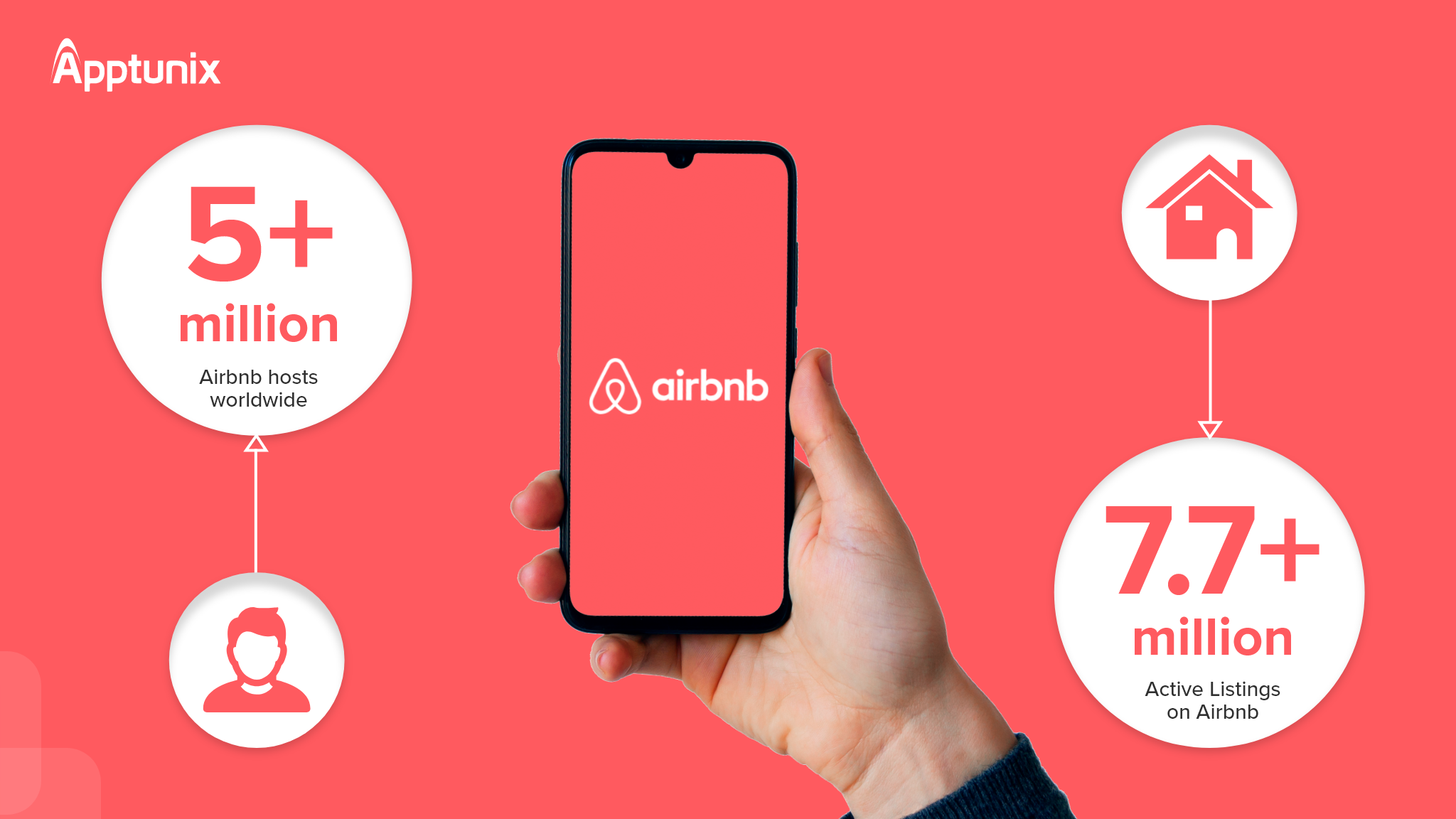
The Airbnb platform facilitates the connection between hosts and guests. It streamlines the process by enabling both parties to communicate, arrange stays, and negotiate terms.
This concept benefits both parties economically and promotes cultural exchange, which builds trust and a sense of community.
The Airbnb business model canvas details key partners, operations, channels, value propositions, resources, and customer relationships. It also outlines Airbnb’s revenue sources and cost structure.
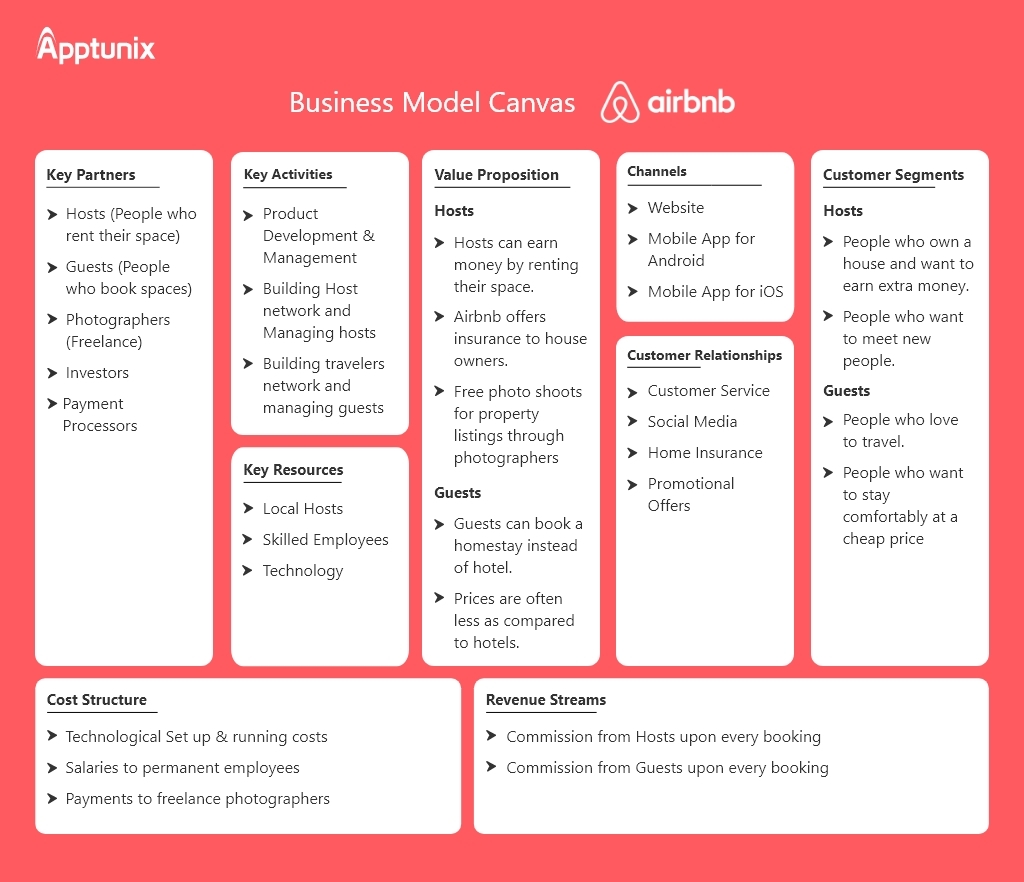
Airbnb allows guests to explore and select suitable rooms on the platform, and provides property owners with free listings. There are two primary revenue streams for the company:
These sources of income allow Airbnb to maintain operations and expand its base while offering value to hosts and visitors.
Investing in holiday rental apps like Airbnb can seem daunting, but we are here to clear up your doubts. We’ve listed three compelling reasons to invest in Airbnb-like app development.
1. Strong Market DemandA recent survey indicates that 64% of Americans intend to rent vacation homes in 2023. When it comes to booking accommodations, the majority of travelers (85%) favor Airbnb.
The travel industry continuously evolves, with many travelers seeking authentic and unique experiences. Tourists prefer affordable stays over expensive hotels.
Holiday rental apps cater to all the demands of tourists and a wide range of accommodation options. Moreover, this diversity attracts travelers looking for personalized experiences and ultimately drives the growth of rented apps like Airbnb.
2. Growth OpportunitiesVacation rental apps like Airbnb have expanded rapidly and attracted users from all over the world. The number of users in this market is also expected to increase to 64.10m users by 2028.
This platform has connected people from diverse locations, facilitating cross-border transactions. Investing in these platforms offers the potential for quick growth and widespread use because of their scalability, which opens access to a substantial market of travelers and property owners.
3. Lucrative ProfitsThe Vacation Rentals market in the United States is projected to generate a revenue of US$19.77bn by 2024.
Holiday rental apps like Airbnb offer lucrative opportunities to generate revenue via various channels. It includes service fees, subscription models, booking fees, etc. Some apps offer premium features for hosts and guests, providing enhanced visibility, tracking, and more.
These platforms are appealing investment options because they can achieve high profit margins through effective cost structures and revenue-sharing mechanisms.
Airbnb has two types of users – Hosts and Guests. To make an app like Airbnb, you must understand how the app works for both these parties.
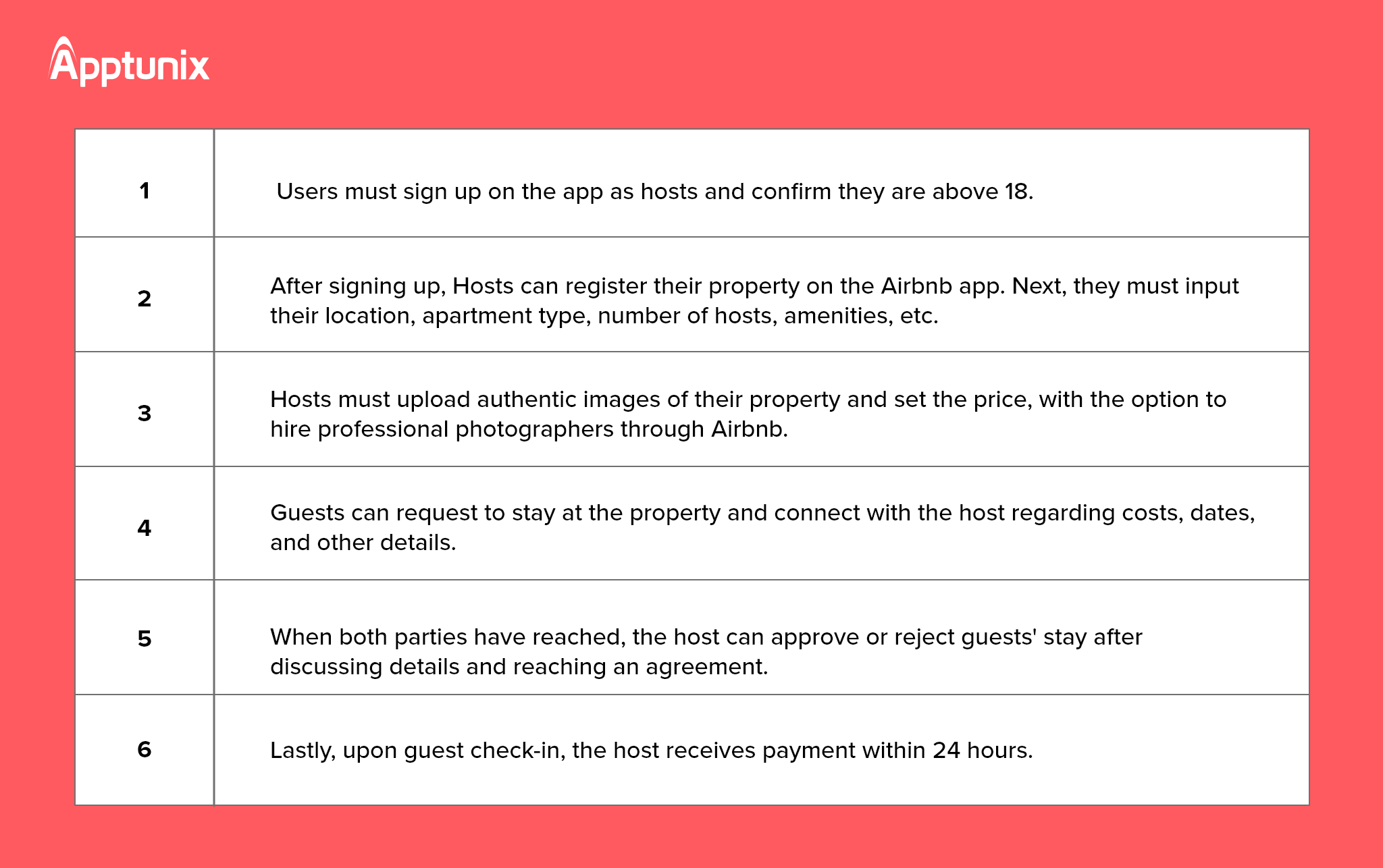
Let’s first understand how Airbnb works for the host segment:
1. Users must sign up on the app as hosts and confirm they are above 18.
2. After signing up, Hosts can register their property on the Airbnb app. Next, they must input their location, apartment type, number of hosts, amenities, etc.
3. Hosts must upload authentic images of their property and set the price, with the option to hire professional photographers through Airbnb.
4. Guests can request to stay at the property and connect with the host regarding costs, dates, and other details.
5. When both parties have reached, the host can approve or reject guests’ stay after discussing details and reaching an agreement.
6. Lastly, upon guest check-in, the host receives payment within 24 hours.
Now, let’s understand how Airbnb works for Guests:
1. Guests must sign up via mobile or web version of the platform.
2. Upon profile creation, guests provide necessary details like name, address, profile picture, and ID number.
3. Guests can search and filter listings based on accommodation type, prices, dates, and other preferences.
4. Once they’ve chosen a place, guests request their stay and await confirmation.
5. Upon receiving confirmation, guests pay for their reservation using various payment methods such as credit cards, debit cards, Google Pay, or Apple Pay.
Read More: Step into the Most Profitable Business: Yacht Rental App Development!
Following, we’ve discussed essential features to incorporate into your Airbnb-like app. Here’s the breakdown in three segments – guest/ users panel, host/property owner panel, and admin panel.
Let’s check:
a) Key Features for User/Guest PanelCheck the listed essential features for the user/guest panel for the Airbnb-like app:
b) Key Features for Host/Property Owner PanelCheck the listed essential features for the host/property owner panel for the Airbnb-like app:
c) Key Features for Admin PanelCheck the listed essential features for the admin panel for the Airbnb-like app:
The right strategy roadmap determines a business’s success, and developing an Airbnb-like app is no exception. Let’s delve into the steps involved in it:
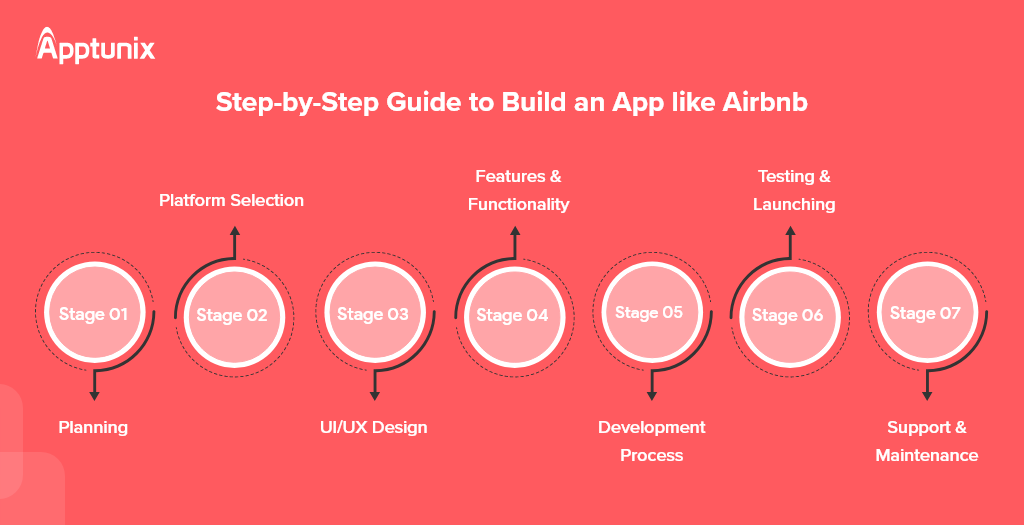
Stage 1: PlanningIn planning, you must recognize market demand, customer preferences, and competitors. Specify the features, advantages, and target audience you want to serve. Using Airbnb as a model for inspiration will help you develop a solid roadmap for the future.
Stage 2: Platform SelectionDecide whether you want to opt for Android, iOS, or both or cross-platform development frameworks like Flutter or React Native. Note that your choice of platform will affect the time, cost, and resources required for app development.
Stage 3: UI/UX DesignAmong other aspects, one thing that has led Airbnb to set itself apart from its competitors is its – UI/UX design. Airbnb design is intuitive, accessible, and user-friendly. It makes the app easy to use, attractive in design, and convenient for users.
Keeping all these aspects in mind, you can get started with this stage – to design to attract users to your app.
Create a thorough plan for your app, including mockups and wireframes. Ensure the user interface (UI) and user experience (UX) are visually appealing, accessible, and easy to use.
Stage 4: Features & FunctionalityWhat makes your app unique from others? – Features & Functionalities. Incorporating amazing features in your Airbnb-similar app will enhance seamless navigation and customer experience.
You can implement basic features such as booking management, messaging, reviews and ratings, and user profiles in your app. However, it won’t be able to garner as much attention from users as it will with advanced feature apps like map integration, real-time notifications, and social sharing.
However, to build a low-cost Airbnb-like app, you can opt for this method during the initial stage. Then, we can move to the MVP (Minimum Viable Product).
Here, you can launch your white-label Airbnb-like app with basic features. Once it is launched and you’ve tested the waters – you can opt for the fully-developed app by obtaining funds from investors.
This way, you can build your app with limited resources, analyze the market, and go for a fully developed app later.
If you want to know more about MVP, contact Apptunix Experts!
Stage 5: Development ProcessThe Development process of an Airbnb-like app involves certain key stages. Developers choose the right platform and tech stack for app development.
They also put the backend infrastructure needed for data storage, content distribution, and user authentication in place.
Tech Stack:
Step 6: Testing & LaunchingIt’s time to test and launch your app. The app is tested across a variety of platforms and operating systems to identify, track down, and resolve any faults or incompatibilities. Exact user testing is also necessary to gather input on the app’s functionality and usability.
Developers optimize performance and complete settings to get the app ready for launch on the Apple Store or Google Play Store.
After everything is authorized, the app is made available online, and its developers keep an eye on user comments and its functionality.
Step 7: Support & MaintenanceIt is crucial to improve your app’s performance continually. As your user base expands, provide ongoing assistance to respond to user comments, enhance features, resolve issues, and ensure scalability.
With analytics data and user input, you can determine what needs to be improved. Iterate on your app often to enhance user experience and stay ahead in the market.
Recommended Read: Build Hotel Booking App Like Booking.com with AI Innovation
An Airbnb clone app development can generate revenue through multiple profitable business models. The most common is the commission-based model, where the platform charges a percentage fee on every booking made between hosts and guests. For example, Airbnb typically earns 10–15% commission per booking, which quickly scales with volume.
Other ways to monetize your vacation rental app include:
Subscription Fees – Charging hosts or property managers a monthly/annual fee to list unlimited properties.
Featured Listings & Promotions – Allowing hosts to pay extra for priority visibility in search results.
Service Fees – Collecting transaction fees from guests for added services like cleaning or insurance.
Partnerships & Ads – Collaborating with travel services, local businesses, or running targeted in-app ads.
By combining these strategies, an Airbnb clone app can maximize revenue streams while offering value to both hosts and travelers.
The overall development cost to develop an app like Airbnb depends on several factors. It includes:
However, the estimated cost of an Airbnb-like app development with basic features ranges between $15,000 and $50,000. The cost significantly increases with advanced features, up to $80,000 or above.
MVP Web Development Solution Like Airbnb – A Cost-Effective Approach
Building a Minimum Viable Product (MVP) like Airbnb requires a cost-effective yet scalable approach.
With a budget-friendly solution of around $4,000, you can develop a streamlined web platform featuring essential functionalities such as user authentication, property listings, booking management, and payment integration.
By leveraging open-source technologies, pre-built templates, and agile development practices, you can minimize costs while ensuring a functional and visually appealing product. This approach allows startups to validate their idea, attract early adopters, and secure funding for further enhancements without overspending.

While Airbnb dominates the vacation rental industry, several Airbnb alternatives have carved out profitable niches with unique features and business models. If you’re planning to build an Airbnb-like app, it’s worth studying these competitors:
Vrbo focuses exclusively on vacation rentals—no shared spaces. It appeals to families and large groups looking for entire homes. Its niche approach makes it one of the strongest Airbnb alternatives for travelers who want privacy.
Originally a hotel booking giant, Booking.com now lists apartments, homes, and vacation rentals. Its global reach and integrated hotel listings make it a strong competitor to Airbnb, especially for international travelers.
Now merged with Vrbo under Expedia Group, HomeAway was a pioneer in online vacation rentals. It offers property owners subscription-based listing options, giving them flexibility beyond commission models.
TripAdvisor leverages its massive travel community by offering vacation rentals alongside reviews, tours, and activities. This integration makes it an attractive Airbnb alternative for travelers seeking a comprehensive travel-planning experience.
Owned by TripAdvisor, FlipKey lists unique vacation rentals and highlights verified guest reviews. It appeals to travelers seeking authenticity and trust while booking stays.
Here are some key reasons why people prefer Airbnb over hotel booking sites:
Airbnb offers a diverse range of accommodations beyond standard hotel rooms, including cozy apartments, luxury villas, cabins, tiny homes, treehouses, and even castles. This variety allows travelers to find stays that match their preferences and add a unique touch to their trip.
Many Airbnb rentals are more affordable than hotels, especially for longer stays or when traveling in groups. Guests can save on extra costs like service fees, dining out (by using in-house kitchens), and laundry services. Additionally, Airbnb often provides discounts for extended stays.
Unlike hotels that offer limited space, Airbnb properties often include multiple rooms, kitchens, living areas, and outdoor spaces. This setup provides more comfort, privacy, and flexibility, making it ideal for families, remote workers, and long-term travelers.
Staying in an Airbnb often means residing in a residential neighborhood rather than a tourist district. This allows travelers to experience the local culture, interact with residents, visit lesser-known spots, and enjoy an authentic stay away from commercialized areas.
Airbnb hosts often provide flexible check-in and check-out times, making it easier for travelers to accommodate their schedules. Some listings also offer flexible cancellation policies, giving guests peace of mind if their plans change.
Airbnb is an excellent choice for groups and families, as properties often feature multiple bedrooms, shared common spaces, and amenities such as kitchens, patios, and game rooms. This setup fosters a communal experience while also saving money compared to booking multiple hotel rooms.
Airbnb offers significant discounts for long-term stays, making it a popular choice for digital nomads, remote workers, and people relocating to new cities. Many listings include workspaces, WiFi, and other amenities tailored to long-term guests.
Unlike standardized hotel services, Airbnb hosts often add personal touches to make guests feel at home. This can include welcome gifts, local recommendations, homemade meals, or customized travel guides, creating a more personalized and memorable experience.
Many Airbnb listings welcome pets, whereas most hotels have strict pet policies or high pet fees. Travelers with pets can find accommodations with yards, pet-friendly furniture, and even hosts who provide pet supplies, making vacations easier for pet owners.
Hotels are typically clustered in busy tourist areas, while Airbnb rentals are spread across neighborhoods, rural areas, and even remote locations. This allows travelers to choose between urban convenience, scenic retreats, or off-the-beaten-path experiences.
To get started with your dream project, you must collaborate with Apptunix, a leading mobile app development company. Wondering how to make an Airbnb clone app successful?– For that, you must partner with Apptunix to build a solid vacation rental app like Airbnb. Our experienced team of mobile app developers, designers, and other professionals understand the intricacies of complex projects. Without a reliable team, you might face several challenges to kick-start your business and make it a huge success. Contact us now to start building your dream Airbnb-like app and discuss your app’s specific needs and requirements.
Q 1.Who built the Airbnb app?
The company was founded in 2007 by Brian Chesky, Nathan Blecharczyk, and Joe Gebbia. Its official website ‘Airbedandbreakfast.com’ was officially launched on August 11, 2008
Q 2.How long does it take to develop an app like Airbnb?
Developing an app like Airbnb may take several months to a year. It all depends on the project’s complexity, integration of features/functionalities, and other factors. To learn more, get in touch with Apptunix experts.
Q 3.How much does it cost to build an app like Airbnb?
The cost to create an app like Airbnb ranges between $15,000 and $80,000 or above, depending on features, design, and other aspects.
Q 4.What are the different methods to monetize my vacation rental app?
You can monetize your vacation rental app through commission fees on bookings, promoting ads, collaborating with local service providers for referrals, and offering premium listings.
Q 5.Who are the main competitors of Airbnb?
Here are some major competitors of Airbnb with a brief line for each:
Q 6.How to Start a Website Like Airbnb?
To start a website like Airbnb, follow these key steps:
(1 ratings, average: 5.00 out of 5)
Get the weekly updates on the newest brand stories, business models and technology right in your inbox.
Reena Bhagat, the CTO and Head of AI at Apptunix, is a seasoned technology strategist with a deep-rooted expertise in emerging technologies. With a focus on AI/ML integration, product engineering, cloud management, she leads the technical vision for high-performance SaaS infrastructures. Reena is recognized for building secure, scalable, and decentralized systems that solve real-world complexities. Her passion lies in leveraging data science and future-tech to create resilient digital products, making her a trusted authority for organizations looking to lead in the age of intelligent automation.
Book your consultation with us.
Book your consultation with us.


One Central, The offices 3, Level 3, DWTC, Sheikh Zayed Road, Dubai
+971 50 782 1690


Offer Ends Soon
Get a quick expert response in under 5 minutes.