Wedding/Marriage App Development for KSA and GCC: A Founder’s Playbook
258 Views 12 min December 26, 2025

Lively and spirited. You may call me a tech-geek. I like to explore latest advancements in the technical areas and develop case studies. Being a computer science graduate, I like to traverse through the technical platforms as well. You can find me understanding or playing with the latest technology.
Today’s economy is digital-first and every organization must make a critical decision: build or buy software. As businesses compete to innovate, rationalize operations, and provide frictionless customer experiences, the argument for building bespoke software from ground up or purchasing pre-existing software applications has never been more topical.
The urgency is apparent: digital transformation is no longer optional, yet the way ahead is not easy. Custom software development provides enterprises with full control, scalability, and differentiation. But these have enormous initial investment, extended timeframes, and the need for technical know-how. Alternatively, purchasing software solutions provides for quickness, lower upfront investment, and tried-and-tested trustworthiness. But these come at the cost of ownership, long-term value, and flexibility.
The build versus buy software conundrum is not merely about cost, it impacts your business’s competitive advantage, responsiveness, and capacity to grow in the long term. For a startup, the decision may determine survival; for a company, it can define the ROI and innovation strategy.
In this post, we’re going to dissect the expenses, advantages and disadvantages, and decision-making model in order to assist you in assessing if building or purchasing is appropriate for your business in 2026. Read on!

Before diving into the decision framework and cost comparisons, it is important to clarify what the build vs buy software debate actually means. At its core, the question comes down to whether your business should build custom software that is uniquely designed for your purposes, or buy off-the-shelf software applications that are ready to deploy.
When a company chooses to build custom software, it either relies on an in-house development team or partners with a software development company to create a solution from the ground up. The biggest advantage of this approach is ownership and flexibility. You decide the functionalities, integrations, scaling capabilities, and user experience.
Custom software is especially attractive for organizations in industries like healthcare, fintech, enterprise SaaS, and logistics, where it is important to have unique workflows, brand differentiation, and compliance requirements. However, it often requires significant upfront investment, a longer time-to-market, and technical expertise.
In contrast, buying software applications means choosing pre-built SaaS platforms or enterprise tools that can be quickly implemented. Popular examples include accounting software, CRM platforms, or project management tools. The appeal lies in their speed, affordability, and reliability, businesses can get started in days or weeks instead of months.
The trade-off is limited customization and vendor dependence. You rely on the provider’s roadmap, pricing model, and security updates. Over time, subscription costs may add up, and scaling beyond what the software offers can become restrictive.
“Building is always more expensive.” Not necessarily, long-term ownership of custom software can actually reduce costs compared to recurring subscription fees.
“Buying is always faster.” While deployment is quick, heavy customization, data migration, and training often delay ROI.
Understanding these realities is key before analyzing the build vs buy software pros and cons in depth.
The choice between developing in-house software vs purchasing applications is never easy. Companies need to weigh cost, time, flexibility, and risk before deciding on a course of action. To make such an evaluation practical, let’s separate the most significant aspects that characterize the build vs buy software choice in 2026.
1. Cost Analysis of Build vs Buy Software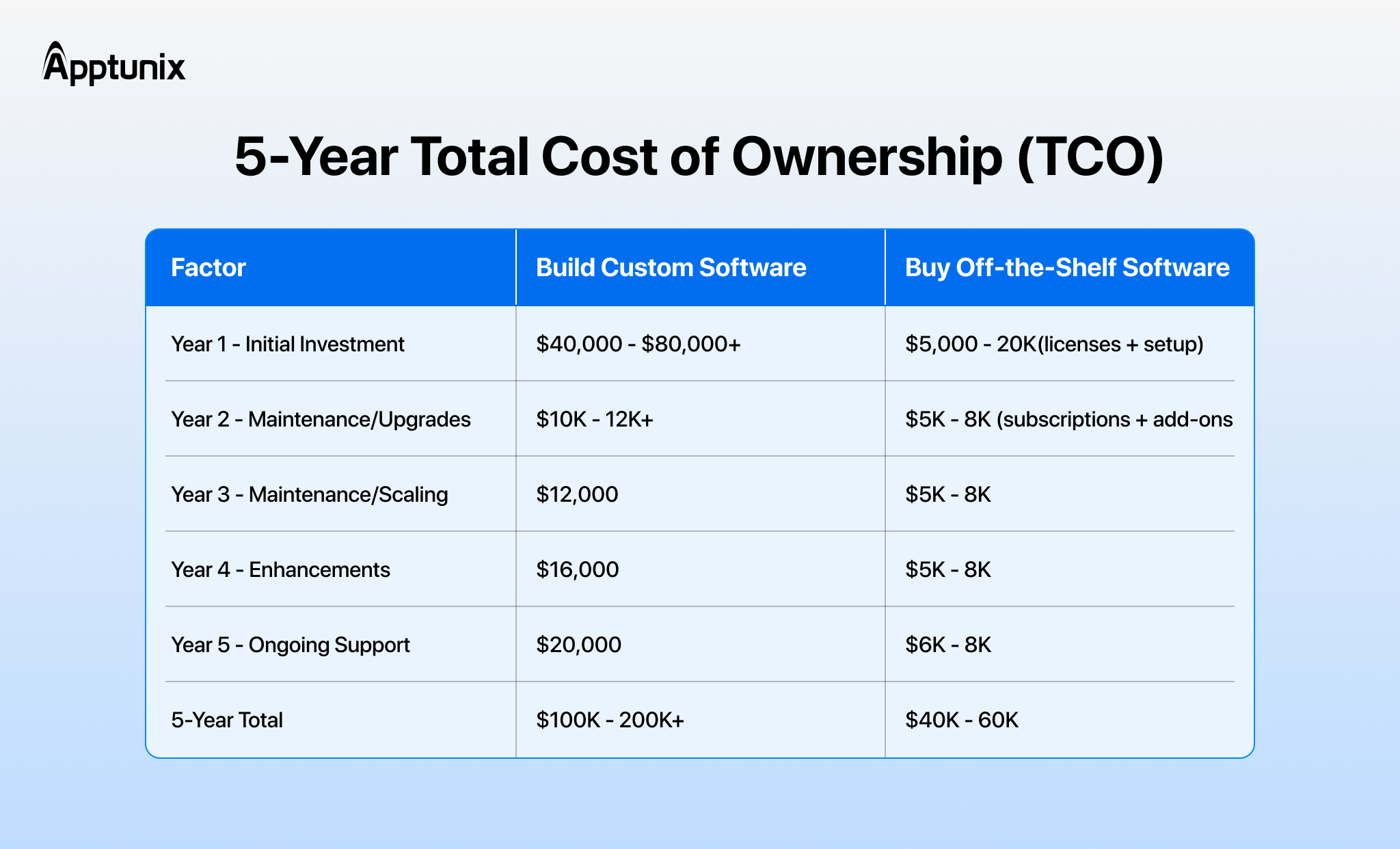
While buying software applications looks cheaper, businesses often face hidden costs like integration, training, or vendor lock-in. For companies with long-term scalability needs, building custom software may offer better control and ROI despite higher upfront spend.
2. Time to Market – Speed vs CustomizationBuying software offers rapid deployment, making it ideal for businesses that need to act fast. Most SaaS products can be set up in days or weeks, giving companies immediate functionality.
Building software, however, requires months (sometimes years) of development. For startups racing against competition, this delay can be risky. But enterprises looking for differentiation may find the longer timeline worthwhile.
Startups: Often prioritize buying for quick validation
Enterprises: More likely to build to achieve strategic customization
3. Control, Customization, and DifferentiationOne of the strongest arguments in favor of building custom software is control. You own the code, decide the roadmap, and tailor every feature to match your processes and customer experience. This makes building the preferred route when software becomes a competitive differentiator.
By contrast, buying software applications means adapting your workflows to fit the vendor’s design. While customization is possible, it rarely matches the level of flexibility that comes with owning your own system.
4. Scalability & Long-Term FlexibilityBusinesses evolve, and so must their software.
If your business expects to scale rapidly or pivot frequently, building offers more flexibility in the long run.
5. Security & ComplianceIn regulated industries—healthcare, fintech, insurance, government services—security and compliance are critical.
For mission-critical applications with sensitive data, many enterprises lean toward building custom solutions for peace of mind.
6. Risk and ReliabilityBoth building and buying carry risks, just different ones:
Ultimately, the risk boils down to control vs dependency—do you want to own and manage your risks (build), or delegate them to a third party (buy)?
When evaluating the build vs buy software decision, there is no one-size-fits-all answer. Building custom software offers control, scalability, and differentiation but comes at a higher cost and slower rollout. Buying off-the-shelf software applications ensures speed, affordability, and convenience—but limits flexibility and creates long-term vendor reliance.
The right choice depends on your business goals, growth stage, and risk appetite—which we’ll explore further in the decision-making framework.

Even after weighing pros and cons, the build vs buy software decision often feels overwhelming. To simplify, businesses need a structured software build vs buy analysis framework that aligns technology choices with long-term strategy.
Below is a step-by-step framework designed to bring clarity and objectivity to your decision-making process.
Step 1: Freemium ModelsThe first step is identifying whether the software directly impacts your core value proposition or if it’s a supporting function.
Ask yourself: “Will this software define how customers perceive our brand or experience?” If yes → lean toward build.
Step 2: Calculate Total Cost of Ownership (TCO)Don’t just compare upfront licensing fees vs development costs. Consider the 5-year TCO, including:
A TCO comparison often reveals that while buying is cheaper short-term, building software applications may deliver stronger ROI in the long run.
Step 3: Map Time-Sensitivity of DeploymentSpeed is a decisive factor in the build vs buy software analysis.
Example: A startup validating its MVP should buy/subscribe initially. An enterprise planning a long-term digital ecosystem may build.
Step 4: Evaluate In-House vs Outsourced ExpertiseThe feasibility of building depends heavily on your talent pool:
Step 5: Risk AssessmentBoth routes come with risk. Use this checklist:
In industries where compliance and security are critical (healthcare, fintech, government), the risk assessment often tilts in favor of building custom software.
Step 6: Scalability RoadmapYour decision should match your growth trajectory:
Here’s a decision matrix that compares building vs buying across critical dimensions:
By following this build vs buy software decision framework, businesses can objectively evaluate whether to build custom software applications or buy ready-made solutions. The key is aligning the decision with your core business goals, scalability roadmap, and risk appetite.
In many cases, companies adopt a hybrid approach—buying tools for non-core needs while building custom platforms for differentiation. This ensures speed today without sacrificing long-term innovation.
When deciding between build vs buy software applications, businesses must carefully weigh the pros and cons of each approach. The right choice can accelerate growth, while the wrong one may drain resources and limit flexibility.
Here’s a detailed breakdown to help you navigate this decision.
While both strategies have clear benefits, it’s equally important to recognize their downsides.
Pitfalls of building custom software:
Pitfalls of buying off-the-shelf software:
Ultimately, the pros and cons of build vs buy software development depend on your priorities:
Many enterprises today adopt a hybrid strategy, where core business functions are powered by custom-built platforms, while secondary processes rely on ready-made solutions. This balanced approach ensures both agility and innovation.
When evaluating build vs buy software, cost is often the biggest deciding factor. However, the price comparison isn’t as simple as upfront expenses—it’s about short-term affordability vs long-term return on investment (ROI).
Short Term Costs
Buying software applications –
Building custom software –
Long-term ROI
Buying software –
Building software –
For many organizations, the smartest choice isn’t strictly build or buy—it’s a hybrid strategy. This approach allows businesses to balance cost-efficiency with innovation by combining off-the-shelf solutions for standard needs and custom-built applications for areas that drive competitive advantage.
Functions like HR, accounting, payroll, or CRM are essential for operations but rarely provide unique differentiation. Here, buying software applications makes more sense. Ready-made SaaS tools are cost-effective, quick to deploy, and regularly updated, saving businesses both time and effort.
When it comes to what makes your company unique—such as a customer-facing mobile app, a proprietary logistics system, or a tailored marketplace—building custom software is often the better choice. It enables full control over the user experience, scalability, and intellectual property, giving you a competitive edge that pre-packaged software can’t deliver.
The build vs buy software decision in 2026 is no longer just about cost and time—it’s also heavily shaped by fast-moving technology trends. Businesses today must weigh not only their current needs but also how emerging tools and platforms will affect scalability, compliance, and competitiveness in the future.
AI is transforming how businesses build custom software. With generative AI tools, developers can accelerate code generation, automate testing, and even simulate user flows—cutting development timelines by weeks or months. This makes custom software development far more accessible, reducing one of the biggest barriers (time-to-market) in the build vs buy debate.
Most modern SaaS vendors are adopting cloud-first architectures, making buying software applications more attractive than ever. Seamless integrations with APIs, robust uptime guarantees, and global scalability mean enterprises can plug these tools into existing stacks without heavy technical overhead. For non-core processes like CRM or HR, this makes buying even more compelling.
One of the most disruptive shifts is the rise of low-code and no-code development platforms. These tools allow businesses to “build” apps quickly without deep technical expertise, while still relying on pre-configured modules—essentially sitting in between build vs buy software applications. This hybrid middle-ground is especially appealing for startups and mid-sized companies seeking speed without full vendor lock-in.
As data privacy regulations (GDPR, HIPAA, UAE PDPL) get stricter, organizations in healthcare, fintech, and government sectors are leaning toward custom software builds. With a bespoke solution, businesses can ensure compliance, enforce security policies, and avoid vulnerabilities that come with widely adopted SaaS platforms targeted by hackers.
In 2026, the software build vs buy decision will be less binary and more strategic. Emerging technologies like AI and low-code reduce build timelines, while cloud-first ecosystems make buying smoother. The smartest companies will factor these trends into their long-term software strategies rather than making one-off decisions.
When it comes to the buy vs build software decision, there is no one-size-fits-all answer. The right path depends on your business stage, growth plans, and resource availability. Here’s what experts recommend for different business types:
Startups
For early-stage startups, speed and cash flow are critical. Buying off-the-shelf software or using low-code platforms can help validate your idea quickly without burning through resources. Once you achieve product–market fit, you can gradually build custom software to scale.
SMBs (Small & Mid-sized Businesses)
SMBs should take a hybrid approach. Buy software applications for non-core functions (HR, accounting, CRM) to save cost and time. Invest in custom builds where differentiation matters—such as customer experience, loyalty systems, or industry-specific workflows.
Enterprises
Large enterprises with complex ecosystems and compliance needs often benefit from building custom software applications. However, to remain agile, they still rely on enterprise-grade SaaS tools for standardized processes. The decision often comes down to whether the process provides a competitive edge (build) or is simply an operational requirement (buy).
Practical Checklist Before Deciding
The software build vs buy decision is strategic, not just financial. Start small, stay flexible, and align your choice with both your short-term goals and long-term growth strategy.
The build vs buy software debate ultimately comes down to strategy, not just cost. Custom software development offers flexibility, scalability, and the ability to create a competitive edge, but it requires higher upfront investment and a longer timeline. Buying ready-made applications delivers speed, lower costs, and vendor support—but may limit customization and long-term control.
There is no universal answer. The right choice depends on your business stage, budget, technical resources, and long-term goals. Startups may prioritize speed and validation through ready-made solutions, while enterprises with complex workflows often gain more by investing in custom software development.
The key is to analyze your core vs non-core processes, evaluate the total cost of ownership, and align the decision with your growth strategy.
If you’re still unsure, Apptunix can help. Our experts provide a free build vs buy software analysis to guide you through the decision-making process and design the right solution for your business.
Consult Apptunix today and make the smarter software choice.
Get the weekly updates on the newest brand stories, business models and technology right in your inbox.
Lively and spirited. You may call me a tech-geek. I like to explore latest advancements in the technical areas and develop case studies. Being a computer science graduate, I like to traverse through the technical platforms as well. You can find me understanding or playing with the latest technology.
Book your free consultation with us.
Book your free consultation with us.

One Central, The offices 3, Level 3, DWTC, Sheikh Zayed Road, Dubai, United Arab Emirates
+971 50 782 1690