Build a Podcast Hosting & Analytics Platform with Full Audience Data Ownership
30 Views 15 min July 30, 2026

Reena Bhagat, the CTO and Head of AI at Apptunix, is a seasoned technology strategist with a deep-rooted expertise in emerging technologies. With a focus on AI/ML integration, product engineering, cloud management, she leads the technical vision for high-performance SaaS infrastructures. Reena is recognized for building secure, scalable, and decentralized systems that solve real-world complexities. Her passion lies in leveraging data science and future-tech to create resilient digital products, making her a trusted authority for organizations looking to lead in the age of intelligent automation.
Most products don’t fail because the idea was bad. They fail because the first version was wrong!!!
In fact, studies consistently show that nearly 70% of digital products fail to gain real traction, not due to lack of demand, but because users don’t see enough value early on. The product either launches too thin to be useful or too heavy to adapt.
Some teams rush to market and ship something that barely holds user interest. Others spend six to nine months polishing features nobody actually needs. Both mistakes come from the same gap: not being clear about what the first version of the product is supposed to prove.
This is where the debate around minimum viable product vs minimum lovable product starts to matter more than most founders expect.
Your first release does more than test an idea. It sets expectations. Research shows that over 88% of users won’t return after a poor first experience. That means your initial product version shapes how users judge your brand long before you get a second chance.
A smart startup product launch strategy balances speed with substance. You need enough functionality to test real demand, but also enough quality to earn trust. Understanding the real MVP vs MLP difference helps you avoid launching too early or waiting too long.
A Minimum Viable Product is the simplest version of your product that can still solve a real problem for real users.
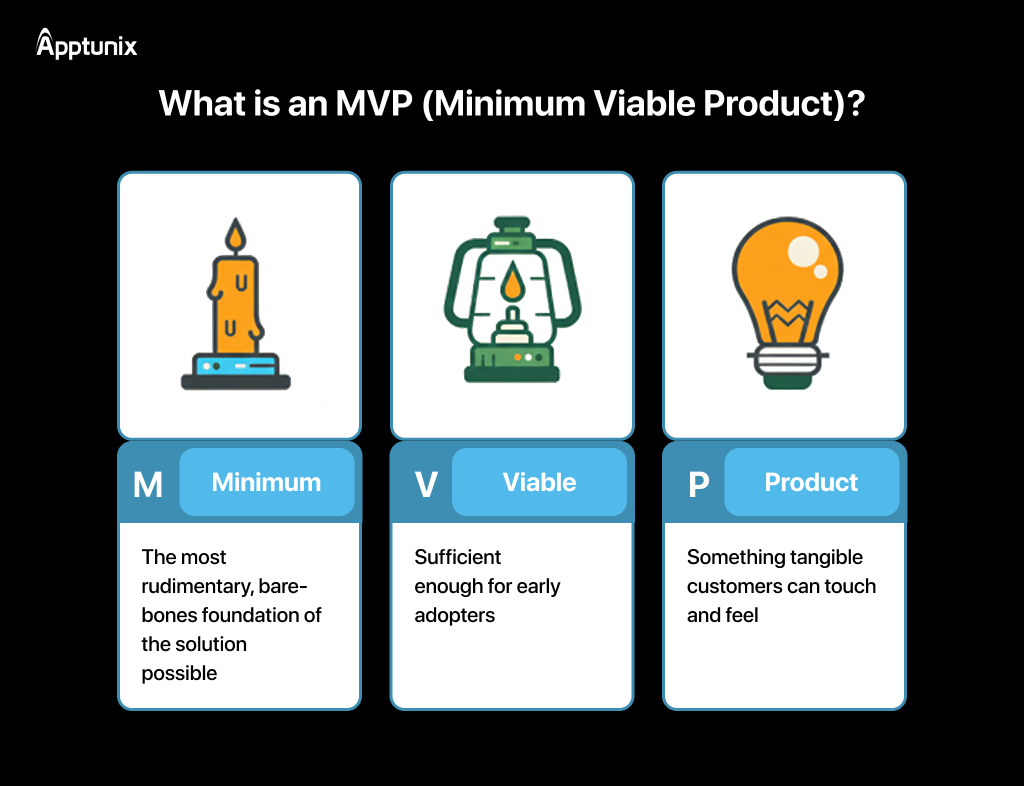
Not a demo. Not a prototype. A working product with just enough features to validate whether the idea is worth building further.
Early traction, even at a small scale, signals momentum. Confusion or weak engagement signals hesitation. In crowded markets, users don’t announce their exit. They just move on.
For startups and enterprises alike, an MVP exists for one main reason: learning. It helps you answer critical questions early. Will users actually use this? Are they willing to pay? Which features matter and which ones don’t?
When teams talk about MVPs, they often make the mistake of thinking smaller is always better. That’s not true. A good MVP is focused, not bare. It delivers value, even if the experience isn’t fully polished yet.
This approach makes sense when:
This is where custom MVP development services come into play. A strong product development company helps define what truly needs to be built now and what can wait. The goal isn’t to launch fast for its own sake. The goal is to launch smart, gather insight, and reduce risk.
A Minimum Lovable Product takes a different approach. It still starts small, but it places a lot more weight on how the product feels to users from day one.
An MLP goes beyond basic functionality. It focuses on clarity, usability, and trust. The product works, yes, but it also feels intentional. Users don’t just tolerate it. They enjoy using it.
This matters more than ever in crowded markets. If users already have alternatives, being functional is not enough. They need a reason to stay.
MLPs are often the better choice when:
This doesn’t mean overbuilding. It means being thoughtful. Every screen, every flow, every interaction has a purpose. That emotional connection, even at a small scale, can be the difference between early traction and early churn.
For many teams, the real challenge isn’t choosing sides. It’s knowing MVP vs MLP which one to choose based on context. That decision becomes much easier when guided by an experienced app development company that understands both product strategy and execution.
Let’s clear up the confusion first, because this topic gets overcomplicated fast. The real minimum viable product vs minimum lovable product difference is not about how many features you ship. It’s about what you’re trying to learn from the market. That difference matters more than most teams realize.
An MVP is built to answer one question:
Does this product solve a real problem well enough that users will engage with it?
An MLP answers a different question:
Can this product earn users’ trust and preference from the first interaction?
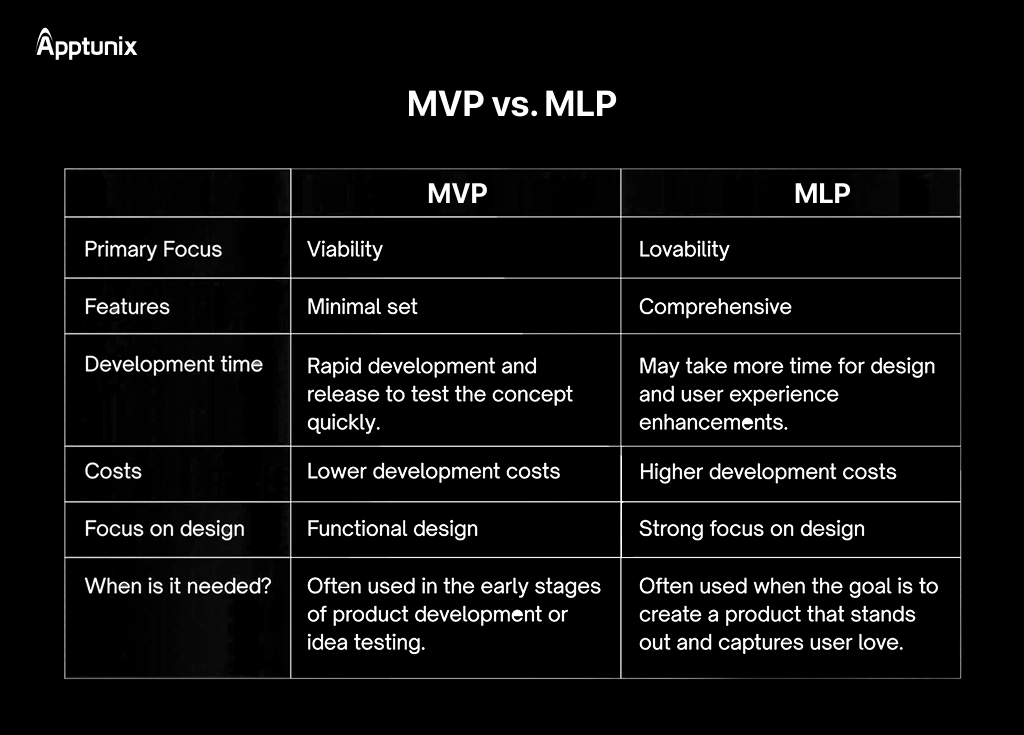
1. Validation vs User LoveAn AI MVP is validation-first. You release a focused version of the product to see how users behave, not how they feel. The goal is learning, not loyalty.
An MLP shifts the focus. Here, usability, clarity, and emotional response matter. You still keep the scope tight, but you make sure users enjoy using what you ship.
This is why many consumer apps struggle when they launch with MVP thinking in markets that already have strong competitors.
2. Speed vs ExperienceSpeed is the MVP advantage. You move fast, launch early, and iterate based on real data. This works well when the market is new or the problem is still being defined.
MLPs take more time because experience cannot be rushed. User flows, onboarding, and visual clarity all need attention. That extra effort often pays off in stronger early adoption.
This trade-off becomes especially important when deciding whether to build an MVP vs. an MLP. If your users expect a polished experience from day one, speed alone will not save you.
3. Cost vs RetentionMVPs usually cost less upfront. The build is lean, and the focus stays on functionality. This makes sense when budgets are tight or when you are testing multiple ideas.
MLPs cost more to build, but they often reduce long-term churn. Users are more likely to stay, engage, and recommend the product when the experience feels thoughtful.
From a business lens, this is not about saving money. It is about spending money in the right order.
4. MVP vs MLP for EnterprisesFor enterprises, the decision carries more weight. Internal tools may benefit from MVP thinking, where validation and efficiency matter most. Customer-facing products often demand MLP thinking, because brand trust and usability are non-negotiable.
This is why MVP vs MLP for enterprises is rarely a one-size-fits-all answer. Context drives the choice.
There is no universal rule here. But there is a clear way to think about the decision. The question is not what most startups do. The question is what your product actually needs at this stage.
If you are entering a new or underserved market, an MVP is often enough. Users are more forgiving when they are searching for a solution that barely exists.
If the market is mature and crowded, expectations are already set. In these cases, an MLP is often the safer move. This is where MLP product development strategy starts to make sense.
Low competition gives you room to experiment. High competition punishes weak experiences.
If users can switch to another app in seconds, launching with only basic functionality is risky. Many MVP vs MLP examples in mobile app development show that early user drop-off often happens not because features were missing, but because the product felt unfinished.
Limited budget and urgent timelines often point toward an MVP. But this does not mean careless execution. A focused MVP still needs clarity and stability.
If you have the resources to invest a bit more upfront, an MLP can reduce costly redesigns later. This is where smart product strategy consulting adds real value.
Internal teams, early adopters, and technical users are usually comfortable with MVPs. General consumers are not. They judge fast and move on faster.
Understanding who you are building for helps you decide far more accurately than following trends.
A capable mobile app development company does not push MVPs or MLPs by default. It helps you choose the right starting point, define the scope, and build with intention.
Strong MVP development services focus on learning without waste. Reliable custom MVP development services help teams scale from validation to adoption without rebuilding everything from scratch.
Most teams don’t struggle because they don’t know what an MVP or MLP is. They struggle because they don’t know when to build an MVP vs MLP. The decision becomes easier when you stop thinking in labels and start thinking in situations.
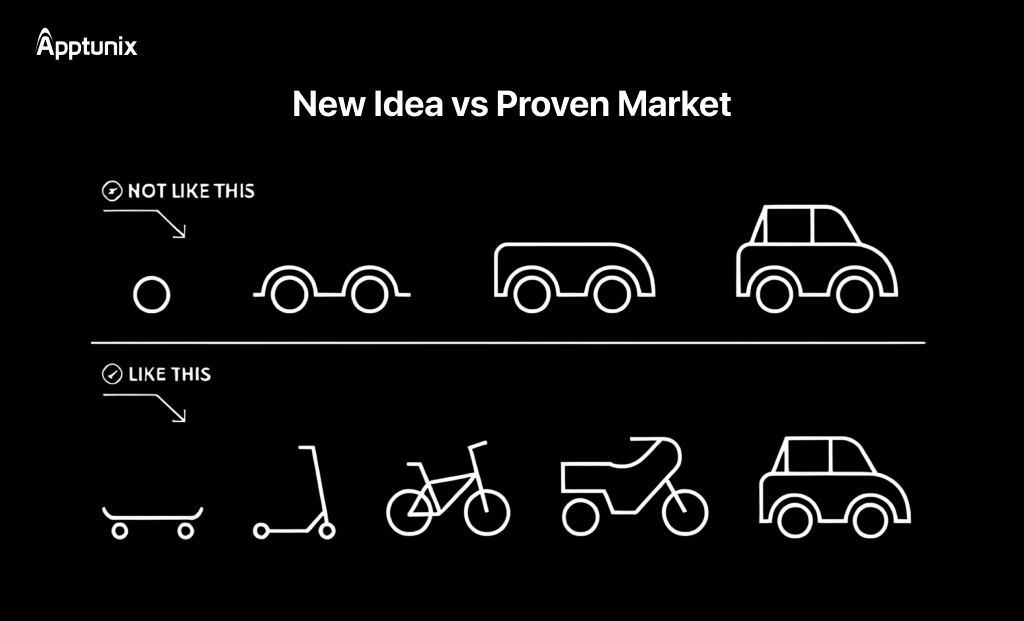
If you are working on a new idea with limited market data, an MVP is usually the right starting point. The goal is to test assumptions quickly and avoid spending months building something the market may not want.
This is where understanding the minimum viable product vs minimum lovable product difference really helps. An MVP gives you clarity. It tells you what works and what doesn’t without draining your budget early.
If the market is already proven and demand is clear, an MLP often makes more sense. Users already know what good looks like. They compare your product with existing options from day one.
B2B products tend to lean toward MVPs in early stages. Buyers care more about solving a specific problem than about visual polish. Functionality, reliability, and clarity matter most.
B2C products play by different rules. Here, user experience heavily influences adoption. If onboarding feels confusing or slow, users drop off quickly. In many consumer use cases, an MLP sets a stronger foundation.
This contrast is evident in discussions of the MVP vs. MLP difference across industries.
Internal tools are often safe territory for an MVP. The users are known. Feedback cycles are short. You can release, improve, and refine without public pressure.
Consumer apps face a harsher reality. First impressions carry real weight. Once users leave, they rarely return. This is why a mobile app development company recommend an MLP approach for public-facing launches.
Startups live under constant pressure. Limited runway. High expectations. Minimal margin for error.
For early-stage teams, MVPs are often the smartest move. They support fast learning, quick pivots, and honest feedback. When done right, an MVP becomes a strong foundation for both growth and fundraising.
Investors care less about polish and more about insight. A clear problem, a working solution, and real user data speak louder than a perfect interface.
This is where a thoughtful startup product launch strategy makes all the difference. Speed matters, but direction matters more.
That said, startups entering crowded or consumer-heavy markets may need to lean toward MLP thinking earlier. Strong onboarding, clear value, and trust-building design can improve early traction.
This is why many founders struggle with MVP vs MLP which one to choose. The answer depends on risk, competition, and timing.
An MVP helps prove demand. An MLP helps show vision.
Both matter. What matters more depends on what stage you are pitching and what story you need to tell.
MVPs excel at fast iteration. You build, release, learn, and repeat. Feedback comes quickly, and changes are easier to make.
MLPs slow this cycle slightly, but often deliver stronger user engagement from the start. It is a tradeoff, not a flaw.

Enterprises don’t get the luxury of experimenting in public. Brand trust, internal alignment, and long-term planning all influence product decisions.
This is where MVP vs MLP for enterprises becomes a strategic conversation, not a technical one. For internal enterprise tools, MVPs work well. The audience is controlled. Feedback is structured. Risk stays low.
For customer-facing enterprise products, MLPs often make more sense. Expectations are higher. A poor first experience reflects on the entire organization, not just the product team.
Enterprises manage risk differently. They cannot afford unstable releases or confusing workflows. Even early versions need to feel reliable.
This pushes many enterprise teams toward MLP thinking earlier than startups.
Executives, partners, and internal teams all influence product decisions. A clear product vision, supported by a well-defined MVP vs MLP product roadmap, helps align stakeholders and secure long-term commitment.
Whether starting with an MVP or MLP, enterprises must think ahead. Architecture, integrations, and future expansion should be considered from day one.
This is where working with the right product development company matters. Experienced teams help balance short-term goals with long-term scalability through structured planning and custom MVP development services.
Good products rarely appear fully formed. They evolve through deliberate stages, each one solving a different business problem. Understanding this evolution helps teams stop arguing about MVP or MLP and start planning what comes next.
A clear MVP vs MLP product roadmap removes guesswork and keeps teams aligned from idea to scale.
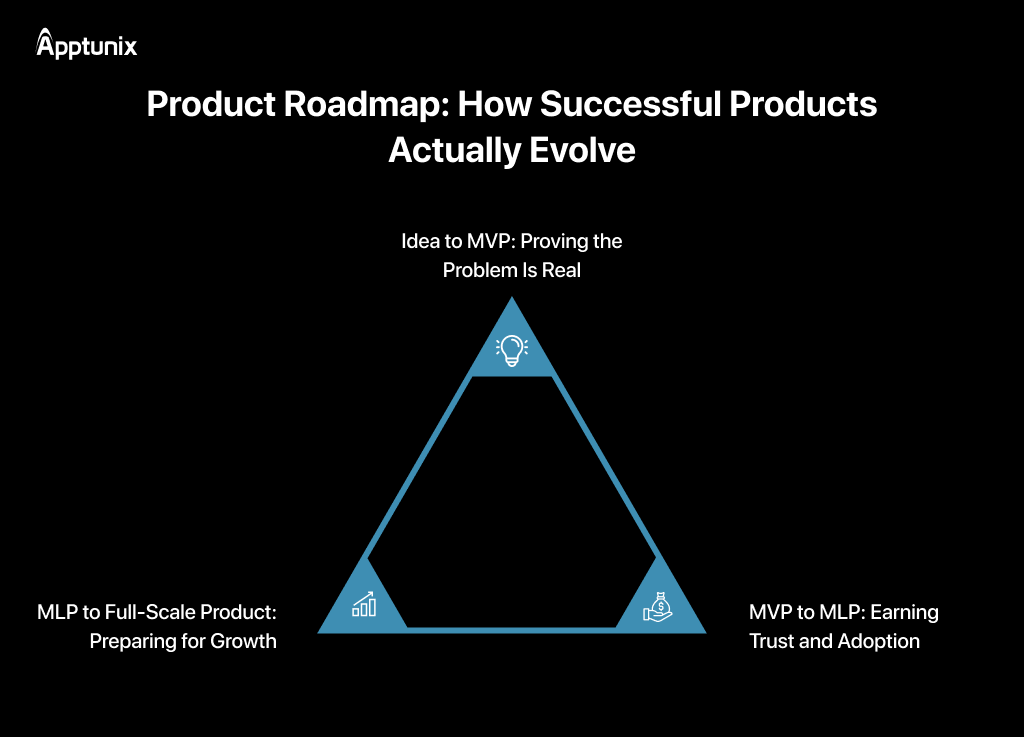
A. Idea to MVP: Proving the Problem Is RealThis stage is about assumptions. You have an idea, a hypothesis, and a belief that a problem exists.
The MVP phase focuses on answering one question clearly:
Are users actually willing to engage with this solution?
Features stay tight. Scope stays controlled. The goal is insight, not perfection. This is where strong MVP development services add value by keeping teams focused on outcomes instead of feature lists.
B. MVP to MLP: Earning Trust and AdoptionOnce validation is in place, the focus shifts. Now the product must feel reliable and intuitive.
This transition is where many teams struggle. They either keep iterating functionally without improving experience or jump straight into overbuilding.
A thoughtful MLP product development strategy balances both. Usability improves. Onboarding gets clearer. The product starts to feel intentional.
This stage often shows up clearly in MVP vs MLP examples in mobile app development, where early versions worked but failed to retain users until experience caught up with functionality.
C. MLP to Full-Scale Product: Preparing for GrowthAt this point, the product has direction. Users are engaged. Feedback is consistent.
Now the focus moves to scalability, performance, integrations, and long-term growth. Decisions made earlier about architecture and scope are starting to pay off.
When founders compare MVP and MLP approaches, cost and timeline often drive the final decision. Both aim to launch quickly, but the level of experience you choose to deliver changes the investment required.
Understanding these differences early helps teams plan smarter and avoid mid-project resets.
An MVP is built to validate the idea with minimal upfront investment. The focus stays on solving the core problem, not on visual refinement.
Typical MVP development timeline-
Estimated MVP development cost-
Best fit for-
An MLP requires more investment because it prioritizes experience alongside functionality. Design, usability, and trust-building elements take center stage.
Typical MLP development timeline-
Estimated MLP development cost-
Best fit for-
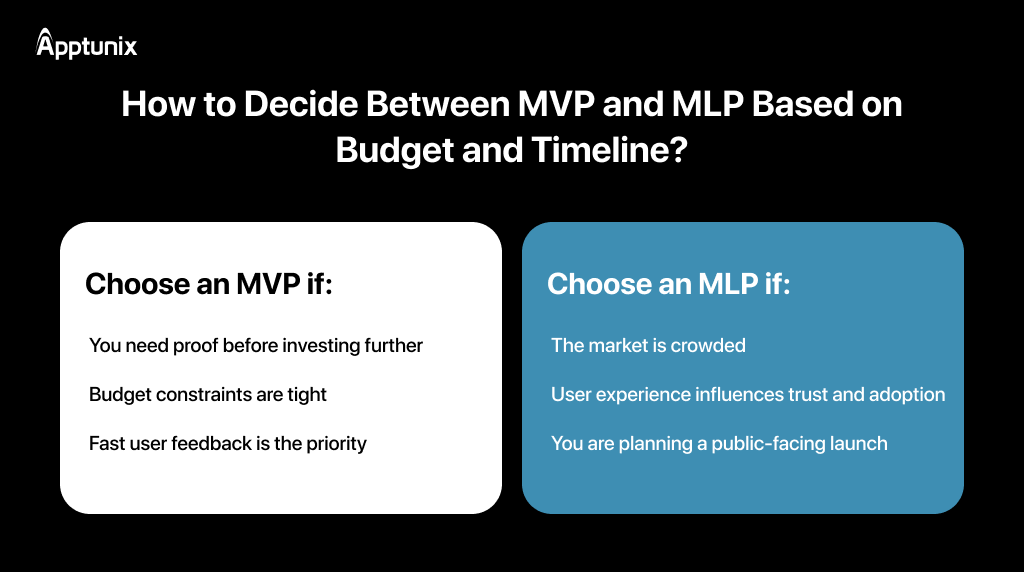
The decision becomes easier with the right product strategy consulting, especially when guided by an experienced mobile app development company that understands both cost control and long-term growth.
Most product failures are not caused by poor execution. They are caused by poor judgment early on. Understanding what to avoid is just as important as knowing what to build.
An MVP is not a smaller version of the final product. When teams pack too many features into the first release, they slow down learning and burn budget faster than expected.
Overbuilt MVPs often miss their core purpose: clarity. Instead of validating the idea, they create confusion around what users actually value.
An MLP without validation is a risky bet. Strong design cannot fix a weak problem statement.
Teams that skip validation often invest heavily before knowing whether users care enough to stay. When adoption stalls, the cost of correction becomes much higher.
Feedback only matters if it shapes decisions. Many teams collect data, run surveys, and hold interviews, yet continue to build based on internal opinions.
Many teams collect data, run surveys, hold interviews, or collect input through quick touchpoints like in-product prompts, event forms, or QR-based feedback links using tools such as Uniqode’s Dynamic QR Codes, yet continue to build based on internal opinions.
Listening closely and adjusting early separates products that grow from products that stall.
Users often ask for features, not solutions. Treating every request as a roadmap item leads to bloated products with no clear direction.
Strong teams look deeper. They focus on the underlying problem, not just the requested feature. This mindset is critical when deciding whether to build an MVP vs. an MLP.
Vanity metrics feel good but rarely tell the full story. Downloads, sign-ups, or demo requests mean very little without engagement and retention.
Poor metric choices can mislead teams into thinking a product is working when it is not.
Many teams think MVP or MLP is something you complete and move past. In reality, both are part of an ongoing learning process.
Products that grow successfully treat early versions as living systems, not milestones to check off.
Rushing early development without thinking about structure leads to problems later. Poor architecture, quick fixes, and ignored scalability issues slow down growth once traction starts.
This is especially common when MVPs are built without guidance from an experienced app development company.
When business goals and product decisions drift apart, even well-built products struggle.
Clear alignment between strategy, design, and development prevents wasted effort and missed opportunities. A capable product development company helps teams avoid common MVP mistakes by asking the hard questions early. With the right custom MVP development services, teams stay focused on outcomes instead of assumptions.
Choosing how to build your first product is important. Choosing who builds it often decides whether that product survives its first year.
Apptunix has been building digital products for over a decade, working with startups, funded scaleups, and enterprise teams that needed clarity before code. During this time, the team has delivered 700+ mobile and web products across global markets, many of them starting as MVPs.
✔Speed to market without shortcuts
Clients come to Apptunix at different stages. Some have a raw idea and a tight runway. Others are enterprises launching new digital initiatives under pressure from internal stakeholders. In both cases, the challenge is the same: decide what actually needs to be built first.
This is where Apptunix stands out as an app development company that understands the real MVP vs MLP difference, not just in theory, but in execution.
✔Early validation using real user behavior
The team has built MVPs across fintech, healthcare, logistics, real estate, on-demand services, marketplaces, and enterprise platforms. Many of these products moved from early validation to full-scale platforms without being rebuilt from scratch.
✔Scalability that supports future growth
Apptunix maintains 4.5+ average ratings across major review platforms, backed by long-term client relationships in North America, Europe, the Middle East, and Asia. That consistency comes from a simple philosophy: build only what matters now, and plan clearly for what comes next.
A Real-World Snapshot→ One Apptunix client entered the market with a strong idea but no clarity on scope. Instead of building a full product, the team launched a focused MVP in under three months. Early usage data revealed which features users actually valued. The result was a cleaner roadmap, lower burn, and a product that evolved with confidence instead of rework.
Building a product is rarely a technical problem. Apptunix offers product strategy consulting for teams that want help making the right calls early, before timelines and budgets lock them in.
The process starts with understanding the business problem, the market, and the users. Only then does the conversation move to features. This is where founders and enterprise leaders get clarity on MVP vs MLP which one to choose, based on context rather than trends.
For teams starting lean, Apptunix delivers custom MVP development services that prioritize validation and learning. The goal is to test direction early, reduce uncertainty, and avoid expensive course correction later.
For teams operating in competitive or consumer-facing markets, Apptunix supports experience-led MLP builds. These focus on usability, onboarding, and trust, without inflating scope unnecessarily. Many of these projects reflect common MVP vs MLP examples in mobile app development, where early experience directly impacts adoption.
Across both approaches, the principles stay consistent:
This approach naturally fits into a practical MVP vs MLP product roadmap, helping teams move from idea to traction and from traction to scale.
Speed gets attention. Clarity builds businesses.
The choice between MVP and MLP is not about following what other startups are doing. It is about understanding your reality. A smart startup product launch strategy does not start with features or timelines. It starts with intent.
What exactly does this first version need to prove? Is it demand, usability, trust, or adoption?
When teams skip this thinking, they move fast in the wrong direction. Understanding the real minimum viable product vs minimum lovable product difference gives you a sharper lens. It helps you invest effort where it matters and avoid paying twice for the same decisions later.
Before you commit to building, pause and ask:
These questions are simple, but the answers shape everything that follows. If they feel hard to answer, that is not a weakness. It is a sign that the decision deserves experience. Product decisions rarely fail because teams lack effort. They fail because teams move forward without enough perspective.
If you are planning your first release and want guidance from a product development company that has helped both startups and enterprises navigate this choice, Apptunix can help you decide with confidence. Whether you need focused custom MVP development services or a more experience-driven MLP approach, the goal stays the same: launch with purpose, learn fast, and build something that lasts.
That is how strong products begin!
Q 1.What is the main MVP vs MLP difference?
The main MVP vs MLP difference lies in intent. An MVP focuses on validating whether a product solves a real problem. An MLP focuses on how users feel while using that solution. MVPs prioritize learning and speed, while MLPs prioritize usability, trust, and early adoption.
Q 2.Minimum viable product vs Minimum lovable product: Which one should I build first?
The choice depends on your market and users. If you are testing a new idea or an uncertain market, an MVP is usually the right starting point. If you are entering a competitive or consumer-facing market, an MLP may be the better first release.
Q 3.MVP vs MLP which one to choose for startups?
Startups often begin with an MVP to validate demand quickly and manage risk. However, startups building consumer apps or entering crowded markets may benefit from an MLP approach to improve early retention and credibility.
Q 4.When to build an MVP vs MLP for enterprise products?
Enterprises often use MVPs for internal tools and pilot programs, where speed and validation matter more than polish. For customer-facing products, MLPs are usually preferred due to brand expectations and long-term trust.
Q 5.How does MVP vs MLP impact a product roadmap?
An MVP helps define early direction by validating assumptions. An MLP builds on that foundation by improving experience and adoption. Together, they form a practical MVP vs MLP product roadmap that supports steady growth without unnecessary rework.
Q 6.Are MVPs cheaper than MLPs?
Yes, MVPs typically cost less upfront because they focus on core functionality. MLPs require more investment in design and usability. The right choice depends on whether you need fast validation or stronger early engagement.
Q 7.How does Apptunix help decide between MVP and MLP?
Apptunix starts by understanding your business goals, market conditions, and users. Through product discovery and product strategy consulting, the team helps you decide whether an MVP or MLP makes more sense for your first release.
Q 8.What makes Apptunix’s MVP development services different?
Apptunix focuses on building MVPs that validate ideas without blocking future growth. Their custom MVP development services balance speed, clarity, and scalability, helping teams move forward with confidence instead of assumptions.
Q 9.Can Apptunix support both startups and enterprises?
Yes. Apptunix works with early-stage startups, funded companies, and large enterprises. Their experience across industries allows them to adapt MVP and MLP strategies based on scale, risk tolerance, and long-term goals.
Get the weekly updates on the newest brand stories, business models and technology right in your inbox.
Reena Bhagat, the CTO and Head of AI at Apptunix, is a seasoned technology strategist with a deep-rooted expertise in emerging technologies. With a focus on AI/ML integration, product engineering, cloud management, she leads the technical vision for high-performance SaaS infrastructures. Reena is recognized for building secure, scalable, and decentralized systems that solve real-world complexities. Her passion lies in leveraging data science and future-tech to create resilient digital products, making her a trusted authority for organizations looking to lead in the age of intelligent automation.
30 Views 15 min July 30, 2026

38 Views 15 min July 15, 2026

127 Views 15 min June 26, 2026
Book your consultation with us.
Book your consultation with us.


One Central, The offices 3, Level 3, DWTC, Sheikh Zayed Road, Dubai
+971 50 782 1690


Offer Ends Soon
Get a quick expert response in under 5 minutes.