How to Hire App Developers in Kuwait: A Complete 2026 Guide
60 Views 13 min February 13, 2026

Reena Bhagat, the CTO and Head of AI at Apptunix, is a seasoned technology strategist with a deep-rooted expertise in emerging technologies. With a focus on AI/ML integration, product engineering, cloud management, she leads the technical vision for high-performance SaaS infrastructures. Reena is recognized for building secure, scalable, and decentralized systems that solve real-world complexities. Her passion lies in leveraging data science and future-tech to create resilient digital products, making her a trusted authority for organizations looking to lead in the age of intelligent automation.
The startup experience reaches a critical point when one decision begins to determine all future outcomes. The startup needs to choose between establishing an internal team or selecting an external development team. Founders tend to experience this decision point sooner than they expect.
The first week involves testing ideas while securing initial funding. The next stage requires users to demand new features while fixing existing bugs, and investors to demand business progress. Your team will determine your organization’s speed, overall expenses, and its capacity to shift in response to changing needs.
Startups experience operational slowdown because their team structure fails to match their current operational level.
Founders usually weigh a few critical factors when choosing a dedicated development team vs in-house. Speed matters because markets move fast. Cost matters because the runway is always limited.
This blog dives into the critical choice every startup faces:
By the end, you’ll have a clear roadmap to structure your tech team for maximum impact, avoid common pitfalls, and set yourself up for faster growth.

The two models require demonstration through actual operating procedures.
In-house software development teams employ developers who work exclusively for the organization. They operate solely on your product development and adhere to your company procedures as they develop alongside your organization. The dedicated software development company handles all aspects of hiring, including managing employee wages, training new hires, and retaining existing employees. Implementing this method enables the organization to maintain complete control over the entire development process.
A dedicated development team works differently. You partner with a development company that assigns a team to your project. They act like an extension of your startup while the provider handles hiring, management, and operations. Many startups choose this model when they want speed and flexibility without the overhead of full-time hiring.
When founders compare a dedicated development team vs in-house team, the conversation usually centers on ownership versus agility. Here’s a clear comparison:
In-house development vs outsourcing often makes sense when the product is stable, the roadmap is clear, and the company can afford long-term investment in people. A dedicated model works well when speed matters, when the scope may change, or when the startup wants access to experienced developers without building everything from scratch.
Some startups also choose an offshore development company as part of this approach. This allows them to hire dedicated developers from global talent pools, often at a lower cost, while still maintaining focus and accountability. The key takeaway here is simple. Neither option is better by default. The real question is which model fits your startup’s current reality, not just your long-term vision.
The process of hiring developers requires founders to identify the right moment to hire a dedicated development team. Founders consider hiring a significant commitment they must undertake at the beginning of their business. The current situation requires companies to pay high salaries while their needs remain ambiguous and their product development continues. The organization needs to hire dedicated developers who can work at the required pace, as delays in the current work environment are causing hiring delays.
Your organization needs to determine two factors for in-house development vs. outsourcing: development time and developer positions.
Startups in their initial phase start with either technical co-founders or small teams of freelancers. The approach works for both validation and initial prototype development. User interactions with products create a situation that leads to rapid changes in all aspects. The cost of handling bugs increases. The number of feature requests continues to increase. The need for speed becomes more important than all other aspects of project management.
This point in the process leads founders to begin evaluating a dedicated development team vs in-house staff. At this stage, some founders choose to build an internal team while thinking about how to hire dedicated developers who can step in quickly and bring structure to the development process. Both paths can work, but timing matters. The founders experience pressure to increase work output, but they also need to make development decisions that require long-term commitments.
Here are a few signs your startup is ready to expand its technical team:
If your roadmap changes often and priorities shift every quarter, hiring a dedicated engineering team gives you room to adapt without the stress of constant rehiring. On the other hand, if your product vision is stable and funding is secure, building an in-house team may make more sense. When the product depends heavily on mobile performance, founders often look to hire Android or iOS developers early.
Cost is where this debate becomes very real. On paper, hiring in-house development vs outsourcing team looks straightforward. You pay salaries, set up infrastructure, and build a long-term team. In practice, the in-house development cost often surprises founders.
When you build internally, salary is only the starting point. You also pay for:
All of this adds up quickly. For early-stage companies, the cost of hiring offshore developers for startups can stretch the runway faster than expected.
Now compare a dedicated development team vs in-house model. The dedicated development team’s cost is usually a predictable monthly expense. You pay for the developers, their management, and the tools they need. There are no recruitment delays and no long-term employment risks. If priorities change, the team size can change too.
This is why many founders spend time analyzing the costs of outsourcing vs. in-house development before making a decision. Outsourcing, when done through a dedicated team model, often reduces upfront spending and removes hidden expenses.
Software development hiring expenses exhibit different patterns across geographic regions. Your hiring expenses will increase because you will need to pay higher salaries when you hire a dedicated development team from your local area. An offshore development company hire skilled engineers at economic prices while maintaining high work standards.
The requirement for multiple developers or temporary capacity expansion makes this distinction more crucial. The smartest founders do not chase the cheapest option. The model becomes their choice because it enables them to develop their business to optimize mobile app maintenance cost as well.
Building an in-house software development team feels like a long-term commitment to your product. For some startups, that commitment pays off. For others, it becomes a weight they were not ready to carry.
For many startups, a dedicated team offers a faster and more flexible way to build products without the weight of permanent hiring.
Founders will need to make a decision at a specific moment in their entrepreneurial journey. The product has advanced beyond its initial concept development. The user base is growing. The user base expects more. The development process now holds equal value to the product’s final outcome.
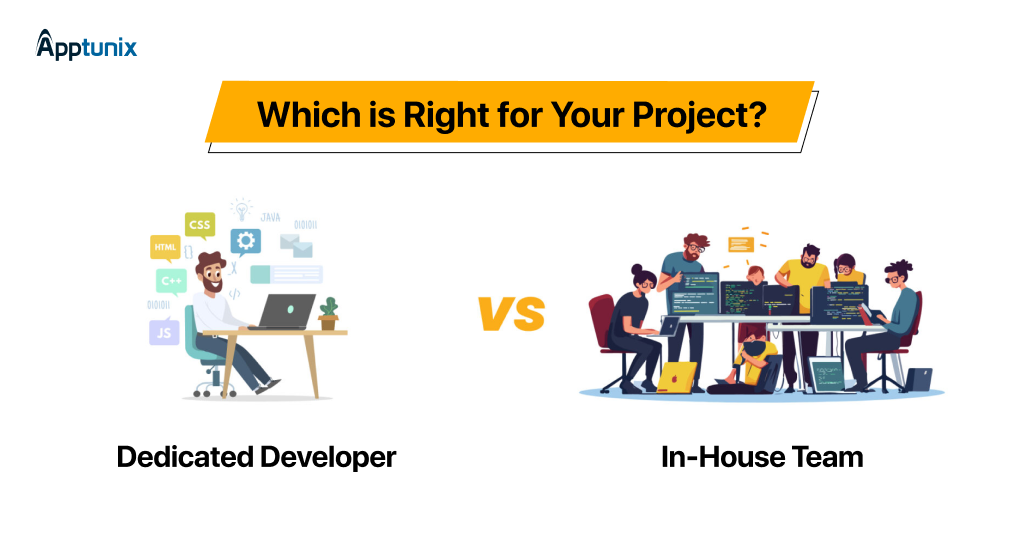
The discussion about choosing between dedicated development team vs in-house team becomes critical for startups at this point.
Early-stage outsource companies require operational resources. Their operational needs demand rapid execution, concentrated effort, and the flexibility to switch strategies without jeopardizing their entire operation. Many founders opt for dedicated teams during their minimum viable product development because it provides them with essential project resources.
In-house operations function effectively when organizations establish their permanent business vision and secure their financial resources. The system provides you with continuous product control and essential product details. The system requires a significant investment of both time and financial resources, and your personal dedication to the process.
Startups use dedicated teams to increase their operational efficiency. Dedicating engineering resources to your project enables you to access skilled engineers with comprehensive knowledge of product development processes. Your minimum viable product evaluation needs actual consumers who provide authentic feedback, not just programming expertise.
Mobile-first product founders prefer this hiring method. The company needs to hire Android and iOS developers immediately to meet development needs. The dedicated software development company supports project progress while keeping expenses under control.

Founders often hesitate before outsourcing. The fear usually comes from losing control or ending up with poor-quality work. Still, the real issue is not outsourcing itself. It is how and when you do it.
So, should startups outsource development? In many cases, yes. Especially when speed and cost control matter more than long-term hiring.
Outsourcing works well when:
Startups often work with a full-stack or enterprise software development company to cover multiple needs without building large internal teams.
Outsourcing fails when expectations are unclear. Here are mistakes founders make and how to avoid them:
To reduce risk, treat your partner like a team member. Set clear goals, review work regularly, and stay involved in key decisions. When done right, working with an IT staffing augmentation company can feel less like outsourcing and more like collaboration.
Use this quick guide to sense-check your choice.
For most startups, the best development model is not permanent. It evolves. Many start with a dedicated development team vs in-house, then move parts of development internally once the product matures.
There is no universal answer for in-house development vs outsourcing, and most founders learn that the hard way. The right development model depends on your product, your people, and the stage you are actually in, not the stage you want to reach six months from now.
A mistake many startups make is choosing a team structure based on ego or long-term dreams. What matters more is what helps you build, learn, and adjust without burning time or money.
Let’s break this down in a practical way.
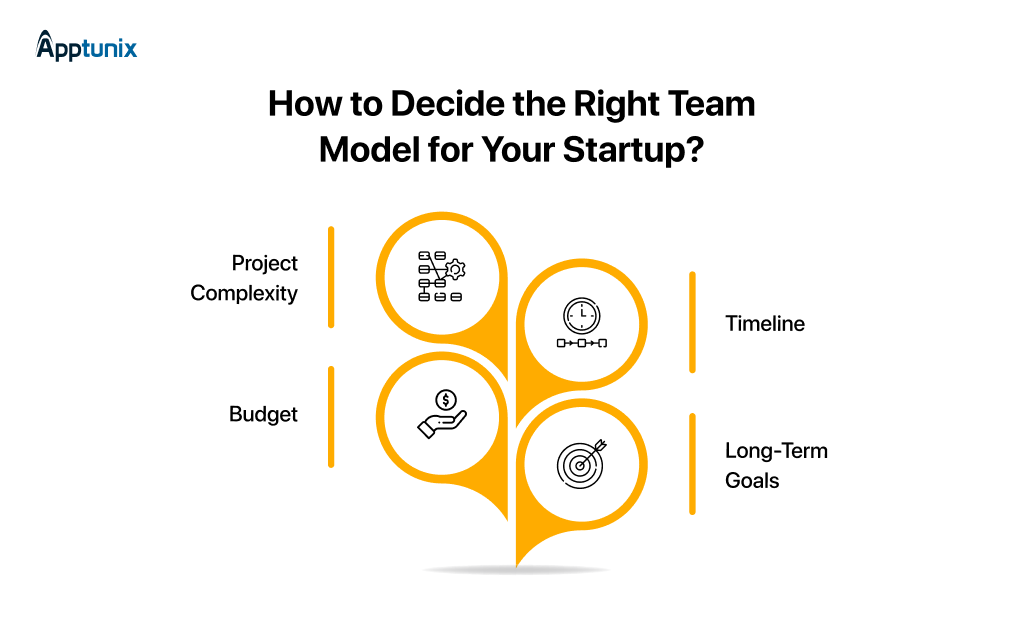
The initial ownership requirement for each product should correspond to its specific requirements. When developing an MVP to test market demand, speed is more important than achieving flawless results.
People should not approach a complex platform system. Fintech products and enterprise tools and systems that manage sensitive data require this level of architectural development and sustained operational control. The products require more complex architectural solutions that require permanent maintenance. The organization should establish an internal core team while maintaining its need for external assistance during execution.
The best guideline to follow is based on this principle. The product logic needs frequent updates when your organization requires more flexible operations than stable processes. The product requires actual ownership when its functions remain unchanged and expand into new areas of development.
Founders often underestimate the role of deadlines in their decision-making.
The timeframe for launching your product must meet two upcoming events: investor demonstrations and the closing of market opportunities. Internal hiring appears attractive at first but requires a recruitment process that consumes 50 percent of the available time. The process of conducting interviews, reaching agreements, and completing onboarding activities tends to progress slowly.
The dedicated teams demonstrate their strengths in this particular area. Startups can establish operations within weeks by hiring remote developers or a dedicated development team vs in-house resources. The company gains an advantage when it begins operations, as this advantage determines whether it will successfully meet its launch deadline or fail.
When your schedule is tight, prioritize speed first. The model needs your immediate approval because you can change it later.
People find budget discussions difficult yet essential to their work.
Startups with limited runways often underestimate the cost of full-time hiring, focusing only on salaries. Salaries are only part of the picture. The organization will experience extra costs through employee benefits and required AI coding tools, and the gradual loss of workers.
Founders of startups in their early stages want to evaluate the costs of developing software internally by comparing them with the option of outsourcing. The dedicated team solution, together with outsourcing, enables businesses to maintain consistent cost calculations. You pay for output, not idle time.
A founder once expressed an idea simply. I would rather spend money building features than maintaining payroll. That mindset often leads startups toward flexible models early on.
People often ignore this element because they want to complete their work quickly.
A business needs strong internal ownership to build enduring products. The best way to develop technical vision and product thinkingis through internal knowledge retention.
A company does not need to create a large internal team. Many successful startups delay heavy in-house hiring until they find product-market fit. They focus first on learning, then on scaling. The organization should use long-term goals to define its path to success rather than creating urgent requirements that must be addressed.
Most companies do not struggle because they lack developers. They struggle because they hire the wrong way at the wrong time.
The best teams are not built overnight. They evolve in stages. Smart founders choose models that support where the startup is today, while keeping the door open for where it wants to go tomorrow.
That is where Apptunix comes in.
We have worked with early-stage startups, funded scaleups, and enterprise teams with existing internal engineering departments. Across all of them, the challenge was similar. They needed to move faster without losing control, and they needed teams that could adapt as the product evolved.
This is why our approach to dedicated teams looks different.

Clients require two types of services: fast testing to validate their ideas and our team’s execution of their internal development plans. Our dedicated software development company uses two development methods, but we recommend dedicated setups only when they prove practical.
Our teams function as an extension of the client’s engineering team. They participate in planning meetings and they implement internal procedures while maintaining their connection to product objectives. The method enables your organization to build minimum viable products while your enterprise develops its intricate platform features.
Apptunix becomes the choice for startups facing hiring difficulties because their internal hiring process takes too much time. Enterprises choose us when internal teams are stretched thin.
Startups needed our assistance in finding remote developers to help them meet their launch schedules. Many companies spent several months searching for local talent before moving to dedicated recruiting. After the team was established, the company achieved regular product launches alongside enhanced decision-making processes.
Enterprises approach our company to establish development partnerships when they need to grow their software development capacities. Their internal teams focus on strategy and architecture, while our engineers handle execution and delivery. This balance maintains high productivity levels while protecting internal business operations.
Some companies look for an offshore development company. Others want to hire an IT staff augmentation company. What they really need is reliability and accountability
We operate somewhere in between.
Our dedicated teams are structured, communicate with discipline, and take ownership. Clients do not have to manage recruitment, attrition, or scaling issues. At the same time, they keep visibility and control over priorities.
This is why companies often stay with us long term. We do not lock clients into rigid contracts. We grow with them.
Over time, clients tell us the same things:
That consistency matters more than flashy promises. It is also why companies looking for a best software development agency often stay after the first engagement.
There is no single right answer in the debate around team models. Choosing between a dedicated development team vs in-house team is not about right or wrong. It is about timing, priorities, and clarity.
In-house teams offer ownership and deep alignment. Dedicated teams offer speed, flexibility, and access to experience. Both work when chosen at the right time. The problem starts when startups default to a model instead of designing.
Early-stage startups need speed and flexibility. Growing companies need balance. Enterprises need scale without disruption. The smartest teams adapt their approach as they grow, rather than forcing one model to work forever. This is where the right partner makes the difference.
At Apptunix, we help companies design engineering teams that fit their stage, not just their ambition. Whether you need a dedicated team, a hybrid setup, or a long-term partner to scale execution, we focus on building teams that support real growth.
If you are deciding how to build next, Apptunix can help you choose the right model.
The best teams evolve alongside the product. When you choose a model that supports how your startup grows today, you set yourself up for better decisions tomorrow.

Q 1.Which is better for startups, in-house or a dedicated development team?
It depends on the stage. Early-stage startups usually benefit from dedicated teams because they can move faster and scale more cost-effectively. In-house teams make more sense once the product stabilizes.
Q 2.Is in-house vs outsourced development a permanent decision?
No. Most startups change models over time. Many begin with outsourced or dedicated teams and later build internal ownership as they grow.
Q 3.When should startups outsource development?
Startups should outsource when speed, flexibility, and budget control matter more than long-term hiring.
Q 4.How does Apptunix manage dedicated teams differently?
We build teams that integrate closely with clients. Our developers follow your workflows and stay aligned with your goals, rather than working in isolation.
Q 5.Can Apptunix support both startups and enterprises?
Yes. We work with early-stage startups and large enterprises, offering flexible team structures for both.
Q 6.Does Apptunix offer hybrid team models?
Yes. Many clients use a hybrid approach where internal teams handle strategy and our teams focus on execution.
Q 7.How quickly can Apptunix set up a dedicated team?
In most cases, teams can be onboarded within a few weeks, depending on the skill requirements.
Q 8.Is Apptunix only an offshore development company?
No. While we offer offshore teams, we focus on collaboration, communication, and accountability rather than location alone.
Q 9.Why do startups choose Apptunix over other agencies?
Startups choose us because we stay flexible, transparent, and focused on outcomes, not just delivery.
Q 10.How do I get started with Apptunix?
You can start by discussing your product goals with us. We help you choose the right team model before jumping into development.
(1 ratings, average: 5.00 out of 5)
Get the weekly updates on the newest brand stories, business models and technology right in your inbox.
Reena Bhagat, the CTO and Head of AI at Apptunix, is a seasoned technology strategist with a deep-rooted expertise in emerging technologies. With a focus on AI/ML integration, product engineering, cloud management, she leads the technical vision for high-performance SaaS infrastructures. Reena is recognized for building secure, scalable, and decentralized systems that solve real-world complexities. Her passion lies in leveraging data science and future-tech to create resilient digital products, making her a trusted authority for organizations looking to lead in the age of intelligent automation.
60 Views 13 min February 13, 2026
73 Views 13 min February 10, 2026
![How to Hire Mobile App Developers in UK: Costs, Tips & Top Agencies [2026]](https://media.apptunix.com/wp-content/uploads/sites/3/2026/02/09113338/Frame-97.jpg)
105 Views 13 min February 9, 2026
Book your free consultation with us.
Book your free consultation with us.

One Central, The offices 3, Level 3, DWTC, Sheikh Zayed Road, Dubai, United Arab Emirates
+971 50 782 1690