How Much Does It Cost to Build a Money Transfer App Like Wise?
36 Views 14 min August 25, 2026


The launch happens. Downloads come in. Users sign up. Then small issues start piling up. An OS update breaks a feature. Performance drops on newer devices. A security patch gets delayed. Support tickets increase. Ratings slip. Retention falls. Revenue follows. This is where mobile app maintenance cost stop being a technical line item and become a business risk.
Industry projections already show that post-launch spending accounts for 20-30% of the total app lifecycle cost within the first year. By the third year, that number often crosses 50%. This is because platforms evolve faster than most businesses expect.
Apple releases major iOS updates every year. Android rolls out new versions across dozens of device manufacturers. Users expect faster performance, fewer bugs, and zero downtime. All of that has a cost.
When companies ignore this reality, the app maintenance budget becomes reactive. Money gets spent in a rush, usually during outages or user churn. When companies plan for mobile app maintenance early, things become predictable, controlled, and far less expensive.
The real question is not whether you will spend on maintenance. The question is whether you will plan for it or pay for it later?
Many teams still think maintenance means fixing bugs after users complain. That is only a small part of the picture. The cost to maintain a mobile app comes from everything that keeps it usable, secure, and relevant after launch.
Maintenance is not about keeping the app alive. It is about keeping the business stable. When leaders understand this, maintenance stops feeling like a cost and becomes growth insurance.
To truly understand the mobile app maintenance cost breakdown, you need to look at what goes into it:
No app is perfect at launch. As users interact with your app across different devices and conditions, issues surface. Fixing these bugs is a recurring cost.
Apps tend to slow down over time due to increased data, user load, and backend strain. Regular optimization ensures:
Both Android and iOS release frequent updates. Your app must adapt to:
User expectations evolve quickly. To stay competitive, apps need:
With increasing cyber threats, security is non-negotiable. Maintenance includes:
If your app relies on backend servers or cloud services, you’ll incur ongoing costs for:
This is why professional mobile app maintenance services focus on prevention rather than damage control. A travel app that keeps its booking flow up to date will avoid revenue loss during peak seasons. A fintech app that stays compliant will avoid regulatory trouble. A SaaS platform that monitors performance will scale without panic.
The cost of mobile app support and maintenance changes sharply as an app grows. Not because teams suddenly charge more, but because the nature of work changes. An app with 500 users behaves very differently from one with 500,000. Let’s break this down properly.
For MVPs and early-stage apps, maintenance is mostly about keeping things stable. The focus stays on basic bug fixes, minor updates, and ensuring the app works on the latest OS versions. Infrastructure is usually simple. Traffic is manageable. Support requests are limited.
At this stage, the mobile app maintenance cost is lower, but it is still real. Skipping maintenance here often leads to expensive rebuilds later.
This is where many founders underestimate the cost to maintain a mobile app, assuming early stability means long-term safety. It rarely does.
Once an app gains traction, maintenance becomes more strategic. User volume increases. Feature usage patterns shift. Performance issues start appearing under load. Support tickets rise. OS updates begin to affect more workflows. This is where the ongoing app maintenance cost becomes noticeable. Teams now need regular monitoring, structured updates, and faster response times.
The app maintenance budget must account for growth, not just survival.
Enterprise apps operate under a different set of expectations. Downtime is not acceptable. Security audits are routine. Compliance matters. Updates must be tested thoroughly before release. Infrastructure scales continuously.
Here, the annual app maintenance cost reflects operational responsibility, not just technical upkeep. Maintenance teams often work under SLAs, with clear response timelines and accountability.
At this level, maintenance is no longer optional support. It is a core business function.
How companies really pay for maintenance and why planning always beats reacting. Most businesses do not overspend on maintenance because rates are high. They overspend because maintenance is treated as a side task rather than a long-term operating cost.
Once an app is live, expenses do not stop. They shift. How you structure those costs decides whether maintenance stays predictable or keeps surprising your finance team. This is where mobile app maintenance cost matters more than most people realize.
A.Monthly Maintenance Plans: What You Pay For Each MonthMonthly maintenance plans are built for stability. Companies usually pay a fixed monthly amount to cover monitoring, minor bug fixes, routine updates, and basic support. This keeps the app functional without requiring internal teams to approve tickets.
For many products, this becomes the baseline ongoing app maintenance cost. It covers the everyday work that users never see but always feel when it is missing.
The upside is flexibility. If priorities change, the scope can adjust. The downside is that deeper improvements often get postponed. Monthly plans tend to focus on keeping things running, not improving how they run.
B.Annual Maintenance Planning: The Cost After LaunchAnnual planning is where mature teams separate themselves from reactive ones.
Instead of approving fixes one by one, companies forecast the annual cost to maintain app after launch and plan maintenance as part of operations. OS updates, performance tuning, and security improvements are scheduled instead of rushed.
This approach reduces emergency work, lowers hourly rates, and gives teams room to prioritize properly. It also makes the annual app maintenance cost easier to defend internally because it is tied to outcomes, not incidents.
C.Predictable Maintenance Costs vs Variable ExpensesNot every web maintenance cost behaves the same way. Some expenses are stable. Monitoring, routine support, and basic updates rarely change year to year. These should always be planned.
Others are variable. Platform updates, security requirements, infrastructure scaling, and third-party API changes can shift timelines and budgets.
Smart teams separate these early. Predictable work is included in the core app maintenance budget. Variable work is treated as a contingency, not as a surprise. That single decision prevents most budget overruns.
A real-world breakdown of where the money actually goes. There is no single number that defines maintenance cost. But there is a pattern. Once you understand the pattern, the app maintenance cost breakdown in 2026 becomes easier to plan and harder to underestimate.
1.Bug Fixing and Production Issue ManagementNo app stays bug-free after launch. New devices expose issues. User behavior changes. Third-party services update without notice. This is why reliable developers for bug fixing and app maintenance are part of every serious product team.
Proactive teams fix issues before users notice. Reactive teams fix them after reviews drop and support tickets pile up. The second approach always costs more. Bug fixing is not optional. The only choice is whether it is controlled or chaotic.
2.OS Updates, SDK Changes, and Platform CompatibilityEvery year brings platform changes. Apple introduces new requirements. Google updates Android versions across multiple device manufacturers. APIs get deprecated. SDKs evolve.
This is where iOS app maintenance cost and Android app maintenance cost begin to differ. Android requires broader testing due to device diversity. iOS demands tighter compliance with platform policies. Skipping compatibility work leads to crashes, store rejections, or silent feature failures. None of those are cheap to fix later.
3.Performance Optimization and App StabilityGrowth changes how apps behave. Databases slow down. APIs hit limits. App launch times increase. None of this is visible on a feature list, but users feel it immediately.
Performance work is ongoing by nature. It keeps the app usable as traffic grows and expectations rise. Ignoring it leads to churn that is hard to explain but easy to feel.
4.Security Maintenance and Compliance UpdatesSecurity is no longer a one-time setup. Dependencies need patching. Vulnerabilities appear without warning. Compliance requirements evolve. Delaying security updates saves money only in the short term.
Long-term, prevention is always cheaper than recovery. This category has become a permanent part of every serious app maintenance cost breakdown.
5.Infrastructure, Cloud Costs, and MonitoringApps do not run in isolation. Servers scale with usage. Logs and analytics grow. Monitoring tools become essential as uptime expectations rise. Infrastructure costs increase quietly, often without immediate warning.
Without active monitoring, teams notice these costs only when performance drops or bills spike.
6.Ongoing Support and Small Feature EnhancementsMaintenance is not just technical. Users expect minor improvements. UI refinements. Workflow adjustments. These are not major upgrades, but they keep the app relevant.
This is why most mobile app maintenance services bundle support and enhancements together. Treating them as separate line items creates friction and slows progress.
iOS maintenance costs stay controlled when updates are planned. Problems usually appear when teams delay updates and rush fixes close to app store deadlines.
Android apps require broader coverage. As scale increases, testing and compatibility become major contributors to maintenance spending.
Most businesses plan a maintenance budget for obvious items: bug fixes, OS updates, and basic support. But some costs quietly accumulate and often catch teams off guard. These hidden costs can silently erode your ROI if they are not accounted for.
As user numbers grow, your infrastructure needs to scale. More users mean higher server loads, more database queries, and increased cloud storage. If scaling is reactive, costs spike suddenly and unpredictably. Planning for growth upfront helps keep ongoing mobile app maintenance cost stable.
Most apps rely on external services for payments, analytics, notifications, maps, and more. These APIs often introduce changes, pricing updates, or outages. Integrating and testing each change adds to maintenance costs. Overlooking them can break features silently and increase support tickets.
Vulnerabilities appear constantly. Fixing them quickly is not optional, especially for apps handling sensitive data. Security updates that are delayed often require emergency patches, which are far more expensive than regular maintenance.
Keeping an eye on performance, crashes, and user behavior requires logging and monitoring tools. While they are essential for maintaining app health, subscriptions and data storage costs can be significant if unplanned.
Regulations evolve constantly. Data protection rules, payment compliance, and industry-specific standards all require ongoing attention. Missing an update can lead to penalties or forced emergency changes, which inflate maintenance costs.
Reducing mobile app maintenance cost does not mean cutting corners. It means planning, foresight, and smart decisions. Here are eight actionable strategies to keep your spending efficient and predictable.
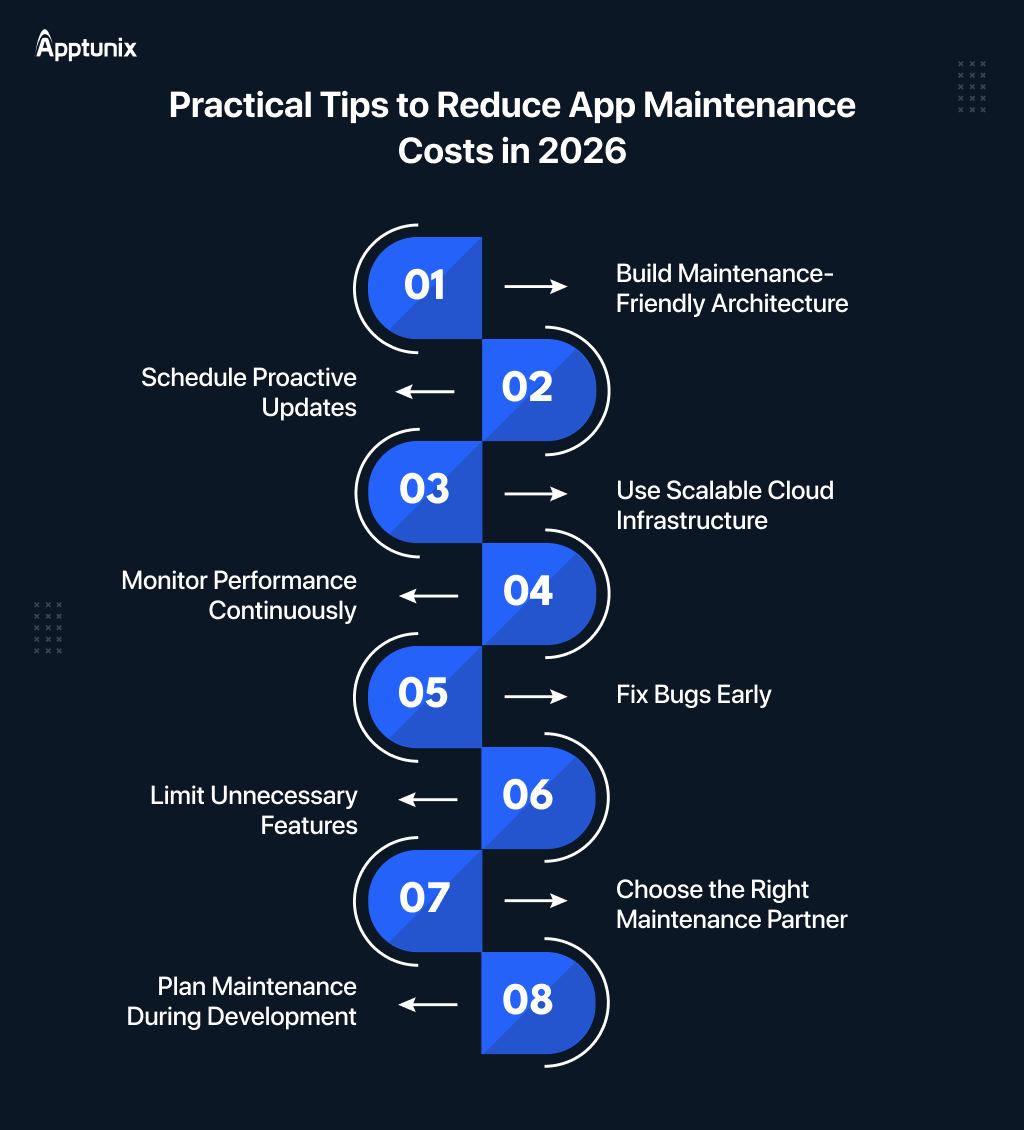
A clean, modular architecture allows developers to make updates without breaking other parts of the app. This reduces the risk of costly emergency fixes and simplifies testing.
Regularly plan OS updates, dependency upgrades, and performance optimizations. Staying ahead prevents last-minute, high-cost interventions.
Opt for cloud solutions that scale automatically with traffic. This reduces over-provisioning costs while avoiding downtime during traffic spikes.
Implement monitoring and alert systems to catch issues early. Proactive monitoring reduces cost to maintain a mobile app by avoiding major disruptions.
The earlier a bug is detected, the cheaper it is to fix. Integrate continuous testing and rapid response workflows to address issues before they escalate.
Every extra feature increases maintenance complexity. Focus on core functionality and avoid building features that will rarely be used.
Experienced teams reduce unexpected costs. They handle updates, compatibility, and bug fixes efficiently. A reliable partner lowers long-term risk.
Maintenance planning should start at the design phase, not after launch. Architect the app for scalability, modularity, and long-term stability.
Apps do not maintain themselves.
They stay stable because skilled developers actively monitor how the product behaves in the real world and respond before small issues become business problems.
This is why developers for app updates and OS compatibility are not optional support resources. They are a core part of long-term app ownership.
1-Keeping Up With iOS and Android Platform ChangesEvery year, Apple and Google change how apps are expected to work.
Permissions evolve. APIs get deprecated. Background tasks behave differently. UI guidelines shift. What worked last year may quietly fail after the next OS release.
Handling these changes correctly affects both iOS app maintenance cost and Android app maintenance cost.
Android maintenance often requires broader testing because of device diversity and manufacturer customizations. iOS maintenance demands strict adherence to platform rules and app store policies.
When teams fall behind, the result is predictable. Crashes increase. Store rejections happen. Features stop working without warning. Users notice before dashboards do.
2-Managing SDKs, APIs, and Third-Party DependenciesMost modern apps depend on external services to function.
Payments, analytics, maps, notifications, authentication, and customer support tools all run on third-party SDKs and APIs. These tools update on their own schedules.
When they change, apps must adapt.
This work is invisible to users, but critical to stability. Ignoring dependency updates creates fragile systems that break under pressure.
This layer alone directly impacts the cost of mobile app support and maintenance, especially for apps with complex feature sets.
3-Backward Compatibility and Device CoverageUsers upgrade at different speeds. Some stay on older OS versions. Others use lower-end devices with limited resources. Maintenance teams must ensure that updates do not break experiences for these users.
Backward compatibility requires careful testing, version control, and gradual rollouts. It is one of the main reasons maintenance effort grows as an app scales.
Skipping this work leads to fragmented experiences and rising support costs.
4-Reactive vs Proactive Bug FixingHow bugs are handled matters as much as how quickly they are fixed.
Reactive maintenance waits for users to complain. Proactive maintenance looks for warning signs before users feel the impact.
Apps that rely on developers for proactive bug fixing and maintenance spend less over time. They avoid emergency releases, reduce churn, and protect ratings.
Reactive teams always pay more because urgency compresses timelines and raises risk.
5-SLAs, Response Time, and Their Impact on Maintenance CostResponse expectations shape maintenance budgets.
An app that can tolerate a 24 or 48-hour fix window costs less to maintain than one that requires immediate resolution. Enterprise applications often need strict SLAs, on-call coverage, and continuous monitoring.
These requirements increase maintenance costs, but they also protect revenue, user trust, and operational stability. Maintenance is not just about fixing code. It is about how quickly problems are detected and how reliably they are resolved.
Every business faces the same question after launch: should maintenance be handled internally or outsourced? The answer depends on your priorities, resources, and growth plans. Here’s a practical comparison.
Key Takeaways
App maintenance is not just about fixing bugs or updating an OS. It’s about ensuring your app stays reliable, performant, secure, and ready to scale as your business grows. Companies that treat maintenance as a strategic priority gain a competitive edge. That’s why many turn to Apptunix for long-term support.
Apptunix works as an extension of your team, not just a vendor. From early-stage startups to global enterprises, the company provides structured processes, specialized expertise, and dedicated teams that adapt as your app evolves. This partnership ensures continuity, reduces knowledge gaps, and allows businesses to focus on growth rather than firefighting technical issues.
Maintenance shouldn’t be a hidden expense. Apptunix plans every update, patch, and scalability effort in advance, ensuring the annual app maintenance cost aligns with your projections. By clearly outlining deliverables and timelines, the cost to maintain a mobile app becomes predictable, helping finance teams plan budgets without surprises.
The Apptunix team doesn’t wait for problems to appear. They monitor apps continuously, manage OS updates, SDK changes, security patches, and bug fixes before they impact users.
This proactive approach reduces emergency fixes, prevents downtime, maintains app ratings, and ensures your app continues performing smoothly under all conditions.
Maintenance needs change as apps grow. An MVP requires lightweight monitoring and reactive support, while enterprise apps demand strict SLAs, extensive testing, and high availability.
Apptunix scales its maintenance plans accordingly, adjusting team size and expertise to match traffic, feature complexity, and evolving business requirements. This ensures mobile app maintenance services remain cost-effective and efficient at every stage.
Security is no longer optional. Apptunix integrates continuous security monitoring, vulnerability patching, and compliance checks into all maintenance plans. Apps remain compliant with platform policies, data protection regulations, and industry standards, reducing risk and safeguarding user trust.
Maintenance is not just backend upkeep. Apptunix continuously optimizes performance, monitors crashes, and enhances UX where needed. By doing so, apps stay fast, reliable, and user-friendly, improving engagement and retention without unnecessary feature bloat.
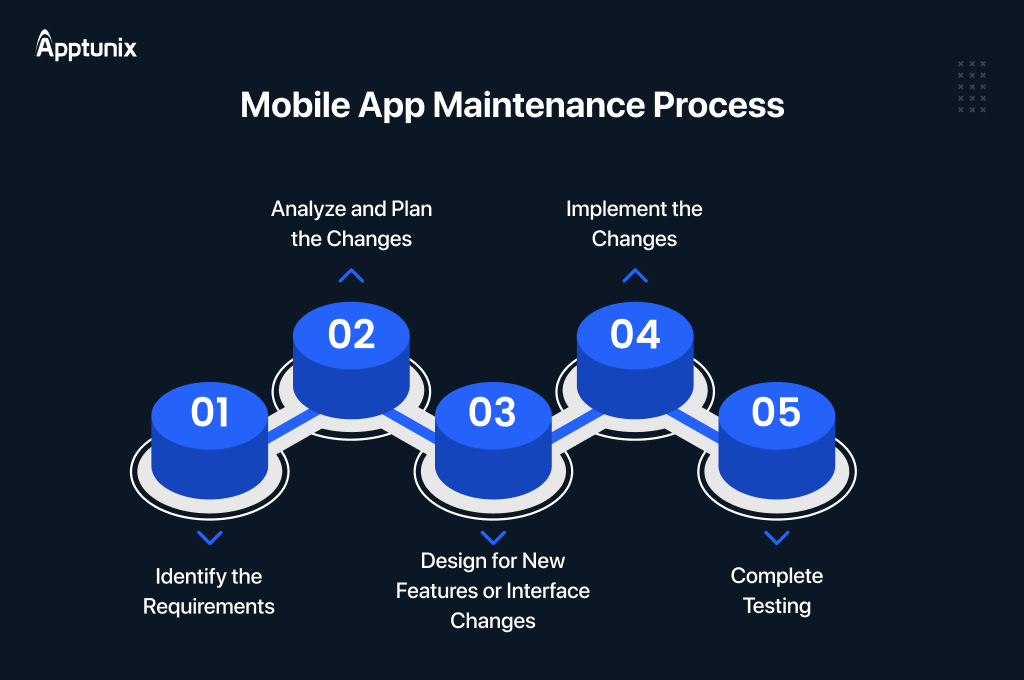
Maintaining a mobile app successfully is more than reacting to issues. It requires a structured approach, clear visibility, and proactive planning. At Apptunix, we follow a 7-step maintenance process designed to keep apps stable, secure, and scalable while keeping the ongoing app maintenance cost predictable.
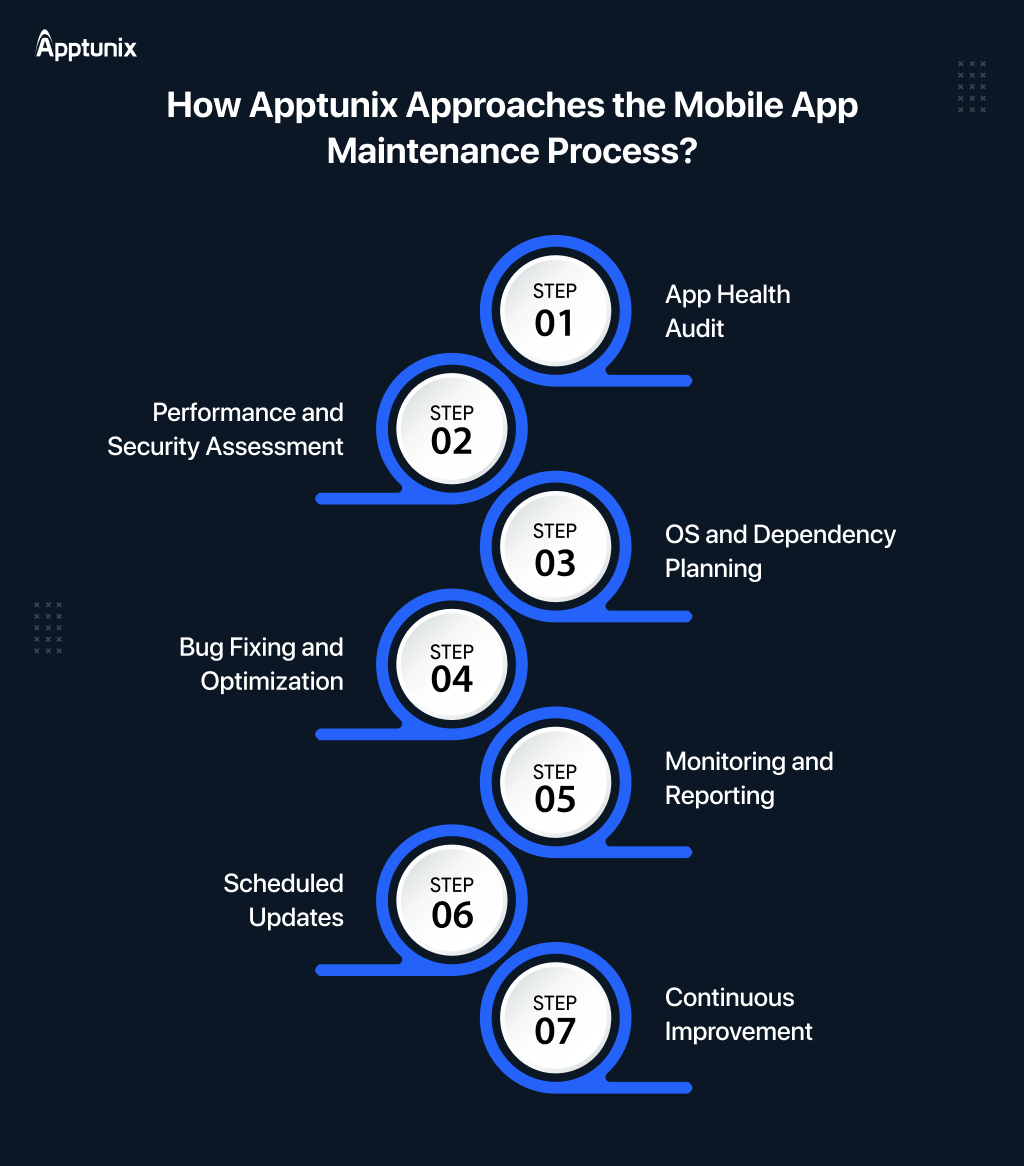
Every maintenance engagement begins with a thorough health audit. We analyze the app’s performance, infrastructure, code quality, security, and user feedback. This step identifies hidden issues that could inflate the cost to maintain a mobile app if left unchecked.
We assess speed, responsiveness, crash reports, and security vulnerabilities. By prioritizing both iOS app maintenance cost and Android app maintenance cost, we ensure that updates and optimizations are planned to avoid costly emergencies later.
Mobile platforms and third-party services evolve constantly. We plan for OS updates, SDK upgrades, and API changes in advance. This keeps apps compatible across devices and ensures smooth operations, minimizing unexpected spikes in annual app maintenance cost.
Proactive bug fixing reduces downtime and improves user satisfaction. Our team addresses both functional issues and performance bottlenecks. This step forms the core of the cost of mobile app support and maintenance, ensuring stability while preventing urgent, high-cost interventions.
We implement continuous monitoring for crashes, performance, and user engagement. Transparent reporting provides clear visibility into the app maintenance budget, making it easy for decision-makers to understand where investments are going and the ROI of maintenance activities.
Regular updates for features, OS compatibility, and security patches are scheduled based on business priorities. This ensures apps remain modern, secure, and aligned with platform requirements without inflating mobile app maintenance pricing.
Maintenance is never static. We analyze performance trends, user feedback, and industry changes to improve the app continuously. Over time, this approach reduces reactive work, stabilizes ongoing app maintenance cost, and strengthens the app’s competitive position.
Did you know that over 70% of mobile apps fail within the first year after launch, not because the idea was bad, but because maintenance was neglected? Poorly planned updates, delayed bug fixes, and unexpected platform changes quietly kill app performance and user trust.
The early decisions you make—architecture, platform strategy, monitoring, and partner selection—directly shape the mobile app maintenance cost after launch.
The right mobile app development company turns maintenance from a reactive expense into a long-term growth engine. Don’t wait for crashes or app store rejections to force action. Evaluate your current maintenance strategy today. Plan for proactive updates, assign the right team, and choose a partner who can handle OS updates, bug fixes, and growth scaling.
Take action now: Secure predictable maintenance, reduce risk, and keep your app ready for growth before it’s too late.

Q 1.What is mobile app maintenance cost in 2026?
Mobile app maintenance cost typically ranges from 15% to 30% of the original development cost per year. The exact figure depends on app complexity, platforms, integrations, and user scale.
Q 2.What does the cost to maintain a mobile app include?
It includes bug fixes, OS updates, security patches, performance optimization, server costs, third-party API updates, and ongoing monitoring.
Q 3.How do I estimate my app maintenance budget accurately?
Start by assessing app size, platform count, traffic volume, third-party services, and expected update frequency. A structured maintenance plan makes budgeting predictable.
Q 4.What is the annual app maintenance cost after launch?
For most businesses, the annual app maintenance cost falls between $20,000 and $100,000+, depending on scale, features, and growth expectations.
Q 5.How does Apptunix handle iOS and Android maintenance together?
Apptunix uses proactive monitoring, planned updates, and transparent reporting to prevent surprise expenses. Dedicated teams manage platform-specific updates while maintaining a unified maintenance roadmap.
Q 6.How often should an app be updated after launch?
Most production apps require updates every 4 to 6 weeks for bug fixes, compatibility, or performance improvements.
Q 7.How do I know if my app maintenance strategy is failing?
Frequent crashes, delayed updates, rising support tickets, and declining ratings are early warning signs.
Q 8.What makes Apptunix different from other maintenance providers?
Apptunix focuses on long-term stability, not reactive fixes. Clients get predictable costs, fewer outages, and better app performance. Apptunix conducts a full app audit, documents the system, and transitions maintenance smoothly without downtime.
Get the weekly updates on the newest brand stories, business models and technology right in your inbox.
Book your consultation with us.
Book your consultation with us.


One Central, The offices 3, Level 3, DWTC, Sheikh Zayed Road, Dubai
+971 50 782 1690