Airbnb Business & Revenue Model Explained!
6301 Views 14 min January 8, 2026

Explores how the U.S. sports betting industry evolved after regulatory changes and why profitability required more than transaction volume
Examines the strategic positioning and ecosystem thinking behind the FanDuel business model and its market leadership
Breaks down platform structure across sportsbook, casino, fantasy sports, racing, media, and data infrastructure layers
Explains diversified revenue streams that shape modern sportsbook platform monetization strategies
Extracts practical lessons for entrepreneurs building engagement driven digital ecosystems
Reveals the technical architecture powering real time wagering platforms, from betting engines to fraud detection
Provides a structured development roadmap for launching a sportsbook platform aligned with compliance and scalability
Highlights essential features that influence user trust, engagement depth, and retention
Outlines realistic investment ranges and cost expectations across product maturity stages
Demonstrates how Apptunix supports businesses in translating strategy into scalable platform execution
Sports betting in the United States has long carried an unusual reputation. It grew rapidly, attracted substantial user interest, and generated substantial transaction volume. Yet profitability remained elusive. Industry projections indicate that U.S. digital gaming revenue will rise to nearly $56 billion by 2030.
The repeal of the Professional and Amateur Sports Protection Act opened the door for regulated betting across multiple states. Competition intensified almost overnight. New entrants raced to secure market share, legacy gaming companies expanded their digital offerings, and technology providers introduced data-driven tools.
That turning point came with the rise of the FanDuel business model. Instead of relying solely on betting volume, the platform leaned into diversification and ecosystem thinking. It built multiple revenue streams, invested in behavioral data, and prioritized user retention as much as acquisition.
Looking through the lens of a broader US sports betting market analysis, FanDuel’s position stands out clearly. The platform commands roughly 43 percent of the sports betting market share US, which places it ahead of most competitors. Scale alone does not explain that outcome. Strategy does.
To understand the structure behind the platform, start with ownership and evolution. FanDuel operates under Flutter Entertainment, a global gaming company that provides operational scale and technological backing. This relationship strengthens capital access, infrastructure investment, and regulatory positioning across markets.
The platform did not begin as a sportsbook. It entered the market through the daily fantasy sports business model, where users assembled virtual teams and competed based on real athlete performance. That format built a loyal user base and provided behavioral insights long before nationwide sports wagering expanded.
Timing played a critical role as well. Flutter increased its stake in FanDuel just as legalization accelerated across states. That move positioned the platform to capture growth when market demand surged. Early access to users and data translated into an advantage that competitors struggled to match.
Today, discussions around the broader sportsbook business model often reference this trajectory as a case study in strategic pivoting. Instead of launching directly into wagering without context, FanDuel entered with an existing engagement funnel and transitioned users naturally into expanded offerings.
Market leadership does not happen by accident. FanDuel established dominance through aggressive product rollout and disciplined user retention strategies. It secured a leading position in sportsbook usage while also growing its presence in online casino gaming, a segment known for steadier margins and consistent engagement patterns.
Revenue momentum reflects this positioning. Continued user expansion, combined with higher participation across multiple products, strengthens financial outcomes year over year. Industry observers frequently point to the platform when analyzing competitive benchmarks because its performance reflects more than short-term promotional gains.
From a practical perspective, the platform illustrates how scale interacts with trust and usability. Users stay where interfaces remain intuitive, payouts feel reliable, and experiences stay consistent across sports seasons. This dynamic reinforces leadership within the sports betting market share US landscape and supports long-term engagement cycles.

At its center, FanDuel operates as a digital-first entertainment ecosystem rather than a single betting tool. The platform focuses on immediacy and accessibility. Users interact with live data, place wagers in real time, and track performance through responsive interfaces that adapt quickly to changing events.
Several principles shape this value proposition:
These elements work together to create an environment where interaction extends beyond placing bets. When people explore how FanDuel works, they often notice how recommendations, odds adjustments, and interface prompts align closely with past activity. Personalization plays a direct role in engagement and conversion.
This approach reflects a matured interpretation of the sportsbook business model. Instead of transactional interaction, platforms prioritize relationship building through tailored experiences.
FanDuel’s ecosystem demonstrates how layered product offerings strengthen resilience. Each component supports others, creating a loop that encourages exploration and retention.
When people explore the FanDuel business model, revenue often becomes the focal point. Yet revenue does not come from one activity. Modern platforms rely on layered monetization, where different services reinforce each other. This structure reflects the reality of the sports betting app development , where engagement depth matters as much as transaction volume.
To understand how sportsbook apps make money, it helps to break down the streams that contribute to stability and growth. FanDuel’s approach illustrates how diversification shapes the broader FanDuel revenue model and why similar platforms design ecosystems rather than single offerings.
Below are six revenue streams that highlight the mechanics behind successful online betting platform revenue streams.
Sports wagering forms the largest contribution to overall income. At a basic level, operators set odds that create a margin between potential payouts and total wagers placed. That margin, often called the hold, produces earnings when balanced correctly.
Consider live betting as an example. Users place multiple wagers during a single match. Increased activity expands total handle, which improves revenue potential even when margins stay modest. This explains why betting innovation remains central to the FanDuel revenue model.
Sports seasons fluctuate. Casino activity fills the gaps. Digital table games and slots operate year round and deliver steadier engagement patterns. These characteristics make them highly valuable in financial planning.
These factors align with broader iGaming monetization strategies seen across global operators. Platforms often encourage migration from sports betting into casino experiences because consistent engagement stabilizes earnings.
The platform’s origins in the daily fantasy sports business model still influence acquisition strategy today. Fantasy contests attract users who enjoy sports analysis but may hesitate to wager directly.
For example, a user who tracks player performance in fantasy leagues often feels comfortable exploring betting options later. That progression demonstrates how fantasy sports operate as both revenue contributors and onboarding tools within larger online betting platform revenue streams.
Engagement does not rely solely on transactions. Content also drives participation. FanDuel integrates media services that deepen user interaction and extend time spent within the ecosystem.
Horse racing illustrates this clearly. It operates on different cycles than major sports leagues, which expands betting opportunities throughout the year. This complementary structure strengthens the overall sports betting platform business model.
Modern betting platforms collect significant performance data and analytical insights. FanDuel converts that expertise into commercial value through technology products and analytical services.
Such activity shows that digital platforms monetize knowledge alongside transactions. Data becomes a product in itself, contributing another layer to the FanDuel revenue model.
Strategic collaborations generate indirect yet meaningful income. Partnerships with sports leagues, brands, and media companies expand exposure and unlock sponsorship opportunities.
Though less visible than wagering income, partnerships reinforce the ecosystem structure central to the FanDuel business model.
Studying FanDuel reveals more than revenue tactics. It offers insight into decision-making that shapes sustainable platforms. Entrepreneurs exploring betting or entertainment ecosystems can draw several practical lessons.

Platforms that rely on one service limit growth potential. FanDuel demonstrates how interconnected offerings strengthen engagement. Users shift between fantasy contests, wagering, and casino activities, which increases lifetime value.
Behavioral data guides recommendation engines, odds refinement, and promotional targeting. Thoughtful data use transforms insights into revenue opportunities while improving user experience.
Users rarely begin with full participation. Platforms that nurture progression from entry level interaction to advanced engagement unlock higher returns over time.
Operating in regulated markets demands preparation and discipline. Companies that plan for compliance early build trust and scale faster once approvals arrive.
Growth brings operational efficiency. Larger platforms negotiate better partnerships, invest in stronger technology, and distribute costs across wider audiences. Scale strengthens resilience within competitive markets.

When people study the FanDuel business model, they often focus on market share or revenue. Technology rarely gets the spotlight, yet it holds everything together. A sportsbook does not function like a typical entertainment app. It behaves more like financial infrastructure. Money moves in real time. Decisions rely on data that changes every second. A minor delay can disrupt trust or create risk exposure.
This reality shapes how developers approach architecture. Strong engineering discipline defines success in the sportsbook business model, and it plays a direct role in executing a profitable sportsbook strategy. Anyone planning sports betting app development must understand that reliability, speed, and compliance carry equal weight alongside user experience.
Let’s break down the foundations that support platforms operating at scale.
This system calculates potential payouts, accepts wagers, and balances exposure. Developers design it to process thousands of actions per second while maintaining accuracy.
During a major football match, users place bets continuously. The engine must update odds and accept wagers instantly. Even slight delays frustrate users and introduce financial risk.
Platforms rely on live sports data streams to reflect match progress. These feeds trigger interface updates and pricing adjustments. Without fast event processing, users would see outdated information, which damages credibility and engagement.
This layer handles deposits, withdrawals, and balance updates. It mirrors fintech transaction handling because money movement demands traceability and security.
Developers integrate encryption, transaction monitoring, and reconciliation processes to maintain trust.
Operators track unusual betting patterns and suspicious activity. Analytical tools identify anomalies and flag them for review.
This capability protects both users and operators while supporting compliance obligations highlighted in many US sports betting market analysis reports.
Developers prepare systems to handle bursts during major league games or playoffs. Capacity planning ensures performance remains stable under pressure.
Many modern platforms adopt microservices structures. Teams separate functions like payments, odds calculation, and notifications into independent services.
This setup allows updates without disrupting the entire platform. Monolithic designs still appear in smaller projects, yet they limit flexibility as user bases grow.
Cloud infrastructure distributes traffic across servers. Load balancing prevents bottlenecks and maintains responsiveness during sudden spikes.
This approach aligns well with scaling needs observed across leading operators implementing the daily fantasy sports business model, where event driven engagement also creates unpredictable usage patterns.
These partners deliver live statistics and event updates. Reliable feeds ensure accurate betting interfaces and informed odds management.
User onboarding requires age checks and identity confirmation. Verification tools automate this process while reducing fraud risk.
Understanding architecture provides context, but execution requires structure. Building a betting platform like FanDuel demands coordination across strategy, compliance, design, and engineering. Teams that rush forward often miss regulatory constraints or scalability needs, and those gaps surface later as expensive rebuilds. A disciplined approach prevents that.
The pathway below reflects industry practice and lessons drawn from observing successful implementations across mature operators.
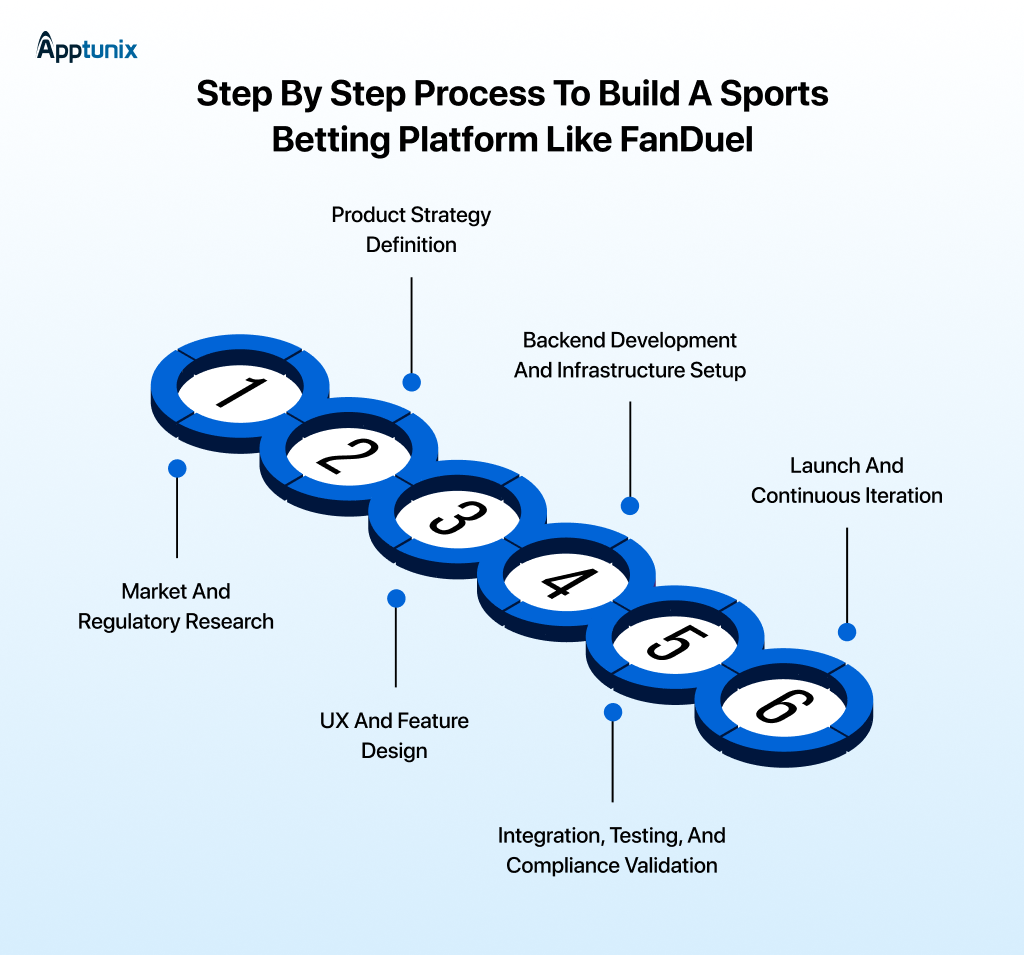
Development starts well before any technical work begins. Founders study target regions, local laws, and operational limits to understand where and how a platform can operate. This stage shapes every later decision, from onboarding workflows to payment options and identity checks.
Teams evaluate market demand across jurisdictions, examine licensing obligations, and map compliance requirements that influence product architecture. When organizations skip this groundwork, they often redesign systems mid project because regulatory realities clash with product assumptions. Solid preparation lays the foundation for a sustainable sportsbook business model and aligns early thinking with insights commonly surfaced in US sports betting market analysis discussions.
Once constraints become clear, teams define direction. Strategy determines what gets built first and what waits. Scope planning influences investment, timelines, and competitive positioning, so decision makers treat this stage seriously rather than as a quick checklist.
Leaders determine whether to launch with a focused MVP or a feature rich release, select target sports and wager formats, and shape monetization goals that reflect realistic expectations. These choices guide whether the platform supports a viable profitable sportsbook strategy or spreads resources across too many features too early. Thoughtful planning here echoes patterns seen in the FanDuel business model, where staged expansion created stability over time.
User experience defines trust. Designers shape flows that feel intuitive and responsive, because hesitation during transactions undermines confidence. Clear navigation and predictable interactions encourage engagement and repeat usage.
Teams design bet placement journeys that minimize friction, build real time odds displays that update smoothly, and craft dashboards that show balances and histories without confusion. A helpful comparison comes from financial apps. People expect clarity when managing funds, and betting platforms must meet similar expectations during sports betting app development. Careful interface work often separates platforms users try once from platforms they adopt regularly.
Engineering teams transform strategy and design into functioning systems. This stage centers on building the engine that powers wagers, payments, and account handling. Developers structure infrastructure for reliability because the platform must respond instantly under pressure.
Work includes constructing the betting engine environment, integrating external data sources, and configuring systems that maintain performance under heavy traffic simulations. Teams test extensively during this phase because realistic load conditions reveal issues long before public release. Strong engineering discipline supports scalability and protects the integrity of the broader sportsbook business model.
Before launch, teams refine connections between internal systems and external services while validating regulatory alignment. This stage blends technical checks with operational readiness, ensuring everything works together smoothly.
Developers connect identity verification tools, payment services, and data providers while testing performance across varied scenarios. Compliance reviews confirm that user flows respect jurisdictional requirements and geolocation rules. This phase often determines long term stability because rushed validation leads to disruptions after release. Mature operators treat testing as refinement rather than formality.
Release signals the beginning of learning rather than completion. Once users engage with the platform, real behavior reveals patterns impossible to predict during planning. Teams observe usage closely and adjust accordingly.
Operators analyze interaction data, refine risk controls, and introduce new features gradually as confidence grows. Continuous evolution keeps the platform relevant and responsive to changing expectations. This approach mirrors patterns visible across the FanDuel business model, where steady iteration supported expansion from fantasy sports roots into a broader wagering ecosystem influenced by the daily fantasy sports business model mindset of engagement driven growth.
Feature selection shapes perception more than branding or promotions. Users judge a platform by how easily they move through it, how quickly it responds, and how confident they feel placing wagers. That reality defines the sports betting platform business model today. Platforms win loyalty through usability and trust rather than flashy interfaces.
When teams study the FanDuel business model, they notice careful layering of functionality across user experience, operational control, and engagement mechanics. Building a competitive product through sports betting app development services means balancing all three areas without overloading early releases.
Below are seven capabilities that consistently define strong platforms.
Onboarding sets the tone for trust. Users expect smooth registration, identity validation, and payment setup without friction or confusion. Teams design this flow to feel guided rather than procedural, because hesitation during sign up often leads to abandonment. This stage also connects closely to compliance obligations and lays the foundation for monetization seen across many online betting platform revenue streams.
The betting interface acts as the core interaction layer. Users browse markets, compare odds, and place wagers within seconds, so responsiveness matters. Designers focus on clarity and quick updates that mirror live match progress. Anyone exploring how sportsbook apps make money quickly realizes that interface efficiency directly impacts betting frequency and transaction volume.
Cashout capability allows users to settle wagers before outcomes conclude. This feature improves perceived control and reduces anxiety during volatile events. Platforms that integrate flexible settlement mechanisms often see stronger engagement patterns because users feel empowered rather than locked in. It also reflects maturity within modern iGaming monetization strategies that prioritize experience alongside profit.
Users enjoy combining wagers across events or outcomes. Multi bet tools support this behavior by simplifying complex selections into manageable workflows. This capability increases session depth and average wager value, aligning closely with patterns established through the daily fantasy sports business model, where strategic combinations drive engagement.
Operational teams require robust dashboards to manage risk and performance. Admin tools allow configuration of odds, monitoring of player trends, and oversight of exposure levels. These insights strengthen decision making and shape the evolving FanDuel revenue model, where analytics guide pricing and promotional targeting rather than guesswork.
Real time wagering and tailored suggestions transform casual users into active participants. Live betting keeps engagement high during events, while recommendation systems surface markets aligned with individual behavior. This combination reflects practices visible across the FanDuel business model, where personalization strengthens lifecycle value.
Retention tools encourage long term participation through rewards, tier progression, and promotional benefits. Platforms introduce these incentives gradually to avoid overwhelming users while still reinforcing loyalty. Thoughtful implementation supports sustainable online betting platform revenue streams and contributes to broader lifecycle engagement.
Investment planning shapes execution as much as technical capability. Costs vary based on complexity, compliance scope, and market ambitions. Instead of fixed numbers, realistic planning relies on ranges because each platform reflects different priorities.
Organizations often align budgets with staged expansion. This mirrors lessons visible in the FanDuel business model, where growth followed gradual capability increases rather than immediate large scale deployment. Below is a simplified planning view showing how investment and development time often align across project scales.
An entry level platform focuses on core wagering flows, basic integrations, and foundational backend services. Teams prioritize validation over scale, which keeps early investment manageable.
Typical Range: $40K to $90K
A more mature release introduces full sportsbook features, scalable infrastructure, and stronger security layers. This stage prepares the product for sustained growth and deeper market competition.
Typical Range: $100K to $250K
Large scale ecosystems support multi region deployment, advanced personalization, and sophisticated risk management engines. This tier resembles platforms competing at market leadership levels.
Typical Range: $300K to $700K+
Post launch expenses include data subscriptions, regulatory licensing, infrastructure hosting, and compliance updates. These recurring investments ensure stability and support long term sports betting platform business model sustainability.
Entering digital wagering markets requires more than ambition. Founders face regulation complexity, infrastructure challenges, and monetization strategy decisions that shape long term viability. This is where Apptunix steps in as a technology and product partner focused on execution as much as planning.
We work with startups and established enterprises that want to translate insights from evolving platform ecosystems into real products grounded in performance and scalability. Our role goes beyond coding applications. We guide businesses through architectural thinking and product alignment so their sports betting platform business model matches market realities.
Our teams convert industry understanding into actionable system design that supports both compliance and scale. We evaluate monetization approaches, map technical dependencies, and align product features with long term growth objectives. Businesses entering regulated betting environments benefit from this structured connection between planning and implementation.
We support the full lifecycle of platform creation through discovery, experience design, engineering, and optimization. Product teams collaborate on roadmaps that emphasize engagement and retention, then build custom sportsbook applications integrated with payment systems, wallets, and regulatory requirements. Continuous scaling support ensures platforms evolve with market expansion rather than reacting to it.
Modern betting systems demand high performance infrastructure that processes live data instantly while maintaining security. Our engineers design environments capable of handling real time transactions, dynamic content updates, and cloud based scaling. Analytics integration allows operators to refine personalization, strengthen retention strategies, and experiment with iGaming monetization strategies using behavioral insights.
Execution should always align with measurable outcomes. We prioritize transparency, agile collaboration, and milestone driven development so stakeholders maintain visibility throughout production cycles. This approach ensures that technical investment contributes directly to ROI and sustainable platform growth, especially for organizations searching for a reliable sports betting app development company.
Stepping back and looking at what the industry has built over the last decade, one thing becomes obvious. Success rarely comes from copying features. It comes from understanding why those features exist and how they fit into a bigger ecosystem. Studying the FanDuel business model offers exactly that kind of perspective. It shows how diversification, user engagement, and technology discipline combine to shape a profitable platform.
The market continues to expand geographically and digitally. Regulatory frameworks evolve, mobile adoption grows, and younger audiences expect seamless experiences. Industry leaders offer valuable signals, not templates to copy blindly. Their strategies reveal patterns, priorities, and execution discipline. When founders analyze them carefully, they gain direction without losing originality.
If you plan to enter this space, now is a practical moment to move from observation to action. Build a roadmap grounded in data. Think beyond feature lists. Design an ecosystem that evolves with users.
And when you reach the point of turning strategy into execution, remember you do not have to navigate it alone. Our team stands ready to help businesses explore platform development, architect scalable systems, and bring competitive products to market.

Q 1.What is the FanDuel business model and why is it considered successful?
The FanDuel business model centers on diversification rather than relying on one revenue stream. Platforms combine sportsbook betting, fantasy contests, casino games, and partnerships to create multiple earning channels. This structure reduces risk and keeps users engaged across different formats, which explains how FanDuel achieved sustained profitability while scaling in competitive markets.
Q 2.How sportsbook apps make money beyond user wagers?
People often assume betting margins drive all revenue, but that only explains part of it. To understand how sportsbook apps make money, look at multiple channels such as commissions on bets, promotional partnerships, cross selling casino products, and subscription features. These methods form key online betting platform revenue streams and align with broader iGaming monetization strategies.
Q 3.What trends define the US sports betting market today?
A strong US sports betting market analysis highlights rapid legalization across states, rising mobile adoption, and intense competition among operators. Market expansion influences user acquisition costs and shapes long term planning. Changes in sports betting market share US rankings often reflect innovation in product experience, partnerships, and promotional investment.
Q 4.How complex is it to build a sportsbook platform from scratch?
Launching a betting product involves more than interface design. Teams must address compliance, payment security, real time data feeds, and scalability. Partnering with a specialized sports betting app development company helps organizations navigate regulatory structures and technical complexity while aligning execution with their chosen sports betting platform business model.
Q 5.What should businesses evaluate before entering betting markets?
Organizations benefit from assessing jurisdiction regulations, infrastructure requirements, competitive positioning, and monetization planning before development begins. Strategic clarity at this stage ensures product decisions align with realistic growth expectations and reduces expensive adjustments later.
Get the weekly updates on the newest brand stories, business models and technology right in your inbox.
Book your free consultation with us.
Book your free consultation with us.

One Central, The offices 3, Level 3, DWTC, Sheikh Zayed Road, Dubai, United Arab Emirates
+971 50 782 1690