Top 50 Startup Business Ideas in Australia: 2026 Updated List
3 Views 11 min March 2, 2026

Mobile-first learning is no longer optional, with students, teachers, and parents relying on educational apps for daily learning and outcomes.
The blog explains how EdTech has shifted from a nice-to-have to a necessity, driven by interactivity, automation, and scalable learning models.
It breaks down what makes top educational apps successful, covering UX, gamification, AI assistance, content quality, and retention strategies.
Readers get real-world insights into how leading apps design for different audiences, from school students to professionals and lifelong learners.
The content highlights monetization models used by top education apps, including subscriptions, freemium, enterprise licensing, and course-based pricing.
Key market insights show why EdTech continues to grow globally, with strong demand across K-12, higher education, and professional upskilling.
It explains how startups can validate, design, and scale competitive education apps with a mobile-first, product-led approach.
Top 10 Educational Apps include Duolingo, Khan Academy, BYJU’S, Coursera, Photomath, Quizlet, Edmodo, Skillshare, Google Classroom, Brainly, Udemy, Mimo, SoloLearn, Codecademy Go, Babbel, Memrise, Rosetta Stone, Busuu, Socratic, Khanmigo, ELSA Speak, and ChatGPT.
The global appetite for mobile-first learning is clear. Students expect interactivity. Teachers expect automation. Parents expect results. And education platforms? They’re expected to deliver all of that without friction. EdTech is redefining how people learn, teach, and build knowledge at scale. Over 90% of students use top educational apps for studying.
Here’s the thing: mobile learning has officially crossed over from novelty to necessity.
If you’re a startup founder, product owner, or innovation lead thinking about education app development, understanding what today’s market leaders are doing right isn’t optional. It’s foundational. We’ve pulled together 10 top online learning apps for students that are setting new standards in usability, scale, and learning outcomes.
Whether you’re working on e-learning app development, researching features of top educational apps for your MVP, this list shows what’s working in the real world and why.
1 DuolingoWhat it does: Helps users learn languages through micro-lesson, gamified format.
Why it works: Duolingo has combined small, light learning with tracking progress and light gamification – gaps, hearts, challenges – and it worked enough that people kept coming back. Their UX is simple, playful, and mobile-first.
Key takeaway: If you’re building an education app, do not view a gamification as fluff. It is a habit-forming design that defines retention.
2 Khan AcademyWhat it does: Free learning across math, science, history, and so on.
Why it works: A strong back-end bolsters Khan Academy’s personalized learning paths and strong analytics. Even while capturing millions of learner experiences, it also exposes teachers to learner performance. It can be used by independent learners or in classrooms.
Key takeaway: Scalability is important as well. If you’re building an edtech app, then carefully consider investing in the infrastructure that can support adaptive content while scaling student workflows to teacher workflows.
3 BYJU’SWhat it does: Provides curriculum-aligned learning for K-12 and competitive exams.
Why it works: BYJU’S teaches through visual storytelling, AI-based personalization, and a library of high-quality video content. This works particularly well for younger students and as such is one of the best educational apps in Asia for kids.
Key takeaway: High-quality content + intelligent delivery = competitive product. Do not just think of the app functionality when providing learning and development apps consider how much impact the content experience has on the brand value.

4 CourseraWhat it does: Provides online courses from top universities and companies across the globe.
Why it works: Modular, Scale, and Certification. Coursera’s flexible user environment suits both individuals and enterprises at large, creating a large and repeatable user base.
Key takeaway: If you’re building for adult learners or enterprise learners, look at how online learning apps for students work such as Coursera, modular course design, verified certificates and enterprise licensing features.
5 PhotomathWhat it does: Solves math problems using a camera on your phone and gives you a step-by-step explanation.
Why it works: Because it uses OCR and AI to give immediate feedback – a real-world problem. It is one of the most useful top mobile apps for education.
Key takeaway: Functionality wins. When you think about what educational application development to pursue, ask: Does your app solve something real in a way that nothing else does?
6 QuizletWhat it does: Offers study tools such as flashcards, quizzes, and gamified practice.
Why it works: Quizlet relies on user-generated content and is fast, flexible, and works for solitary and group study purposes. It allows for over 200M study sets created by users.
Key takeaway: There is power in user-generated, community learning. If you are going to the mobile application development route for an edtech startup, consider functions that allows learners to generate and share content on their own.
7 EdmodoWhat it does: Provides a private social network for classroom collaboration and communication.
Why it works: Allows teachers to assign work, message students, and manage class conversations without leaving the platform, or using other apps. Teachers for teachers build it, and from the UX you can tell!
Key takeaway: Don’t overlook communication in education app development. Messaging, real-time updates, and workflow visibility are mission-critical for teacher-led platforms.
8 SkillshareWhat it does: Offers video-based ‘classes’, centered around creativity, business and technology skills.
Why it works: Skillshare is calling itself a community – not just a platform. And really, it’s a compelling model too: to reward creators, while soliciting feedback and insights from users, keeping the course material fresh and original.
Key takeaway: For lifestyle and skills-based learning; consider monetizing from day one, subscription models, micro-courses, and creator-first design approaches are what makes it one of the best apps for education for adults.
9 Google ClassroomWhat it does: Provides schools with an integrated way to manage virtual classrooms using the Google ecosystem.
Why it works: The power of simplicity and integration. Teachers can assign, collect and grade work all in one ecosystem, without logins, installations, or headaches.
Key takeaway: Simplicity is scalable. In edtech development for institutions, do the hard work on integration and being easy to use first – and in-contrast to building shiny new things.
10 BrainlyWhat it does: delivers a peer-to-peer homework help platform, depending on community answers and moderated with AI.
Why it works: Brainly makes learning collaborative. It combines the scale of a Q&A forum with trust mechanisms like answer ratings and content moderation.
Key takeaway: If you’re building around UGC (user-generated content), moderation tools and smart community design are non-negotiable. It’s how Brainly stays usable and credible at scale.

These apps focus on core academic subjects, exam preparation, and curriculum-aligned learning.
Khan Academy: A non-profit giant offering free, world-class lessons in math, science, and humanities. Its personalized dashboard allows students to master concepts at their own pace with high-quality video tutorials and interactive exercises.
BYJU’S: Famous for its engaging visual animations, BYJU’S makes complex concepts easy to understand for K-12 students. Its “Learning App” features 1-on-1 mentorship and adaptive journeys tailored to individual student performance.
Quizlet: The ultimate tool for memorization, Quizlet uses digital flashcards and AI-powered study sets to help students ace exams. It’s perfect for medical, law, and language students who need to master large volumes of terms.
Google Classroom: A must-have for modern students, this app streamlines the connection between teachers and learners. It simplifies assignment tracking, material sharing, and collaborative group projects within a secure, organized digital environment.
Brainly: A community-driven Q&A platform where students help each other with homework. With millions of verified answers in subjects like Social Studies and Science, it’s a reliable peer-to-peer learning network for tough assignments.
Perfect for those looking to switch careers or master the latest technology.
Coursera: Partnering with top universities like Stanford and Google, Coursera offers professional certificates and degrees. It is the gold standard for high-level technical skills, data science, and business management with industry-recognized credentials.
Udemy: With over 200,000 courses, Udemy is the go-to platform for affordable, specialized skills. Whether you want to learn Excel, Digital Marketing, or Photography, you can find expert-led video courses that fit any budget.
Mimo: Mimo turns learning to code into a game. It offers bite-sized lessons in Python, JavaScript, and HTML, allowing busy learners to build real-world projects and maintain coding streaks right from their smartphones.
SoloLearn: Featuring a massive community of coders, SoloLearn provides interactive lessons across all major programming languages. Its built-in mobile code editor lets you practice writing and running real code while you learn on the go.
Codecademy Go: This mobile companion to the popular website helps you practice coding syntax and concepts through flashcards and quizzes. It’s an excellent way to review programming logic during your daily commute or breaks.
Whether for travel or fluency, these apps make speaking a new language intuitive.
Duolingo: The world’s most popular language app uses gamification to keep you motivated. With short, 5-minute lessons and a competitive leaderboard, it makes learning 40+ languages feel like playing a fun mobile game.
Babbel: Focused on real-life conversation, Babbel is designed by language experts to get you speaking quickly. Its lessons focus on practical topics like ordering food or asking for directions, supported by sophisticated speech recognition.
Memrise: Memrise uses “mems” and videos of native speakers to help you learn a language in context. It focuses on how people actually talk in real life, making it great for picking up local slang and authentic accents.
Rosetta Stone: A pioneer in the field, Rosetta Stone uses an immersive method without translations. It teaches you to associate words with imagery directly, building a deeper, more natural understanding of your target language from day one.
Busuu: Busuu offers structured courses and the unique ability to have your speaking and writing exercises corrected by native speakers. This social feedback loop ensures you learn the nuances of a language correctly.
These apps use cutting-edge Artificial Intelligence to solve doubts and explain logic.
Photomath: Simply point your camera at a math problem, and Photomath provides a step-by-step explanation. It’s not just about the answer; it helps students understand the underlying logic of algebra, calculus, and geometry, while those needing extra support can also seek professional math assignment help.
Socratic by Google: Powered by Google AI, this app helps you find the best online resources for any question. Whether it’s biology or history, Socratic provides visual explanations and curated links to help you understand complex topics.
Khanmigo: This is Khan Academy’s AI tutor that acts as a personal coach. Instead of giving you the answer, it asks guiding questions to help you think critically and solve the problem yourself, mimicking a real human tutor.
ELSA Speak: Using advanced AI speech recognition, ELSA helps you perfect your English pronunciation. It analyzes your voice and gives instant feedback on how to improve your accent, rhythm, and intonation for better communication.
ChatGPT (OpenAI): The ultimate AI assistant for brainstorming, summarizing long chapters, or explaining difficult concepts in simple terms. It can draft essays, write code, and act as a 24/7 study buddy for almost any academic subject.

Great content is only half the equation. The best platforms not only teach well—they monetize wisely. If you’re planning education app development, understanding revenue models used by the top educational apps will help shape your product roadmap and business plan from the start.
Here are five models that continue to drive real growth:
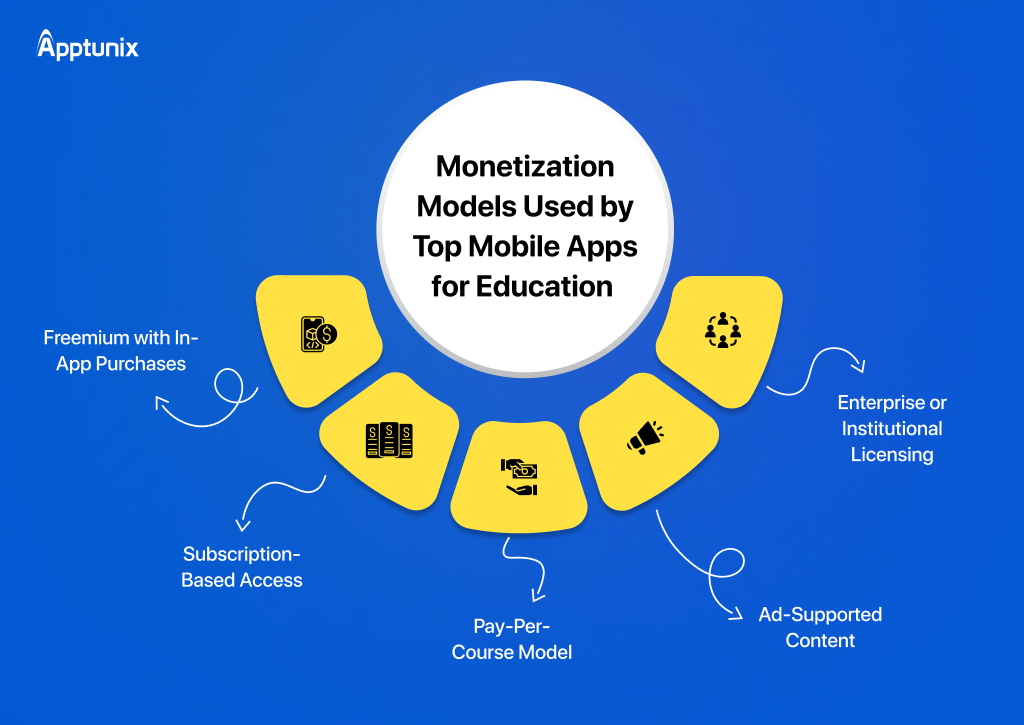
(Examples: Duolingo, Quizlet)
Users get access to basic features for free, while upgrades like ad removal, offline access, or advanced analytics are available via micro-transactions or premium tiers.
Works well for online learning apps for students who are price-sensitive but willing to pay for added convenience or features.
(Examples: Skillshare, BYJU’S)
Content is locked behind a recurring monthly or annual fee. This model works when your platform delivers ongoing value through fresh content, live classes, or personalized learning paths.
Ideal for education app development targeting professional learners, exam prep markets, or school-age users with evolving needs.
(Example: Coursera)
Users pay for individual courses, sometimes with the option to receive a certification. It offers flexibility, particularly in professional or skills-based learning.
A solid model for top mobile apps for education focused on adult learners, corporate training, or higher-ed partnerships.
(Example: Brainly)
Free access in exchange for ad views, often combined with an option to pay for an ad-free experience. It’s a common strategy for platforms targeting large-scale student audiences.
Makes sense when targeting the best educational apps for kids and teens in price-sensitive regions.
(Examples: Google Classroom, Edmodo)
Schools, districts, or enterprise clients license the platform for internal use, often bundled with training, onboarding, and support.
Ideal for B2B edtech app development where scalability, admin control, and integrations matter more than individual sales.
Also Read: How Much Does it Cost to Build an Educational App?
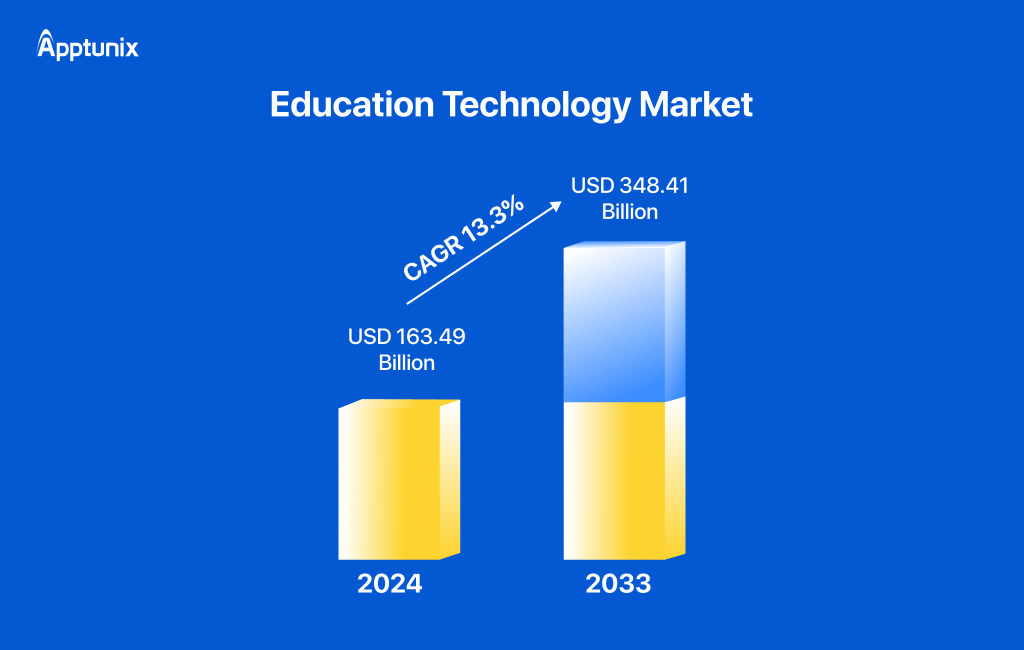
If you’re considering whether now is the right time to build an educational app, here’s what the data says: there’s real demand and real room to grow. The global EdTech market is projected to hit $348 billion+ by 2030, growing at a CAGR of over 13% Learning apps are among the top-performing segments, driven by mobile-first adoption across K-12, higher education, and corporate upskilling.
The usage gap is widening. Top mobile apps for education are seeing significantly higher engagement and retention than their web-only counterparts. Why? Because students expect to learn on the go. And schools are increasingly enabling mobile access.
If you’re investing in custom educational app development, a mobile-first approach is the standard.
Despite market shifts, EdTech remains a magnet for venture capital. The focus is shifting from “growth at any cost” to product-market fit, monetization, and learning outcomes. Investors are looking closely at unit economics, long-term retention, and platform defensibility.
Markets in Southeast Asia, MENA, and parts of Africa are seeing explosive demand for online learning apps for students especially in areas where traditional education systems are under-resourced. Platforms built with these regions in mind offline capabilities, multilingual support, lightweight architecture are finding strong early traction.
Let’s be honest, building an EdTech app that actually competes in today’s market is hard. There’s no shortage of content out there. What’s rare is an experience that’s smart, scalable, and actually improves how people learn.
That’s where we come in.
At Apptunix, we don’t just write code. We partner with EdTech startups and education companies to design, build, and scale platforms that learners actually want to use.
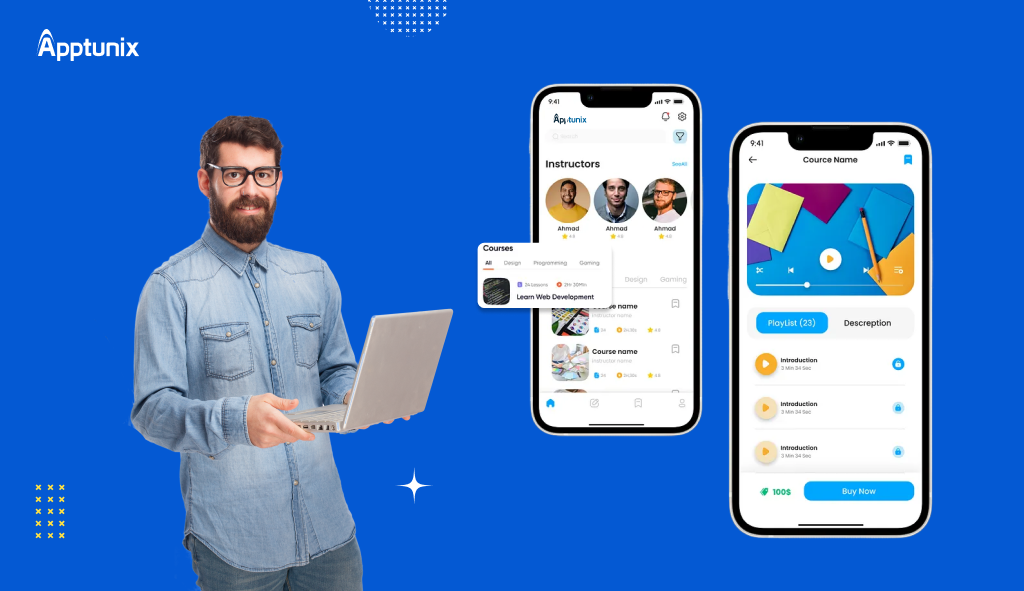
Our work spans every corner of the education space from K-12 learning apps and test prep platforms, to corporate training systems and microlearning tools. If you’re looking for custom educational app development, we’re the team that knows what it takes to go from concept to competitive product.
We work in four clear stages, each one designed to reduce risk, move faster, and deliver results.
Our dedicated development team starts with clarity. We work with you to define what you’re building, who it’s for, and what outcomes you’re aiming for. This is where we lock down your business goals, user personas, core features, and technical roadmap. Whether you’re a solo founder or a funded team, this step makes sure we’re building the right thing.
Education apps aren’t just about content they’re about usability. We craft UX and UI that aligns with how your users learn. For younger audiences, we focus on playful, simplified flows. For professional learners, we streamline navigation and deliver focused functionality. Our goal is to make every interaction intuitive.
We build using modern, scalable frameworks tailored for education. Whether you’re targeting mobile-first users or cross-platform flexibility, we handle the heavy lifting native or hybrid, single language or multilingual. We’ve delivered high-performance platforms powered by Flutter, React Native, Python, Firebase, and more.
We don’t disappear at launch. We track usage, gather feedback, and support product iterations. From onboarding improvements to retention strategies, we help you grow.
Thinking about launching your own EdTech platform?
Get real-world advice from people who build this every day! Let’s validate your idea, map out your MVP, or audit your existing product.
Let’s wrap this up with what really matters. The top 10 educational apps dominating the market today didn’t get there by luck. They’re backed by smart design, strategic technology choices, and a deep understanding of their users. From BYJU’S and Coursera to Duolingo and Quizlet, the winners have something in common: they deliver actual learning value and they’re built to grow.
Whether you’re building for kids, teens, or working professionals, there’s room in the market—but only if your product delivers outcomes.
And that’s where we can help!
Our education app development company take your raw idea and turn it into something learners rely on, and investors notice. If you’re looking for serious EdTech app development, you need more than a dev shop. You need a partner who understands the space and knows how to build for it.

Q 1.How do I start with education app development for my startup?
Start by defining your core users and identify the learning gaps you aim to solve. Then, partner with an EdTech development company experienced in mobile app development for EdTech startups to build a roadmap from MVP to scale.
Q 2.What are the key features of top educational apps?
The most effective educational apps include personalized dashboards, progress analytics, live sessions, gamified elements, offline access, and strong content moderation. These features of top educational apps help boost both user engagement and learning outcomes.
Q 3.Which platforms should I build my educational app on—iOS, Android, or both?
For most online learning apps for students, building for both iOS and Android is essential to maximize reach. A cross-platform framework like Flutter or React Native can speed up development and reduce costs.
Q 4.How much does it cost to build an educational app?
Custom educational app development costs can range from $30,000 to $150,000 depending on features, tech stack, and the complexity of content delivery. Advanced features like AI-driven recommendations or AR-based learning will increase the budget.
Q 5.What are the best monetization models for EdTech apps?
Top mobile apps for education use models like freemium, subscription (monthly/yearly), pay-per-course, or enterprise licensing. Choosing the right model depends on your audience and the depth of your content.
Q 6.What tech stack is ideal for EdTech app development?
Popular stacks include Node.js or Python for backend, Flutter or React Native for frontend, Firebase or AWS for infrastructure, and Mixpanel or Amplitude for analytics. AI tools and OCR are also used in top educational apps like Photomath.
Q 7.Can I add gamification when I build an educational app?
Absolutely. Gamification is one of the key features of top educational apps. Progress bars, streaks, quizzes, and rewards boost engagement and make learning more enjoyable.
Q 8.What makes mobile app development for EdTech startups different from other industries?
EdTech apps need to balance engagement with pedagogy. This means development must be user-first, compliant with standards like COPPA/GDPR, and optimized for different age groups and device types.
Q 9.How long does custom educational app development take?
A basic MVP can take 10–14 weeks, while a full-featured education app development timeline may stretch to 6–9 months depending on complexity and content integration.
Q 10.What role does AI play in today’s top educational apps?
AI is used in EdTech development to power personalized learning paths, automate grading, recommend content, and analyze user performance. Apps like Duolingo and Coursera use AI to adapt learning experiences in real time.
Get the weekly updates on the newest brand stories, business models and technology right in your inbox.
Book your free consultation with us.
Book your free consultation with us.

One Central, The offices 3, Level 3, DWTC, Sheikh Zayed Road, Dubai, United Arab Emirates
+971 50 782 1690