
GITEX 2025 Highlights: Top Tech Trends That Will Define the Next Decade
506 Views 13 min October 18, 2025

A seasoned Content Manager and Senior Technical Writer with 8+ years of experience in crafting impactful B2B content. With an MTech in Computer Science, Radhika brings a strong blend of technical depth and creative strategy. Her expertise spans content strategy, blogging, technical writing, and copywriting across emerging technologies. At Apptunix, she leads content initiatives that simplify complex ideas and drive engagement. Outside of work, Radhika enjoys exploring new cuisines.

AI in the supply chain promises a more streamlined and efficient way of operating.
Recently, people have become aware of the fragility of the global supply chains. These far-reaching networks, crucial for manufacturers everywhere, are often plagued by logistical challenges, labor stoppages, and growing complexity, which worsen their current problems.
To untangle these closely knitted networks, supply chain planners are leveraging a cutting-edge technology that proffers exceptional, still largely untapped potential. This is where AI in supply chain management is put to work to make the entire process more efficient and resilient, as we head into an increasingly globalized future.
Believe it or not, artificial intelligence’s future is strong among technology enthusiasts.
Businesses are leveraging AI to manage supply chain activities – like balancing inventory, monitoring product quality, and identifying fuel-efficient delivery routes – with more efficiency compared to conventional software.
Thanks to Machine Learning (a subset of artificial intelligence), AI systems can outperform conventional software in activities like understanding information from videos, interpreting verbal and written text, predicting future market behaviors, making decisions in complicated situations, and surfacing insights from huge data sets.
For example, AI can analyze factors like traffic and weather conditions to suggest alternative shipping routes, minimizing the risk of unplanned delays and improving delivery times. Surprisingly, it can track workspaces to identify poor quality processes and any health or safety violations.
Companies are establishing AI in supply chain management software to help optimize distribution routes, manifold warehouse productivity, streamline factory workflows, and much more. The AI in the supply chain market is projected to reach USD 50.01 billion by 2031, with a CAGR of 22.9%.

Primarily, manufacturers depend on hundreds, if not thousands, of elements shipped from partners across the globe to arrive in their assembly on a coordinated schedule. Here, AI assists by identifying patterns and relationships within huge data sets that help in optimizing logistics networks from cargo freighters to distribution centers.
Some manufacturers are harnessing AI in forecasting, using it to predict production and optimize warehouse capacity, considering the customer demand. A handful of them are integrating AI to flag potential bottlenecks and tool malfunctions before they cause any production problems. Besides, AI can be utilized to get operational insights from behemoth data inflow from emerging IoT (Internet of Things) and sensors established across their storage and transportation infrastructure.
Today’s supply chains have become so intricate, entangled, and wide-ranging that manufacturers often face difficulty in maintaining an end-to-end flow of materials and goods reaching their premises. Fortunately, AI’s unique capability to quickly analyze data sets can highlight the inner workings of the most complex logistics networks.
AI-driven supply chain management tools are better than conventional systems at monitoring voluminous quantities of supplies in real time as they funnel through intermediary manufacturing and distribution partners in the process of becoming the final product.
Organizations can’t afford to work with suppliers, especially those rooted overseas, to manage concerns like infringe on labor, good governance or environmental rules. Thus, AI-enabled supply chains provide improved visibility and traceability to help manufacturers identify suppliers who are potentially compromising ethical sourcing practices or quality.

Manufacturers have been spearheading AI innovations, experimenting and integrating different forms of the technology across different aspects of production facilities, distribution centres and storages and logistic vehicles in modern supply chains.

Let’s look at the top 9 benefits AI ushers in the supply chain management
1: Enhanced Warehouse EfficiencyUndoubtedly, AI makes warehouses more efficient by assisting in organizing their racking and layout design. By evaluating the quantities of materials transported through warehouses, Machine Learning models can recommend floor layouts that accelerate access and travel time of inventory – from receiving racks to packing and shipping stations.
Moreover, they can plan optimal routes for workers and robots alike to shuttle inventory faster, further boosting productivity rates. By analyzing demand signals from marketing, point-of-sale systems, and production lines, AI-driven predicting systems help manufacturers balance inventory against shipment costs, further optimizing warehouse capacity.
2: Huge Savings on Operating CostsWith AI’s potential to learn complicated behavior and work under unpredictable conditions, repetitive tasks, like
With AI’s ability to learn complex behaviors and work under unpredictable conditions, repetitive tasks, such as counting, tracking, and documenting inventory, can be completed with greater accuracy and less labor; bottlenecks are identified and mitigated. By identifying inefficiencies and learning from repetitive tasks, AI can reduce the cost of operating a complex supply chain.
AI can also save manufacturers and distribution managers money by reducing the downtime of vital equipment. Intelligent systems, especially those processing data from IoT devices in smart factories, can identify malfunctions and breakdowns in their early stages or predict them before they happen, limiting disruptions and the associated financial losses.
3: Fewer Errors and More SustainableAI can easily spot anomalous behavior from machines and humans more quickly than we can.
This is why everyone from the hierarchy is training algorithms to expose errors in their workflows, product flaw and employee slip-ups. Cameras equipped with logistic hubs, delivery vehicles, and assembly lines feed into computer vision systems that use AI to analyze work and save on recalls, returns, and rework.
The AI-enabled system can identify mistakes before products are misassembled or sent to the wrong destinations, saving efforts, material,s and time. Smart systems can also carry root cause analysis, assessing large volumes of data to detect correlations explaining failures and equip teams to make better decisions sooner.
💡 AI can be embedded in ERP systems to manage financial transactions as good flows through supply chain, assisting businesses avoid any costly slip ups and payment errors.
4: Precise Inventory ManagementManufacturers are utilizing AI’s potential to manage their inventory levels with greater accuracy and efficiency. For instance, AI-driven forecasting systems can utilize inventory information shared from downstream customers to gauge the respective demand. So, if the demand is growing, then it’ll automatically alter the manufacturer’s demand forecast accordingly.
Supply chain managers and manufacturers alike are establishing computer vision systems – integrating cameras on supply chain infrastructure, vehicles, racks, and even drones – to tabulate goods in real time and track warehouse storage capacity. Artificial Intelligence tracks these workflows in inventory ledgers and automates the procedures of creating, updating, and extracting information from inventory documentation.
5: Optimized Operations With SimulationsLeverage AI-powered simulations to get comprehensive insights into the operations of complex, global logistics networks and simultaneously identify ways to improve them.
Surprisingly, the increased use of AI is seen in conjunction with digital twins – a 3D graphical representation of physical objects and processes, like factory production lines or gathered goods. The operational aspect can simulate numerous methods and approaches on digital twins – how much output would increase if they increase capacity at point A compared to point B? And gauge results without interrupting real-world operations.
When AI is incorporated into the models and controls the workflows, these simulations become more precise than those run with traditional methods. This AI application, developed by an AI development company, helps engineers as well as production heads to evaluate the impacts of redesigning products, installing new machines, or replacing parts in the factory. Besides, AI and ML also help in creating 2D visual models of external processes to determine the potential impact of changing suppliers, redirecting shipping or distribution routes, or even relocating warehouses, etc.
Most Recommended: Custom AI vs Off-the-Shelf Solutions: What’s Right for Your Enterprise?
6: Improved Material and Worker SafetyAI in the supply chain can monitor everything from storage facilities to flag conditions that jeopardize the safety of workers and the public. This might mean using computer vision to enforce the use of PPE (Personal Protective Equipment) or check if workers adhere to company protocols and OSHA (Occupational Safety and Health Administration) standards.
Surprisingly, AI-powered wearable safety devices increase protection. Imagine a sensor-enabled vest that is connected to AI-systems, analyzing warehouse workers’ movements and notifying them of the injury based on their posture, movements, or location in the warehouse.
Nowadays, the most pressing question is “how can AI enhance sustainability in supply chains?
In distribution facilities, AI helps ensure that hazardous materials are properly handled and disposed of, securing those who dwell and work nearby. For instance, AI-enabled bots plot the most efficient route through a warehouse, then transport hazardous materials while avoiding objects in their paths and relaying results to a warehouse management system. In case of any failure or accident, AI can perform analysis to identify the exact causes and prevent repeats.
7: Timely DeliveriesManufacturers that collect products through complex supply chains are highly dependent on timely and well-oriented deliveries. Thus, delayed deliveries of the single component can hinder the entire production schedule.
Simply put, AI is taking big on minimizing these delivery holdups.
Logistic companies are leveraging machine learning to train models that optimize and manage the delivery routes by which every component will follow along the supply chain. Moreover, these shipments can prioritize shipments based on order volumes, contractual deadlines, customer importance and much more. Also, they provide all nodes in the distribution network with more-accurate ETA, identifying shipments that, if delayed, can create fuss.
8: Accurate Demand PredictionAI is etched as the golden standard for forecasting demand based on both internal data signals, like sales pipelines and marketing leads, external signals like economic outlook, seasonal sales trends.
Supply chain planners can leverage AI integration in demand planning software to circumscribe not merely demand but also the potential impact of scenarios like severe weather conditions or economic downturns, production capabilities and ability to make deliveries.
9: Enhanced Supply Chain SustainabilityAI can make supply chains more sustainable and minimize their harmful environmental impacts. For instance, ML-trained models prove beneficial in assisting organizations reduce energy consumption by optimizing truckloads and delivery routes to ensure less fuel burning.
Artificial Intelligence can also be used to analyze the lifecycle of finished products and simultaneously deliver insights that contribute to a circular economy, where materials can be reused and recycled. Furthermore, supply chain planning and sourcing systems with built-in AI manifolds transparency across suppliers, allowing them to adhere to both social as well as environmental sustainability standards.
Also Read: Top 10 AI & Automation Trends Every Enterprise Should Prepare for in 2026
Believe it or not, artificial intelligence’s future is strong among technology enthusiasts.
Businesses are leveraging AI to manage supply chain activities – like balancing inventory, monitoring product quality, and identifying fuel-efficient delivery routes – with more efficiency compared to conventional software.
Thanks to Machine Learning (a subset of artificial intelligence), AI systems can outperform conventional software in activities like understanding information from videos, interpreting verbal and written text, predicting future market behaviors, making decisions in complicated situations, and surfacing insights from huge data sets.
For example, AI can analyze factors like traffic and weather conditions to suggest alternative shipping routes, minimizing the risk of unplanned delays and improving delivery times. Surprisingly, it can track workspaces to identify poor quality processes and any health or safety violations.
Companies are establishing AI in supply chain management software to help optimize distribution routes, manifold warehouse productivity, streamline factory workflows, and much more. The AI in the supply chain market is projected to reach USD 50.01 billion by 2031, with a CAGR of 22.9%.
Primarily, manufacturers depend on hundreds, if not thousands, of elements shipped from partners across the globe to arrive in their assembly on a coordinated schedule. Here, AI assists by identifying patterns and relationships within huge data sets that help in optimizing logistics networks from cargo freighters to distribution centers.
Some manufacturers are harnessing AI in forecasting, using it to predict production and optimize warehouse capacity, considering the customer demand. A handful of them are integrating AI to flag potential bottlenecks and tool malfunctions before they cause any production problems. Besides, AI can be utilized to get operational insights from behemoth data inflow from emerging IoT (Internet of Things) and sensors established across their storage and transportation infrastructure.
Today’s supply chains have become so intricate, entangled, and wide-ranging that manufacturers often face difficulty in maintaining an end-to-end flow of materials and goods reaching their premises. Fortunately, AI’s unique capability to quickly analyze data sets can highlight the inner workings of the most complex logistics networks.
AI-driven supply chain management tools are better than conventional systems at monitoring voluminous quantities of supplies in real time as they funnel through intermediary manufacturing and distribution partners in the process of becoming the final product.
Organizations can’t afford to work with suppliers, especially those rooted overseas, to manage concerns like infringe on labor, good governance or environmental rules. Thus, AI-enabled supply chains provide improved visibility and traceability to help manufacturers identify suppliers who are potentially compromising ethical sourcing practices or quality.
Manufacturers have been spearheading AI innovations, experimenting and integrating different forms of the technology across different aspects of production facilities, distribution centres and storages and logistic vehicles in modern supply chains.
Let’s look at the top 9 benefits AI ushers in the supply chain management
1: Enhanced Warehouse EfficiencyUndoubtedly, AI makes warehouses more efficient by assisting in organizing their racking and layout design. By evaluating the quantities of materials transported through warehouses, Machine Learning models can recommend floor layouts that accelerate access and travel time of inventory – from receiving racks to packing and shipping stations.
Moreover, they can plan optimal routes for workers and robots alike to shuttle inventory faster, further boosting productivity rates. By analyzing demand signals from marketing, point-of-sale systems, and production lines, AI-driven predicting systems help manufacturers balance inventory against shipment costs, further optimizing warehouse capacity.
2: Huge Savings on Operating CostsWith AI’s potential to learn complicated behavior and work under unpredictable conditions, repetitive tasks, like
With AI’s ability to learn complex behaviors and work under unpredictable conditions, repetitive tasks, such as counting, tracking, and documenting inventory, can be completed with greater accuracy and less labor; bottlenecks are identified and mitigated. By identifying inefficiencies and learning from repetitive tasks, AI can reduce the cost of operating a complex supply chain.
AI can also save manufacturers and distribution managers money by reducing the downtime of vital equipment. Intelligent systems, especially those processing data from IoT devices in smart factories, can identify malfunctions and breakdowns in their early stages or predict them before they happen, limiting disruptions and the associated financial losses.
3: Fewer Errors and More SustainableAI can easily spot anomalous behavior from machines and humans more quickly than we can.
This is why everyone from the hierarchy is training algorithms to expose errors in their workflows, product flaw and employee slip-ups. Cameras equipped with logistic hubs, delivery vehicles, and assembly lines feed into computer vision systems that use AI to analyze work and save on recalls, returns, and rework.
The AI-enabled system can identify mistakes before products are misassembled or sent to the wrong destinations, saving efforts, material,s and time. Smart systems can also carry root cause analysis, assessing large volumes of data to detect correlations explaining failures and equip teams to make better decisions sooner.
💡 AI can be embedded in ERP systems to manage financial transactions as good flows through supply chain, assisting businesses avoid any costly slip ups and payment errors.
4: Precise Inventory ManagementManufacturers are utilizing AI’s potential to manage their inventory levels with greater accuracy and efficiency. For instance, AI-driven forecasting systems can utilize inventory information shared from downstream customers to gauge the respective demand. So, if the demand is growing, then it’ll automatically alter the manufacturer’s demand forecast accordingly.
Supply chain managers and manufacturers alike are establishing computer vision systems – integrating cameras on supply chain infrastructure, vehicles, racks, and even drones – to tabulate goods in real time and track warehouse storage capacity. Artificial Intelligence tracks these workflows in inventory ledgers and automates the procedures of creating, updating, and extracting information from inventory documentation.
5: Optimized Operations With SimulationsLeverage AI-powered simulations to get comprehensive insights into the operations of complex, global logistics networks and simultaneously identify ways to improve them.
Surprisingly, the increased use of AI is seen in conjunction with digital twins – a 3D graphical representation of physical objects and processes, like factory production lines or gathered goods. The operational aspect can simulate numerous methods and approaches on digital twins – how much output would increase if they increase capacity at point A compared to point B? And gauge results without interrupting real-world operations.
When AI is incorporated into the models and controls the workflows, these simulations become more precise than those run with traditional methods. This AI application, developed by an AI development company, helps engineers as well as production heads to evaluate the impacts of redesigning products, installing new machines, or replacing parts in the factory. Besides, AI and ML also help in creating 2D visual models of external processes to determine the potential impact of changing suppliers, redirecting shipping or distribution routes, or even relocating warehouses, etc.
Most Recommended: Custom AI vs Off-the-Shelf Solutions: What’s Right for Your Enterprise?
6: Improved Material and Worker SafetyAI in the supply chain can monitor everything from storage facilities to flag conditions that jeopardize the safety of workers and the public. This might mean using computer vision to enforce the use of PPE (Personal Protective Equipment) or check if workers adhere to company protocols and OSHA (Occupational Safety and Health Administration) standards.
Surprisingly, AI-powered wearable safety devices increase protection. Imagine a sensor-enabled vest that is connected to AI-systems, analyzing warehouse workers’ movements and notifying them of the injury based on their posture, movements, or location in the warehouse.
Nowadays, the most pressing question is “how can AI enhance sustainability in supply chains?
In distribution facilities, AI helps ensure that hazardous materials are properly handled and disposed of, securing those who dwell and work nearby. For instance, AI-enabled bots plot the most efficient route through a warehouse, then transport hazardous materials while avoiding objects in their paths and relaying results to a warehouse management system. In case of any failure or accident, AI can perform analysis to identify the exact causes and prevent repeats.
7: Timely DeliveriesManufacturers that collect products through complex supply chains are highly dependent on timely and well-oriented deliveries. Thus, delayed deliveries of the single component can hinder the entire production schedule.
Simply put, AI is taking big on minimizing these delivery holdups.
Logistic companies are leveraging machine learning to train models that optimize and manage the delivery routes by which every component will follow along the supply chain. Moreover, these shipments can prioritize shipments based on order volumes, contractual deadlines, customer importance and much more. Also, they provide all nodes in the distribution network with more-accurate ETA, identifying shipments that, if delayed, can create fuss.
8: Accurate Demand PredictionAI is etched as the golden standard for forecasting demand based on both internal data signals, like sales pipelines and marketing leads, external signals like economic outlook, seasonal sales trends.
Supply chain planners can leverage AI integration in demand planning software to circumscribe not merely demand but also the potential impact of scenarios like severe weather conditions or economic downturns, production capabilities and ability to make deliveries.
9: Enhanced Supply Chain SustainabilityAI can make supply chains more sustainable and minimize their harmful environmental impacts. For instance, ML-trained models prove beneficial in assisting organizations reduce energy consumption by optimizing truckloads and delivery routes to ensure less fuel burning.
Artificial Intelligence can also be used to analyze the lifecycle of finished products and simultaneously deliver insights that contribute to a circular economy, where materials can be reused and recycled. Furthermore, supply chain planning and sourcing systems with built-in AI manifolds transparency across suppliers, allowing them to adhere to both social as well as environmental sustainability standards.
Also Read: Top 10 AI & Automation Trends Every Enterprise Should Prepare for in 2026
The role of AI in supply chain management varies according to industry needs. While the core idea remains the same, its actual impact appears differently in each sector. Below are industry-specific examples showing how artificial intelligence in supply chain operations delivers real business value.
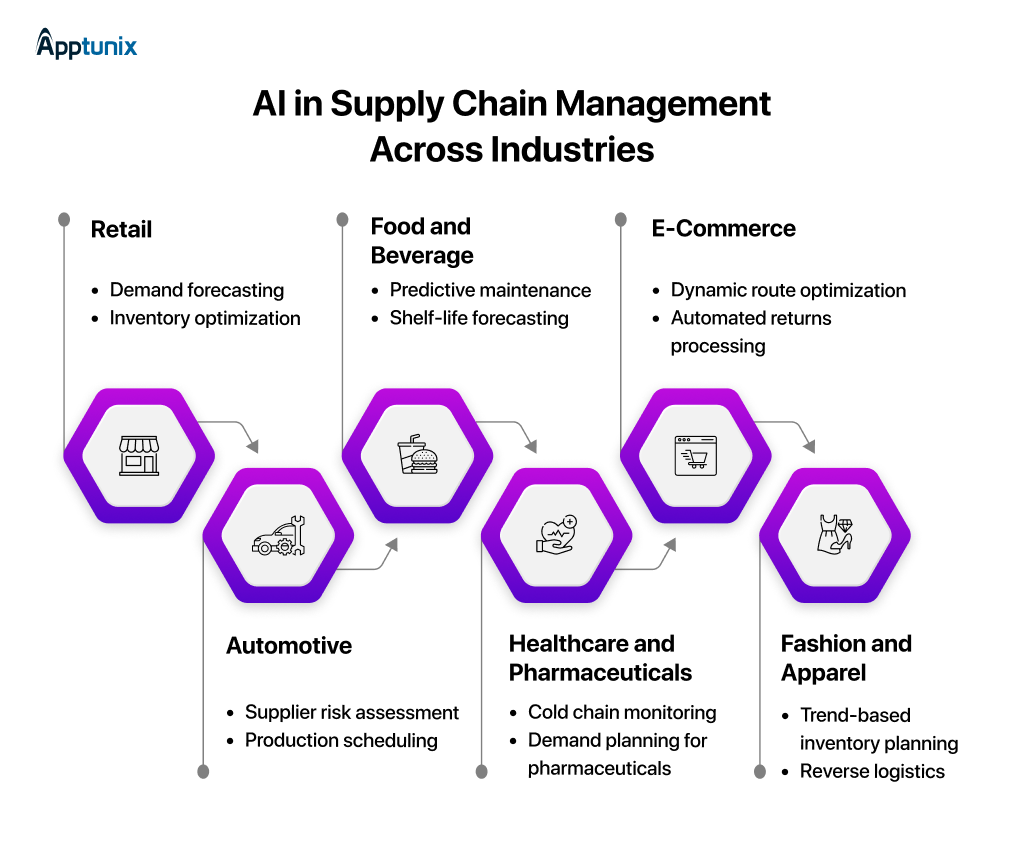
1: RetailRetailers deal with unpredictable demands and fast product cycles. AI-powered supply chain systems analyze sales history and seasonal trends to support accurate demand forecasting. This reduces overstock situations and prevents shortages of high-moving products.
Additionally, many brands also rely on AI-enabled procurement solutions to assess supplier pricing patterns and improve purchase planning. With AI analytics in supply chain processes, retail businesses gain tighter control over inventory while improving shelf availability across stores and fulfillment centers.
2: Food and BeverageSupply chains in food and beverage face strict timelines due to perishability. AI supply chain solutions monitor storage and transit time to reduce spoilage. Predictive models help forecast demand for items to allow replenishment to happen at the right moment.
Moreover, route optimization plays a major role here. Smart logistics solutions powered by AI shorten delivery times and cut fuel costs. This approach supports waste reduction and helps brands maintain product quality from source to shelf.
3: E-CommerceE-commerce operations depend on speed and scalability. Supply chain automation using AI improves order fulfillment by coordinating warehouse operations and last-mile delivery. AI in warehouse management supports robotic picking and real-time stock updates.
Large platforms rely on AI supply chain management systems to balance inventory across multiple locations. This setup reduces delivery errors and enables faster shipping while keeping operational costs under control.
4: AutomotiveAutomotive supply chains involve thousands of components sourced globally. Machine learning in supply chain management helps manufacturers predict part demand and manage supplier timelines with precision.
With AI-driven supply chain optimization, manufacturers reduce idle production time and avoid excess inventory. Supply chain risk management using AI also supports early detection of supplier disruptions.
5: Healthcare and PharmaceuticalsHealthcare supply chains demand accuracy and reliability. AI solutions for supply chain visibility track the movement of medicines, devices, and equipment across distributors, hospitals, and pharmacies. Predictive analytics help forecast demand for vaccines, diagnostic tools, and emergency supplies.
By using AI-powered supply chain planning, pharmaceutical companies maintain compliance while reducing shortages. Hospitals benefit from real-time supply chain analytics that support faster decision-making during critical situations.
6: Fashion and ApparelFashion brands operate under tight seasonal deadlines and shifting consumer preferences. AI-based demand forecasting in supply chain processes helps predict upcoming trends and regional demand. This supports smarter fabric sourcing and production planning.
Intelligent supply chain solutions also guide distribution decisions, ensuring new collections reach stores and online platforms on schedule. With digital supply chain transformation, fashion companies reduce markdowns and respond faster to market changes.
These examples show how AI use cases in supply chain operations vary widely. Businesses that invest in AI supply chain software gain operational clarity and long-term cost control while preparing for scale.
Also Read: The Total Cost of Ownership of AI Automation vs Manual Process
Enterprises across heavy industries are investing heavily in AI in supply chain management. Below are practical examples of how artificial intelligence in supply chain operations delivers measurable results, along with common use cases.
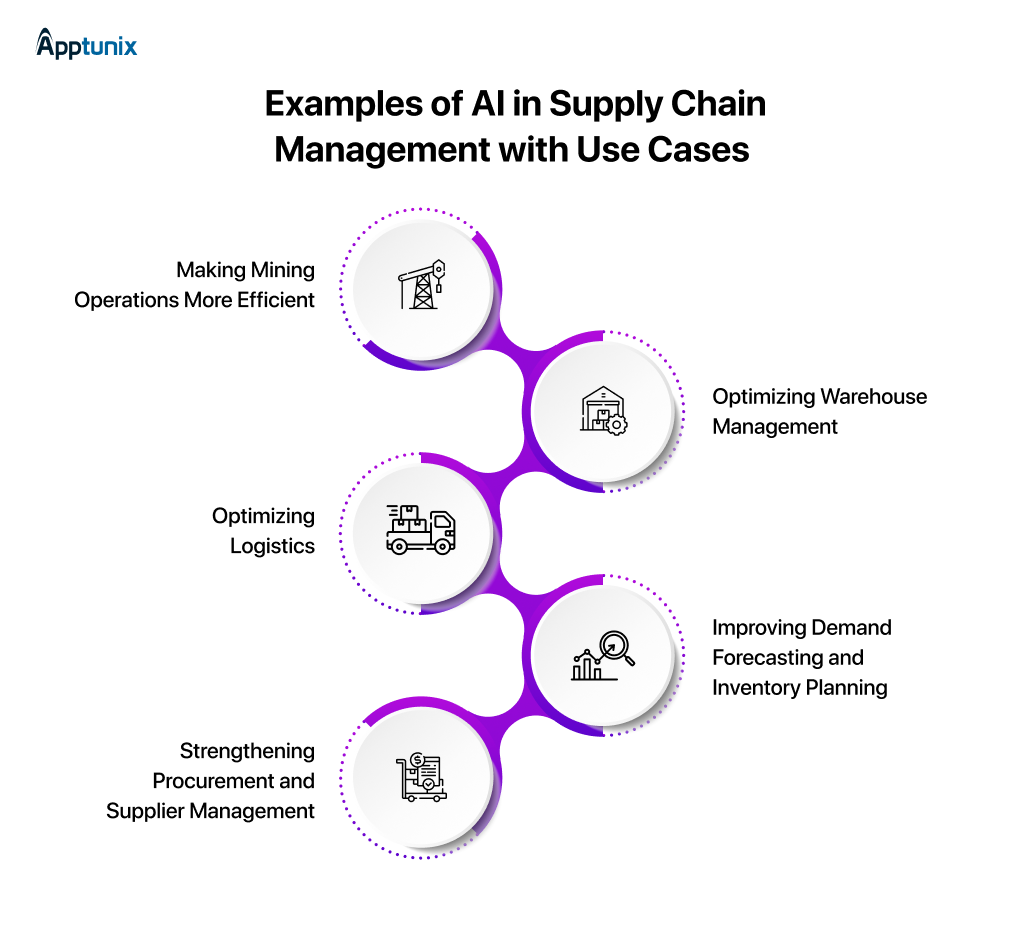
1: Making Mining Operations More EfficientMining supply chains operate across remote locations with high equipment dependency. The AI in Mining Market is expected to reach USD 9.93 billion by 2032 from USD 2.60 billion in 2025. AI supply chain solutions analyze sensor data from machinery, vehicles, and processing units to improve planning and reduce downtime.
Use cases:
2: Optimizing Warehouse ManagementWarehouses are central to modern AI supply chain management systems. AI analyzes order patterns, SKU movement, and space utilization to improve storage planning and picking efficiency. Many enterprises rely on AI in warehouse management to support automation and real-time inventory updates.
Use cases:
3: Optimizing LogisticsLogistics is one of the strongest areas for supply chain automation using AI. AI evaluates traffic, weather, delivery history, and fuel usage to improve routing and delivery schedules. This leads to better delivery reliability and lower transportation costs.
Use cases:
4: Improving Demand Forecasting and Inventory PlanningAccurate forecasting is one of the biggest benefits of machine learning in supply chain management. AI models analyze historical sales data, seasonality, promotions, and regional trends to enhance demand predictions. This helps businesses strike a balance between stock levels and overbuying.
Use cases:
4: Strengthening Procurement and Supplier ManagementProcurement teams use AI-enabled procurement solutions to evaluate supplier performance, pricing trends, and contract risks. AI supports better sourcing decisions and reduces dependency on manual analysis.
Use cases:
Adopting AI in supply chain management offers long-term operational gains, but enterprises often face practical obstacles during implementation. Below are six common challenges, along with clear solutions that help businesses gain value from AI-powered supply chain systems.
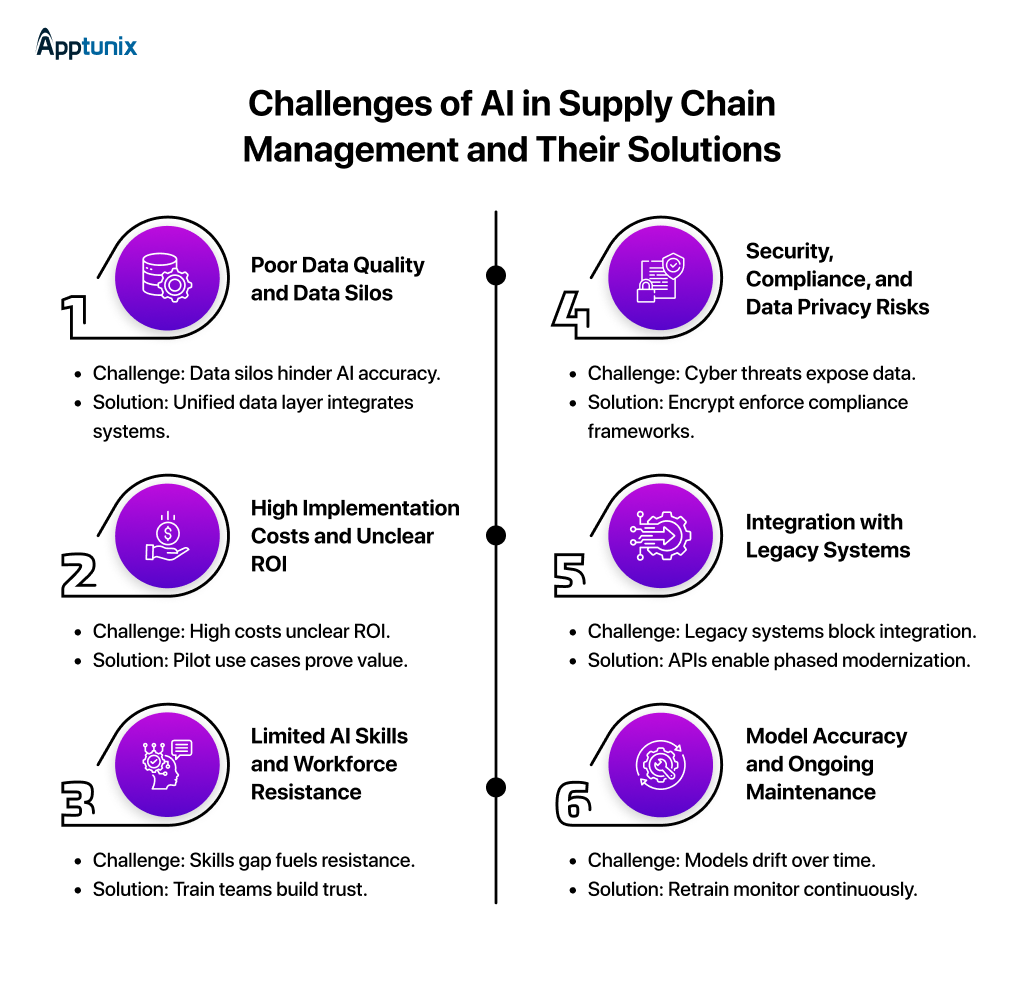
1: Poor Data Quality and Data SilosChallenge: Artificial intelligence in supply chain operations relies on large volumes of accurate data. Many organizations store procurement, logistics, inventory, and sales data in separate systems. Inconsistent formats and missing records reduce model accuracy and weaken decision-making.
Solution: Create a unified data layer that connects ERP, WMS, and TMS platforms. Data cleansing, standardization, and real-time integration improve the reliability of AI-driven supply chain optimization outcomes.
2: High Implementation Costs and Unclear ROIChallenge: Deploying AI supply chain management systems requires spending on software, infrastructure, integration, and talent. Without a clear business case, enterprises struggle to justify large investments.
Solution: Start with focused use cases such as demand forecasting or logistics optimization. Measure cost savings and efficiency gains early, then scale AI initiatives once value is proven.
3: Limited AI Skills and Workforce ResistanceChallenge: Machine learning in supply chain management demands technical expertise that many internal teams lack. Resistance from employees who prefer manual processes further slows adoption.
Solution: Combine external AI expertise with internal training programs. Clear communication, transparent AI insights, and gradual workflow integration increase trust and adoption.
4: Security, Compliance, and Data Privacy RisksChallenge: AI supply chain software processes sensitive supplier, pricing, and logistics data. This increases exposure to cyber threats and compliance risks, especially in regulated industries.
Solution: Apply strong access controls, encryption, and AI governance frameworks. Regular audits and compliance monitoring reduce security risks during digital supply chain transformation.
5: Integration with Legacy SystemsChallenge: Many enterprises rely on older ERP and logistics platforms that do not easily support AI supply chain solutions. Poor integration limits data flow and delays implementation.
Solution: Use APIs and middleware to connect legacy systems with AI platforms. A phased integration approach avoids operational disruption and supports gradual modernization.
6: Model Accuracy and Ongoing MaintenanceChallenge: AI models can lose accuracy as market conditions, supplier behavior, and demand patterns change. Without maintenance, AI analytics in the supply chain outputs become less reliable.
Solution: Continuously monitor model performance and retrain algorithms using updated data. Dedicated governance teams ensure AI models stay aligned with current business conditions.
Using AI in supply chain management works best when it follows a structured approach tied to real business needs. Below are practical steps that help enterprises apply artificial intelligence in supply chain operations effectively and at scale.
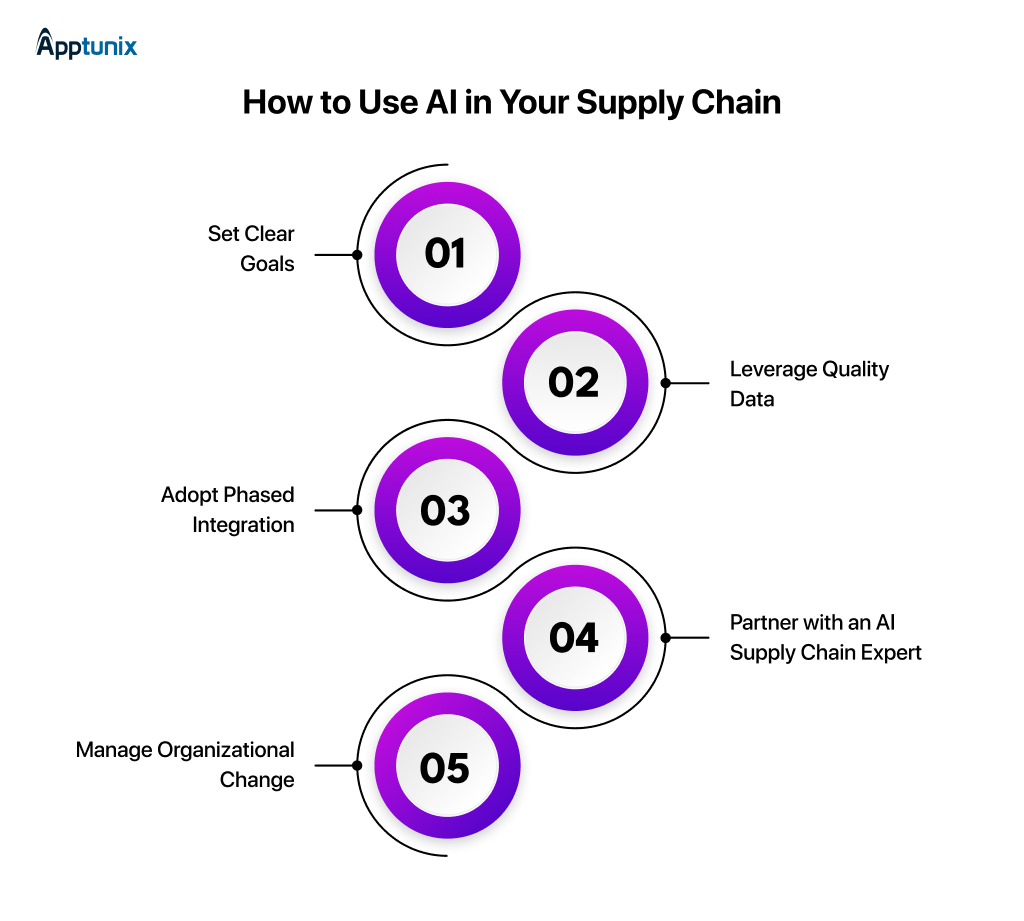
Step 1: Set Clear GoalsStart by defining what success looks like for your supply chain. Some organizations focus on reducing inventory costs, while others aim to improve delivery timelines. Clear goals guide the selection of AI supply chain solutions and prevent investment in tools that do not align with business priorities. We help you build an AI development strategy to avoid pitfalls.
Step 2: Leverage Quality DataAI-powered supply chain systems depend on accurate, connected data from procurement, inventory, logistics, and sales. Clean and consistent data improves forecasting, planning, and automation outcomes. Standardizing data sources and maintaining real-time updates helps AI analytics in supply chain processes deliver reliable insights that teams can trust.
Step 3: Adopt Phased IntegrationIntroducing AI supply chain management systems in phases reduces risk and operational disruption. Begin with a single use case, such as demand forecasting or warehouse optimization. Once results are proven, expand AI adoption to logistics, procurement, and supplier management. This phased approach supports smoother adoption and faster value creation.
Step 4: Partner with an AI Supply Chain ExpertMany enterprises choose to work with specialists offering AI supply chain consulting and implementation services. An experienced partner helps with strategy design, data readiness, model development, and system integration. This support accelerates deployment and increases the effectiveness of AI-driven supply chain optimization initiatives.
Step 5: Manage Organizational ChangeAI adoption affects workflows, decision-making, and team responsibilities. Clear communication, training programs, and leadership support are critical for building trust in AI supply chain software outputs. When teams understand how AI supports their work, adoption improves, and resistance decreases.
Also Read: How Blockchain Can Transform Your Supply Chain Management

In this video, we have discussed the use cases and AI supply chain integration cost:
If you are looking to leverage AI in your logistics business software, look no further than Apptunix. Here’s why:
Apptunix is a leading AI app development company that seamlessly integrates AI into logistics software. Our dedicated team starts by analyzing your current systems and identifying areas for improvement. Next, we develop AI-powered tools like predictive analytics to forecast demand accurately, helping in maintaining inventory.
We optimize processes, ensuring efficient and timely transportation using AI tools. Notably, our machine learning algorithms continuously learn from data, enhancing overall performance.
Additionally, we offer an AI-powered tracking system to manage shipments in real-time, boosting security and reliability. Leverage our experience and expertise in this technology to manifold your ROI seamlessly.
Q 1.What is AI in supply chain management?
AI in supply chain management refers to the use of artificial intelligence technologies such as machine learning and predictive analytics to improve planning, inventory control, logistics, procurement, and supplier coordination. These systems analyze large data sets to support faster and more accurate decisions across the supply chain.
Q 2.How is AI used in supply chain management?
AI is used for demand forecasting, inventory planning, warehouse automation, logistics routing, supplier analysis, and risk prediction. Many businesses rely on AI-powered supply chain systems to monitor operations in real time and adjust plans based on changing conditions.
Q 3.What are the benefits of AI in supply chain management?
The main benefits include improved forecast accuracy, reduced operational costs, better inventory control, faster deliveries, and improved supply chain visibility. AI-driven supply chain optimization also helps businesses respond quickly to disruptions and market changes.
Q 4.Which industries benefit the most from AI supply chain solutions?
Retail, e-commerce, manufacturing, automotive, healthcare, food and beverage, and mining industries benefit significantly from AI supply chain solutions. Each industry uses AI differently based on demand patterns, logistics complexity, and data availability.
Q 5.How does AI improve demand forecasting in supply chains?
AI-based demand forecasting in supply chain operations analyzes historical sales data, seasonality, promotions, and market trends. Machine learning models adjust predictions continuously, helping businesses avoid overstocking and stock shortages.
Q 6.What role does AI play in inventory management and logistics?
AI for inventory management and logistics supports stock optimization, warehouse automation, route planning, and delivery scheduling. AI supply chain software helps reduce carrying costs while improving delivery accuracy and speed.
Q 7.What challenges do businesses face when adopting AI in supply chains?
Common challenges include poor data quality, integration with legacy systems, high implementation costs, skill shortages, and data security concerns. These issues can slow adoption if not addressed early with a clear AI strategy.
Q 8.How can enterprises start using AI in their supply chain?
Enterprises should start by defining clear goals, improving data quality, and adopting AI in phases. Partnering with experts who provide AI supply chain consulting and implementation services helps reduce risk and speed up results.
Q 9.Is AI supply chain software suitable for small and mid-sized businesses?
Yes, AI supply chain software can support small and mid-sized businesses, especially cloud-based platforms that scale with growth. Many solutions focus on demand forecasting, inventory planning, and logistics optimization without heavy infrastructure investment.
Q 10.How do AI supply chain management systems support long-term growth?
AI supply chain management systems improve decision-making, reduce inefficiencies, and support scalability. With real-time insights and predictive analytics, businesses gain stronger control over operations and maintain stability as demand increases.
Get the weekly updates on the newest brand stories, business models and technology right in your inbox.
A seasoned Content Manager and Senior Technical Writer with 8+ years of experience in crafting impactful B2B content. With an MTech in Computer Science, Radhika brings a strong blend of technical depth and creative strategy. Her expertise spans content strategy, blogging, technical writing, and copywriting across emerging technologies. At Apptunix, she leads content initiatives that simplify complex ideas and drive engagement. Outside of work, Radhika enjoys exploring new cuisines.
506 Views 13 min October 18, 2025

911 Views 13 min October 16, 2025

980 Views 13 min October 10, 2025
Book your free consultation with us.
Book your free consultation with us.

One Central, The offices 3, Level 3, DWTC, Sheikh Zayed Road, Dubai, United Arab Emirates
+971 50 782 1690