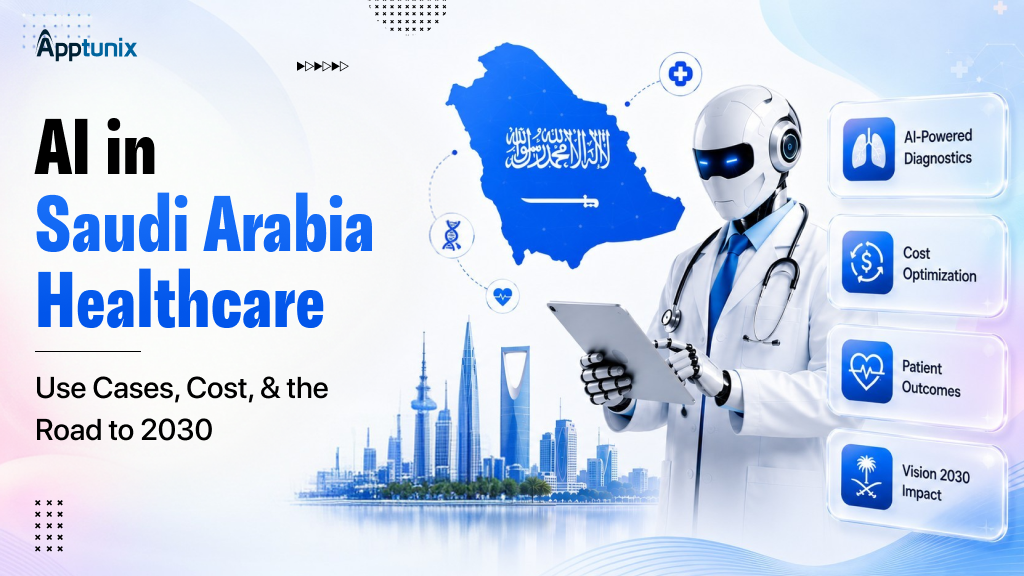
AI in Saudi Arabia Healthcare: Use Cases & Current Regulatory Landscape
9 Views 12 min July 31, 2026

Reena Bhagat, the CTO and Head of AI at Apptunix, is a seasoned technology strategist with a deep-rooted expertise in emerging technologies. With a focus on AI/ML integration, product engineering, cloud management, she leads the technical vision for high-performance SaaS infrastructures. Reena is recognized for building secure, scalable, and decentralized systems that solve real-world complexities. Her passion lies in leveraging data science and future-tech to create resilient digital products, making her a trusted authority for organizations looking to lead in the age of intelligent automation.
Choosing between custom AI vs off-the-shelf solutions often feels like standing at a crossroads where both paths look promising, but each one leads your enterprise in a completely different direction.
Many organisations begin with off-the-shelf AI solutions because they’re quick to start with. As operations grow, though, the limits of commercial AI software solutions become more visible. That’s where custom AI solutions for enterprises enter the picture, offering room to shape capabilities around real goals instead of forcing teams to adjust their habits.
This shift is exactly why the conversation around custom AI development vs ready-made AI is gaining more attention among decision-makers.
In this blog, you’ll explore the difference between custom AI and off-the-shelf AI, and how each fits into long-term plans. You’ll discover why some companies lean toward scalable AI solutions for business, and the challenges of using off-the-shelf AI solutions that aren’t built for unique workflows.
This guide even breaks down the cost comparison of custom AI vs ready-made AI solutions, so your decision feels practical rather than rushed.
So, let’s get started!
Custom AI refers to AI systems created specifically for an enterprise’s internal processes and long-term goals. Instead of using ready-made tools, creating an AI model is shaped around how a company actually works. It learns from the organisation’s own datasets, adapts to unique workflows, and supports decisions or automation needs that off-the-shelf tools usually can’t address.
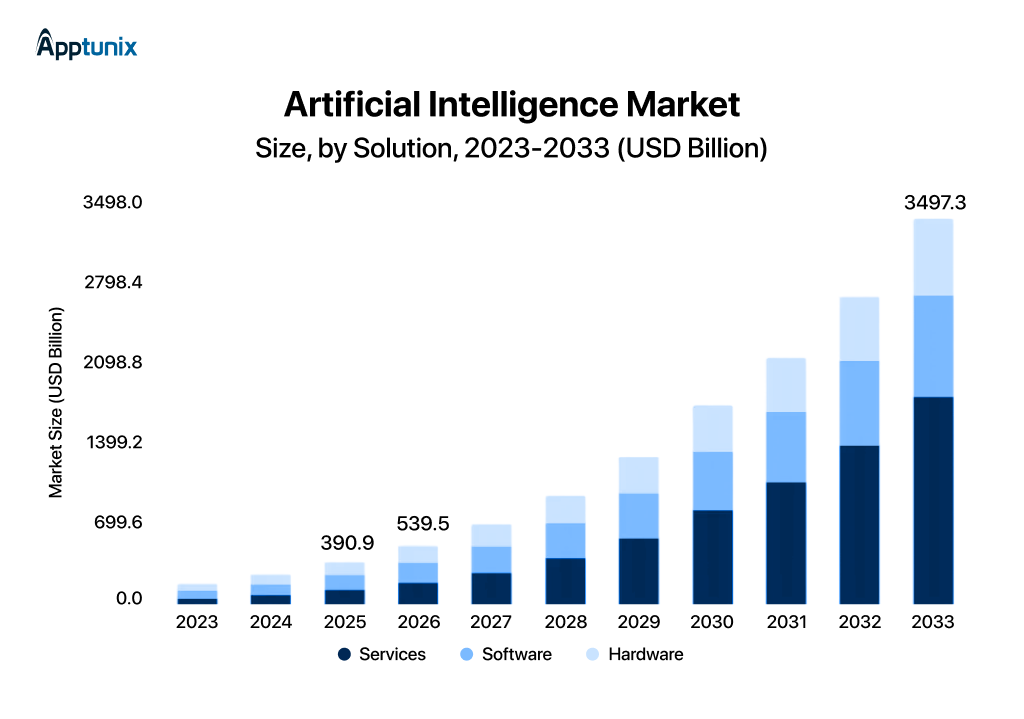
The interest in custom AI is growing fast. According to Statista, the global artificial intelligence market size was estimated at USD 279.22 billion in 2024 and is projected to reach USD 3,497.26 billion in 2033 with a CAGR of 31.5%. A large share of this growth is driven by enterprises investing in AI models built around their specific requirements rather than relying only on commercial AI software.
Here are the prime benefits of Custom AI development
Custom AI fits best for enterprises that:
Off-the-shelf AI refers to ready-made AI software for enterprises that can be deployed quickly without building a model from scratch. These tools come with pre-trained algorithms and standard workflows that suit the most common business needs. Many companies choose enterprise AI platforms like this to accelerate their AI journey.
As interest in enterprise automation grows, the demand for off-the-shelf AI continues to rise. Market reports show that the Al-as-a-Service market is projected to reach from USD 20.26 billion in 2025 to USD 91.20 billion by 2030 with a CAGR of 35.1%. This rise is strongly linked to the popularity of AI automation tools for enterprises.
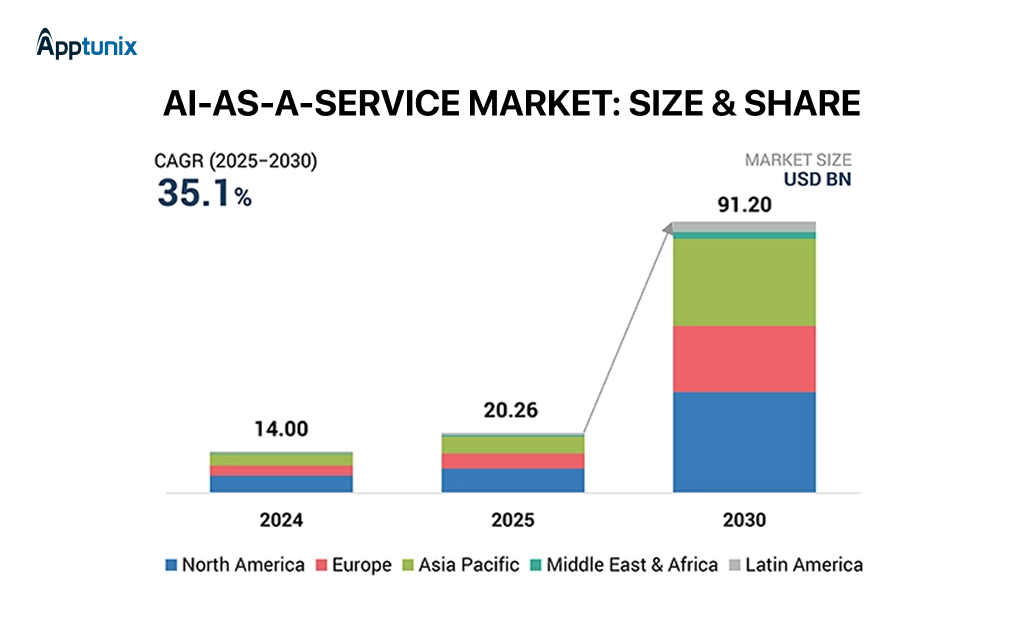
Why Off-the-Shelf AI Appeals to Many Enterprises
Who Should Choose Off-the-Shelf AI?
Off-the-shelf AI fits best for companies that:
It’s a practical choice for small and medium-sized businesses, especially when they just need AI solutions for business without advanced personalisation.
When enterprises compare custom AI vs off-the-shelf AI, the real debate goes far beyond price or implementation time. It comes down to how each option impacts long-term ROI and the ability to innovate. That’s why businesses seriously evaluating AI app development services vs subscribing to white-label AI software must look at the ripple effects over 12–36 months.
Below is a clearer breakdown of how each choice shapes growth and competitive advantage.
1: Customization Off-the-shelf: Off-the-shelf AI tools are built for general needs and common workflows; they offer fixed features and often only limited configuration. They rarely adapt to business-unique data patterns or domain-specific logic.
Custom: Custom AI solutions are developed to reflect your exact processes, data characteristics, business rules, and metrics. That makes them ideal if your enterprise has special workflows or industry-specific requirements.
2: Cost & LicensingOff-the-shelf AI generally offers a lower upfront cost and uses subscription– or licensing-based pricing. A document-automation AI at $800/month feels affordable at first. But as workflows expand, API usage fees spike, OCR add-ons stack up, and enterprise support pushes you into higher tiers. Three years later, you’ve spent more than $70K on a system you can’t customize.
Custom AI is the opposite. Yes, the build might be $100K–$150K, but it fits your workflows, your security rules, and your compliance needs. And because you own it, scaling doesn’t multiply your costs.
What this translates into in a monthly vs annual vs 2-year view
3: ScalabilityOff-the-Shelf AI can work well for predictable usage levels and standard tasks. But when business grows, workflows become more complex, and such solutions often hit limits. Their performance may degrade, or additional subscription tiers may become expensive.
Custom AI can be built with scalability in mind: as data grows or new use-cases emerge, models and infrastructure can be extended or modified to keep pace with evolving business requirements.
This flexible growth path makes custom AI more suitable for enterprises expecting evolving operational demands.
What scaling AI appears to be:
4: Deployment SpeedOff-the-shelf AI stands out here. An automation tool might be live in less than 20 days. This appeals to organisations seeking quick wins or needing an immediate fix for support or internal workflow gaps.
Custom AI takes longer because it’s shaped around your actual operations. This often stretches from 8 to 14 weeks, depending on the complexity. But the rollout matches your workflow exactly. There’s no “force fit,” no unnecessary features, and no dependency on vendor timelines.
5: Compliance & SecurityOff-the-shelf tools generally follow a fixed security framework designed for mass use, which means you get standard compliance certifications such as ISO, SOC 2, GDPR, or HIPAA if the vendor supports them. However, your business has minimal control over how data is shared inside the vendor’s infrastructure.
Custom-built AI gives your enterprise complete control over security architecture, compliance workflows, and data governance, making it easier to meet industry mandates such as GDPR, PCI DSS, HIPAA, and region-specific policies.
6: MaintenanceOff-the-shelf AI tools come with vendor-managed maintenance, which means updates and security patches are handled automatically. You cannot decide when updates roll out or how model changes affect your workflows.
Custom AI systems give you full ownership of maintenance. Your team or your AI development partner controls long-term system stability. You can implement continuous monitoring, automated pipelines (CI/CD for AI), and custom SLAs that guarantee uptime and reliability.
Also Read: Selecting the Right AI Partner vs Building In-House: What Enterprises Should Know
Bottom line:
The benefits of custom AI for large enterprises are huge. However, always validate numbers with your AI development partner and conduct a total cost of ownership (TCO) analysis before making a final decision.
There are a lot of off-the-shelf software solutions that are available these days for businesses to embark on their journey of AI digital transformation. Here are some business-specific examples where custom AI is more effective:
1: Retail & E-CommerceRetail teams work with massive product catalogs and customers who expect personalized responses. Off-the-shelf AI solutions handle simple use cases like FAQ chatbots and product tagging. But once you move into hyper-personalized recommendations or multi-channel forecasting, you start seeing the limits of ready-made tools.
Example:
Many large retailers now rely on custom AI solutions for enterprises to manage real-time inventory and prediction models that adjust pricing based on customer behavior.
Bottom Line:
2: HealthcareHealthcare organizations need AI that aligns with strict compliance rules and clinical accuracy. Commercial AI software solutions assist with appointment reminders or basic triage chatbots. But once you require model explainability and integration with EHR systems, the difference between custom AI and off-the-shelf AI becomes clear.
Example:
Hospitals are increasingly adopting tailored AI solutions for enterprises to support diagnostics and maintain full control over sensitive patient data.
Bottom Line:
3: Finance & BankingFinancial firms face strict transparency and audit requirements that ready-made AI software for enterprises often cannot meet. Off-the-shelf tools work well for entry-level fraud alerts or credit pre-checks, but large institutions quickly need deeper control over model logic and audit trails.
Example:
JP Morgan’s COIN platform is a custom AI system that analyzes thousands of contracts in seconds and saves hundreds of thousands of manual hours.
Drill-down:
4: Logistics & Supply ChainLogistics companies run on precision and massive operational data spread across warehouses, fleets, partners, and regional regulations. Off-the-shelf AI solutions help with route suggestions and automated customer notifications. But once the system expands into cross-border operations, ready-made platforms begin to limit performance.
Example:
Large logistics players now rely on custom AI solutions for enterprises to predict delays and build AI automation tools that consistently cut downtime and fuel usage. These setups enable AI system integration for enterprises that require real-time accuracy.
Drill-down:
5: ManufacturingFactories depend on precision, predictable operations, and constant optimization. Ready-made AI tools help with workflow monitoring and basic scheduling, but they struggle when production lines have unique configurations, custom machinery, or region-specific compliance rules.
Example:
Manufacturing leaders are shifting to custom AI solutions for manufacturing enterprises to support predictive maintenance, quality checks, and AI automation tools for enterprises that must operate with minimal downtime.
Drill-down:
6: SMBs & Customer SupportSmall and mid-sized businesses need speed, affordability, and minimal complexity. Off-the-shelf AI solutions shine here because they offer quick deployment, lower commitment, and ready-made AI workflows that SMBs can adopt immediately.
Example:
Many SMBs rely on off-the-shelf AI platforms to manage helpdesk automation, lead triage, and basic CRM enrichment.
Drill-down:
Also Read: How to Build an AI Strategy for Your Enterprise App: Roadmap & Cost
Budget considerations often fuel the debate. At first glance, off-the-shelf AI appears to be the more economical choice, while custom AI demands a hefty initial investment. However, when you factor in long-term operations, the cost dynamics between ready-made solutions and tailor-made AI shift considerably, revealing a more complex financial picture.
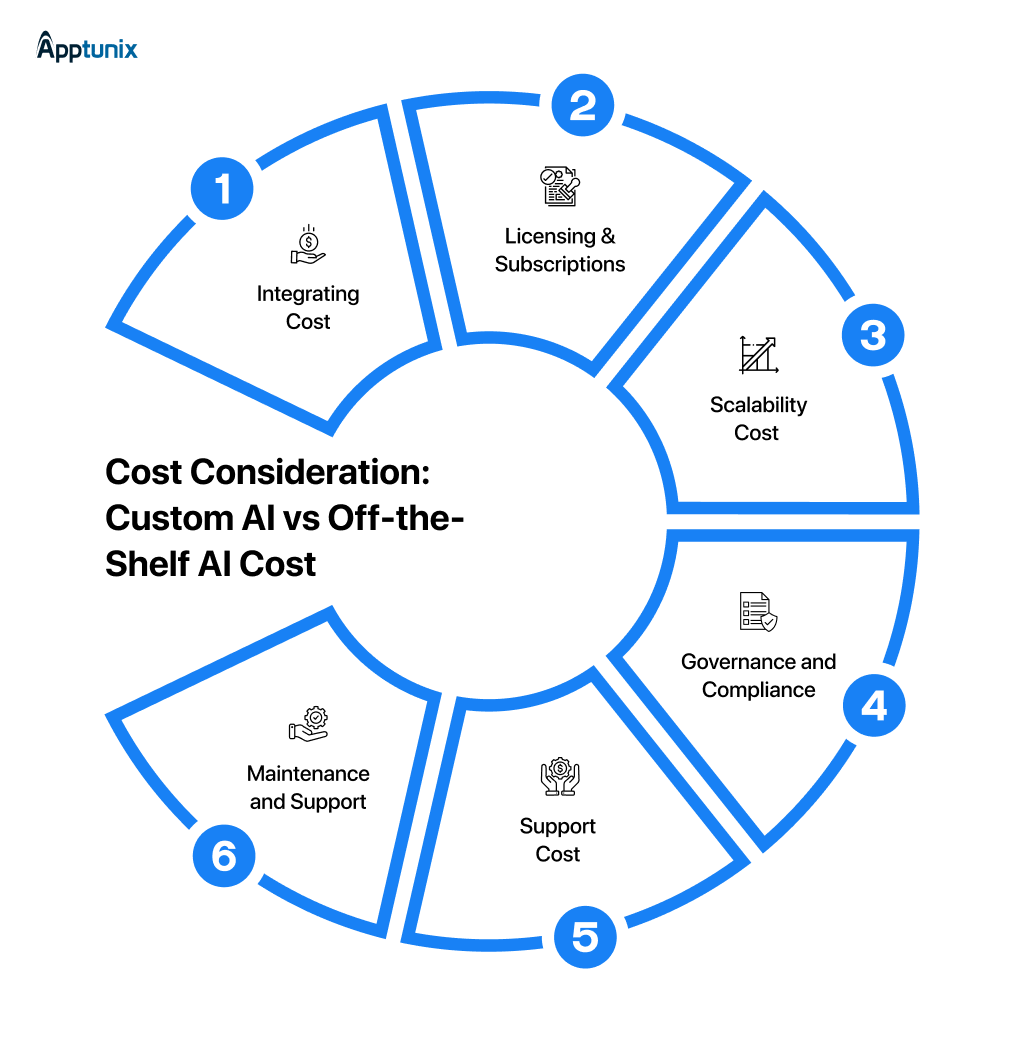
1: Integrating Cost Off-the-shelf AI: It comes with preset workflows that limit how deeply it can integrate with your architecture. Integrations with CRMs, ERPs or custom software often require additional modules or advanced-tier subscriptions, costing $15K to $ 25K annually. Those add-ons accumulate quietly.
Custom AI: It involves a one-time integration effort during development. The initial spend is higher, but your internal data flows and pipelines become part of the core system, not layered extras.
2: Licensing & SubscriptionsOff-the-shelf AI usually starts around $3K–$5K per month for standard business features. That’s $36K–$60K per year. At enterprise scale, annual licensing can climb into six-figure territory because API limits and processing volume drive the price upward.
Custom AI often requires $50K–$150K upfront across research, model design, training, testing, and integration. But once deployed, you’re not trapped in subscription tiers. Costs remain linked to infrastructure and upgrades, not usage spikes.
3: Scalability Cost Off-the-shelf AI: As your business grows, off-the-shelf AI becomes more expensive. Higher traffic or new departments often push you into a new bracket. Two years later, a system that was $3K per month may be touching $20K due to usage surcharges.
Custom AI doesn’t punish growth. Scaling costs relate primarily to infrastructure or new features, not to licenses. Growth increases ROI instead of multiplying monthly bills.
4: Governance and Compliance Off-the-shelf AI: Compliance is never free. Off-the-shelf tools charge extra for regulated data handling, private-cloud deployment, audit logs, and region-specific governance. Some features might not even be available unless you upgrade to their highest plan.
Custom AI allows you to define governance from the start, and all follow your internal policy instead of a vendor’s menu.
5: Support Cost Off-the-shelf AI: Support quality depends on your subscription. Entry-level plans often offer slow response times and limited help with technical issues. Faster support usually requires a premium contract.
Custom AI typically includes a dedicated support team during deployment and post-launch. Since the system is built for your processes, troubleshooting happens faster with fewer unknowns.
6: Maintenance and SupportOff-the-shelf AI updates are out of your control. Some changes help, others interrupt workflows, and some require paid add-ons. In the long run, you pay for continual upgrades whether you use them or not.
Custom AI gives you predictable maintenance cycles. You decide what needs improvement and which features matter for the next quarter. Costs stay aligned with your roadmap rather than a vendor’s pricing strategy.
Also Read: Top AI Automation Examples to Apply in Your Own Business
Investors often view companies with custom AI solutions for enterprises as stronger long-term bets.
Off-the-shelf AI solutions help teams move quickly, but they don’t create defensibility. Custom AI, on the other hand, becomes an asset that grows in value as the system learns from real workflows.
A business powered by tailored AI solutions for enterprises owns its technology stack, which means scaling doesn’t inflate costs at the same pace. Investors pay close attention to this because predictable economics make a company far more attractive.
Moreover, custom-built enterprise AI platforms give founders more control. This reduces operational risk. That’s why investors lean toward custom and scalable AI solutions for business because the technology keeps improving outcomes without multiplying costs.
Also Read: Selecting the Right Al Partner vs Building In-House: What Enterprises Should Know
Every enterprise faces its own data maturity and growth pressures. That’s why our team supports both approaches: off-the-shelf AI solutions for quick wins and custom AI development for businesses that want long-term impact. Our AI development services help you toward the option that fits your budget and operational needs without forcing you into a one-size model.
At Apptunix, we help you choose what is right for your business. We assist you in leveraging the right off-the-shelf AI based on:
Our team of AI developers helps you leave the benefits of custom AI development when:
Apptunix supports both directions because businesses often use a mix of them. Some workflows benefit from quick-deploy tools, while others require something built from the ground up. Our AI app development company helps you combine both smoothly. Over time, you get an AI foundation that grows with your business instead of holding it back.
You can schedule a meeting and get started today!
Q 1.What is the main difference between custom AI and off-the-shelf AI?
Custom AI is explicitly built for your workflows and business goals, while off-the-shelf AI solutions come pre-built with fixed features. Custom AI offers more control and flexibility, whereas off-the-shelf AI is faster to deploy but limited in its ability to adapt.
Q 2.Which is better for my business: custom AI or off-the-shelf AI?
If your needs are standard and you want quick deployment, off-the-shelf AI works well. If you need deeper automation, stronger security, or long-term scalability, custom AI solutions for enterprises are the better choice.
Q 3.How much does custom AI development cost?
Custom AI development typically ranges from $20,000 to $180,000, depending on model complexity, integration depth, and performance requirements. Although the upfront cost is higher, it often saves money in the long term compared to subscription-based off-the-shelf tools.
Q 4.Are off-the-shelf AI solutions cheaper in the long run?
Not always. Off-the-shelf AI solutions start at $2K–$5K per month, but costs increase with more users, API usage, storage, and advanced-tier features. Many enterprises end up spending six figures within two to three years.
Q 5.How does scalability differ between custom AI and ready-made AI?
Off-the-shelf AI scales through pricing tiers that increase as your usage grows. Custom AI scales at infrastructure cost, giving you more control and predictable spending as data volume expands.
Q 6. Is custom AI better for compliance-heavy industries?
Yes. Custom AI solutions let enterprises build compliance, governance, encryption rules, and region-specific data handling directly into the system. On the other hand, off-the-shelf AI tools often charge extra for these features or may not fully support them.
Get the weekly updates on the newest brand stories, business models and technology right in your inbox.
Reena Bhagat, the CTO and Head of AI at Apptunix, is a seasoned technology strategist with a deep-rooted expertise in emerging technologies. With a focus on AI/ML integration, product engineering, cloud management, she leads the technical vision for high-performance SaaS infrastructures. Reena is recognized for building secure, scalable, and decentralized systems that solve real-world complexities. Her passion lies in leveraging data science and future-tech to create resilient digital products, making her a trusted authority for organizations looking to lead in the age of intelligent automation.
9 Views 12 min July 31, 2026
45 Views 12 min July 21, 2026
93 Views 12 min July 2, 2026
Book your consultation with us.
Book your consultation with us.


One Central, The offices 3, Level 3, DWTC, Sheikh Zayed Road, Dubai
+971 50 782 1690


Offer Ends Soon
Get a quick expert response in under 5 minutes.