How Much Does It Cost to Build ESG Reporting Software in 2026?
19 Views 14 min August 4, 2026

Hardeep Singh is a seasoned B2B technical writer at Apptunix with a sharp eye for strategy and a mind wired for innovation. With over a decade of experience in technical and SEO writing, and a Master’s degree in Wireless Communication, he’s written across domains including AI, Blockchain, IoT, Cybersecurity, and beyond. At Apptunix, Hardeep drives content that bridges business goals with future-ready mobile and web solutions, thus helping startups and enterprises make smarter digital decisions.
AI therapy app development creates digital platforms that use Natural Language Processing (NLP), machine learning, and sentiment analysis.
It provides personalized and 24/7 mental health support, such as CBT-based exercises, mood tracking, and empathetic, conversational AI.
Key Features of AI Therapy Apps
AI Therapy App Development Process
Technology Stack & Tools
A person feels anxious late at night.
No clinic is open.
No therapist is available.
And then a mobile app becomes the first point of support.
Well, this moment explains why AI therapy app development is reshaping mental healthcare worldwide.
Artificial intelligence now understands emotions, language, and behavior patterns. Smart systems respond in real time and adapt to user needs. That shift has transformed mental health app development into something far more powerful. Modern therapy apps guide users through stress, anxiety, and emotional challenges using data-driven insights. This progress fuels the rapid growth of AI-powered therapy app development across global markets.
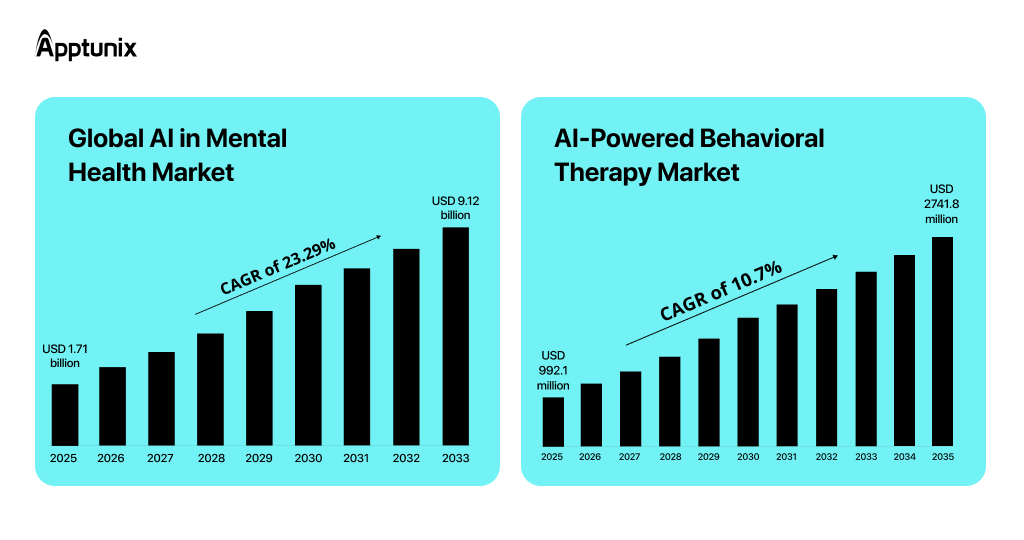
And even market data confirms this shift. The global AI in mental health market reached USD 1.71 billion in 2025. Projections show it growing to USD 9.12 billion by 2033 at a CAGR of 23.29 percent.
Furthermore, behavioral therapy shows similar momentum. The AI-powered behavioral therapy market stood at USD 992.1 million in 2025. Experts expect it to reach USD 2741.8 million by 2035, growing at a CAGR of 10.7 percent.
Well, rising stress levels, limited access to therapists, and growing acceptance of digital care make AI therapy apps essential today. So, businesses entering this space are not only building products. They are solving real human problems at scale.
This guide explains the complete journey of AI therapy app development, from concept to revenue. Each section focuses on clarity, practicality, and results. Stay with us to the end to see how a well-built AI therapy app can create impact and long-term business value.
An AI therapy app is a digital platform designed to support emotional and mental well-being through intelligent systems. It uses artificial intelligence to understand how users feel, respond to their concerns, and guide them through proven therapeutic techniques.
AI therapy apps rely on several core technologies working together.
Emotionally, AI therapy offers a safe space. Users can express thoughts without fear of judgment. Functionally, the app delivers structured guidance. Examples include CBT exercises, mood tracking, breathing routines, and stress management techniques. The goal stays consistent. Support users when they need it most.
Both approaches serve important roles. The difference lies in access, scalability, and cost.
| Feature | Traditional Therapy | AI Therapy App |
|---|---|---|
| Availability | Limited to scheduled sessions | 24/7 access |
| Cost | High per session | Lower and scalable |
| Personalization | Depends on the therapist | Data-driven and adaptive |
Traditional therapy depends on human availability. AI therapy apps remain accessible at any time. That difference explains why demand continues to grow across global markets.
Mental health challenges no longer affect a small group. They impact students, professionals, parents, and seniors across every region. This reality makes AI therapy software development a critical focus area for healthcare innovators and digital businesses in 2026. Demand continues to rise, and traditional systems struggle to keep pace. That gap accelerates global interest in AI-based therapy app development and emotional health app development.
Depression and anxiety rates continue to increase every year. The World Health Organization reports that more than 280 million people globally live with depression. Anxiety disorders affect over 300 million people worldwide.
Access to therapy remains uneven. Many regions face shortages of therapists, long wait times, and high treatment costs. These gaps leave millions without timely support. AI therapy apps address this challenge by offering immediate and scalable assistance.
AI removes many barriers tied to mental healthcare. Users do not need appointments or travel. Support becomes available at any hour. Costs remain significantly lower than in-person therapy. Mobile access allows people in remote or underserved areas to receive help. Privacy also improves adoption. Many users feel more comfortable opening up to a digital interface during the early stages of emotional distress.
Investors see strong long-term value in this space. Recurring revenue models, high user retention, and global scalability attract startups and enterprises alike. AI therapy apps also open doors to partnerships with employers, insurers, and healthcare providers. The market rewards platforms that combine clinical credibility with strong user experience.
Mental healthcare is moving from treatment to prevention. AI therapy apps help users manage stress early before conditions worsen. Daily check-ins, mood tracking, and behavior analysis support long-term well-being. This preventive approach reduces healthcare costs and improves outcomes. That shift positions AI therapy apps as essential tools rather than optional add-ons.
Every successful product starts with clarity. Founders planning to build AI therapy app solutions must first understand which type aligns with user needs and business goals. Each category serves a distinct purpose within mental health app development features, complexity, and scalability. Choosing the right direction early strengthens long-term success in AI therapy app development.
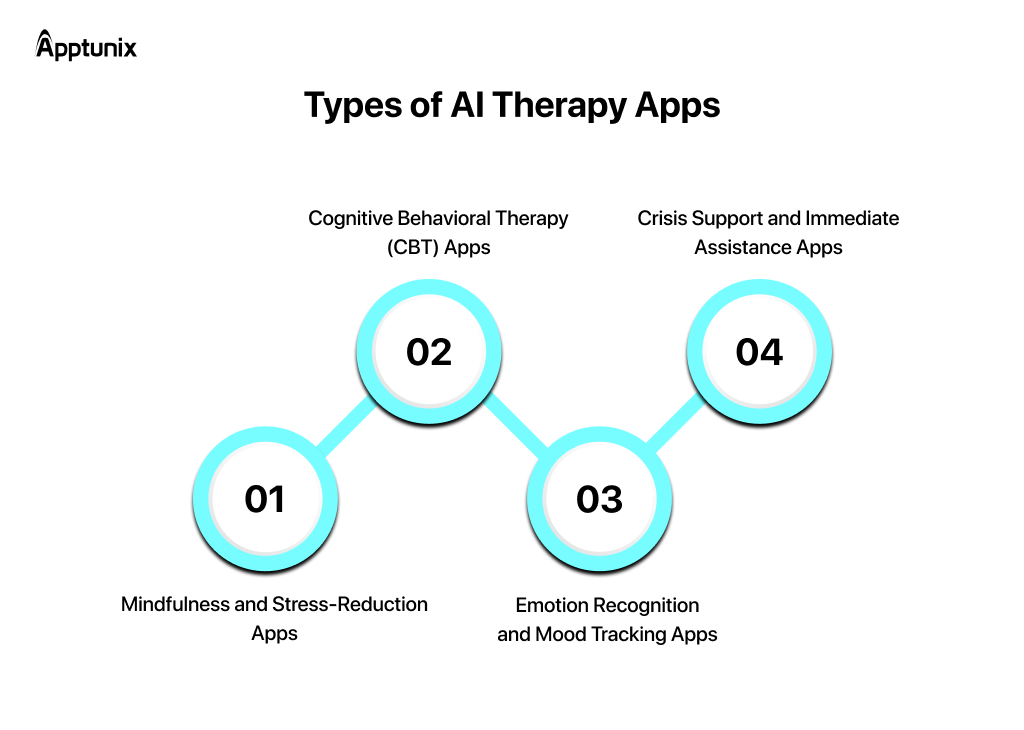
1.Mindfulness and Stress-Reduction Apps
Mindfulness apps emphasize calm, focus, and emotional balance. AI personalizes meditation routines, breathing exercises, and relaxation sessions based on user behavior. These platforms attract a broad audience seeking daily emotional wellness rather than clinical therapy. Engagement stays high due to simple and repeatable experiences.
2.Cognitive Behavioral Therapy (CBT) Apps
CBT-based apps focus on structured therapy techniques. AI guides users through thought reframing, behavioral exercises, and goal tracking. These apps often rely on conversational AI and evidence-based workflows. They work well for anxiety, depression, and stress management. Many users prefer CBT apps due to their clear structure and measurable progress.
3.Emotion Recognition and Mood Tracking Apps
Emotion-focused apps analyze text input, voice tone, or behavior patterns to detect mood changes. AI then offers insights, coping strategies, or alerts. These apps support self-awareness and early intervention. They play a key role in preventive mental healthcare and long-term emotional monitoring.
4.Crisis Support and Immediate Assistance Apps
Crisis support apps address urgent mental health situations. AI identifies high-risk signals and responds with calming guidance or emergency resources. Some platforms connect users to hotlines or human counselors when needed. Trust, accuracy, and response speed remain critical in this category.
| App Type | Primary Focus | Key AI Capabilities | Ideal Use Case |
|---|---|---|---|
| CBT Apps | Thought and behavior change | NLP, adaptive learning | Anxiety, depression |
| Mindfulness Apps | Stress and relaxation | Personalization engines | Daily wellness |
| Emotion Tracking Apps | Mood awareness | Sentiment analysis | Preventive care |
| Crisis Support Apps | Immediate assistance | Risk detection | Emergency situations |
Also Read: AI Development in Healthcare: Can Artificial Intelligence Replace Doctors?
A strong product does not happen by chance. It follows a clear and proven path. Businesses looking to develop AI therapy app solutions must focus on both technology and human behavior. This structured approach defines successful AI therapy software development and reduces long-term risk when creating an AI therapy app for real users.
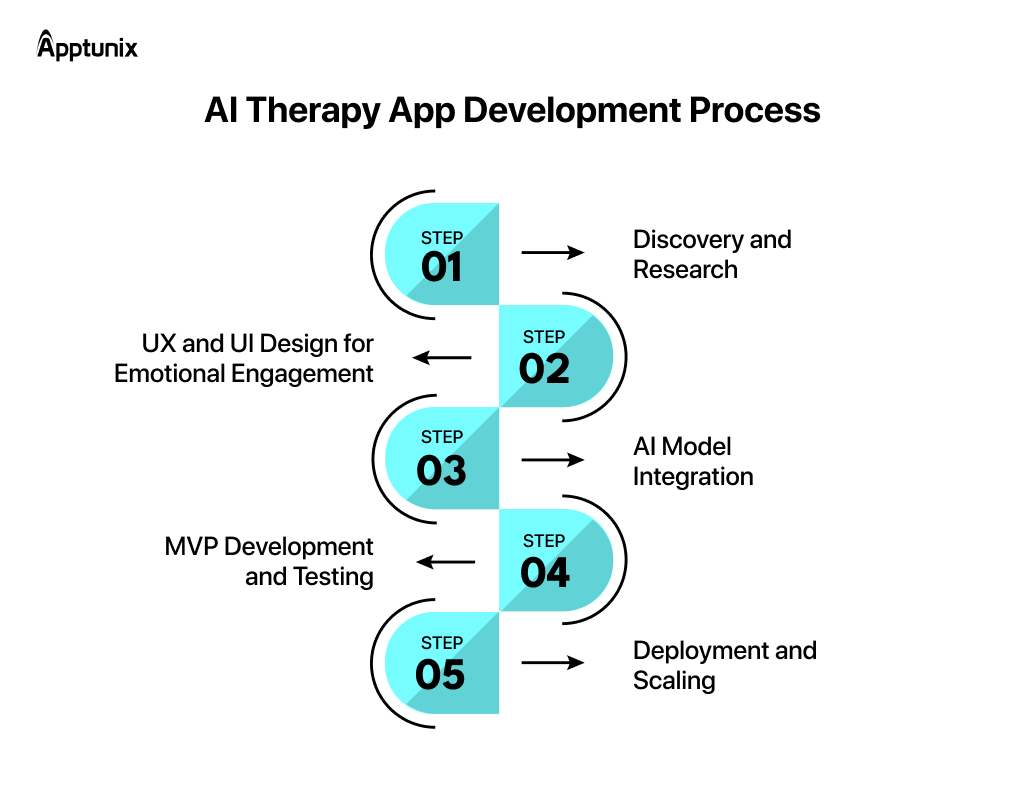
Step 1: Discovery and Research
Every project begins with understanding the problem. Research identifies user pain points, emotional triggers, and therapy gaps. Market validation confirms demand and monetization potential. Clinical inputs help align features with mental health standards. Skipping this stage often leads to low adoption and weak engagement.
Step 2: UX and UI Design for Emotional Engagement
Design shapes how users feel. Emotion-centric UX builds trust, comfort, and safety. Simple layouts, calming colors, and supportive microcopy improve retention. Users must feel understood from the first interaction. Strong design also reduces cognitive load during emotionally vulnerable moments.
Step 3: AI Model Integration
This stage brings intelligence to life. NLP enables meaningful conversations. Machine learning adapts responses over time. Sentiment analysis detects emotional shifts. Ethical safeguards remain essential. Bias control, data privacy, and responsible responses protect users and platforms alike.
Step 4: MVP Development and Testing
An MVP helps validate assumptions quickly. Core features launch first. Real user feedback guides improvements. Testing focuses on accuracy, response quality, and emotional safety. Early validation lowers cost and prevents expensive redesigns later.
Step 5: Deployment and Scaling
Launch marks the beginning, not the end. Scalable infrastructure supports growth. Continuous monitoring improves AI performance. Feature updates respond to user needs and regulatory changes. Platforms built for scale outperform rushed solutions.
Skipping any step weakens the entire product. Apps fail when technology ignores psychology or ethics. Partnering with experienced teams that understand mental health technology creates safer, stronger, and more scalable outcomes.
Also Read: The Ultimate Guide to AI Physiotherapy App Development
Users stay loyal to apps that feel helpful, safe, and personal. Businesses planning to develop AI therapy app solutions must focus on features that solve real emotional needs. Strong feature selection also defines success in AI-powered therapy app development and long-term growth in behavioral health app development.
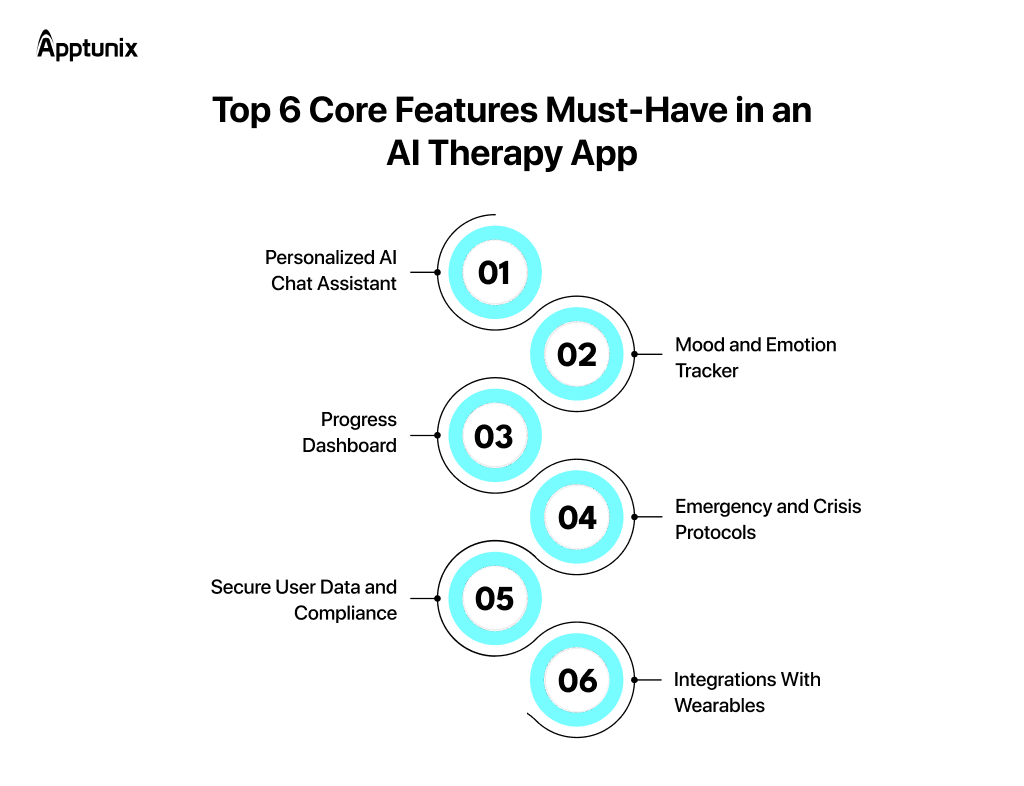
1.Personalized AI Chat Assistant
The AI chat assistant acts as the core interaction layer. It listens, responds, and adapts over time. Personalization improves relevance and trust. Users feel understood when responses reflect their emotional history, goals, and behavior patterns.
2.Mood and Emotion Tracker
Mood tracking builds self-awareness. AI analyzes daily inputs to identify emotional patterns. Visual insights help users recognize triggers and progress. This feature also supports early intervention and preventive care.
3.Progress Dashboard
A clear dashboard shows growth over time. Users see completed sessions, emotional trends, and achieved milestones. Progress visibility motivates consistency and reinforces positive behavior changes.
4.Emergency and Crisis Protocols
Safety remains critical. AI must detect distress signals and respond responsibly. Crisis protocols guide users through calming steps or connect them to helplines when needed. This feature builds trust and ensures ethical support.
5.Secure User Data and Compliance
Mental health data demands strong protection. Encryption, secure authentication, and regulatory compliance protect user privacy. Transparency about data use improves confidence and adoption.
6.Integrations With Wearables
Wearables add real-time behavioral insights. Sleep, heart rate, and activity data improve emotional analysis. Integration enables more accurate support and personalized recommendations.
Feature vs Benefit Comparison
| Feature | User Benefit |
|---|---|
| AI Chat Assistant | Immediate emotional support |
| Mood Tracking | Better self-awareness |
| Progress Dashboard | Motivation and consistency |
| Crisis Protocols | Safety and trust |
| Data Security | Privacy assurance |
| Wearable Integration | Deeper personalization |
Understanding the AI therapy app development cost is essential before you invest time, money, and effort. Costs vary widely based on app complexity, AI sophistication, compliance needs, platform choice, and team expertise. Below is a clear and verified cost overview to help you plan effectively.
Advanced NLP, sentiment analysis, voice recognition, and real-time adaptation require more development time and expertise. AI training and custom models can significantly add to the overall cost.
Native Android and iOS app development cost more than cross-platform frameworks such as Flutter or React Native.
Additional modules, such as real-time video sessions, crisis protocols, wearable integrations, or advanced user dashboards, raise prices.
Healthcare compliance (HIPAA, GDPR) and strong data encryption add to development time and cost.
Emotion-focused design and user research require specialized expertise to create safe and engaging experiences.
Below is a realistic cost breakdown of AI therapy app development, including AI integration and core features.
| Component | Estimated Cost Range |
|---|---|
| Basic App (simple AI chatbot + mood tracking) | $20,000 – $30,000+ |
| Intermediate App (chatbots + analytics + progress tracking) | $30,000 – $60,000+ |
| Advanced App (AI personalization + wearables + secure compliance) | $60,000 – $200,000+ |
| AI Integration Module (NLP + sentiment + real-time response) | $20,000 – $40,000+ |
Notes:
Also Read: Healthcare App Development Cost in Dubai
You can optimize the budget while still achieving high impact:
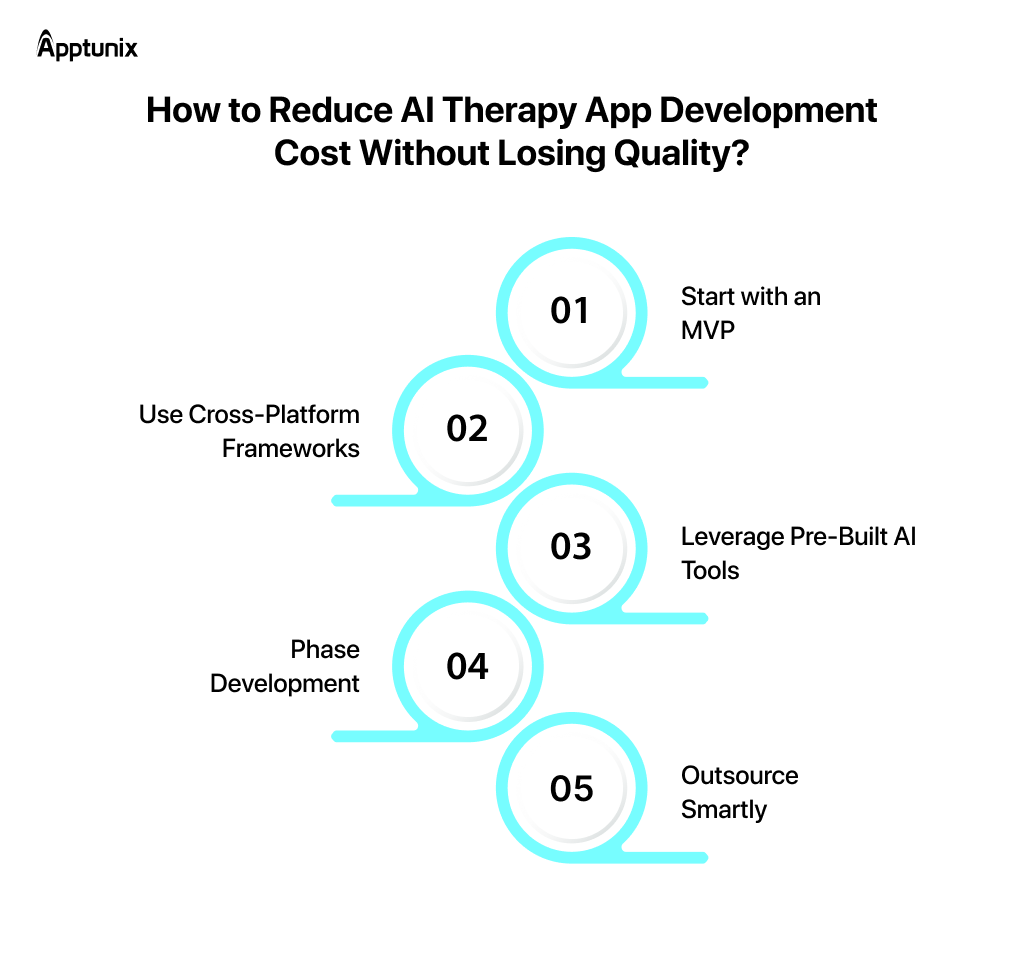
Build core functionality first to test market response without committing to all advanced features at once. This reduces initial cost and risk.
2.Use Cross-Platform Frameworks
Tools like Flutter or React Native let you launch on iOS and Android with a shared code base.
3.Leverage Pre-Built AI Tools
Instead of custom AI from scratch, integrate reliable third-party AI APIs where possible.
4.Phase Development
Prioritize features and release in stages. Each release improves user value and spreads cost over time.
5.Outsource Smartly
Consider global talent with proven healthcare app experience. Teams in Asia and Eastern Europe often deliver high-quality solutions at competitive rates.

Understanding the leaders in AI therapy app development helps you spot trends and build smarter. Below are some of the most prominent AI-based therapy app development platforms in 2026, each showing unique strengths and limitations. This comparison will inspire confidence and clarify what features users value most today.
1.Wysa – AI Therapy With Clinical RootsWysa is one of the most credible AI mental health apps available. It uses evidence-based cognitive behavioral therapy (CBT) techniques through a chatbot that feels warm and supportive.
Strengths
Weaknesses
2.Woebot – Lighthearted, Research-Backed AI CoachWoebot delivers personalized mental health support through bite-sized conversations rooted in CBT and tracking.
Strengths
Weaknesses
3.Youper – AI Therapy Meets Mood AnalyticsYouper combines AI dialogues with mood tracking and emotional insights.
Strengths
Weaknesses
4.Replika – Deep Conversational CompanionReplika focuses on emotional support and companionship rather than structured therapy.
Strengths
Weaknesses
5.Tess by X2AI – Scalable Multilingual AI SupportTess is an AI therapy platform designed for broad use through SMS, messaging, and web.
Strengths
Weaknesses
6.therappai – AI Video Therapy Pioneertherappai is an emerging app that uses AI video avatars to simulate therapy sessions with real-like interaction qualities.
Strengths
Weaknesses
Newer entrant – long-term user outcomes still emerging.
7.Flourish – Personalized Well-Being SupportFlourish combines AI guidance with habit building, positive psychology, and engagement tools.
Strengths
Weaknesses
Less focused on clinical therapy than structured tools.
Users report that structured CBT exercises feel like guided coaching between real sessions. Its hybrid option offers human support when needed.
Clinical research shows measurable improvement for anxiety when used regularly. Users appreciate check-ins tailored to emotional history.
While not a clinical tool, millions use it daily for emotional conversation. Its personalized AI forms deep bonds, though ethical concerns have been reported.
Now, the question is, what does this mean for your project?
Well, these apps show key trends in AI therapy app development:
Understanding these elements helps you build smarter, safer, and more competitive AI therapy solutions in 2026.
A sustainable product must deliver value to users and returns to founders. Smart monetization plays a key role in long-term success. Teams investing in AI therapy software development should plan revenue models early, and not after launch. Clear monetization also influences feature prioritization when you create AI therapy app solutions for scale.
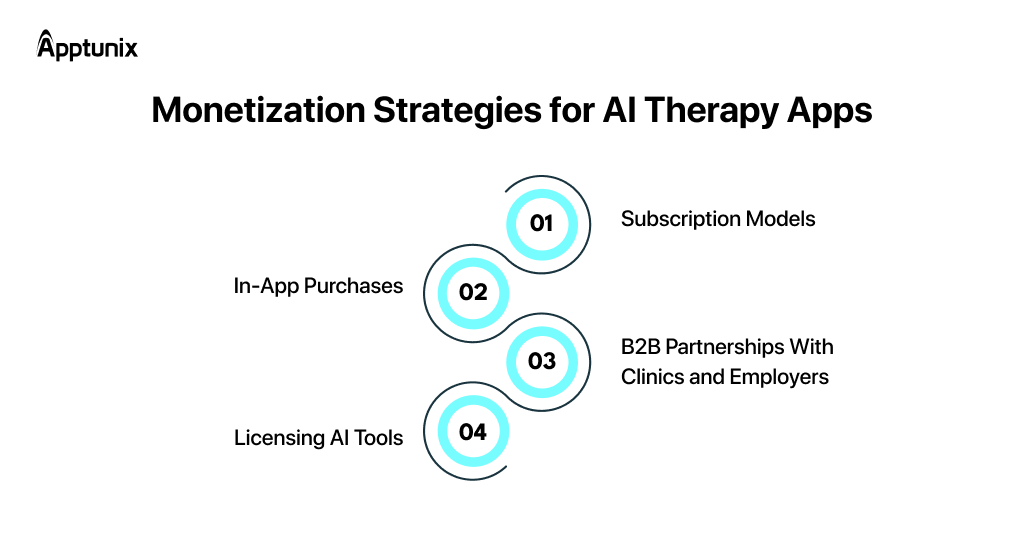
1.Subscription ModelsSubscriptions remain the most common revenue stream. Users pay monthly or yearly for premium access. Plans often unlock advanced AI conversations, detailed analytics, and personalized therapy programs. Predictable revenue helps forecast growth and attracts investors. Tiered pricing allows both casual users and serious learners to stay engaged.
2.In-App PurchasesIn-app purchases offer flexibility. Users pay only for what they need. Examples include guided therapy sessions, specialized programs, or expert-created content packs. This model works well for users who prefer control over spending. It also increases lifetime value without forcing subscriptions.
3.B2B Partnerships With Clinics and EmployersEnterprise partnerships unlock larger revenue streams. Clinics integrate AI therapy apps into patient care plans. Employers offer mental wellness apps as employee benefits. These contracts often involve bulk licensing and long-term agreements. B2B adoption improves credibility and accelerates user acquisition.
4.Licensing AI ToolsSome companies license their AI engines to healthcare providers or wellness platforms. This approach generates recurring income without managing end users directly. Licensing works best for apps with strong AI models and proven outcomes.
Revenue Model vs Expected ARPU
| Revenue Model | Expected ARPU (Annual) |
|---|---|
| Subscription | $60 – $180 |
| In-App Purchases | $20 – $90 |
| B2B Partnerships | $120 – $300 |
| AI Tool Licensing | $200 – $500 |
Choosing the right mix improves ROI and scalability. Many successful apps combine multiple models to balance growth and stability.
Trust defines success in digital healthcare. Users share deeply personal information, and any misuse can damage credibility forever. Strong legal and ethical planning is essential in AI therapy application development, mental health app development, or behavioral health app development. Compliance and responsibility protect users and strengthen long-term brand value.
Healthcare apps must follow strict regulations. HIPAA governs the protection of health data in the United States. GDPR regulates personal data usage across the European Union. These frameworks require clear data handling policies, secure storage, and transparent user rights. Non-compliance risks heavy penalties and loss of user trust. Building compliance from day one avoids costly corrections later.
AI must respond responsibly during emotional distress. Algorithms should avoid harmful language, misinformation, or overdependence. Ethical AI design includes bias control, safe response limits, and clear disclaimers. Apps must recognize when to escalate to human support. Responsible AI strengthens confidence and reduces legal exposure.
Strong encryption protects sensitive data at rest and in transit. Secure authentication prevents unauthorized access. Clear consent flows explain how data is collected, used, and stored. Users should control their information easily. Transparency builds confidence and increases long-term engagement.
Note: Legal readiness is not optional. Ethical design is not negotiable. Apps that respect privacy and user safety stand out in a competitive market and earn lasting trust.
Innovation in mental healthcare is accelerating. Emerging technologies continue to reshape how emotional support is delivered and experienced. Businesses investing in AI therapy app development today gain a long-term advantage by aligning with future-ready solutions. Let’s now go through some top trends that define the next phase of AI-powered therapy app development across global markets.
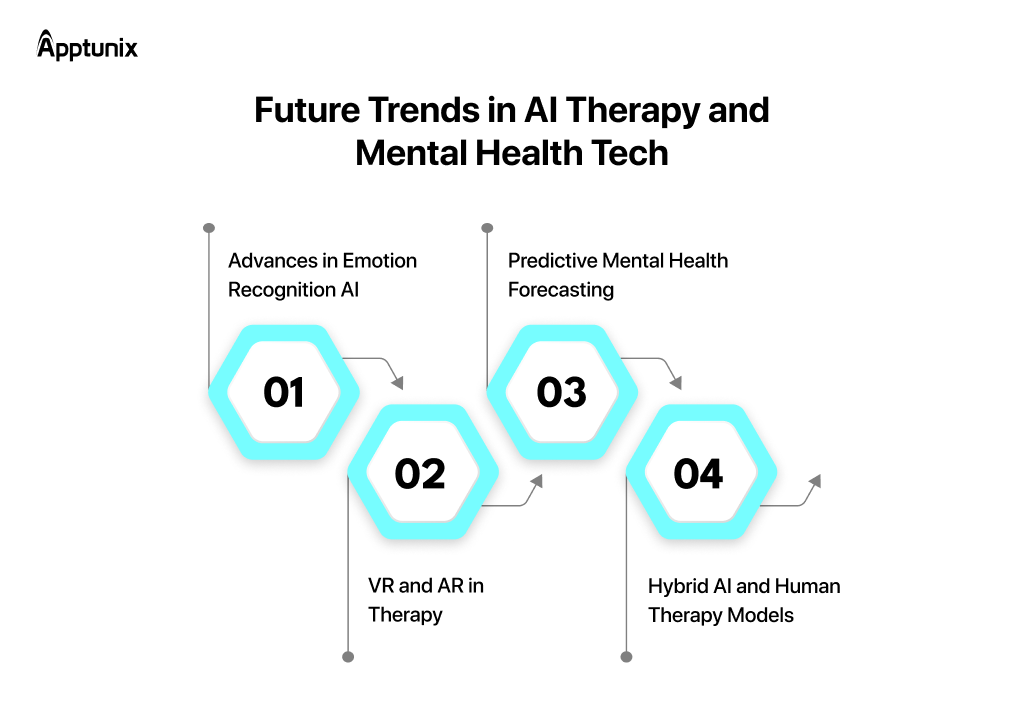
1.Advances in Emotion Recognition AI
Emotion recognition is becoming more precise. AI now analyzes text, voice tone, facial cues, and behavioral patterns together. Multi-modal analysis improves accuracy in detecting stress, anxiety, and mood shifts. Better emotional understanding leads to more relevant and supportive responses.
2.VR and AR in Therapy
Virtual and augmented reality are expanding therapy experiences. VR environments help users practice exposure therapy in controlled settings. AR supports mindfulness and grounding exercises in real-world contexts. These tools improve engagement and therapy outcomes when used alongside AI guidance.
3.Predictive Mental Health Forecasting
Predictive analytics allow early intervention. AI models analyze long-term behavior trends to identify risk before symptoms escalate. This proactive approach supports preventive care and reduces crisis situations. Forecasting strengthens both clinical outcomes and user trust.
4.Hybrid AI and Human Therapy Models
Future platforms blend AI efficiency with human expertise. AI handles daily support and monitoring. Human professionals step in for complex or high-risk cases. Hybrid models improve scalability while preserving clinical depth. This approach is gaining strong acceptance among users and providers.
Staying ahead of these trends helps founders build resilient, future-proof mental health solutions.
Building a successful mental health solution requires more than coding. It demands clinical awareness, ethical AI, and deep product strategy. As a specialized healthcare app development company, we have helped founders and enterprises build AI therapy app solutions that are secure, scalable, and user-centric. Our team understands both technology and human behavior, which allows us to develop AI therapy app platforms that people truly trust.
Our Expertise and Services
Each project starts with research and validation. Every healthcare solution is built for long-term growth and real-world impact.
Proven Work and Portfolio
Our portfolio includes AI-driven healthcare and wellness platforms designed for global audiences. Each product focuses on privacy, accuracy, and user retention. Detailed case studies and live demos are available on request to help you evaluate our approach and results.
What Our Clients Say?
Clients choose us for reliability, transparency, and deep domain knowledge. Many highlight our ability to translate complex mental health requirements into intuitive digital experiences. Long-term partnerships reflect the trust we build at every stage of AI app development.
So, if you are planning to launch or scale an AI therapy product, now is the right time to act. Let our experts guide you from idea to market-ready solution.
Q 1.What does AI therapy app development involve?
AI therapy app development covers research, UX design, AI model integration, testing, and deployment. The process includes NLP, machine learning, sentiment analysis, and secure infrastructure. We focus on emotional safety, privacy, and scalability while building therapy-focused digital products.
Q 2.How much does it cost to develop an AI therapy app?
The cost to develop an AI therapy app depends on features, AI complexity, platforms, and compliance needs. A basic app usually starts around $20,000. Advanced platforms with deep AI and integrations can exceed $200,000. Accurate estimates require clear requirements.
Q 3.What is the cost to create an AI therapy app with advanced AI?
The cost to create an AI therapy app using advanced NLP, emotion recognition, and predictive analytics usually ranges from $60,000 to $200,000 or more. Costs increase due to AI training, data security, and regulatory compliance.
Q 4.What features should an AI therapy app include?
Core features include an AI chat assistant, mood tracking, progress dashboards, crisis protocols, and secure data handling. Wearable integrations and personalization improve engagement. These features define successful Building AI therapy app strategies.
Q 5.Can I build AI therapy app for emotional health support?
Yes, you can build AI therapy app solutions focused on emotional health. These apps support stress management, anxiety relief, and self-awareness. Strong UX and ethical AI design play a major role in adoption.
Q 6.How long does developing AI therapy app solutions take?
Developing AI therapy app platforms usually takes 3 – 5+ months for an MVP and medium complexity projects. Advanced apps may require 6 – 9+ months. Timelines depend on AI depth, testing cycles, and compliance requirements.
Q 7.What is the cost to build an AI therapy app for enterprises?
The cost to build an AI therapy app for enterprises typically ranges from $50,000 to $200,000+, depending on advanced AI models, enterprise integrations, scalability needs, security standards, and regulatory compliance.
Q 8.Is AI therapy app development safe and compliant?
Safety depends on secure architecture, encryption, and regulatory compliance. HIPAA and GDPR standards protect user data. Ethical AI responses and consent flows increase trust and credibility.
Q 9.Can AI therapy apps replace human therapists?
AI therapy apps support mental wellness but do not replace licensed professionals. They offer early support, guidance, and monitoring. Hybrid models combine AI efficiency with human expertise for better outcomes.
Q 10.How do AI therapy apps make money?
Revenue comes from subscriptions, in-app purchases, B2B partnerships, and AI licensing. Clear monetization planning improves ROI and long-term sustainability in AI therapy app development.
(3 ratings, average: 4.00 out of 5)
Get the weekly updates on the newest brand stories, business models and technology right in your inbox.
Hardeep Singh is a seasoned B2B technical writer at Apptunix with a sharp eye for strategy and a mind wired for innovation. With over a decade of experience in technical and SEO writing, and a Master’s degree in Wireless Communication, he’s written across domains including AI, Blockchain, IoT, Cybersecurity, and beyond. At Apptunix, Hardeep drives content that bridges business goals with future-ready mobile and web solutions, thus helping startups and enterprises make smarter digital decisions.
Book your consultation with us.
Book your consultation with us.


One Central, The offices 3, Level 3, DWTC, Sheikh Zayed Road, Dubai
+971 50 782 1690


Offer Ends Soon
Get a quick expert response in under 5 minutes.