
Manufacturing Execution System (MES) Development: Features, Costs & Industry 4.0 Integration
10 Views 9 min June 22, 2026

Reena Bhagat, the CTO and Head of AI at Apptunix, is a seasoned technology strategist with a deep-rooted expertise in emerging technologies. With a focus on AI/ML integration, product engineering, cloud management, she leads the technical vision for high-performance SaaS infrastructures. Reena is recognized for building secure, scalable, and decentralized systems that solve real-world complexities. Her passion lies in leveraging data science and future-tech to create resilient digital products, making her a trusted authority for organizations looking to lead in the age of intelligent automation.
Hospitals receive hundreds of appointment calls daily, many after working hours. Patients expect instant scheduling, but they don’t get a response, leading to frustrated patients.
However, technology has evolved very much so that now voice-enabled systems handle requests 24/7. It automatically schedules appointments, updates records, and reduces administrative burden.
This is how voice technology in healthcare improves both patient experience and operational efficiency.
No hold, no receptionist queues, and no manual paperwork at all; just a seamless appointment booking.
The global voice technology in the healthcare market is expected to reach $21.67 billion by 2032, with a CAGR of 19.9% between 2026 and 2032.
It is growing fast because with AI and NLP, these intelligent systems allow patients to schedule, reschedule, or cancel appointments using simple voice commands. AI voice assistants in healthcare effectively function as a 24/7 virtual receptionist.
Leading to this, hospitals and clinics are investing heavily in AI-powered voice-enabled custom healthcare solutions. This streamlines documentation, workflows, communication, and patient support.
In this blog, you will get to know everything about how voice technology in healthcare is enhancing patient care experience and efficiency.
Let’s get started with the definition!

Voice technology refers to the use of AI-powered speech recognition and natural language processing systems in healthcare. It allows patients and medical staff to interact with digital systems using voice commands.
Healthcare voice AI technology enables tasks like appointment scheduling, patient support, clinical documentation, and real-time data entry. All these without manual typing or work.
This advanced voice technology converts spoken words into structured medical information. This improves communication, reduces administrative workload, and enhances both patient experience and operational efficiency.
Now, let’s discover the facts why healthcare professionals and organisations are investing heavily in Voice technology in healthcare.
The main motive of voice technology is not just the automation of processes, but it is about making a faster, more accessible, and more patient-centric journey. Voice-enabled systems make healthcare interactions more natural and convenient by removing friction from traditional healthcare processes.
Here are the 6 ways in which voice technology enhances patient experience across the globe:
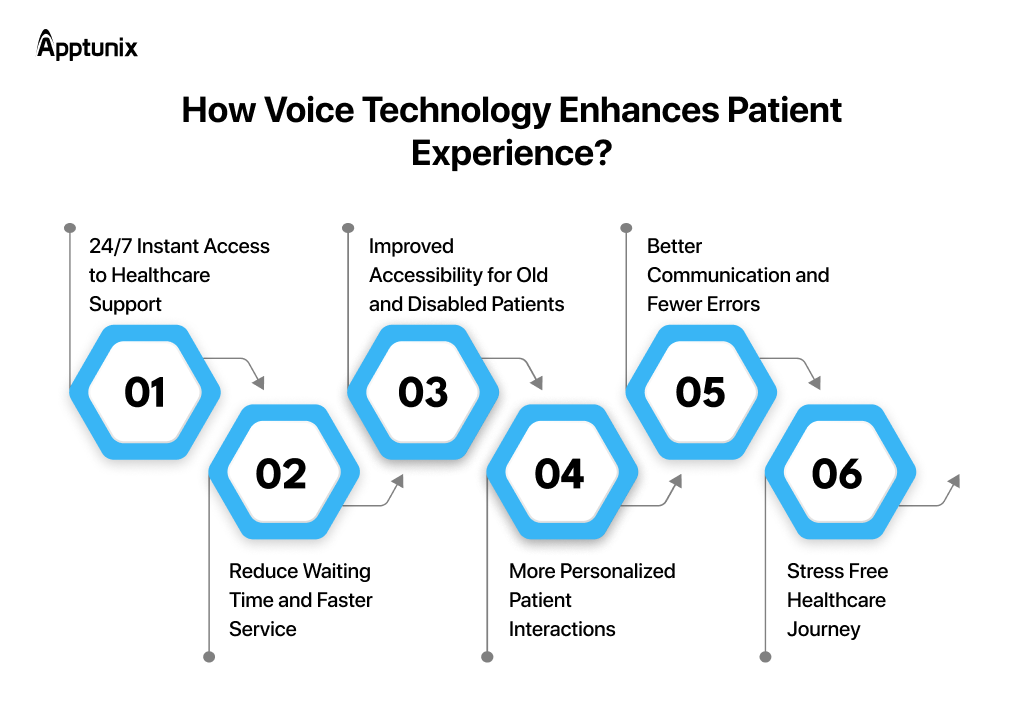
1:24/7 Instant Access to Healthcare SupportThe simplest way to explain this is that voice-enabled AI assistants are virtual receptionists that give patients 24/7 access to healthcare support. It allows patients:
The best thing about voice technology is that it eliminates wait time. Patients can simply speak their request and receive immediate confirmation. It eventually reduces frustration and improves overall patient satisfaction.
2:Reduce Waiting Time and Faster ServiceAI voice assistants in healthcare also reduce wait time and lead to faster service. For example, it streamlines the front desk operations and call handling. Voice technology leads to automated responses to common queries like
This leads to shorter wait times and quicker service for patients, enhancing patient experience. Moreover, it allows healthcare providers to deliver more focused, high-quality care without operational delays.
3:Improved Accessibility for Old and Disabled PatientsAI-powered voice command provides a more inclusive solution to the people who struggle with navigating applications, typing, or reading small screens. With the help of speech-based interactions, voice technology makes healthcare systems easier to use for
This ensures equal access to healthcare services without technological barriers. It promotes digital inclusion while empowering vulnerable patients to manage their health independently and confidently.
4:More Personalized Patient InteractionsThe best thing about AI-powered voice systems is that they can access patient history and provide tailored responses, reminders, and health updates, leading to more personalized patient interactions.
Automated medication reminders or follow-up notifications are crucial and help patients stay on track with treatment plans. This improves adherence and outcomes, as well as the overall patient experience.
Moreover, it also strengthens patient and healthcare provider communication and builds long-term trust.
5:Better Communication and Fewer ErrorsVoice-enabled healthcare solutions or clinical documentation enhance communication between patients and healthcare providers. The technology minimizes errors and improves clarity by offering real-time transcription.
It ensures that symptoms, diagnoses, and care instructions are accurately recorded.
6:Stress Free Healthcare JourneyAs an experienced healthcare provider, you know that healthcare visits for people can be stressful. However, voice technology in healthcare is making it stress-free by simplifying processes like
Voice automation in hospitals makes the entire experience smoother and less overwhelming by reducing uncertainty, minimizing waiting times, and giving patients a sense of control. This makes the healthcare journey more comfortable and reassuring.
As it enhances patient experience, voice technology also impacts operational efficiency. As a healthcare professional and organization, you understand how healthcare systems face constant pressure to reduce costs, manage staff shortages, and improve workflow speed. To address these challenges, voice AI automates repetitive tasks and optimizes clinical processes.
Discover how AI improves healthcare efficiency in 2026:
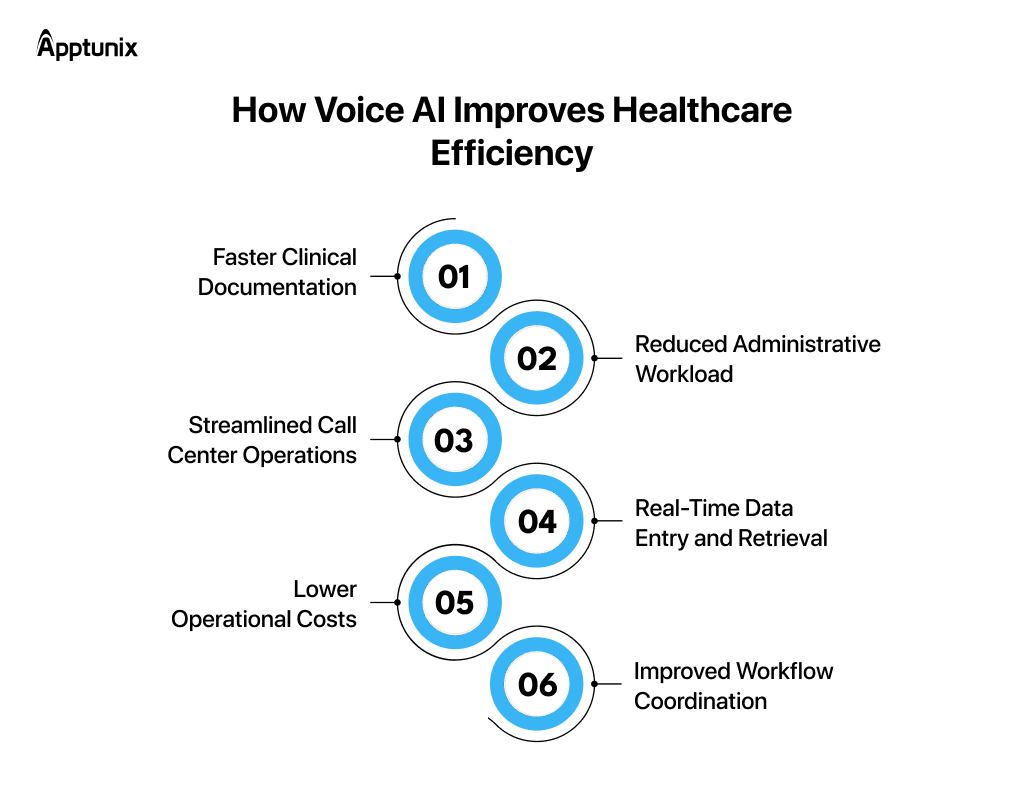
1:Faster Clinical DocumentationVoice AI improves healthcare efficiency by providing faster clinical documentation. It enables real-time speech-to-text transcription, which allows doctors to dictate notes during or after consultations.
As a doctor, you can understand how much time you spend on paper records. But it is not the case with voice AI and electronic health record (EHR) documentation. Voice AI reduces manual typing, minimizes after-hours paperwork, and improves record accuracy.
2:Reduced Administrative WorkloadHealthcare voice AI technology integrated system handles administrative workloads such as
AI voice assistants automate such routine tasks and allow healthcare staff to focus on higher-value responsibilities, improving overall productivity.
3:Streamlined Call Center OperationsVoice-enabled healthcare solutions also help hospitals and clinics that receive thousands of daily calls. With advanced AI-powered voice assistants, these organizations can answer frequently asked questions.
It directs calls to the right department and manages peak call volumes without increasing staff numbers. Leading to this, healthcare providers experience a reduction in operational bottlenecks and response delays.
4:Real-Time Data Entry and RetrievalBy using voice commands, healthcare professionals can easily access patient records, lab results, and treatment histories.
As a doctor, you can retrieve information instantly with voice AI since it eliminates the need for navigating multiple screens, which ultimately speeds up decision-making.
5:Lower Operational CostsVoice AI also helps in lowering overall operational costs by reducing manual processes and improving workflow automation and overall efficiency. The factors that usually help you save expenses include
This strengthens financial sustainability and maintains high-quality patient care standards.
6:Improved Workflow CoordinationVoice-enabled healthcare tools and solutions can integrate with hospital systems and ensure smoother coordination between departments in hospitals and other healthcare organizations.
It improves workflow coordination with automated updates and voice-triggered task assignments. This helps in preventing delays and improving communication gaps.
Well, you see how voice technology in healthcare enhances both patient experience and efficiency. Now, it’s time to examine the 4 major real-world use cases.
In today’s highly digital healthcare environment, voice technology is no longer experimental, but it is actively being implemented across healthcare organizations like hospitals, clinics, and digital health platforms. By improving patient monitoring and documentation, voice AI improves care delivery and efficiency.
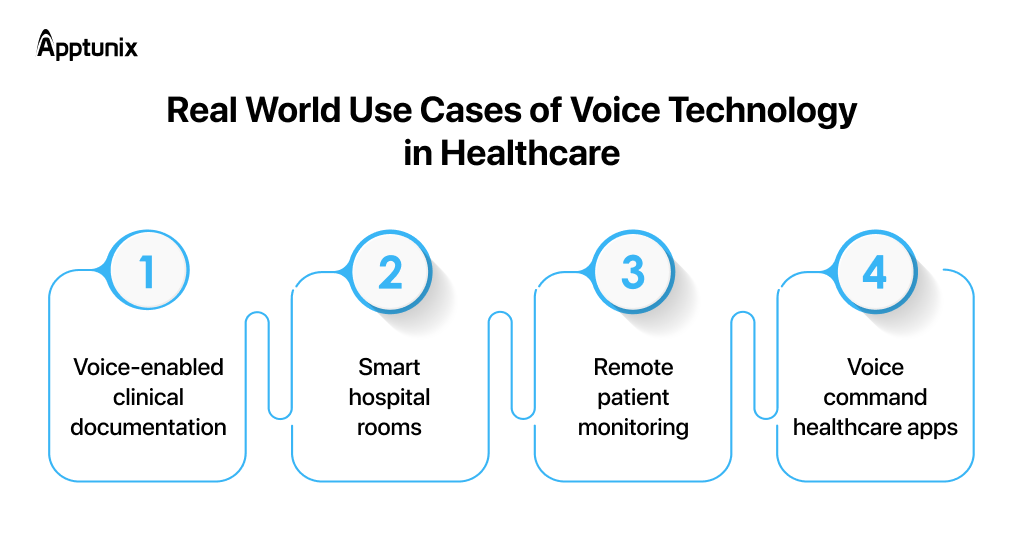
Real-time clinical documentation is one of the most impactful uses of voice technology. This voice-enabled, AI-powered speech recognition in healthcare allows doctors to dictate patient notes during consultations. It converts spoken words into structured electronic health records.
The system
This allows clinicians to focus more on patient interaction than on screen time.
Smart hospital rooms are also one of the biggest use cases of voice technology in healthcare. Today, modern hospitals are investing in voice assistants in patient rooms to make a more comfortable and responsive environment. It can be used in so many ways, like
This improves staff efficiency and patient satisfaction while reducing non-critical nurse calls.
Healthcare voice AI technology plays an imperative role in remote patient monitoring for chronic disease management, elderly care, and other patient care. Remote patient monitoring allows patients to
Artificial intelligence here analyzes inputs and alerts healthcare providers if it finds abnormalities. This supports continuous care outside clinical settings and enables early intervention.
One of the most common uses of voice command functionality is in healthcare mobile app development. Such digital solutions allow users to simply speak commands instead of navigating multiple menus. Users can command to
It is good for older patients and patients with disabilities, making digital healthcare more accessible and easy to use.
AI-powered voice technology in healthcare leads to several benefits. Let’s understand this by analyzing a table that mentioned benefits and impact.
Now, before wrapping up this detailed guide on how voice technology in healthcare enhances patient experience and efficiency, understand the ways to implement voice technology in your healthcare organization.
Well, implementing voice technology in the healthcare sector doesn’t require a complete system overhaul. It is crucial to follow the right strategy to introduce AI-powered voices gradually and effectively.
Here are the 7 steps you must follow to implement AI voice assistants in healthcare organizations:
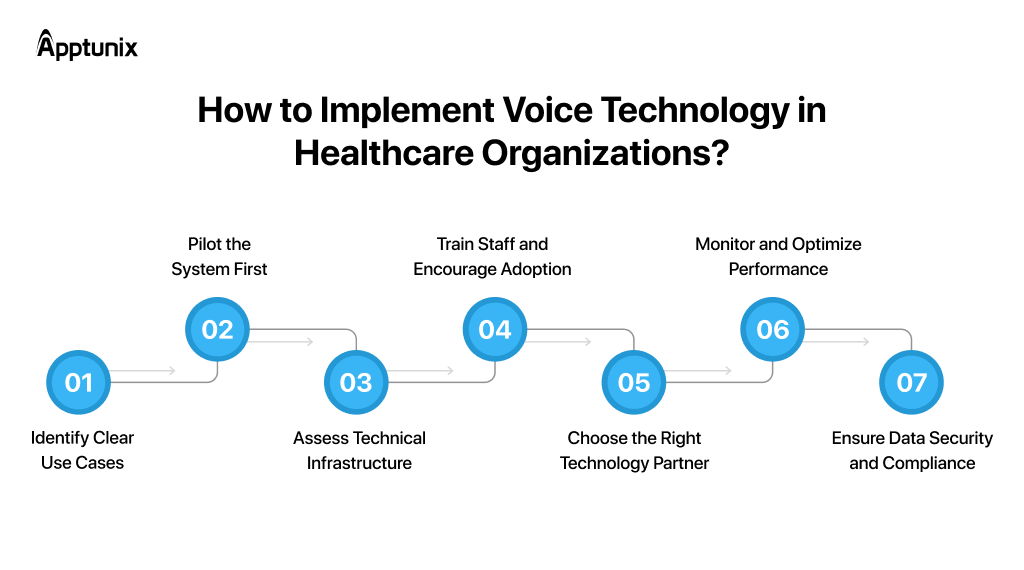
1:Identify Clear Use CasesFirst, you have to identify where the voice technology will have the greatest impact. For example, the most common uses of voice technology include:
Note: Focus on one high-impact area before expanding.
2:Assess Technical InfrastructureAssessing the technical infrastructure is essential, so review your existing systems, especially:
Before heading ahead, ensure your infrastructure can support AI integration and real-time data processing.
3:Choose the Right Technology PartnerPartnering with the right technology partner is the most important factor since it decides your business success. Choose a reliable or trustworthy healthcare technology provider with experience in
Always choose a reliable partner to ensure smooth deployment and long-term scalability.
4:Choose the Right Technology PartnerAs a healthcare professional or organization, you must understand the importance of data security and compliance. So, ensure data security and compliance by making sure the solution complies with
Prioritize security from the start for safe voice technology implementation.
5:Pilot the System FirstAfter ensuring the security and compliance, launch a pilot program in one department before developing a full-scale system. This helps you to
Remember, you have to refine the system before an organization-wide rollout.
6:Train Staff and Encourage AdoptionTraining staff and encouraging adoption are crucial since even the best technology fails without proper adoption. As a result, provide them
Don’t forget to make the transition smooth and collaborative.
7:Monitor and Optimize PerformanceOnce everything is done and the voice technology is actually implemented, track factors like
As healthcare professionals and organizations, you must use data insights to refine workflows and maximize ROI.
Voice technology use cases in the healthcare industry are exceptional. It’s no longer a futuristic concept, but it’s a practical solution that is transforming patient experience and operational efficiency.
The voice AI reduces administrative burden, improves accessibility, and enhances care delivery by providing faster appointment scheduling, real-time clinical documentation, and other tasks.
Today, the adoption of voice-enabled solutions is becoming a strategic necessity as healthcare organizations strive to provide smarter and patient-centric services.
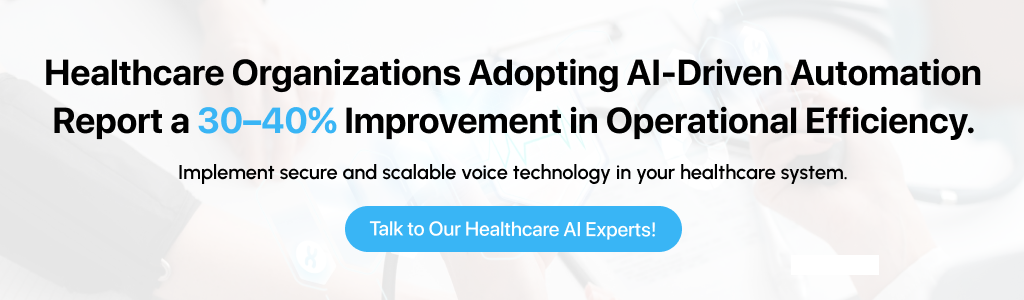
However, to streamline and automate your healthcare services, you must create a healthcare system that uses voice technology. Do that by partnering with an experienced healthcare app development company like Apptunix.
It can help you seamlessly integrate secure, scalable voice technology tailored to your needs.
The future of healthcare is conversational, intelligent, and efficient, and now is the time to embrace it. So what are you waiting for?

Q 1.How is voice technology used in healthcare?
Organizations and healthcare professionals use voice technology for patient engagement. It is used for appointment scheduling, patient support, clinical documentation, and remote monitoring. Basically, AI-powered speech recognition converts spoken words into medical records, automates routine tasks, and enables hands-free access to patient data.
Q 2.What are the benefits of technology in healthcare?
The benefits of technology in healthcare include
Q 3.How to implement technology in healthcare?
You can implement technology in healthcare by following the steps:
Q 4.What is the use of voice automation in hospitals?
Voice automation in hospitals is used to manage and handle several tasks, which include
Q 5.What is conversational AI in healthcare?
Conversational AI in healthcare refers to AI-powered systems for patients who use natural language. It supports symptom checking, appointment booking, reminders, and patient support through voice assistants and chatbots.
Q 6.How does technology improve efficiency in healthcare?
Technology improves healthcare efficiency by automating administrative tasks, enabling digital health records, supporting telemedicine, and using AI for data analysis. These tools reduce paperwork, speed up clinical workflows, minimize errors, and allow healthcare professionals to focus more on patient care.
Q 7.How can technology further enhance communication and efficiency in healthcare settings?
Technology enhances communication in healthcare through secure messaging platforms, electronic health records, telehealth services, and voice-enabled systems. These tools allow faster information sharing between staff and patients, improving coordination, reducing delays, and supporting better clinical decision-making.
Q 8.How can technology assist in improving the patient care experience?
Technology improves patient care experience by enabling online appointments, remote monitoring, digital health records, and AI-powered support systems. These solutions provide faster access to services, personalized care, and better communication between patients and healthcare providers.
Get the weekly updates on the newest brand stories, business models and technology right in your inbox.
Reena Bhagat, the CTO and Head of AI at Apptunix, is a seasoned technology strategist with a deep-rooted expertise in emerging technologies. With a focus on AI/ML integration, product engineering, cloud management, she leads the technical vision for high-performance SaaS infrastructures. Reena is recognized for building secure, scalable, and decentralized systems that solve real-world complexities. Her passion lies in leveraging data science and future-tech to create resilient digital products, making her a trusted authority for organizations looking to lead in the age of intelligent automation.
10 Views 9 min June 22, 2026

17 Views 9 min June 22, 2026

46 Views 9 min June 17, 2026
Book your consultation with us.
Book your consultation with us.


One Central, The offices 3, Level 3, DWTC, Sheikh Zayed Road, Dubai
+971 50 782 1690