Cost to Build an App Like Eventbrite: Complete Development & Pricing Guide (2026)
20 Views 11 min September 16, 2026

Arohi Singh is a technology content strategist at Apptunix, where she writes about software and app development across industries, from on-demand and logistics to fintech, healthcare, and applied AI. With over 5 years of experience, she works closely with Apptunix’s engineers, product managers, and solution architects to turn real project insights into clear, decision-ready guidance for founders and business leaders. Her writing focuses on what matters before you build: market context, feature trade-offs, realistic costs, and compliance considerations
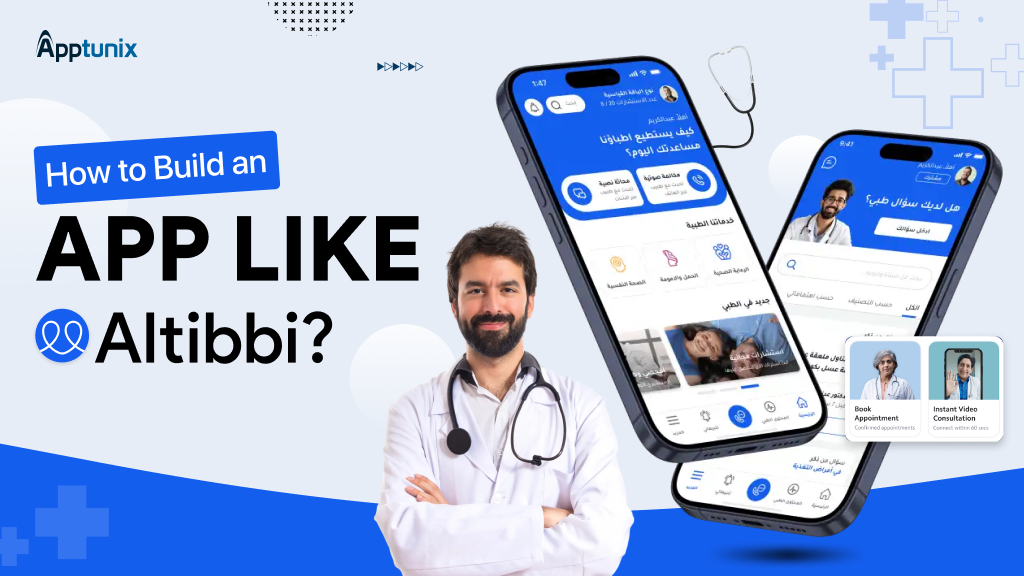
Let’s be honest: Telemedicine isn’t the future in the Middle East anymore. It’s the new baseline. And if you’re not aggressively carving out your digital footprint today, you are already falling behind.
The numbers explain the urgency. The global telemedicine market is projected to grow from $111.99 billion in 2025 to over $334.80 billion by 2032. That growth isn’t theoretical. It’s already visible in MENA, where virtual care usage remains well above pre-pandemic levels, according to the World Health Organization.
Platforms like Altibbi recognized this early. Its footprint across the UAE, KSA, and Jordan showed one thing clearly: when you remove wait times, traffic, and clinic queues, people don’t just adopt virtual care, they rely on it. That’s why investors across the region are now exploring how to build an app like Altibbi.
This growing reliance is creating both pressure and opportunity. Governments want scalable digital care, providers wish to unify platforms, and patients want instant access and trusted outcomes. If you’re exploring custom healthcare app solutions, this window won’t stay open forever.
Launching a telemedicine app like Altibbi today isn’t about cloning success. It’s about securing relevance before the market matures.
So, let’s start by looking at what makes Altibbi so successful, and how you can build something even better.
Altibbi is the Middle East’s most prominent Arabic-language digital health platform. Headquartered in Jordan, Altibbi has conquered the need to offer instant and localized virtual care to millions in the MENA region.
From a product standpoint, Altibbi operates as a comprehensive telemedicine app, consolidating multiple care touchpoints into a single interface. Virtual doctor appointments, AI-based symptom evaluation, and consecutive consultations are also available to users without requiring a clinic visit. This approach minimizes patient wait times while amplifying provider efficiency, which directly drives user retention.
The most significant distinction of Altibbi is its AI-powered triage. The platform stands out for utilizing structured medical data to route patients to the right specialists. This capability refines diagnostic accuracy while lowering unnecessary consultations, a critical requirement for scalable eHealth app solutions.
Altibbi values the security of patient information and adheres to the national health standards of the area. This trust layer is essential for enterprises considering telehealth app development services in the Middle East. Since there is no compromise on data privacy and clinical governance.
If you are willing to build a telemedicine app like Altibbi, it’s essential to understand the underlying business forces driving this opportunity. Here are the three core reasons:
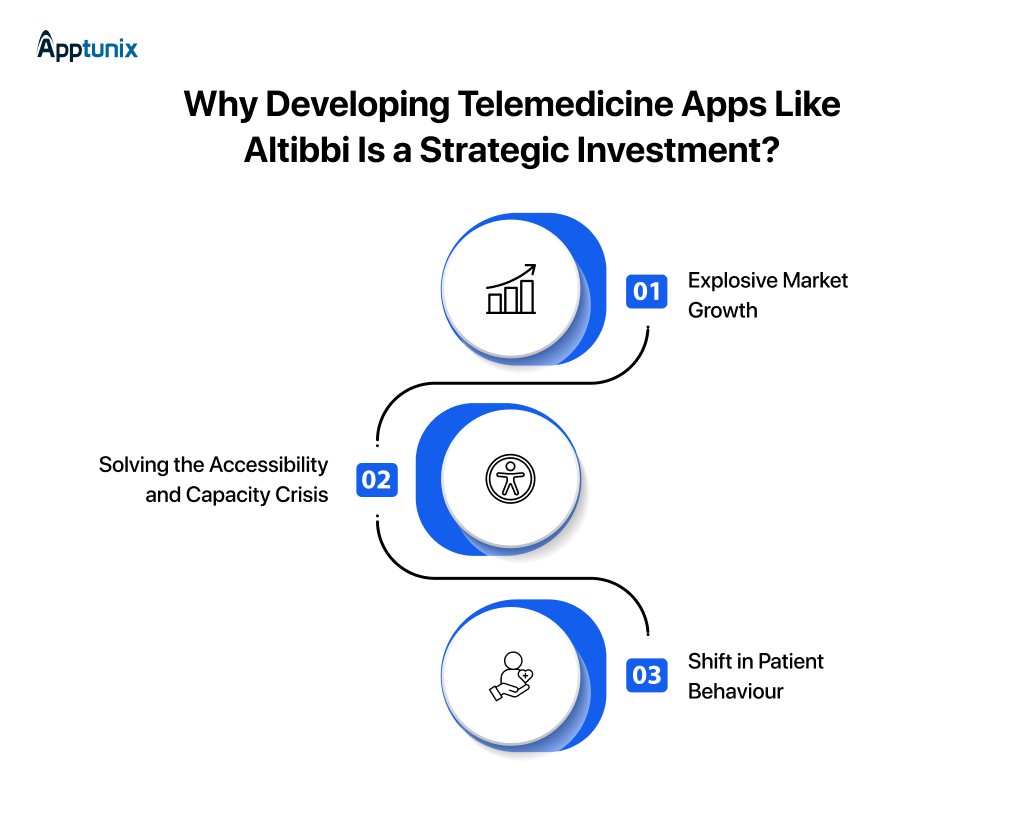
1. Explosive, Government‑Backed Market GrowthThe Middle East and Africa have shown immense adoption of digital healthcare. In fact, predictions indicate that the digital healthcare industry will surpass $30 billion by 2028. Such increased adoption is driven by enormous government programs, such as Saudi Vision 2030, and healthcare innovation in the UAE. These initiatives are actively pushing for the development of online doctor consultation app solutions to modernize infrastructure.
Investing in a telemedicine app like Altibbi means joining a market backed by strong demand and government support.
2. Solving the Accessibility and Capacity CrisisThe healthcare systems in the MENA region are overburdened, and patients need medical facilities that offer speed and convenience. A telemedicine app like Altibbi can fill this gap by providing patients with online medical consultations with a doctor.
3. Shift in Patient BehaviourTelemedicine is no longer a pandemic artefact; it’s the preferred model of care delivery. Across the MENA region, smartphone penetration and mobile health usage have surged, enabling broader access to remote care. For entrepreneurs, this means a telemedicine app like Altibbi is strategically essential.
To successfully build an app like Altibbi, features must solve real healthcare friction. Every function should reduce waiting time, improve trust, and simplify care delivery.
Below are the top 12 features that define a scalable telemedicine app like Altibbi.
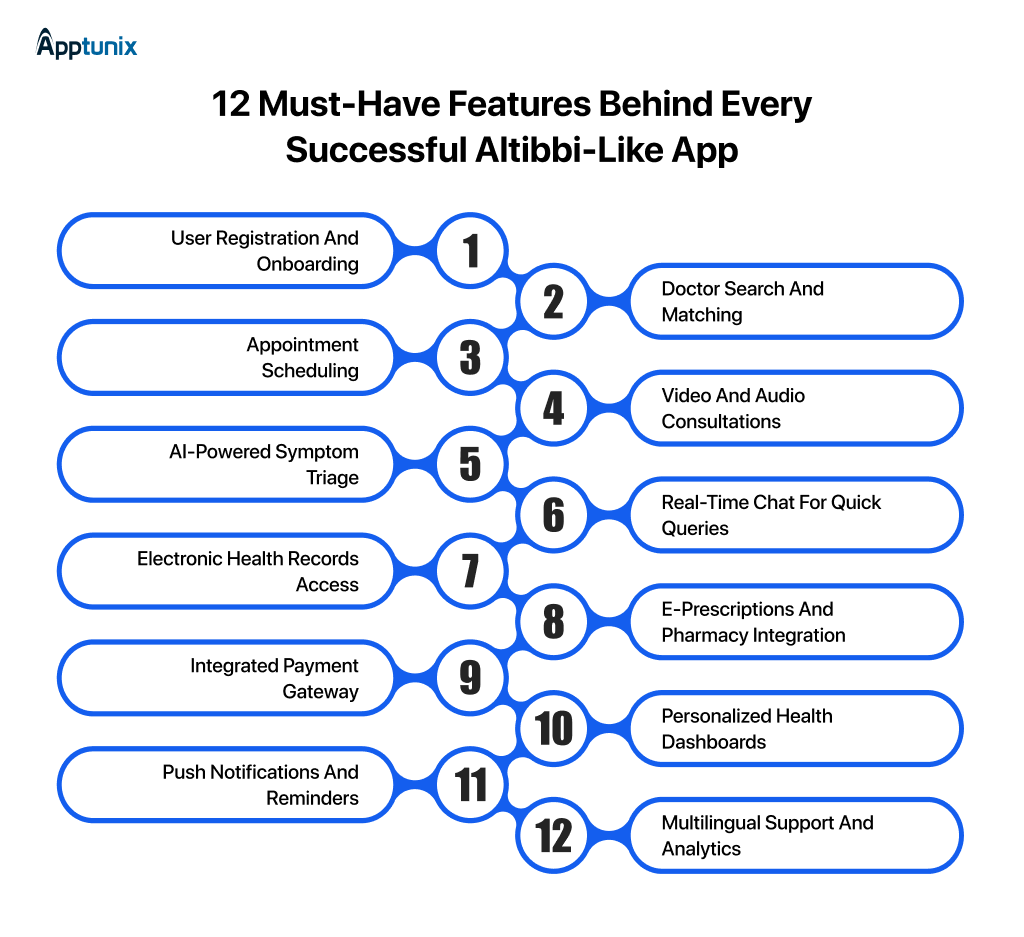
1. User Registration and OnboardingA smooth onboarding experience sets the tone for trust and engagement. Patients should register quickly while securely sharing basic medical details. This reduces friction and supports personalized care from the very first consultation in an online doctor consultation app.
2. Advanced Doctor Search and MatchingPatients have come to demand quick access to the right specialist. Filters based on expertise, language, availability, and rating systems are an essential component of an effective search. Smart matching improves consultation success and strengthens user trust in a telemedicine app like Altibbi.
3. Smart Appointment SchedulingOn-time scheduling removes delays and misunderstandings. Patients can immediately schedule an appointment, and doctors can easily manage their availability accordingly. The feature makes workflows predictable and enhances the platform’s reliability for enterprise healthcare providers.
4. Secure Video and Audio ConsultationsVirtual care is dependent on high-quality audio and video consultations. Flexible consultation modes guarantee access even in low-bandwidth regions. Security and stability are important for establishing a trusted relationship.
5. AI-Powered Symptom TriageAI-powered telemedicine apps like Altibbi use symptom triage to guide patients before consultations. This reduces unnecessary doctor load and improves clinical accuracy. It also speeds up care delivery across large user volumes.
6. Real-Time Chat for Quick QueriesChat-based consultations offer instant support for minor concerns. Patients value quick answers without full appointments. This feature increases engagement and improves doctor productivity.
7. Electronic Health Records AccessCentralized access to medical history improves care continuity. Doctors make better decisions with complete patient data. Secure records management is essential for compliant custom healthcare app solutions.
8. E-Prescriptions and Pharmacy IntegrationDigital prescriptions streamline post-consultation care. Patients receive medicines faster through integrated pharmacies. This closes the healthcare loop and enhances the overall care experience.
9. Integrated Payment GatewayFlexible payments support pay-per-consult and subscription models. Secure gateways enable regional payment methods. This is essential for monetizing telehealth app development services effectively.
10. Personalized Health DashboardsDashboards give patients visibility into their health journey. View past consultations, prescriptions, and reports in one place. This improves retention and long-term engagement.
11. Push Notifications and RemindersTimely reminders reduce missed appointments. Notifications keep users informed about consultations and prescriptions. This feature improves operational efficiency and user satisfaction.
12. Multilingual Support and AnalyticsArabic and English support is essential for Middle East markets. Analytics track usage, doctor performance, and patient behavior. These insights drive smarter decisions in telemedicine app development in the UAE, Saudi Arabia, and Jordan.
When you decide to develop an App like Altibbi, you are working inside a strictly compliant environment. Patient expectations are very high for telemedicine apps like Altibbi with immense responsibility around data, uptime, and accuracy.
Here’s the approach any reliable healthcare app development companies takes to build an app like Altibbi:
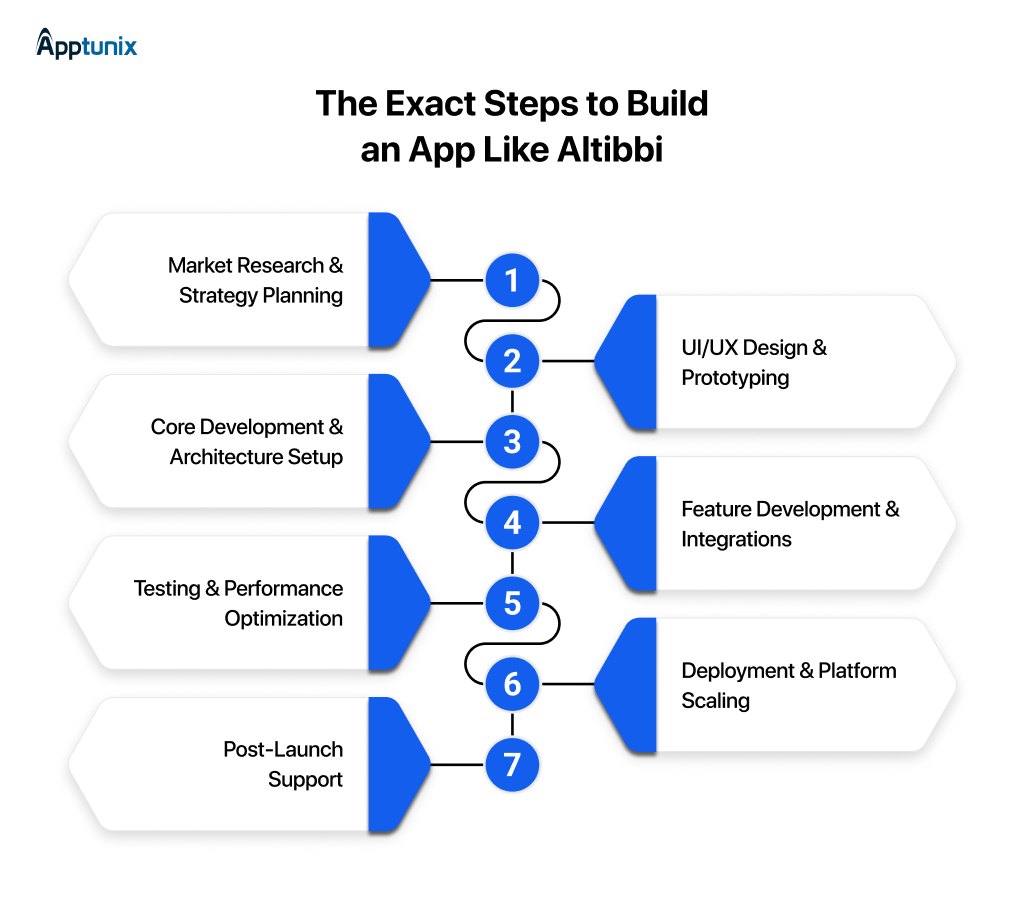
Step 1: Market Research & Strategy PlanningThe first step is to understand which healthcare gap you want to solve.
This step focuses on researching patient behavior, doctor availability, and telehealth adoption in the UAE, Saudi Arabia, and Jordan. Competitor platforms are analyzed to identify what users adore and what still frustrates them.
At this stage, the foundation for custom healthcare app solutions is laid. When strategy is clear, execution becomes predictable.
Step 2: UI/UX Design & PrototypingOnce the strategy is defined, it transforms into real user journeys. Designers map how patients search for doctors, book consultations, and receive care. Doctors’ workflows are also designed to keep consultations fast and efficient.
Prototypes are tested with real users to eliminate confusion early. This step ensures your telemedicine app, like Altibbi, feels intuitive before development even begins.
Step 3: Core Development & Architecture SetupThe platform architecture is designed for scalability, security, and real-time communication. Backend systems are structured to handle growth across multiple regions. Strong encryption and role-based access are built in early to support secure patient data management.
This step creates the technical backbone of the platform.
Step 4: Feature Development & IntegrationsNow the product comes alive. Patient apps, doctor apps, and admin dashboards are built simultaneously. Features such as bookings, consultations, prescriptions, and payments are introduced as core features. Third-party integrations would come next, such as payment gateways, laboratories, pharmacies, and notifications. Every integration enhances the overall ecosystem.
This phase transforms the platform into a fully-fledged online doctor consultation app.
Step 5: Testing & Performance OptimizationBefore launch, the platform is tested rigorously. Functional testing ensures every feature works as expected. Load testing will ensure the system has the capacity to accommodate heavy volumes of consultations. Security testing protects sensitive medical data. This step ensures your telemedicine app, like Altibbi, performs reliably under real-world conditions.
Step 6: Deployment & Platform ScalingOnce testing is complete, the platform is deployed with region-specific infrastructure. The concept of data hosting complies with Middle Eastern healthcare regulations. Performance is monitored using monitoring tools. With increased adoption, infrastructure scales automatically. This step prepares the platform for enterprise clients and nationwide expansion.
Step 7: Post-Launch Growth & Continuous ImprovementLaunch is the inauguration of a new phase. Post-launch activities aim to track performance, user feedback, and feature improvements. Analytics can indicate interactions between patients and doctors on the platform. Updates improve consultation quality, retention, and monetization. This continuous evolution turns a product into a long-term healthcare business.
The cost to develop a telemedicine app like Altibbi is not fixed, and that’s actually a good thing. It allows entrepreneurs to start lean, test demand, and scale at will.
Depending on scope and maturity, the average cost to build an app like Altibbi ranges from $15,000 to $120,000+. A simple version focuses on core consultations. A more advanced product adds AI, subscriptions, and enterprise workflows. Most founders begin with a focused MVP, then expand as traction grows.
If your goal is to develop an app like Altibbi, early investment should prioritize trust, performance, and compliance. A telemedicine app like Altibbi must feel reliable from day one. That’s where smart planning and custom healthcare app solutions make a real difference.
The key is not always spending more but spending right. Begin with what patients require today, then grow into what enterprises demand tomorrow.
When estimating the cost to create an app like Altibbi, it’s important to understand where the investment actually goes. The factors given below define how scalable, secure, and competitive your telemedicine app, like Altibbi, will be.
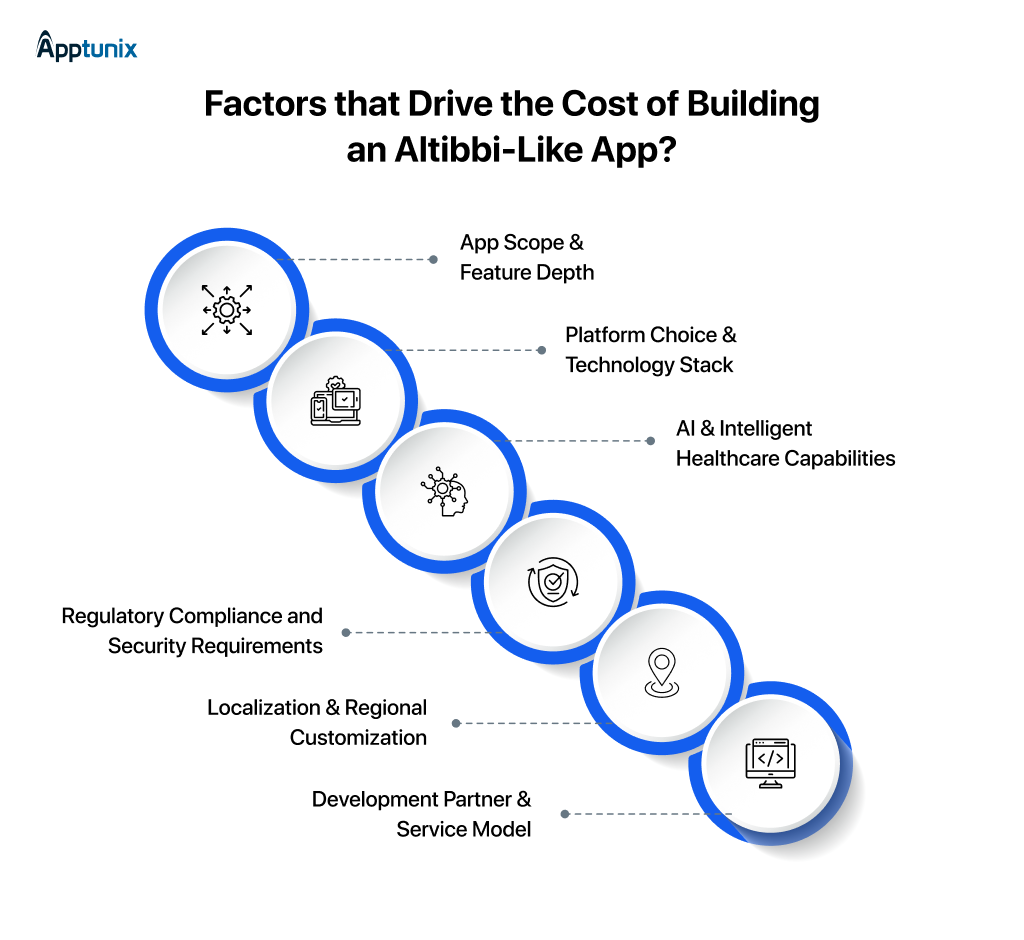
1. App Scope & Feature DepthThe more problems your app solves, the more value it delivers, and the higher the cost. A basic consultation app is quicker to build. Advanced platforms with AI triage, subscriptions, and analytics require more engineering effort. The number and intricacy of features are the single biggest cost driver. This is why Altibbi clone app development costs vary widely.
2. Platform Choice & Technology StackBuilding for iOS, Android, or both affects timelines and budgets. Native apps offer performance but increase cost. Cross-platform solutions balance speed and quality. These technical decisions shape long-term stability. Choosing the right stack is critical to the success of mobile health app development.
3. AI & Intelligent Healthcare CapabilitiesAI-powered telemedicine apps like Altibbi require additional investment. Models should be trained and validated to ensure smart routing and data-driven insights, as well as symptom checkers. AI will enhance efficiency and reduce the doctor’s workload. However, it also demands clinical accuracy and testing. This makes AI both a major cost driver and a strong competitive advantage.
4. Regulatory Compliance and Security RequirementsHealthcare apps deal with patient-sensitive information. In the Middle East, data laws are strict and dynamic. Access controls, compliance structures, audit trails, and encryption are obligatory there. Strong security increases development effort but builds long-term trust.
5. Localization & Regional CustomizationA global template doesn’t work in MENA. Support for the Arabic language, RTL design, and workflows in a region is necessary. Cultural adaptation enhances adoption and retention. Regional-specific payment practices and medical standards are also part of localization.
This aspect is one of the greatest contributors to the telemedicine app development in the UAE, Saudi Arabia, and Jordan.
6. Development Partner & Service ModelThe team you choose shapes both cost and outcome. Experienced partners offering telehealth app development services bring healthcare expertise and faster execution. Low-cost service providers are likely to compromise quality, which will raise the expenses in the future. A strategic partner delivers custom healthcare app solutions aligned with your business goals.

A sustainable healthcare investment, such as building a telemedicine app like Altibbi, can generate predictable income. What makes Altibbi’s model powerful is that it doesn’t rely on one source of income. Instead, it blends patient payments, enterprise contracts, and long-term subscriptions.
Given below are the monetization strategies that work best:
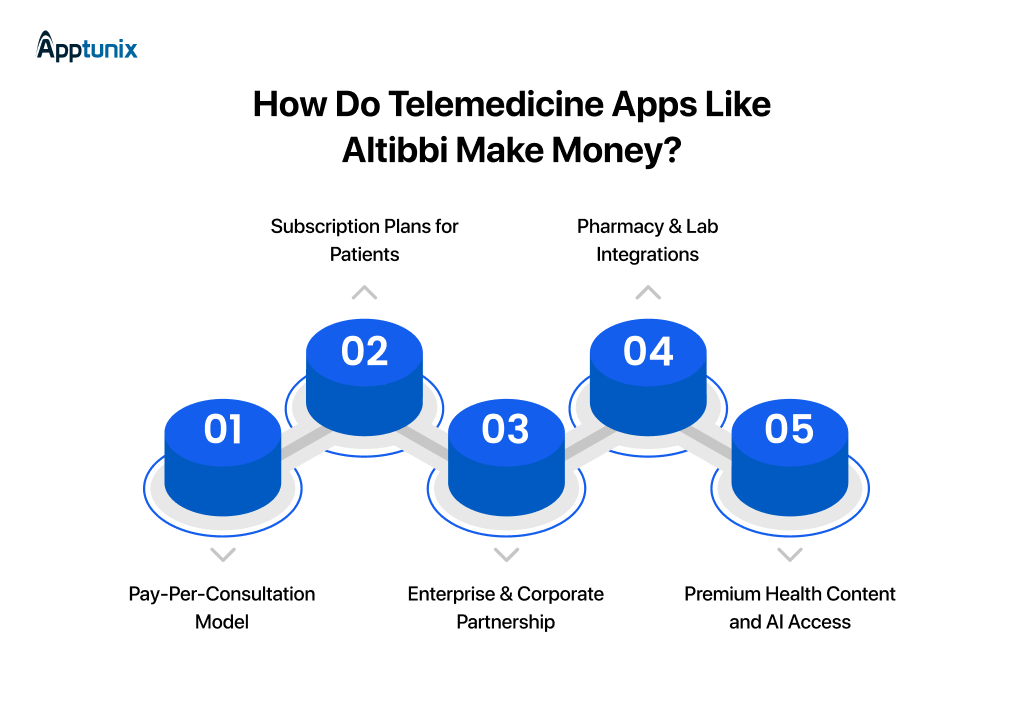
1. Pay-Per-Consultation ModelThis is the most direct and trusted revenue stream. Patients pay for each virtual visit based on the doctor’s speciality or consultation type. The platform retains a commission (typically 15–30%) from the doctor’s fee. In pharmacy app development, a similar commission-based model applies, where the platform earns a percentage from every medicine order or prescription fulfilled through partner pharmacies. For an online doctor consultation app, this model drives quick adoption and immediate cash flow.
2. Subscription Plans for PatientsSubscriptions create predictable revenue. Monthly or annual plans offer unlimited or discounted consultations. This works well for families, chronic patients, and frequent users. For businesses, it creates a sticky user base and predictable recurring revenue. Most successful telemedicine apps like Altibbi rely heavily on this model.
3. Enterprise & Corporate PartnershipLarge organizations prefer digital healthcare for employees. Businesses pay for bulk contracts to provide virtual doctor access as a benefit. This model brings high-value, long-term revenue.
4. Pharmacy & Lab IntegrationsEvery digital prescription or lab request is a revenue opportunity. By integrating with local pharmacies and diagnostic centers, the app receives a referral commission for every prescription fulfilled or test booked through the platform. This transforms your eHealth app solutions into a complete logistics pipeline for healthcare.
5. Premium Health Content and AI AccessYou can monetize the platform’s non-clinical intellectual property. Charging a subscription fee for access to specialized medical content or unlocking advanced features of your AI-powered telemedicine apps, like Altibbi. This adds a premium revenue tier that leverages your technical investment.
To create an app like Altibbi, what is needed is a collaborator with knowledge of the Middle East market as a whole. Your Android & iOS healthcare app developer must understand healthcare, technology, and the regulations of your specific region. That’s exactly where Apptunix stands apart.
Apptunix is not a generic healthcare app development company. We have been focusing on constructing enterprise-grade digital health platforms that scale across regions, users, and regulatory frameworks. Our team has delivered healthcare and telemedicine solutions for businesses operating in the UAE, KSA, and neighbouring markets. This obviously implies that we already know the clinical workflow, compliance requirements, and user behavior peculiar to this region.
What truly differentiates us is our strength as an AI-driven enterprise digital transformation company. From AI-powered triage to smart doctor routing and data-led decision systems, we design future-ready platforms. Every telemedicine app like Altibbi we build is customized, secure, and designed to ensure growth for a prolonged period of time.
Our healthcare app development services cover everything, from strategy, UI/UX design, and development, down to post-launch scaling.
If you’re serious about developing a telemedicine app like Altibbi, now is the moment to act. Let’s build something trusted, scalable, and region-ready healthcare product that leads your market, not follows it.
Q 1.What is the cost to develop a telemedicine app like Altibbi?
The cost to develop a telemedicine app like Altibbi typically ranges between $15,000 and $120,000+. The pricing will be based on feature depth, AI capabilities, compliance needs, and regional customization. A basic online doctor consultation app costs less. However, an AI-powered telemedicine app like Altibbi, with multilingual support, analytics, and enterprise security, lies at the higher end.
Q 2.How long does it take to build an app like Altibbi?
The timeline for developing an app like Altibbi typically ranges from 3 to 12 months, depending on complexity and feature set. The basic telemedicine app can be created and deployed more quickly. Although more advanced technologies may require additional time to incorporate AI, comply, and test.
Q 3.What are the hidden costs most entrepreneurs miss when building a telemedicine app like Altibbi?
Many entrepreneurs underestimate costs beyond development. Common hidden expenses include:
Ignoring these can inflate the actual cost of building an app like Altibbi.
Q 4.How to ensure compliance and secure patient data management in telemedicine app development?
Compliance starts with architecture. An encrypted data storage, role-based access, and secure APIs are used in a secure telemedicine app like Altibbi. It should comply with regional laws, such as those in the UAE and KSA, and international laws such as HIPAA.
Collaborating with a healthcare app development company experienced in secure patient data management ensures legal safety from day one.
Q 5.What tech stack is best for creating an AI-powered telemedicine app like Altibbi?
A modern AI-powered telemedicine app like Altibbi typically uses:
Q 6.What monetization models work best for an online doctor consultation app?
Successful telemedicine platforms use multiple revenue streams, including:
Q 7.How to choose the right healthcare app development company for an Altibbi clone?
Q 8.Should businesses build a custom healthcare app solution or use an Altibbi clone approach?
An Altibbi clone approach is faster and cost-effective for validation. Custom healthcare app solutions are, however, more advantageous to businesses that expect growth in the long term. Customized solutions enable distinctive features, artificial intelligence, and improvement in scalability. Most successful telemedicine companies start with a proven model and then customize it to fit their market.
(2 ratings, average: 5.00 out of 5)
Get the weekly updates on the newest brand stories, business models and technology right in your inbox.
Arohi Singh is a technology content strategist at Apptunix, where she writes about software and app development across industries, from on-demand and logistics to fintech, healthcare, and applied AI. With over 5 years of experience, she works closely with Apptunix’s engineers, product managers, and solution architects to turn real project insights into clear, decision-ready guidance for founders and business leaders. Her writing focuses on what matters before you build: market context, feature trade-offs, realistic costs, and compliance considerations
20 Views 11 min September 16, 2026
11 Views 11 min September 14, 2026

30 Views 11 min September 8, 2026
Book your consultation with us.
Book your consultation with us.


One Central, The offices 3, Level 3, DWTC, Sheikh Zayed Road, Dubai
+971 50 782 1690