Airbnb Business Model & Revenue Strategy: 5 Insights for New-Age Businesses
6689 Views 11 min January 8, 2026

With over 20+ years of experience in driving global digital initiatives, Nikhil Bansal is the CEO & Director of Apptunix. He specializes in orchestrating large-scale digital transformations, enterprise-grade software solutions, and high-level business strategies that redefine industry standards. Nikhil is known for his ability to bridge the gap between complex business challenges and innovative technology, helping Fortune 500 companies and startups alike achieve sustainable growth. A visionary leader, he empowers enterprises to navigate the digital landscape with agile, ROI-focused models and future-ready business strategies.

As a budding mobile app entrepreneur, you’re always on the lookout for the next big thing in the world of mobile apps. And if you’re anything like us, you’ve probably been keeping a close eye on Clubhouse, the latest sensation in the mobile app development industry.
Clubhouse has quickly become the app everyone is talking about, with its unique audio-only approach and exclusive invite-only model. In just a few months, it attracted millions of users from around the world and has become the go-to platform for networking, sharing ideas, and building communities.
So, what can budding app entrepreneurs learn from the success story of Clubhouse? In this blog, we will take a deep dive into the inner workings of Clubhouse and explore the different factors that have contributed to its meteoric rise. We’ll also discuss the business and revenue model that Clubhouse has adopted and how you can leverage them in your own app.
Thus, if you’re looking to develop your own social media app or Clubhouse clone app, read on to discover the secrets of Clubhouse’s success and get inspired to create the next big thing in the world of mobile apps.
Behind every successful Mobile App Startup, there’s often a story of hard work, perseverance, and plenty of setbacks. The Clubhouse is no exception. To truly understand how it became the success it is today, we need to take a closer look at its journey from the very beginning.
Clubhouse was founded by Paul Davison and Rohan Seth in March 2020, but the idea for the app came about well before that. Both of the app’s founders were interested in the idea of using audio to connect people and make something engaging.
The app may seem like an overnight success, but it is actually the result of years of hard work and many failures. Coming from similar backgrounds, both its founders experienced many hurdles and failures in their professional journeys.
Founded by Paul Davison and Rohan Seth.
Launched in March 2020 as an invite-only iOS app focused on live audio chat rooms.
Created under the company name Alpha Exploration Co.
Gained initial traction among Silicon Valley insiders and tech influencers during the early pandemic lockdowns.
Davison had previously founded a Social Media Application called Highlight, which used location-based technology to help users discover people nearby who shared their interests. Initially, the app was a success but it failed eventually because of various reasons. After that, he founded two more apps named Roll and Shorts – both of them also failed to get traction for a long-time.
Seth had worked as a product manager at Google and had experience in developing communication tools. He was also a founder of apps like Dayfie and Phone-A-Friend, the apps that initially made their name in the market but failed eventually.
But destiny had some good plans as well for both of them. They met and began exploring different ways to connect people through audio. They were both interested in creating a more intimate and personal social media platform that would allow people to have real-time conversations and share ideas in a more natural way. After experimenting with different concepts, they came up with the idea of Talkshow.
While Talkshow never really got the required traction, it managed to ignite the spark in the founders that led to the creation of Clubhouse.
Used by brands like TED, L’Oreal Paris, and many others to get consumers’ attention, Clubhouse is an audio-only social media app that allows users to create and join virtual rooms where they can have conversations on various topics.
Contributing to its early success, the app’s exclusive invite-only model helped create a sense of exclusivity and scarcity. The model also helped the company manage growth, as they could control the number of users joining the platform and ensure that the user experience remained high-quality.
Clubhouse’s founders envisioned the app as a way to connect people and provide a platform for meaningful conversations. The app’s design intentionally keeps the focus on audio, with no video or text-based communication. This helps users to focus on the conversation and be more present in the moment, without the distractions that come with other forms of social media.
Since its launch, Clubhouse has gone on to become one of the fastest-growing social media platforms in recent years. The app has attracted a diverse range of users, including celebrities, entrepreneurs, and thought leaders. Its unique approach to social media has helped it stand out in a crowded market, and its popularity has continued to grow.
Today, Clubhouse has over 10 million weekly active users, and its success has inspired other social media platforms to explore the use of audio in their own apps.
Overall, the story of Clubhouse is a testament to the power of hard work, determination, and innovation in the world of startups. While the app’s success may look like a fairy tale from afar, it’s clear that there’s a lot more to the story than what meets the eye.
Also Read: How to Build Social Media App From Scratch?
Clubhouse is a social networking app that allows users to participate in voice chat rooms on various topics. Launched in 2020, the app quickly gained popularity, particularly among tech industry professionals and entrepreneurs. It is currently available on iOS and Android devices and users can join chat rooms to participate in discussions or start their own chat rooms.
Here’s a detailed Business Model Canvas of Clubhouse, covering how the platform works and delivers value across key business dimensions:
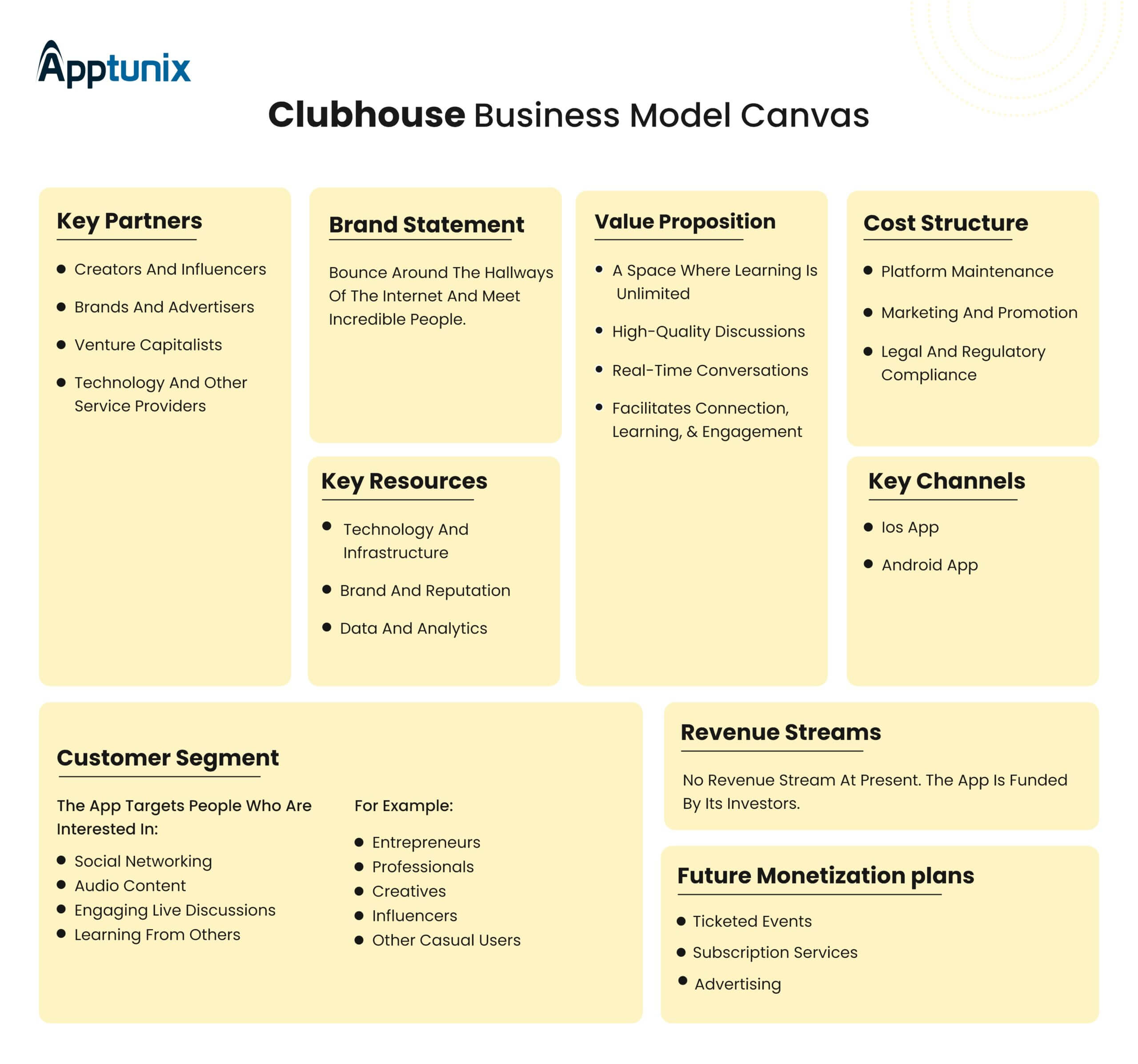
Strategic collaborations that power and support Clubhouse’s ecosystem:
Stripe – Handles payment processing for Clubhouse Payments and tipping features.
Venture Capital Firms – Investors like Andreessen Horowitz provided financial backing and strategic support.
Influencers and Celebrities – Early adopters like Elon Musk, Mark Zuckerberg, and Oprah drove mass visibility and credibility.
Content Creators & Moderators – Core to driving engagement and user retention through live rooms.
Cloud & Infrastructure Providers – Power hosting, data storage, and app scalability (likely AWS or Google Cloud).
Sponsorship Platforms – Clubmarket and others helped creators monetize through brand deals.
What Clubhouse does to create and deliver its product:
Product Development – Building and refining the mobile app, live audio infrastructure, and new features (e.g., replays, payments, backchannel).
Platform Moderation & Community Management – Ensuring content safety, compliance, and healthy user interaction.
User Engagement & Retention – Running initiatives like “Creator First,” notifications, topic discovery, and curated rooms to boost usage.
Monetization Innovation – Developing tipping, ticketing, subscription models, and exploring premium features.
Strategic Partnerships – Working with brands, influencers, and platforms for broader reach and integration.
Why users, creators, and partners choose Clubhouse:
Live, Unscripted Conversations – Offers a unique audio-based experience unlike static podcasts or text posts.
Real-Time Networking – Connects people across industries, regions, and topics through shared live discussions.
Creator Monetization – Enables creators to earn via tips, ticketed events, and sponsorships.
Exclusive Experiences – Initially invite-only, creating scarcity and high perceived value.
No Ads Model – Clean user experience without intrusive ads (as of now).
Who Clubhouse serves:
General Users & Listeners – People who join rooms to learn, network, or be entertained.
Content Creators & Moderators – Hosts who create rooms, invite guests, and build followings.
Brands & Sponsors – Businesses seeking access to niche, engaged audiences via sponsored rooms or collaborations.
Influencers & Public Figures – Looking to engage directly with their audience in real time.
Communities – Users forming interest-based clubs or niche groups.
How Clubhouse engages its users:
Direct Engagement – Through push notifications, in-app invites, and personalized room suggestions.
Creator Support – Programs like “Creator First” provide financial help and platform guidance.
Community-Driven – Users form clubs and follow moderators to build micro-communities.
User-Moderated Content – Listeners and speakers have control over the tone, rules, and flow of each room.
How Clubhouse reaches and serves users:
Mobile App (iOS & Android) – Primary product access point.
Word of Mouth & Influencer Buzz – Early growth fueled by social media and big-name users.
Media & PR Coverage – Major tech and entertainment media helped amplify the brand.
Social Media – Twitter and LinkedIn especially useful for room promotion and sharing links.
Clubhouse Clubs – In-app groups organized by topic or community, improving room discoverability.
How Clubhouse makes and plans to make money:
Tipping (Clubhouse Payments) – Users send money to creators; Clubhouse currently takes no cut, but could introduce fees later.
Ticketed Events – Paid access to exclusive rooms; Clubhouse may take a percentage.
Sponsorships & Brand Collaborations – Indirect revenue through sponsored events and partnerships.
Future Premium Features – Potential for paid memberships (Clubhouse Pro), analytics tools, or ad-free premium subscriptions.
Assets Clubhouse relies on to function:
Technology & Infrastructure – Audio streaming technology, app development, backend servers.
Brand Reputation – Known for exclusivity and early tech-elite adoption.
User Base & Creator Community – Engaged creators and listeners drive growth and content generation.
Investor Capital – Funded development, expansion, and creator grants.
Content Moderation Systems – Tools and protocols for managing real-time conversations.
Major costs involved in running Clubhouse:
App Development & Engineering – Continuous improvement of platform features.
Infrastructure & Bandwidth – High cost of real-time audio streaming and data handling.
Creator Grants & Incentives – Supporting programs like “Creator First” or exclusive content shows.
Content Moderation & Safety – Hiring staff and building tools to ensure safe user experience.
Marketing & PR – Campaigns to increase visibility and user acquisition.
Customer Support – Ensuring smooth onboarding, bug resolution, and feedback loops.
Bonus Read: I have an App Idea, what to do next?
Clubhouse is a relatively new social media platform, and its revenue model is still evolving. As of now, Clubhouse does not have any revenue stream, and its operations are solely dependent on the funding provided by its investors.
However, it directly allows creators to generate revenue through the platform and has several monetization plans for the future. Let’s shed some light on the same:
In April 2021, Clubhouse launched Clubhouse Payments, enabling users to send money directly to creators via Stripe. Creators receive 100% of the tip; Clubhouse takes no cut—only the Stripe processing fee applies.
While this feature doesn’t generate direct revenue for Clubhouse, it helps fuel creator growth, positioning Clubhouse to monetize through value-added services in the future.
Premium or exclusive rooms (e.g. workshops, live Q&As with celebrity speakers) are accessible via ticketed admission, with Clubhouse taking a cut along with the moderators or creators.
Clubhouse has explored offering paid subscriptions for premium membership—sometimes called “Clubhouse Pro”—which would provide perks like early access to rooms, analytics, or specialized badges; moderators and creators would also receive payment from this revenue.
Clubhouse enables brand-sponsored rooms, clubs, or campaigns, where businesses pay creators or Clubhouse to reach target audiences through branded discussions or events.
Platforms like Clubmarket mediate these deals—taking a cut (e.g., ~20%)—and helping brands find creators, manage campaigns, and deliver real-time metrics.
Through initiatives like Creator First, Clubhouse has offered stipends (e.g. US $5,000/month) to select creators to build exclusive shows, to promote premium content and long-term user retention.
Tell us what you're building — we'll send a quote built around your vision, not a template.
Here’s a detailed SWOT analysis of Clubhouse, the live audio-based social networking app:
Clubhouse pioneered the live audio social networking space, creating a unique and engaging format of drop-in audio chat rooms.
This novelty helped it attract early adopters, including Silicon Valley influencers, celebrities, and thought leaders.
Gained popularity with the support of high-profile users like Elon Musk, Oprah Winfrey, Mark Zuckerberg, and Kevin Hart.
This created significant media buzz and credibility, attracting millions of users in a short time.
Initially invite-only, Clubhouse created a sense of exclusivity and curiosity, driving demand and FOMO (fear of missing out).
This exclusivity encouraged higher user engagement and retention among early adopters.
Clubhouse offers monetization tools like tipping, ticketed events, and sponsorships.
These empower creators directly and position Clubhouse as a pro-creator platform without relying on traditional ads.
Offers an authentic and spontaneous way to interact—unlike text or pre-recorded content—which fosters genuine community building and networking.
Users often find it hard to discover relevant or high-quality rooms due to poor content categorization and algorithmic recommendations.
Clubhouse conversations are live and ephemeral (often not recorded), which limits long-term content value and discoverability for late joiners.
While creators can monetize, Clubhouse itself hasn’t fully established a sustainable, scalable revenue model, making profitability uncertain.
Live audio poses significant challenges for content moderation, including misinformation, hate speech, or harassment—often in real-time without immediate oversight.
After the initial hype, user engagement dropped, and many users stopped opening the app regularly due to lack of new features or repetitive room experiences.
With the rise of podcasts and voice assistants (Alexa, Siri), audio content is booming. Clubhouse can expand into podcasting, voice search, or audio summaries.
Clubhouse can target non-English speaking markets with localized rooms, regional creators, and multi-language support to drive growth.
Potential collaborations with news outlets, conferences, universities, or brands can help drive platform legitimacy and monetization through sponsored content.
Offering premium features like enhanced room analytics, audience segmentation, and cross-platform integrations could generate steady B2B or creator revenue.
Clubhouse can build private networks or audio collaboration tools for remote teams, startups, or corporate training sessions.
Platforms like Twitter Spaces, Spotify Greenroom, Discord, and LinkedIn Audio Events have launched similar features with larger existing user bases.
Meta (Facebook) and Reddit have also entered the live audio space, making competition fierce.
Clubhouse saw a massive decline in daily active users after peaking during the pandemic. Retaining long-term users remains a challenge.
With significant VC funding and high valuation, Clubhouse is under pressure to show revenue and profitability—without alienating its core community.
As a live audio app, Clubhouse faces risks related to data security, unconsented recordings, and potential leaks from private conversations.
The platform’s success heavily depends on active, engaging creators. If creators shift to other platforms with better tools or audiences, Clubhouse could lose its appeal.
Clubhouse has captured the attention of the world with its booming success. Here are some key takeaways that budding entrepreneurs can learn from Clubhouse business model:
1. The Power of Exclusivity and Scarcity for Creating DemandClubhouse’s invite-only model created a sense of exclusivity and scarcity, making it more desirable and sought-after. This has helped to generate a lot of buzz around the app, which has translated into a rapid increase in user numbers. This approach can be applied to other products and services as well, as people are often drawn to things that are exclusive or hard to get.
2. The Power of User-Generated ContentClubhouse’s content is created entirely by its users, who host and participate in audio discussions on a variety of topics. By empowering users to create their own content, Clubhouse has built a strong community that is highly engaged and invested in the app. This is a powerful way to build a loyal following and increase user retention.
3. The Importance of Continuous InnovationClubhouse’s success has not come without its challenges, as other social media platforms have quickly jumped on the audio bandwagon. However, Clubhouse has continued to innovate and introduce new features, such as monetization options for creators and the ability to record and save conversations. This has helped to keep the app fresh and relevant and has allowed it to maintain its position as a leader in the audio space. For budding entrepreneurs, it’s important to constantly innovate and evolve to stay ahead in a competitive market.
Also Read: How Much Does it Cost to Build a Social Media App?
In conclusion, Clubhouse business model provides valuable insights into the factors that contribute to a mobile app’s success. Aspiring mobile app entrepreneurs can learn from Clubhouse’s journey and leverage its business and revenue model to create their own successful social media apps. If you’re looking for Clubhouse clone app development, Apptunix’s team of mobile app developers can help you bring your vision to life.
We are a leading mobile app development company that specializes in developing cutting-edge mobile apps for various platforms, including iOS and Android. Our team can assist you with every aspect of mobile app development, including ideation, prototyping, design, development, testing, and deployment.

Q 1. How does Clubhouse make money?
Clubhouse generates revenue primarily through ticketed events, where users pay to attend exclusive audio sessions. It also enables tipping via Clubhouse Payments, though it currently takes no cut. Future monetization may include premium subscriptions and brand-sponsored content.
Q 2.Does Clubhouse run ads?
No, Clubhouse currently operates with a no-ads model to maintain a clean and authentic user experience. Instead, it relies on creator monetization tools and direct support.
Q 3.How do creators make money on Clubhouse?
Creators earn through:
Tipping (Clubhouse Payments)
Ticketed Rooms
Sponsored Rooms (brand deals)
Third-party platforms like Clubmarket for influencer collaborations.
Q 4.What makes Clubhouse’s business model unique?
Unlike most social platforms, Clubhouse:
Focuses entirely on live audio conversations.
Prioritizes creator-first monetization without intrusive ads.
Encourages real-time engagement and community-led discussions rather than algorithmic feeds.
Q 5. What is the long-term revenue plan for Clubhouse?
Long-term, Clubhouse may explore:
Subscription-based premium features
Revenue-sharing from ticketed events
Enterprise offerings for teams or private communities
Branded partnerships and integrations
Q 6.Who are Clubhouse’s main customers?
Clubhouse serves:
Listeners looking for live discussions and insights.
Creators who host rooms and build communities.
Brands seeking unique live audio marketing opportunities.
Communities organized around shared interests or topics.
Q 7.How long does it take to build a Clubhouse-like app?
It typically takes 3–8 months, depending on features, platforms (iOS/Android), and team size.
Q 8.How much does it cost to build an app like Clubhouse?
The cost to build an app like Clubhouse ranges from $40,000 to $150,000+, based on complexity, region, and feature set.
Q 9.Is Clubhouse scalable for millions of users?
Yes, with proper cloud infrastructure and scalable microservices architecture.
(1 ratings, average: 5.00 out of 5)
Get the weekly updates on the newest brand stories, business models and technology right in your inbox.
With over 20+ years of experience in driving global digital initiatives, Nikhil Bansal is the CEO & Director of Apptunix. He specializes in orchestrating large-scale digital transformations, enterprise-grade software solutions, and high-level business strategies that redefine industry standards. Nikhil is known for his ability to bridge the gap between complex business challenges and innovative technology, helping Fortune 500 companies and startups alike achieve sustainable growth. A visionary leader, he empowers enterprises to navigate the digital landscape with agile, ROI-focused models and future-ready business strategies.
6689 Views 11 min January 8, 2026

6855 Views 11 min December 21, 2025

7453 Views 11 min November 26, 2025
Book your consultation with us.
Book your consultation with us.


One Central, The offices 3, Level 3, DWTC, Sheikh Zayed Road, Dubai
+971 50 782 1690


Offer Ends Soon
Get a quick expert response in under 5 minutes.