How Much Does Procurement Software Development Actually Cost in 2026?
89 Views 3 min May 14, 2026

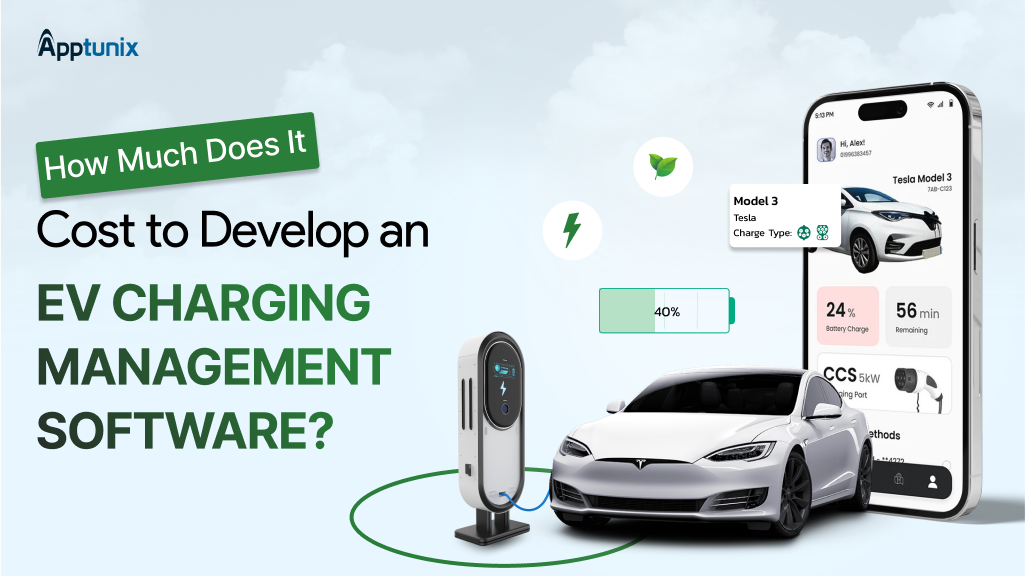
The electric vehicle boom isn’t coming. It’s already here. Governments are incentivizing it, automakers are restructuring around it, and energy companies are scrambling to keep up. According to Business Market Insight, the EV charging app market is projected to reach $20526.11 Million by 2032 with a CAGR of 40.5%. As the EV market is advancing, the need for EV charging management software has become the new standard of transportation.
That’s what this guide will break down. We’ll walk through the cost to develop EV charging software, what features matter, and the tech stack that supports it. You’ll leave with a clear understanding of what it takes to build a powerful, future-ready EV software solution.
Let’s get into it.
At its core, EV charging management software is the digital brain behind any electric vehicle charging network. It’s what keeps the system running, connected, and under control whether you’re managing 10 chargers or 10,000.
Here’s what it actually does:
It connects with your charging hardware, tracks usage in real-time, handles user access, collects payments, balances power loads, and provides insights through analytics dashboards. It’s an EV charging platform that brings together your users, chargers, payments, and energy management all in one place.
To build a complete EV charging ecosystem, you need more than just one app. A functional EV charging platform includes multiple components tailored for different users from operators to EV drivers to energy managers. Here are the core types of EV charging software you’ll typically need:
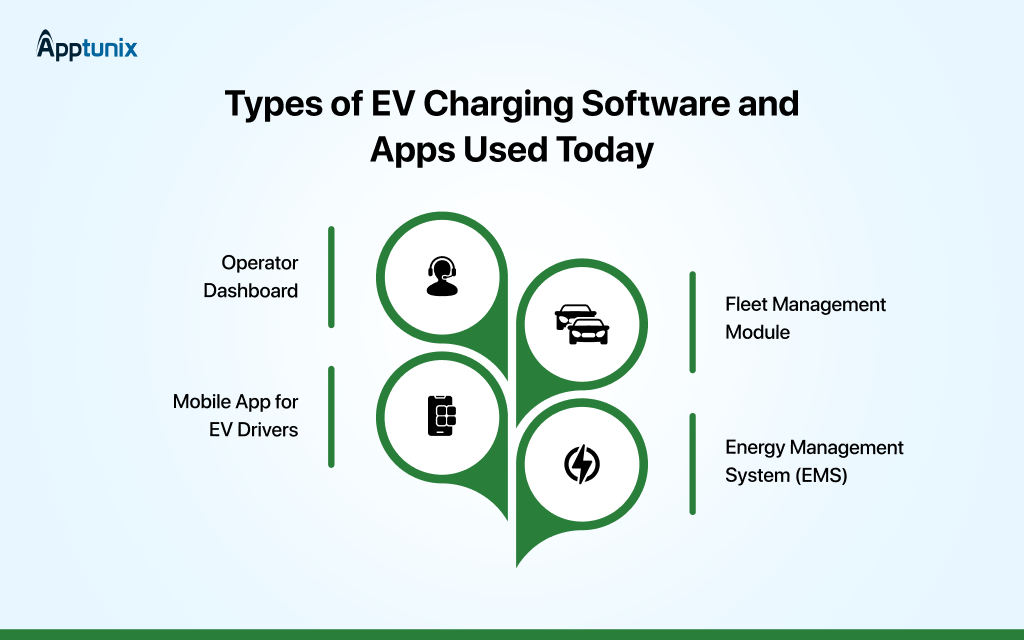
This is the central control system for charge point operators and station owners. It’s usually a web-based panel where admins can monitor station performance, view usage analytics, set pricing rules, manage user access, and handle maintenance. A good dashboard gives operators real-time visibility into what’s working, what’s not, and how to optimize energy flow and revenue across their charging network.
The driver-facing mobile app is the bridge between your charging stations and end-users. Drivers use it to find nearby charging stations, check availability, start or stop sessions, and make payments through saved cards or digital wallets. It also helps track past sessions, manage invoices, and receive notifications. User experience here is critical this is the front door to your charging service.
Fleet operators need more advanced control. This module allows commercial EV fleet managers to assign chargers to vehicles, schedule charging times, monitor battery health, and optimize routes based on charging station availability. It’s built for scale whether it’s 50 electric delivery vans or an entire public transport fleet.
This EV charging management software ensures that charging activity doesn’t overwhelm the grid or inflate energy costs. An EMS balances the load across multiple stations, prioritizes green energy when available, and integrates with solar panels or battery storage. For large networks or sites running multiple chargers, this backend tool is essential for sustainability and cost-efficiency.
When you’re building or investing in electric vehicle software, these are the features that make the difference between a functional system and a future-proof one.
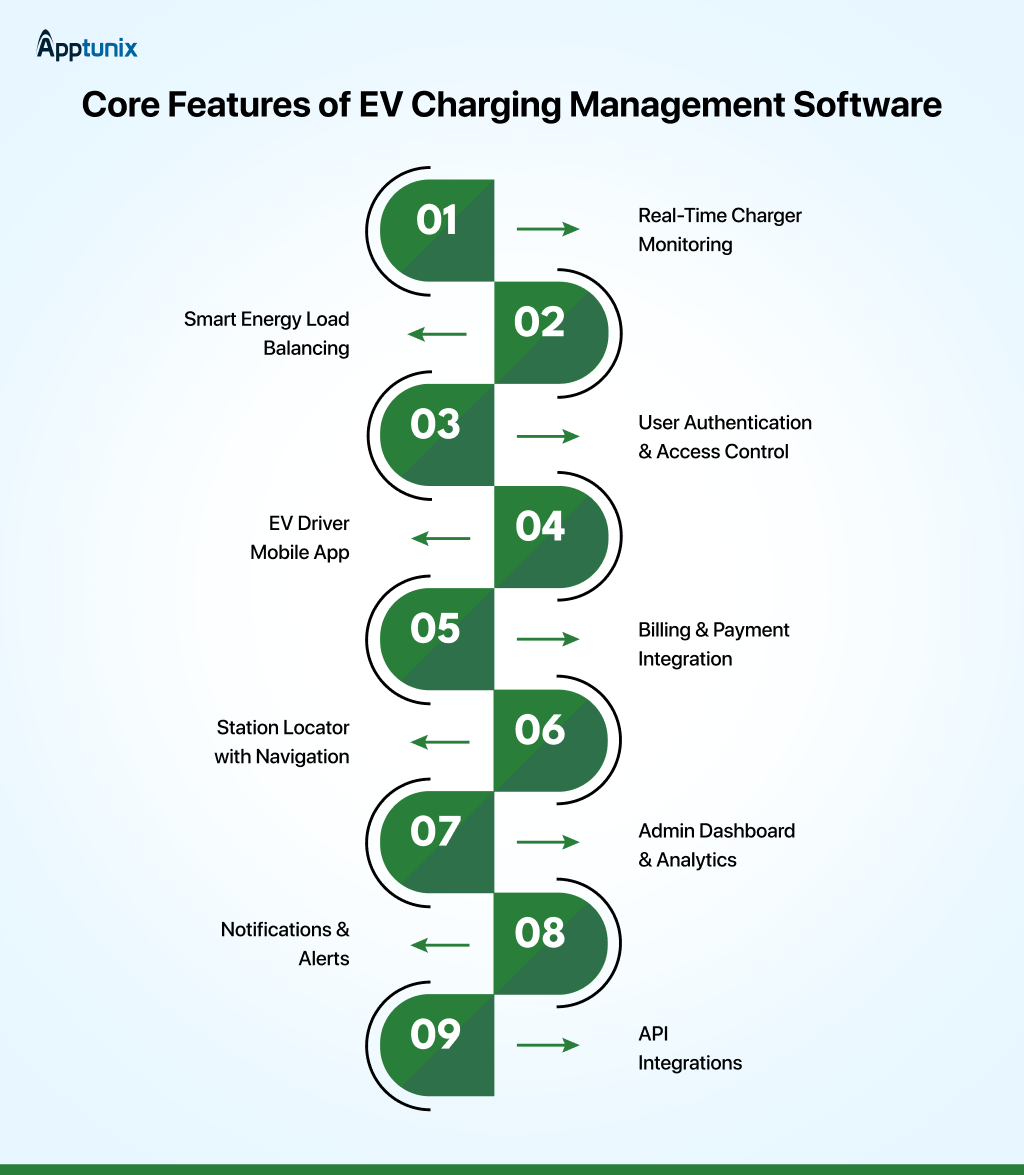
Every charging session, every station, every error tracked as it happens. Real-time charger monitoring gives you live data on station availability, charging speed, session durations, and performance issues. For operators, this visibility helps prevent downtime. For users, it ensures reliability. If you’re building an EV software solution, real-time updates are the foundation.
As EV adoption grows, so does the demand on power infrastructure. Smart energy load balancing ensures your chargers don’t overload local grids or spike your electricity bills. The software automatically distributes energy based on demand, usage patterns, and grid availability. If you’re managing multiple fast chargers, this feature keeps things efficient and compliant with energy standards.
Security matters especially when your stations are part of a paid public network. User authentication features allow you to limit access to verified users. Whether it’s through mobile app logins, RFID cards, QR codes, or OTPs, your EV charging management system should protect against unauthorized access while keeping the experience frictionless for actual users.
A smooth driver experience is non-negotiable. Your EV app development should include a full-featured mobile app for end-users. Drivers can search for nearby stations, check charger status, reserve time slots, initiate charging, view session progress, and pay all from their phones. This is where your brand meets your customer, so the UX needs to be clean, fast, and reliable.
Your EV charging management software should support flexible and secure payment workflows. Think beyond just card payments include mobile wallets, UPI, fleet billing accounts, and subscription options. The system should let you set pricing based on energy consumed (kWh), session time, peak hours, or even dynamic pricing. A solid revenue model for an EV charging platform starts with smooth transactions.
Location is everything. Your platform should integrate with geolocation services like Google Maps or Mapbox to help users find the nearest available EV chargers. By combining real-time charger status updates and live navigation, you can reduce driver anxiety —a key factor in adoption and repeat use.
For operators, the backend dashboard is mission control. It should offer deep analytics on station usage, energy consumption, revenue per location, session trends, uptime reports, and customer behavior. With this data, operators can plan maintenance, optimize pricing, and scale with confidence. If you’re serious about building EV software that grows with your business, invest in a smart admin panel.
Keep everyone in the loop. The system should push alerts for charging completion, power faults, station downtime, or upcoming maintenance. Users get session updates. Admins get performance warnings. Whether via SMS, push notification, or email, this communication loop boosts trust and reduces manual follow-ups.
Your EV charging platform doesn’t exist in isolation. It should integrate easily with EV charging hardware (OCPP compliance), payment gateways, CRM tools, fleet platforms, solar energy systems, and enterprise resource planning (ERP) tools. These API integrations allow your ecosystem to evolve whether you’re managing a single charging station or scaling across cities.
Most Recommended: How Much Does it Cost to Build a Mobile App?
There’s no one-size-fits-all answer when it comes to the cost to develop EV charging software. It depends on how ambitious you want to be and what functionality your business really needs. Here are the core factors that shape the final pricing of your EV software solution:
Are you building just a mobile app for EV drivers, or a full EV charging management system that includes an operator dashboard, analytics, and web access? A web + mobile solution naturally involves more development time and cost.
The more stations your software needs to support, the more robust your backend needs to be. Whether you’re managing 10 or 10,000 stations, scalability has a direct impact on EV software pricing.
If your system involves real-time data sync across locations, third-party API integrations, or hardware communication via OCPP/OCPI, development gets more complex. These integrations are essential for smart charging but they do require experienced engineering.
A smooth, intuitive interface for both users and admins is a must. But the more customized the experience the more design hours you’re budgeting for.
Connecting your electric vehicle software to local utilities, solar panels, or battery systems? That adds layers of work. Grid interaction and smart energy features are powerful but they come at a premium.
Features like live station maps, geofencing, or smart routing use GPS and third-party APIs. These are important for user convenience and charger discovery but also add to your EV app development cost.
Your software must comply with protocols like OCPP (Open Charge Point Protocol) and OCPI (Open Charge Point Interface) if you want to operate across different charger brands or networks. Secure architecture, token-based authentication, and encrypted data storage are not optional and they affect your development timeline.
MVP (Minimum Viable Product): $30,000 – $50,000
A basic mobile app with user login, charger discovery, session tracking, and manual payments. Great for proof-of-concept or pilots with a limited number of stations.
Mid-Range Build: $60,000 – $100,000
Includes a user-facing mobile app + admin dashboard, billing integration, real-time data, analytics, and support for 50–500 charging points. Ideal for growing CPOs and early-stage fleets.
Enterprise-Grade Platform: $120,000+
Fully scalable EV SaaS platform development with support for 1000+ stations, smart energy management, multi-location monitoring, robust analytics, hardware integrations, API access, and advanced security. This is the level used by large fleets and nationwide operators.

Every dollar you invest in building EV charging management software goes toward improving efficiency, user experience, and long-term scalability. The key is to align your budget with your business model, infrastructure needs, and growth roadmap.
Here’s the thing: building EV charging software isn’t a one-size-fits-all timeline. It depends entirely on what you’re trying to build and for whom.
If you’re developing a basic MVP, you’re looking at 3 to 4 months. This includes core functionality like charger monitoring, basic user management, mobile app access, and payment integration. It’s designed to get your product live and test the waters without overbuilding too early.
Go a step further and add advanced dashboards, analytics, mobile app polish, and smart load balancing and the timeline stretches to 5 to 7 months. At this stage, you’re building something that works not just for users, but for operators who need insights and control at scale.
Now, if you’re targeting an enterprise rollout multi-city operations, deep energy grid integration, hardware compatibility, APIs, OCPP/OCPI compliance you’re in for a 8 to 12+ month development cycle. You’re essentially building infrastructure software, and that takes time to design, test, and scale.
What can delay or speed things up?
The smarter move? Start lean, launch fast, iterate with real usage data.
This is a foundational decision and it directly impacts how your platform grows, how much you spend, and how complex your operations become.
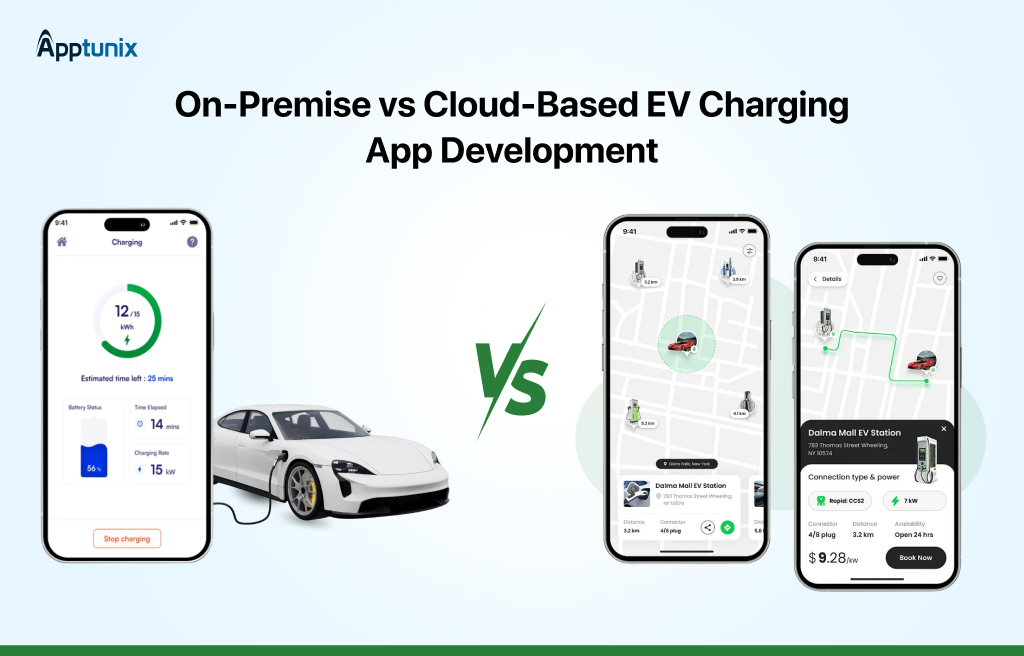
So, which one’s better? Depends on your goals.
Startups, fast-scaling EV platforms, and SaaS-based players usually go cloud-first. It’s flexible, affordable, and gets you to market faster. Larger organizations with sensitive data or legacy systems may lean toward on-premise especially when internal policy or compliance demands it.
Ask yourself: Do you need full control, or fast growth? Do you have IT infrastructure in place, or are you building from scratch?
The EV charging market is growing fast but the real potential lies in what comes next. If you’re thinking long-term, here’s where the real upside lives:
Charging stations are increasingly pairing with solar panels, battery storage, and smart grids. EV charging software that can manage these inputs will be in high demand especially in regions prioritizing clean energy targets.
Large EV fleets need software that can optimize charging schedules based on usage patterns, grid demand, and energy prices. Smart scheduling algorithms, load forecasting, and predictive maintenance will separate commodity platforms from strategic ones.
As the market matures, many charge point operators (CPOs) are moving toward recurring revenue with software-as-a-service models. Monthly subscription fees, usage-based pricing, and white-label licensing open up steady income streams.
From the EU to the US, government incentives are accelerating public charging infrastructure. EV charging management software that offer usage analytics, load management, and compliance reporting will be favored in grant-backed deployments.
Smart platforms don’t just support EV adoption they create new revenue opportunities across the entire ecosystem. Revenue isn’t just about selling charging sessions. There are multiple ways to turn an EV charging platform into a sustainable, scalable business:
This is the most straightforward model. Users pay per charging session based on time, energy consumed, or dynamic pricing. It’s simple, transparent, and familiar to most drivers.
Recurring plans work well for high-frequency users or fleets. You can also offer station owners a monthly fee for access to advanced analytics, maintenance tools, or custom branding.
This model lets casual users access basic features for free, while monetizing traffic through in-app promotions or EV brand partnerships. Premium plans can unlock navigation, fast-charger filters, or live energy tracking.
If your platform aggregates chargers from multiple networks, taking a percentage per transaction or reservation adds a low-risk revenue stream.
Sell your EV charging management software as a white-label solution to businesses, municipalities, or CPOs. This model can generate long-term contracts with higher average deal sizes especially when bundled with maintenance and support.
Building EV charging software isn’t just about creating another mobile app. It’s about designing the digital backbone of an energy ecosystem. And that requires a team that understands both the complexity of infrastructure and the demands of user experience. That’s exactly what Apptunix brings to the table.
We specialize in building high-performance digital products across mobility, energy, and transportation domains where reliability, compliance, and scale matter just as much as speed and usability. Our experience with EV charging platforms spans OCPP hardware integration, OCPI roaming setups, smart energy management, fleet tracking, and real-time analytics. So, we’re not learning as we go: we’ve done this before.
Here’s how we make a difference:
EV adoption is accelerating. Governments are offering incentives, charging infrastructure is expanding, and drivers are demanding smarter ways to manage energy on the go. But the software behind all this? That’s where real innovation and business opportunity lies.
At Apptunix, we’ve helped brands launch successful platforms in mobility, logistics, and energy and we’re ready to do the same for you.
Let’s talk about what your EV charging management software solution could look like. Reach out for a consultation or get a custom quote today.
Let’s build the software that powers the EV future.

Q 1.What is EV charging management software and who needs it?
EV charging management software is the control center behind EV charging networks. It helps station operators manage charger status, monitor energy usage, handle billing, support users, and ensure everything runs smoothly. Whether you’re a charge point operator (CPO), fleet owner, or utility company, this software is essential to scaling EV infrastructure efficiently.
Q 2.How much does it cost to develop EV charging software?
The cost to develop EV charging software typically ranges from $30,000 for a basic MVP to $120,000 or more for an enterprise-grade solution. Pricing depends on factors like platform (web + mobile), feature set, integrations with OCPP/OCPI, and energy load balancing capabilities.
Q 3.How long does it take to build EV charging software?
On average, development can take 3 to 6 months. A basic version might be ready in under 12 weeks, while a full-featured platform with fleet management, analytics, and smart energy controls may take longer. Timeline depends on your feature list, design complexity, and how many integrations are needed.
Q 4.Does Apptunix provide end-to-end EV software development services?
Absolutely. From initial product strategy and UI/UX design to backend development, app testing, and post-launch maintenance, Apptunix handles every stage of EV software development. We also assist with feature planning, monetization strategy, and third-party integrations (billing, maps, energy grids, etc.).
Q 5.What features are essential in an EV charging app?
Some of the must-have features include real-time charger monitoring, user authentication, payment systems, smart energy load balancing, station navigation, and admin analytics. These features help deliver a smooth user experience while ensuring network stability.
Q 6.How can I get a quote from Apptunix for EV charging software development?
It’s easy. Just reach out via our website with a few details about your idea or requirements. Whether you need a full platform or just want to scope out your MVP, we’ll set up a free consultation and provide a custom estimate based on your EV software goals and timeline.
Q 7.Can I monetize my EV charging platform?
Yes. There are multiple EV app revenue models: pay-per-charge, user subscriptions, freemium plans with ads, SaaS licensing for B2B clients, and commission on third-party chargers. Your monetization strategy depends on whether you’re targeting consumers, businesses, or public sector clients.
Q 8.Is it better to build a cloud-based or on-premise EV charging solution?
For most startups and mid-size operators, cloud-based EV software is more scalable, cost-effective, and easier to maintain. On-premise platforms make sense for large enterprises with strict compliance needs or local hosting requirements, but they come with higher setup and maintenance costs.
Q 9.What makes Apptunix the right partner for EV software development?
Apptunix combines deep domain experience in mobility and energy platforms with technical expertise in protocols like OCPP, OCPI, and smart grid integrations. From concept to launch, we offer full-cycle EV app development services—including architecture design, development, QA, compliance, and post-launch support.
Q 10.How do I get started building my EV charging software?
Start by identifying your use case: public charging, private fleets, commercial hubs, or utilities. From there, consult a trusted EV software development company like Apptunix to map out your features, compliance needs, and monetization strategy. We’ll help you define the right roadmap and give you a custom quote to move forward.
(1 ratings, average: 5.00 out of 5)
Get the weekly updates on the newest brand stories, business models and technology right in your inbox.
Book your consultation with us.
Book your consultation with us.


One Central, The offices 3, Level 3, DWTC, Sheikh Zayed Road, Dubai
+971 50 782 1690