
Build ERP Software for the Manufacturing Industry
56 Views 9 min October 27, 2026

Arohi Singh is a technology content strategist at Apptunix, where she writes about software and app development across industries, from on-demand and logistics to fintech, healthcare, and applied AI. With over 5 years of experience, she works closely with Apptunix’s engineers, product managers, and solution architects to turn real project insights into clear, decision-ready guidance for founders and business leaders. Her writing focuses on what matters before you build: market context, feature trade-offs, realistic costs, and compliance considerations
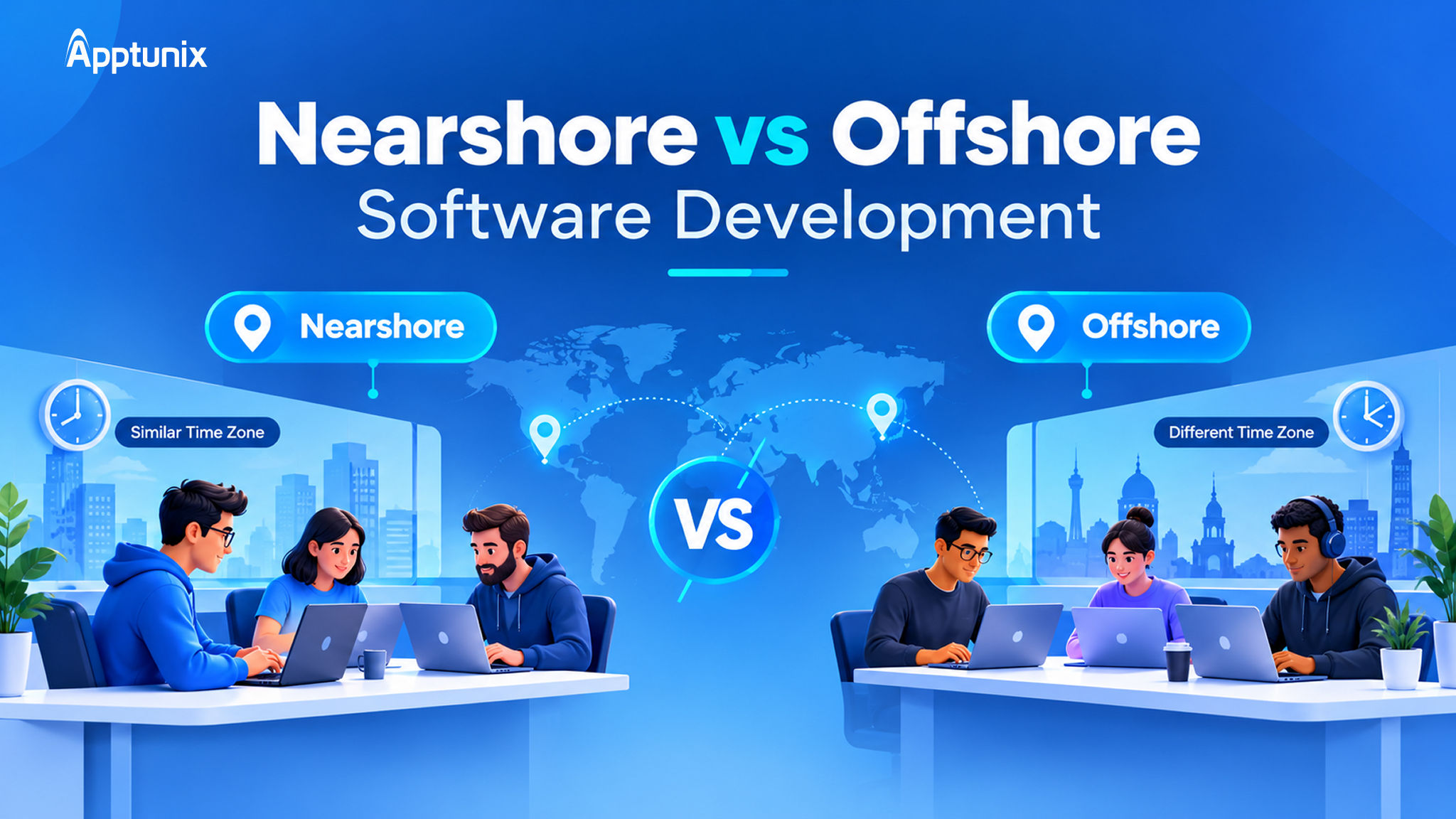
Saving money on software development sounds great, right? But what if a cheaper development team ends up costing your business more than expected? That’s the real question behind the nearshore vs. offshore debate, especially for US companies trying to balance development costs with project deadlines.
→ Hiring offshore means that they might charge less per hour. But the different time zones could have a negative impact on the routine calculus.
→ A nearshore team could cost more, but they also make real-time collaboration more accessible.
The real difference, of course, probably depends on where your team is and on how your project works. So, which option makes more sense for your business?
Well, there’s no universal answer. A company building a complex SaaS product may value daily collaboration more than hourly savings. Another business with clearly defined tasks might work perfectly well with a team halfway around the world.
That’s why choosing between nearshore and offshore outsourcing requires more than comparing price quotes. You need to understand the trade-offs before committing your budget.
In this guide, we’ll break down the real differences, starting with development costs and time-zone overlap. You’ll also learn where each model can fall short, so you can make a decision that fits your business, not just your budget.
The most important difference between onshore, nearshore, and offshore is the geographic location of your software development team in relation to your business. The setting where you collaborate with teams during work hours can have an impact on how easy it is to work with them, as well as your development costs. However, geography alone does not determine whether a project succeeds.
Onshore development, in the case of US businesses, involves employing a development team in the USA. Nearshore software development typically involves cooperation with software development partners in close geographical proximity, typically Latin America. Offshore software development is a collaboration with a team from a remote land such as India.
Onshore software development provides you with the most control and the highest bill. Nearshore outsourcing is generally more expensive on an hourly basis, but provides more hours of shared usage.
Offshore vs. nearshore is therefore a trade-off between rate and real-time collaboration. Neither model ranks higher on engineering quality by default.
Since price is where most buyers start, we’ll start there too.

Nearshore software development costs are generally more expensive than offshore software development. The final cost, however, will be based on the skills of the team and the extent of work that needs to be completed. For US businesses, nearshore partners in Latin America might provide a sweet spot in between competitive pricing and convenient collaboration. No matter how many countries you look at, offshore teams in India can offer you talent at different price points.
However, the price per hour doesn’t always provide the whole picture. A reduced quote might seem appealing at first, but when there is extra coordination and/or rework, the total spend for the project may rise. You’ll have a much better idea of the engagement model, the team composition, and the expectations for delivery when you do a comparison.
These figures are intended to be used as a planning guideline, not market averages or quotes in USD.
The ranges can be used to help you to budget, and then ask for other quotes from shortlisted suppliers.
The cost of your development is not going to be solely dependent on your developers’ location. Before comparing nearshore vs. offshore software development rates, it is recommended to check out what they offer first.
Check if project management, testing, deployment support, and post-deployment maintenance are included in the quote. Some providers charge for these separately.
Suppose that you have a project that needs 1000 development hours. The quoted cost of the development is $45,000 at $45/hour. If it is an offshore team that charges $30 per hour, they would charge $30,000 for the same number of hours.
| Nearshore quote at $45/hour | $45,000 |
|---|---|
| Offshore quote at $30/hour.
Illustrative calculation for 1,000 hours, excluding other project expenses. |
$30,000 |
The $15,000 difference is significant, but only when both estimates relate to similar services. If the lower bid needs lots more time to understand the issues or rectify any problems, the cost saving can be reduced.
When taking the time to evaluate offshore software development services, request an estimate of hours and deliverables. Let any business looking into nearshore outsourcing ask for the same information, then compare the total projected expenditure, instead of the headline rate.
Rates tell you what you’ll pay. Time zones tell you how much of it you’ll wait for.
A development team needs enough overlapping working hours to resolve important questions. You need enough time overlap between your development team to be able to answer critical questions without stalling progress. When it comes to comparing nearshore vs offshore software development, time-zone compatibility can be a critical factor for US businesses.
In many cases, onshore staff in Latin America will work a few hours with onshore staff in the United States. For developers from countries like Mexico or Colombia, it is generally possible to attend daytime meetings with US developers. Specific overlaps vary according to the cities involved and due to seasonal time changes.
Indian or Philippines offshore teams will probably be further out of the way from US business days. Teams may have to have their meetings anytime at dawn or dusk as a result. Routine updates can happen asynchronously, but urgent technical decisions may take longer.
The ideal overlap depends on how often your developers need input from your internal team.
These ranges are only guidelines and not industry standards. Your team’s communication matters just as much as how long they overlap.
Imagine a project in which your US product manager must approve a feature before leaving it for developers to work on. If a team is located nearshore, the approval could take place on the same workday. With offshore outsourcing, the developers have to wait until the next time zone overlap.
But offshore software development is not related to delays in delivery. Good documentation, assigned response times, and distribution of responsibilities within the team keep the process smooth.
Ask about the offshore software solutions company’s approach to common issues and everyday transactions prior to hiring it. Find out if they overlap you with your US team for the same time.
Once you’ve calculated the time difference, the next thing you have to learn is the risks that can each be presented by the two models.
Offshore and onshore software development risks are non-geographic. Communication, ownership, or security expectations are generally the problems.
Risks worth checking before you sign:
1. Communication gapsIf requirements are not clear, shared working hours won’t work, even with nearshore outsourcing. Have agreed response times and make sure to record decisions following significant meetings.
2. Unexpected costsRequirements can evolve, or work can be done wrong and have to be redone, resulting in a lower initial quote for the project to be higher. Request milestones and how further work will be approved.
3. Data security and IP ownershipThe third-party developers are given confidential information or proprietary software code. Define the owner of the intellectual property in the contract, restrict access to mission-critical systems, and perform due diligence.
4. Quality and delivery issuesIf the deadlines aren’t met, it can outweigh the advantages of hiring an offshore software development company. It is important to review the code regularly and set up measurable acceptance criteria and tests.
5. Vendor dependencyChanging partners can be challenging if one provider has the codebase and technical documentation. Ensure access to the repositories and documentation during development.
Come up with a clear and concise milestone to begin with, and then proceed further.
Check out their references and make a quick phone call with the developer they will be using to build your project. All deliverables, security, payments, and rights to the software should be written in the contract.
Truthfully, everyone doesn’t need to pay for a development team that is not an efficient fit for their business. This will depend on the needs of your project and what compromises you’re willing to make.
In some cases, a product, such as SaaS, might require regular feedback and might be better suited for nearshore software development. Common working hours make it easier to discuss and resolve any technical issues and changes. That convenience might be worth the higher rate per hour.
Offshore software development, on the other hand, can be appropriate for projects that have well-defined requirements. If your team is able to develop without assistance between check-ins, then you might be able to get to some lower development rates without compromising delivery.
But if your project deals with confidential client data, what are you going to do about that? But don’t just pick a provider based on location. Check its security protocols, contractual safeguards, and track record of meeting the security needs in your industry.
When deciding, ask yourself: What is most important for this project at this time?
Do not buy based on a sales presentation. Discuss with the developers who will actually do the work, look at references, and establish what success will be like in delivery.
But when none of the above seems to be a suitable fit, there’s another way to go that is worth considering. Mixing nearshore and offshore.
Recommended Read: Top 10 Software Development Outsourcing Companies
Deciding whether to opt for nearshore or offshore software development can sometimes be like a compromise. You want developers who are able to work with your US developers in real time. However, you also need your budget to reach even further. You can achieve a blend of both with a hybrid model.
But simply adding another team doesn’t necessarily make things more efficient, though. When there’s overlap of responsibility or a lack of effective decision-sharing, the setup can end up being more work than it’s worth.
Before implementing a hybrid model, have one consistent process for delivery. The teams must code in the same manner and follow the same project documentation. Give someone responsibility for decisions to avoid waiting for another team to give answers.
Cost matters, too. Compare overall project cost to one nearshore/offshore engagement. Add in the expense of coordinating and project management.
Nearshore development gives you real-time daylight collaboration. Offshore teams stretch your engineering runway and deliver massive talent pools.
The decision of nearshore vs offshore is a matter of your sprint approach and management style. Communication and code reviews are more important than developer location.
Apptunix empowers U.S. companies to scale out remote engineering teams with structured overlap shifts. You can achieve alignment with talent in real time every day, with low operational costs. Talk to Apptunix software strategists to create your best engineering model.

Q 1.What is the main difference between nearshore and offshore software development?
Nearshore Software Development is a type of outsourcing where developers are based in a country that is close by, typically having similar working hours. Offshore software development is developing software with a team that is located in a different country. For US businesses, nearshore teams may have better real-time collaboration, and for offshore teams, it may be a better choice for competitive development rates.
Q 2.Is nearshore software development more expensive than offshore development?
The expense of nearshore software development services is higher than that of offshore software development services, though this varies based on the country, the experience of the developers and the complexity of the project. It is possible that the offshore providers may charge less per hour, and communication delays can be cut cost-effective with nearshore teams. Make a cost estimate for the project, not just an hourly rate.
Q 3.Which countries are popular for nearshore and offshore software development?
US businesses often consider Mexico and Colombia for nearshore software development because of their geographic proximity. India and the Philippines are popular offshore destinations for accessing technical talent.
Q 4.How much can businesses save with offshore software development?
Savings vary based on the provider’s rates, project scope, and the amount of coordination required. Offshore software development can actually help to minimize hourly development costs compared with US-based hiring. But project management, testing, maintenance, and rework also need to be taken into consideration when businesses calculate their investments.
Q 5.Is offshore software development suitable for startups?
Yes, offshore software development can suit startups that need technical expertise while managing limited budgets. It can help businesses build an MVP or expand development capacity without hiring an entire in-house team. Startups should define deliverables clearly and establish regular communication before development begins.
Q 6.How can I choose a reliable offshore software development company?
Look for a company with relevant project experience and a transparent development process. Ask to speak with the developers who would handle your project, review previous work, and clarify intellectual property ownership. Before signing, confirm how the provider manages deadlines, testing, security, and changes to the project scope.
(5 ratings, average: 5.00 out of 5)
Get the weekly updates on the newest brand stories, business models and technology right in your inbox.
Arohi Singh is a technology content strategist at Apptunix, where she writes about software and app development across industries, from on-demand and logistics to fintech, healthcare, and applied AI. With over 5 years of experience, she works closely with Apptunix’s engineers, product managers, and solution architects to turn real project insights into clear, decision-ready guidance for founders and business leaders. Her writing focuses on what matters before you build: market context, feature trade-offs, realistic costs, and compliance considerations
56 Views 9 min October 27, 2026

57 Views 9 min October 23, 2026
131 Views 9 min October 9, 2026
Book your consultation with us.
Book your consultation with us.


One Central, The offices 3, Level 3, DWTC, Sheikh Zayed Road, Dubai
+971 50 782 1690