AI Compliance Automation: How AI Is Transforming Regulatory Compliance
30 Views 14 min October 13, 2026

Avinash Kumar is a highly experienced technical writer with 5+ years in B2B and technology content. He specializes in simplifying complex tech topics into clear, engaging, and conversion-focused content. At Apptunix, he helps startups and enterprises make informed digital decisions through insightful blogs, guides, and strategic storytelling that drives real business growth.
According to the American SPCC, 66% of parents report using digital tools and apps to support parenting decisions. Yes, that’s right, this fast technology is growing in every field.
Becoming a parent is one of the most rewarding experiences in the world, but parenting is undoubtedly one of the most challenging tasks.
Parents juggle several responsibilities, including managing their child’s daily routine, supporting their emotional and physical development, while balancing careers and other commitments.
This makes it the ideal time for them to integrate technology or a powerful support system like artificial intelligence into their lives.
Today, AI parenting apps are transforming child development and the way modern families navigate childcare. Parental control apps are offering smart insights, real-time tracking, and personalized parenting assistants that adapt to the child’s needs.
The demand for intelligent parenting solutions is increasing every year; as a result, AI parenting app development is emerging as a promising opportunity. These parenting and child safety apps are redefining what it means to raise children in today’s modern world.
AI in modern parenting enables parents worldwide to monitor their children, establish healthy routines, manage screen time effectively, and ensure child safety.
In this blog, you will learn about the AI parenting app, its importance, examples, key considerations, steps to build an AI parenting app, development cost. And, in the end, you will get to know about the best AI app development company.
Let’s get started!
An AI parenting app is a smart digital solution that helps parents manage their
This digital solution for mobile is not like a traditional parenting app, but it’s an AI-powered parenting app that learns from several aspects of parenting, including
AI parenting apps provide real-time suggestions, personalized insights, and proactive reminders. Such a smart baby growth tracker app helps in child development tracking, sleep schedules, feeding patterns, screen time management, safety alerts, and emotional well-being guidance.
The best thing about an AI parenting app is its AI algorithms that analyze data to offer accurate recommendations tailored to each child’s age, habits, and needs. This makes parenting easier, smarter, and more organized.
These child safety apps act like a digital assistant for busy parents by offering top AI parenting app features, which include
In conclusion, an AI parenting app helps parents reduce stress, stay informed, and support their child’s growth using intelligent technology.
AI parenting tools are transitioning from the fringe to the mainstream, presenting an opportunity for entrepreneurs, investors, and parents to invest. Here are some interesting facts and statistics about AI parenting tools:
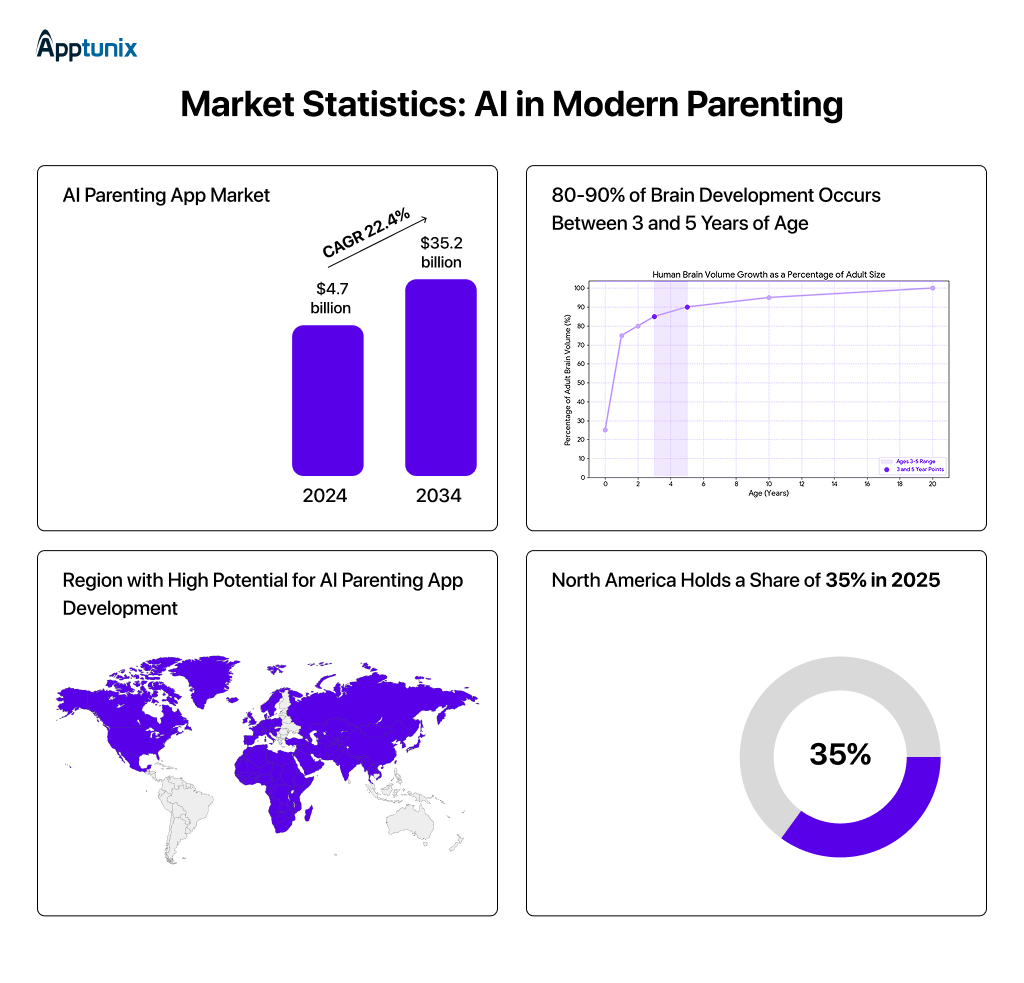
-> Neuroscience research says that 80-90% of brain development occurs between 3 and 5 years of age, making AI parenting tools crucial for better development.
-> AI in the childcare and parenting market was valued at $4.7 billion in 2024 and is projected to cross $35.2 billion by 2034, growing at a CAGR of 22.4% during the forecast period.
-> The region with high potential for AI parenting app development includes North America, Europe, Asia, Latin America, the Middle East, and Africa.
-> Top countries for AI in childcare and parenting include the United States, Canada, the United Kingdom, Germany, China, India, Japan, Brazil, France, and Spain.
-> North America is expected to lead the AI parenting app development market, holding a share of over 35% in 2025.
Artificial intelligence in modern parenting is undoubtedly transforming the way parents raise their children. From offering personalized guidance to implementing smarter routines, AI parenting apps help parents in numerous ways, making parents informed, reducing stress, and improving child development.
1:Personalized Parenting SupportAI in modern parenting offers personalized advice tailored to a child’s age, behavior, and developmental milestones. This enables parents to make more informed decisions.
2:Better Time ManagementAI parent apps enhance time management by providing automated reminders for feeding, sleep, medication, and activities. It leads parents to stay organized with less stress.
3:Enhanced Child SafetyThis AI-powered application’s tools, like geofencing, location tracking, and online activity monitoring, protect kids in both the physical and digital worlds.
4:Early Detection of IssuesAI-powered parenting apps also analyze children’s growth patterns and behavior to identify potential developmental delays or emotional concerns early.
5:Improved Communication and BondingAI in children’s care and parenting helps parents better understand their kids’ feelings, habits, and needs. This improves communication and bonding between parents and children.
6:Reliable Parenting TipsAI-powered parenting apps offer reliable parenting tips and expert-backed recommendations. This reduces the need for endless online searches and saves a lot of time.
7:Support for Working ParentsArtificial intelligence helps working parents to balance childcare responsibilities and automate routine tasks. It eventually facilitates a better balance between personal and professional life.
Now that you have read about the importance of AI in parenting apps, it’s time to examine AI parenting tool examples.
In case you’re not aware, several AI parenting tools and apps give a clear picture of what smart and technology-enabled parenting looks like. From BabyMind to Cubo AI, here are the best parenting apps in 2026:
#1:BabyMindBabyMind is an AI-powered parenting app that is trusted by 500,000 mothers globally. It combines baby tracking, growth milestone monitoring, and even cry analysis.
This helps the mother to understand whether a baby is hungry, uncomfortable, or sleepy. The application offers personalized insights and reminders that make newborn care more manageable.
#2:Glow BabyGlow Baby is an ultimate AI-powered tracker or tool for tracking feeding, diaper changes, sleep, and development milestones. This China-based application helps parents maintain daily logs and get AI-driven guidance tailored to the child’s age and growth stage.
The application has over 1 million downloads on Google Play and has a rating of 4.2.
#3:Cubo AICubo AI is one of the first AI-powered applications that applies AI to baby sleep, safety, and memories. This solution uses AI to monitor sleep, breathing, and the baby’s movement patterns.
The application alerts parents in real time if something unusual is happening, which ensures safety even when parents aren’t physically beside the baby.
#4:HuckleberryHuckleberry is one of the best AI parenting apps that allow parents to log sleep, feedings, diaper changes, and other care activities. This app is best when parents are struggling with sleep management.
Using AI, the app recommends optimal nap/bedtime windows, supports sleep routines, and improves sleep quality for babies and toddlers. It has 1 million+ downloads and a 4.9 rating on the App Store.
#5:CanopyCanopy is a leading AI-powered app that gives parents parental control using AI to scan and block inappropriate content. This parental control app for kids’ screen time ensures safer internet usage for kids. Basically, the application is useful as children grow older and start using devices.
The solution has over 100k+ downloads and has a rating of 4 on Google Play.
Now, before understanding the steps for building the best parenting app in 2026, examine the key considerations for AI parenting app development.
Parental control apps like Glow Baby and Cudo AI offer incredible support that plays a crucial role in positive parenting. However, parents should keep a few factors in mind before relying on these AI-powered parenting apps:
1:Data Privacy and SecurityRemember, AI parenting apps collect sensitive details about children. So parents must choose trusted platforms that follow strict data protection.
2:Human Connection Comes FirstNever forget that AI can guide and automate tasks, but it cannot replace emotional bonding. Intuition and personal interactions between parent and child must be remembered.
3:Accuracy of InsightsAI-parenting apps give recommendations based on algorithms and available data. So parents must validate insights with medical professionals when required.
4:Age Appropriate Usageemember, not every single feature can be good for every stage of a child’s development. As a result, parents should personalize settings and permissions carefully.
5:Screen Time BalanceIt is essential to manage the screen time when using the application. AI should help reduce stress, not increase screen dependency for children or parents.
6:Cultural and Personal ValuesIndeed, different parents come with different cultures and backgrounds that also have different personal values. AI suggestions should align with a family’s beliefs and parenting methods.
7:Cost and AccessibilityYou should know that premium AI features may require subscriptions or extra charges. This leads parents to evaluate which tools provide real value or which provide basic value.
It is crucial to do proper research for AI parenting app development because it decides whether your application will succeed or not. It requires the right strategy, technology, and understanding of modern parenting needs. From proper research and target audience analysis to frontend and backend development, here are the 7 steps you must follow to create the best parenting app in 2026:
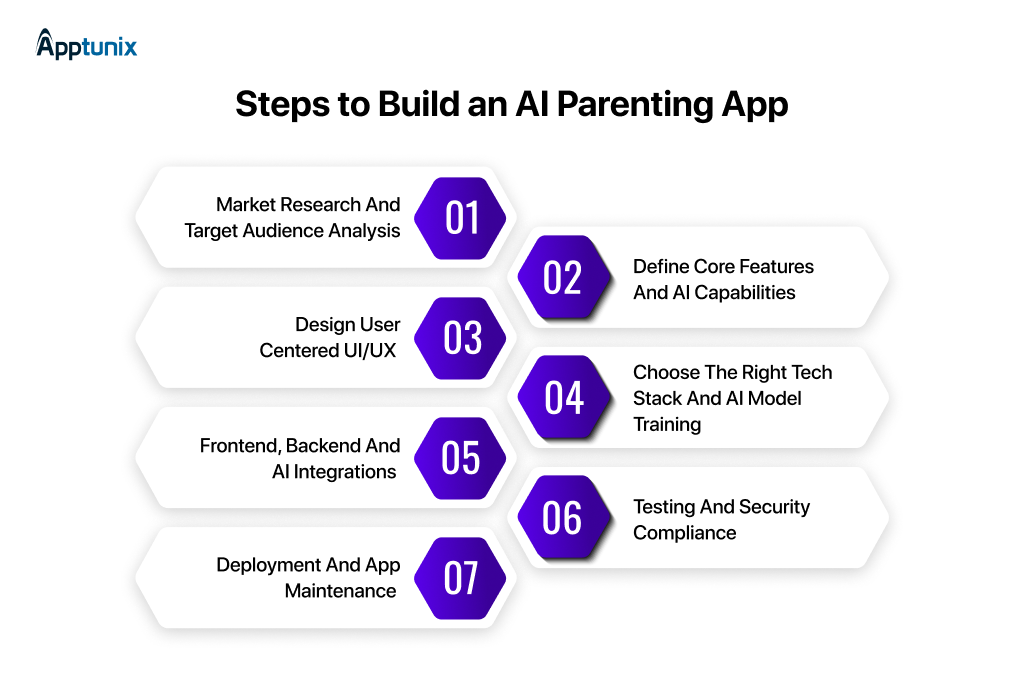
Step 1:Market Research and Target Audience AnalysisFirst, understand who your parenting app will serve. They can serve a number of users, such as
Later, conduct competitor research to study top AI parent apps like Huckleberry, Glow Baby, and Cudo AI. Evaluate gaps in their features and identify emerging needs like emotional health tracking or smart behavioral analytics.
This leads you to define your app’s core value, AI features, monetization strategies, and positioning within the growing digital parenting market.
Step 2:Define Core Features and AI CapabilitiesOnce you’re done with the research and target audience analysis, define AI parenting app features. Convert your insights into a clear feature roadmap. Include high-value features like
Choose AI models suited for tasks including behavior prediction or automated reminders. Also, determine what requires machine learning, natural language processing (NLP), computer vision, or predictive analytics in AI parenting app development.
You must ensure your app’s features align with real parenting challenges. In that way, you can build an AI parenting app that stands out and engages users consistently.
Step 3:Design User Centered UI/UXUser interface and user experience play a crucial role in the success of the application. Your AI parenting app’s design must be simple, accessible, and stress-free. For quick interaction during hectic parenting moments, you should include features like
UI/UX designers design user-centric design because it not only improves usability but also boosts app retention and user trust. Here, wireframing and prototyping ensure that every screen is optimized for real parenting situations.
Step 4:Choose the Right Tech Stack and AI Model TrainingChoose the best app development frameworks for iOS and Android for a scalable backend and secure database. Go with a cross-platform app development framework when you want to launch an app for both Android and iOS in a single codebase.
A right framework trains AI systems with safe, diverse datasets focused on child development patterns, behavior recognition, and scheduling habits.
AI model training is crucial to building a child safety and location tracking app. Ensure real-time processing for alerts and smart suggestions. Maintain credibility with data validation, model accuracy, and regular updates.
The tech stack or AI model must support advanced AI parenting app features like sleep analytics, geofencing, and secure cloud integrations as your user base grows.
Step 5:Frontend, Backend, and AI IntegrationsNow it’s time to actually build the application, which includes building core modules, connecting user interfaces to backend logic, and integrating AI models into the solution. This stage includes
Top Android and iOS AI parenting app developers follow agile methodology to ensure flexibility and continuous improvements. AI engineers, developers, and UX designers work together to ensure the AI parenting app functions reliably while delivering personalized, real-time assistance for parents.
Step 6:Testing and Security ComplianceParental control apps like Huckleberry and Canopy must meet strict compliance requirements for child data and digital safety. Quality analysts conduct extensive quality assurance checks, usability testing, and security assessments to prevent vulnerabilities. This step includes
Apart from that, it is crucial to conduct beta testing with real parents. This provides valuable feedback to refine the experience. Moreover, ongoing monitoring ensures smooth AI feature integration and maintains trust among users.
Step 7:Deployment and App MaintenanceThis last step of AI parenting app development includes launching the application on the App Store and Google Play. Launch the application with strong branding and onboarding guidance. Apart from that, post-launch is also essential, especially for AI-integrated apps that keep learning from anonymized usage data to deliver smarter insights over time.
Analyze users and collect feedback to introduce new tools like chat-based parenting coaches or emotional analytics. The app development team continues optimization, timely updates, and integrates new technologies and features to stay competitive in the market.
Features are everything in an application, and if it’s an AI-powered parenting app, it delivers real value and support to the users. AI parenting apps must include intelligent, easy-to-use, and safety-focused features. Parents can give positive parenting and early childhood education through the parenting app features. Here are the 8 features of an AI parenting app:
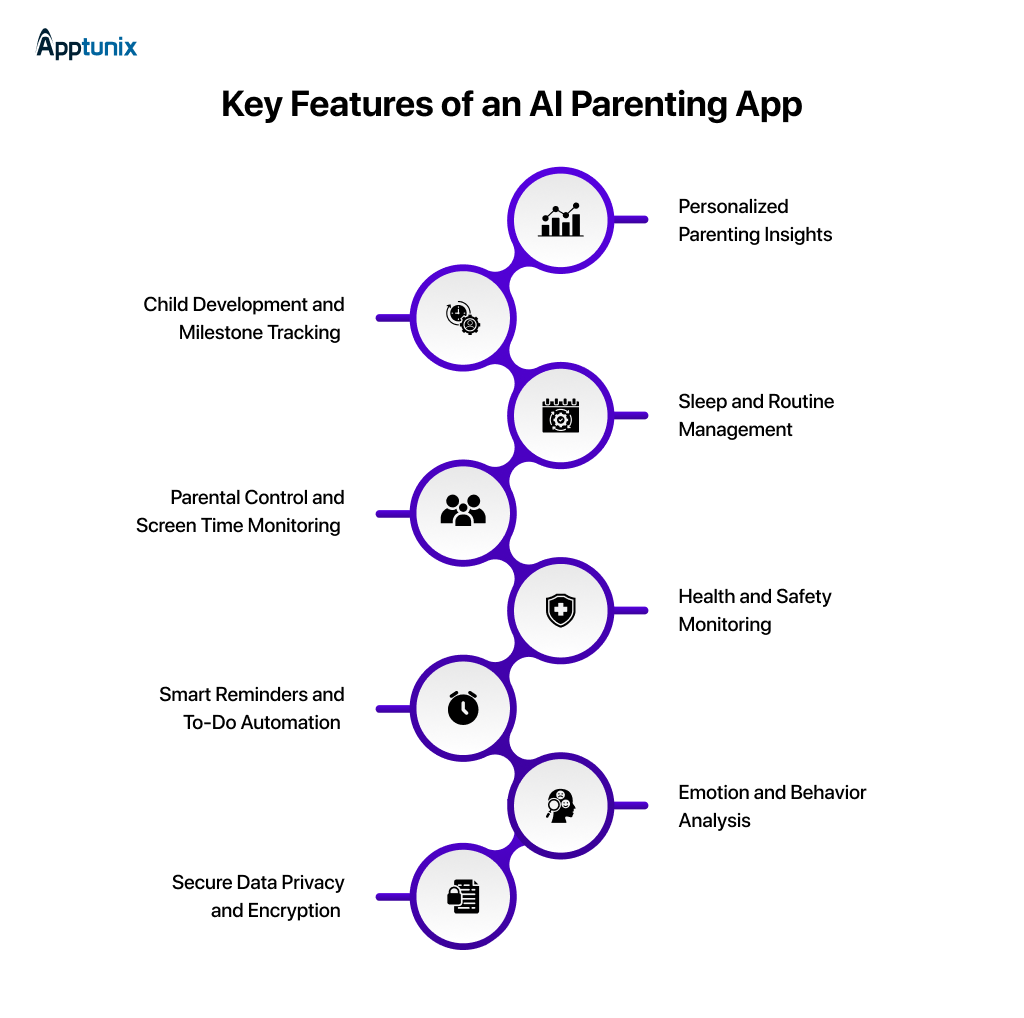
1:Personalized Parenting InsightsThis is the most important feature of an AI parenting app because it analyzes a child’s behavior, growth, and daily patterns. Gives tailored tips and expert-backed suggestions to parents.
2:Child Development and Milestone TrackingThe child development and tracking feature allows parents to monitor physical, cognitive, and emotional milestones with reminders and early detection indicators. Helps personalize growth plans tailored to each child’s needs.
3:Sleep and Routine ManagementThe sleep and routine management feature offers smart scheduling and predictive analytics that help in creating healthy habits for feeding, naps, study time, and other activities. It improves consistency and reduces daily parenting stress with automation.
4:Parental Control and Screen Time MonitoringParental control apps for kids’ screen time are crucial. It regulates device usage, blocks harmful content, and ensures a safer digital experience for kids.
5:Health and Safety MonitoringThis safety AI feature of an AI parenting app alerts for potential risks. It includes temperature changes, location tracking, geofencing tools for outdoor safety, and other potential risks for children.
6:Smart Reminders and To-Do AutomationSmart reminders and to-do automation are crucial tools of an AI-powered parenting app. It reminds parents about vaccination, medication, and doctor appointments, and daily tasks become easier to manage.
7:Emotion and Behavior AnalysisThe AI-powered emotion and behavior analysis feature can easily interpret mood changes or unusual behavior patterns. This helps parents address concerns early and keep the emotional and behavioral change on track.
8:Secure Data Privacy and EncryptionData security and encryption are crucial for any app, especially an app including family. This feature protects child and family information by safeguarding it with strong protection standards.
It is imperative to choose the right tech stack to develop an AI parenting app that is scalable, secure, and high-performing.
Analyze the table to understand the tech stack for AI parenting app development. Understand their purpose in mobile app development as well:
| Category | Technologies/Tools | Purpose |
|---|---|---|
| Frontend (UI/UX) | React Native, Flutter, Swift (iOS), Kotlin (Android) | Build smooth, responsive apps on both iOS & Android |
| Backend Development | Node.js, Python, Ruby on Rails | Scalable server architecture and API development |
| Cloud Services | Firebase, AWS, Microsoft Azure | Real-time data sync, hosting, media storage |
| AI & Machine Learning | TensorFlow, PyTorch, OpenAI APIs, Google Cloud AI | Personalization, milestone predictions, chatbots & smart analytics |
| Database & Storage | MongoDB, PostgreSQL, MySQL, AWS S3, Firebase Storage | Store user profiles, media, health & growth data securely |
| Security & Compliance | OAuth 2.0, JWT, E2E Encryption, COPPA & GDPR compliance tools | Secure user access and protect sensitive child data |
| Notifications & Communication | Firebase Cloud Messaging, OneSignal, WebSockets | Real-time reminders, alerts, and updates for parents |
Do you know 70% of parents feel more confident when they use child safety apps or tools?
AI-driven child safety apps play an imperative role in keeping the child safe. The digital solutions help parents stay aware, proactive, and informed about their child’s surroundings and online behavior. They use intelligent algorithms to detect risks like screen overuse, exposure to harmful content, and unusual safety concerns early.
Examine the features that drive child safety through a parenting app:
1:Smart Geofencing AlertsThis intelligent feature instantly notifies parents if children enter or exit unsafe locations like unknown neighborhoods, malls, or public spaces.
2:AI-Based Cyber Safety MonitoringAI-based cyber safety monitoring helps parents detect cyberbullying, explicit content, and predatory messages to ensure safe online engagement.
3:Predictive Safety InsightsArtificial intelligence in parenting apps helps analyze behavioral changes, such as social withdrawal, to alert parents to potential emotional or mental wellness issues.
4:SOS & Emergency AssistanceThese quick-access panic buttons help children instantly alert family and authorities if they feel threatened, which is very crucial.
5:Device and Screen Time ProtectionThe device and screen time protection feature tracks harmful screen habits and recommends healthier routines to achieve digital balance.
AI-powered parenting apps are addressing modern family needs as they evolve to meet market demands. Trends such as emotion recognition, mental health support, and others are transforming how parents guide and protect their children in today’s digital world.
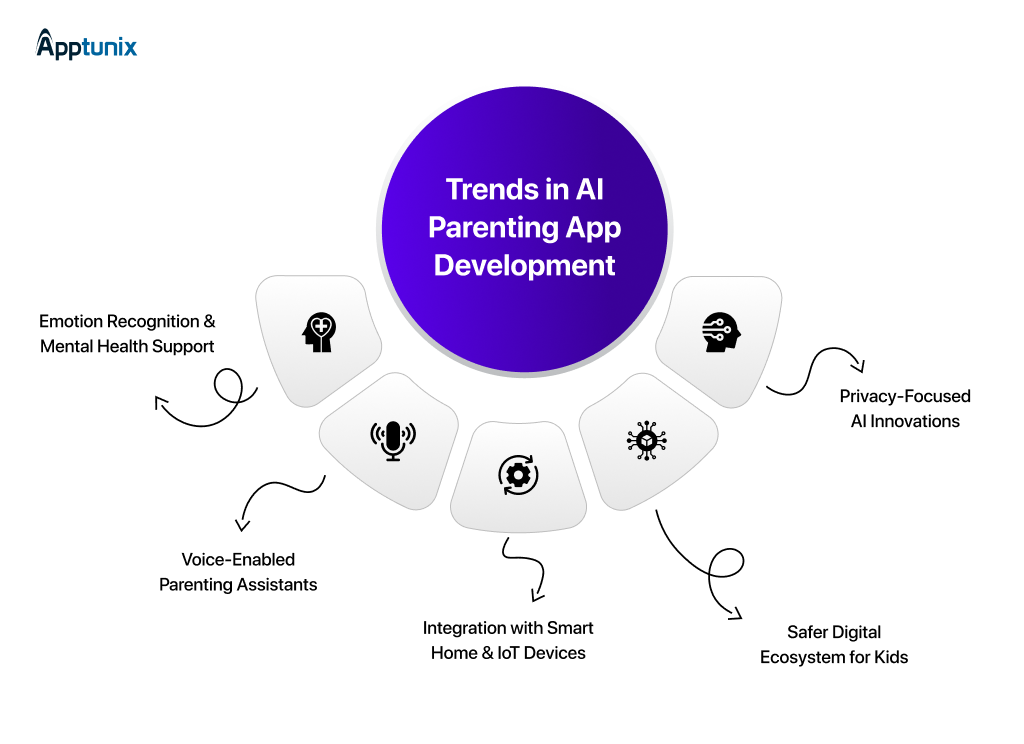
Trend 1:Emotion Recognition & Mental Health SupportAI is so advanced that it can analyze behavior patterns, facial expressions, and communication trends to identify emotional struggles early. It supports parents in managing
Trend 2:Voice-Enabled Personalized Parenting AssistantsVoice assistants for parenting are one of the biggest trends in AI parenting app development. It helps parents multitask with hands-free support for
These tools are good for busy or first-time parents since they increase accessibility.
Trend 3:Integration with Smart Home & IoT DevicesIntegrating AI parenting apps with smart homes, baby monitors, wearables, cameras, and home devices is another trend in AI parenting apps. It provides real-time updates on
Makes homes more child-friendly and secure, which is crucial in today’s fast-paced world.
Trend 4:Safer Digital Ecosystem for KidsArtificial intelligence creates a safer digital ecosystem for kids by filtering online content, monitoring social interactions, and blocking harmful content.
This trend is crucial because it ensures children use technology wisely while protecting them from cyberbullying and unsafe digital behavior.
Trend 5:Privacy-Focused AI InnovationsPrivacy-focused AI innovations are the future of AI parenting apps. Today, companies are implementing on-device AI processing, stronger encryption, and COPPA-compliant systems to
AI parenting app development cost ranges $20,000-$120,000, depending on the AI complexity of the solution and other factors like
Analyze the table to discover the timeline and cost to develop an AI parenting app:
| Complexity | Estimated Timeline | Estimated Cost |
|---|---|---|
| Basic AI Parenting App | 2-3 months | $20,000-$30,000+ |
| Mid-Level AI Parenting App | 3-5 months | $30,000-$60,000+ |
| Complex AI Parenting App | 5-8 months | $60,000-$120,000+ |
MVP Development: Standing as a minimum viable product, MVP app helps you validate core AI features with real parents while keeping the budget low and development faster. Based on user feedback and market demand, it allows you to scale later as the business grows.
| Version | Estimated Timeline | Estimated Cost |
|---|---|---|
| MVP AI Parenting App | 4-8 weeks | $12,000-$20,000+ |
As an entrepreneur, enterprise, startup, or investor, you desire to build an AI parenting app that generates high revenue. Well, you can fulfill your desire by implementing monetization strategies, including
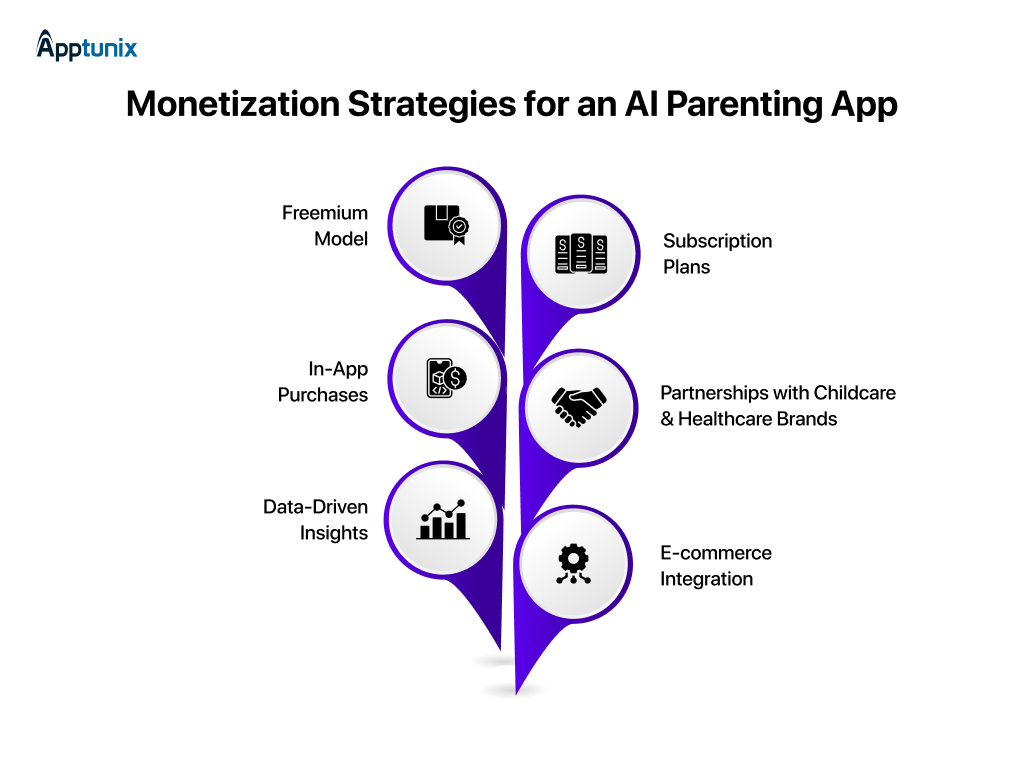
1:Freemium ModelThis business model allows users to get basic tracking and safety features for free. However, the advanced tools like AI insights, expert support, and premium analytics are locked behind upgrades. The freemium model helps build a large user base quickly.
2:Subscription PlansThe subscription plan is one of the high-generating revenue models of an AI parenting app that unlocks exclusive AI capabilities. Routine automation, personalized monitoring, premium customer support, and milestone predictions are some premium contents that ensure steady revenue growth.
3:In-App PurchasesAn in-app purchase revenue model of an AI parenting app allows parents to buy add-ons like educational content, growth reports, parenting programs, and smart devices. This revenue model is good for boosting revenue without forcing costly upgrades.
4:Partnerships with Childcare & Healthcare BrandsParenting with childcare and healthcare brands can also generate revenue from an AI parenting app. Collaborate with pediatricians, learning platforms, daycare chains, or insurance companies to offer value-added services. This generates revenue through referrals, promotions, and co-branded features.
5:Data-Driven InsightsWith strict privacy compliance, anonymous behavioral insights can support research, product innovation, or marketing analytics. This creates an ethical revenue stream without exposing personal family data.
6:E-commerce IntegrationIntegrating your platform with e-commerce platforms leads you to make more money. In-app stores can sell baby products, parenting tools, and smart wearables. AI here plays a crucial role by recommending the right products based on age, milestones, and needs, boosting sales and user engagement.
Also Read: Top 10 Artificial Intelligence development companies in the USA
We’re living in the digital world, where technologies like AI play a crucial role in the success of any business. This also applies to the AI parenting app business.
To build an AI parenting app, you require more than coding. You require deep expertise in child safety, secure data handling, predictive analytics, and family-centric design to develop a successful AI parent app in 2026.
Developing the application is a bit daunting; as a result, you must hire top developers from a leading AI development company like Apptunix.
As a leading mobile app development company, Apptunix brings 12+ years of experience delivering innovative AI solutions that are scalable and built for real-world parenting needs.
The reasons that will let you choose us are that we specialize in
Our highly advanced team ensures your product succeeds by focusing on strategy, UI/UX, AI model development, and post-launch support.
So what are you waiting for? Don’t be so late; the market is evolving every single day. Act now and secure your place in the fast-growing AI parenting app industry.
The future of AI parenting apps is brighter than ever, so partner with Apptunix and build the future of smarter childcare together!
Q 1.How much does it cost to build an AI parenting app?
The cost to develop an AI parenting app is between $20,000 and $120,000, depending on the app’s complexity and integration. However, an MVP development for an AI parenting app can be developed for up to $20,000 only.
Q 2.How long does it take to develop an AI parenting app?
AI parenting app development takes 2-8 months, or even more if you build an app from scratch. However, MVP can be developed in 4-8 weeks since it can be built with core features only to test the market and users’ potential.
Q 3.How to develop an AI-powered parenting app?
The steps for developing an AI-powered parenting app include:
Q 4.What are the key AI parenting app features?
The key AI parenting app features are as follows:
Q 5.What are the ways to earn money from an AI parenting app?
AI parenting app monetization models include subscription plans, a freemium model, in-app purchases, partnerships with brands, data-driven insights, and e-commerce integration.
Q 6.What are the top parenting apps in 2026?
The top AI parenting apps in 2026 include
Q 7.Why choose Apptunix for AI parenting app development?
Apptunix offers 12+ years of expertise in AI app development, secure child data handling, COPPA/GDPR compliance, and end-to-end support. The AI parenting app development company ensures scalable, user-friendly, and future-ready AI parenting apps.
(1 ratings, average: 5.00 out of 5)
Get the weekly updates on the newest brand stories, business models and technology right in your inbox.
Avinash Kumar is a highly experienced technical writer with 5+ years in B2B and technology content. He specializes in simplifying complex tech topics into clear, engaging, and conversion-focused content. At Apptunix, he helps startups and enterprises make informed digital decisions through insightful blogs, guides, and strategic storytelling that drives real business growth.
30 Views 14 min October 13, 2026
47 Views 14 min October 8, 2026
44 Views 14 min October 8, 2026
Book your consultation with us.
Book your consultation with us.


One Central, The offices 3, Level 3, DWTC, Sheikh Zayed Road, Dubai
+971 50 782 1690