Top 16 AI Consulting Companies in Saudi Arabia: Compare Services, Expertise & Pricing
92 Views 18 min January 22, 2026

Hardeep Singh is a seasoned B2B technical writer at Apptunix with a sharp eye for strategy and a mind wired for innovation. With over a decade of experience in technical and SEO writing, and a Master’s degree in Wireless Communication, he’s written across domains including AI, Blockchain, IoT, Cybersecurity, and beyond. At Apptunix, Hardeep drives content that bridges business goals with future-ready mobile and web solutions, thus helping startups and enterprises make smarter digital decisions.
In today’s digital economy, users expect more than generic experiences. They want apps that understand their behavior, adapt to their needs, and offer recommendations that feel personal.
Isn’t it?
This is where AI in mobile apps acts as a game-changer. Businesses can now create AI-based mobile apps that deliver tailored interactions at every touchpoint through advanced data processing and predictive algorithms.
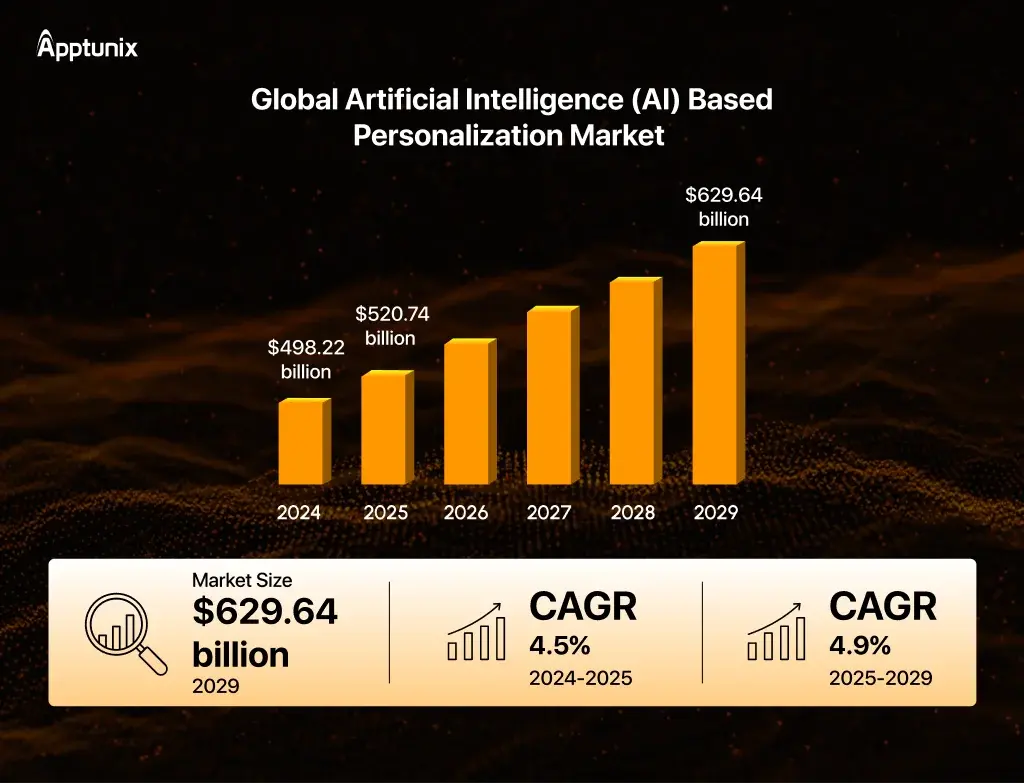
And the number speaks on behalf of the potential behind this massive shift. According to the AI Market Report, the global artificial intelligence (AI) based personalization market is projected to grow from $498.22 billion in 2024 to $520.74 billion in 2025, reflecting a CAGR of 4.5%. The momentum doesn’t stop there. By 2029, the market is expected to hit $629.64 billion, expanding at a CAGR of 4.9%.
Several factors are fueling this growth:
So, this is a pivotal moment for companies exploring AI app development. Personalization is no longer a value-add; it is the foundation of modern mobile experiences. Businesses that invest in AI-powered mobile app development are positioning themselves to build stronger user loyalty and stand out in a competitive app market.
The impact of artificial intelligence in mobile app development goes far beyond simple automation. Today, businesses are using AI to reshape how apps interact with users, creating experiences that feel highly personalized and human-like. From voice assistants to predictive search, AI app development is enabling mobile apps to act as intelligent companions rather than just digital tools.
Both the Android app and iOS app ecosystems are being enhanced by AI. For instance, Apple’s Siri and Google Assistant are prime examples of AI mobile applications built into smartphones that learn from user interactions and improve responses over time. Developers are now embedding similar AI-driven features in everyday apps, making personalization seamless across different platforms.
One of the most powerful contributions of AI in app development lies in its ability to collect and analyze massive amounts of data. An artificial intelligence mobile app can study user behavior, location, preferences, and even purchase history to deliver unique recommendations.
This is why Netflix’s movie suggestions, Spotify’s curated playlists, and Amazon’s shopping feeds feel so relevant. Each relies on machine learning mobile applications that adapt to user activity in real time.
A smooth user experience (UX) is often the deciding factor in whether a customer stays loyal to an app. AI makes it possible to customize layouts, adjust notifications, and even predict what the user will search for next. This level of personalization improves engagement and drives retention – two key goals for any brand investing in artificial intelligence for app development.
eCommerce Apps: AI-powered recommendation engines drive higher sales by showing the right products at the right time.
Fitness Apps: Personalized workout and nutrition plans adapt to the user’s progress.
Finance Apps: AI detects fraud and predicts spending patterns.
Entertainment Apps: AI suggests songs, shows, or videos based on mood or listening history.
Table: AI-Powered Personalization Across Mobile Apps
| Industry | Example App | AI-Powered Feature | Technology Used |
|---|---|---|---|
| eCommerce | Amazon | Personalized product recommendations | Machine Learning, NLP |
| Fitness | Nike Training Club | Tailored workout plans | Predictive Analytics |
| Finance | PayPal | Fraud detection & alerts | AI + Big Data |
| Entertainment | Netflix, Spotify | Smart content curation | Deep Learning, AI in mobile apps |
We have seen how artificial intelligence in mobile app development is reshaping both Android and iOS platforms with smarter experiences, personalized recommendations, and predictive insights. But the true value of AI app development emerges when we look at how different industries are applying these technologies to solve real business challenges.
From online shopping to fitness tracking, every sector is finding unique ways to harness the power of AI-based mobile apps to deliver value-driven personalization. Let’s now explore industry-specific strategies – starting with eCommerce and then moving into fitness, travel, healthcare, and beyond.
The eCommerce industry has been one of the earliest adopters of AI in mobile apps. It uses data-driven insights to transform how people shop online. And why not when personalization powered by AI app development is no longer optional, but the competitive edge that separates successful brands from the rest?
AI helps retailers track and analyze customer activity such as browsing history, click patterns, and purchase behavior. An artificial intelligence phone app can predict what a customer is most likely to buy next and show products tailored to their unique interests. This approach not only boosts conversions but also strengthens customer trust.
eCommerce platforms can implement dynamic pricing models using machine learning mobile applications. AI evaluates demand, competitor prices, seasonality, and customer purchase intent to recommend the best price in real time. For example, airlines and ride-hailing apps rely heavily on this feature to maximize profits and keep users engaged.
Recommendation engines are the backbone of personalization in eCommerce. An AI mobile application can suggest products that users didn’t even know they needed, just by analyzing large datasets. Amazon, eBay, and Alibaba are strong examples where artificial intelligence in mobile app development has turned browsing into a personalized shopping experience.
Sending the right notification at the right time is crucial for customer retention. Artificial intelligence for mobile apps makes it possible to segment audiences and deliver contextual messages. So, instead of generic promotions, users receive personalized offers that match their shopping behavior, thus increasing the likelihood of action.
Also Read: 10 Advanced eCommerce Mobile App Features
Health and wellness have become central to people’s lifestyles, and mobile apps are playing a huge role in supporting these goals. Fitness platforms are now offering personalized training, nutrition guidance, and preventive insights that adapt to each user’s progress by embedding AI in mobile apps. This shift has made AI mobile app development a critical component in the fitness tech industry.
Every fitness journey is unique, and a one-size-fits-all approach rarely works. Using machine learning mobile applications, fitness apps analyze user activity, fitness level, and preferences to deliver tailored workout plans. For example, the Nike Training Club app adapts exercise routines based on completed sessions, thus ensuring workouts evolve with the user.
Fitness isn’t just about workouts – it’s about nutrition too. An artificial intelligence mobile app can assess calorie intake, track meal history, and even suggest meal plans customized to health goals such as weight loss or muscle gain. Apps like MyFitnessPal integrate artificial intelligence for mobile personalization to recommend foods and recipes based on user data.
Perhaps the most promising innovation lies in preventive health. AI in app development enables fitness apps to provide early warnings or suggestions for better lifestyle management by analyzing sleep patterns, heart rate, and daily activity through IoT integration. This proactive approach is making AI mobile applications more than just training guides – they are evolving into digital health companions.
Also Read: How Much Does It Cost to Build a Fitness App in 2025?
Travel planning can be overwhelming, but AI in mobile apps is transforming how people explore destinations, book accommodations, and enjoy seamless journeys. Through AI mobile app development, travel platforms can now anticipate user preferences, provide predictive recommendations, and enhance overall customer experiences. This makes artificial intelligence in mobile app development essential for modern travel businesses.
Instead of static travel packages, machine learning mobile applications curate unique itineraries based (a planned route or journey) on traveler profiles, interests, and budget. For instance, if someone loves history and cuisine, an AI mobile application can create a day-by-day plan that blends museum visits with local food tours. Apps like TripIt and Google Travel already leverage artificial intelligence mobile apps to design trips that feel tailor-made.
Traditional booking filters are being replaced by AI-powered personalization. With artificial intelligence for app development, travel apps can recommend hotels and flights not just on price, but also on proximity to attractions, family-friendliness, or eco-sustainability. Hopper, for example, uses AI in mobile apps to predict airfare changes with high accuracy, helping users save money and plan smarter.
Travelers expect instant support while on the go. By combining artificial intelligence for mobile with chatbots and voice assistants, Android app and iOS app developers are creating tools that provide real-time updates on flight delays, nearby restaurants, or local events. This turns an artificial intelligence phone app into a true travel concierge, offering timely and personalized guidance throughout the journey.
Also Read: Cost to Build a Travel App Like Wego in 2025
Healthcare is one of the industries where AI in mobile apps is making the most profound impact. From preventive care to personalized treatments, AI mobile app development is enabling solutions that adapt to each patient’s unique needs. In simple words, healthcare platforms are no longer just information providers – they are becoming proactive health companions.
One of the biggest breakthroughs in artificial intelligence for app development is clinical decision support. Machine learning mobile applications analyze patient symptoms, lab results, and medical histories to suggest potential diagnoses. Apps like Ada Health and Buoy use artificial intelligence mobile apps to deliver symptom assessments, helping patients understand their conditions before visiting a doctor.
No two patients respond to treatment the same way. With AI app development, healthcare apps create personalized treatment recommendations that evolve with patient progress. For example, an AI mobile application may track medication adherence, lifestyle changes, and biometrics to adapt care plans. Livongo, a digital health platform, uses artificial intelligence in mobile apps to help diabetes patients manage blood sugar levels more effectively.
Preventive care is a critical area where artificial intelligence for mobile shines. By leveraging IoT devices and wearables, healthcare Android apps and iOS apps can detect early warning signs such as irregular heartbeats, high blood pressure, or sleep apnea. AI-enabled platforms like Fitbit and Apple Health integrate artificial intelligence phone apps with predictive analytics to alert users before issues escalate, thus making healthcare more proactive and accessible.
Dating has shifted from chance encounters to digital-first interactions, and AI in app development is driving the next level of personalization. By leveraging user behavior, preferences, and even conversation patterns, AI mobile app development is transforming how people connect. In fact, artificial intelligence in mobile app development ensures that dating platforms go beyond swipes, delivering meaningful matches that adapt to each user’s needs.
If we talk about the core of any AI mobile app for dating, it is its ability to recommend compatible matches. Machine learning mobile applications analyze user data such as interests, browsing behavior, and past interactions to refine matchmaking. Apps like Tinder and Bumble already employ artificial intelligence for mobile to suggest partners with higher compatibility scores, reducing random mismatches.
Engaging conversations are crucial in dating apps. Using artificial intelligence for app development, platforms now integrate chat suggestions, icebreakers, and sentiment analysis to improve user interactions. More importantly, artificial intelligence mobile apps help flag harmful or inappropriate content, thus ensuring a safer experience. For instance, Bumble’s AI feature automatically detects and blocks offensive images, enhancing trust.
Every individual seeks different things – some look for casual connections, others for serious relationships. AI mobile applications personalize the user journey by adjusting recommendations and features. Whether it’s event suggestions, location-based meetups, or curated content, both Android apps and iOS apps in dating now use artificial intelligence to deliver tailor-made experiences that resonate with each user’s intent.
Also Read: How Much Does it Cost to Develop a Matrimonial/Dating App?
Astrology has always been about aligning cosmic insights with personal lives. With the rise of AI in mobile apps, astrology platforms are now delivering highly customized horoscopes, predictions, and life guidance. These apps can analyze birth charts, planetary movements, and even user behavior to provide hyper-personalized experiences through AI-powered app development. Artificial intelligence in mobile app development ensures astrology is no longer generic but deeply individual.
Traditional horoscopes often provide broad predictions. But with machine learning mobile applications, astrology apps can analyze exact birth details – time, date, and location – to generate precise natal charts. Artificial intelligence mobile apps like Co-Star compare cosmic data with personal inputs, thus offering highly accurate personality insights and future forecasts.
Astrology enthusiasts often seek daily advice. Artificial intelligence in app development allows apps to process astronomical datasets and past user engagement to deliver personalized daily horoscopes, relationship advice, or career predictions. AI mobile applications in astrology even integrate push notifications to keep users engaged with real-time guidance that evolves with planetary shifts.
One of the most popular astrology app features is compatibility analysis. Using artificial intelligence in mobile platforms compare two individuals’ charts to suggest relationship strengths and challenges. Artificial intelligence phone apps like The Pattern integrate AI in mobile apps to give deeper, data-backed compatibility insights, thus making connections feel more relevant and personalized.
Bonus Read: Astrology App Development Guide to Build App like The Daily Horoscope
The logistics and supply chain industry thrives on efficiency and precision. By embedding AI in mobile apps, logistics platforms can now optimize delivery routes, reduce delays, and predict supply-demand trends with high accuracy. Through AI mobile app development, companies are creating smarter solutions that personalize workflows for drivers, businesses, and customers. Artificial intelligence in mobile app development is transforming logistics from reactive operations into predictive and data-driven systems.
Every delivery depends on timely execution. Using machine learning mobile applications, logistics apps can analyze traffic conditions, weather data, and delivery schedules to create personalized, real-time optimized routes for drivers. Apps like Route4Me integrate artificial intelligence in mobile apps to cut fuel costs and save delivery time.
Logistics apps powered by AI can forecast can forecast demand trends, ensuring warehouses stay stocked appropriately. By analyzing purchasing patterns and seasonal spikes, AI mobile applications help businesses maintain the right inventory levels. This level of personalization ensures retailers and suppliers avoid stockouts or overstocking, thus boosting profitability.
Customers today expect transparency. Through artificial intelligence phone apps, logistics platforms allow users to track packages in real time, with AI predicting exact delivery times based on current conditions. This personalization builds trust and improves customer retention while reducing customer support queries.
Bonus Read: AI-Powered Taxi App Development: Revolutionizing the Ride-Hailing Landscape
Buying or renting a property is one of the most personal and financially significant decisions people make. Real estate apps are now leveraging AI in mobile apps to deliver hyper-personalized property recommendations, financial insights, and even virtual tours. Through AI mobile app development, platforms are shifting from static listings to intelligent, tailored experiences. This makes artificial intelligence in mobile app development a game-changer for real estate businesses worldwide.
Every buyer or renter has unique needs – budget, location, lifestyle, and preferences. Machine learning mobile applications analyze user behavior, search filters, and past interactions to recommend the most relevant properties. For instance, Zillow and Trulia use artificial intelligence mobile apps to display properties that closely match user intent, thus improving conversion rates.
Photos are no longer enough. With artificial intelligence for app development, real estate apps now integrate AR/VR-powered virtual tours, enabling users to experience properties remotely. AI further enhances personalization by showing homes styled according to the user’s taste – modern, minimalistic, or luxury, thus enhancing the mobile AI app experience.
Beyond listings, real estate apps are becoming financial advisors. By embedding artificial intelligence for mobile, platforms can predict property appreciation, recommend mortgage plans, and assess investment potential based on market trends. This transforms an AI mobile application into a holistic guide, thus giving users confidence in long-term decisions.
Also Read: How to Build Property Management Software
Gaming has evolved beyond static experiences into dynamic, adaptive worlds. By integrating AI in mobile apps, developers can now deliver games that adjust difficulty, storylines, and rewards to each player’s behavior. With AI mobile app development, gaming platforms are creating immersive environments that keep players engaged for longer while driving higher retention and monetization..
Not every gamer plays the same way. Machine learning mobile applications can track player behavior, skill level, and in-game actions to dynamically adjust difficulty. For instance, Resident Evil 4 uses AI to scale enemy toughness based on the player’s performance. This makes the experience challenging but not frustrating. Such features show the potential of an artificial intelligence mobile app in keeping players hooked.
Reward systems drive engagement. Through artificial intelligence for app development, gaming apps can personalize in-game rewards, suggest new levels, or recommend relevant items in the store. Mobile platforms like PUBG and Fortnite use AI-powered personalization to suggest skins, weapons, or upgrades based on past player activity, thus creating a more engaging mobile AI app experience.
AI is revolutionizing character interaction. Using artificial intelligence for mobile, non-playable characters (NPCs) can now respond more naturally, adapting dialogues and strategies to each player’s choices. This makes an AI mobile application not just a platform for gaming, but an evolving world with limitless replayability – offering users a personalized story every time.
Social media platforms thrive on engagement, and personalization is the backbone of that success. By integrating AI in mobile apps, social platforms create curated feeds, smart recommendations, and personalized interactions that keep users scrolling. Social media companies are redefining how people connect, consume, and share content with AI app development.
One of the most visible uses of machine learning mobile applications in social media is the content feed. AI analyzes user preferences, watch time, and interactions to deliver posts, reels, and stories tailored to each user. For example, TikTok’s “For You” page is powered by advanced algorithms that make it one of the best AI mobile apps for personalization.
Social media is about connections, and artificial intelligence mobile apps enhance this by recommending friends, groups, and communities aligned with user interests. Facebook and LinkedIn use artificial intelligence for app development to suggest people you may know, while niche platforms apply AI to build stronger communities around shared interests.
Personalization isn’t only about engagement, but also about safety. AI-powered moderation systems in AI mobile applications filter harmful or irrelevant content, ensuring feeds remain enjoyable. Instagram, for instance, uses AI to detect bullying, hate speech, or spam. This makes artificial intelligence for mobile an essential pillar of trust and user retention in social networks.
From streaming platforms to interactive experiences, AI in mobile apps is transforming how people consume entertainment. By leveraging AI in app development, companies are delivering hyper-personalized experiences that keep users hooked for longer. Entertainment is no longer about static recommendations – it’s about dynamic, predictive, and adaptive engagement through AI mobile applications.
Streaming apps like Netflix and Amazon Prime rely heavily on machine learning mobile applications to analyze viewing history, ratings, and browsing behavior. These insights enable artificial intelligence-based mobile apps to create highly curated recommendations that match user moods, genres, and watch-time patterns. The ability to predict “what’s next” makes these platforms some of the best AI mobile apps in the entertainment sector.
Music apps such as Spotify and Apple Music use artificial intelligence for app development to create personalized playlists that evolve with listening habits. AI not only tracks favorite artists and genres but also learns from contextual factors like time of day or activity. This ensures that mobile AI apps serve up the right songs for workouts, relaxation, or commutes – making AI-driven playlists a game-changer.
Beyond passive consumption, artificial intelligence for mobile enhances discovery and interactivity. Platforms like YouTube leverage AI in app development to surface trending videos aligned with individual interests, while gaming-entertainment hybrids like Twitch use AI to recommend streamers and live events. This fusion of discovery and personalization showcases how artificial intelligence phone apps are blurring the lines between content and user experience.
The finance industry is at the forefront of leveraging AI in mobile apps to deliver secure, seamless, and highly personalized services. Through artificial intelligence in mobile app development, financial platforms are transforming the way users interact with money – offering smarter insights, fraud detection, and predictive guidance. For developers, AI app development in FinTech is not just about building digital wallets, but about creating intelligent financial companions.
One of the biggest challenges in finance is preventing fraud. Machine learning mobile applications analyze transaction patterns in real time to detect anomalies and flag suspicious activity instantly. For example, PayPal uses artificial intelligence for app development to monitor billions of transactions daily, identifying risks with high accuracy. This proactive approach makes AI mobile applications a cornerstone of financial security.
FinTech apps now go beyond basic account management by providing personalized money management tools. Through artificial intelligence mobile apps, platforms like Mint or Cleo categorize spending, forecast bills, and suggest budgeting strategies. Furthermore, by embedding artificial intelligence for mobile, these apps deliver real-time insights that help users save more and spend smarter.
The rise of robo-advisors showcases the potential of AI in app development for wealth management. Apps such as Betterment or Robinhood use predictive algorithms to analyze markets and recommend tailored investment portfolios. FinTech platforms are democratizing wealth management by transforming traditional advisory services into mobile AI apps. Thus making advanced financial tools accessible to everyone.
Also Read: How to Develop a Fintech App Like STC Pay
So, we have explored how AI in mobile apps is driving personalization across industries – from fitness and fintech to entertainment and beyond. But while opportunities are immense, developers and businesses also face practical challenges when integrating artificial intelligence for app development. Addressing these obstacles is crucial to fully unlock the potential of AI mobile applications and ensure long-term success.
Even though artificial intelligence in mobile app development is revolutionizing user experiences, implementing it is far from simple. Below are the key challenges businesses must tackle when building AI mobile apps for Android and iOS platforms.
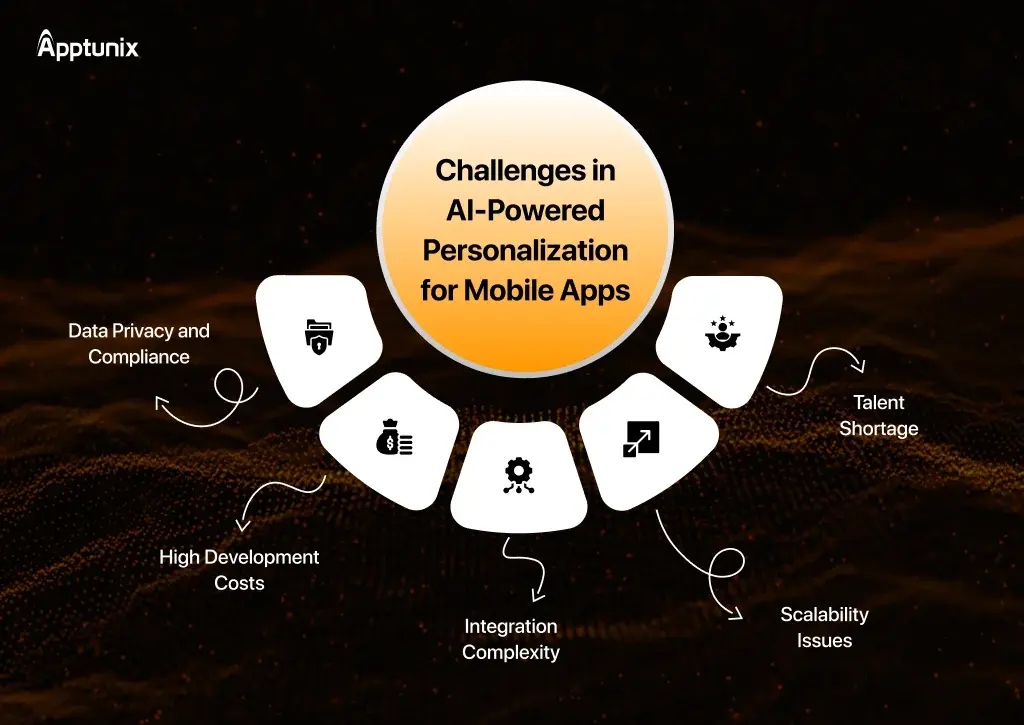
AI thrives on data, but sensitive personal information – especially in artificial intelligence phone apps for fintech or healthcare – requires strict compliance with GDPR, HIPAA, and other regional laws. Mishandling data can erode user trust and lead to heavy penalties.
Building intelligent apps with personalization features requires significant investment in AI app development and infrastructure. From machine learning model training to cloud integrations, the cost in this case can be much higher than the traditional Android app or iOS app development cost. Startups can even go for an AI MVP development.
Adding artificial intelligence for mobile into existing apps is not always straightforward. Legacy systems, third-party APIs, and diverse platforms (Android and iOS) make integration technically complex and resource-intensive.
As user bases grow, ensuring real-time personalization at scale becomes challenging. Machine learning mobile applications demand robust cloud infrastructure and optimized models to serve millions of users simultaneously without delays.
There’s a global shortage of AI engineers and data scientists skilled in AI mobile app development. Without the right expertise, businesses risk building apps that underperform or fail to deliver meaningful personalization.
Overcoming these challenges is only one side of the story. The other side is far more exciting – the rapid advancements shaping the future of AI in mobile apps. As technology evolves, businesses that embrace the next wave of artificial intelligence in mobile app development will be the ones creating truly immersive, personalized, and future-ready experiences.
The coming years will witness a deeper blend of AI mobile application development with emerging technologies like 5G, AR/VR, and multimodal AI. Here are the top 5 trends redefining the way personalization works in AI mobile apps.
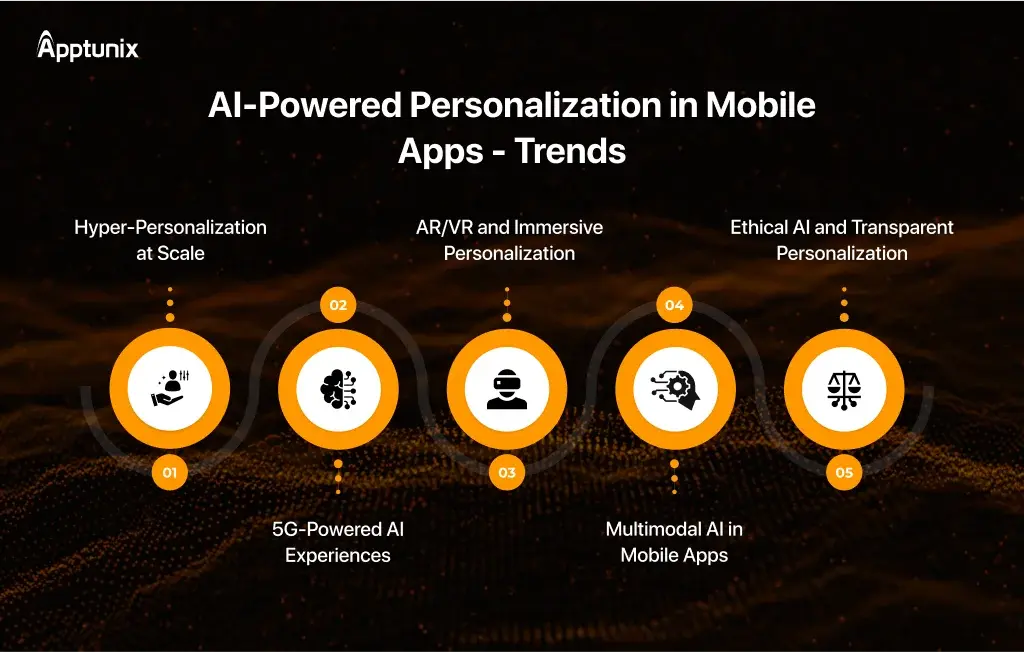
AI will move beyond basic personalization to deliver real-time hyper-personalization. Apps will analyze not just browsing history but also mood, environment, and even biometric signals to deliver dynamic recommendations. Imagine a music app suggesting playlists based on your heart rate or a shopping app changing product recommendations as per your browsing session mood.
With the global rollout of 5G, artificial intelligence for mobile apps will operate at lightning speeds. Faster networks will enable apps to process massive amounts of data instantly, allowing smoother real-time personalization – whether it’s a live fitness coach, AR shopping assistant, or a telemedicine app giving instant diagnoses.
AI and augmented reality/virtual reality will merge to deliver deeply engaging user journeys. Retail apps will let users try clothes virtually while AI recommends outfits based on style history. Travel apps may craft virtual tours where destinations adapt to personal interests. This blend of AI app development with immersive tech will transform industries.
Next-gen AI won’t just process text or voice – it will combine vision, audio, and touch inputs. For instance, machine learning mobile applications could detect facial expressions, interpret voice tones, and track gestures simultaneously to refine personalization. This multimodal approach will make apps more human-like and context-aware.
As personalization gets smarter, transparency will matter more. Future-ready AI mobile apps will not only offer recommendations but also explain why they are being suggested. This shift toward explainable AI will build stronger trust, especially in sensitive sectors like healthcare and finance.
AI-powered personalization is no longer just a trend, but a new standard for building engaging and future-ready mobile apps. From fitness and fintech to travel, gaming, and entertainment, industries worldwide are proving that AI in mobile apps can drive deeper customer engagement, retention, and revenue growth. And with upcoming innovations like hyper-personalization, 5G, multimodal AI, and AR/VR integration, the opportunities are limitless.
For businesses, the real challenge lies in finding the right technology partner. Developing such intelligent, scalable, and secure apps requires more than just coding skills. It demands a team that understands artificial intelligence in mobile app development, cutting-edge algorithms, and industry-specific challenges.
That’s where Apptunix comes in.
As a leading AI app development company, Apptunix specializes in crafting tailored solutions across industries. Our expert AI mobile app developers build intelligent applications with machine learning, natural language processing, and predictive analytics to ensure unmatched personalization.
We also stand out as a top AR/VR game development company, combining immersive technologies with AI to deliver engaging, next-gen experiences that captivate users globally.
Whether you need a custom AI mobile application, an AI-powered eCommerce solution, or an AR/VR-based game development service, Apptunix provides end-to-end development support – from ideation to deployment.
Why Choose Apptunix?
Last, but not least, the future of personalization in mobile apps is already here – and Apptunix can help you lead it.
Bonus Read: Top 10 AI development companies in the USA, 2025

Q 1.How much does AI mobile app development cost in Dubai, UAE?
The cost of AI mobile app development in Dubai typically ranges between $20,000 and $150,000, depending on features, complexity, and integration of technologies like machine learning, AR/VR, or blockchain.
Q 2.Why should I hire AI app developers in the Middle East?
Hiring AI app developers in Dubai or the Middle East ensures region-specific expertise, faster delivery, and compliance with local business and data regulations. Plus, you benefit from cutting-edge development at competitive pricing.
Q 3.What industries benefit most from AI-powered mobile apps?
AI mobile app development adds value across industries such as fintech, eCommerce, healthcare, real estate, logistics, travel, gaming, fitness, astrology, and social media, helping businesses personalize user journeys and boost ROI.
Q 4.How long does it take to develop an AI-based mobile app?
On average, MVP AI apps take 2 – 4 months, while enterprise-level AI solutions may take 6 – 12 months. The timeline depends on features like chatbots, predictive analytics, or AR/VR integrations.
Q 5.Do you offer custom AI-based mobile app development services?
Yes. We specialize in end-to-end custom AI app development – from ideation and design to deployment and scaling – tailored to your industry, users, and business goals.
Q 6.Can AI be integrated into my existing mobile app?
Absolutely. Our AI app developers can upgrade your existing app with AI features such as personalized recommendations, fraud detection, chatbots, or predictive analytics without disrupting core functionality.
Q 7.What is the future of AI in mobile app development?
The future lies in hyper-personalization, voice and image recognition, predictive analytics, and AR/VR experiences. Businesses adopting AI now gain a major competitive advantage in the Middle East and beyond.
Q 8.What AI technologies are used in mobile app development?
AI mobile apps commonly use machine learning (ML), natural language processing (NLP), computer vision, predictive analytics, chatbots, and recommendation engines, often combined with AR/VR for immersive experiences.
Q 9.How secure are AI-powered mobile apps?
AI enhances app security with real-time fraud detection, biometric authentication, anomaly detection, and data encryption, making it a strong choice for industries like fintech, healthcare, and logistics.
Q 10.What is the difference between AI mobile app development and traditional app development?
Unlike traditional apps, AI mobile apps learn, adapt, and predict user behavior. They evolve over time, offering smarter personalization, better security, and higher ROI for businesses.
Get the weekly updates on the newest brand stories, business models and technology right in your inbox.
Hardeep Singh is a seasoned B2B technical writer at Apptunix with a sharp eye for strategy and a mind wired for innovation. With over a decade of experience in technical and SEO writing, and a Master’s degree in Wireless Communication, he’s written across domains including AI, Blockchain, IoT, Cybersecurity, and beyond. At Apptunix, Hardeep drives content that bridges business goals with future-ready mobile and web solutions, thus helping startups and enterprises make smarter digital decisions.
92 Views 18 min January 22, 2026

154 Views 18 min December 26, 2025

122 Views 18 min December 23, 2025
Book your free consultation with us.
Book your free consultation with us.

One Central, The offices 3, Level 3, DWTC, Sheikh Zayed Road, Dubai, United Arab Emirates
+971 50 782 1690