
How Much Does Procurement Software Development Actually Cost in 2026?
89 Views 8 min May 14, 2026

Reena Bhagat, the CTO and Head of AI at Apptunix, is a seasoned technology strategist with a deep-rooted expertise in emerging technologies. With a focus on AI/ML integration, product engineering, cloud management, she leads the technical vision for high-performance SaaS infrastructures. Reena is recognized for building secure, scalable, and decentralized systems that solve real-world complexities. Her passion lies in leveraging data science and future-tech to create resilient digital products, making her a trusted authority for organizations looking to lead in the age of intelligent automation.
The cost to build a Fitness app like Strava ranges from USD $15K to $150K+, mainly based on feature depth, real-time data, and app complexity.
Launching with an MVP keeps risk low, helps validate demand, and allows smarter future investment.
User retention depends on accuracy and experience, especially GPS tracking, performance insights, and a frictionless interface.
Wearable integrations and scalable infrastructure should be planned early to avoid costly rebuilds later.
The real spend continues after launch, with maintenance, updates, and performance optimization driving long-term success.
Imagine this.
You finish a morning workout and instinctively open Strava on your phone. In a few seconds, your route, pace, calories burnt, and recovery stats are on your phone screen. A simple workout can turn into meaningful insights about your body and health progress.
Now look at that moment from an investment angle.
Plenty of users rely on fitness apps like Strava to stay consistent, plan workouts, and track long-term health. That daily habit is what makes building a fitness app like Strava a strong business opportunity.
The global mHealth apps market is growing fast, projected to grow from USD 40.65 billion in 2025 to USD 113.2 billion by 2034, growing at a CAGR 11.80% annually.
The real question isn’t if there’s demand, but how much it costs to build a fitness app like Strava. This guide will reveal everything about it.
We break down the cost to build a fitness app like Strava and the factors that impact fitness app development costs. With that, you can easily judge whether investing in a fitness app like Strava makes sense for your goals.
The cost to build a fitness app like Strava ranges from USD $15,000 to USD $150,000+, depending on the app’s complexity.
Below, you’ll find more information on the app’s complexity (basic, moderate, and advanced) and the associated costs.
| Fitness App Complexity | Cost in USD | Timeline | Features & Functionality |
|---|---|---|---|
| Basic Fitness App Development | USD $15,000–$60,000+ | 2–3 months |
Simple & Clean Design Ready-Made Workout Plans Easy-to-Use Dashboard Limited App Integrations Workout Tracking |
| Moderate Fitness App Development | USD $60,000–$100,000+ | 4–6 months |
Essential Features Custom UI/UX Design Community-Driven Tools Video Learning API Integrations |
| Advanced Fitness App Development | USD $100,000–$150,000+ | 8–10 months |
AI Recommendations Live Coaching & Streaming Advanced Insights Multi-Language Access Real-Time Syncing |
Strava app development involves design, features, and tech choices. Each decision impacts the cost of making a fitness app like Strava. Understanding all these factors helps you plan smarter and avoid surprises. Below are the 10 key factors that impact the cost of Strava-like app development.
A basic fitness app might track workouts and show stats. A Strava-like fitness app development project goes much further. It should include functionality like:
Every added feature increases mobile app development time, testing effort, and maintenance. Note that more features for a fitness app like Strava mean higher app development costs.
| Average Cost to Implement Features | $6,000 – $10,000 |
One of the biggest decisions affecting the cost to create an app like Strava is platform choice. Building only for iOS or Android costs less upfront. But it also limits the app’s reach from day one.
Strava runs smoothly across platforms because it’s heavily optimized. If your app needs that polish, native or advanced cross-platform development will cost more. Have a close look at which fits the best.
| App Platform | Best For | Cost IN USD |
|---|---|---|
| Single Platform (Android/iOS) | Lower upfront cost | USD $4,000–$6,000 |
| Cross-platform | Balanced cost, faster launch | USD $5,000–$8,000 |
| Native Apps for Both Platforms | Best performance, higher cost | USD $6,000–$9,000 |
UI/UX design of the app is also a factor that impacts the Strava-like app development cost. A fitness app isn’t just about tracking workouts. Users open it daily, sometimes multiple times a day. If the app feels confusing or cluttered, they leave. The user journey must be short and meaningful.
| App Design Type | Details |
|---|---|
| UX (User Experience) | Includes user flows, wireframes, and usability testing. |
| UI (User Interface) | Includes clean visuals, readable stats, and intuitive navigation. |
Simple screens cost less. Custom animations, smart dashboards, and smooth transitions cost more. Good UI/UX design also takes time. Designers test flows. They tweak layouts. They fix friction points.
| Average Cost of UI/UX Design | USD $5,000-$8,000 |
This is where most of the budget usually goes. Backend and frontend app development costs depend on how complex your fitness app is and how polished you want it. For that, your backend and frontend must be phenomenal. Find more details in the table:
| Development Type | Cost Range | Details |
|---|---|---|
| Backend App Development | USD $4,000–$8,000 | The backend handles GPS data, activity tracking, user accounts, workouts, social feeds, and real-time syncing. |
| Frontend App Development | USD $3,000–$6,000 | Screens, animations, maps, dashboards, and smooth navigation come in the frontend. |
Fitness apps like Strava collect sensitive data: location, health metrics, and routines. That data needs serious protection.
Security impacts: authentication systems, encrypted data storage, secure APIs, and access controls. Strong security doesn’t just protect users; it protects your brand, which also increases the mobile app development cost.
| Average Cost of Data Security & Privacy | USD $3,000-$5,000 |
Strava connects with wearables, smartwatches, and other fitness platforms with ease. Common integrations include:
Each API adds development time, testing complexity, and ongoing maintenance. This means the more external systems you connect, the higher the cost to create an app like Strava.
| Average Cost of Third-Party Integrations | USD $3,000-$5,000 |
Building for scalability Upfront increases initial Strava app development cost but saves painful (and expensive) rebuilds later. This is especially important if subscriptions or global expansion are part of your plan.
A fitness app might start with a few thousand users, but success demands scale. You’ll need infrastructure that handles high traffic during peak workout hours, real-time data syncing, and large volumes of activity data.
| Average Cost of Scalability & Performance | USD$4,000-$8,000 |
The real testing is the most important because users don’t just open the app for the numbers. They’ll track workouts in poor network conditions, switch between apps mid-activity, drain their battery, or use older devices.
Also, quality control makes sure your fitness app stands in the above-mentioned real-world moments.
| Average Cost of Testing & Quality Control | USD $3,000-$5,000 |
When estimating the cost to build a fitness app like Strava, many teams focus only on launch. That’s a mistake. Real costs show up after release, when bugs appear, devices update, and user expectations change.
Ongoing support can’t be an afterthought. It needs planning from day one. Apps that ignore maintenance struggle fast.
Launching the app is just the start. Long-term updates keep it relevant. Regular fixes protect the experience. That’s how fitness apps stay reliable and worth using.
| Average Cost of Launch & Ongoing Support | USD $40-$100/hr |
This is where budgets really shift. A freelance setup may look cheaper at first. But fitness apps are complex. You need backend logic, performance tuning, and data accuracy. One mistake can ruin user trust.
A solid fitness app development team usually includes designers, mobile developers, backend engineers, and a project manager. You pay more. But things move faster.
| Development Team Location | Cost Range |
|---|---|
| India (Asia) | USD $10,000–$120,000+ |
| USA | USD $25,000–$150,000+ |
| Europe | USD $30,000–$200,000+ |
Now that we’ve covered what impacts Strava app development costs, let’s look at the features that actually drive those numbers.
If you want a fitness app like Strava, focus on essentials. Users love apps with smooth tracking, social sharing, and challenges. Knowing the key Strava app features helps you plan right. Start with what matters most, like an MVP app development, then scale as your app grows.
These features are a must in your fitness app like Strava. Without them, the app can’t stand out from the crowd.
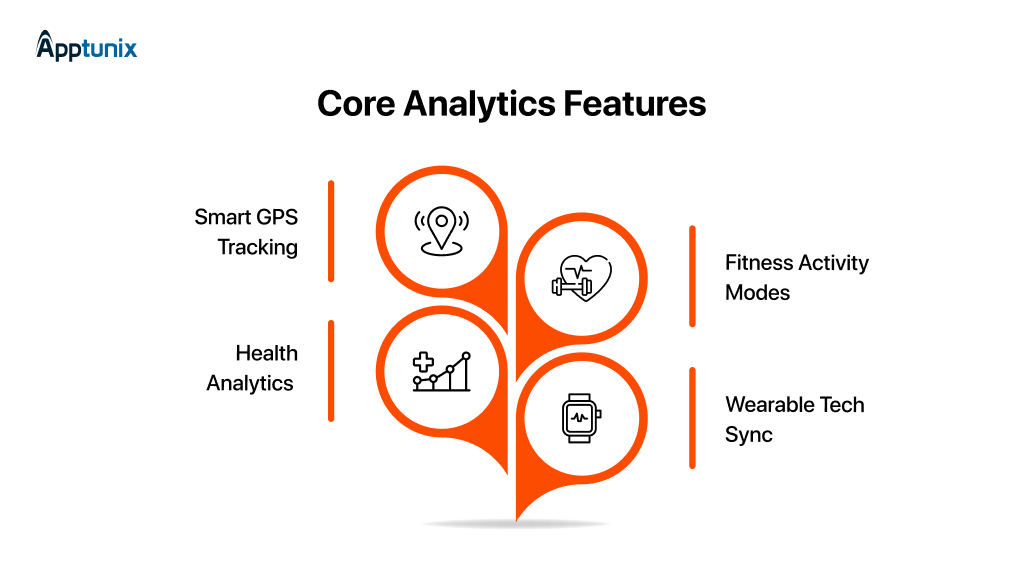
GPS tracking is the centerpiece of your Strava-like fitness app. It must be accurate, always. A few metres off might not sound serious, but fitness users notice.
Different activity modes allow users to track workouts the right way. Each mode needs its own metrics. With them, the app feels personal, not generic.
Health data turns workouts into insights. When users see improvement from the app clearly, motivation increases. That’s what keeps daily active users excited.
Most fitness app users already own a smartwatch or band. If your app doesn’t sync with wearables, it feels outdated. So smart wearable syncing should also be a part of your Strava-like app.
Social interaction keeps fitness apps exciting and motivating. These Strava app features for fitness applications turn workouts into a social experience.
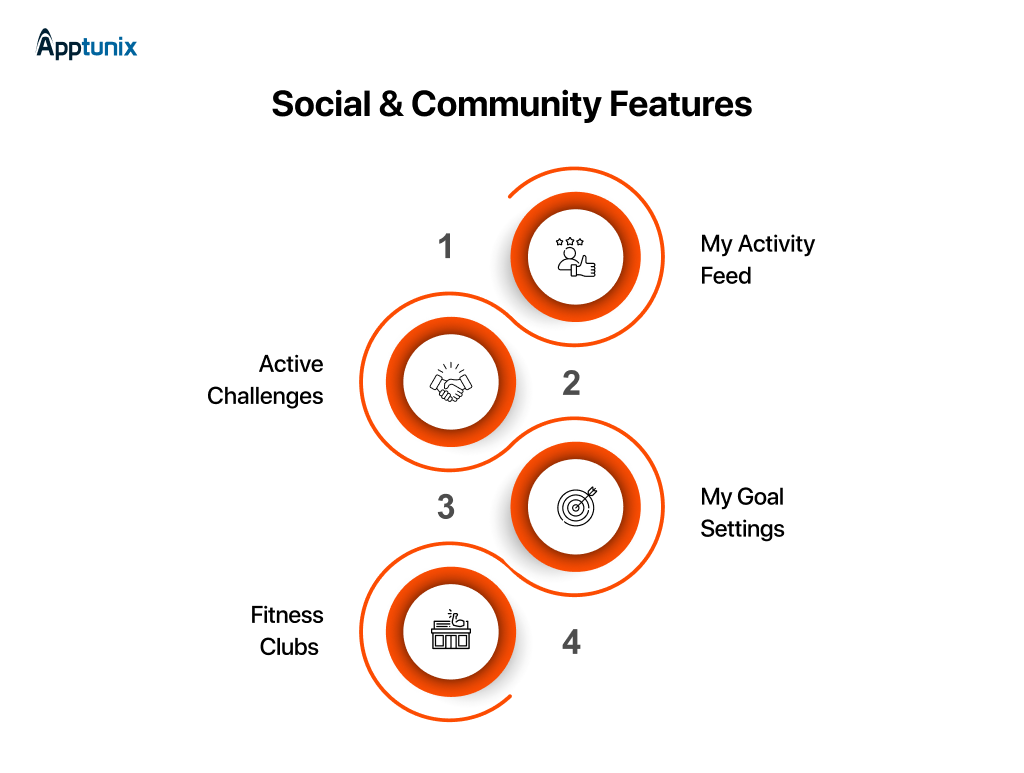
The activity feed is where engagement lives. Users want to see what they did and what others are doing. It turns solo workouts into shared moments. When users scroll and react, they stay longer.
Challenges push people when motivation drops. They work because they create urgency. That pressure is healthy in fitness apps. It keeps people moving even on lazy days.
Goals make progress feel real. Without them, workouts feel random. Let users set clear targets. When goals are visible, users stay focused.
Fitness is more fun in groups. Clubs bring community into the app. Users join based on interests or location, share the results, and encourage each other, which builds loyalty.
Users expect more than basic tracking today. Advanced Strava app features make workouts smarter and social. Let’s explore the advanced features your Strava-like app must have.
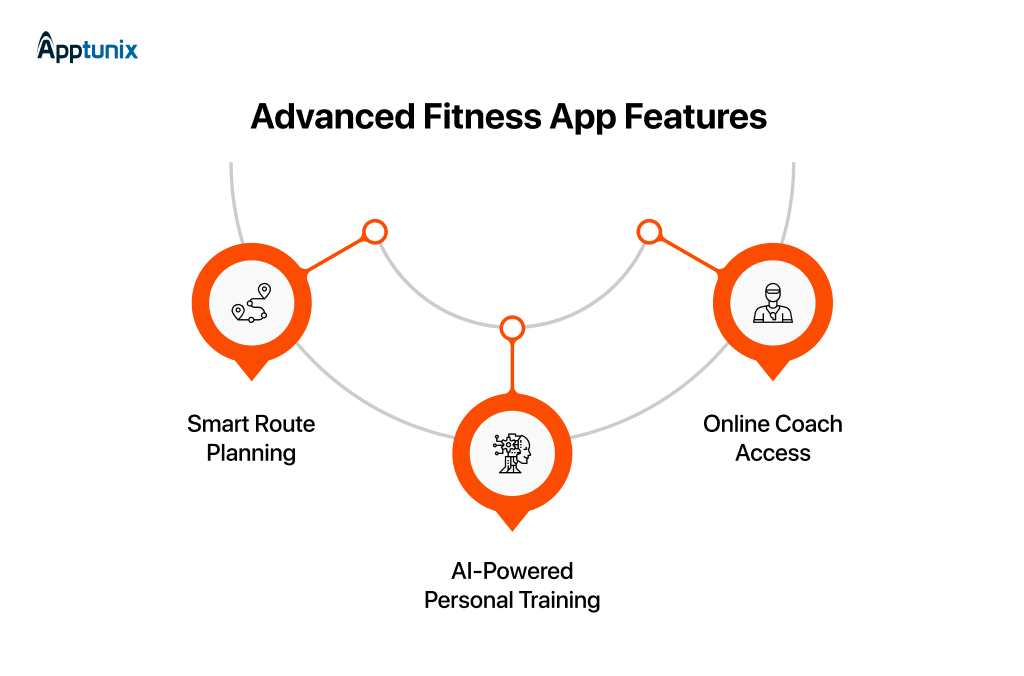
Users want routes that match their goals, like flat paths for recovery runs, hills for strength, and low-traffic areas for safety. When the app suggests better routes, users trust it more. That trust keeps them coming back instead of switching apps.
Personal training that adapts to performance helps keep workouts challenging but doable. With AI-powered personal recommendations keep coming in the app, the user will click it to make their workout more challenging.
Some users want human guidance, especially the beginners. Access to online coaches fills that gap. It offers feedback, corrections, and motivation. It makes the app feel serious about results, not just tracking data.
To create a fitness app like Strava, it takes more than solid code. It takes judgement, knowing what to build first, what to delay, and what actually matters to users once the app is live. That’s where Apptunix, the leading fitness app development company, brings real value.
Apptunix doesn’t start with features. We start with use cases. That approach keeps development focused and budgets realistic.
Every build decision is tied to impact. Apptunix helps founders control the Strava app development cost without cutting corners that can damage it later.
Apptunix knows fitness apps inside out, from precise GPS tracking to smart subscription models. It’s not just about getting the app live but keeping it fast, reliable, and built for the long term.
Timelines are realistic. Trade-offs are explained. You always know what’s being built and why. That clarity matters when money and time are on the line.
Apptunix perfectly balances with technology, timelines, and business goals so your fitness app launches with purpose and scales with confidence. The result is a Strava-like app built to perform, adapt, and win user trust from day one.
Let’s Build Your Dream Fitness App
Q 1.How Much Does it Cost to Develop an App Like Strava?
The cost to develop a fitness app like Strava ranges from USD $15,000 to $150,000. Various factors impact the Strava-like app development cost, like feature complexity, frontend, backend, UX/UI design, and ongoing maintenance.
Q 2.How Do Apps Like Strava Make Money?
Apps like Strava mainly earn through premium subscriptions that unlock advanced analytics and training insights. They also make money from brand partnerships, sponsored challenges, and anonymized data insights shared with urban planners and organizations.
Q 3.How to Develop a Fitness App Like Strava?
There are 7 steps that you need to follow one by one, because every step is essential:
Step 1: Research and planning
Step 2: App tech stack
Step 3: UX/UI design
Step 4: App development
Step 5: Testing and Q&A
Step 6: Launching the app
Step 7: Maintenance & support
Q 4.How Much Time Does it Take to Make an App Like Strava?
The basic app development timeline is from 2 to 3 months, the medium-complex app development timeline is from 3 to 5 months, and the advanced/enterprise strava-like app timeline is from 5 to 9 months.
Q 5.How Much Does it Cost to Make an MVP App Like Strava?
The MVP (minimum viable product) Strava-like app development can cost you around USD $15,000 to $60,000+ with core features and functionality. However, the final cost depends on app complexity, platform choice, integrations, and customization requirements.
Q 6.How Can Apptunix Help You Create a Fitness App?
Apptunix helps you turn your fitness app idea into a powerful, user-friendly product. Our team manages everything from strategy and UI/UX to development, testing, and launch. We build scalable fitness apps with smart features tailored to your business goals.
Get the weekly updates on the newest brand stories, business models and technology right in your inbox.
Reena Bhagat, the CTO and Head of AI at Apptunix, is a seasoned technology strategist with a deep-rooted expertise in emerging technologies. With a focus on AI/ML integration, product engineering, cloud management, she leads the technical vision for high-performance SaaS infrastructures. Reena is recognized for building secure, scalable, and decentralized systems that solve real-world complexities. Her passion lies in leveraging data science and future-tech to create resilient digital products, making her a trusted authority for organizations looking to lead in the age of intelligent automation.
Book your consultation with us.
Book your consultation with us.


One Central, The offices 3, Level 3, DWTC, Sheikh Zayed Road, Dubai
+971 50 782 1690