Hardeep Singh is a seasoned B2B technical writer at Apptunix with a sharp eye for strategy and a mind wired for innovation. With over a decade of experience in technical and SEO writing, and a Master’s degree in Wireless Communication, he’s written across domains including AI, Blockchain, IoT, Cybersecurity, and beyond. At Apptunix, Hardeep drives content that bridges business goals with future-ready mobile and web solutions, thus helping startups and enterprises make smarter digital decisions.
1263 Views|9 mins | March 20, 2026
Read Time: 9 mins | March 20, 2026
Share this article
Quick Summary:
Marketplace app development involves creating a multi-vendor platform (e.g., Etsy, Uber) that connects buyers and sellers through specialized apps or web interfaces, featuring secure payments, vendor dashboards, and admin panels.
Success requires defining a niche, selecting a monetization model (commissions, subscriptions), and prioritizing MVP features like search and user profiles.
Key Steps in Marketplace App Development
Step 1: Choose the Type of Marketplace
Step 2: Outline Your Marketplace App Development
Step 3: Decide on the Monetization Model
Step 4: Choose a Reliable Online Marketplace App Development Company
Step 5: Design User Experience of Marketplace
Step 6: Start with Marketplace App Development
Step 7: Test and Resolve
Step 8: Launch Your Marketplace
Core Features of a Marketplace App
User/Vendor Profiles: Distinctive, secure profiles for both parties.
Search & Filters: Advanced filters for products/services (price, category, ratings).
Dashboard: Seller-centric dashboards to manage listings, track sales, and access analytics.
Payment Integration: Secure, multiple payment options including wallets, cards, and UPI.
Ratings & Reviews: Fosters trust and transparency.
Messaging System: Direct communication between buyers and sellers.
Estimated Development Costs
Basic MVP: $20,000 – $40,000.
Advanced Features: $40,000 – $100,000 or higher, depending on complexity.
Key Success Metrics
User Engagement: Active users, conversion rates, and app session length.
Transaction Volume: Number of orders and total sales value.
User Feedback: App ratings and reviews to drive improvements.
Architecture: Microservices are recommended for scalability, although monoliths may suit early-stage startups.
With 23% of retail purchases expected to take place online, and eCommerce sales expected to reach $7.9 trillion by 2027, accessing how to build a marketplace app seems like a money-making proposition.
However, with big mammoths like Amazon, Airbnb, eBay and Alibaba dominating the landscape, businesses may be at unease to test the water. Thankfully, there are several niches that still have rooms, with new opportunities knocking every now and then.
If you are preparing to kickstart your own marketplace app development project, this piece of information will assist you in creating a marketplace that succeeds. As an online marketplace app development company with myriad successful apps under our hat, we can assure you that it’s financially rewarding if you choose the right team to do the job.
Let’s jump right into it to help you make the most out of it!
What is an Online Marketplace?
An online marketplace is a type of ecommerce website or an app that offers products or services by third-party providers. In layman’s terms, the marketplace owner doesn’t necessarily store or sell physical inventory, indeed, they present other sellers products and services and handle the transactions.
To your surprise, a study by Think with Google stated 84% of people purchase something in any given 48 hours accompanied with 63% shopping done online. This unearths the treasure trove and underlines the fact “why a brand must have a strong online presence”.
When talking about a marketplace, you must have heard words like peer-to-peer, vertical and horizontal or B2B marketplace app development. As for now, we want to spill the beans about different types of online marketplaces.
Categories of Online Marketplaces
Primarily, there are four facets of online marketplaces:
Vertical Marketplace
This online marketplace sells one kind of product or services from several different sources. Udemy exclusive boutique of services from modules, languages to courses curates it as an example of a vertical marketplace. These types of websites offer a range of solutions that cater to well-defined users or customers with similar needs.
Horizontal Marketplace
“Horizontal” as the name suggests sells different products or services with similar characteristics. Etsy is an example of a horizontal marketplace primarily selling handmade products.
Global Marketplace
This marketplace not just sells goods but simultaneously facilitates trades and exchange of services, like Craiglist. Often, customers are attracted to these marketplaces because of the easy access they get to a variety of products, information or services in a hassle-free manner.
Service-based Marketplace
This marketplace extensively sells services rather than products. Freelancer, Care.com are some of the examples of service-based marketplaces offering services varying from design, writing, household chores etc.
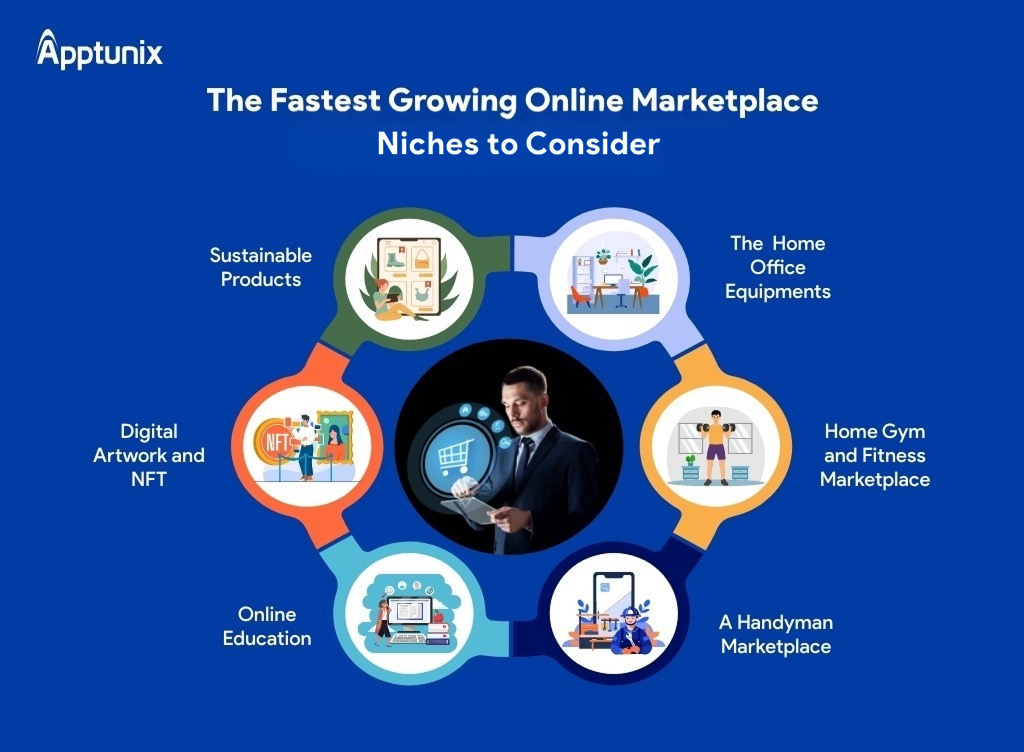
The Fastest Growing Online Marketplace Niches to Consider in 2026
With industry big names like Amazon, Flipkart and eBay dominating the lion’s share, it may seem onerous to penetrate the market. However, there are a handful of emerging niches for online marketplace app development.
Sustainable Products
With climate change reaching an alarming level, more and more people are inclining towards environmentally conscious and eco-friendly products. Though, the diversity in product is pretty huge, consisting of sustainable clothes, reusable straws, biodegradable garbage bags, glass bottles, etc.
So, considering this segment for your horizontal online marketplace app development, definitely marks it as a groundbreaking idea.
Digital Artwork & NFT
The NFT (Non-Fungible Token) market is rapidly growing, with projections expected to reach $342.54 billion by the end of 2032. This focuses on the fact that the digital art industry is gaining momentum and recognition, therefore making an NFT online marketplace a rewarding investment with minimal competition.
Online Education
Nowadays, the conventional way of educating is fading away.
Online education is the new buzz allowing people to access knowledge easier, quicker and in a pocket-friendly manner. Therefore, considering all these parameters make it an ideal choice for startups and entrepreneurs alike as it caters a huge market base from toddlers to learning aficionados.
A Handyman Marketplace
Chop Chop the complex process of going through agencies and paying hefty amounts for finding and hiring a reliable professional. Address this pain point with a handyman marketplace app that lets people offer their services and find gigs in a hassle-free way.
Home Gym & Fitness Marketplace
There’s no denying pandemic has revolutionized the way people work and workout. With a huge percentage of people working from home, it’s directly relatable that they buy fitness gadgets and equipment at home to stay healthy.
This trend in the market witnessed and overlaps $16.5 billion revenue last year defining a CAGR of 10.1% growth by 2027. If you are at square one, this is the time to jump on the bandwagon and cement your footprints.
The Home Office Equipment
During the peak of the epidemic, many people opted for WFH (Work From Home), and even in the present scenario, more than half of them prefer working from home on the grounds of a pay cut. Thus, the home office equipment market proves to be a dark horse and launching a marketplace app catering to the niche would be profitable.
How to Build a Marketplace App From Scratch?
We at Apptunix understand the challenges of creating an online marketplace platform, especially if it’s built from scratch. Herein, we are not just sharing you a tutorial on how and what to consider in the marketplace app development process, but the core objective is to help you plan in terms of development time, tech stack and developers skills.
Step 1: Choose the Type of Marketplace
First and foremost, picking the type of marketplace holds the utmost importance when catering your specific audience. Therefore, identify and categorize the right marketplace platforms to attract your target audience and create an app that bridges the gap left unaddressed.
Refer to the below table for different types of online marketplace:
Step 2: Outline Your Marketplace App Development
Next, outline the key consideration to develop successful marketplace app. It includes careful consideration of several aspects, from defining your target audience and choosing the right type of marketplace scalable business model to crafting the user experience and establishing key features.
The key features your app must have include user profiles, product listings, search option, rating and review, and a safe payment method, ensuring your online marketplace app stands out from the crowd.
Step 3: Decide on the Monetization Model
The inescapable is deciding on monetary strategies, especially when the focus is on earning passive income from online marketplace apps. Therefore, to get the maximum ROI (Return On Investment) on B2B marketplace app development, pick the best scalable monetization models from the below table that suits your business as well as audience requirements.
Therefore, considering the business and target audience requirements, you can choose your monetization model. Make sure to choose the right monetization model for maximum as well as quick ROI (Return On Investment).
Step 4: Choose a Reliable Online Marketplace App Development Company
Now that you are all set to bring your groundbreaking marketplace application development idea to life, it’s time to access and partner with a trusted marketplace app development services provider. This pivotal step marks the initiation of bringing concepts to creation, where you’ll further collaborate with development teams who understand your vision.
Imagine having a dedicated development team who not just understand the complexity of online marketplace app development but also value your efforts. Apptunix is a reputed marketplace app development company with a track record of delivering successful projects, ranging from creating online marketplaces to innovating with AI and crafting immersive experiences. Their dedicated team dwells with bespoke experience in languages, tools and frameworks, articulating technical concepts seamlessly.
Whether you believe it or not, designing the visual aspect of your B2B marketplace app development to attract and engage the audience, especially, if you are planning to develop a multi-vendor marketplace app.
So, let your partner app development company share the accountability of aesthetics and functionality offering an experience that is personalized and effortless. Besides, BA starts by analyzing the required functionalities and understanding the objectives and needs of the target audience. Next, they outline wireframes that offer a visual representation of the app’s interface.
Once wireframes are approved, a prototype is created. Further, the design team works on creating the UI/UX of the marketplace app with a user interface that anticipates user needs and streamlines their journey of your marketplace app.
Keep a Note – User Experience is not limited to the screen – rather, it’s an emotional journey. So, it’s important to infuse every interaction with purpose and clarity, from the first impression to the final action.
Step 6: Start with Marketplace App Development
Now that you have picked up a development company, without gushing any more moment start coding for features and functionalities of your marketplace application. Also, ensure your marketplace app development team is well-versed with backend and front-end development as it serves as the foundation for seamless operations.
Here are the functions of backend and frontend development in the online app marketplace development.
Collectively, backend and frontend development collaborate to develop an online marketplace app that caters the needs of both sellers and customers, offering a smooth experience.
Throughout the development cycle, your partner development team ensures to create a marketplace platform using the best coding practices that is easily scalable to address the future requirements. Also, an experienced development company keeps the communication transparent, provides regular updates and ensures the app is aligned with the goals.
Step 7: Test and Resolve
The most crucial element in the complete marketplace app development process is testing and debugging.
To assure the app functions precisely, caters to the needed requirements and offers a flawless user experience carrying testing and debugging is inescapable. Here, the QA team comes into the picture crafting a comprehensive testing strategy with best-in-class development practices.
They carry thorough examinations reviewing code compliance and identifying potential red flags across devices. From functionality to performance, the QA team deployed various testing methods, encompassing unit, functional, performance, security, compatibility, usability, and finally user acceptance testing.
Step 8: Launch Your Marketplace
Finally, your marketplace app is all set for roll-out.
Once again your development team will initiate the deployment across several online platforms, customized to your specifications. However, prior to launch, adhering to the app’s store guidelines and prerequisites is crucial.
Whether you are planning to launch your marketplace app on the Apple Store or Google Play store, it’s a must for an eCommerce mobile app builder to navigate the deployment process for your marketplace app. Also consider, the approval time bracket is from 2 days to 5 business days for Apple stores whereas it can extend to 7 days in case of Google play store.
Final Verdict
Evaluating how to build a marketplace app might seem tricky at first for startups and SMBs. Thankfully, with the right marketplace app development company, tech stack and best development practices like MVP, you can deliver a groundbreaking product without having a burning hole in your pocket.
After all, the industry is growing at an exceptional pace opening up new opportunities for entrepreneurs. So it’s time to bring the ball in your court and develop your own online marketplace app like NAMSHI, Amber, and many more.
Experts at Apptunix are all ears to share your ideas while sipping coffee, so why wait? Get in touch now and bring your idea to life.
Frequently Asked Questions(FAQs)
Q 1.What is marketplace app development?
Marketplace app development is the process of building a digital platform where multiple sellers and buyers can connect, list products or services, and complete transactions. A well-planned marketplace application development project includes UI design, backend development, payment integration, an admin panel, and security setup. Businesses invest in marketplace platform development to create apps similar to Amazon, Uber, Airbnb, or Fiverr.
Q 2.How much does it cost to develop a marketplace app?
The cost to develop a marketplace app depends on features, platform, and complexity. A basic marketplace app development cost may start from $20,000, while advanced marketplace platform development can go beyond $150,000. Factors that affect marketplace app development cost include design, payment gateway, real-time chat, admin dashboard, cloud hosting, and third-party integrations.
Q 3.How long does it take to build a marketplace app?
The time required to build a marketplace app usually ranges from 3 to 9+ months. A simple marketplace application development project takes less time, while a custom marketplace platform development with AI, analytics, and automation takes longer. Timeline also depends on team size, features, and testing requirements.
Q 4.What features are required to create a marketplace app?
To create a marketplace app, you need a buyer panel, a seller panel, an admin dashboard, secure login, a payment gateway, product listing, order management, and notifications. Advanced marketplace app development also includes AI recommendations, live tracking, chat, reviews, and multi-language support. These features help in building a scalable marketplace platform development solution.
Q 5.What is the best technology for marketplace app development?
The best technology for marketplace app development depends on your business goals. Many companies use Flutter or React Native for the frontend and Node.js or Python for the backend. Cloud platforms like AWS and Google Cloud are common for marketplace platform development because they support high traffic and fast performance.
Q 6.How do I start marketplace platform development for my business?
To start marketplace platform development, first define your business model, target audience, and revenue strategy. After that, plan features, choose technology, and hire a marketplace app development company. A professional team helps you create a marketplace app that is secure, scalable, and ready for global users.
Q 7.Why should businesses invest in marketplace application development?
Businesses invest in marketplace application development because marketplace platforms generate revenue from commissions, subscriptions, and ads. A well-built marketplace app also grows faster than a single-vendor app. Marketplace platform development helps startups and enterprises build scalable digital businesses with long-term profit potential.
Q 8.What factors affect marketplace app development cost the most?
Marketplace app development cost mainly depends on app complexity, number of features, supported platforms, and integrations. Custom design, AI features, payment systems, and real-time tracking can increase the cost to develop a marketplace app. Choosing experienced developers for marketplace platform development also affects the final budget.
Q 9.Can I develop a marketplace app for Android and iOS together?
Yes, you can develop a marketplace app for both Android and iOS using cross-platform technologies. Many companies prefer this approach in marketplace application development because it reduces cost and development time. Cross-platform marketplace app development also makes maintenance easier.
Q 10.How do marketplace apps make money after development?
After marketplace app development, apps earn money through commission fees, listing charges, subscriptions, ads, and premium features. A strong marketplace platform development strategy includes multiple revenue models. This helps businesses recover development costs faster and grow the platform globally.
Rate this article!
Join 60,000+ Subscribers
Get the weekly updates on the newest brand stories, business models and technology right in your inbox.
Hardeep Singh
Hardeep Singh is a seasoned B2B technical writer at Apptunix with a sharp eye for strategy and a mind wired for innovation. With over a decade of experience in technical and SEO writing, and a Master’s degree in Wireless Communication, he’s written across domains including AI, Blockchain, IoT, Cybersecurity, and beyond. At Apptunix, Hardeep drives content that bridges business goals with future-ready mobile and web solutions, thus helping startups and enterprises make smarter digital decisions.
Related Posts
Generative AI Software Development: Benefits, Possibilities, and Cost Involved
1234 Views9 minFebruary 18, 2026
How to Build a Grubhub Clone App? Readymade vs Custom Solutions
976 Views9 minNovember 19, 2025
Comprehensive Guide to Develop an Enterprise Software in 2026
1793 Views9 minNovember 13, 2025
Partner with tech catalysts who transform ideas into impact.
Book your consultation with us.
Let’s Talk!
Partner with tech catalysts who transform ideas into impact.
Book your consultation with us.
Let’s Talk!
Speak With Our Experts
UNITED ARAB EMIRATES
One Central, The offices 3, Level 3, DWTC, Sheikh Zayed Road, Dubai
Ready to Transform Your Ideas into Enterprise Grade Digital Solutions?
Get a quick expert response in under 5 minutes.
I worked with Apptunix on both retail and logistics projects. The experience was truly amazing. Their strong ethics, professional communication, and high-quality delivery make them stand out. I highly recommend them.
Meshari ALMaqhawi
Founder & CEO - Logibids
Apptunix has shown commendable dedication to my project. The delivery got pushed back a bit due to COVID but they worked continuously in those circumstances. I appreciate all your efforts and hard work. Thanks!
Marco Perez
Co-Founder - Bancreach
Apptunix delivered two fully integrated, enterprise-grade applications for our healing and social platform. Their proactive engineering, rigorous QA, and ability to refine complex, evolving features made them a highly reliable product partner.
Jocelyn Pettitt
CEO - HiViibe
Apptunix transformed Finco by streamlining property community workflows—fixing inefficient violation management, communication gaps, and manual processes through a tailored, scalable platform with outstanding engineering and long-term partnership.
Rich Suchevits
Founder & CEO - Finco
You may share your requirements at sales@apptunix.com, and our team will get back to you right away.
Still exploring? Let us help
AI Engineering Expertise drives 3X faster execution and stronger enterprise ROI.
Apptunix demonstrated strong technical expertise, transparent communication, and consistently high-caliber delivery — a trusted development partner I confidently recommend.
Meshari ALMaqhawi
Founder & CEO - Logibids
Despite COVID delays, Apptunix maintained seamless delivery cycles with zero quality compromise — an exceptionally reliable engineering partner I strongly recommend.
Marco Perez
Co-Founder - Bancreach
Apptunix re-architected infrastructure—optimizing workflows, scaling the platform, and delivering strong engineering depth as a trusted partner.
Rich Suchevits
Founder & CEO - Finco
Apptunix engineered a robust, enterprise-grade application with rigorous QA, scalable architecture, and precise execution — highly recommended for any build.
Jocelyn Pettitt
CEO - HiViibe
You may share your requirements at sales@apptunix.com, and our team will get back to you right away.
Trusted Enterprise Technology Partner - Since 2013
Build Faster. Modernize Smarter. Save Up to 40%*
Offer Ends Soon
30-Minute Strategy Session with Our Enterprise Experts
Confidential Consultation • Mutual NDA • No Obligation
Turn Your Vision into an Enterprise Digital Solution
Get a quick expert response in under 5 minutes.
Almost There, You’re One Step Away From an Engineered Digital Solution
2500+
Empowered Clients
13+
Years of Experience
25+
Countries Served
300+
AI-Expert Engineers
Recognized for Excellence in Enterprise Digital Transformation
Appfutura
GoodFirms
Clutch
ITFirms
Business Awards 2025
TopDevelopers
You may share your requirements at sales@apptunix.com, and our team will get back to you right away.
Digital Transformation Eguide — Apptunix
Thank You for Your Submission.
Your e-guide has been sent to your email address. One of our senior consultant will be in touch with you shortly.