AI Compliance Automation: How AI Is Transforming Regulatory Compliance
36 Views 11 min October 13, 2026

Reena Bhagat is a seasoned technology strategist with a deep-rooted expertise in emerging technologies. She began as an engineer in Android and React Native, moved into Delivery Manager and Program Manager roles, and now leads AI at Apptunix, setting the technical vision for high-performance SaaS infrastructure across AI and ML integration, product engineering, and cloud management. Her programs land on time, within scope, and aligned with strategic objectives, and the systems behind them are secure, scalable, and decentralized.
Let’s imagine a real-life scenario where a customer asks your business a question at midnight. However, due to the unavailability of customer service, you’re not replying at the moment, which increases the chance of losing the customer, since many customers can’t wait until the morning.
But today, businesses use AI agents that can instantly understand the request, check inventory, process the order, and update CRM. Yes, everything without human intervention.
This is not the future; forward-thinking businesses have already started implementing agentic AI to provide seamless services to their customers 24×7. This is just one example. AI agents can reason, plan, use digital tools, and execute multi-step workflows with minimal human interference.
In fact, McKinsey and Company stated that 88% of businesses now use artificial intelligence in at least one business function. This highlights how quickly intelligent automation is becoming mainstream for businesses across industries.
However, you must choose a goal-based agent that your business requires. To pick the right option, you’re supposed to explore types of AI agents based on operations, customer support, or decision-making. Your decision influences efficiency and ROI.
To help you choose the right type, consider learning how AI agents work, their different types, their business applications, and how to pick the best AI agent for your business.
Explore this detailed guide to understand everything about them. Let’s get started by knowing what exactly AI agents are:
AI agents are intelligent software systems that understand information, make the right decisions, and take actions to achieve an important goal with very little or no human intervention.
They’re not like traditional software that follows fixed rules. They analyze data, adapt to changing situations, and learn from interactions to improve their performance over time.
Basically, AI agents use technologies like machine learning (ML), large language models (LLMs), and natural language processing (NLP). These technologies help AI agents to understand requests, plan tasks, and execute them seamlessly.
Understand this with an example of an AI customer support agent that can answer queries, retrieve account information, escalate complex issues, and schedule follow-ups automatically.
In simple terms, AI agents are like digital teammates that help businesses automate workflows, improve productivity, and deliver data-driven and smarter customer experiences.
Let’s now understand how such technologies work.
By following an ongoing cycle of understanding, reasoning, acting, and learning, these agents work toward a specific goal. It all begins with gathering information from their surroundings; things like user inputs, databases, sensors, or connected applications.
They later start analyzing the data using AI models to determine the best course of action. Basically, these agents powered by AI answer a customer’s question, automate a workflow, generate a report, or trigger another system through APIs based on the task as well.
When the work is done, they evaluate the outcome and use feedback to improve future decisions.
AI agents don’t rely on fixed rules like traditional AI software; instead, they adapt to changing situations. This makes them suitable for dynamic business environments.
The technology’s ability powers different types of AI agents, including advanced learning, simple rule-based systems, and autonomous agents. This capability leads the system to handle complex workflows with minimal human intervention.
Here’s a simplified workflow:
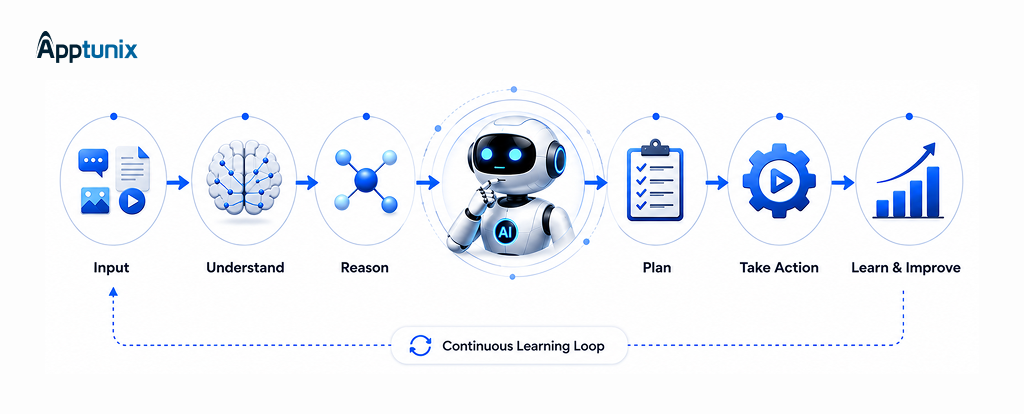
Input → Understand → Reason → Plan → Take Action → Learn & Improve
So this is how AI agents work; now, come to the main question: how many types of AI agents are there? Let’s find out.
Not every agent works the same way. Depending on the job, you need a different type.
Some tasks are simple and repeat over and over, like answering a common question. A basic system can easily manage that. But other tasks are trickier. They change over time and need a system that can learn from what’s happened before and adjust as things shift.
So how do you pick the right one? Just ask yourself three questions. How much thinking does this task really need? How complex is your current process? And what result are you actually trying to get for your business?
There are five basic types you’ll usually come across. One reacts right away to what’s happening. Another remembers things about its surroundings before acting. A third works toward a clear goal. A fourth compares different options and picks the best one. And the last type gets better over time by learning from experience.
Here’s a simple look at what each one actually does:
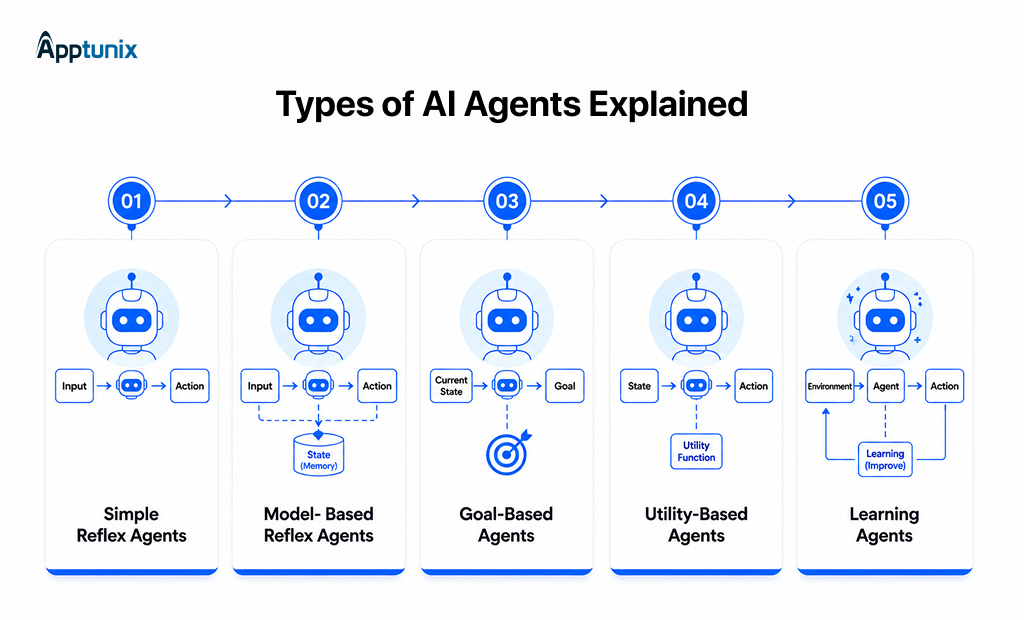
1:Simple Reflex AgentsOut of all five agents, simple reflex agents are the most basic because they make decisions based only on current information. Such an agent type is predefined with if-then rules and doesn’t remember past interactions or consider future outcomes. A simple reflex agent works best in predictable environments where the same conditions produce the same results.
2:Model-Based Reflex AgentsModel-based reflex agents are very different from simplex reflex agents since they maintain an internal model of their environment. The best thing about model-based agents is that they can remember previous information and make better decisions even when they don’t have complete data. This model continuously updates their understanding as new information becomes available.
3:Goal-Based AgentsAs one of the popular AI agents, the goal-based system makes decisions by evaluating different actions and choosing the best one that helps in achieving a specific objective. Such an agent plans and picks the most effective path toward a defined goal instead of simply reacting to inputs. Meanwhile, goal-based agents adapt their actions when conditions change, focusing on achieving the desired outcome.
4:Utility-Based AgentsUtility-based agents are one of the best types of AI agents that go a step further by measuring the value or utility of different outcomes before making a decision. This agent compares multiple options and chooses the one that delivers the highest overall benefit based on predefined priorities. They’re ideal for situations where multiple factors like time cost, risk, or customer satisfaction must be balanced before taking action.
5:Learning AgentsLearning agents continuously improve performance through experience and feedback. As the most advanced AI agent type, they analyze new data, identify patterns, and refine their decisions over time instead of relying only on predefined rules. Their ability makes them ideal for environments where user behaviour and business requirements evolve.
In recent years, advancements in large language models (LLMs) have also introduced modern architectures like LLM agents and multi-agent systems, which are transforming how businesses automate complex tasks.
So these were the five main types of AI agents in 2026. However, in recent years, with the advancements in large language models (LLMs), modern architectures like LLM agents and multi-agent systems have been introduced. Let’s understand these in the next section.
Also Read: Top 20 AI Agent Business Ideas for 2026
The five classical AI agent types undoubtedly provide the foundation of artificial intelligence. However, applications today are powered by more advanced agent architectures. Modern AI agent solutions can reason, collaborate, and automate complex workflows across multiple systems. The three types of common modern AI agent architectures your business should consider are as follows:
Large language model agents run on advanced language models, giving them a real grasp of natural language. They reason through tasks, generate content, and tap external tools when needed. Traditional AI agents just follow fixed rules; LLM agents read intent instead, handling multi-step tasks with far more flexibility.
Multi-Agent Systems bring several AI agents together toward one shared goal instead of relying on a single agent to do it all. Each one owns a specific task, sharing information and staying coordinated with the others. For large, tangled business processes, this setup usually cuts down on bottlenecks.
Autonomous agents are built around one idea: minimal human involvement. The agent looks at the information it has, decides what to do, acts, checks the results, then adjusts based on feedback. Reasoning, planning, memory, and tool use work together underneath, letting it handle problems simpler systems can’t.
AI agents do more than automate repetitive tasks. They help businesses respond faster, work smarter, and make value-driven decisions. Here are the key benefits of AI agents in 2026:
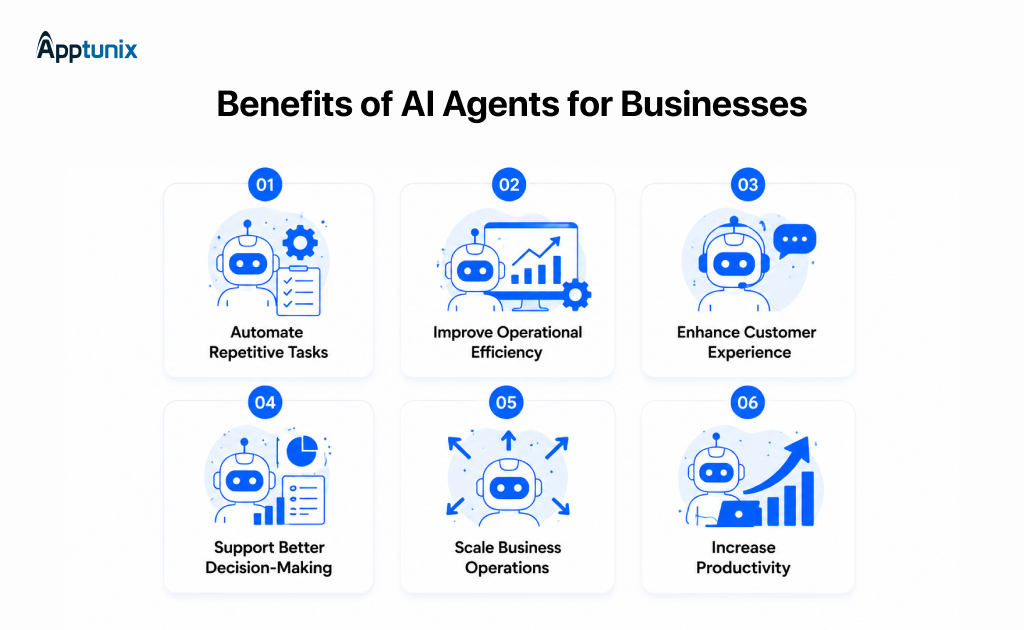
Business AI agents can easily handle routine tasks like customer queries, processing invoices, scheduling meetings, and managing workflows. The system allows employees to focus on strategic work by reducing manual effort.
AI agents improve operational efficiency by analyzing data and executing in real-time. They streamline business processes, minimize delays, and reduce human errors, leading to faster and more efficient operations.
With an agentic AI system, businesses can get 24/7 support, deliver personalized responses, and resolve customer issues quickly and efficiently. This helps businesses reduce customer wait times, reduce support costs, and improve overall customer satisfaction.
Decisions make or break a business, so AI agents work aggressively to make the right ones. They can process large volumes of data, identify trends, and generate actionable insights, enabling businesses to make faster and data-driven decisions.
Business AI agents manage increasing workloads without demanding a proportional increase in staff. Basically, they make it easier for businesses to scale and control overall operational costs.
AI agents free up employees to focus on innovation, strategy, and high-value tasks by automating time-consuming tasks. This ultimately improves overall business productivity and accelerates business growth.
So this is how you get benefits from AI agents. However, you can’t experience benefits if you haven’t chosen the right agent based on your business goals and requirements. Well, let’s find out the tips and tricks to pick the right AI agent in the next section.
Picking the right AI agent is not about going with the most advanced solutions; it’s actually finding one that aligns with your business goals and operational needs. Once you choose the right AI agent, you can reduce costs, improve efficiency, and deliver measurable results. Here are the best ways of choosing an AI agent in 2026:
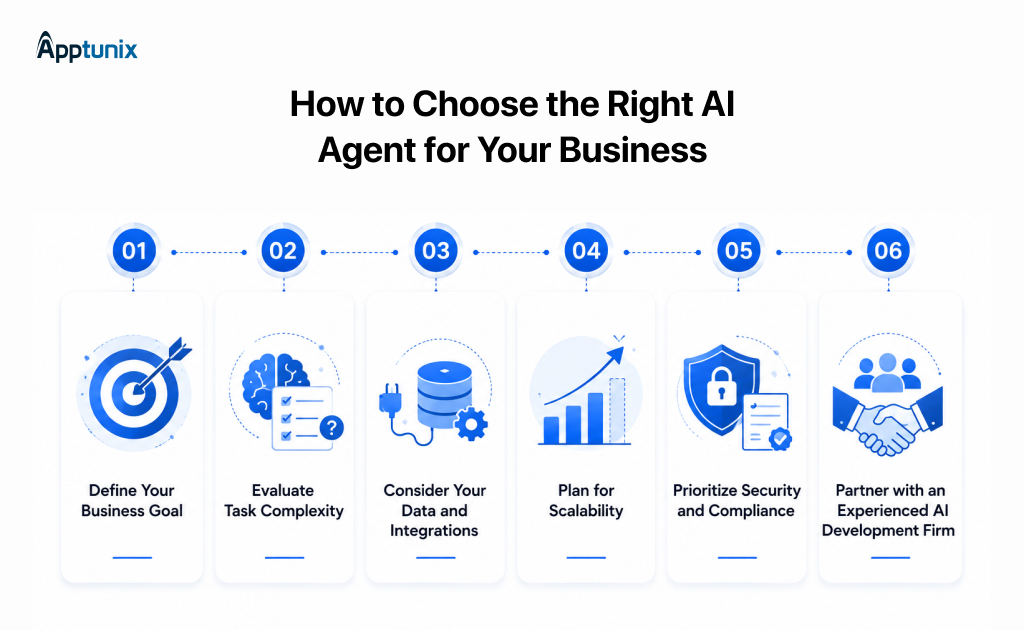
1:Define Your Business GoalFirst, identify the main problem you want to solve. Remember, whether it’s streamlining operations, automating customer support, increasing sales, or improving decision-making, your business objective must determine the type of AI agent you go with.
2:Evaluate Task ComplexityDecide whether your task is a bit simple or highly complex because simple or repetitive tasks can be handled by a simple rule-based AI agent. On the other hand, you require advanced LLM-powered solutions for complex workflows that require planning, reasoning, or learning.
3:Consider Your Data and IntegrationsChoose AI agents that consider data and integrations. An AI agent performs best when they have access to accurate data and can connect with your existing systems like ERPs, CRMs, databases, and third-party apps.
4:Plan for ScalabilityGo for an AI agent that can grow with your business. Your business must be able to handle more users, larger datasets, and complex workflows without compromising performance as your operations expand.
5:Prioritize Security and ComplianceIf your main concern is compliance and security because your business handles sensitive customer or financial data, then ensure the AI agent follows industry security standards. Pick one that complies with relevant regulations to protect your information.
6:Partner with an Experienced AI Development FirmIntegrating AI agents into your business demands the right strategy, technology, and expertise. You will get that when you work with an experienced AI development company that helps you choose, build, and deploy a solution tailored to your business needs, improving your ROI.
You have to understand one thing: there is no single best AI agent. Choose the one that suits your specific use case, business goals, and the level of intelligence and automation your workflow requires.
Your business process complexity decides whether you should choose a single agent or a multi-agent system.
A single-agent system is good for handling one well-defined task. On the other hand, a multi-agent AI system uses multiple agents that work together to solve complex obstacles. Based on your business goals, scalability needs, and operational requirements, you should pick the right architecture.
Here’s the table explaining key differences between a single-agent and multi-agent system in 2026:
The cost to build an AI agent ranges from $20,000 to $200,000, depending on AI agent use cases, complexity, features, integrations, AI models, and deployment requirements.
For example, a simple AI agent for customer support costs less than an enterprise-grade agent that can automate workflows and integrate with multiple business systems.
Examine the cost based on the complexity and agent type through the table:
You can start with an MVP solution for AI agents with core features and less development cost. A minimum viable product that is built to test an idea with real users and get feedback.
Now, before concluding this detailed guide on types of AI agents, explore the challenges you can face during the implementation of the system.
Well, there are some challenges that you might face while integrating AI agents into your business operations. Successful implementation requires careful planning. From data quality to system integration, understand the challenges to build an AI agent that can scale business for the long run.
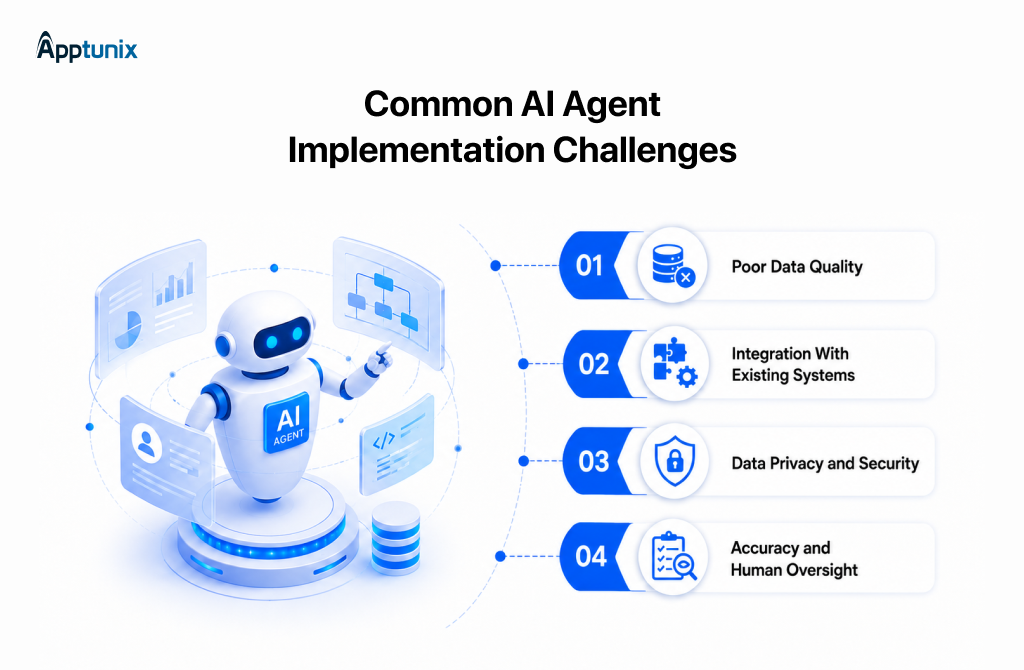
Business AI agents rely on authentic and relevant information to make more informed decisions. If they get incomplete, outdated, or inconsistent data, they can reduce performance and lead to unreliable outputs.
Businesses today use multiple platforms like ERPs, CRMs, and third-party apps. Incorporating an AI agent with these systems can be a bit complex, and it requires custom AI agent development services.
Some businesses also find it a little challenging to implement data privacy and security, and they can’t avoid this since AI agents process sensitive customer and business information. Integrating strong security measures and compliance with regulations helps businesses to protect data.
It’s a fact that AI agents are highly capable, even though they occasionally generate wrong responses or make mistakes by making poor decisions. Here, human oversight and regular monitoring help maintain accuracy and improve performance over time.
Successfully implementing an AI agent requires more than just choosing the right technology. It requires a clear strategy, seamless integration, and continuous improvement.
However, you will achieve that when you partner with a reliable AI agent development company like Apptunix.
With 13+ years of experience and thousands of clients worldwide, Apptunix helps businesses design, develop, and deploy custom AI agents that solve real-world challenges and deliver measurable results.
From workflow automation to enterprise-grade AI solutions, Apptunix develops scalable, secure, and future-ready systems tailored to your business needs and goals.
We have top AI developers who provide comprehensive support at every stage. So whether you explore your first AI initiative or scale existing operations with advanced AI capabilities, Apptunix is a flawless choice.
So what are you waiting for? Transform your business with advanced AI agents by partnering with a global leader and accelerate growth. Give your business a lasting competitive edge.
Q 1.What are the different types of AI agents?
The classic AI agent types in 2026 include simple reflex agents, model-based reflex agents, goal-based agents, utility-based agents, and learning agents. Apart from these, there are some modern AI agents like LLM agents, multi-agent systems, and autonomous AI agents for advanced business use.
Q 2.How are AI agents used in business?
AI agent use cases in businesses are for streamlining workflows, automating customer support, analyzing data, managing repetitive tasks, generating insights, improving decision-making, and optimizing operations. AI agents are widely used by industries such as finance, healthcare, logistics, and manufacturing to boost efficiency and reduce operating costs.
Q 3.What is the best AI agent for business?
Well, there is no single best AI agent for every business. The best is the one that suits your business goals and use case. For example, multi-agent systems are suited for enterprise automation and highly advanced workflows, and LLM agents are good for customer support and content generation.
Q 4.Can AI agents work without human intervention?
Absolutely, AI agents can perform tasks without or with minimal human intervention by analyzing data, making decisions, and executing actions. But in some cases, human oversight is recommended for complex, high-risk, or compliance-sensitive tasks to guarantee accuracy and security.
Get the weekly updates on the newest brand stories, business models and technology right in your inbox.
Reena Bhagat is a seasoned technology strategist with a deep-rooted expertise in emerging technologies. She began as an engineer in Android and React Native, moved into Delivery Manager and Program Manager roles, and now leads AI at Apptunix, setting the technical vision for high-performance SaaS infrastructure across AI and ML integration, product engineering, and cloud management. Her programs land on time, within scope, and aligned with strategic objectives, and the systems behind them are secure, scalable, and decentralized.
36 Views 11 min October 13, 2026
52 Views 11 min October 8, 2026
79 Views 11 min October 8, 2026
Book your consultation with us.
Book your consultation with us.


One Central, The offices 3, Level 3, DWTC, Sheikh Zayed Road, Dubai
+971 50 782 1690