
Cost to Build an App Like Eventbrite: Complete Development & Pricing Guide (2026)
12 Views 16 min September 16, 2026

Hardeep Singh is a seasoned B2B technical writer at Apptunix with a sharp eye for strategy and a mind wired for innovation. With over a decade of experience in technical and SEO writing, and a Master’s degree in Wireless Communication, he’s written across domains including AI, Blockchain, IoT, Cybersecurity, and beyond. At Apptunix, Hardeep drives content that bridges business goals with future-ready mobile and web solutions, thus helping startups and enterprises make smarter digital decisions.

AI agriculture app development leverages machine learning, computer vision, and IoT to optimize farming through automated pest detection, predictive crop analytics, and resource management.
These apps enhance productivity, reduce costs, and improve yield quality.
Key Features of AI Agricultural Apps
Development Process & Technologies
Imagine a farmer working under a scorching sun, checking soil moisture by hand, inspecting crops row by row, worrying about pests and the weather, and still not sure whether the harvest will pay off.
Now picture that same farmer using a simple AI agriculture app on a smartphone, getting alerts when the soil is too dry, early warnings of diseases, and suggestions on when to irrigate or fertilize.
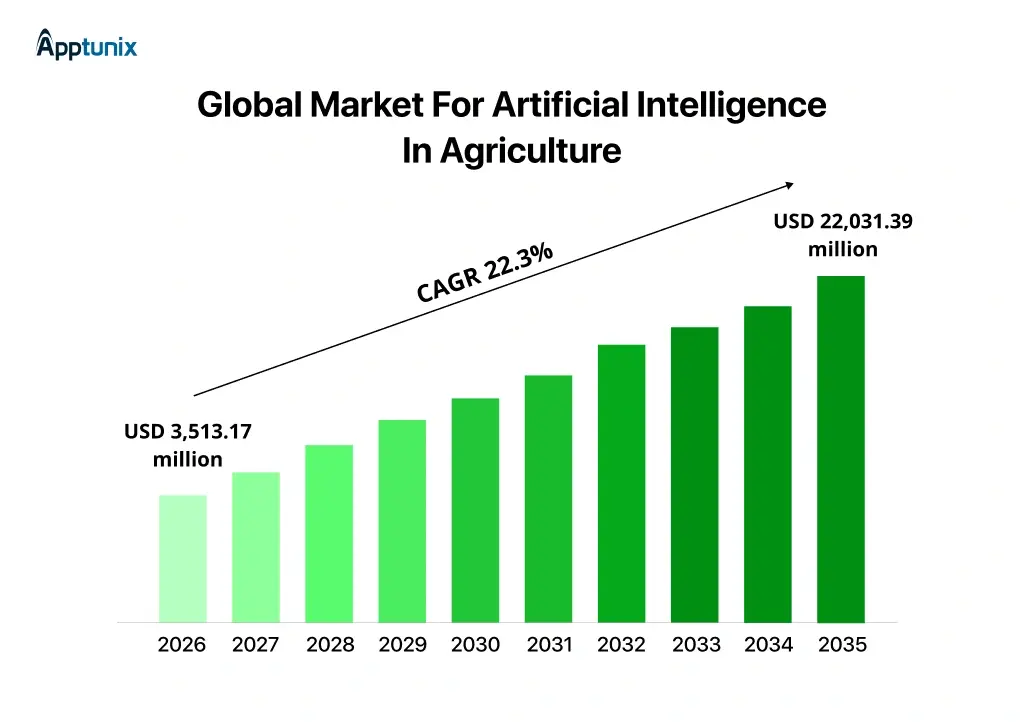
Well, that transformation is no longer a far-off dream. Technology is stepping into fields, and farming is changing fast. The global market for artificial intelligence in agriculture is growing at a remarkable pace. According to one recent forecast, the global Artificial Intelligence in Agriculture market is projected to grow from USD 3,513.17 million in 2026 to USD 22,031.39 million by 2035, at a compound annual growth rate (CAGR) of 22.3%.
Emerging economies and smallholder farms stand to gain a lot from this transformation. Many of these farms struggle with unpredictable weather, limited access to agronomy expertise, a lack of infrastructure, and scarce resources.
AI-powered agriculture mobile app development offers a way for such farmers to access high-quality predictive insights, soil health analytics, pest alerts, yield predictions, and more. And this all through a smartphone or low-cost device. This levels the playing field, reduces risks, and increases efficiency even for farmers working on small plots.
In this guide, you will see how agriculture mobile app development powered by AI can support farmers, agribusinesses, and other stakeholders. We will cover the AI agriculture app development process, trending features, and the cost to develop an AI agriculture app.
Apart from this, we will also read how agriculture apps can make money, what trends and real-world use cases are driving adoption, what challenges to expect, and how a professional agriculture app development company can help deliver tailored, impactful solutions.
So, if you’re interested in creating or adopting an AI agriculture solution, this guide will map the complete journey for you – from concept to field-ready application.
Agriculture app development has shifted far beyond simple farm record tools. Today’s digital agriculture platforms support farmers, agribusiness teams, and supply-chain partners through mobile apps, cloud dashboards, IoT sensors, and AI-powered insights. Farmers across developing and developed markets now depend on these tools to improve crop quality, reduce losses, and make decisions backed by real-time data.
But the question is, what really is agriculture app development?
Agriculture app development refers to the process of creating mobile and web solutions that help farmers manage day-to-day tasks. These apps support activities like field monitoring, crop planning, soil testing, irrigation scheduling, weather alerts, farm equipment management, and market access.
Modern agriculture mobile app development focuses on ease of use, offline access, local languages, and fast data capture. Farmers gain one place to store data, track farm activities, and plan ahead based on insights rather than guesswork. Businesses gain visibility into field-level operations.
AI agriculture app development builds on standard agricultural app features but adds intelligence and automation. An experienced AI development company develops smart agriculture solutions using machine learning models trained on crop images, soil datasets, satellite data, and weather patterns. These apps can detect pests early, measure crop health, suggest the right fertilizer mix, and predict yields with high accuracy.
The application of artificial intelligence in agriculture creates a strong foundation for better crop decisions and healthier fields. AI agriculture software development also covers livestock management, greenhouse automation, farm inventory tracking, and supply chain traceability, helping farmers improve productivity and operational efficiency.
Understanding a few common terms helps simplify the topic.
AI use cases in agriculture continue to expand every year. Some of the most widely adopted ones include:
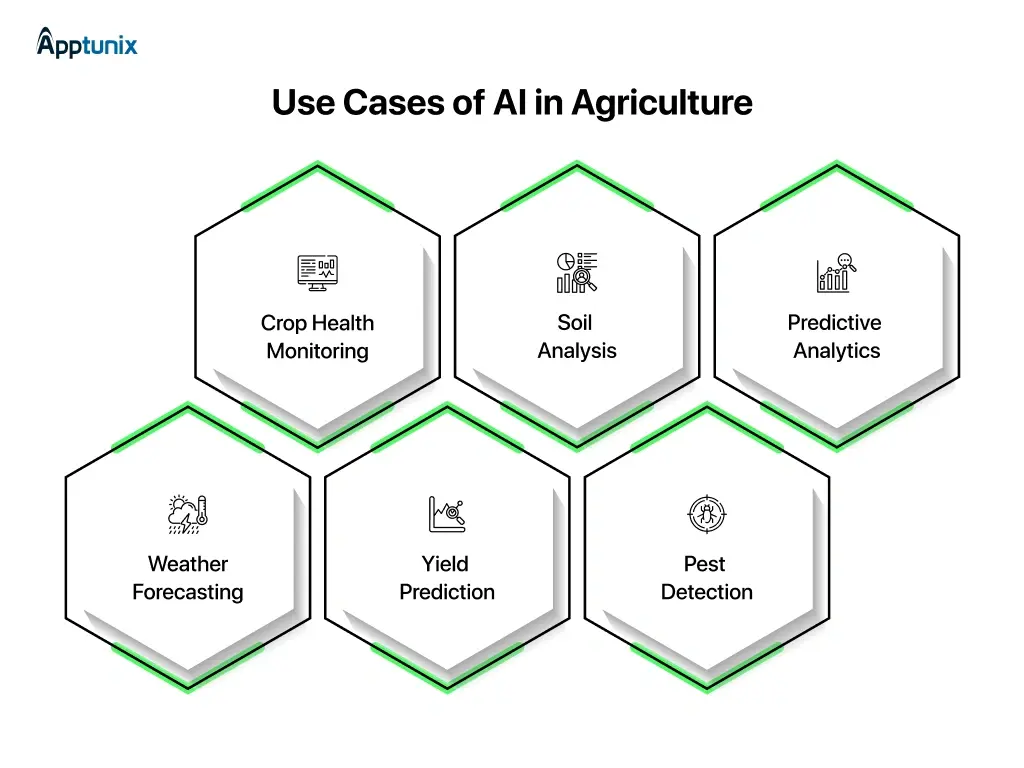
AI models can scan leaf images and detect early signs of stress, nutrient deficiency, and disease. Farmers get alerts before the problem spreads across the field.
AI systems understand soil patterns, moisture levels, and nutrient levels. Apps provide fertilizer suggestions and guide farmers toward the right soil treatment.
AI predictive analytics help farmers prepare for seasonal conditions. These insights reduce uncertainty and improve farm planning.
Accurate hyperlocal weather forecasting is essential for irrigation, spraying, and harvesting. AI improves accuracy by combining satellite data, historical trends, and sensor readings.
AI forecasts total yield based on soil data, crop growth stages, weather patterns, and historical records. Agribusiness teams rely on this to plan supply, storage, and market strategies.
Image-based pest detection allows farmers to act fast. Early identification cuts losses and protects crops without unnecessary chemical use.
Use of artificial intelligence in agriculture is not limited to crops. AI also powers livestock monitoring, feed optimization, disease detection in animals, and real-time tracking of cattle. Smart supply-chain systems built on AI trace produce from farm to market and ensure transparency for buyers and exporters. Agriculture app development companies now integrate AI into cold-chain logistics, farm machinery management, and greenhouse automation.
AI agriculture application development unlocks better productivity for smallholder farmers and large enterprises. Farmers get insights that were once available only to large organizations. Agribusiness companies gain structured data, predictable supply, and higher efficiency. Stakeholders across the value chain make faster and safer decisions.
Agriculture mobile app development powered by AI makes farming more reliable, more profitable, and more resilient to climate risks.
A strong AI agriculture app must solve real problems that farmers face every day. The right features help farmers reduce risk, protect crops, and plan more effectively. Agribusiness teams also gain reliable insights that support large-scale operations.
AI in agriculture adds greater accuracy, automation, and intelligence to each module. Machine learning in agriculture then learns from data over time and continually improves its output. This section explains the key modules that every AI-powered agriculture mobile app should include.
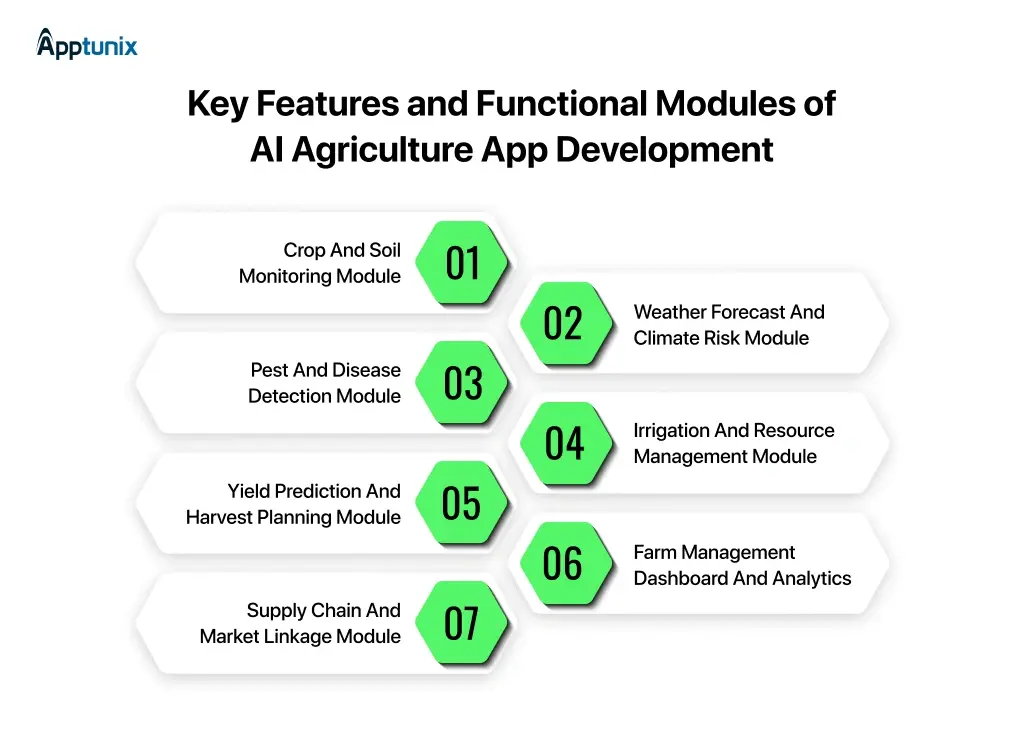
1.Crop and Soil Monitoring ModuleCrop and soil health tracking is a crucial part of AI agriculture app development. Soil conditions change often, and every change affects growth. A smart crop and soil monitoring module provides farmers with a clear picture of what is happening under the surface.
AI models study soil patterns and guide farmers on soil treatment. Moisture sensors capture real-time water levels. Soil nutrient tracking highlights gaps early. The application of AI in agriculture becomes visible when the app analyzes patterns and offers recommendations based on data, not guesswork. Machine learning in agriculture projects uses thousands of soil samples to improve accuracy every season. Farmers rely on this module to enhance crop quality and reduce waste.
2.Weather Forecast and Climate Risk ModuleFarming depends on the weather more than anything else. A powerful AI agriculture app must offer reliable forecasting and climate insights. Farmers get alerts for rainfall, storms, temperature swings, and humidity changes. These alerts help plan spraying, irrigation, and harvesting.
Seasonal planning becomes easier when the app predicts patterns based on historical data, satellite imagery, and machine learning models. Climate risk alerts reduce losses and protect yield during uncertain conditions.
3.Pest and Disease Detection ModulePests can destroy fields quickly. Early detection saves the season. AI-powered pest detection turns a simple smartphone camera into a diagnostic tool. Farmers capture images of leaves and stems. The app scans the image and detects pests or diseases based on machine learning algorithms trained on large crop datasets.
Drone and satellite imagery add another layer of accuracy for large farms. This module helps farmers take quick action, reduce chemical use, and prevent crop-wide infections.
4.Irrigation and Resource Management ModuleWater scarcity affects farmers worldwide. Smart irrigation tools in an AI agriculture app help manage water better. The irrigation module uses soil moisture data, crop type, and weather predictions to suggest the right time to irrigate. Farmers avoid overwatering and save resources. Resource optimization also covers fertilizer planning, labor allocation, and equipment usage. AI models study past patterns and offer simple action steps that fit local conditions.
5.Yield Prediction and Harvest Planning ModulePrediction ability sets AI apart from traditional agriculture apps. A yield prediction module studies weather data, soil quality, crop growth stages, field photographs, and historical records. Farmers and agribusiness teams receive early yield forecasts that help in planning harvest days, storage, transport, and market supply. Predictive analytics support decisions that improve profit and reduce last-minute losses. This is one of the strongest use cases of AI in agriculture.
6.Farm Management Dashboard and AnalyticsFarmers need a single place to track everything. A modern farm management dashboard shows daily tasks, crop progress, resource usage, and farm expenses. Data from sensors, satellites, and field entries are displayed on a screen. Farmers get simple charts and insights that guide decisions. Agribusiness companies use the analytics panel to understand supply conditions, farm performance, and upcoming risks. AI-supported dashboards turn raw data into clear action points.
7.Supply Chain and Market Linkage ModuleA smart agriculture app must also support market access. Farmers get real-time market price alerts, demand forecasts, and buyer opportunities. AI studies local and regional price trends to guide farmers on the best selling window. Traceability tools track produce from farm to market. Agribusiness companies gain visibility into logistics and quality. This module also creates monetization opportunities when integrated with marketplaces, aggregator platforms, and farm-to-consumer channels.
A clear process helps build a reliable and scalable AI-powered farming solution. Every agriculture app needs careful planning, deep field understanding, strong AI engineering, and ongoing support. A professional agriculture app development company follows a structured path that ensures the app works in real farm conditions and delivers real value. The steps below show how application development in agriculture unfolds from idea to final deployment.
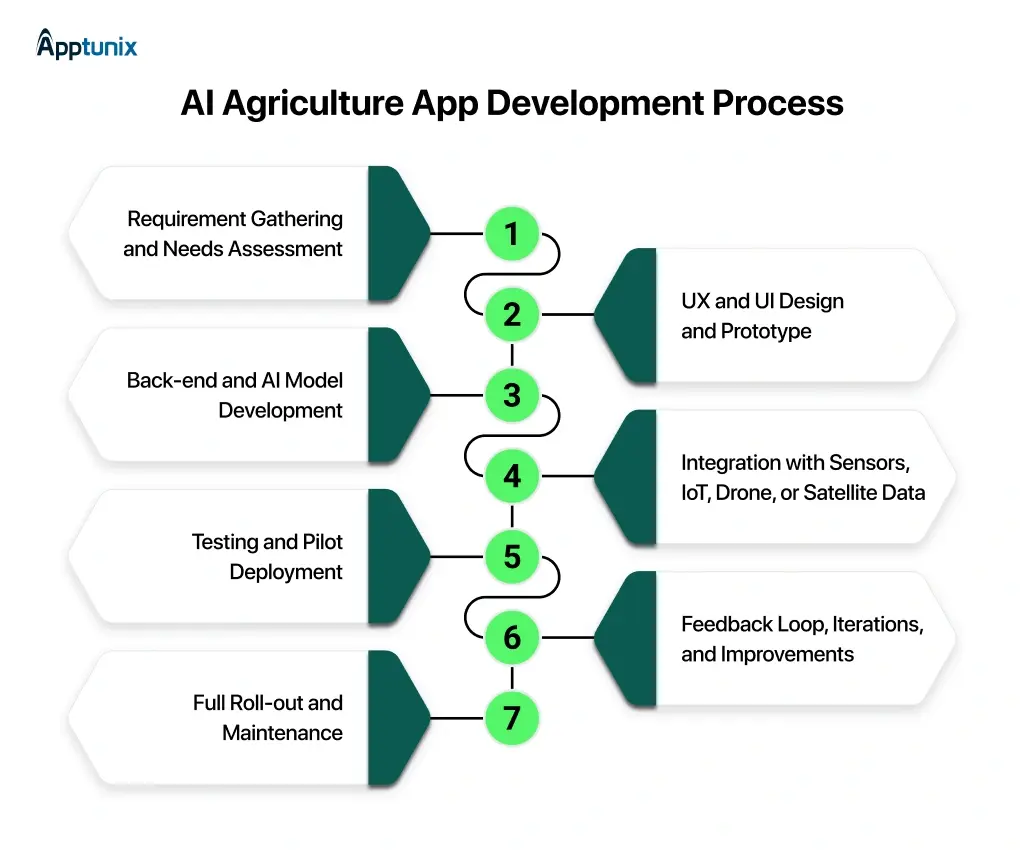
The process starts by understanding the real needs of farmers and agribusiness teams. Speak to agronomists, local cooperatives, and farm owners. Study farm size, soil type, crop categories, and user goals. This helps shape the initial blueprint of the agriculture mobile app development. Clear requirements also guide the core AI features that will support field tasks. These insights help avoid guesswork and keep the project focused.
Farmers prefer simple screens that do not demand high digital literacy. A clean and practical interface helps them trust the app. Designers create wireframes and simple prototypes to test early ideas. Buttons stay large. Icons stay clear. Menus stay short. Dashboards show only what matters. A good agriculture app development company pays special attention to field conditions such as glare, dust, and low network zones. The goal is to make the app easy for any farmer to use.
The next stage involves strong engineering work. Teams collect soil data, crop images, climate records, and satellite inputs. This data trains the AI models used for soil analysis, crop detection, and predictive analytics. AI agriculture software development depends on reliable datasets and accurate machine learning pipelines.
Engineers build models for yield prediction, pest detection, and soil health analysis. The back-end handles data storage, user authentication, and secure access. This is a core part of application development in agriculture.
Many modern farms use IoT sensors to monitor soil moisture, temperature, and crop growth. Drone and satellite images add more detail for large fields. These data sources connect directly to the app. A skilled agriculture app development company knows how to integrate these tools smoothly. Better integration improves the accuracy of AI features. It also helps farms automate irrigation, monitor crops, and track field conditions without manual effort.
Real-world testing matters. Pilot deployment takes place on a small farm or a test plot. Farmers test the features and share feedback. The team checks how well the AI predictions match ground reality. The pilot phase highlights gaps that need improvement. Agriculture mobile app development always benefits from field-driven insights.
The team collects feedback from farmers, agronomists, and stakeholders. AI models get fine-tuned to local soil conditions and seasonal patterns. The user interface improves based on real usage. Data pipelines become more efficient. This stage keeps the platform relevant and accurate. Agriculture app development becomes stronger after every iteration.
Once the app performs well during the pilot, the full launch begins. Farmers get training. Agribusiness teams get dashboards. The agriculture app development company offers updates to improve security, speed, and accuracy. Ongoing support ensures that the AI features continue to learn and improve. Application development in agriculture does not end at launch. Regular maintenance keeps the app reliable for long-term use.
Also Read: Green App Development – What Investors Must Know?
Farmers, agritech startups, and enterprises often ask one clear question. What does an AI agriculture app development cost? The answer depends on many factors. Every agriculture app has a different scope and different levels of AI complexity. This section explains what shapes the cost and how the investment creates long-term value.
Several elements influence both the AI agriculture app development cost and the general agriculture app development cost. A short list makes it easier to understand.
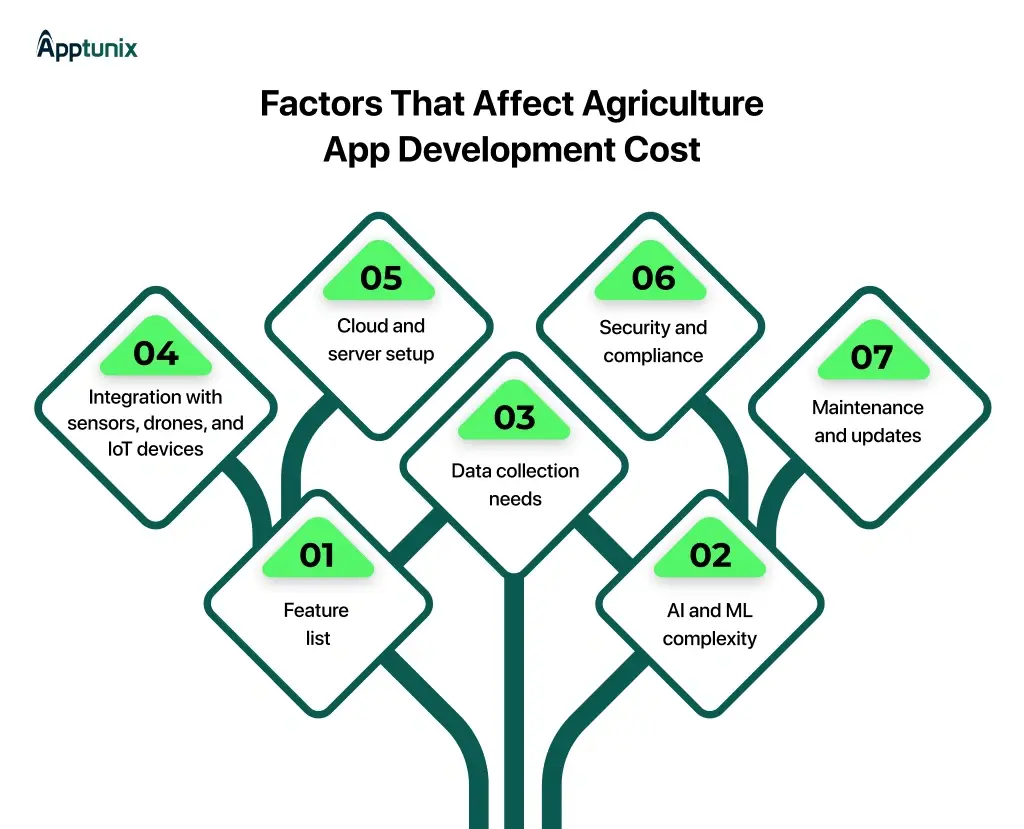
1.Feature list: More modules mean more design, development, and testing time.
2.AI and ML complexity: Soil analysis, crop detection, and yield prediction require advanced models. Model training adds extra effort.
3.Data collection needs: Reliable AI models depend on field data, soil samples, crop images, and weather patterns. Collecting and preparing this data adds to the cost.
4.Integration with sensors, drones, and IoT devices: Farms that use drones or soil sensors need smooth integration pipelines. This increases effort and infrastructure planning.
5.Cloud and server setup: AI-powered agriculture apps often rely on secure cloud platforms. Storage, computation, and backups add to operational cost.
6.Security and compliance: Agriculture often involves sensitive data. Strong security protocols are essential.
7.Maintenance and updates: Regular updates keep AI models accurate. Ongoing support ensures long-term performance.
These factors play a major role in AI application development for agriculture and help teams estimate the investment required for a smooth, scalable product.
Costs vary widely based on the project scope, region, and the type of AI features included. A small, basic app that handles simple farm tasks often stays at the lower end. A full AI agriculture software platform that includes advanced analytics, IoT integration, and marketplace features sits at the higher end.
Below is a clean estimate for agriculture mobile app development based on complexity.
AI Agriculture App Development Cost Table
| App Type | Cost Range (USD) | What You Get |
|---|---|---|
| MVP Agriculture App | $15,000 to $40,000+ | Basic farm logs, simple advisory, weather updates, basic crop records, entry-level dashboard. Limited AI. Good for idea validation. |
| Mid-Level AI Agriculture App | $40,000 to $80,000+ | Strong dashboard, soil analytics, AI-assisted crop insights, moderate ML models, early pest detection, IoT integration for simple sensors. |
| Advanced AI Agriculture Platform | $80,000 to $200,000+ | Full predictive analytics, AI pest and disease detection, satellite and drone data integration, advanced soil intelligence, yield forecasting, supply chain tools, multi-role dashboards. Enterprise-grade AI agriculture software development. |
These ranges give a realistic view of the AI agriculture app development cost and the general agriculture app development cost for different product scales.
A well-built AI agriculture app pays back fast. Farmers save water. Farmers avoid crop losses. Farmers reduce chemical waste. Agribusiness teams lower operational risk through forecasting. These benefits directly connect to top AI use cases in agriculture.
Most farms see better productivity once AI models understand local soil and crop conditions. Over time, ROI increases as the AI learns more and makes more accurate decisions. The investment supports yield growth, resource savings, and long-term stability.
A successful AI-powered agriculture app can earn steady revenue. Farmers benefit. Agribusinesses benefit. App owners benefit. Strong monetization keeps the platform sustainable for years. Here, we will learn the most reliable earning models used in agriculture mobile app development and AI agriculture software development.
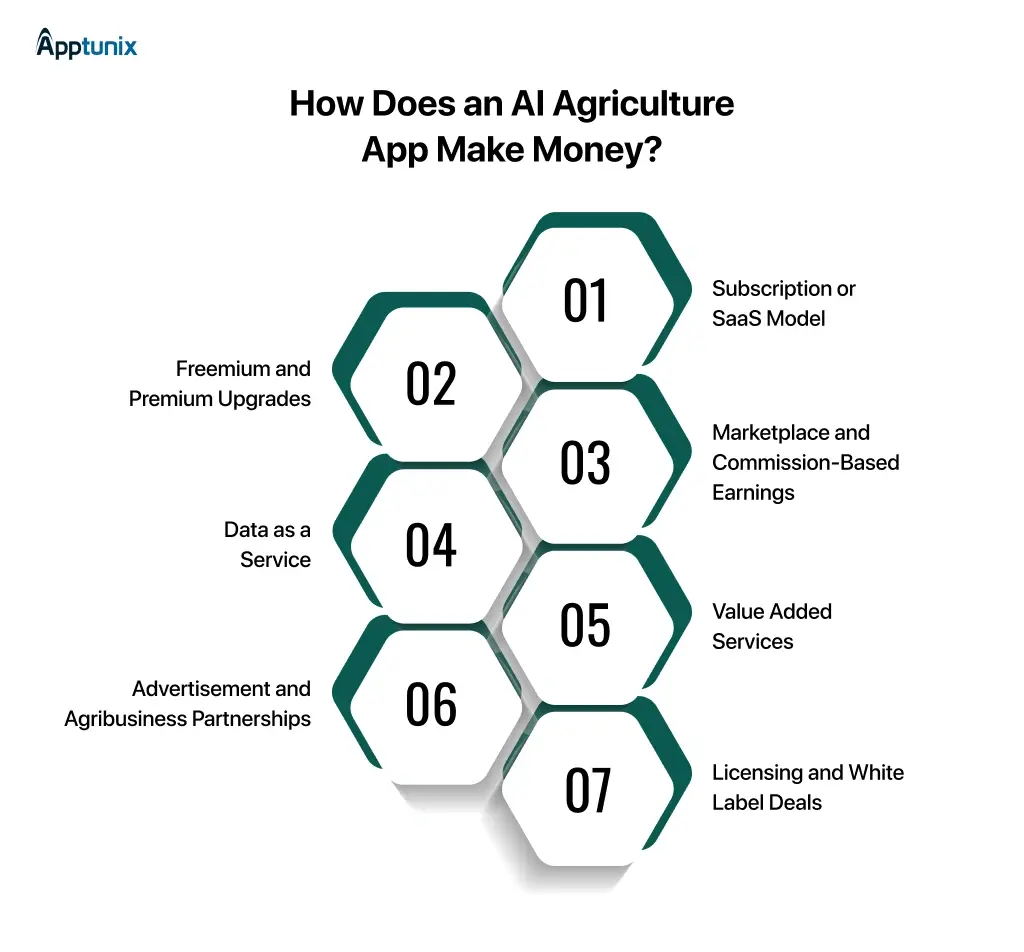
1.Subscription or SaaS ModelMany agriculture platforms use a simple subscription model. Farmers pay a small monthly or yearly fee for advanced features. They get soil insights, crop health alerts, market updates, and AI-powered analytics. Agribusiness teams pay for farm dashboards, predictive insights, and planning tools. This model creates stable recurring revenue and supports long-term growth.
2.Freemium and Premium UpgradesThe freemium approach makes adoption easy. Farmers explore the basic tools at no cost. Features like crop logs and weather updates stay free. Advanced modules such as pest detection, yield prediction, and precision irrigation stay locked behind a premium plan. This model works well when the app targets large farmer groups or rural networks.
3.Marketplace and Commission-Based EarningsMany AI agriculture apps help farmers sell produce at better prices. The app connects farmers to wholesale buyers, retailers, exporters, or food processors. Each sale generates a small commission. It becomes a strong revenue source for apps that aim to support both supply and demand. This model also builds trust among users and keeps them active.
4.Data as a ServiceFarms create valuable insights every day. Aggregated and anonymized data help seed companies, crop scientists, insurance firms, and food processors. They use this data to understand patterns and demand. The app can sell these insights as a Data-as-a-Service model. No personal data is shared. Only combined trends are used. This model supports advanced AI agriculture software development and helps generate high-value revenue.
5.Value Added ServicesSome users prefer expert guidance. Many apps earn by offering farm advisory sessions, soil testing services, and tailored crop plans. These services create direct revenue and build stronger relationships with farmers. Precision farming support often becomes a premium add-on. This model enhances the app’s credibility and improves user satisfaction.
6.Advertisement and Agribusiness PartnershipsFarmers often look for seeds, pesticides, fertilizers, and equipment through digital channels. The app can collaborate with suppliers and offer simple ads or sponsored recommendations. These ads stay relevant and help farmers discover trusted brands. Partnerships with agrochemical firms and equipment manufacturers create strong revenue without hurting user trust.
7.Licensing and White Label DealsA mature platform can scale into new regions. The owners can license the system to cooperatives, NGOs, or private firms. Many partners want a ready-made AI agriculture app that works under their brand. This white label model helps expand the product’s reach. It also creates strong income streams for the platform owner.
Also Read: Milk Delivery App Development: Cost, Features & Process
The agriculture industry is changing at an alarming pace. Farmers want accurate insights. Agritech companies want reliable platforms. AI agriculture application development is rising because it solves real problems at scale. Well, let’s now discuss the latest trends that shape application development in agriculture and the new direction of AI-based farming solutions.
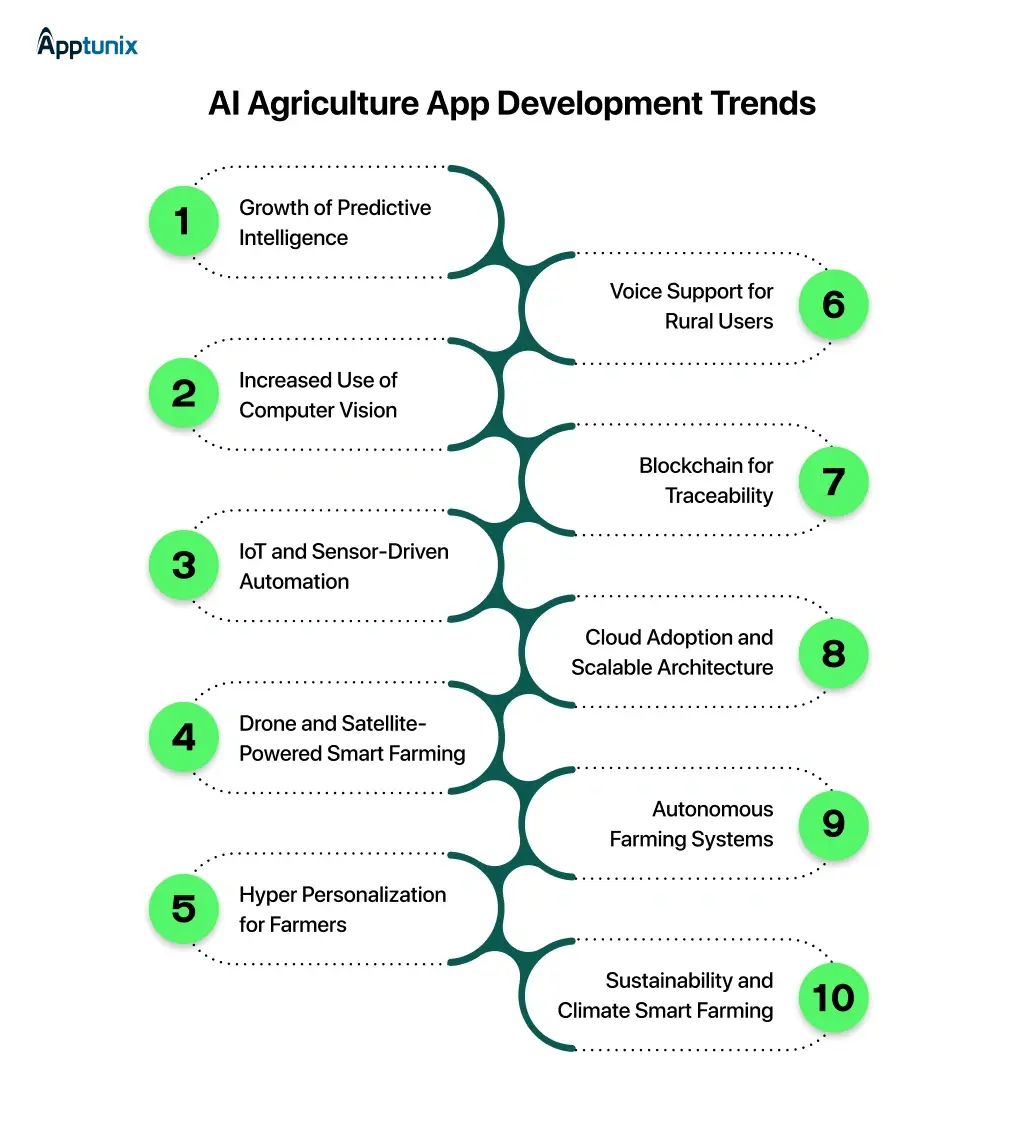
1.Growth of Predictive IntelligenceFarmers rely on forecasts for quick decisions. AI models now track soil health, crop stress, rainfall patterns, and market changes in real time. This trend makes mobile app development for agriculture more strategic. Predictive intelligence supports early warnings, crop planning, and yield improvement. Many new machine learning projects in agriculture focus on this area.
2.Increased Use of Computer VisionPhoto-based diagnosis has become common on farms. Apps now scan leaves, soil surfaces, plant stems, and fruit textures. Computer vision detects pests, diseases, and nutrient gaps. Farmers only need a phone camera. Many AI agriculture software development projects combine images from phones, drones, and satellites to improve accuracy.
3.IoT and Sensor-Driven AutomationFarmers use sensors to track moisture, temperature, soil nutrients, and microclimate conditions. These sensors send data to the app. AI models study the pattern. The farming app then guides irrigation, fertilization, or pest control. IoT makes agriculture app development more powerful and practical. Many large farms demand this integration in every new solution.
4.Drone and Satellite-Powered Smart FarmingDrones collect aerial images that show crop stress and weed growth. Satellites support long-term monitoring. The data feeds AI models for faster decision-making. This trend drives more investments in drone-based application development in agriculture. Agribusiness teams use these insights to plan and manage their supply chain.
5.Hyper Personalization for FarmersApps now adjust recommendations for each farmer. The system studies farm size, soil type, crop season, past performance, and climate zone. Farmers then receive personalized tips instead of generic advice. This trend improves user retention and ROI. Many agriculture app development companies now build personalization engines into their platforms.
6.Voice Support for Rural UsersMany farmers prefer voice commands to typing. Modern apps now support multilingual voice search and voice-based instructions. Voice AI helps farmers who have limited digital experience. This trend makes agriculture mobile app development more inclusive and accessible.
7.Blockchain for TraceabilityFood buyers want to know where crops come from. Farmers want fair prices. Blockchain helps record every step in the chain. The app shows seed quality, field data, harvest time, and transport history. This trend supports market trust and export compliance. Many new AI agriculture projects include blockchain as a core feature.
8.Cloud Adoption and Scalable ArchitectureMany agritech solutions now move to cloud-based platforms. This approach supports real-time data synchronization, lower storage costs, and flexible scaling. Large farms and enterprises prefer cloud architecture because it can handle massive amounts of data. AI agriculture app development becomes more efficient when the platform runs on stable cloud systems.
9.Autonomous Farming SystemsRobots and autonomous tools support sowing, spraying, and harvesting. AI helps these machines make fast decisions in the field. Many agriculture app development companies now build apps that connect directly to autonomous tools. This trend will grow as farms expand and face labor shortages.
10.Sustainability and Climate Smart FarmingFarmers want lower input costs and healthier soil. Apps now guide water usage, fertilizer planning, and carbon-friendly practices. AI-powered sustainability tools help farms reduce waste and increase efficiency. Many agritech investors look for climate-smart solutions before funding new projects.
Choosing the right agriculture app development company is one of the most crucial decisions for any agribusiness, startup, or farming enterprise aiming to build a future-ready digital product. Well, here is the criterion to choose the best.
✔ Proven Agriculture Tech Expertise
Choose a vendor with hands-on experience in agriculture mobile app development and real-world farm-tech implementations.
✔ Strong AI/ML & Data Science Capabilities
Ensure they excel in AI agriculture software development, including machine learning, computer vision, predictive analytics, and model deployment. Review their past AI-based agriculture projects.
✔ Ability to Integrate IoT, Sensors & Drones
The company should support end-to-end integration with soil sensors, weather stations, drones, and satellite imagery.
✔ Domain Knowledge in Agriculture & Agronomy
They must understand crop cycles, soil types, climatic zones, water usage, and regional farming challenges. Look for teams that collaborate with agronomists.
✔ Customization for Local Farming Conditions
Ask whether they tailor solutions to local crops, languages, field sizes, and market conditions.
✔ Transparent Costing & Clear Timelines
Ensure clarity on agriculture app development cost, feature-wise pricing, maintenance charges, and hosting expenses.
✔ Strong UI/UX for Farmers
The vendor must design interfaces that work for low-literacy farmers, in offline conditions, and areas with limited connectivity.
✔ Security, Scalability & Cloud Expertise
Look for capabilities in secure data handling, scalable cloud architecture, and long-term growth planning.
✔ Post-Launch Support & Continuous Improvement
Verify they provide updates, monitoring, training, and iterative enhancements for AI models.
✔ Portfolio, Case Studies & Client Proof
Prefer companies with successful AI projects in agriculture, testimonials, and measurable outcomes.
Agriculture is moving fast toward data-driven farming, and businesses need a partner who understands both technology and real-world farming challenges. Apptunix is an enterprise-grade AI app development company that specializes in AI agriculture app development and full-scale AI agriculture software development designed for different crops, climates, and soil conditions.
Every agriculture app development project we have done before begins with a deep understanding of goals, local farming realities, and the market our clients serve. And the results were amazing.
Clients choose us because we deliver end-to-end solutions. The process covers everything from requirement analysis to UX/UI design, AI model development, integrations, deployment, and long-term support. A tailored approach ensures that your AI agriculture app includes accurate soil analytics, real-time crop monitoring, weather intelligence, pest detection, yield prediction, and all the modules needed for modern farming.
Each feature is built to solve real use cases of AI in agriculture, helping farmers save resources, increase yields, and operate more efficiently.
Furthermore, budget transparency remains a priority. You get clear, flexible options for agriculture app development costs based on the scope, AI complexity, and required integrations. The goal is to help you launch a scalable solution that delivers measurable ROI without financial guesswork.
Your business gains stronger market positioning, recurring revenue opportunities, and a powerful digital footprint by investing in smart agriculture mobile app development. The trend is clear: farms, cooperatives, and agribusinesses adopting AI now are outperforming those relying on traditional methods.
A smart agriculture ecosystem is only a conversation away. If you want to build an enterprise-grade agriculture app that farmers trust and businesses rely on, reach out for a free consultation. Our experts will walk you through the best strategy, cost, features, and roadmap to bring your AI agriculture project to life.

Q 1.What is AI agriculture app development?
AI agriculture app development refers to building mobile and web apps that use artificial intelligence to support farming activities. These apps help with crop monitoring, soil analysis, pest detection, irrigation planning, and yield prediction. Many agribusinesses invest in these solutions to modernize farm operations.
Q 2.How does AI help in agriculture?
AI helps in agriculture through image analysis, predictive analytics, machine learning models, and real-time farm data. It improves crop health monitoring, reduces waste, increases yields, and supports better decision-making.
Q 3.What is the cost of an AI agriculture app development?
The agriculture app development pricing depends on features, AI model complexity, sensor or drone integrations, cloud infrastructure, and scale. Basic agriculture apps cost around $15,000 to $40,000+, while full-featured AI agriculture software costs around $80,000 to $200,000+ due to advanced analytics and data processing.
Q 4.What features should an AI agriculture app include?
Popular features include soil health analytics, crop monitoring, pest and disease detection, irrigation scheduling, weather forecasting, farm dashboards, and supply-chain tracking. These features depend on the user type and project scope.
Q 5.How long does it take to build an AI agriculture app?
Simple AI MVP apps take around 3 – 4 months. Complex AI agriculture software development takes 6 – 9 months or longer due to model training, testing, and integrations with sensors or drones.
Q 6.Do small farms benefit from AI agriculture apps?
Small farms gain huge value from AI apps. They get better crop insights, accurate weather forecasts, and affordable precision-farming tools that increase efficiency and reduce costs.
Q 7.What technologies are used in AI agriculture app development?
Key technologies include machine learning in agriculture, computer vision, IoT sensors, satellite imagery, drone data, cloud computing, and predictive analytics.
Q 8.Can AI agriculture apps work without internet?
Many features work offline. Apps can store farm data locally and sync to the cloud once the device reconnects. Farmers in rural areas find this very useful.
Q 9.What tech stack is used for AI agriculture app development?
Most AI agriculture apps use Flutter or React Native for the frontend, Python or Node.js for the backend, and TensorFlow or PyTorch for AI models. Cloud platforms like AWS or Google Cloud support data processing and IoT integrations.
Q 10.How accurate is AI in crop disease detection?
AI models reach high accuracy when trained on large, verified datasets. Good lighting and clear images improve results. Many agriculture app development companies now build specialized disease-detection systems for specific crops.
Q 11.How do I choose the right agriculture app development company?
Check the company’s experience in agriculture mobile app development, their AI/ML capabilities, past agriculture projects, cost transparency, and support quality. Strong technical skills and real-world agriculture knowledge are essential.
(1 ratings, average: 5.00 out of 5)
Get the weekly updates on the newest brand stories, business models and technology right in your inbox.
Hardeep Singh is a seasoned B2B technical writer at Apptunix with a sharp eye for strategy and a mind wired for innovation. With over a decade of experience in technical and SEO writing, and a Master’s degree in Wireless Communication, he’s written across domains including AI, Blockchain, IoT, Cybersecurity, and beyond. At Apptunix, Hardeep drives content that bridges business goals with future-ready mobile and web solutions, thus helping startups and enterprises make smarter digital decisions.
12 Views 16 min September 16, 2026

4 Views 16 min September 14, 2026
13 Views 16 min September 10, 2026
Book your consultation with us.
Book your consultation with us.


One Central, The offices 3, Level 3, DWTC, Sheikh Zayed Road, Dubai
+971 50 782 1690