How to Build an Auction App: Features, Development Process, Cost & Monetization
28 Views 20 min September 8, 2026

Hardeep Singh is a seasoned B2B technical writer at Apptunix with a sharp eye for strategy and a mind wired for innovation. With over a decade of experience in technical and SEO writing, and a Master’s degree in Wireless Communication, he’s written across domains including AI, Blockchain, IoT, Cybersecurity, and beyond. At Apptunix, Hardeep drives content that bridges business goals with future-ready mobile and web solutions, thus helping startups and enterprises make smarter digital decisions.
Green app development focuses on designing and building mobile/web applications that minimize environmental impact by reducing energy consumption, data usage, and server load.
It involves using sustainable coding practices (lightweight code, dark mode), optimized infrastructure, and creating apps that encourage eco-friendly user behavior.
Key benefits include reduced carbon footprints, lower operational costs, and improved device battery life.
Key Principles and Strategies
Examples of Green Applications
Have you ever wondered how much energy your favorite apps consume every day?
Or what impact do millions of app downloads have on our planet’s resources?
Well, the truth is that every tap, scroll, and data transfer leaves a digital carbon footprint. As users become more environmentally aware and businesses face growing sustainability pressures, green app development has emerged as the future of responsible innovation.
Now you might ask, What is this Green App Development?
Green app development is the process of designing, developing, and maintaining mobile or web applications that minimize environmental impact throughout their lifecycle. This ranges from development and deployment to daily usage and maintenance.
In simpler words, it’s about building high-performing apps that are energy-efficient, carbon-conscious, and aligned with global sustainability goals.
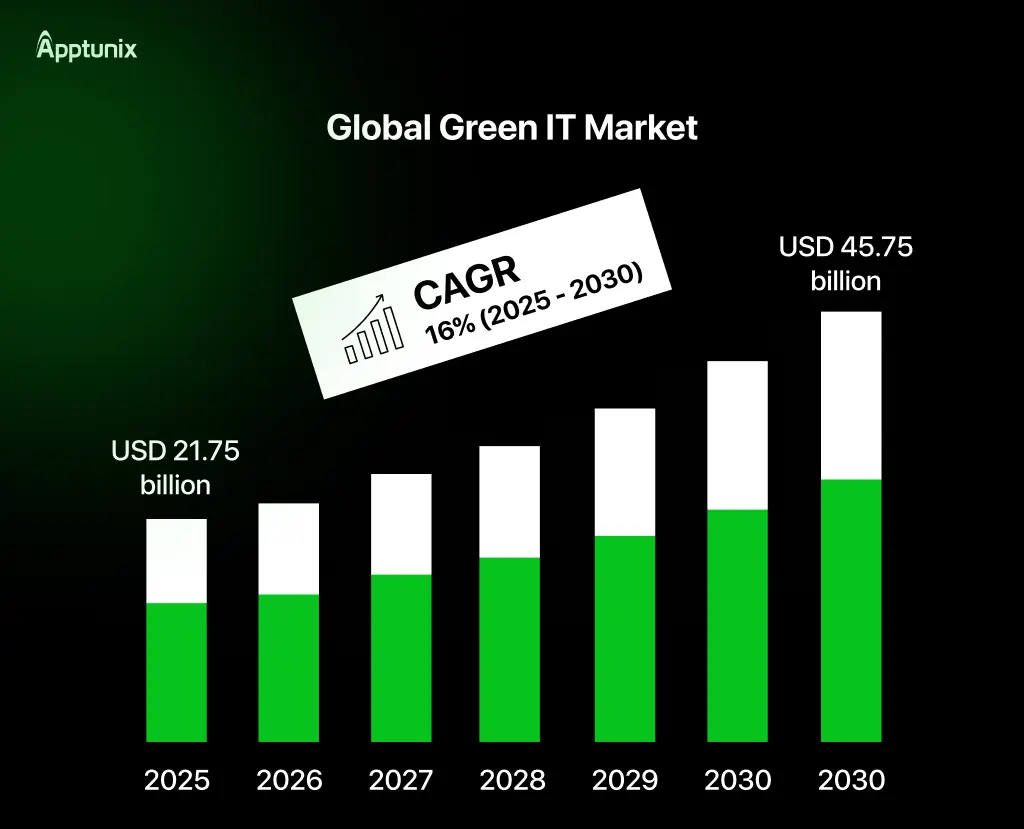
And the timing couldn’t be more critical. According to a recent report, the global green IT market is projected to soar from USD 21.75 billion in 2025 to USD 45.75 billion by 2030, growing at an impressive CAGR of 16% during the forecast period, 2025 – 2030. This rapid rise reflects a massive shift in business priorities, where sustainability is no longer optional but essential for long-term success.
Talking about us – as a leading green app development company, Apptunix has been at the forefront of this transformation. We have earned a solid reputation globally in delivering future-ready green app development services and green app development solutions that empower startups and enterprises to innovate sustainably while reducing operational costs and boosting user trust.
Well, in this comprehensive guide, we are going to uncover everything you need to know about green app development. Ranging from the core principles, features, and technologies behind sustainable software to the complete development process, cost insights, and future trends shaping the green digital revolution.
By the end, you will not only understand why the world is turning green but also how your business can lead the change by choosing the right partner to build your next green app.
So let’s begin straight!
Every app we use, whether it’s for fitness, shopping, or finance, consumes energy. Each image loaded, notification sent, or data synced requires power from devices, servers, and networks. Over time, these seemingly small actions add up to a massive environmental impact. That’s where green app development or green software development steps in to reshape how digital products are built, deployed, and managed.
Traditional app development often overlooks its ecological footprint. Heavy backend requests, unoptimized code, and constant server pings drain device batteries and increase carbon emissions by increasing data center load. Green application development focuses on reducing digital waste by adopting cleaner code, optimized APIs, and intelligent data use. Thus, creating apps that are lighter, faster, and environmentally conscious.
According to Fortune Business Insights, the global green technology and sustainability market is projected to grow from US $25.44 billion in 2025 to US $105.26 billion by 2032, expanding at a remarkable CAGR of 22.1%. This explosive growth highlights how sustainability has become a top business priority across industries.
For businesses, investing in green app development delivers a dual advantage: it benefits the planet and strengthens the brand. Companies adopting green software development practices experience:
In short, green application development is not just about writing efficient code; it’s about coding a better future for businesses and the environment alike.
The surge in green app development isn’t accidental; it’s driven by changing consumer behavior, evolving policies, and groundbreaking technological shifts.
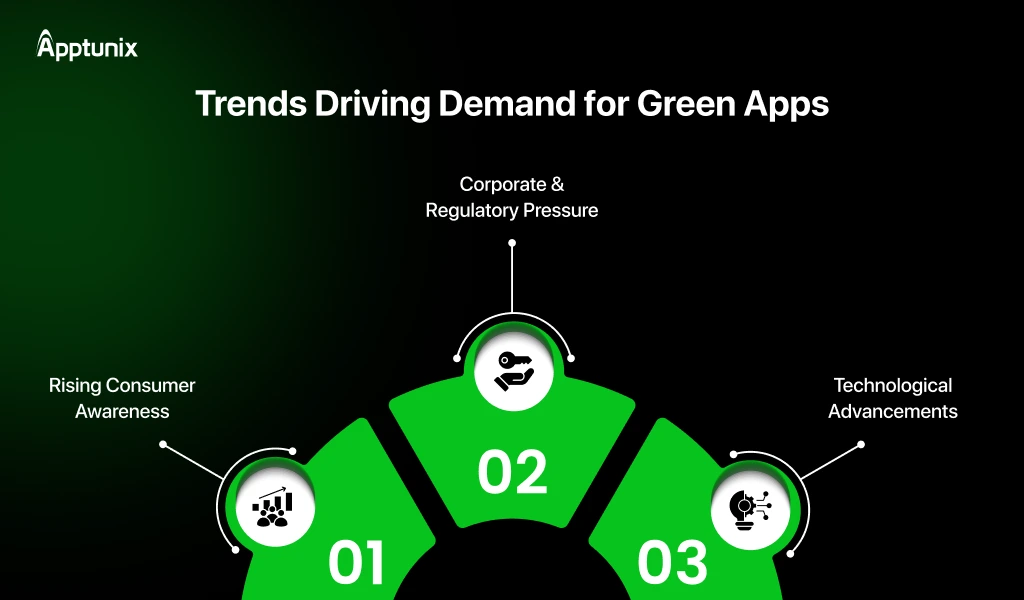
1.Rising Consumer Awareness
Today’s users care deeply about sustainability. From ride-sharing apps that promote electric vehicles to retail platforms offering carbon-neutral delivery, consumers are embracing eco-friendly digital experiences. This shift has fueled the rapid adoption of green mobile app development, where every element, ranging from design to data handling, is optimized for sustainability.
Also, read our eBook on Electric Vehicle Software Development
2.Corporate & Regulatory Pressure
Governments across the globe are introducing digital sustainability regulations. Meanwhile, corporations are integrating ESG mandates into their digital transformation plans. This makes green application development essential for compliance and reputation management. Businesses that fail to act risk being left behind.
3.Technological Advancements
Modern tech ecosystems are enabling green software development at scale. Low-energy coding practices, optimized backends, and carbon-aware computing are transforming how developers build green apps. Cloud providers now offer carbon-neutral hosting, and developers are leveraging AI-driven analytics to track and reduce energy usage.
These trends underscore a powerful truth: developing a green app is no longer a niche goal but the new standard for responsible innovation. As a forward-thinking green app development company, we help businesses navigate this shift with tailor-made green app development solutions that balance sustainability and profitability effortlessly.

Building a sustainable digital product requires more than efficient coding. It demands a mindset shift. Every responsible green app development company follows a defined set of principles to ensure that sustainability is integrated into every layer of an app’s lifecycle.
When you develop a green app or build green app solutions, these foundational practices guarantee reduced energy consumption, improved efficiency, and a lasting positive impact on both users and the planet.
Below are the six key principles that guide the process of green app development and define what modern businesses should expect from their development partners.
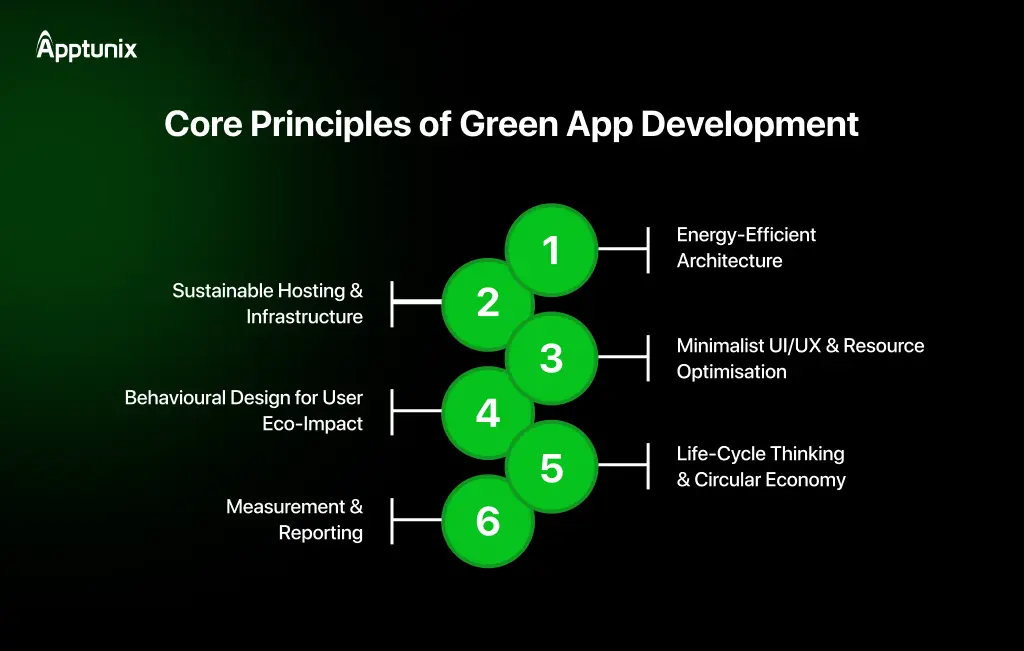
1.Energy-Efficient Architecture
A truly sustainable app starts at the architectural level. Energy-efficient architecture ensures the app uses only the resources it needs – no more, no less.
A professional green app developer focuses on:
This approach is crucial, as an energy-aware architecture can reduce mobile app energy consumption by up to 40%. When developers implement lightweight frameworks and adaptive APIs, they deliver smoother performance while lowering the app’s carbon footprint. A cornerstone of effective green software development.
2.Sustainable Hosting & Infrastructure
The hosting environment plays a massive role in determining an app’s overall sustainability.
Modern green application development emphasizes:
Well, by deploying apps on sustainable cloud platforms like AWS Clean Energy Regions or Google Cloud’s Carbon-Free Energy portfolio, a green application development company ensures that eco-efficiency is achieved not only at the device level but across the entire backend ecosystem.
3.Minimalist UI/UX & Resource Optimization
The front end of any app is what users interact with most. It’s also where resource efficiency often gets overlooked. A well-crafted green app design or green app UI can drastically reduce processing loads and improve device performance.
Here’s how:
A green app developer enhances both sustainability and usability by focusing on simplicity. Thus, ensuring that users enjoy fast, clean, and eco-friendly digital experiences.
4.Behavioural Design for User Eco-Impact
A powerful yet often underestimated part of building a green app is encouraging users to make sustainable choices. Behavioral design integrates features that guide users toward eco-conscious actions without disrupting the app experience.
For example:
When applied effectively, this principle transforms apps from passive tools into active drivers of environmental awareness. One of the most innovative aspects of green application development solutions.
5.Life-Cycle Thinking & Circular Economy
Sustainability doesn’t end when an app launches. True green mobile app development is about considering the entire product lifecycle, ranging from ideation to sunset.
Developers focus on:
This “build once, optimize always” approach makes developing a green app both cost-effective and environmentally responsible. This reduces digital waste and long-term maintenance effort.
6.Measurement & Reporting
The final principle of green software development is transparency. Businesses need measurable insights into how their apps perform environmentally. Through embedded analytics, sustainability dashboards, and energy-usage reports, developers can:
Well, by offering this level of visibility, a green app development company empowers businesses to continuously refine their apps. This ensures that eco-efficiency isn’t just a launch-time promise, but a long-term commitment.
Together, these six principles form the backbone of modern green app development services. A process where technology and sustainability move hand in hand. Furthermore, for forward-thinking brands, adopting these practices isn’t just an ethical choice but a smart business strategy that ensures longevity, loyalty, and leadership in the digital green era.
When building a green app, the actual impact lies in the features that actively reduce energy usage, limit resource consumption, and guide users toward more eco-conscious digital habits. Below are the core functionalities that distinguish a truly eco-friendly mobile application in today’s sustainability-driven digital ecosystem.
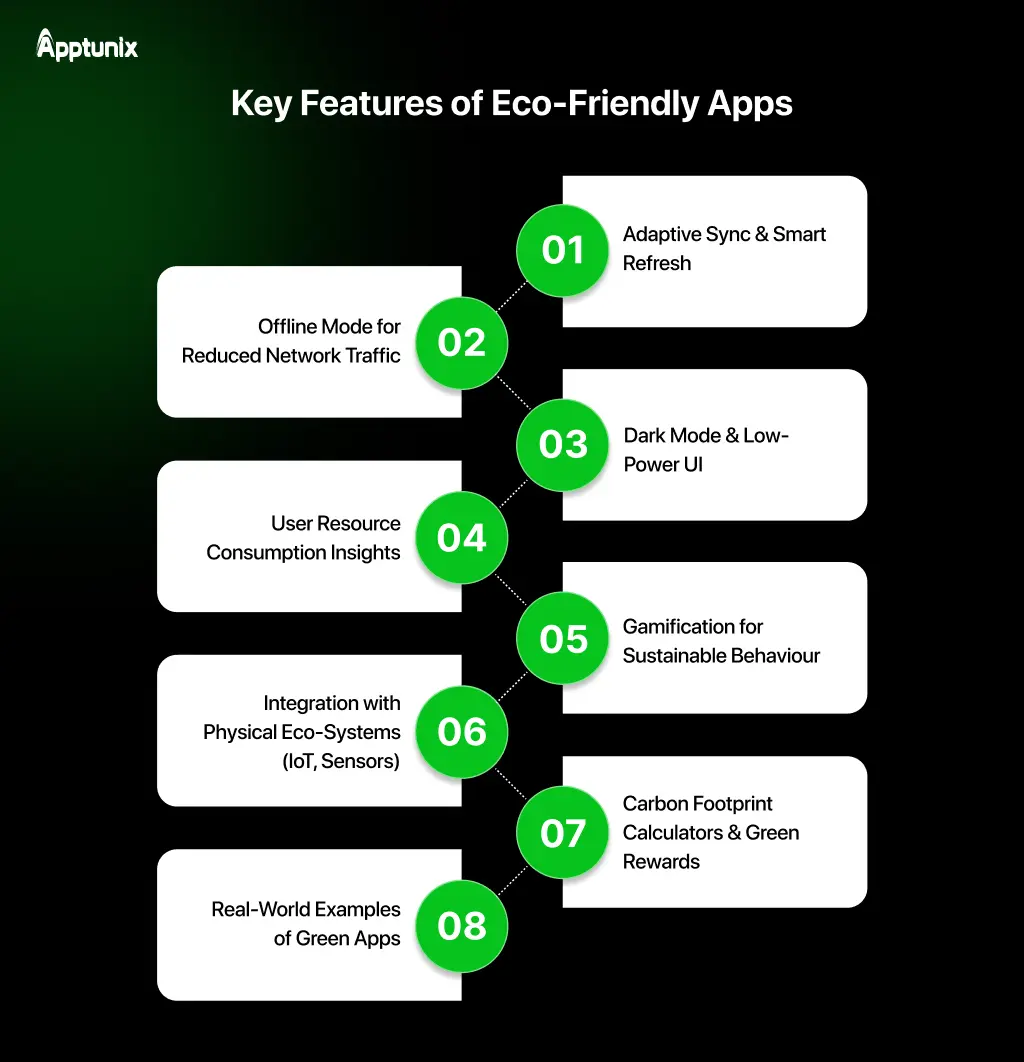
1.Adaptive Sync & Smart Refresh
A defining feature of green applications is adaptive syncing, which refreshes data only when needed rather than constantly pinging servers.
This is one of the simplest but most powerful ways to reduce digital carbon footprint.
2.Offline Mode for Reduced Network Traffic
Offline-first architecture must be a priority as it ensures:
Green mobile app development directly trims server dependency and overall power draw by enabling users to perform key actions without constant connectivity.
3.Dark Mode & Low-Power UI
Integrating dark themes and low-power UI patterns helps reduce screen energy consumption, especially on OLED devices.
Such a thoughtful green app design aligns usability with sustainability.
4.User Resource Consumption Insights
Eco-friendly apps empower users with knowledge:
These features transform sustainability into a shared responsibility. And this is not just something handled by the app developer.
5.Gamification for Sustainable Behavior
To keep users engaged in eco-friendly actions, apps introduce:
This human-centered approach transforms sustainability into a motivating experience.
Also Read: Incorporating Gamification Elements in Mobile App Development
6.Integration with Physical Eco-Systems (IoT, Sensors)
Green apps increasingly pair with IoT devices, smart meters, and environmental sensors:
This enables more powerful sustainability insights and automated green actions.
7.Carbon Footprint Calculators & Green Rewards
Modern users expect apps to quantify their impact. Essential features include:
These features highlight the app’s tangible environmental value.
8.Real-World Examples of Green Apps
Here are real applications that showcase what’s possible when building a green app with purpose-driven features:
Each integrates sustainability into everyday behavior, proving that smart feature design can reshape user habits at scale.
These powerful features not only reduce environmental impact but also elevate user experience. This makes it easier for modern businesses to stand out when developing green apps that align with global sustainability demands.
Modern businesses looking to build sustainable digital products need more than just efficient code. They need a strategic mix of technologies, architectures, and practices that minimize carbon footprint end-to-end. As a leading provider of green app development solutions and green app development services, we leverage advanced tools, lightweight frameworks, and carbon-aware infrastructure to help companies build fast, scalable, and environmentally responsible apps.
Below is a clear breakdown of the technologies and trends shaping the future of green mobile app development.
Energy efficiency starts at the user interface. The goal is simple: fewer CPU cycles and lower GPU load.
Core Enablers:
These tools support green application development services by ensuring the UI consumes less device energy while delivering smooth performance.
The backend contributes significantly to an app’s overall carbon footprint. A modern green stack focuses on efficiency, elasticity, and carbon neutrality.
Key Technologies:
Our green app development solutions include strategic backend optimization that minimizes cloud costs and environmental impact.
Data-driven apps consume heavy resources unless they are designed sustainably.
AI, IoT, and analytics can massively enhance environmental efficiency when implemented correctly.
Applications in Sustainability:
Reference: The “Greening AI-enabled Systems” agenda on arXiv highlights how optimization, pruning, and energy-aware ML models are becoming essential for low-carbon digital ecosystems.
The future of green mobile app development is shaped by new techniques and paradigms that prioritize sustainability by design.
Major Trends:
The latest industry reports on sustainable app development reinforce the rise of eco-first engineering as a mainstream development philosophy.
As the device landscape expands, efficiency must adapt accordingly. A truly green app is performant across multiple screens and hardware configurations.
Key Considerations:
Industry sources highlight that platform diversity is pushing modern teams to build apps that adapt intelligently and not just visually.
Green technology is no longer optional. The companies investing today in sustainable stacks, low-carbon infrastructure, and efficient algorithms will lead tomorrow’s digital economy. And needless to say, with powerful green app development services, your business can join that league. Responsibly, competitively, and future-ready.
Investors and business owners choosing to develop green app products need a crystal-clear roadmap. A structured process not only ensures fast delivery but also guarantees real environmental impact reduction.
As a dedicated green app development company, we follow a sustainability-driven workflow that blends strategy, design, coding, and continuous optimization. This step-by-step journey helps businesses build green app solutions that stay efficient, scalable, and future-ready.
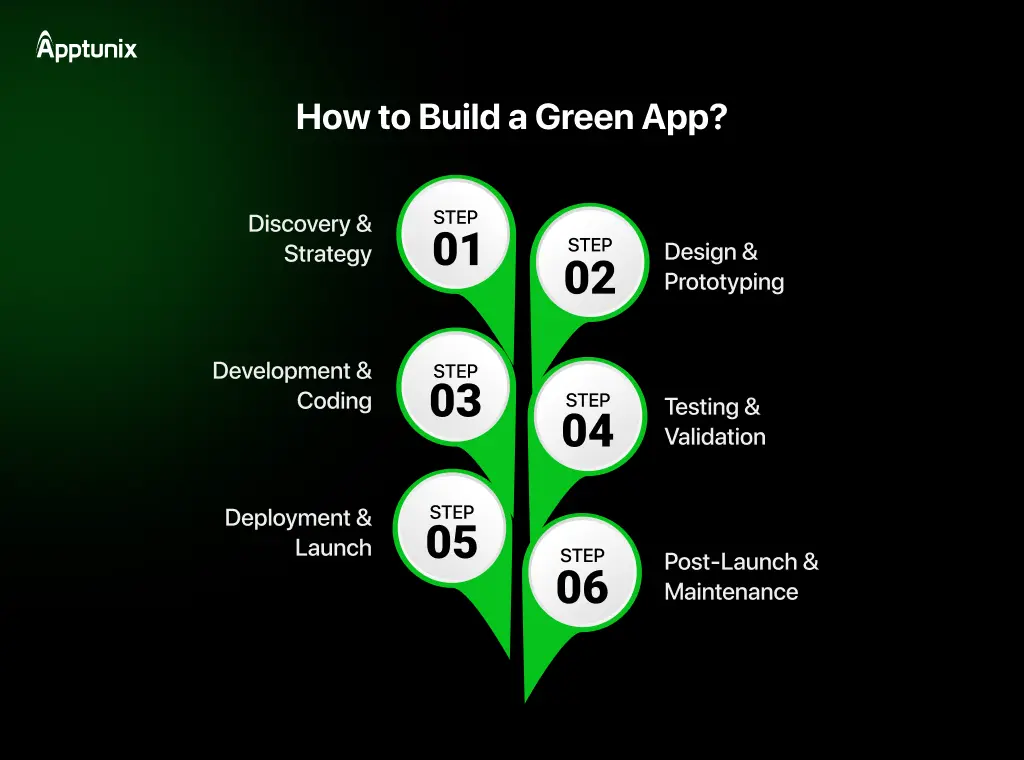
Every successful green product starts with a deep understanding of business intent and sustainability outcomes.
Core activities:
This stage sets the foundation for green application development that delivers genuine value and measurable impact.
The interface influences both user experience and an app’s environmental footprint. Smart design means fewer visual assets, lighter rendering, and mindful interactions.
Key elements:
A strong UI foundation helps businesses begin building a green app that is visually appealing and naturally efficient.
This stage brings the app to life with lightweight code, optimized architecture, and techniques that reduce energy consumption.
What happens here:
This is where we ensure the product meets modern standards for developing a green app that performs smoothly even under limited resources.
Testing ensures the app is both eco-efficient and user-ready. It validates whether the development aligns with the sustainability strategy.
Tests included:
Once these checks are done, we proceed to launch planning.
A green product must run on infrastructure that aligns with low-carbon goals.
Launch activities:
A smart launch ensures you make green app solutions visible, stable, and ready to scale.
Sustainability doesn’t stop at launch. Continuous optimization is essential for keeping the app lean and impactful.
Continuous improvements include:
Partnering long-term with a skilled green software development company ensures ongoing eco-optimization, keeping your product efficient and competitive.
Well, by following this structured process, businesses gain the confidence to build green app solutions that match modern user expectations and global sustainability trends. This journey ensures your investment is future-ready, resource-efficient, and aligned with the rising global demand for genuinely greener digital products.
Businesses planning to develop green app solutions often wonder whether sustainability affects overall investment. The truth is simple: a green product follows the same development flow as any modern app, yet certain eco-driven practices and tools influence the green app development cost.
Understanding the cost to develop a green app helps investors plan better, avoid unexpected expenses, and choose the right green app development company for long-term returns. Building responsibly is not just an environmental decision but a strategic business advantage. Let’s break down the cost factors clearly and realistically.
Creating an eco-efficient product involves unique considerations compared to traditional development. These factors directly influence the cost to build green app solutions.
Key cost drivers include:
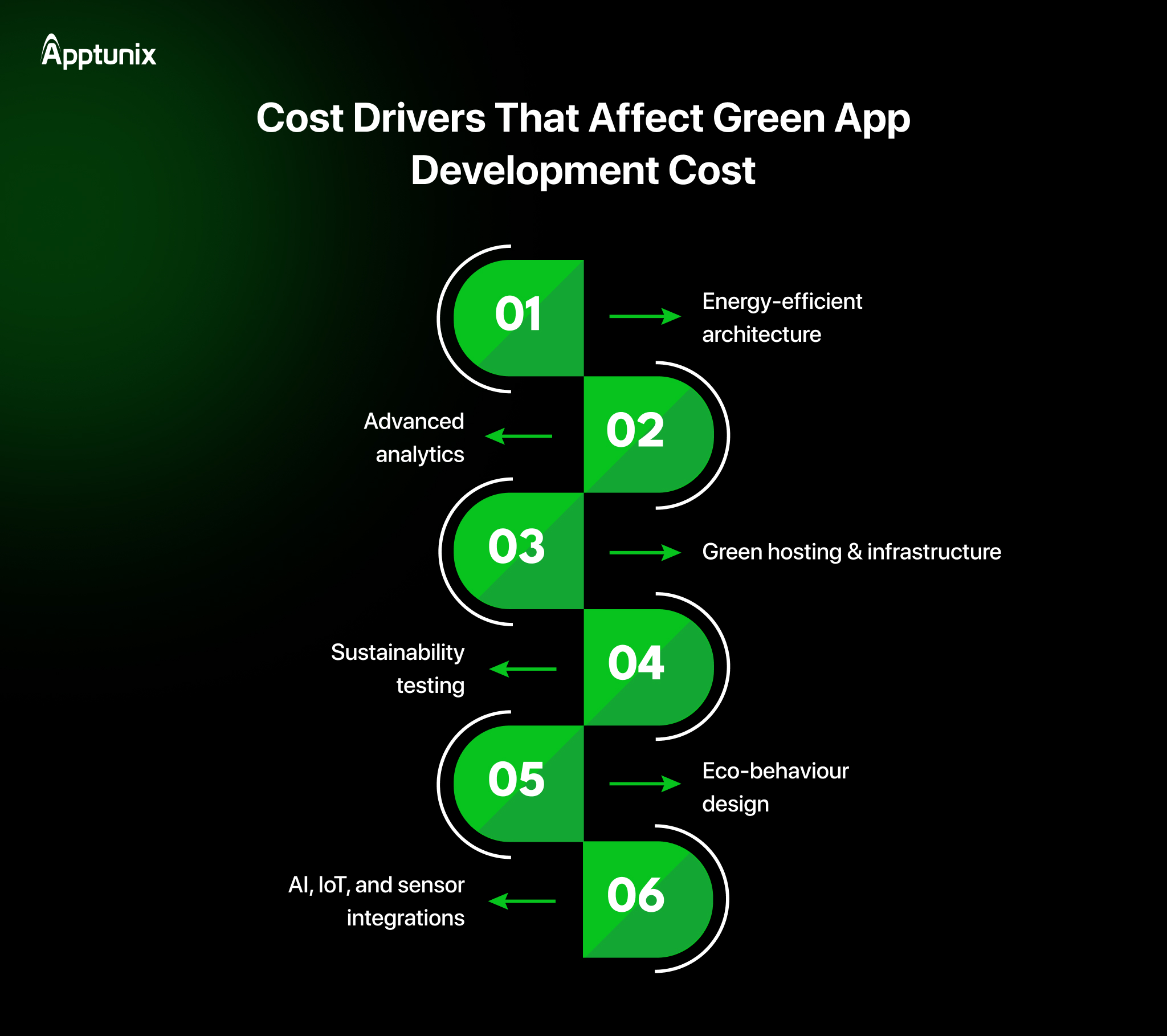
1.Energy-efficient architecture: Lightweight structures, optimized rendering, and minimal server dependency take more time to plan and engineer.
2.Advanced analytics: Tools that measure carbon emissions, battery usage, and network efficiency require specialist integration.
3.Green hosting & infrastructure: Carbon-neutral cloud services often come at a slightly higher premium.
4.Sustainability testing: Battery drain testing, network optimization checks, and carbon footprint validation add to QA cycles.
5.Eco-behavior design: Crafting UI patterns and workflows that encourage sustainable habits requires extra research and strategy.
6.AI, IoT, and sensor integrations: Many businesses investing in green application development require smart insights, which may add to the budget.
These drivers are essential for any business serious about building a green app that meets modern environmental expectations.
The green app development cost varies by location, scope, and feature depth. Generally, it ranges between USD 20,000 – USD 250,000+. Below are realistic, industry-backed ranges to guide your planning.
Estimated Green App Development Cost Ranges
| App Type | Estimated Cost (USD) | What’s Included |
|---|---|---|
| Simple green utility app (carbon tracker, eco-tips, low-features) | $20,000 – $40,000 | Basic UI, single platform, simple analytics |
| Mid-level green app (resource monitoring, user dashboards, gamification) | $40,000 – $80,000 | Advanced UI, multi-feature workflows, and sustainability reporting |
| Feature-rich eco platform (AI, IoT sensors, multi-device sync, enterprise dashboards) | $80,000 – $250,000+ | Complex integrations, cross-platform apps, cloud optimization |
Regional costs can vary, too:
By the way, actual pricing depends on the level of eco-features, integrations, API complexity, and long-term maintenance.

Investing in green app development services delivers long-term benefits far beyond eco-compliance. Businesses see direct returns across cost reduction, brand trust, and user engagement.
Key ROI factors:
Note: Choosing to make green app solutions today gives your business a measurable competitive edge tomorrow.
Businesses must be selective when choosing a partner for green app development solutions. Not all companies follow sustainable practices, and the gap affects performance, compliance, and costs.
Key questions to ask before hiring:
✔ Do they measure carbon emissions and energy usage during development?
✔ Can they show experience in developing a green app or eco-friendly platforms?
✔ Which cloud providers, frameworks, and sustainability tools do they use?
✔ How do they optimize UI, backend, and data processes for efficiency?
✔ Do they provide post-launch eco-optimization?
✔ Can they offer a transparent cost breakdown for the cost to develop a green app?
A reliable partner ensures your vision becomes a scalable, efficient, and sustainable product and not just another app.
A well-planned investment in green technology ensures your digital product stands out, performs better, and aligns with global sustainability expectations. Furthermore, when executed by the right green app development company like Apptunix, the journey becomes smoother, predictable, and highly rewarding.
Investors often ask one crucial question: How green apps make money while staying environmentally responsible? The answer is clear – green apps generate revenue just like mainstream digital products, but they unlock additional income streams tied to sustainability. When businesses develop green app solutions or invest in building a green app, they gain a dual advantage: strong commercial potential and measurable eco-impact.
Below are the most practical and profitable monetization models used by successful green platforms.
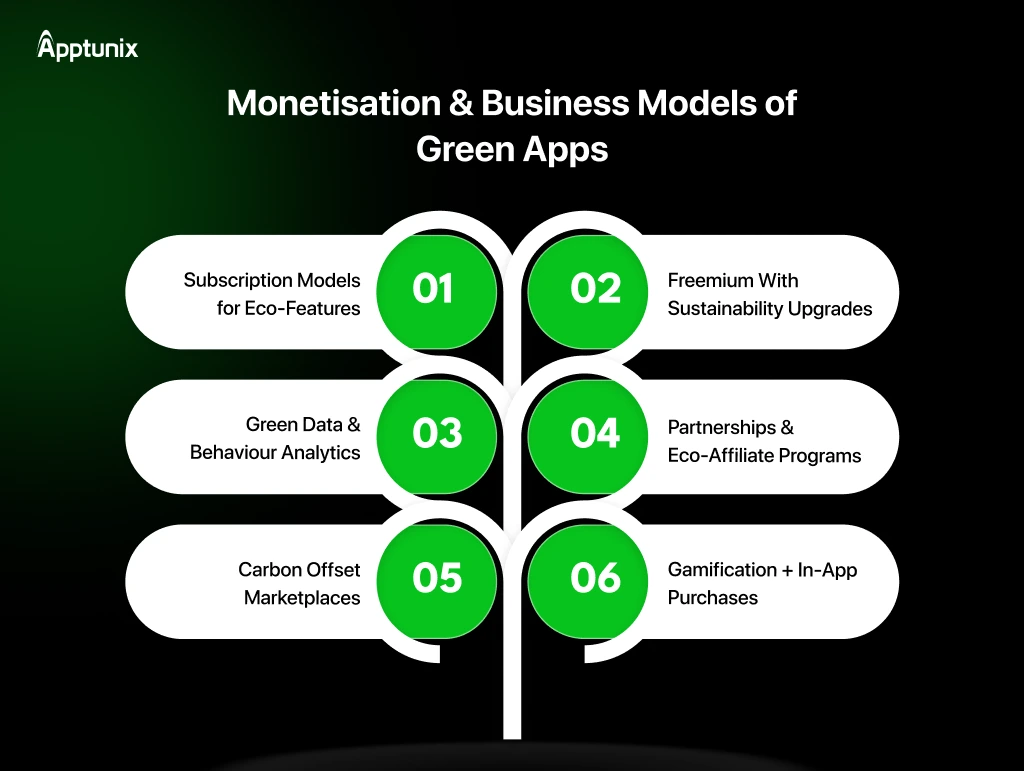
1.Subscription Models for Eco-FeaturesMany users are willing to pay monthly or yearly fees for advanced sustainability tools.
Examples of paid features:
A subscription model works perfectly for companies aiming to make green app platforms that become daily habit tools.
2.Freemium With Sustainability UpgradesBusinesses can attract a wide audience by offering free core features while charging for premium eco-benefits.
Premium upgrades may include:
This model fits products built through robust green application development, where user adoption matters before monetization.
3.Green Data & Behavior AnalyticsEthical and anonymized sustainability data holds strong value.
Investors and partners may pay for:
These insights enable brands, governments, and eco-focused companies to plan more effective sustainability initiatives. This revenue stream becomes powerful when you build green app solutions that collect meaningful environmental metrics.
4.Partnerships & Eco-Affiliate ProgramsGreen apps can easily partner with eco-friendly brands, generating commissions per purchase.
Examples:
This approach works beautifully for apps built by a green app development company that understands strategic integrations.
5.Carbon Offset MarketplacesA fast-growing revenue model allows users to:
Apps earn a margin on every transaction. This model is becoming a major monetization channel in green software development, especially for global platforms.
6.Gamification + In-App PurchasesGamified systems make sustainable actions fun and profitable.
Possible revenue streams:
Apps built with green mobile app development methods often integrate lightweight gamification to reduce resource usage while increasing revenue.
When developing a green app, you aren’t just creating another digital product. You are building something with:
Dual Value Power
Users are more loyal to brands that align with their values. Investors increasingly prioritize sustainable digital products. The market for eco-focused apps is expanding rapidly and creating massive opportunities for anyone looking to build green app solutions today.
A well-designed monetization strategy ensures your green app remains profitable while contributing meaningfully to the planet. When paired with expert green app development services, the outcome is a future-ready product that stands out in a crowded market and creates lasting business value.

The next decade will transform how businesses approach green mobile app development or green software development. Global demand for low-carbon digital products is rising fast, driven by new regulations, smarter users, and rapid technological progress. Businesses that start building a green app now gain a massive early-mover advantage as sustainability becomes a non-negotiable standard across industries.
According to IMARC Group, the global green IT services market is projected to reach USD 102.47 billion by 2033, showing how strongly the world is shifting toward eco-centric technology. This momentum unlocks powerful opportunities for innovators ready to develop green app platforms that meet the needs of a changing digital landscape.
Future opportunities extend far beyond traditional apps. Businesses adopting green application development today can tap into high-growth ecosystems that will dominate tomorrow’s economy.
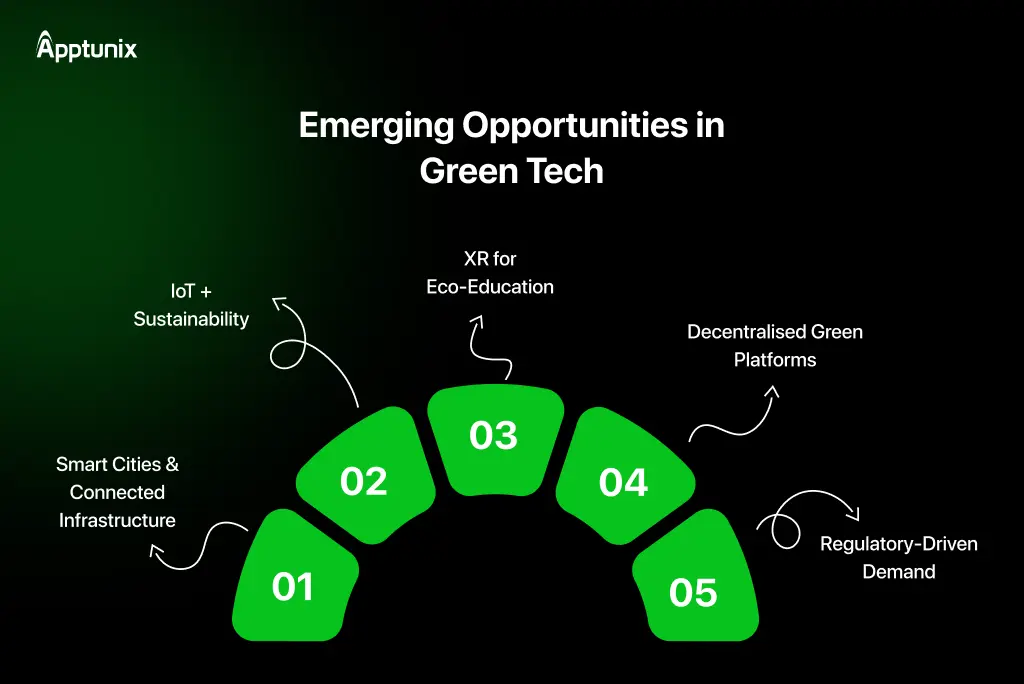
1.Smart Cities & Connected Infrastructure
Governments are investing heavily in smart mobility, smart grids, and intelligent waste management. Green app development solutions can integrate:
This presents massive potential for enterprise-grade green software development.
2.IoT + Sustainability
IoT remains one of the biggest enablers for real-time eco insights.
Use cases include:
Businesses can build green app platforms that manage devices while keeping energy usage minimal.
3.XR for Eco-Education
AR/VR experiences will redefine environmental awareness.
Examples:
This creates premium opportunities for app monetization.
4.Decentralized Green Platforms
Blockchain-based sustainability apps are on the rise, enabling:
Such platforms often require advanced green application development expertise.
5.Regulatory-Driven Demand
More countries are implementing rules on:
This guarantees long-term demand for green app development services.
While opportunities are massive, businesses must navigate certain challenges to stay competitive.
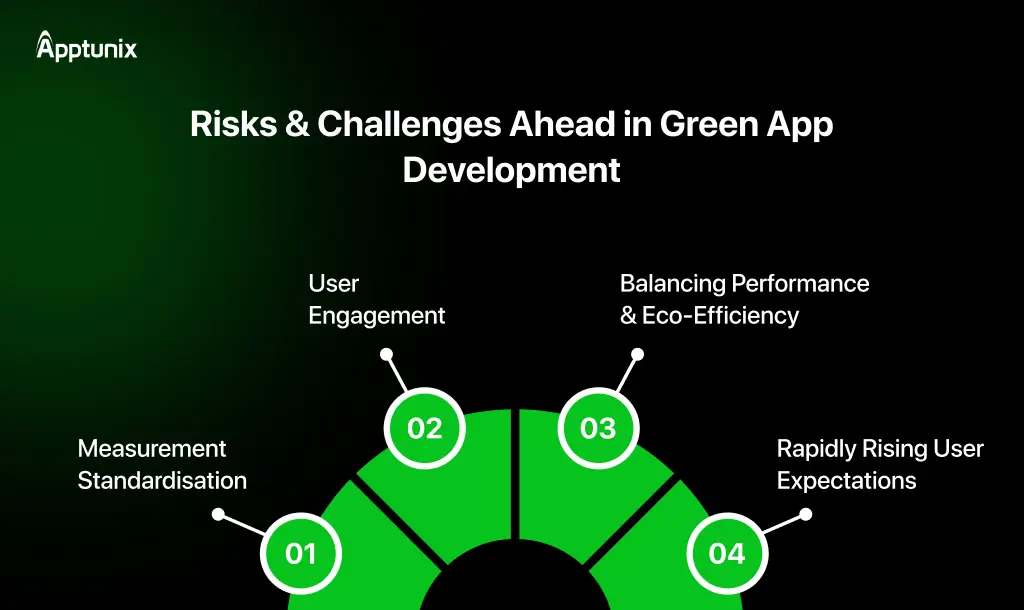
1.Measurement Standardization
There’s still no universal benchmark for measuring an app’s carbon footprint. This makes sustainability scoring inconsistent and complicates compliance.
2.User Engagement
Not all users actively engage with eco-features. Apps need smart behavioral design. Something crucial in developing a green app that actually changes habits.
3.Balancing Performance & Eco-Efficiency
Apps must stay fast and feature-rich while:
Only an experienced Android & iOS green app developer can balance both ends efficiently.
Also Read: iOS App Development Cost: Full Guide
4.Rapidly Rising User Expectations
People around the world are looking for:
Needless to say, apps that fail here risk losing trust.
Now the Final Question: Why Choosing a Future-Ready Partner Matters?
Well, the future of sustainable digital products will be shaped by green app development companies capable of blending innovation with environmental responsibility. Furthermore, when you partner with a team that deeply understands green mobile app development, you gain more than an app. You gain a future-proof solution built to evolve with the global sustainability landscape.
You need a partner that delivers real green outcomes. We are a specialized green app development company that focuses on results. Our team includes experienced green app developers and eco-tech experts. We offer enterprise-grade end-to-end green app development services and tailored green app development solutions for enterprises.
Our work covers green mobile app development and green software development. Apptunix is known for designing energy-efficient systems. In other words, we build low-carbon backends. Apart from this, we specialize in green app design and green app UI that reduce device power draw and network usage. In short, we create apps that perform better while using less energy.
Our core differentiators:
Apptunix has earned a solid reputation in building green app platforms that attract users and partners. You can expect green app solutions that create new revenue instantly. Apart from this, if you are looking for advice on green app development costs and practical budgets, we are here to explain it all so investors can plan ROI.
Choosing us means choosing a future-ready partner for sustainable app development, eco-friendly app development, and energy-efficient app development. We focus on sustainable digital product development and on green IT best practices available globally.
Bonus Read: Why Your Next App Should Be Built With Apptunix?
Q 1.What is green app development?
Green app development refers to designing and building applications that consume less energy, use fewer resources, and reduce overall carbon footprint. It focuses on efficient architecture, low-power usage, carbon-aware computing, and sustainable digital practices. Businesses choose this model to improve performance and support sustainability goals.
Q 2.How much does it cost to develop a green app?
The cost to build green app solutions depends on complexity, platform, features, and sustainability requirements. Simple green utility apps may start at a lower budget of about USD 20,000, while advanced eco-platforms with analytics, carbon tracking, and IoT features cost more and can exceed USD 250,000. Costs vary by region, design scope, and technical depth.
Q 3.What features must a green mobile app have?
A powerful green mobile app development project includes low-energy features such as adaptive sync, offline capability, efficient APIs, dark mode, minimalistic green app UI, energy-saving workflows, green app design, carbon calculators, and behavioral nudges for sustainable actions.
Q 4.How do green apps make money?
Green apps can generate revenue through subscriptions, freemium upgrades, in-app purchases, eco-brand partnerships, carbon offset programs, affiliate referrals, and gamified reward systems. Monetization is stronger when eco-value and user impact are combined.
Q 5.How do I choose a green app development company?
Select from a list of top green app development companies with expertise in sustainable architecture, energy-efficient coding, green cloud hosting, performance optimization, and carbon analytics. Review case studies, certifications, and their ability to deliver measurable eco-impact.
Q 6.Why is green application development important for businesses?
Green application development lowers operational costs, improves energy efficiency, enhances brand reputation, and aligns with ESG mandates. It also futureproofs products against regulatory changes and growing consumer demand for eco-friendly digital services.
Q 7.What industries benefit the most from green software development?
Any industry can gain, but the strongest impact appears in eCommerce, transportation, energy, fintech, education, logistics, fitness, and smart city solutions. These sectors benefit because users interact frequently, so efficiency improvements create bigger environmental savings.
Also Read: Your Ultimate Guide On Fitness App Development Cost
Q 8.Does green app development affect performance or speed?
No. Green app development often improves performance. Efficient code, better algorithms, optimized APIs, and lightweight UI structures reduce load times, battery usage, and server strain. The result is faster, smoother experiences.
Q 9.Can existing apps be converted into green apps?
Yes. Businesses can redesign existing apps using green application development practices. Optimization includes refactoring code, reducing backend load, switching to green hosting, improving UI efficiency, minimizing data calls, and adding sustainability tracking.
Q 10.What are the main benefits of using green app development services?
Benefits include reduced energy consumption, lower cloud costs, improved user retention, stronger brand trust, regulatory compliance, higher app performance, and long-term operational savings. Companies also gain a competitive edge by launching eco-friendly digital products that stand out globally.
(1 ratings, average: 5.00 out of 5)
Get the weekly updates on the newest brand stories, business models and technology right in your inbox.
Hardeep Singh is a seasoned B2B technical writer at Apptunix with a sharp eye for strategy and a mind wired for innovation. With over a decade of experience in technical and SEO writing, and a Master’s degree in Wireless Communication, he’s written across domains including AI, Blockchain, IoT, Cybersecurity, and beyond. At Apptunix, Hardeep drives content that bridges business goals with future-ready mobile and web solutions, thus helping startups and enterprises make smarter digital decisions.
28 Views 20 min September 8, 2026

38 Views 20 min August 27, 2026

815 Views 20 min December 26, 2025
Book your consultation with us.
Book your consultation with us.


One Central, The offices 3, Level 3, DWTC, Sheikh Zayed Road, Dubai
+971 50 782 1690