Vibe Coding vs Professional Development: Which One Should Your Business Actually Bet On?
14 Views 11 min September 30, 2026

Reena Bhagat, the CTO and Head of AI at Apptunix, is a seasoned technology strategist with a deep-rooted expertise in emerging technologies. With a focus on AI/ML integration, product engineering, cloud management, she leads the technical vision for high-performance SaaS infrastructures. Reena is recognized for building secure, scalable, and decentralized systems that solve real-world complexities. Her passion lies in leveraging data science and future-tech to create resilient digital products, making her a trusted authority for organizations looking to lead in the age of intelligent automation.
AI app development costs in Saudi Arabia vary based on app complexity and features.
Simple AI apps (like chatbots) are low-cost, while advanced AI solutions are significantly more expensive.
Major cost drivers include tech stack, data requirements, integrations, and team expertise.
Government initiatives under Vision 2030 are accelerating AI adoption and investment.
Additional costs often come from cloud services, data preparation, and compliance needs.
Businesses can reduce costs by starting with an MVP and using pre-built or AI-as-a-service tools.
Thinking of tapping into the hottest tech moves to grow your business exponentially? Integrating artificial intelligence (AI) in your app is the game-changer you need. And of course, AI is already powering smart apps globally, and Saudi Arabia is right at the centre of this digital shift.
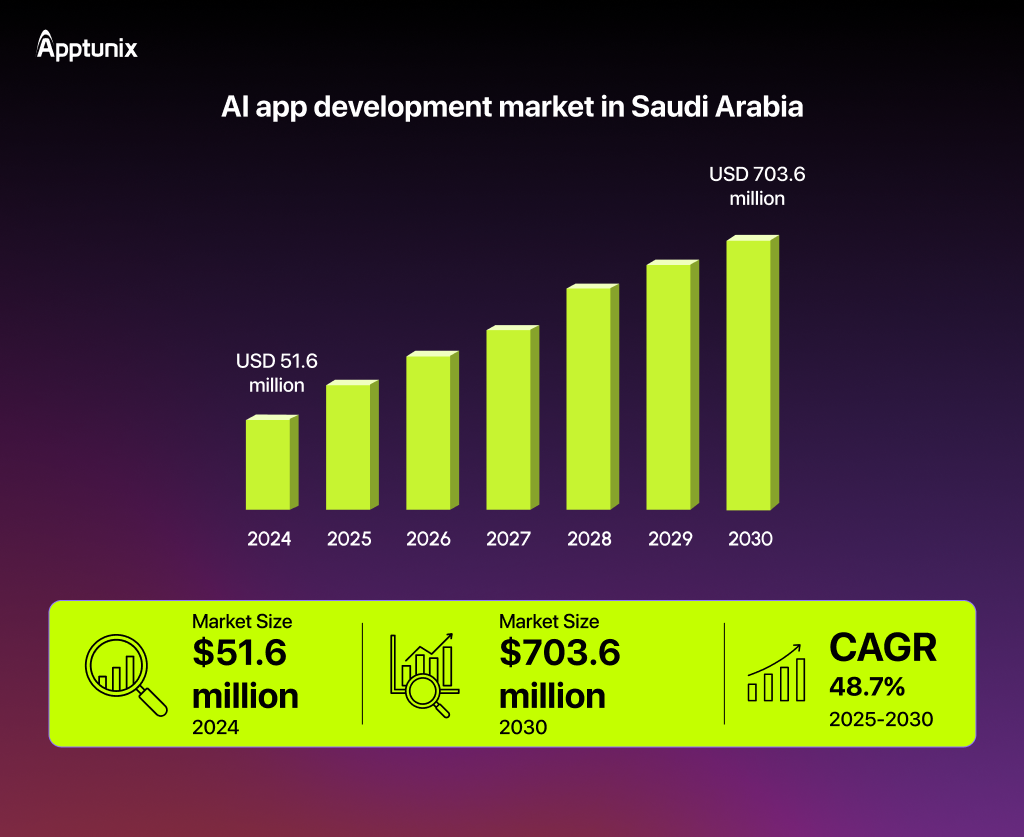
Here’s what number states:
Saudi Arabia’s AI app development market generated approximately USD 51.6 million in revenue in 2024 and is projected to surge to USD 703.6 million by 2030, growing at a remarkable CAGR of 48.7% between 2025 and 2030.
But let’s get to the most asked question: “How much does it cost for AI app development in Saudi Arabia?”
We’ve got the answer and covered it thoroughly in this guide— from key cost factors to money-saving tips— so you can plan your AI app investment with confidence. Let’s dive in!
Saudi Arabia is establishing itself as a premier hotspot for AI app development & tech innovation. Here’s why:
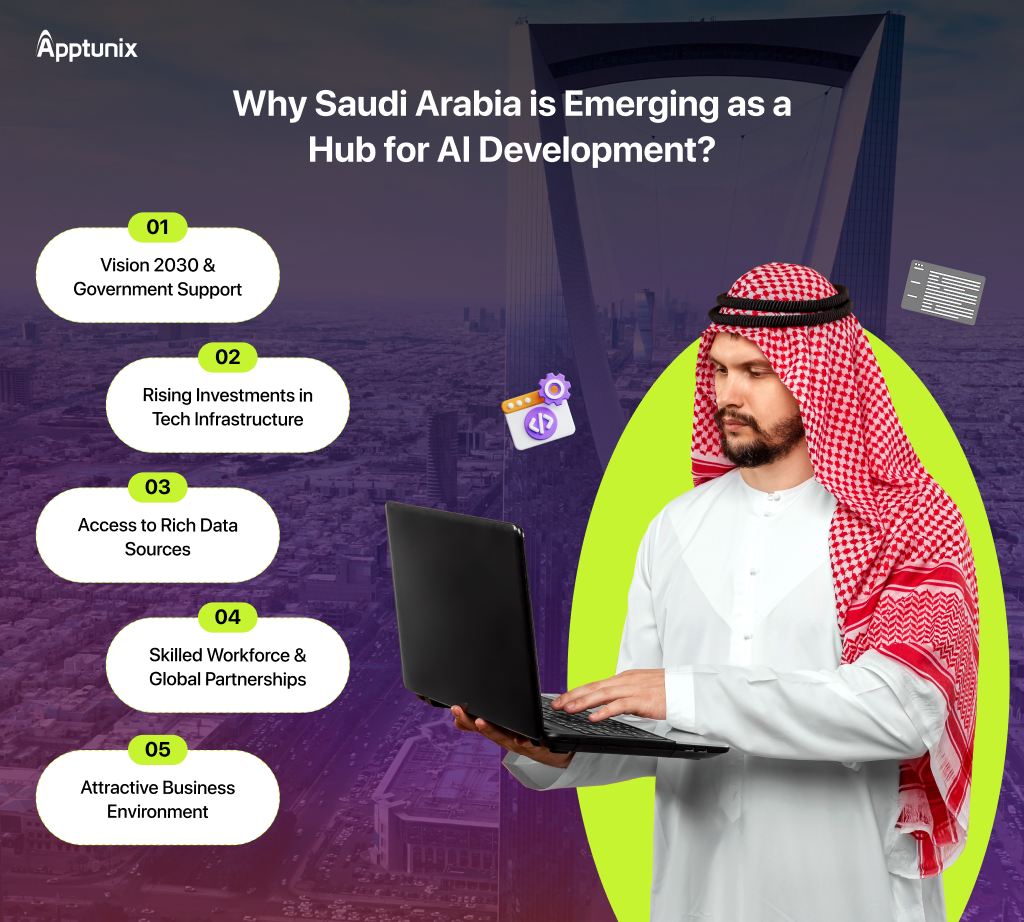
1. Vision 2030 & Government SupportSaudi Arabia’s Vision 2030 initiative is at the core of its AI ambitions. With a focus on AI adoption across a range of industries, including healthcare, energy, education, and logistics, the Saudi government has invested billions in digital transformation.
2. Rising Investments in Tech InfrastructureSaudi Arabia is making significant investments in cloud platforms, data centers, 5G, and smart cities, laying the groundwork for the widespread use of AI.
3. Access to Rich Data SourcesSaudi Arabia is an ideal location for testing AI models and solutions. It’s because it has access to large datasets from a variety of industries, including retail, healthcare, and oil and gas.
4. Skilled Workforce & Global PartnershipsThe country is investing in talent through partnerships with international IT firms and colleges that specialize in AI. This includes AI research facilities, bootcamps, and specialized AI programs.
5. Attractive Business EnvironmentSaudi Arabia’s government is offering attractive incentives to tech startups and international firms. Plus, businesses can also leverage tax relief, grants, and regulatory support. Now, this attracts firms around the world to establish their R&D and dev hubs in Riyadh and beyond.

Here’s a breakdown of different types of AI app development services in Saudi Arabia with estimated costs and use cases:
1. AI Chatbot AppsWant to simulate human-like conversations for your business? AI chatbots are your go-to solution. They offer 24/7 customer support across various industries, including healthcare, eCommerce, education, real estate, and travel.
Businesses & brands integrate contextual and personalized AI chatbots into multiple platforms. It includes voice assistants, websites, social media, and more.
Estimated Cost of AI Chatbot Apps: SAR 20,000 – SAR 40,000+
2. AI-Powered Recommendation AppsIf you want to integrate personalised suggestions for products, content, or services, an AI-powered recommendation is a must. It helps to enhance user experience and boost engagement.
These AI apps leverage artificial intelligence (AI) and machine learning (ML) algorithms to analyse user behaviour. It includes browsing patterns, purchase history, ratings, and demographics.
Estimated Cost of AI-Powered Recommendation Apps: SAR 75,000 – SAR 180,000+
3. Computer Vision AppsIf you want to enable machines to see and interpret visual information, consider using computer vision apps. These AI-powered applications can interpret and analyze visual data in real-time. It helps to support tasks like facial recognition, object detection, barcode scanning, quality inspection, and more.
Developing such apps requires extensive data training, integration with cameras or sensors, and often real-time processing capabilities.
Estimated Cost of Computer Vision Apps: SAR 90,000 – SAR 250,000+
4. Voice Assistant & Speech Recognition AppsThese AI-powered apps leverage natural language processing (NLP) to interpret and respond to voice commands. Simply stated, it converts spoken language into text, interpreting user intent to generate responses or actions. These applications are helpful for hands-free interaction and accessibility.
Estimated Cost of Voice Assistant & Speech Recognition Apps: SAR 120,000 – SAR 280,000+
5. Predictive Analytics AppsAs the name suggests, these AI-powered analytics apps predict future outcomes based on historical & real-time data. This further helps to make strategic & informed decisions.
Predictive analytics solutions turn raw data into valuable insights. Businesses can leverage this AI technology to track trends, analyze customer behavior, and identify potential risks.
Estimated Cost of Predictive Analytics Apps: SAR 90,000 – SAR 280,000+
To maintain your budget, it’s essential to understand the factors that impact the Saudi Arabia cost of AI app development. Let’s find out:
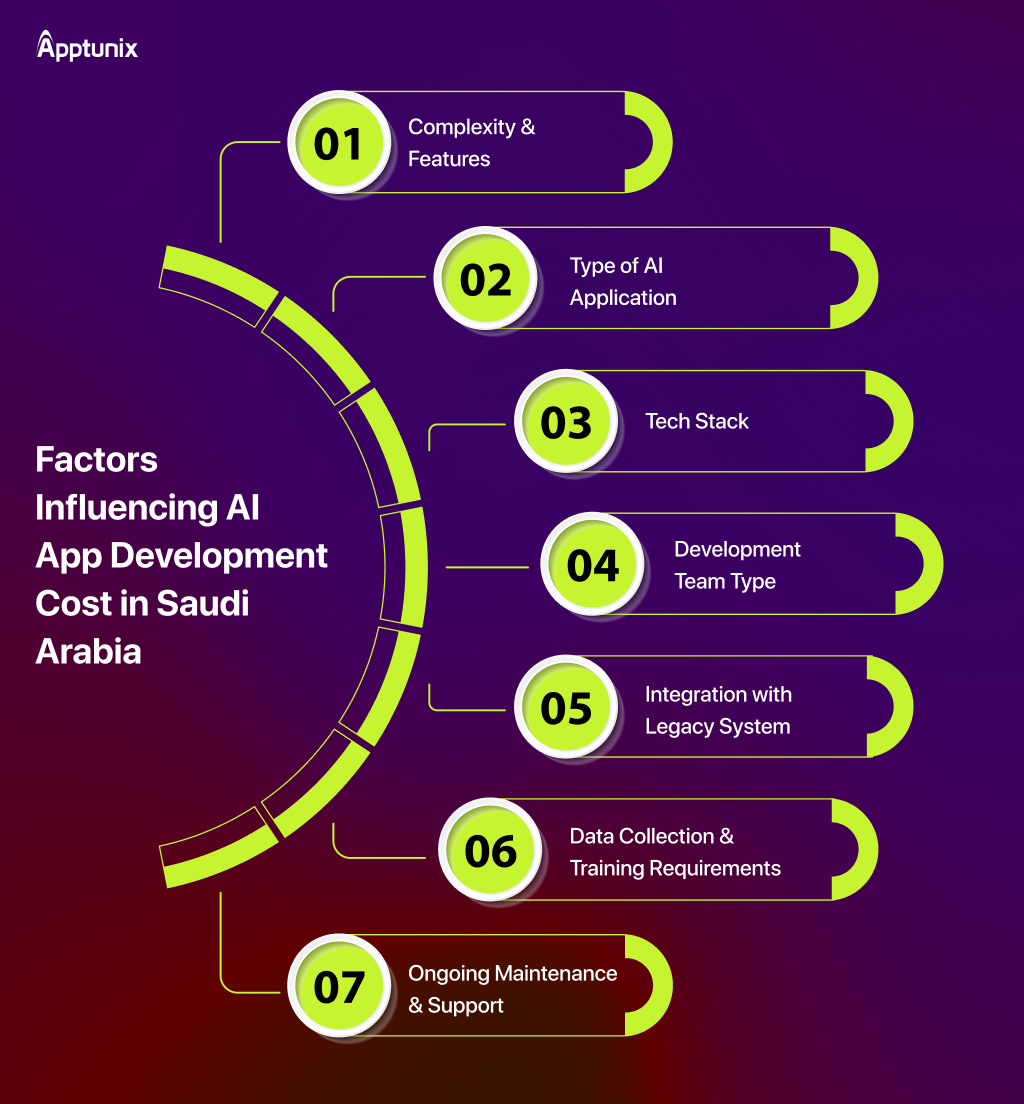
1. Complexity & FeaturesWhen it comes to AI, not all apps are created equal. The more advanced and intelligent your AI solution is, the more resources it demands — in terms of data, algorithms, development time, and testing. Check the table below:
| Complexity | Features | Estimated Cost (SAR) | Timeline |
|---|---|---|---|
| Basic App | Static Responses, Form Autofill, Basic Chatbot | 60,000 – 120,000+ | 1-2 months |
| Mid-Level App | Language Detection, Analytics, Dynamic Replies | 120,000 – 200,000+ | 2-4 months |
| Advanced App | Predictive Modeling, Personalization, Voice Recognition | 200,000 – 500,000+ | 4-6 months |
| Generative/AI-First | LLM integration, real-time learning, generative responses | 500,000 – 1 million+ | 6+ months |
2. Type of AI ApplicationWhen building an AI app, you might think that all AI applications are created equal at a similar cost. Yes, we’ve all been there, but that’s not the truth.
Every AI application requires different development time and budget. Let’s break down the common AI application types and what they typically cost in the Saudi Market:
| AI Application Type | Estimated Cost (SAR) | Complexity |
|---|---|---|
| Chatbots & Virtual Assistants | 40,000 – 150,000+ | Low to Medium |
| Recommendation Engines | 200,000 – 400,000+ | Medium to High |
| Predictive Analytics Tools | 160,000 – 400,000+ | Medium |
| Computer Vision Systems | 300,000 – 500,000+ | High |
| NLP-based Applications | 250,000 – 500,000+ | High |
| Generative AI Solutions | 500,000 – 1,000,000+ | Very High |
3. Tech StackYour AI app performance depends on your tech stack (tools, languages, and frameworks). The cost of an AI app development tech stack depends on its robustness and power.
If your app requires faster go-to-market capabilities, cloud-based AI services (such as Azure Cognitive Services, AWS SageMaker, or Google Vertex AI) offer scalability and pre-trained models — albeit at a premium. However, if you’re using open-source libraries like TensorFlow or PyTorch, you’ll save on licensing fees.
Take a look:
| Tech Stack Type | Common Tools/Platforms | Cost Impact | When to Choose |
|---|---|---|---|
| Open-Source Stack | Python, TensorFlow, PyTorch | Budget-Friendly | MVPs, research projects, and custom models |
| Cloud-based AI Services | AWS, SageMaker, Azure AI, Google Vertex AI | Medium-to-High | Scalable apps, fast prototyping |
| Enterprise Stack | IBM Watson, Oracle AI, Microsoft Azure + Security Tools | High | Large enterprises with security needs |
| Edge + AI Stack | TensorFlow Lite, Core ML, NVIDIA Jetson | Medium-to-High | AI on Mobile, IoT, real-time processing |
4. Development Team Type“Who’s building your AI application?” – This is another factor that influences the cost of developing an AI application. Whether you hire a local mobile app development company in Saudi Arabia, outsource to global teams, or hire freelance developers, all will have their different rates depending on expertise and experience.
Let’s take a closer look:
| Team Type | Estimated Hourly Rate (SAR) | Pros | Cost Impact |
|---|---|---|---|
| Local (Saudi) | SAR 300-500+/hr | Arabic NLP, Cultural Fit, Timezone Match | High |
| Offshore | SAR 100 – 300+/hr | Scalable, Cost-effective, and experienced in AI | Budget-Friendly |
| Freelancers | SAR 80 – 250+/hr | Flexible for short-term or MVP builds | Low to Moderate |
5. Integration with Legacy SystemMost enterprises in Saudi Arabia (Banking, Oil & Gas, and Government) use legacy systems built on outdated technologies. These systems often use outdated databases, lack APIs, or follow non-standard architectures. This makes integration highly complex, expensive, and time-consuming.
So, what does that mean for your AI app development budget?
For instance, integrating a new AI-based demand forecasting tool into a 10-year-old inventory system may cost 30–40% more than building the AI tool itself, solely due to the complexity of the backend.
Check details:
| Integration Case | Challenges | Cost Impact |
|---|---|---|
| Modern APIs Available | Smooth integration possible | Low |
| Limited/Outdated API or Architecture | Requires custom coding, data mapping | Medium |
| Legacy Core (No Integration Support) | Needs middleware, data migration, and extensive testing | High |
6. Data Collection & Training RequirementsAn AI app depends heavily on data. Without clean, structured, and well-labelled data, even the most advanced algorithm will fail to perform effectively.
In Saudi Arabia, collecting local or Arabic-language data introduces an additional layer of complexity. Whether you’re training a chatbot in Arabic dialects or building a recommendation system for Saudi shoppers, you’ll need:
And if your data isn’t readily available? You’ll need to collect it from scratch — either via third-party sources, user input, or IoT sensors.
| Data Type | Effort Level | Cost Impact |
|---|---|---|
| Open Source/Public Datasets | Low | Budget-Friendly |
| Custom Business Data | Moderate (requires cleaning) | Medium |
| Manually Labeled/Collected | High | High |
7. Ongoing Maintenance & SupportMany businesses underestimate this: an AI app requires regular maintenance and monitoring to remain effective. Unlike traditional apps, AI systems evolve with data, and without maintenance, they become less accurate over time.
Here’s what ongoing support usually includes:
This is especially important in dynamic industries such as e-commerce, healthcare, and finance, where behavior patterns shift frequently.
Note: It’s smart to budget 15–25% of your total AI development cost annually for maintenance and model updates.
AI Maintenance Scope & Cost Overview:
| Maintenance Activity | Frequency | Cost Impact (Annual) |
|---|---|---|
| Model Performance Monitoring | Monthly/Quarterly | Low |
| Data Refresh & Re-training | Quarterly/Semi-annually | Medium |
| Full System Upgrades | Annually | High |

No one wants hidden charges or additional costs when budgeting for AI app development. However, various costs arise, impacting the budget, timeline, and compliance. Let’s explore the most common ones:
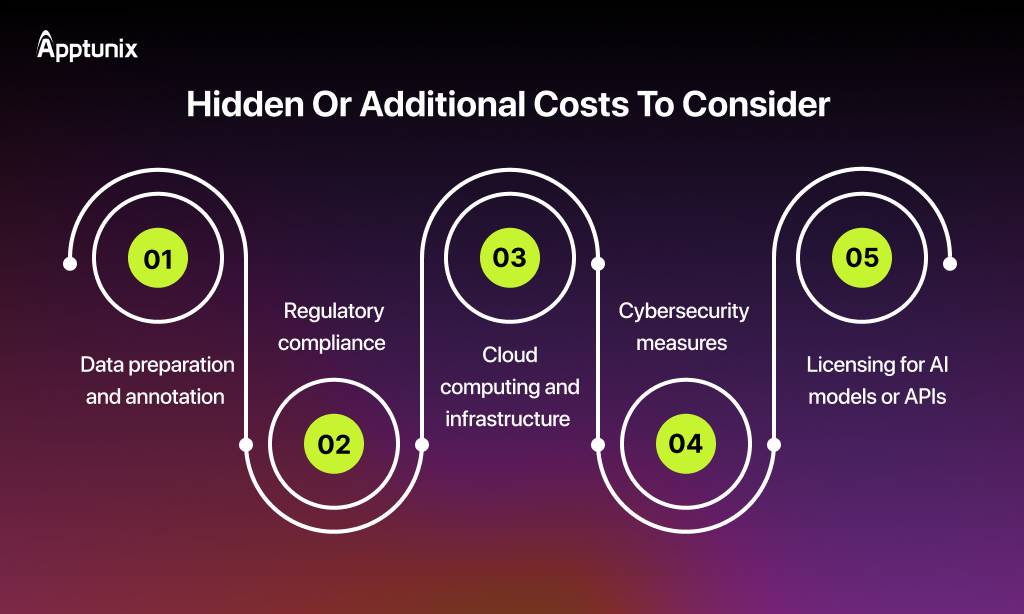
1. Data Preparation & AnnotationThe quality of AI models depends on the quality of the data they are trained on. It may take weeks or even months to prepare this data, including cleaning, categorizing, and arranging it. Whether you hire internal teams or outsource, the cost of manual annotation or using third-party tools adds up quickly.
2. Regulatory ComplianceComplying with local and global regulations is highly crucial for some industries. It includes healthcare, finance, or government. This may require legal consultations, compliance audits, and security updates, all of which incur additional costs.
3. Cloud Computing & InfrastructureTraining and operating AI models require robust cloud environments. Services such as Google Cloud, AWS, and Azure often charge for data storage, compute hours, and usage. This will cost more, especially for large-scale applications.
4. Cybersecurity MeasuresAI apps often handle sensitive data and information, which becomes a prime target for cyber threats. So, investing in secure APIs, encryption, vulnerability testing, and compliance with security standards becomes necessary – but also costly.
5. Licensing for AI Models or APIsThe majority of AI features rely on licensed APIs (such as OpenAI and Google AI). These often follow a subscription pricing model or pay-per-use, which means your expenses increase as your business expands.
Let’s now delve into the most asked question – “How to save money on AI app development?”
Check the following tips:
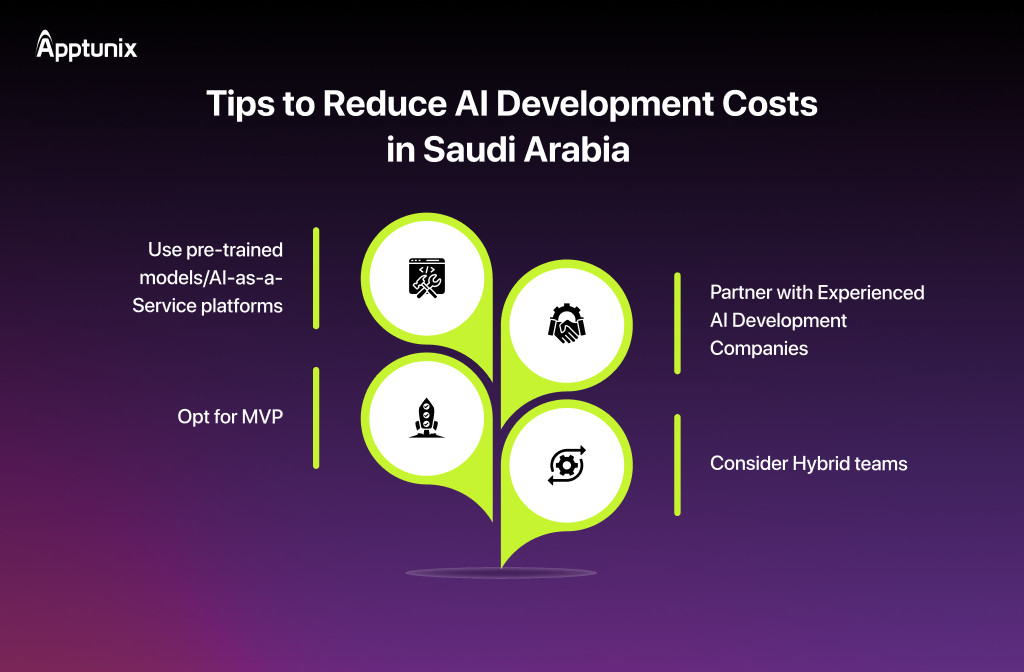
1. Use Pre-Trained models/AI-as-a-Service PlatformsTo build a complex AI model from scratch, you’ve to invest heavily in it. Instead, you can utilize pre-trained models or AI services like OpenAI, Google Cloud, or AWS. Result? You get to save time, reduce training costs, and help you get to market faster without compromising performance.
2. Partner with Experienced AI Development CompaniesIf you want to minimize risk with your project, consider looking for top AI app development companies in Saudi Arabia. They already have the tools, expertise, and proven workflows.
Plus, they have experience in building similar projects, which enables faster delivery, better ROI, and fewer mistakes.
We’re suggesting this option because it will ultimately save you money in the long term. So, it’s like a one-time investment with no hidden costs and no drastic surprises.
3. Opt for MVPStart small and grow eventually – that’s what MVP (Minimum Viable Product) is all about. You don’t have to launch your full-fledged AI app platform.
It’s an affordable and faster option that allows you to test the market, gather user feedback, and evolve a product backed with data – without draining your entire investment upfront.
Once you’ve tested your AI app, you can reach out to investors and launch your fully advanced AI app.
4. Consider Hybrid TeamsOf course, hiring an in-house team in Saudi Arabia can be an expensive option, and outsourcing to an offshore team can also be uncertain.
In that case, you can opt for hiring hybrid teams – the best of both worlds.
Blending local talent with offshore experts not only offers quality and affordability but also flexibility to scale your resources as your project grows.
Get industry-wise insights into AI adoption, use cases, and the estimated cost it takes to build powerful AI-driven applications.
1. AI in HealthcareAI in healthcare has generated significant interest worldwide. Doctors and other medical professionals are employing robots and artificial intelligence to detect and cure critical diseases such as diabetes mellitus and cancer. AI-powered patient monitoring apps make remote vital sign checks easier, especially in the post-COVID era.
Estimated Cost: Developing an AI in a healthcare app in KSA typically ranges between SAR 150,000 to SAR 650,000+, depending on features, integrations (e.g., with hospital EMRs), and regulatory compliance.
2. AI in RetaileCommerce businesses are utilizing AI to enhance customer engagement, provide customized shopping experiences, and expedite inventory management.
From dynamic pricing and product recommendation engines to AI-powered visual search and demand projections, retailers are using data-driven insights to increase conversions and save operating costs.
According to McKinsey, AI in retail can increase profit margins by up to 60% when applied effectively across the supply chain and customer journey.
Estimated Cost: For AI recommendation engines or demand forecasting tools, the cost ranges from SAR 150,000 to SAR 700,000+, depending on the data volume and the need for third-party integrations (such as POS or ERP systems).
3. AI in FinanceeCommerce businesses are utilizing AI to enhance customer engagement, provide customized shopping experiences, and expedite inventory management.
From dynamic pricing and product recommendation engines to AI-powered visual search and demand projections, retailers are using data-driven insights to increase conversions and save operating costs.
According to Business Insider, banks can save up to $447 billion by 2023 through the use of AI applications, demonstrating the long-term impact and cost-effectiveness of these solutions.
Estimated Cost: AI solutions for fraud detection or credit scoring typically cost between SAR 120,000 and SAR 750,000, especially when involving real-time analytics and training machine learning models.
Ready to turn your AI app idea into a robust solution? At Apptunix, a leading AI app development company in Saudi Arabia, we don’t just develop apps—we build intelligent, future-ready experiences tailored to your business goals.
What We Offer:
From concept to deployment, our expert team of Android & iOS app developers in Saudi Arabia ensures smooth execution, data security, and cutting-edge performance. Whether you’re starting small or scaling big, we help you harness the true potential of AI in every line of code.
Let’s bring your AI vision to life—talk to our experts today.

Q 1.How long does it take to build an AI app in Saudi Arabia?
The development time for an AI app in Saudi Arabia typically ranges from 3 to 9 months, depending on the complexity of the features, data availability, and the scale of AI integration.
Q 2. How much does it cost to develop an AI app in Saudi Arabia?
The cost to develop an AI-powered app in Saudi Arabia in 2025 can range from SAR 75,000 to SAR 1,000,000+ (approximately USD 20,000 to USD 266,000+).
Cost depends on factors like:
Complexity of AI models
Customization level
Data processing needs
API integrations
UI/UX design
Government initiatives supporting AI innovation may also offer funding or incentives to reduce costs for local businesses and startups.
Q 3.Is AI app development expensive in Saudi Arabia?
It depends on your business goals. While AI app development is more expensive than traditional apps due to data modeling and algorithm complexity, Saudi Arabia offers competitive rates compared to Western markets. Plus, Vision 2030 initiatives support digital innovation, potentially lowering costs for local businesses.
Q 4.Can startups afford AI development in Saudi Arabia?
Yes, many startups in KSA are investing in AI with MVPs (Minimum Viable Products) to manage costs.
Options like:
Open-source AI models
Low-code tools
Government-backed funding…can help startups launch with a lower initial investment, then scale later.
Q 5.Are there AI development grants or support programs in KSA?
Yes. Saudi Arabia’s Vision 2030 initiative is heavily investing in digital transformation.
Programs like SDAIA (Saudi Data & AI Authority) and NEOM Tech & Digital offer opportunities for funding, partnerships, and innovation support.
Local startups may benefit from tech incubators, VC funds, and government incentives.
Q 6.Do I need a local AI development team in Saudi Arabia?
Not necessarily. While hiring a local team offers benefits like market understanding, compliance, and Arabic localization, many businesses also outsource to experienced global partners familiar with AI in the MENA region. A hybrid approach is often ideal — core AI built by experts, localized by in-country devs.
(3 ratings, average: 5.00 out of 5)
Get the weekly updates on the newest brand stories, business models and technology right in your inbox.
Reena Bhagat, the CTO and Head of AI at Apptunix, is a seasoned technology strategist with a deep-rooted expertise in emerging technologies. With a focus on AI/ML integration, product engineering, cloud management, she leads the technical vision for high-performance SaaS infrastructures. Reena is recognized for building secure, scalable, and decentralized systems that solve real-world complexities. Her passion lies in leveraging data science and future-tech to create resilient digital products, making her a trusted authority for organizations looking to lead in the age of intelligent automation.
14 Views 11 min September 30, 2026
40 Views 11 min September 10, 2026
61 Views 11 min August 25, 2026
Book your consultation with us.
Book your consultation with us.


One Central, The offices 3, Level 3, DWTC, Sheikh Zayed Road, Dubai
+971 50 782 1690