How Much Does It Cost to Build a Money Transfer App Like Wise?
50 Views 9 min August 25, 2026

Reena Bhagat, the CTO and Head of AI at Apptunix, is a seasoned technology strategist with a deep-rooted expertise in emerging technologies. With a focus on AI/ML integration, product engineering, cloud management, she leads the technical vision for high-performance SaaS infrastructures. Reena is recognized for building secure, scalable, and decentralized systems that solve real-world complexities. Her passion lies in leveraging data science and future-tech to create resilient digital products, making her a trusted authority for organizations looking to lead in the age of intelligent automation.
Imagine a traveler rushing to the airport, phone in hand, and booking a last-minute ticket within seconds, without waiting in queues or dealing with agents. Isn’t it good?
People are actually experiencing this seamless digital experience today, thanks to flight booking apps.
The flight booking market is growing rapidly due to user demand; from startups to global airlines, businesses are heavily building applications that simplify travel.
This leads businesses to capture a growing share of the market among digital-first users.
However, before proceeding with flight booking custom app development services, one crucial question comes to mind: how much do these types of travel booking app development cost?
Well, the answer isn’t that simple because it depends on app complexity, requirements, features, and business goals.
As of 2026, the flight booking app development cost ranges from $20,000 to $160,000+, depending on feature integration.
We break down the real cost in this detailed guide to help you plan smarter and invest wisely.
Dive in now!
Well, the flight or airline booking platform market is growing rapidly. It is experiencing a dynamic shift towards mobile and personalized solutions for better convenience for users. Let’s examine the statistics and facts about the airline booking platform market:
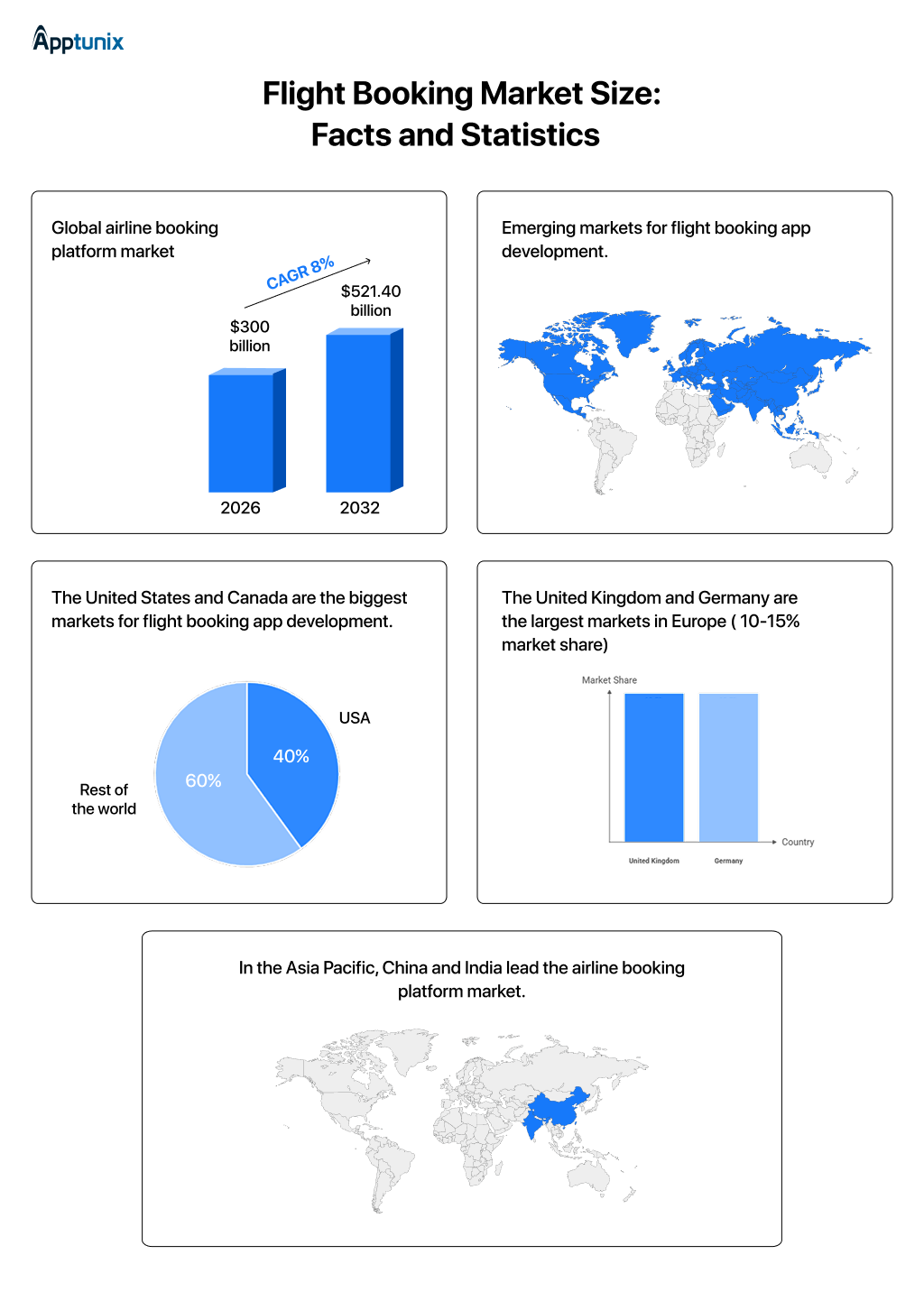
-> The global airline booking platform market is expected to grow with a CAGR of 8% between 2026 and 2032.
-> As of 2026, the flight booking platform market stands at around $300 billion and is expected to reach $521.40 by 2032.
-> North America, Europe, and Asia are the emerging markets for flight booking app development.
-> The United States and Canada are the biggest markets, with the USA alone accounting for 40% of market share.
-> The United Kingdom and Germany are the largest markets in Europe for using travel booking platforms, contributing 10-15% to the overall global market share.
-> In the Asia Pacific, China and India lead the airline booking platform market, where China alone accounts for 12% of the total market share.
Now, it’s time to examine a full cost breakdown of a custom flight booking app in 2026.

The average flight ticket booking app development cost is $20,000 to $160,000+ or more when you integrate extremely high AI or other complex features into your platform.
You can build an MVP or basic app with key features like user registration, flight search, flight booking, and payment integration, costing around $20,000 to $40,000, based on timeline and feature integration. A basic flight booking system takes 2-3 months to be fully developed from scratch.
Basic and MVP app development are kind of the same because both contain key features and can be developed in a short period of time.
A moderate level of feature integration, like real-time flight tracking, multi-language support, fare comparison, and third-party integration, builds a mid-level app. Such a solution requires $40,000 to $80,000 to be fully developed and takes 3-6 months to complete.
An advanced flight booking app takes 6-8 months or even more to build from scratch. To build a flight booking app like Skyscanner or Expedia, the development cost can easily exceed $80,000 or even $160,000 because they require highly experienced flight booking app developers.
A complex flight booking app includes high-end features like dynamic pricing, AI-based recommendations, loyalty programs, and every single feature of a basic or mid-level platform.
Examine the table to understand the flight booking app development cost based on complexity:
Let’s understand the factors that influence the overall cost to develop a flight booking app.
Several factors directly affect your overall app development budget and timeline. From app complexity and feature selection to maintenance and updates, here are the 8 factors that affect flight booking app development cost in 2026:
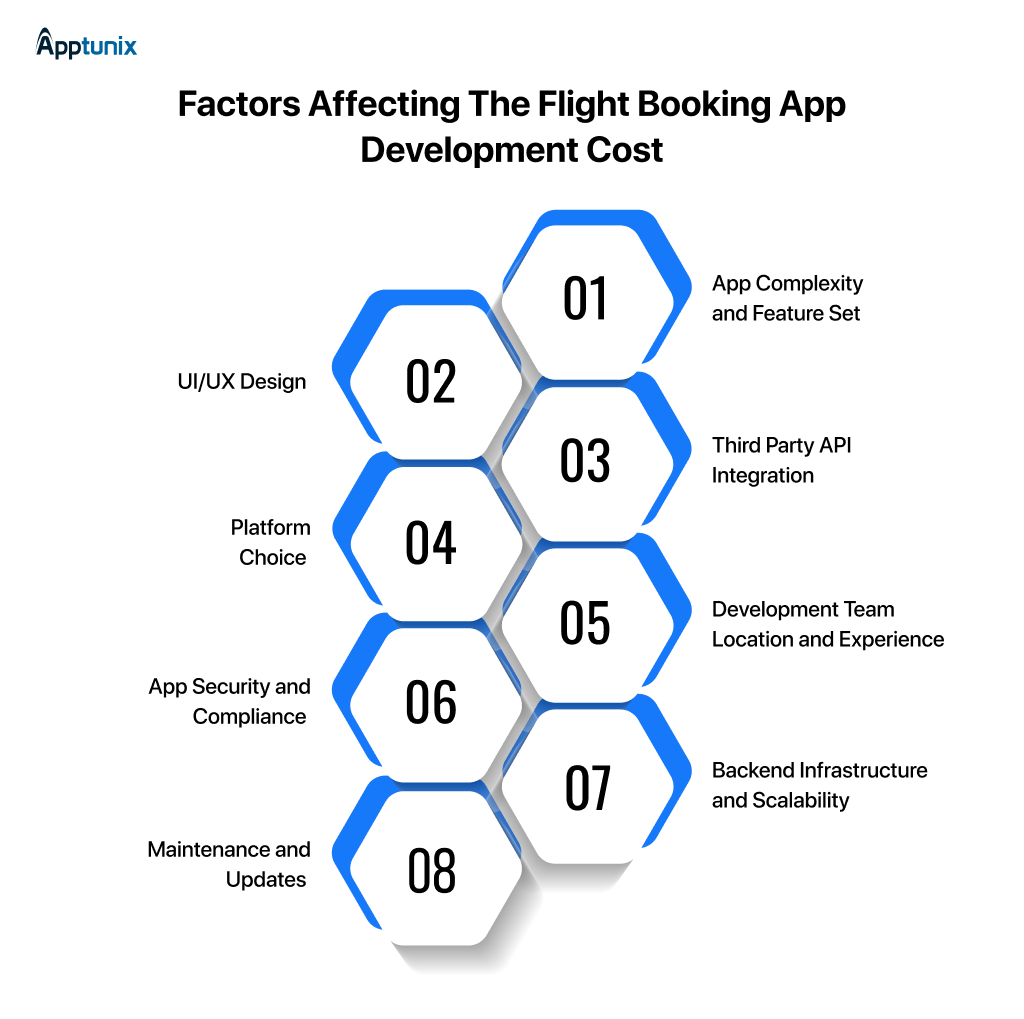
1:App Complexity and Feature SetThe features you decide to integrate, or the overall app complexity, heavily affect flight ticket booking app development costs. The more advanced your app, the higher the cost.
For example, a basic app with search or booking features costs less than adding heavy features like real-time tracking, AI recommendations, etc., which increases development effort and ultimately costs.
2:UI/UX DesignA simple design is budget-friendly, but a highly interactive, user-friendly interface with custom animations and seamless navigation requires more time and skilled designers, raising the overall cost.
3:Third-Party API IntegrationOne of the crucial factors, integrating multiple APIs for payments, flights, maps, and notifications, leads to more development time, complexity, and ongoing airline reservation app development costs.
4:Platform ChoiceDepending on your target audience and business goals, you should choose whether to build a travel app for iOS or Android or even both. Building a cross-platform app (for both iOS and Android) is more affordable than native app development (building twice for different platforms).
Cross-platform app development reduces costs, so picking it saves effort and money.
5:Development Team Location and ExperienceDevelopment team expertise, experience, and location heavily impact overall pricing. For example, countries like the United States or Canada charge more compared to cost-effective regions like India.
6:App Security and ComplianceA digital platform for flight booking handles sensitive user and payment data that requires strong security measures like encryption, secure payment gateways, and compliance with global regulations.
This increases the cost to build a flight booking app but makes the platform fully secured.
7:Backend Infrastructure and ScalabilityIntegrating advanced architecture and cloud services increases the budget since it handles high traffic, real-time updates, and large datasets within the application.
A strong backend infrastructure enables your application to seamlessly run as user demands grow. This prevents performance issues and downtime during peak hours.
8:Maintenance and UpdatesAs an entrepreneur of a travel agency or airline who is looking for an online flight booking system development, it is crucial for you to consider maintenance in your initial stage.
Post-launch support, bug fixes, feature updates, and server maintenance affect the flight booking app development cost, making it one of the crucial factors to consider.
Your application’s features decide your platform functionality and costs. Below is the table mentioning key features, descriptions, and their estimated costs to integrate.
The must-have flight booking app features for a user panel include:
The admin panel is developed with several features, which include
Here is the advanced features breakdown with estimated implementation cost:
For a custom flight booking app development, you must choose a reliable partner to ensure long-term success.
As of 2026, to create an airline booking app, the app development team follows multiple steps that, of course, influence the overall cost. Let’s explore the step-wise airline ticket booking app development cost:
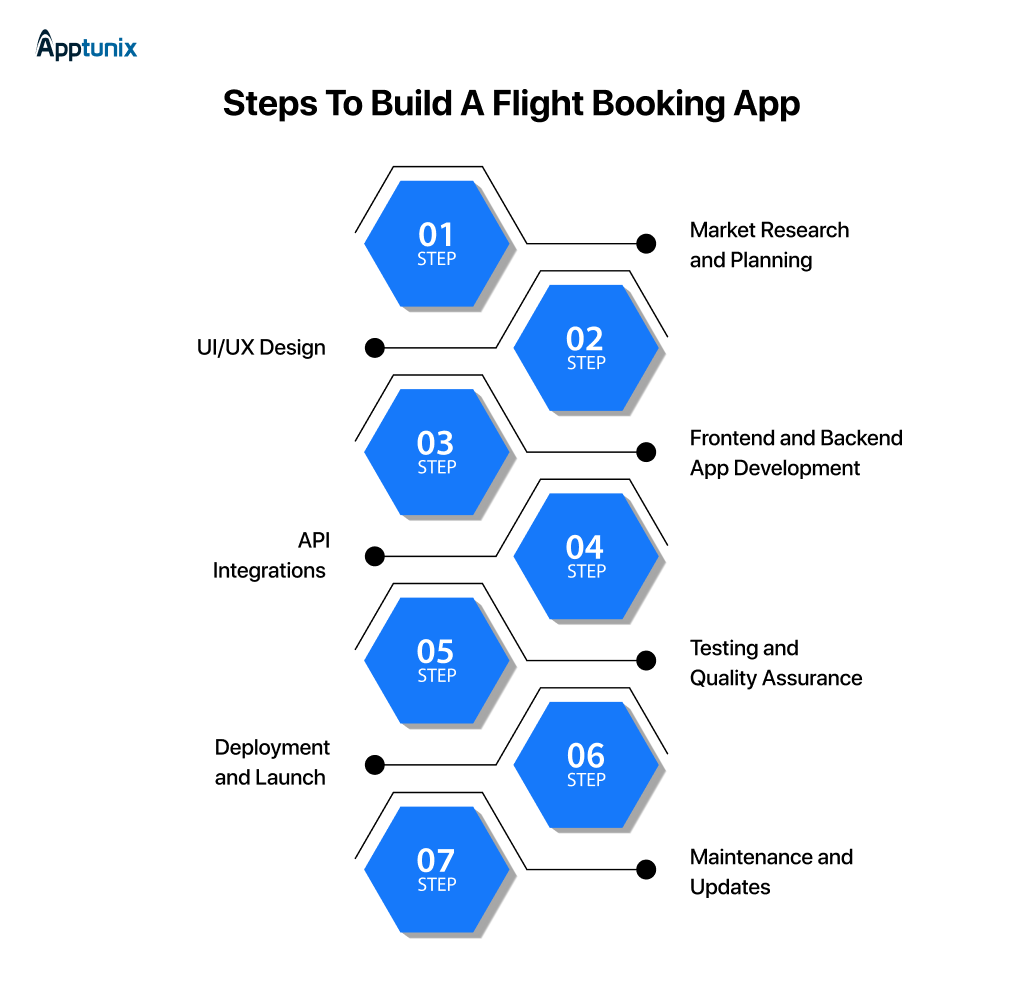
Step 1:Market Research and PlanningMarket research and planning are the most important phases of the flight booking app development process that define your
It helps you avoid costly changes or maintenance after launching the application and keeps development aligned with business requirements.
Estimated Cost: $1,000-$4,000+
Step 2:UI/UX DesignThe design decides on your app’s success, making it the core of app development. UI/UX designers create wireframes and interactive prototypes to ensure a smooth and engaging user experience.
A well-designed interface is important because it improves user retention and makes the other processes smoother.
Estimated Cost: $3,000-$12,000+
Step 3:Frontend and Backend App DevelopmentTop flight booking app developers create the user interface and server-side logic, including booking systems and user management. Here, frontend and backend developers work on their respective pages to deliver seamless UI and robust backend functionality.
This development phase consumes the largest portion of the total app budget due to its complexity, hard work, technology integration, and additional efforts.
Estimated Cost: $10,000-$60,000+
Step 4:API IntegrationsOnce the developers are done with the frontend and backend, they integrate third-party APIs to fetch real-time flight data, enable payments, and provide location services.
API integration is imperative, as it plays a crucial role in enhancing functionality but also adds to the development and maintenance costs of the platform.
Estimated Cost: $3,000-$12,000
Step 5:Testing and Quality AssuranceTesting and QA are crucial to successfully launch a flight booking app. The platform is thoroughly tested to identify
Quality analysis ensures a smooth, secure, and reliable user experience across devices and also affects the overall app development cost.
Estimated Cost: $2,000-$8,000
Step 6:Deployment and LaunchOnce the QA team ensures the quality and performance of the application, the development team goes to the deployment. The application deploys on platforms like the App Store or the Play Store with final configurations and checks.
Basically, this step ensures your app is ready for public use without technical obstacles.
Estimated Cost: $1,000-$3,000
Step 7:Maintenance and UpdatesMaintenance and updates can impact the app development cost on a monthly basis. It includes
This keeps the application running efficiently and is essential to adapt to user needs and market changes.
Estimated Cost: $500-$5,000/month
Now, before wrapping up this detailed guide on flight booking app development pricing, let’s discover the monetization strategies of a flight booking app.
There is not one or two sources to help flight booking apps generate revenue. A flight booking app enables multiple sources of revenue, like commissions, convenience fees, ads, etc.
As of 2026, a flight booking app monetization strategies include
Airline booking apps earn a commission from airlines or travel partners for every booking through the platform. They also get money when users click on the airline partner’s offer. The percentage of the commission depends on partnerships and ticket value.
Flight booking apps also charge users a small convenience fee or service fee per booking, which makes it a key revenue stream. This is a small fee for users, but it becomes a significant revenue stream for the business.
Airline booking apps also make money from displaying ads from airlines, hotels, or travel brands. Apart from that, featured deals and sponsored listings for better visibility also come under this revenue model.
Several platforms offer premium memberships to users and provide benefits like early access to deals, exclusive discounts, or even zero convenience fees. This makes the subscription model a highly income-generating revenue source sometimes.
Custom flight booking apps also generate extra profit margins by adding a small markup to ticket prices or offering dynamic pricing based on demand. This makes dynamic pricing a good source of income for businesses.
Apps also generate revenue by selling add-ons like seat selection, travel insurance, extra baggage, and meal upgrades. This revenue model not only boosts revenue but also enhances user experience.
You can successfully launch an airline booking app when you keep the right balance of features and budget planning.
Understand the development cost to choose the right feature set and monetization strategy. Every single decision impacts the budget and your app’s success.
However, your decision can’t be wrong when you partner with an experienced flight booking app provider like Apptunix. We help you in building an application from scratch and even help you with research and planning.
As a leading global mobile app development company, Apptunix can easily help you to turn your app idea into a powerful and scalable application by integrating advanced features and seamless user experiences.
With over 13+ years of experience in providing mobile app development services, we’ve delivered more than 3,000 projects in over 50 countries.
So don’t just watch the opportunity pass by; instead, turn your idea into a high-performing flight booking app by partnering with Apptunix and leading the digital market.

Q 1.How much does flight booking app development cost?
As of 2026, the cost to build a flight booking app is estimated at $20,000 to $160,000+, depending on features, integrations, and overall project complexity. A basic flight booking app can be developed for $20,000 to $40,000; a mid-complex app costs $40,000 to $80,000; and an advanced app costs $80,000 to $160,000.
Q 2.How long does it take to build a flight booking app?
Custom flight booking app development generally takes 2-8 months or even more with a super complex platform. A basic app takes 2-3 months, and a mid-level app takes 3-6 months; however, a complex flight booking app takes 6-8 months or even more based on project complexity.
Q 3.What are the key features of an airline booking app?
The key features of a flight booking app include:
User Panel Features
Admin Panel Features
Advanced Features
Q 4.What are the easy steps to create a flight booking app in 2026?
Flight booking app development steps include
Q 5.How to choose the best flight booking app development company?
You can choose the best flight booking app development partner with the help of the steps, which include
Check experience in travel or booking app development
Review portfolio of similar projects
Evaluate API integration expertise
Assess UI/UX design capabilities
Ensure scalability and security practices
Verify client reviews and testimonials
Confirm post-launch support and maintenance
Get the weekly updates on the newest brand stories, business models and technology right in your inbox.
Reena Bhagat, the CTO and Head of AI at Apptunix, is a seasoned technology strategist with a deep-rooted expertise in emerging technologies. With a focus on AI/ML integration, product engineering, cloud management, she leads the technical vision for high-performance SaaS infrastructures. Reena is recognized for building secure, scalable, and decentralized systems that solve real-world complexities. Her passion lies in leveraging data science and future-tech to create resilient digital products, making her a trusted authority for organizations looking to lead in the age of intelligent automation.
Book your consultation with us.
Book your consultation with us.


One Central, The offices 3, Level 3, DWTC, Sheikh Zayed Road, Dubai
+971 50 782 1690