
Top 10 Software Companies in London for 2026
2233 Views 15 min April 1, 2026

Sameer is a skilled technical content writer with over 8+ years of experience in the industry. He has a strong grasp of topics like AI, software development, IT solutions, and hardware technologies. Sameer is currently part of Apptunix, an enterprise mobile app development company that helps businesses build innovative digital products and solutions. At Apptunix, he focuses on crafting engaging content that makes complex ideas easy to understand. His work helps tech companies connect with their audience and communicate real value.
Software development methodologies determine far more than how a team organizes its sprints. They actually match what the business needed in the first place. That’s not a minor operational detail. According to the Standish Group CHAOS Study, up to 70% of software projects fail due to budget overruns or missed deadlines.
The reason it matters is that the right software development methodology helps teams identify issues and misalignment early. Instead of choosing software development models based on preference, businesses should consider how stable their requirements are and how quickly they need the software.
This guide covers the different types of software development methodologies in active use today. We’ll also discuss how modern software development methodologies relate to AI-assisted development and other practices reshaping how teams execute in 2026.
The goal is to give you enough to make the right call for the project actually in front of you.
So, let’s get started!
A software development methodology is the overall approach a team follows to plan, build, test, and deliver software. That’s a different thing from three terms people often use interchangeably with it:
The methodology directly shapes outcomes that show up in the budget and the calendar.
The practical stakes: Choosing the wrong software development methodology can lead to unnecessary costs and a final product that does not fully meet the business’s needs. The right approach should match the project’s requirements and how likely those requirements are to change.
Next, let’s look at the top software development methodologies currently in use.
Dozens of named methodologies exist, but most teams in 2026 are really choosing between a handful of practical options. Plus the frameworks and practices built on top of them. Here are the types of software development methodologies and why each one earns a place in this guide.
1: AgileAgile software development methodology that is built around a shared set of values and principles for how software should be built. It is done collaboratively and with a willingness to change course based on what’s actually being learned.
How it works: Work is broken into short, repeated cycles, each producing a working piece of the product. Additionally, requirements are expected to evolve as the team learns more, and priorities get reassessed between cycles.
Typical workflow: Backlog prioritization → Iteration planning → Development and testing within the iteration → Review with stakeholders → Retrospective → Repeat. 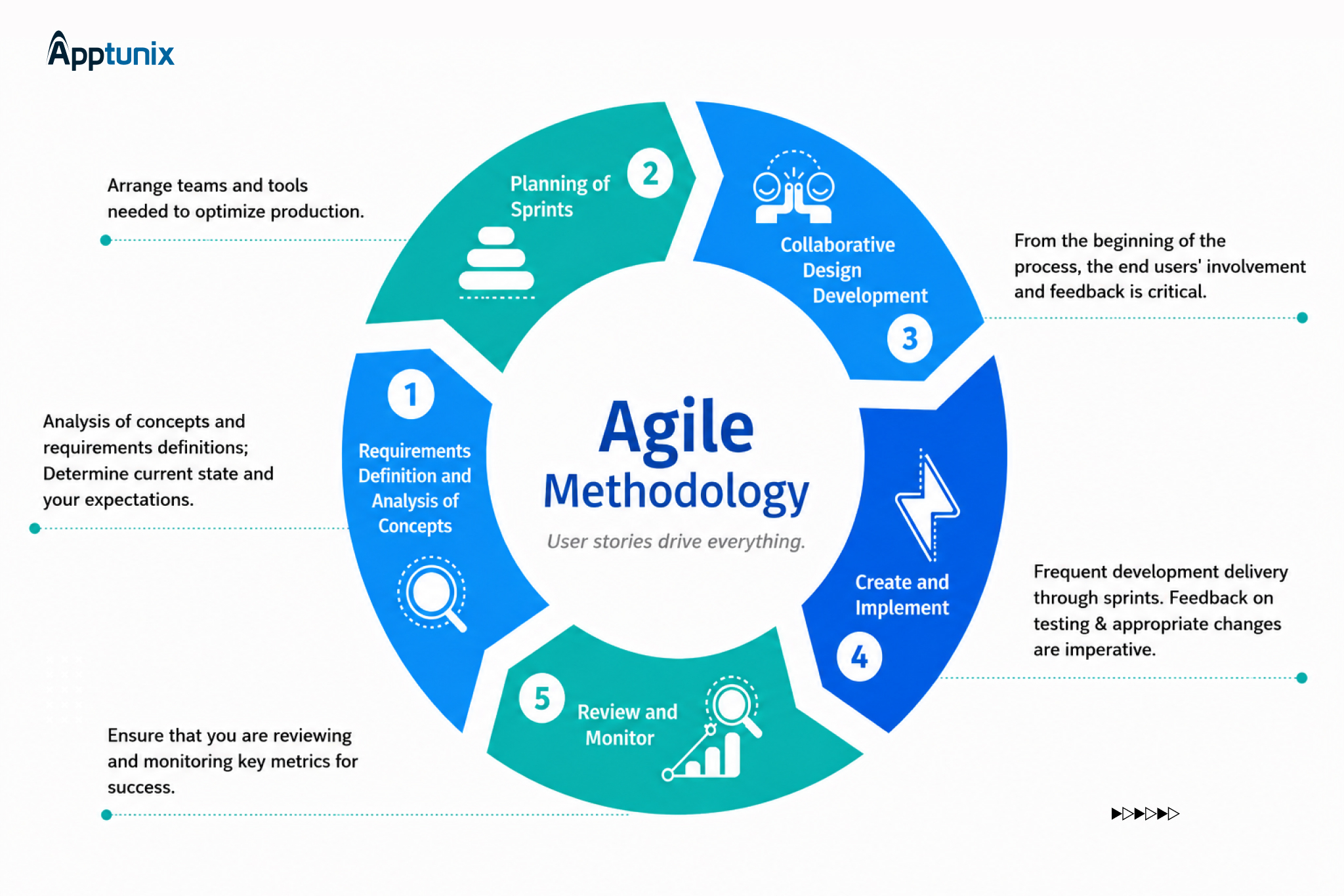
When not to use it: Projects with genuinely fixed scope and low tolerance for schedule ambiguity where Agile’s flexibility becomes a liability.
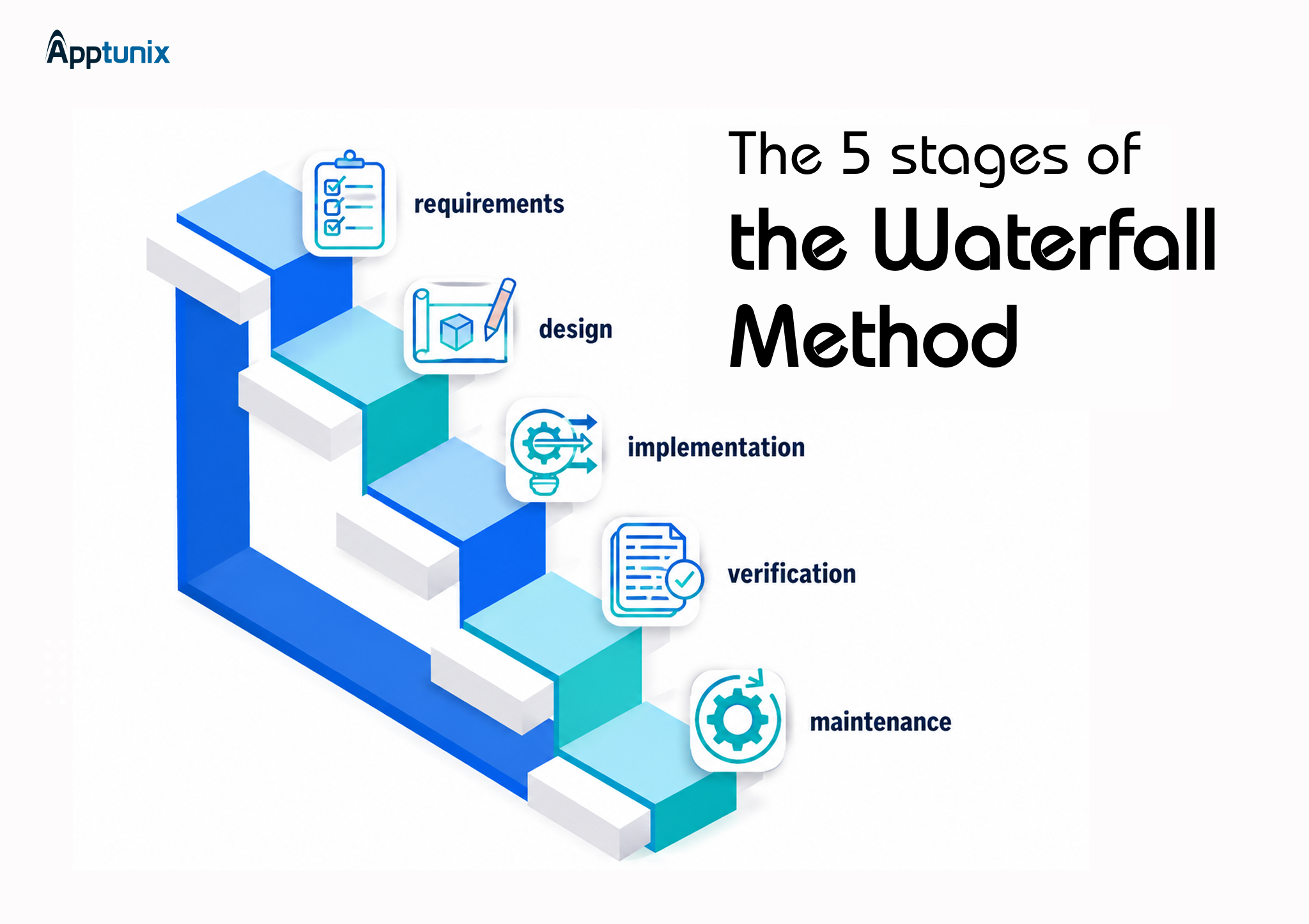
2: Waterfall Waterfall is the original structured approach to custom software development. It is a linear methodology where each phase is completed fully before the next one begins.
How it works: The entire project is planned upfront. Requirements are gathered exhaustively during the initiation and analysis phases, documented in detail, and locked before development starts. Each subsequent phase depends entirely on the completion and sign-off of the one before it.
Typical workflow: Requirements gathering → System design → Implementation → Testing → Deployment → Maintenance.
When not to use it: Any project where requirements are likely to evolve or where a competitor’s faster iteration cycle would put a single-delivery approach at a real disadvantage.
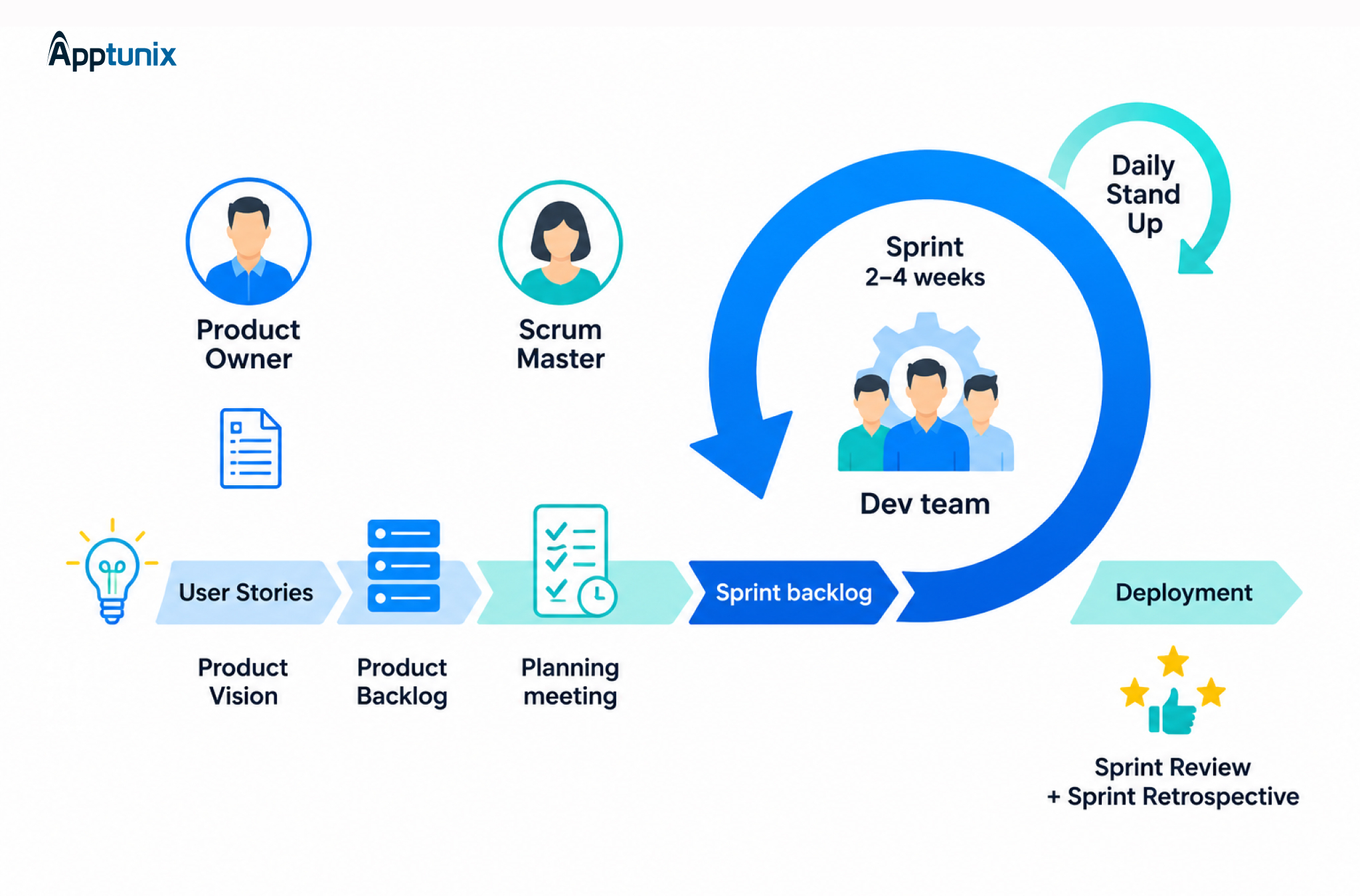
3: ScrumScrum is one of the top 3 software development methods for implementing Agile principles. It is a structured system built around fixed-length sprints and a specific set of recurring ceremonies.
How it works: A product owner maintains a single backlog of work. At the start of each sprint, the team commits to a slice of that backlog it believes it can complete. The team meets daily in a short stand-up to sync on progress and blockers. At the end of the sprint, the team demonstrates what it built in a sprint review, then holds a retrospective specifically focused on how the team’s own process can improve.
Typical workflow: Product backlog refinement → Sprint planning → Daily stand-ups → Sprint execution → Sprint review → Sprint retrospective → Next sprint.
When not to use it: Very great, multi-team efforts without a scaling framework, or teams without a single clear decision-maker who can own backlog prioritization.
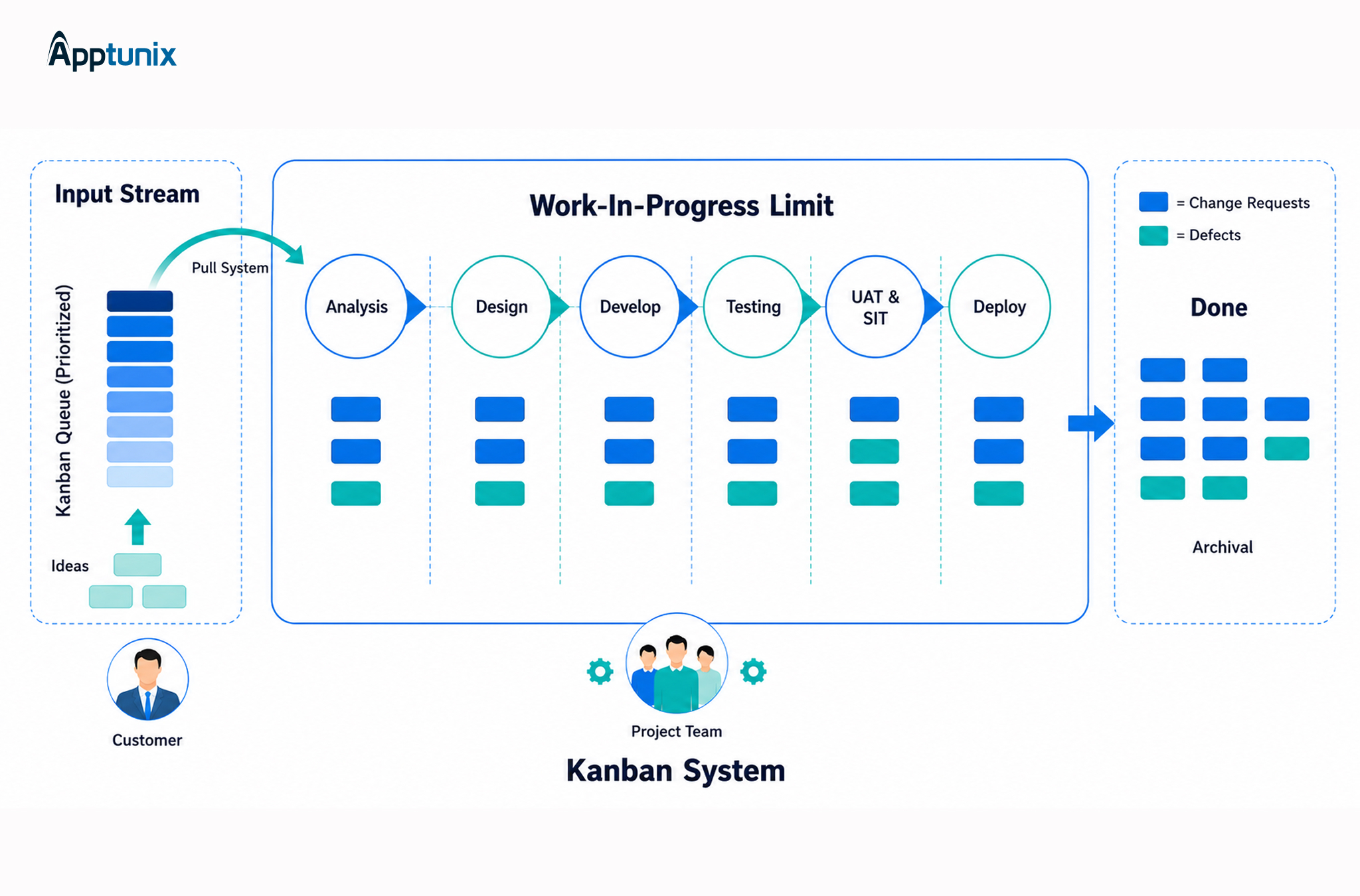
4: KanbanKanban software development methodology takes a fundamentally different shape than sprint-based methodologies. It’s a continuous, visual approach to managing work.
How it works: Work items move across a visual board with explicit limits placed on how many items can be in each stage at once. New work gets pulled in as capacity frees up. There’s no fixed iteration length; work flows continuously.
Typical workflow: A continuous pull-based flow where work enters the backlog, gets pulled into active stages as capacity allows, and exits as “done,” with the board itself functioning as the primary planning and status artifact.
When not to use it: Projects that genuinely need firm, date-based delivery commitments for a fixed set of features — Scrum’s timeboxed commitment structure fits that need more naturally.
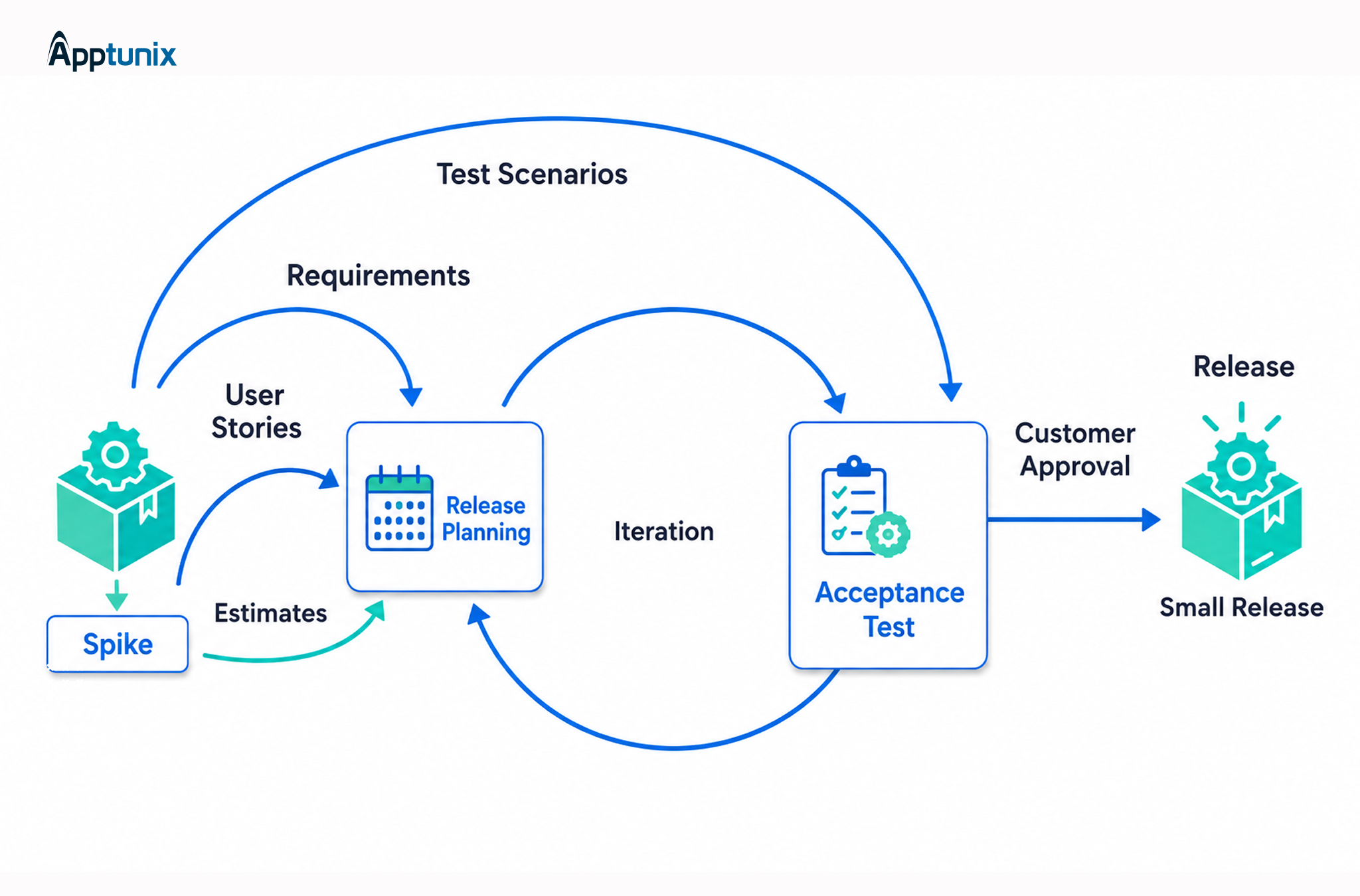
5: Extreme Programming (XP) XP is one of the best agile software development methodologies, but its focus is narrower and more technical than Scrum’s. It’s built specifically around engineering practices designed to make software easier to change safely.
How it works: Short release cycles are paired with a specific set of engineering disciplines: (A) Pair programming, where two developers write code together to catch mistakes as they happen; (B) Test-driven development, where tests are written before the code they’re meant to validate; and (C) Continuous integration.
Typical workflow: Release planning → Iteration planning → Coding (in pairs, test-first) → Continuous integration → Acceptance testing with user feedback → Small, frequent releases.
When not to use it: Teams without genuine discipline or buy-in for practices like mandatory pairing and test-first development.
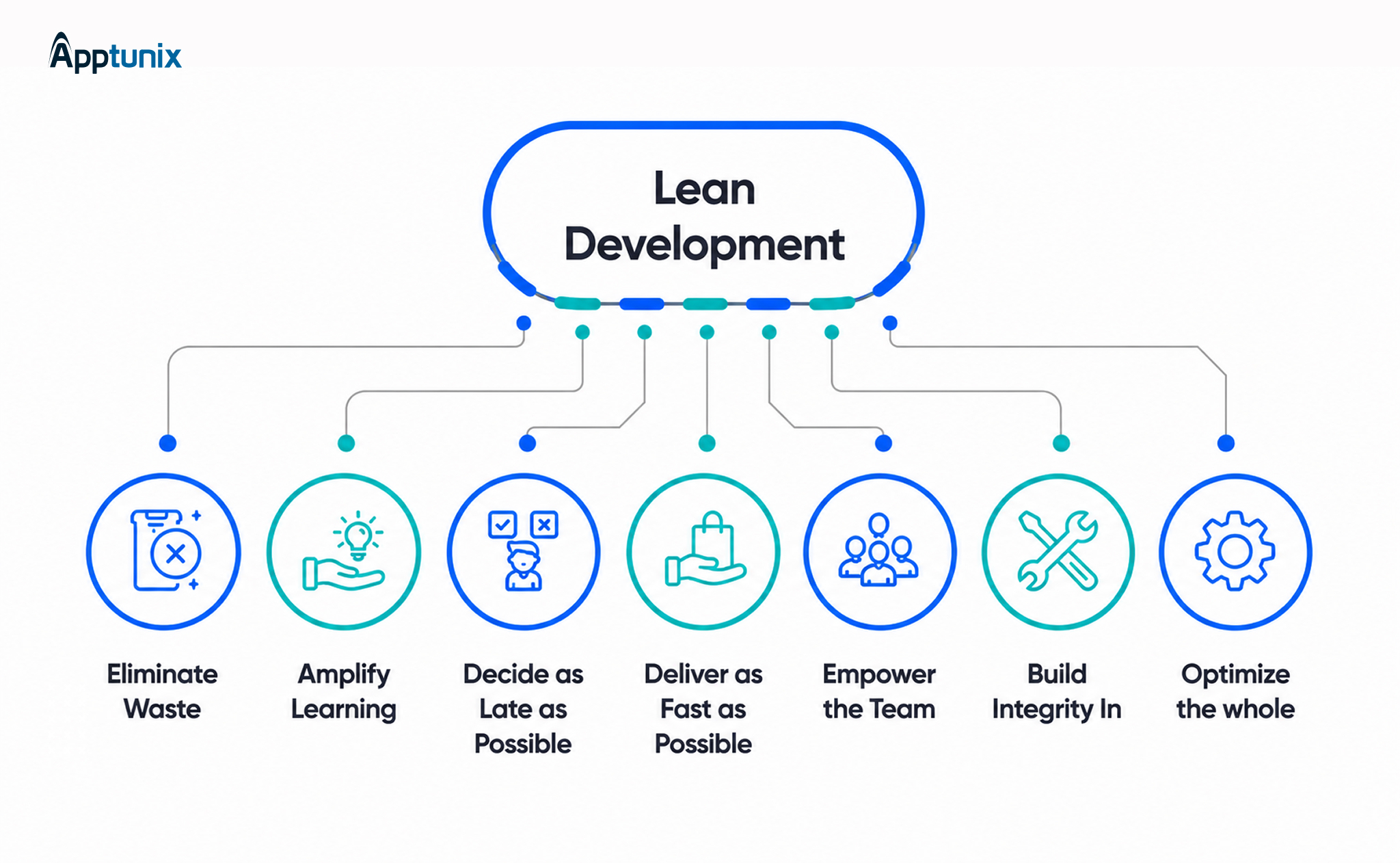
6: Lean Software Development Lean’s adapted from lean manufacturing principles, most famously associated with Toyota’s production system. But it translates surprisingly well to software teams trying to build the most value with the least wasted effort.
How it works: Teams start by identifying what genuinely creates value for the end user, map how work currently flows through their process, and then systematically cut whatever doesn’t contribute to that value. Decisions are made based on real data and direct observation.
Typical workflow: Identify value → Map the value stream → Create flow → Establish pull → Pursue continuous improvement.
Best use cases: MVP development and any project operating under genuinely tight budget or timeline constraints.
7: DevOps DevOps for software development sits slightly apart from the development life cycle methodologies on this list. It’s more a set of practices and a cultural model that unifies development and operations teams around one shared goal.
How it works: Code changes are integrated and tested continuously through automated pipelines that handle deploying without waiting for a scheduled release window. Also, monitoring in production feeds directly back into the next round of development.
Typical workflow: Plan → Code → Build → Test → Release → Deploy → Operate → Monitor, run as a continuous loop rather than a linear sequence.
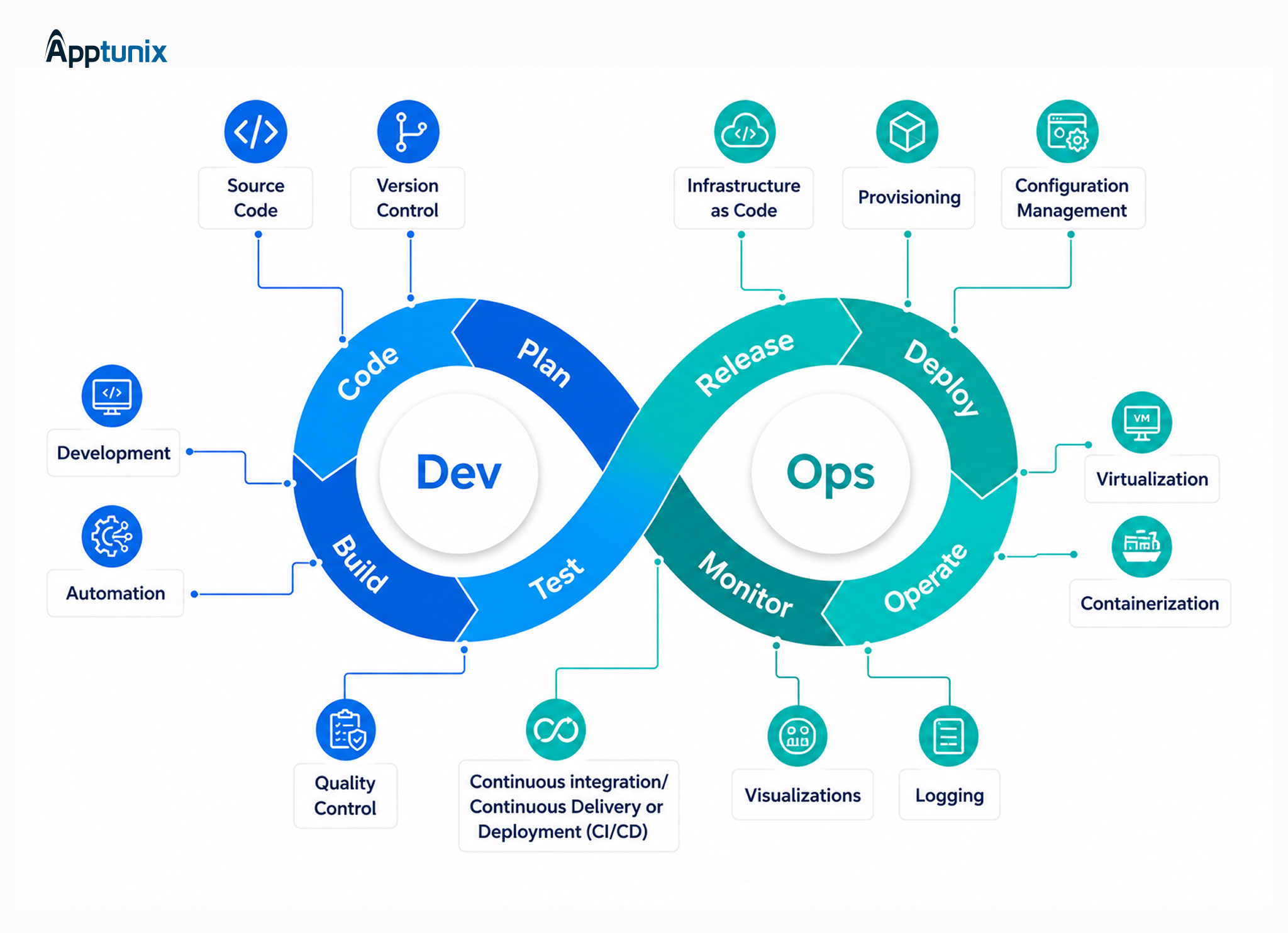
Best use cases: SaaS platform development, and any system where downtime carries a real, direct cost.
8: Spiral ModelThe Spiral model, instead of treating risk management as one activity among many, makes risk the organizing principle of the entire process.
How it works: Development proceeds through repeated cycles, or “spirals,” each one starting by identifying the objectives and risks specific to that phase. The team then builds a prototype addressing those risks and only then decides whether to continue to the next spiral or to stop.
Typical workflow: Determine objectives → Identify and resolve risks → Develop and test → Plan the next iteration, repeated across as many cycles as the project’s risk profile requires.
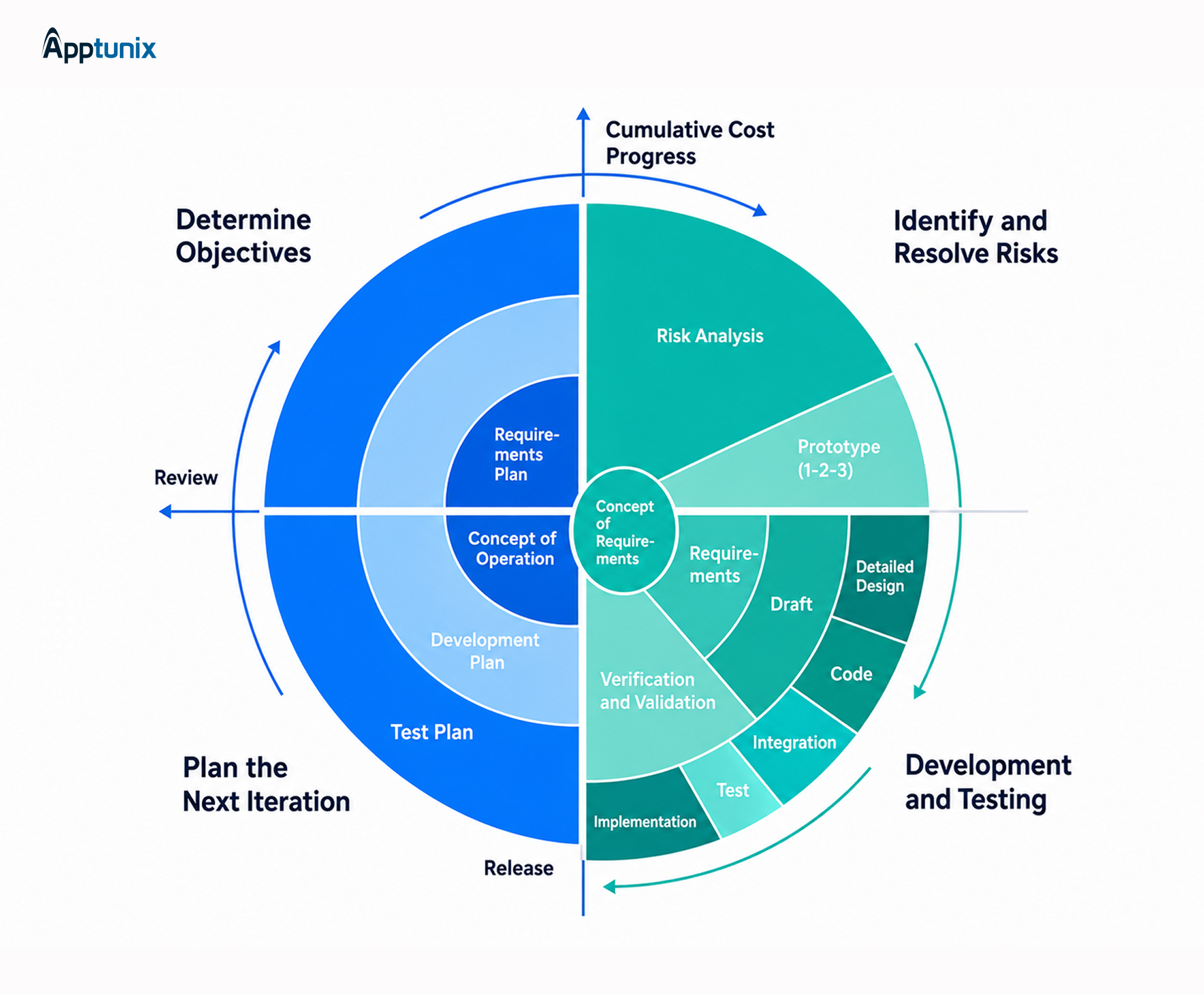
When not to use it: Smaller, lower-risk projects, where the overhead of formal risk analysis at every single cycle costs more than the risk it’s protecting against.
9: V-ModelThe V-Model is best understood as Waterfall’s more rigorous sibling. It keeps Waterfall’s linear structure but pairs every development phase with a corresponding testing phase.
How it works: As requirements are defined, acceptance tests are defined alongside them, by the same stakeholders, at the same time. As the system is architected, integration tests are planned in lockstep with that architecture. The relationship between each development phase and its corresponding test phase gives the model its “V” shape. The development phases descend one side, testing phases ascend the other, meeting at the bottom in implementation.
Typical workflow: Business requirements specification (paired with acceptance testing) → High-level design (paired with system integration testing) → Low-level design (paired with component testing) → Coding → Unit testing → moving back up through each corresponding validation stage.
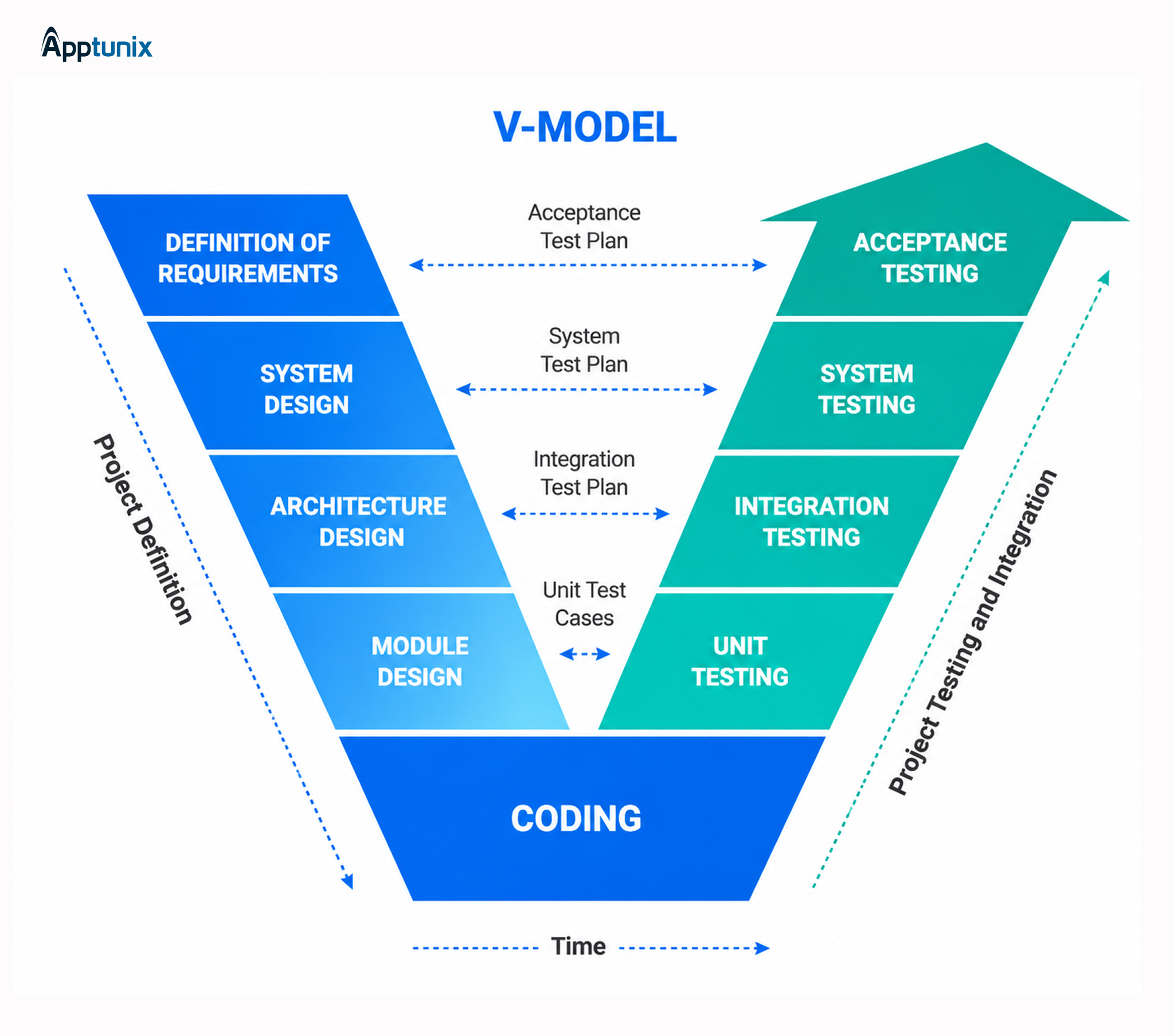
Best use cases: Regtech software development or safety-critical software where the cost of a defect reaching production is potentially unacceptable from a safety or compliance standpoint.
10: RADThe Rapid Application Development (RAD) trades extensive upfront documentation for speed and is also considered one of the modern software development methodologies. It’s built around fast prototyping and continuous user feedback.
How it works: Requirements are gathered through focus groups and workshops. The project is broken into smaller modules developed in parallel by different teams, with existing software components reused wherever possible to accelerate delivery.
Typical workflow: Requirements elicited through workshops → Requirements modularized across teams → Each module developed, designed, coded, and tested in parallel → All modules integrated → Final testing and delivery.
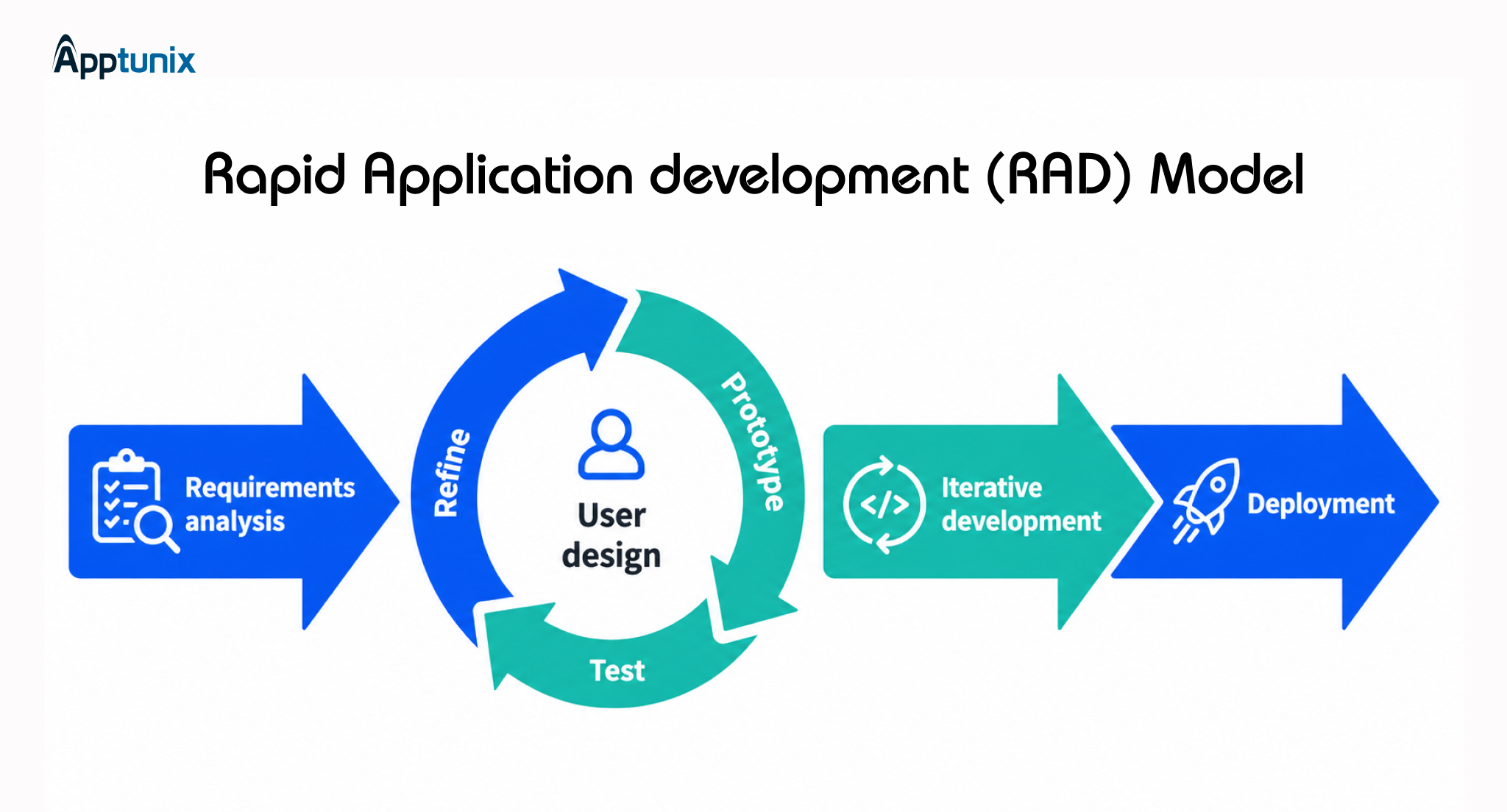
Best use cases: AI product development where requirements can be reasonably identified upfront and the system can be cleanly broken into independent modules.
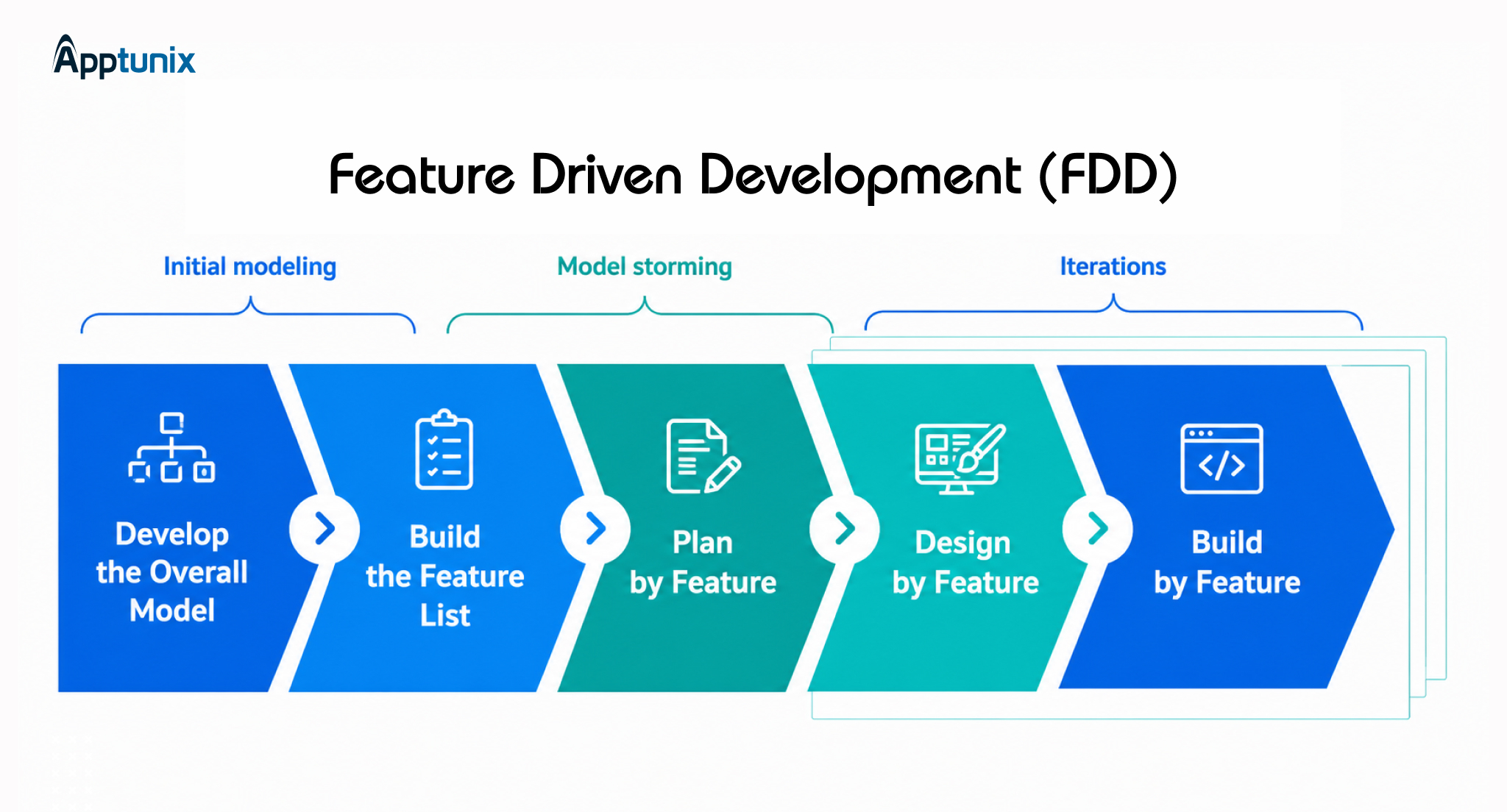
11: Feature-Driven Development (FDD)FDD is one of the lesser-known software development approaches. The entire development process revolves around one clear unit of value: the feature.
How it works: The team first builds an overall model of the system, then compiles a comprehensive feature list from that model. Development proceeds through repeated design-and-build iterations focused on small groups of related features.
Typical workflow: Develop an overall model → Build a feature list → Plan by feature → Design by feature → Build by feature, cycling through this last pair repeatedly across the feature list.
Best use cases: Larger teams and projects that benefit from a defined, trackable structure organized around discrete, demonstrable pieces of functionality rather than broader, harder-to-scope tasks.
“Sequential” here refers to linear, phase-gated approaches like Waterfall and the V-Model. Here’s how they actually differ across the factors that matter most in practice.
The underlying difference comes down to when a sequential approach and an Agile software development methodology each choose to absorb uncertainty. The right choice depends less on which approach is “better” and more on how much of a given project’s uncertainty can genuinely be resolved before writing the first line of code.
Also Read: The Role of Cloud Engineering in Agile Software Development
Choosing the methodology can directly influence a custom software development cost and overall success. While Agile, Waterfall, Scrum, DevOps, and hybrid approaches each have their strengths, the right choice depends on the project’s specific requirements, team structure, and business objectives.
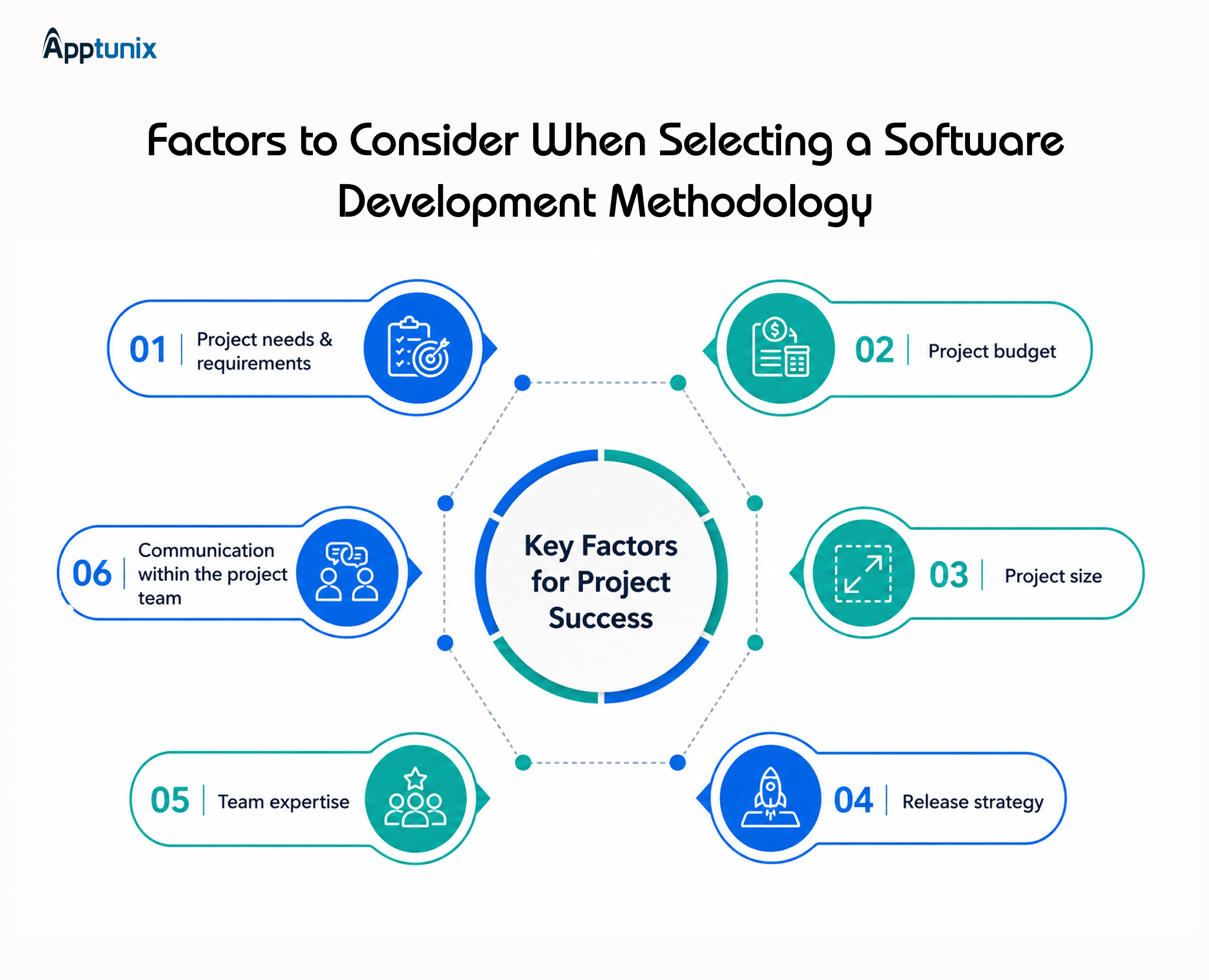
1: Project Needs & RequirementsStart by looking at how clear and stable your project requirements are.
2: Project BudgetYour available budget can also influence the right methodology.
3: Communication Within the Project TeamGood communication keeps everyone aligned throughout software development.
4: Project SizeThe size of your project can determine how much planning and structure you need.
5: Team ExpertiseYour team’s experience should also be considered before choosing a methodology.
6: Release StrategyThink about how you plan to release your software to users.
In many cases, a hybrid methodology can combine the structure of traditional development with the flexibility of Agile practices. The right methodology should ultimately create a development process that allows the team to deliver quality software efficiently.
Most methodology failures aren’t really about picking the “wrong” framework. They’re about how the decision gets made in the first place. These are the mistakes that show up most often.
Most of these mistakes trace back to the same root cause, i.e., treating methodology as an identity (“we’re an Agile team”). Therefore, you must leverage the right software development services to make an informed choice.

Choosing the right methodology is only half the challenge. Executing it well depends on the team behind it. Apptunix brings over 13 years of enterprise software development experience, backed by ISO 27001, ISO 9001, and CMMI Level 3 process certifications. Moreover, we work across Agile, DevOps, and hybrid delivery models depending on what a project actually calls for.
When Apptunix built CURE, a healthcare delivery app for a German client, five-day Agile sprints took it from kickoff to a fully working, on-budget launch in two months. This is a clean example of our team doing exactly what it’s built for. You can read the full story, along with other Agile examples worth knowing, in our Agile software development success stories.
If you’re scoping a new product and aren’t sure about the next step, you can reach out to our team. We offer a 1-hour free consultation to understand your vision. Get in touch today!
Q 1.What is a software development methodology?
A software development methodology is a structured approach for planning, organizing, and managing how software gets built. The process covers how requirements are gathered, how work is broken up, how teams collaborate, and how software gets delivered.
Q 2.What are the main types of software development methodologies?
Here are the top 10+ software development methodologies with the highest success rate:
Remember, each one is suited to different combinations of requirement stability and delivery cadence.
Q 3.What's the most commonly used software development methodology?
Agile is the most widely adopted methodology. As per digital.ai’s State of Agile research, adoption is roughly 71% of organizations. However, a significant share of teams run a hybrid model that blends Agile with DevOps or other practices.
Q 4.How Do I Choose the Right Software Development Methodology?
To choose the right software methodology, you need to follow these steps:
Q 5.How does AI affect software development methodologies?
AI is mostly changing execution speed within existing methodologies. Teams still choose how much to plan upfront and how often to release, but AI tools compress how fast individual increments of work get done, particularly within Agile’s iteration cycles.
Get the weekly updates on the newest brand stories, business models and technology right in your inbox.
Sameer is a skilled technical content writer with over 8+ years of experience in the industry. He has a strong grasp of topics like AI, software development, IT solutions, and hardware technologies. Sameer is currently part of Apptunix, an enterprise mobile app development company that helps businesses build innovative digital products and solutions. At Apptunix, he focuses on crafting engaging content that makes complex ideas easy to understand. His work helps tech companies connect with their audience and communicate real value.
Book your consultation with us.
Book your consultation with us.


One Central, The offices 3, Level 3, DWTC, Sheikh Zayed Road, Dubai
+971 50 782 1690