How AI Integration in Business Apps Builds Smart Workflows?
12 Views 13 min September 10, 2026

Reena Bhagat, the CTO and Head of AI at Apptunix, is a seasoned technology strategist with a deep-rooted expertise in emerging technologies. With a focus on AI/ML integration, product engineering, cloud management, she leads the technical vision for high-performance SaaS infrastructures. Reena is recognized for building secure, scalable, and decentralized systems that solve real-world complexities. Her passion lies in leveraging data science and future-tech to create resilient digital products, making her a trusted authority for organizations looking to lead in the age of intelligent automation.
Almost all companies invest in AI, but just 1% believe they are at maturity. The biggest barrier isn’t adoption—it’s choosing between building in-house and finding the right AI partner.
Building AI capabilities has become a top priority for enterprises, but deciding between an AI partner vs in-house development is one of the biggest choices leaders face today. This decision shapes long-term innovation capacity.
Most enterprises begin by forming an AI team internally, but the reality is far more demanding. A 2024 survey by UST found that over 76% of large companies cited a severe shortage of AI-skilled personnel within their organization. This shows the importance of an AI development partner to reach the goal.
However, both can work, but each path comes with its own demands. Understanding these factors early protects companies from wasted investments and slow progress.
Companies Eventually Need (No Matter Which Team They Choose)
In this AI partner selection guide, you will explore how each approach impacts costs and long-term growth. We will help you choose the path that aligns with your business priorities and sets a strong foundation for AI-driven initiatives.
Going fully in-house is often seen as the “pure commitment” approach in the AI partner vs in-house development debate. Many leaders believe that if the team sits under the same roof, they can build enterprise AI solutions that match every detail of their product vision. This belief is valid, but the full picture is much more nuanced.
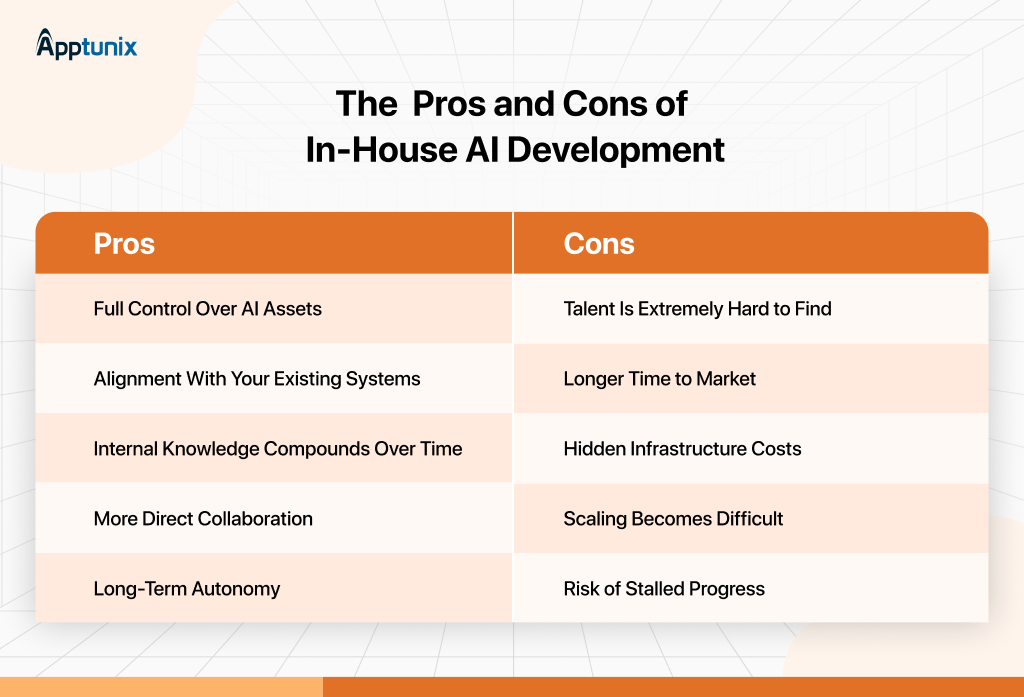
You own every model, pipeline, and workflow. No external vendor is involved, giving you complete independence. For businesses focusing on long-term IP value, this is a strong advantage in the AI outsourcing vs in-house discussion.
Your internal team understands your product deeply. They can build AI features that fit your architecture without guesswork. This is especially useful for enterprise digital transformation with AI, where precision matters.
Once you build an in-house AI team vs an external vendor setup, your internal engineers gain experience that keeps improving your future releases. You build internal strength and long-term confidence.
Everyone is in the same communication loop. Product managers, data scientists, and domain experts work together seamlessly without vendor handoffs.
No ongoing reliance on an AI development partner. You can experiment freely and maintain everything under your own standards.
AI expertise for enterprises is in short supply. Competing with tech giants for skilled machine learning engineers takes time and money. AI project outsourcing often becomes attractive simply because talent shortages slow internal progress.
From data prep to model deployment, building everything internally can stretch across months. For fast-moving industries, this delay can disrupt your AI implementation strategy.
You’ll need:
The cost of in-house AI development increases rapidly as your use cases grow.
When the team is small, managing AI across multiple departments becomes overwhelming. This is where AI integration services from an external team are often more efficient.
Without steady access to diverse experiences, internal teams may get stuck on technical hurdles they haven’t faced before. This is one major reason many organisations explore custom AI development services through specialized partners.
Also Read: AI in Everyday Business: Examples and Trends for 2026
Choosing an AI development partner can be one of the smartest decisions for enterprises, only if you choose the right one. In fact, 75% of businesses lament that the AI talent pool is insufficient to meet their hiring needs. Here’s a deeper look so leaders can make informed choices.
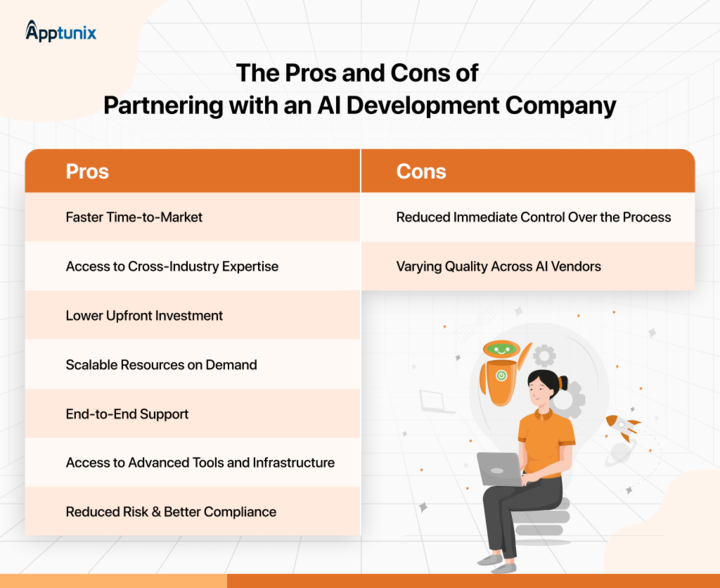
The best AI partner for enterprises already has proven frameworks and established processes. You bypass months of hiring, training, and infrastructure setup. Also, this approach is ideal for companies needing a quick Minimum Viable Product to test the market.
External teams work across industries like fintech, healthcare, logistics, retail, and more. They bring insights and learnings from solving diverse AI problems. Additionally, it reduces the risk of rookie mistakes companies make when building an in-house team.
There is no need for long-term salaries or hardware procurement. You pay for what you need. This reduces financial risks for companies still testing AI feasibility.
Many enterprises just need a computer vision engineer or data scientist for just one or two months. Or they need to add 5 more ML engineers. This is one of the key benefits of AI outsourcing: it lets you scale up or down instantly.
AI expertise for enterprises doesn’t just build; it also drives. They assist with:
This ensures long-term performance and ROI.
By leveraging AI development services, you can avoid paying for costly AI tools and GPU clusters in-house. An AI technology partner already has:
You leverage full AI development services from day one.
Good AI partners follow strict compliance frameworks like GDPR, HIPAA, SOC 2, and ISO 27001. This ensures model safety and ethical AI usage. It is also one of the reasons businesses choose to partner with AI development firms rather than build an in-house team.
Partnering with an AI development firm offers undeniable advantages. However, understanding these limitations helps enterprises plan better and choose the right AI partner with confidence.
One of the biggest concerns enterprises face is the reduced level of day-to-day control. When you rely on an external AI partner, your project must align with the vendor’s workflows and delivery timelines.
The AI services market is wide, and not all vendors offer the same level of expertise or ethical standards. This is why due diligence is non-negotiable when selecting the right AI partner. Look for top AI development companies before onboarding any vendor.
Business leaders are usually stuck in a dilemma: build AI capabilities in-house or partner with experts to fast-track the process? Well, this table clarifies by comparing AI partner vs in-house development:
Bottom Line:
Both approaches have value, but many organisations discover that the fastest and most reliable way to build AI capabilities is through a skilled AI app development partner. They deliver models that have already worked for other enterprises.
Also Read: AI App Development 2026: A Guide for Entrepreneurs & Businesses
Choosing between an AI partner vs in-house development often comes down to one deciding factor: cost. Many enterprises assume building an internal AI team is a one-time investment, but the reality is very different. On the other hand, partnering with an AI development agency allows businesses to access expert talent and enterprise AI solutions without the financial burden of managing a full internal AI department.
Below is a detailed breakdown of the typical costs for each model and why choosing the right AI partner is often the more cost-effective decision for enterprises.
1: Salaries & Talent CostsAI talent is expensive, and demand exceeds supply. Building an internal team requires multiple full-time roles:
When comparing building AI in-house vs outsourcing, in-house becomes significantly more expensive even before considering infrastructure.
2: Benefits, Overhead & HR CostsHiring a full AI team means paying for health insurance, retirement benefits, bonuses, and more. When you work with a vendor, these cost gets eliminated. With an AI outsourcing partner, you only pay for deliverables, not overhead.
3: Training & Upskilling ExpensesAI is evolving at lightning speed. Your internal team will need constant training in:
This training typically costs $5,000–$20,000 per employee per year. An AI solution provider, however, provides experts who are already trained and up to date at no additional cost.
4: Infrastructure & ToolsIn-house teams require investment in:
Typical cost:
When working with an AI technology partner, these tools and infrastructures are usually baked into the project price.
5: Project Management CostsInternal AI initiatives need a full-time project manager to coordinate teams and sprints, which costs around $80k to $120k/year. But when hiring an AI development firm, project management is handled by the consulting firm at no extra cost.
6: ScalabilityScaling an internal team means:
Each additional hire is another $100,000+ commitment. With an AI development partner, you can simply scale your engagement up or down based on project needs.
For most enterprises, partnering with an AI development company is the more cost-efficient and lower-risk choice.
Building in-house makes sense only if:
However, for companies focused on enterprise digital transformation with AI, choosing the best AI app development firm for enterprises delivers measurable business results.
Also Read: How Much Does it Cost to Develop a Generative AI App?
Choosing the right AI partner is one of the biggest decisions an enterprise will make, especially for companies evaluating an AI partner vs in-house development. Below is an action-focused guide to help you choose the right AI development partner for your business.
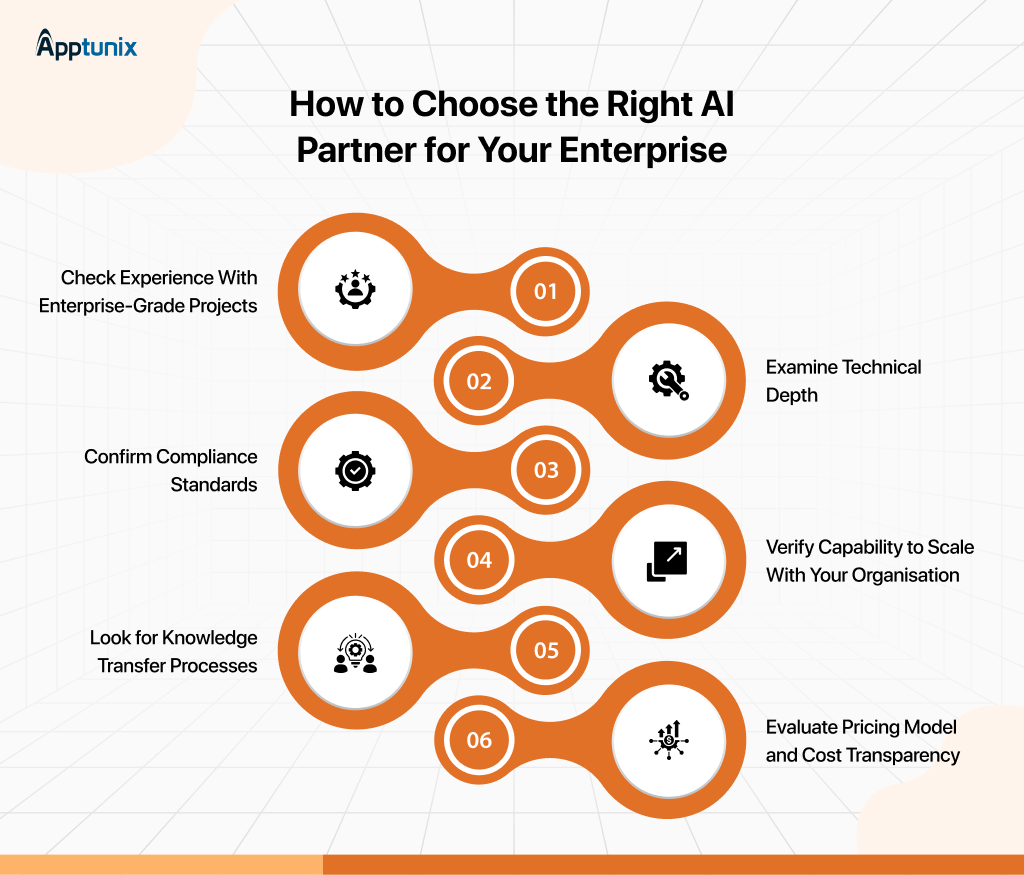
1: Check Experience with Enterprise-Grade ProjectsNot every AI development partner can handle the security requirements or architecture involved in building AI systems for large organizations. Make sure they have:
Your partner should be comfortable building AI systems that integrate with legacy software, cloud platforms, and enterprise databases.
2: Examine Technical DepthAI development is more than just training a model. To support long-term success, partners must be strong in:
A capable partner should demonstrate expertise in real-time systems, batch pipelines, API-based inference, and optimisation techniques suited for enterprise use.
3: Confirm Compliance StandardsA reliable AI partner must protect your data and follow industry regulations. They should be familiar with:
In addition, they should maintain safe workflows that prevent bias, inaccuracies, and unauthorized access to data. This ensures your information remains compliant throughout the AI integration services.
4: Verify Capability to Scale With Your OrganisationEnterprises must choose a partner capable of scaling AI initiatives across:
The ideal partner supports rapid expansion without sacrificing performance or security. This is essential for organisations planning long-term enterprise digital transformation with AI.
5: Look for Knowledge Transfer ProcessesThe goal of outsourcing shouldn’t be permanent dependency. A good AI partner provides:
This allows your team to eventually manage AI pipelines without external help, creating a smooth balance between AI outsourcing vs in-house operations.
6: Evaluate Pricing Model and Cost TransparencyBefore signing, review how the vendor calculates costs. The best partners provide:
This helps companies understand long-term value and prevents budget surprises.
Most enterprises think of partnering with an AI development company only when they lack talent or time. According to the SupportNinja 2024 survey, 77% of customer experience leaders want AI expertise from the outsourcing vendors.
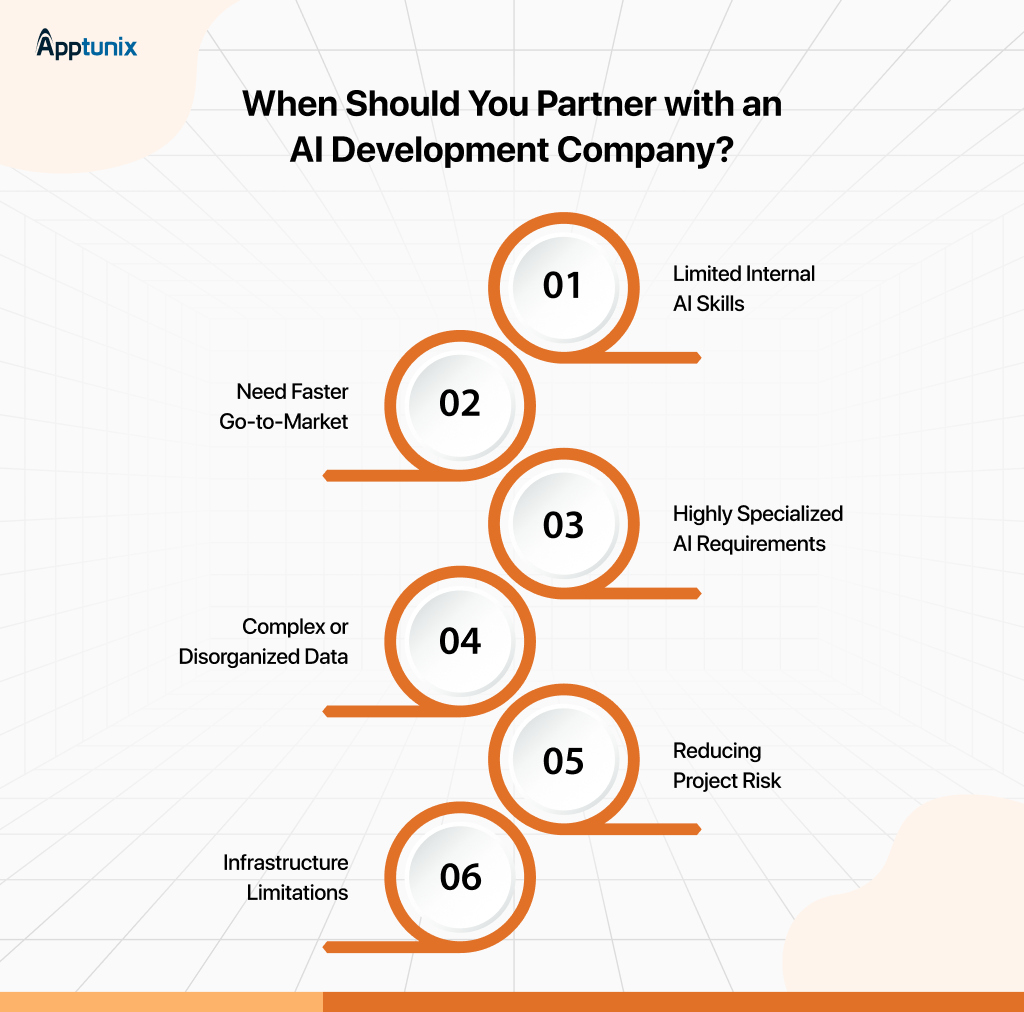
Here are the scenarios leaders often overlook:
1: Limited Internal AI SkillsYour team may understand your product deeply, but AI moves fast. Model standards, MLOps tools, and integration practices change frequently. An experienced AI development partner brings up-to-date knowledge, making it a more reliable approach.
2: Need Faster Go-to-MarketHiring an in-house AI team and building production-ready systems can slow your plans. Vendors already have processes and experts in place. For enterprises racing competitors, outsourcing helps deliver features more quickly.
3: Highly Specialized AI RequirementsIndustries such as fintech, healthcare, and logistics often require niche AI talent. Internal teams may not have this depth. Vendors with a background in such areas offer a safer execution path, strengthening your enterprise AI solutions.
4:Complex or Disorganized DataIf data is scattered across legacy tools or different business units, external teams can help unify and clean it. This step is critical for any AI implementation strategy.
5: Reducing Project RiskInternal teams often learn through trial and error, increasing the risk of costly mistakes. Vendors use proven frameworks and methodologies to reduce failure rates in AI projects.
6:Infrastructure LimitationsAI demands heavy GPU usage and monitoring systems. Fortunately, external vendors already have access to these setups, helping you avoid the high cost of building everything internally.
Also Read: Tips and Tricks to Hire an AI Chatbot Development Company
Enterprises that want a balance between internal control and external expertise often choose a hybrid approach. This setup allows them to benefit from the strengths of an internal AI team while leveraging the speed and specialized skills of an AI partner.
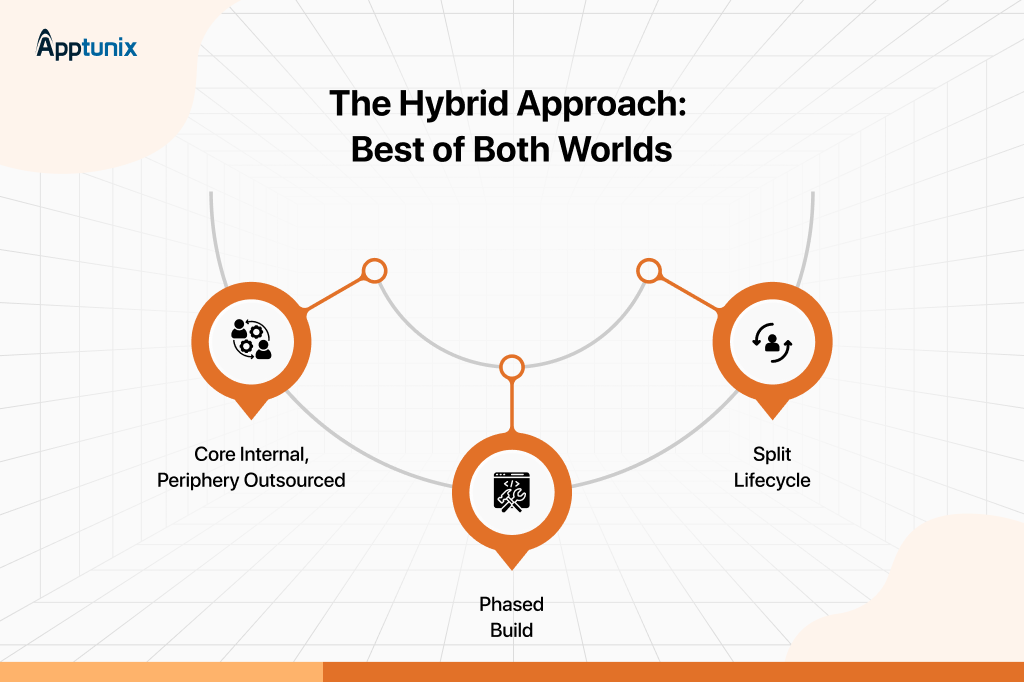
1: Core Internal, Periphery OutsourcedIn this model, your internal AI group owns the most sensitive or high-value components. These typically include:
Meanwhile, the company handles broader or less sensitive tasks such as APIs, automation, or modules. This gives your organisation strong ownership where it matters most, while still benefiting from the speed and flexibility of AI project outsourcing.
2: Two-Phase DevelopmentSome businesses choose to partner early to roll out AI features without delay. The external team builds the initial version and establishes the technical foundation.
As your internal team grows and gains confidence, more responsibilities gradually shift in-house.
This approach is popular among companies still shaping their enterprise AI strategy and seeking quick results without waiting months to hire specialists.
3: Split LifecycleHere, the AI lifecycle is divided between the two teams based on their strengths. Your internal team manages:
The AI technology partner takes care of:
This creates a smooth rhythm in which strategic decisions remain within the company and execution is handled by experts who work across multiple industries.
Selecting between an AI development partner and an in-house AI team becomes far easier when you evaluate your decision through these five strategic questions. These questions help you understand your readiness and long-term operational goals.
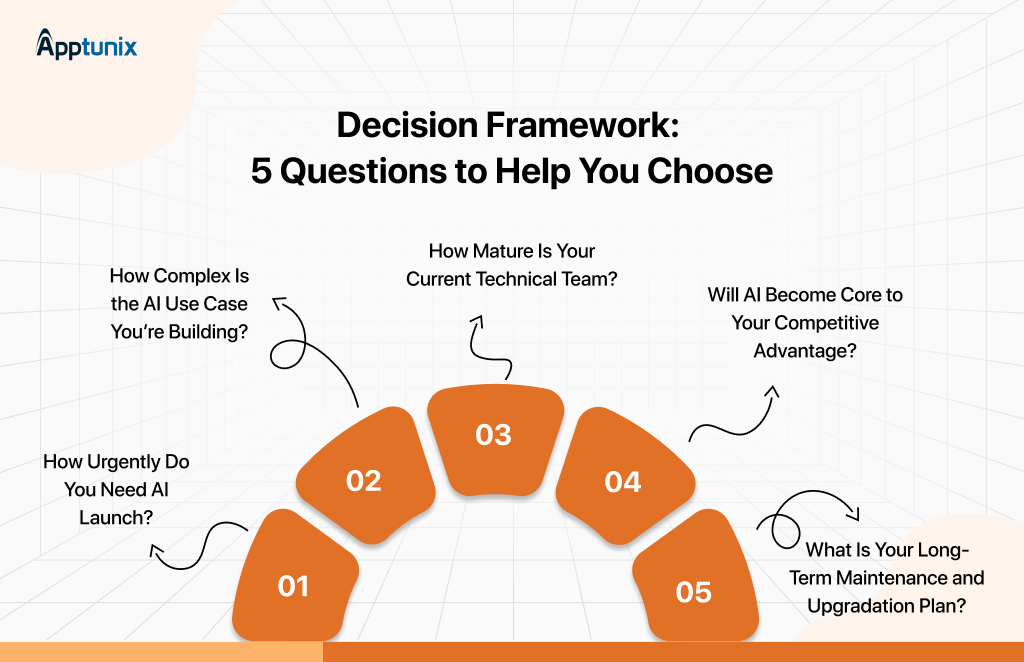
Question 1:How Urgently Do You Need AI Launch?If speed is your top priority, partnering with an AI development company often wins. They come with multidisciplinary teams that can deliver in weeks instead of months.
On the other hand, if timelines are flexible and you have a great budget at your disposal, an in-house team may be the better investment.
Question 2: How Complex is the AI Use Case You’re Building?If your use case involves advanced research (LLMs, predictive analytics at scale, agentic systems), a partner with deep specialization may reduce risk and accelerate outcomes.
However, if the use case is relatively simple, an in-house team can handle it with the proper training.
Question 3: How Mature is Your Technical Team?If your team lacks AI/ML engineering, data engineering, or MLOps expertise, an internal build can lead to long hiring cycles, high costs, and slow progress.
On the flip side, if you already have a strong tech foundation, building internally can give you tighter control and better cross-team collaboration.
Question 4: Will AI Become Core to Your Competitive Advantage?If AI is central to your product strategy and future innovation, building internal capability is almost non-negotiable.
Though if AI supports the business rather than defines it, a partner can shoulder the technical burden while you focus on growth.
Question 5: What Is Your Long-Term Maintenance and Upgradation Plan?AI models degrade over time. If you want a partner to take responsibility for retraining and monitoring, outsourcing is safer. However, if your team is ready for continuous iteration, an internal model offers more control.
Choosing an AI development company is a strategic decision. Therefore, Apptunix brings everything to the table, supported by years of hands-on experience and a strong execution record. We offer:
Apptunix has been building digital products for more than a decade. Over the years, we’ve seen enterprise needs shift from mobile-first to cloud-first, and now to AI-first.
Our team includes machine learning engineers, data scientists, cloud architects, solution designers, and app developers who work together to deliver complete enterprise AI solutions.
Apptunix has delivered thousands of digital solutions across industries, including AI in real estate, logistics, healthcare, retail, government, automotive, and SaaS. Many of these projects now include AI components.
In the last few years, we have worked on:
This helps us understand what works, what fails, and how enterprises can avoid expensive mistakes.
We follow an agile development methodology. Here, the steps include:
This comprehensive support system is a major advantage over typical AI project outsourcing vendors.
Apptunix offers a one-hour FREE session where enterprises can discuss their goals. This helps companies get unbiased advice before choosing between in-house AI vs external vendor models.
Building AI capability is now a priority for enterprises, but choosing the right approach matters just as much as the technology itself. Some companies prefer to grow an internal team, while others move faster with a trusted AI development partner.
Apptunix, a top-notch enterprise-grade AI app development company, supports businesses through every stage of this shift. Our AI app development services help companies build AI features that are ready for real operations. Apptunix gives you the structure and guidance needed to move forward with confidence.
If your next step is launching a new AI initiative, our team is ready to support you.
Q 1.What is the difference between building an AI solution in-house and hiring an AI development Firm?
Well, in-house teams provide more control and long-term ownership, while AI development companies offer faster delivery with lower AI app development costs. The right choice depends on your budget and technical maturity.
Q 2.How long does it take to build an enterprise-grade AI system?
An enterprise AI solutions take 3 to 9 months, while simpler solutions like chatbots may take 4 to 8 weeks if using pre-trained models. However, this depends on various factors like complexity, design, and location of the AI development team.
Q 3.When should a business consider outsourcing AI development?
Outsourcing an AI team makes sense when you lack AI talent or need a faster time-to-market. It is also a viable option when an enterprise requires niche expertise like NLP, CV, predictive analytics, or wants predictable AI development costs.
Q 4.What are the biggest risks of building AI in-house?
The common risks with an in-house AI team include:
Q 5.How do I evaluate the right AI development partner for my business?
You can start by checking their portfolio, years of experience, certifications, team strength, AI frameworks they use, and client testimonials. Also, verify their data privacy and MLOps capabilities.
Q 6.How can I ensure my AI project stays secure and compliant?
Choose partners that follow GDPR, ISO standards, data encryption, and role-based access controls. Also, during the initial team meeting, ask them how they maintain clear governance for datasets, model training, and deployment.
(2 ratings, average: 4.50 out of 5)
Get the weekly updates on the newest brand stories, business models and technology right in your inbox.
Reena Bhagat, the CTO and Head of AI at Apptunix, is a seasoned technology strategist with a deep-rooted expertise in emerging technologies. With a focus on AI/ML integration, product engineering, cloud management, she leads the technical vision for high-performance SaaS infrastructures. Reena is recognized for building secure, scalable, and decentralized systems that solve real-world complexities. Her passion lies in leveraging data science and future-tech to create resilient digital products, making her a trusted authority for organizations looking to lead in the age of intelligent automation.
12 Views 13 min September 10, 2026
59 Views 13 min August 19, 2026
64 Views 13 min August 12, 2026
Book your consultation with us.
Book your consultation with us.


One Central, The offices 3, Level 3, DWTC, Sheikh Zayed Road, Dubai
+971 50 782 1690