Compliance-Ready Software Development in Saudi Arabia: Laws, Standards and Best Practices
39 Views 15 min July 15, 2026

With over 20+ years of experience in driving global digital initiatives, Nikhil Bansal is the CEO & Director of Apptunix. He specializes in orchestrating large-scale digital transformations, enterprise-grade software solutions, and high-level business strategies that redefine industry standards. Nikhil is known for his ability to bridge the gap between complex business challenges and innovative technology, helping Fortune 500 companies and startups alike achieve sustainable growth. A visionary leader, he empowers enterprises to navigate the digital landscape with agile, ROI-focused models and future-ready business strategies.
Here is something most finance leaders already know but rarely say out loud.
Every day your procurement team runs on spreadsheets, your company is quietly bleeding money.
Someone knows which vendor to call. And, someone remembers the approval threshold for capital purchases. While another person manually keys invoice data into the ERP every Monday morning. All this works until the day it does not.
The numbers tell the same story across industries. The global B2B procurement software market is projected to grow $14.5 billion by 2030. Companies using digital procurement solutions report procurement operating costs that run 30% lower on average.
The shift to enterprise procurement software development is a financial decision with a measurable return.
This guide covers everything you need to understand that decision clearly. What enterprise procurement software actually does, which features matter at scale, how to build it, and what it costs.
Enterprise procurement software is a system that manages the full process of acquiring goods and services within a large organization.
From the moment an employee identifies a need to the moment a vendor receives payment, the platform controls, routes, records, and reports on every step in between. Understanding how a procurement management system works means understanding the lifecycle it manages.
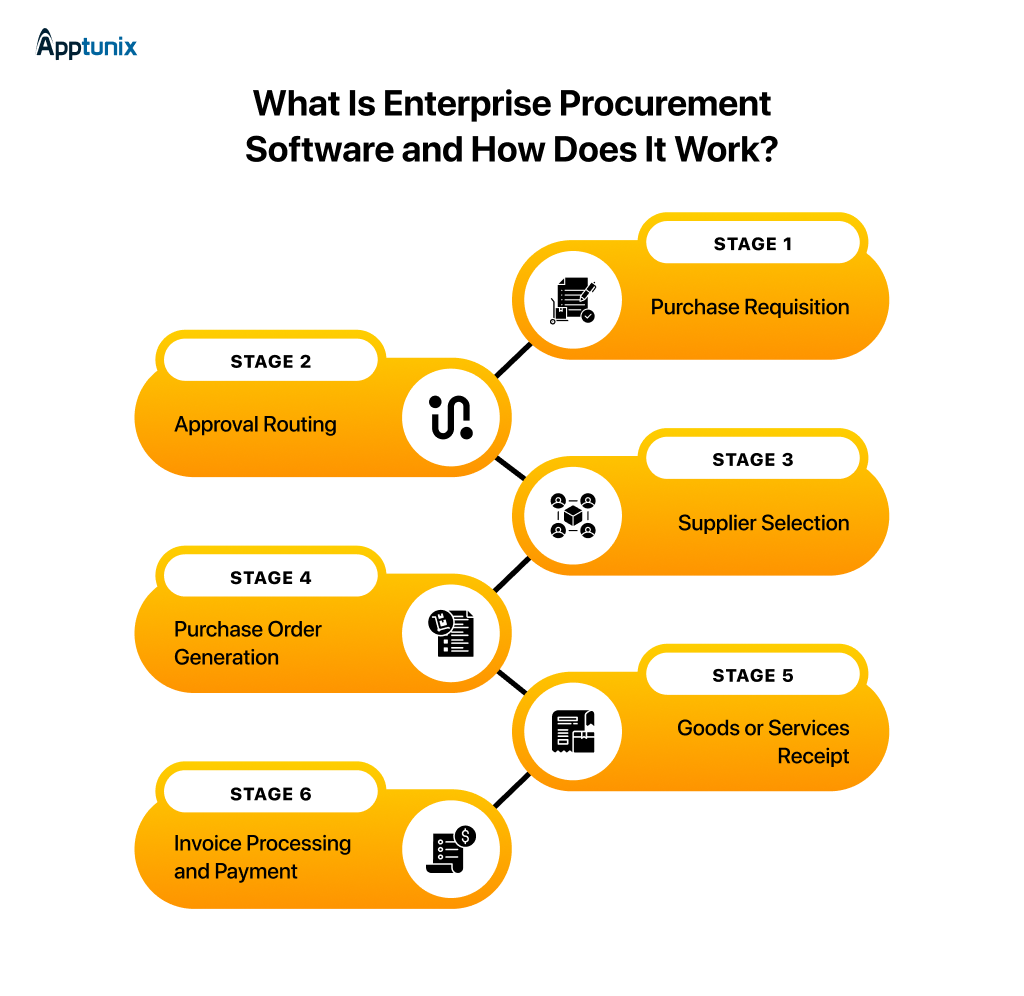
An employee submits a request inside the platform. The system captures what is needed, why it is needed, estimated cost, and which budget line it draws from. Nothing proceeds without this record.
The request automatically routes through the appropriate approval chain based on rules configured in the system. Transaction value, spend category, department, and location all determine who needs to approve. No manual forwarding. No emails asking who the right person to contact is.
The system pulls from your approved vendor database or initiates a sourcing event such as an RFQ or RFP. Supplier responses, pricing, and compliance documents are handled within the platform rather than scattered across individual email inboxes.
Once a supplier is confirmed and approvals are complete, the system generates the purchase order and delivers it to the vendor automatically. No manual document creation.
When delivery occurs, the receiving team confirms it inside the system. The platform immediately checks the confirmation against the original PO and flags any discrepancies before payment authorization moves forward.
Invoices are matched against the purchase order and the delivery confirmation in a three-way match. Approved invoices route to accounts payable or are pushed directly into the ERP. Every step carries a full audit trail.

Most organizations do not decide to invest in digital procurement solutions because someone read a Gartner report and got excited about the technology.
They decide because something broke. A compliance audit surfaced irregular purchasing patterns that nobody could explain. A CFO asked for a real-time spend breakdown by vendor category and was told it would take three days to pull together. A supplier sent a duplicate invoice and got paid twice because the invoice matching process lived in someone’s head rather than in a system.
Manual procurement does not fail dramatically. It erodes slowly.
The average manual PO cycle runs 14 days. Procurement workflow automation software consistently brings that below 48 hours.
When your vendor data, contract terms, and spend records are sitting in Excel files that get shuffled around in email threads, you really don’t have a procurement system. What you have is more like a loose pile of documents nobody 100% trusts and everyone maintains a bit differently. So in practice, decisions happen on older information because nobody is fully sure which file is actually the newest version you know.
A request will just linger in an approver’s inbox for a week or more, because they’re traveling, overloaded, or they simply did not notice the message. And nobody follows up because nobody has clear ownership either. By the time approval finally comes back, the vendor might already be swapped out.
Commercial terms get negotiated over email or via phone calls. Then, if a dispute shows up months later, like six months, nobody can quickly locate what was actually agreed upon. Vendor performance is also judged informally, often based on whoever happened to be involved in the most recent transaction rather than on documented measures.
When procurement processes are slow or just kinda unclear, employees end up looking for quicker workarounds. They buy from vendors that aren’t on the approved list, then somehow justify it later. They also skip the whole approval step for “small” purchases that somehow stack up and become a real thing. Industry research keeps finding the same pattern: maverick buying costs companies something like 12% to 18% in extra spend.
If procurement data is split across systems departments and even among individuals, the CFO can’t answer “what did we spend with this vendor last quarter” without someone spending two full days stitching a report together by hand. Then, by the time that summary exists, the decision it was meant to support has already been made using mismatched information.
Without automated invoice matching, the same invoice can get paid again more often than finance teams would like to admit. Industry estimates usually place duplicate invoice rates in manual setups at around 0.1% to 0.5% of total invoices processed. In a big enterprise processing thousands of invoices each month, that turns into dollars leaving the company.
Most enterprise procurement software development projects that fail do not fail because of bad engineering. They fail because the planning stage did not reflect how procurement actually works inside the organization.
Here is how to avoid that outcome.
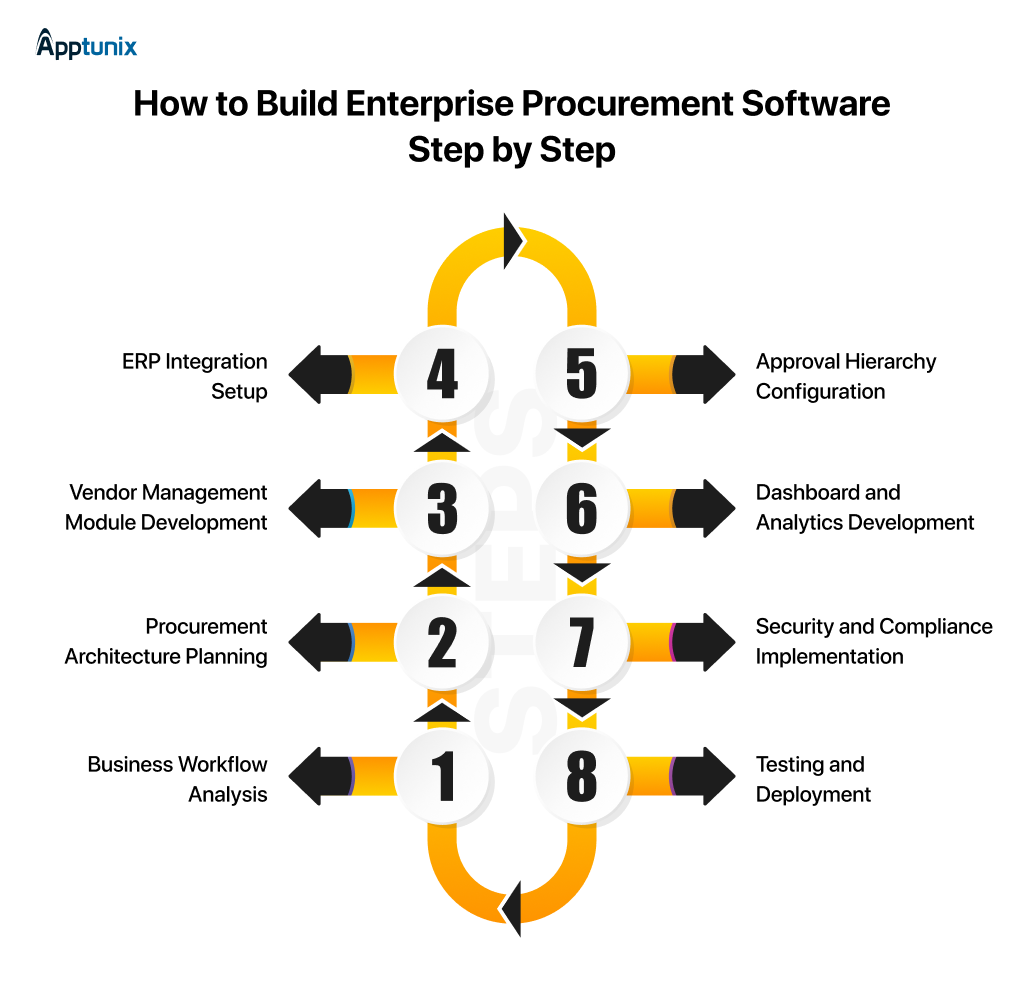
Before making any architectural decisions, document every existing procurement workflow in your organization.
Map who initiates requests, who approves them at each value tier, how vendors are sourced and onboarded, how purchase orders are created and delivered, how invoices are received and matched, and how exceptions are currently handled. Interview procurement managers, finance staff, department heads, and operational teams separately.
With documented workflows in hand, define the technical architecture that supports them.
Decide on the deployment model based on your data sovereignty requirements and existing infrastructure. Define the core system modules and how data flows between them. Identify every external system the procurement platform needs to integrate with. Plan the data model that supports your reporting requirements. Architecture decisions made at this stage are expensive to reverse later.
Build the supplier database structure before the broader workflow engine because almost every other module depends on it.
Vendor management needs to store structured data for onboarding, certification tracking, performance scoring, and contract management. Build and test vendor onboarding workflows first. The approval logic patterns you establish here will be reused throughout the rest of the procurement workflow engine.
Most procurement deployments fail because SAP approval hierarchies and finance permissions are mapped too late in the implementation phase.
Map every data exchange point between the procurement system and your ERP: chart of accounts synchronization, purchase order data flow, invoice posting, goods receipt recording, and vendor master data alignment. Build integration using your ERP’s published APIs where they exist. Plan for data transformation logic where field structures do not align directly.
Build the workflow engine to reflect your full approval matrix.
Configure rules for every combination of transaction value, spend category, department, and location that requires a different approval path. Build escalation logic, delegation rules, and out-of-office routing at this stage. Before finalizing, validate the complete approval matrix with your CFO, CPO, and legal team to confirm it reflects actual authorization policies.
Procurement dashboards are operational tools that drive decisions, not just cosmetic add-ons you slap on and forget, they kind of do more than that.
Build views tailored to each role, such as operational dashboards for procurement managers, financial dashboards for controllers and CFOs, vendor performance views for sourcing folks, and compliance dashboards for audit roles. Also, link every dashboard metric to the live transaction database so the numbers refresh in real time.
Enterprise procurement platforms hold sensitive financial and commercial data. Because of that, they need a security setup that matches the actual sensitivity levels, not something generic that kind of “covers everything”.
Implement role-based access control so users only see and interact with data tied to their function. Add encryption for stored records and for data in transit. Integrate single sign-on with your corporate identity provider to centralize access.
Testing an enterprise procurement system is more than checking that buttons click properly and the screen looks good.
Run end-to-end scenario testing using real procurement workflows, realistic transaction volumes, and real user roles, not sandbox personas. Validate every approval routing combination. Test ERP integration through the entire transaction cycle, starting at requisition all the way through to payment posting. Then do user acceptance testing with actual procurement staff.
Feature lists for procurement platforms tend to look similar across vendor marketing materials. What actually separates functional enterprise systems from tools that create new frustrations is how deeply each capability is built and how well it handles the complexity that comes with real organizational scale.
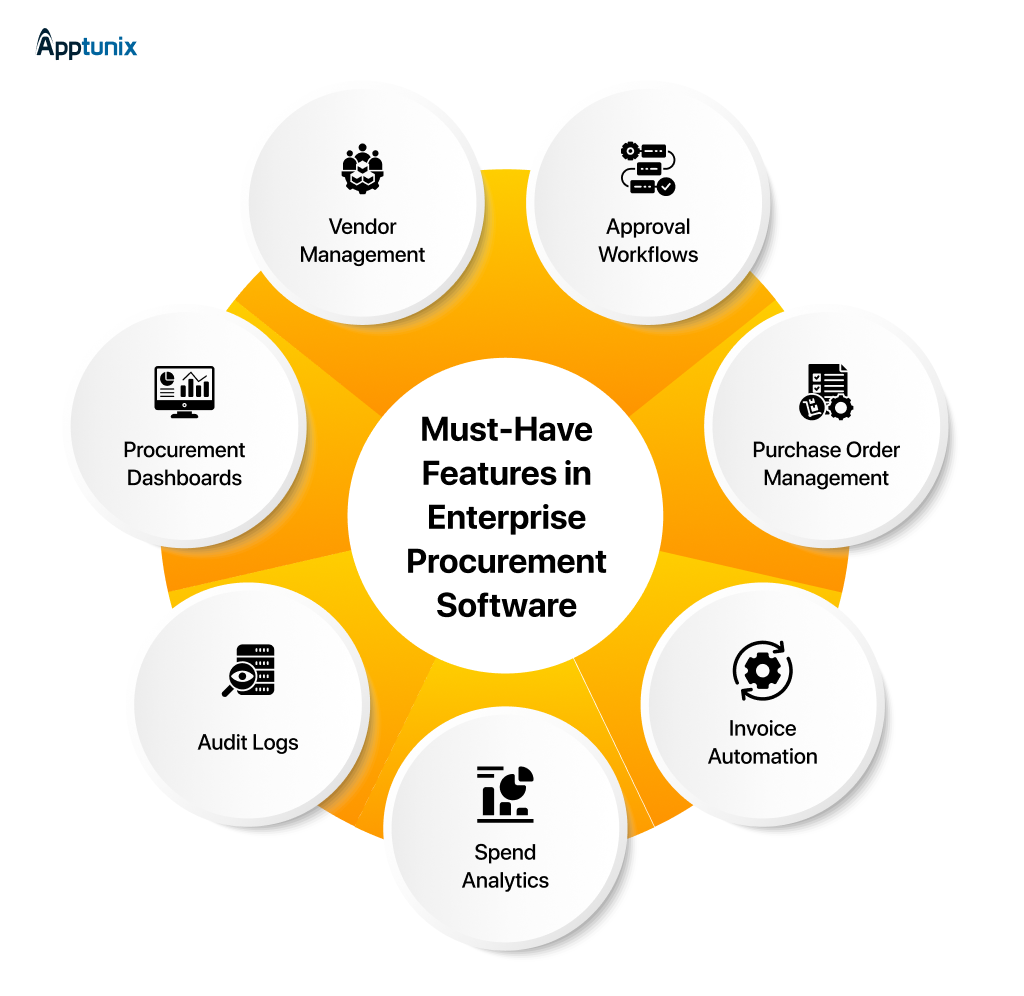
A proper vendor management module is not a contact database.
It contains complete supplier profiles, including certifications, compliance documents, contract terms, performance history, payment terms, and risk classifications. It sends automated alerts before certifications expire.
The approval workflow engine is the operational core of any procurement management system.
It needs to support multi-level chains that route based on transaction value, department, spend category, location, or combinations of these. Parallel approvals for transactions requiring simultaneous review from multiple stakeholders.
PO management handles the full lifecycle from creation through closure.
It auto-populates purchase orders from approved requisitions to eliminate manual data re-entry. Also, it enforces PO numbering sequences. The platform manages amendments when quantities or pricing change after a PO has been issued.
Manual invoice processing is where most procurement cost leakage actually occurs in large organizations.
Invoice automation captures invoices digitally, extracts line-item data, runs three-way matching against the PO and goods receipt records, and surfaces only exceptions for human review. Processing cost per invoice drops significantly. Cycle time from receipt to payment authorization moves from days to hours.
You cannot manage what you cannot see clearly.
Spend analytics gives finance and procurement leadership real-time visibility into total spend by vendor, category, department, location, and time period. The dashboards need to be filterable and usable by non-technical stakeholders without IT involvement. Patterns in spending behavior surface automatically rather than through manual analysis.
Every action inside the system needs a timestamped, tamper-evident record.
Who submitted the request? Who approved it? What was changed and when. This is not a compliance checkbox. It is what makes your procurement platform defensible to external auditors, internal compliance functions, and regulators in industries subject to regulatory scrutiny.
Operational dashboards give procurement managers live visibility into pipeline health: pending requisitions, approvals outstanding, invoices in processing, vendor performance, and budget utilization by category.
Executive dashboards surface the same data at a strategic level for CPOs and CFOs who need to understand spend posture without drilling through individual transaction records.

Procurement workflow automation software does not just accelerate existing processes. It removes the dependency on individual memory, manual handoffs, and personal judgment for decisions that should be governed by clear organizational rules.
The moment a requisition is submitted, the system applies your configured rule set without any human routing decision involved.
A request for IT equipment above a defined value routes simultaneously to the IT budget owner and finance controller. A routine office supply order within a pre-authorized spending limit is approved automatically. A capital expenditure above the threshold enters a board-level review queue. These decisions happen consistently on every transaction, not based on who happens to be available or paying attention.
Large enterprises have procurement rules that vary by department, cost center, geography, and spend category. Often significantly.
A procurement automation platform encodes all of those rules into workflow logic that executes without exception. The system does not forget policy requirements when a new employee joins. It does not make approvals easier for certain departments because of informal relationships. It applies the same rules to every transaction, every time.
Escalation logic is what prevents approvals from dying permanently in someone’s queue.
When a reviewer does not act within the defined response window, the system automatically reassigns to their manager, notifies the original requester of the delay, and logs the escalation with a timestamp. Procurement requests do not go silent. They either get approved, rejected, or escalated. Nothing gets permanently stuck.
Automated notifications keep stakeholders up to date without anyone having to manually chase status.
Requestors receive confirmation when their submission is received and updates as it moves through stages. Vendors automatically receive purchase orders and acknowledgment requests. Finance teams receive alerts when invoices are ready for review. Compliance teams receive advance notice when vendor certifications are approaching expiration.
When approvals are complete, the system generates and delivers the purchase order without manual document creation.
PO templates pull vendor details, agreed pricing, delivery terms, and payment conditions from the system record. This eliminates the data-entry errors that arise when recreating information, and it ensures that every vendor receives a consistently formatted purchase order.
Compliance automation means that no transaction can proceed outside defined policy boundaries without that deviation being flagged and reviewed.
A requisition referencing a vendor not on the approved supplier list gets flagged before approval rather than after payment. A purchase order value exceeding a department’s independent authorization limit automatically triggers additional approval requirements. These guardrails run on every transaction without relying on anyone to remember to check.
A procurement platform that runs independently of your ERP is not an enterprise solution. It is a departmental workflow tool that creates reconciliation work rather than eliminating it.
ERP integration transforms procurement software from a workflow management tool into a genuine financial control system. Every procurement transaction becomes a financial record automatically, without manual data transfer between systems.
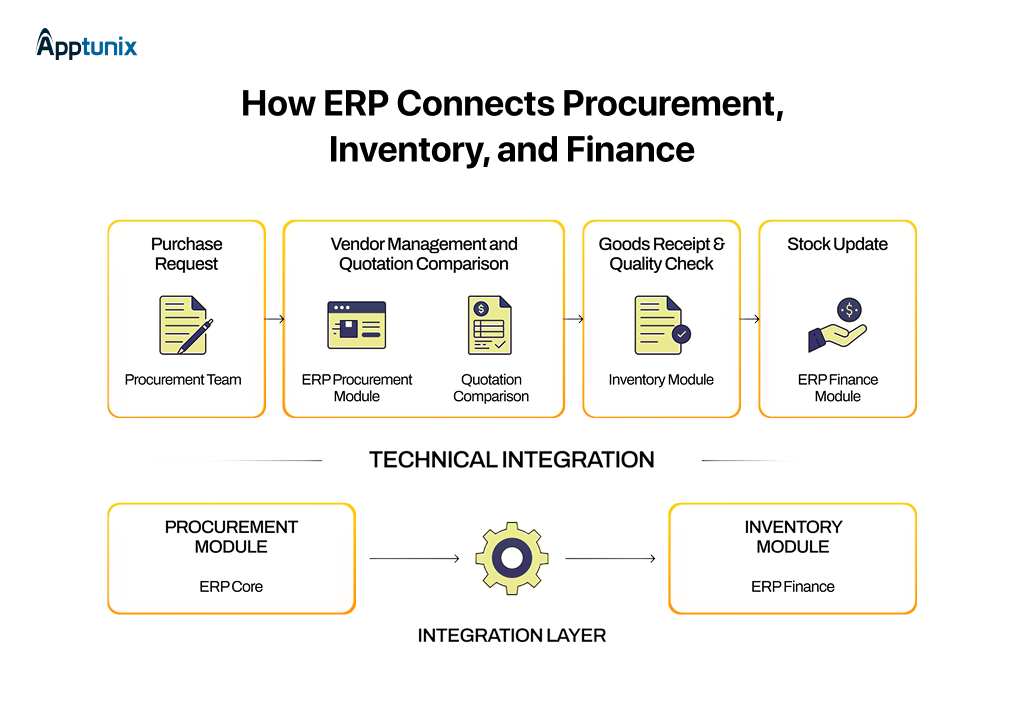
SAP is the most common ERP environment in large enterprises, and SAP integration for procurement software requires careful alignment between procurement data structures and SAP’s financial and materials management modules.
Key integration points include vendor master data synchronization between the procurement platform and SAP MM, purchase order data flowing into SAP for goods receipt recording and accounts payable matching, and invoice posting triggering the appropriate accounting entries in SAP FI automatically. SAP’s APIs and IDocs are the standard integration channels. Custom ABAP development is sometimes required for organizations with heavily customized SAP environments built over many years.
Oracle ERP Cloud and Oracle E-Business Suite require procurement integration that connects purchasing transactions to Oracle’s financial modules and supply chain management functions.
Critical requirements include real-time budget availability checking before PO approval, automatic journal entry creation when invoices are approved, and vendor payment status visible inside the procurement system without switching between applications mid-workflow.
Microsoft Dynamics 365 Finance and Operations is common among mid-market enterprises and organizations already in the Microsoft ecosystem.
Dynamics integration needs to handle procurement transactions flowing into the general ledger, synchronize purchase orders with Dynamics Supply Chain Management, and automate vendor invoicing connected to Dynamics Accounts Payable. Organizations using Dynamics get significant value from tight procurement integration.
For manufacturing and distribution companies, procurement does not operate independently of inventory.
When stock levels drop below defined thresholds, the procurement system should initiate a replenishment requisition automatically. When a purchase order is received, inventory records should update immediately. This closed loop between procurement and inventory eliminates the lag that causes both stockouts and overstock situations.
AI in procurement is not something enterprises are planning for. It is being deployed right now by organizations that want procurement to shift from a reactive administrative function to a capability that creates competitive advantage.
The practical difference between a standard procurement management system and an AI-powered procurement platform is this: a standard system records what happened. An AI-powered system tells you what is about to happen and recommends what to do about it.
Standard procurement analytics report on spend history.
AI procurement analytics find patterns across thousands of transactions that no human analyst would notice manually. Category-level trends that signal budget pressure three months before it shows up in reports. Procurement behaviors in specific departments that consistently operate outside policy. Correlations between vendor selection patterns and operational outcomes. The insight level is different in kind, not just in speed.
AI models trained on your historical procurement data, seasonal demand patterns, and external market signals generate purchase recommendations before demand becomes urgent.
This eliminates the emergency procurement cycle where a department runs short on a critical supply, raises a rush request, and ends up paying premium pricing to a non-preferred vendor because the preferred one has a three-week lead time. Predictive purchasing moves those decisions earlier in the cycle when options are available and pricing is negotiable.
AI-powered supplier risk scoring continuously monitors your vendor base for signals of financial instability, operational disruption, compliance violations, or reputational risk.
A supplier that passed onboarding 18 months ago may have experienced significant financial deterioration since then. Static onboarding assessments do not catch this. Continuous AI monitoring does, with enough lead time for procurement to diversify sourcing before a disruption actually occurs.
AI forecasting models analyze your full procurement history, apply category-specific growth rates, factor in contractual commitments and renewal timelines, and generate budget projections that finance teams can actually defend in planning conversations.
Instead of discovering budget pressure at quarter close, CPOs and CFOs get visibility into where pressure is building three to six months out. That lead time makes a real difference in what options are available.
AI can add a risk-scoring layer to the approval workflow that flags unusual transactions for additional review even when they technically fall within standard approval thresholds.
A purchase order for an approved vendor at a normal value level might pass straight through automated approval under standard rules. But if that same PO is for an unusually large quantity, is submitted outside business hours, and references a delivery address that differs from the standard location, the AI risk layer flags it for human review before it is processed. This catches fraud attempts and errors that purely rule-based systems approve automatically.
Conversational AI interfaces allow employees to submit procurement requests, check PO status, and understand procurement policy through natural language rather than navigating a complex software interface.
This matters most for occasional users who do not interact with the procurement system frequently enough to remember how to navigate it. A chatbot that understands a plain-language question and surfaces the answer directly reduces help desk volume and improves the employee procurement experience without requiring a UI redesign.
AI anomaly detection monitors transaction patterns continuously to identify activity that deviates from established baselines.
Duplicate invoices from the same vendor, unusual volume spikes in a specific category, procurement activity from user accounts at atypical times, pricing deviations from contracted rates: these are all patterns that anomaly detection surfaces. In organizations that process thousands of transactions monthly, manual review cannot reliably catch these patterns. AI does not miss them.
Cost is the first question every stakeholder asks before committing to a procurement software development project. It is also the question that gets the most misleading answers from vendors who want to close the engagement before the scope is properly understood.
Here is a realistic framework.
ERP integration complexity is consistently the largest cost driver in enterprise procurement projects. A system that connects to SAP with custom ABAP development, Oracle ERP, and a legacy inventory platform simultaneously costs meaningfully more to build and test than one that connects through a standard REST API to a modern cloud ERP.
User role complexity increases development time when an organization has many distinct procurement roles with varying access permissions, dashboard configurations, and workflow participation rules.
AI implementation costs vary depending on whether models are built custom for your proprietary data or configured with pre-built AI services. Custom ML model development for procurement forecasting or supplier risk scoring adds significant investment.
Annual maintenance and support typically runs 15% to 20% of the original development cost, covering bug fixes, security updates, and integration maintenance.
Apptunix is a custom procurement software development company and enterprise app development company that has built procurement platforms for manufacturing groups, healthcare networks, logistics companies, and technology enterprises.
Systems are designed to handle enterprise transaction volumes, concurrent users, and integration complexity from the initial architecture stage. Not built for 100 users with a plan to scale later.
Production integrations built with SAP, Oracle ERP Cloud, Microsoft Dynamics 365, and NetSuite. We understand the data models, the API constraints, and the edge cases that only appear when real transaction volumes are running.
Approval workflows and procurement rules your administrators can maintain without returning to the development team. The goal is operational independence for your team, not ongoing dependency on external developers.
Security architecture is designed before application development begins. Role-based access control, encryption at rest and in transit, complete audit logging, and compliance controls are built into the system from the start.
A mid-sized manufacturing group operating across three countries was running procurement through a combination of SAP’s basic purchasing module, department-level spreadsheets, and email-based approval chains. Purchase order cycle time averaged 11 days. Spend visibility was limited to monthly reports assembled manually by the finance team. Vendor onboarding had no standardized process, and several active vendors carried expired compliance documentation.
No single system owns the procurement process end-to-end. SAP held financial records. Spreadsheets held vendor data. Email held approval decisions. Nothing connected automatically. Every reconciliation required manual effort from someone.
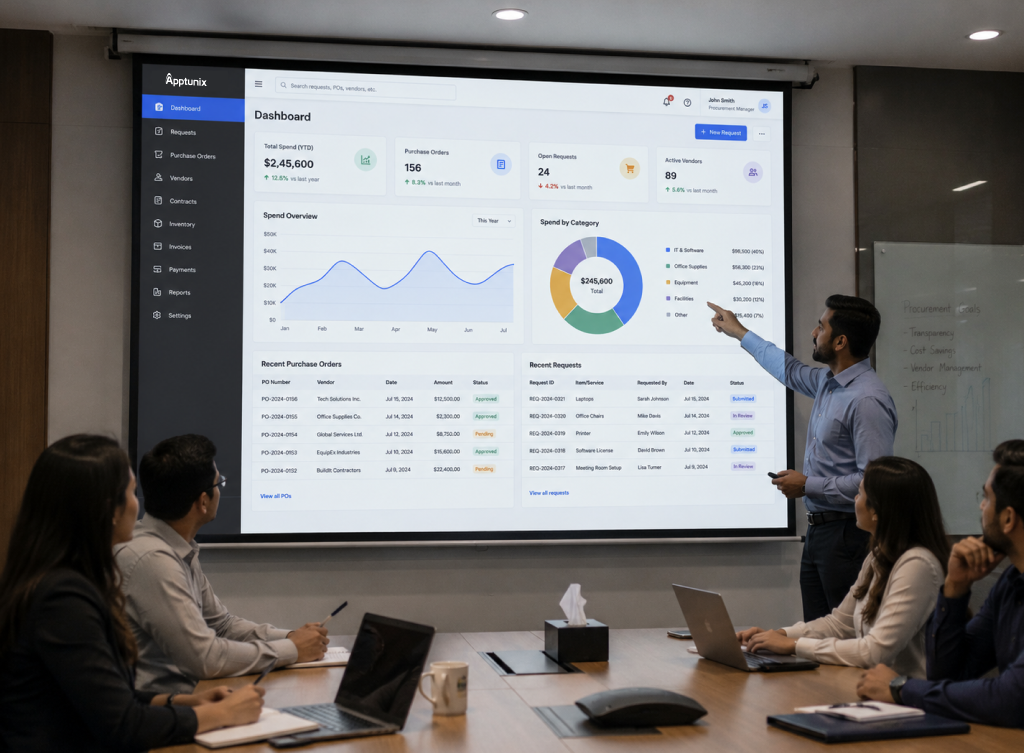
A custom procurement management system with a configurable multi-level approval workflow engine. A vendor management module with automated certification tracking and renewal alerts. Full bidirectional integration with the client’s SAP environment using IDoc interfaces and custom BAPI calls for real-time PO posting. A spend analytics dashboard pulling live data across all three operating companies into a single consolidated view accessible to the CFO and CPO without IT involvement.
Purchase order cycle time dropped from 11 days to under 2 days within the first quarter of deployment. Spend visibility moved from monthly manual reporting to real-time dashboards. Vendor compliance documentation is tracked automatically with zero expired certifications in the 12 months following go-live. The finance team estimated annual savings of approximately $340,000 from reduced administrative overhead, eliminated duplicate payments, and improved contract compliance across spend categories.
If your organization is still running procurement through spreadsheets, email approvals, and institutional memory, the operational and financial gap between where you are and where your competitors operate is widening every quarter.
Apptunix works with enterprises to design and build custom procurement software that fits the actual complexity of your workflows. Not a generic template you have to adapt to. A system built around how your procurement actually works.
We offer a free procurement technology roadmap session. Our enterprise development team reviews your current procurement architecture, maps your specific requirements, and gives you an honest assessment of what it would take to build a system that solves your actual problems.
Planning enterprise procurement automation?
We’ll map your approval workflows, ERP dependencies, and procurement architecture in a free consultation.
Just a direct conversation with people who have built procurement software at enterprise scale and will tell you what your project actually requires.
Q 1.What is B2B procurement software development?
B2B procurement software development involves building digital platforms that help businesses manage purchasing operations, supplier communication, approvals, purchase orders, invoicing, and procurement workflows in a centralized system.
Q 2.What does enterprise procurement software include?
Enterprise procurement software typically includes vendor management, procurement workflow automation, purchase order management, spend analytics, approval hierarchies, ERP integrations, compliance tracking, and reporting dashboards.
Q 3.How does procurement workflow automation software improve business operations?
Procurement workflow automation software reduces manual approvals, minimizes procurement delays, improves compliance, automates purchase order routing, and helps enterprises streamline procurement operations across departments.
Q 4.What is eProcurement software development?
eProcurement software development refers to building digital procurement systems that automate sourcing, purchasing, supplier management, invoicing, and procurement approvals through a centralized online platform.
Q 5.Why do enterprises choose custom procurement software over off-the-shelf platforms?
Enterprises often choose custom procurement software because it offers flexible workflows, deeper ERP integrations, better scalability, advanced security controls, and features tailored to their procurement operations.
Q 6.How much does enterprise procurement software development cost?
The cost of enterprise procurement software development depends on platform complexity, integrations, automation requirements, AI capabilities, and scalability needs. Basic systems may start around $30,000, while enterprise-grade AI-powered platforms can exceed $200,000.
Q 7.What is AI-powered procurement software development?
AI-powered procurement software development involves integrating artificial intelligence capabilities such as predictive analytics, supplier risk scoring, intelligent approvals, spend forecasting, and procurement automation into enterprise procurement systems.
Q 8.Can procurement software integrate with ERP systems?
Yes. Modern enterprise procurement software can integrate with ERP systems such as SAP, Oracle, Microsoft Dynamics, NetSuite, and other accounting or inventory management platforms.
Q 9.How long does custom procurement software development take?
Development timelines vary based on complexity. A basic procurement MVP may take 3–5 months, while large-scale enterprise procurement platforms with AI and ERP integrations may require 8–14 months or more.
Get the weekly updates on the newest brand stories, business models and technology right in your inbox.
With over 20+ years of experience in driving global digital initiatives, Nikhil Bansal is the CEO & Director of Apptunix. He specializes in orchestrating large-scale digital transformations, enterprise-grade software solutions, and high-level business strategies that redefine industry standards. Nikhil is known for his ability to bridge the gap between complex business challenges and innovative technology, helping Fortune 500 companies and startups alike achieve sustainable growth. A visionary leader, he empowers enterprises to navigate the digital landscape with agile, ROI-focused models and future-ready business strategies.
39 Views 15 min July 15, 2026

133 Views 15 min June 26, 2026

256 Views 15 min June 9, 2026
Book your consultation with us.
Book your consultation with us.


One Central, The offices 3, Level 3, DWTC, Sheikh Zayed Road, Dubai
+971 50 782 1690


Offer Ends Soon
Get a quick expert response in under 5 minutes.