Wedding/Marriage App Development for KSA and GCC: A Founder’s Playbook
694 Views 13 min December 26, 2025

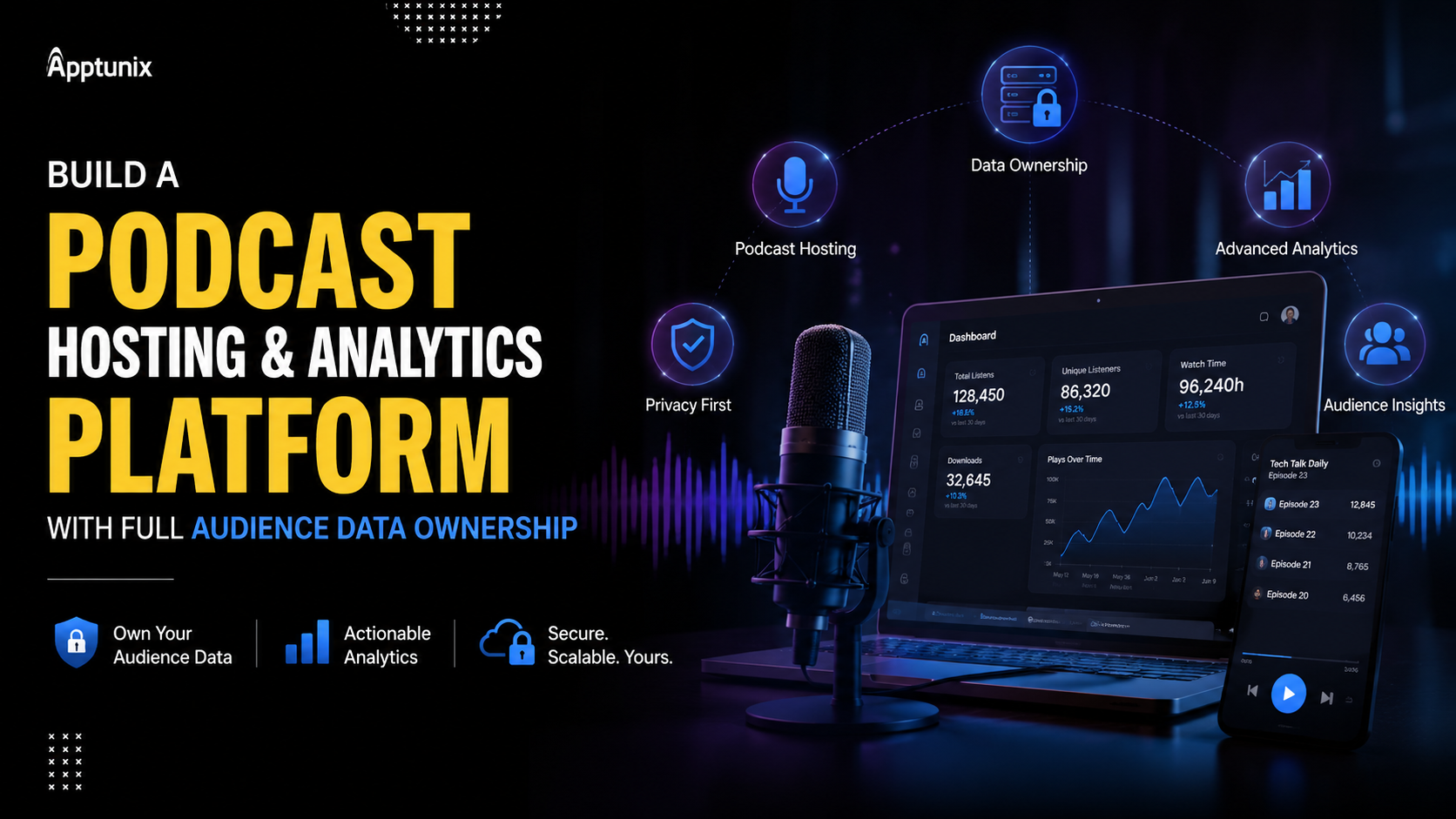
In 2025, there were roughly 584 million people worldwide listening to podcasts. That marks a steady, healthy growth trajectory, up around 6-7 % year‑over‑year, and puts the 2025 listener base well above the ~507 million recorded in 2023.
According to industrywide forecasts from Data Globe Hub, that upward trend is expected to continue, pushing global listenership even higher by 2026 and beyond.
It is more than a vanity metric: for media networks, content-first brands, and even the next-generation creator tool startup, this growth curve is significant. It marks the growing market for podcasting infrastructure: platforms that can host, store and distribute audio and video at volume, and analytics tools that convert raw listener data into actionable insight to drive listener retention, monetization, and content strategy.
Growth in listenership doesn’t automatically lead to revenues or control for publishers, however. The podcasting industry has evolved. Success now depends on owning your platform, not just publishing on one. Businesses that control their platform control their audience, data, and revenue. Those that don’t remain dependent on third-party platforms, their policies, pricing, and data limitations. This is the same for setting up (or investing in) a dedicated podcast hosting and analytics platform that was built specifically for podcasts with trustworthy distribution, detailed analytics and monetization capabilities that a business truly owns.
At the infrastructure level, this is a custom podcast hosting platform development solution.
This guide covers everything users need to know to set up a podcast host and analytics solution that empowers them to own their audience data.
A podcast hosting platform is the infrastructure layer that stores audio files, generates RSS feeds, delivers episodes to listener apps, and captures the engagement data produced by every play, pause, skip, and subscribe event.
Most publishers today use managed platforms such as Buzzsprout, Transistor, Podbean, or the built-in hosting inside Spotify for Podcasters. These platforms have low expenses at a small scale and are quick to establish. What they are not doing is offering first-party data control.
The platform gathers the behavioural signal, device type, geographic location, completion rate, and listening cadence when the listener plays your episode through its infrastructure. All that data is the property of the platform. Publisher’s end result is a report in dashboard format, no API access to raw listener events, and limited ability to export.
This is fine for one user creating hobby material. This is a structural liability for media firms creating programmatic ad endeavors, enterprise brands generating thought leadership audio, and podcasters on networks dealing with many podcasts.
Why this matters now:
The Interactive Advertising Bureau’s 2025 Podcast Revenue Study estimated US podcast advertising revenue at $2.56 billion and projected it to exceed $4 billion by 2026. Programmatic audio ad pricing is increasingly tied to verified audience segments; age, location, listening behaviour, and content affinity. Publishers who can demonstrate these segments from first-party data command meaningfully higher CPMs than those relying on platform-reported estimates.
Also Read: How App like Podbean Works? Guide to Make Podcast App.
Custom podcast platform development is not the right call for every use case. Here is a clear breakdown of who it serves, and who it does not.
If your use case involves any of the above, you are the right candidate for a custom podcast hosting and analytics platform.
Seven core modules make up a production-grade custom podcast hosting platform. Every layer is autonomous and can be scaled or replaced without impacting other layers.
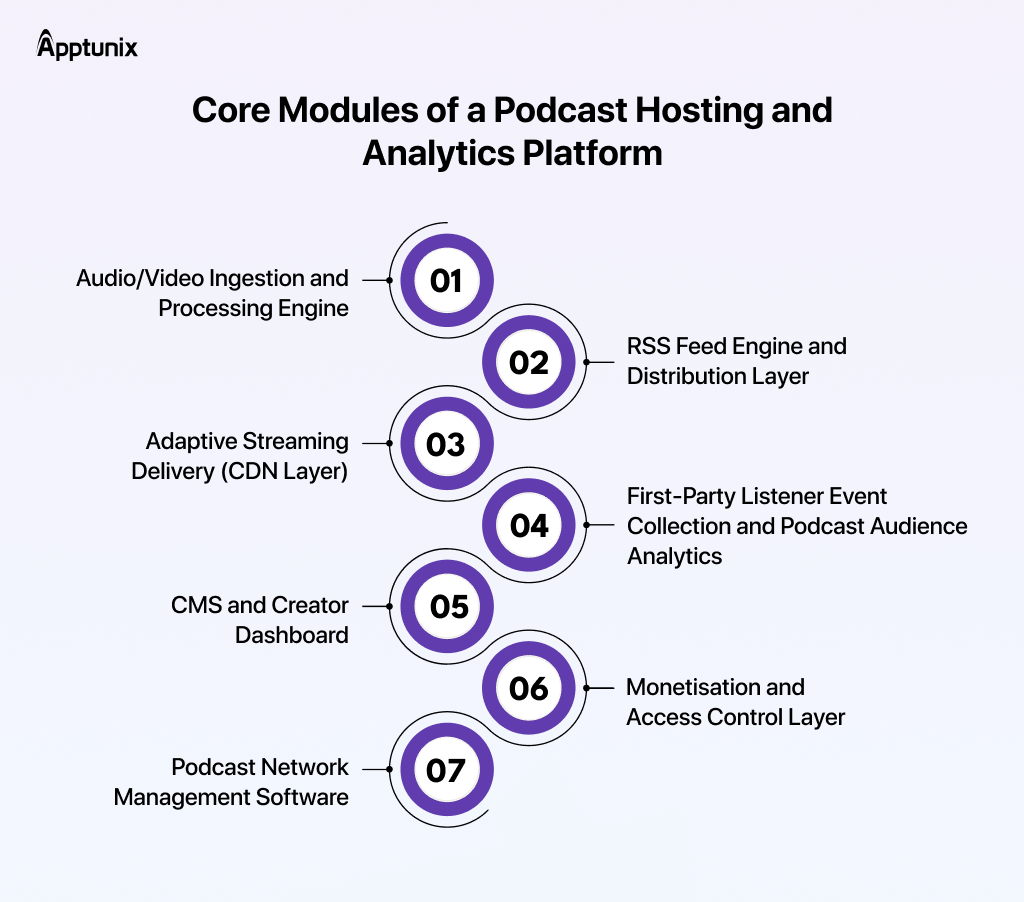
This is an audio/Video Ingestion and Processing Engine.
The content pipeline transforms a stream of raw audio files generated by creator uploads into adaptive bitrate streams (HLS/MPEG-DASH) and stores them on cloud object storage. MP4 normalization and thumbnail extraction are also performed via the same pipeline for enterprise podcast platforms that also host video.
The core technology features: job queue-based scheduling through Redis or RabbitMQ, S3-compatible object storage (AWS S3, Google Cloud Storage, Azure Blob), and FFmpeg transcoding workers.
Each episode comes with a standards-compliant RSS 2.0 feed, extended with Podcast Index namespace elements. The distribution layer automatically submits to Apple Podcasts, Spotify, Amazon Music, iHeartRadio, and Google Podcasts through their APIs. If you are a white label podcast platform, then the distribution layer can be customized with your own domain name.
The listeners on the platform app or embedded player get episodes via an HLS or MPEG-DASH adaptive stream fed via a CDN (Cloudflare, Fastly, or AWS CloudFront). This layer dictates whether audio quality is high or low, buffering behaviour is what you would expect, and geographic latency is high or low. The CDN is also the main IP address for first-party listener event collection.
This is the module that makes sense for data-driven publishers to build their own podcast platform.
All listeners events, play starts, play positions, pauses, resumes, seeks, skips, episode completes, subscribe, unsubscribe are recorded as events with a timestamp and stored as an event stream (Apache Kafka or AWS Kinesis). The raw event stream is pushed into a data warehouse (BigQuery, Snowflake, or Redshift) that’s where the podcast analytics platform layer performs aggregations and segment calculations.
The results include a dashboard showing podcast analytics, including: Listener retention charts, geographic heat maps, device and OS breakdowns, subscriber growth cohorts, cross-episode listener journeys, and episode-level completion curves.
Most importantly, this information is all stored in your own infrastructure and can be accessed through an API without any vendor involved.
The content management layer provides tools to help creators and producers schedule episodes, write show notes, create chapter markers, add transcripts, set access rights (public/private/subscriber-only), and initiate distribution. The CMS is connected with the existing DAM or CMS systems, either through webhook or API, for enterprise podcast platforms.
Monetisation layer provides publishers who are building subscription audio products or dynamic ad insertion workflows with listener authentication, subscription gating, coupon and trial management, and dynamic ad slot injection via VAST/VPAID-compatible ad server integration. It’s the part that converts podcast analytics into targeted ad revenue.
A network management layer provides multi-show podcast network capabilities such as combining all show analytics into a single network, controlling contributor access, managing shared branding assets, and providing advertisers and sponsors with a single, consolidated reporting. This is a feature which is completely lacking in individual show level managed platforms.
Also Read: How To Build a Music Streaming App Like Spotify?
The term “podcast analytics” is used loosely by managed platforms to describe the summary dashboards they provide. Full data ownership is a fundamentally different concept, and it changes what a publisher can actually do with listener data.
For an enterprise podcast platform serving B2B audiences, the difference between aggregate reports and first-party behavioural data is the difference between “we have 80,000 listeners” and “we have 12,400 verified enterprise decision-makers in the US healthcare sector who complete 73% of our compliance episodes.” The latter is a commercial asset. The former is a vanity metric.
Building a production-ready podcast hosting and analytics platform requires a structured podcast app development process. Here is the seven-step framework used by Apptunix for podcast software development engagements.
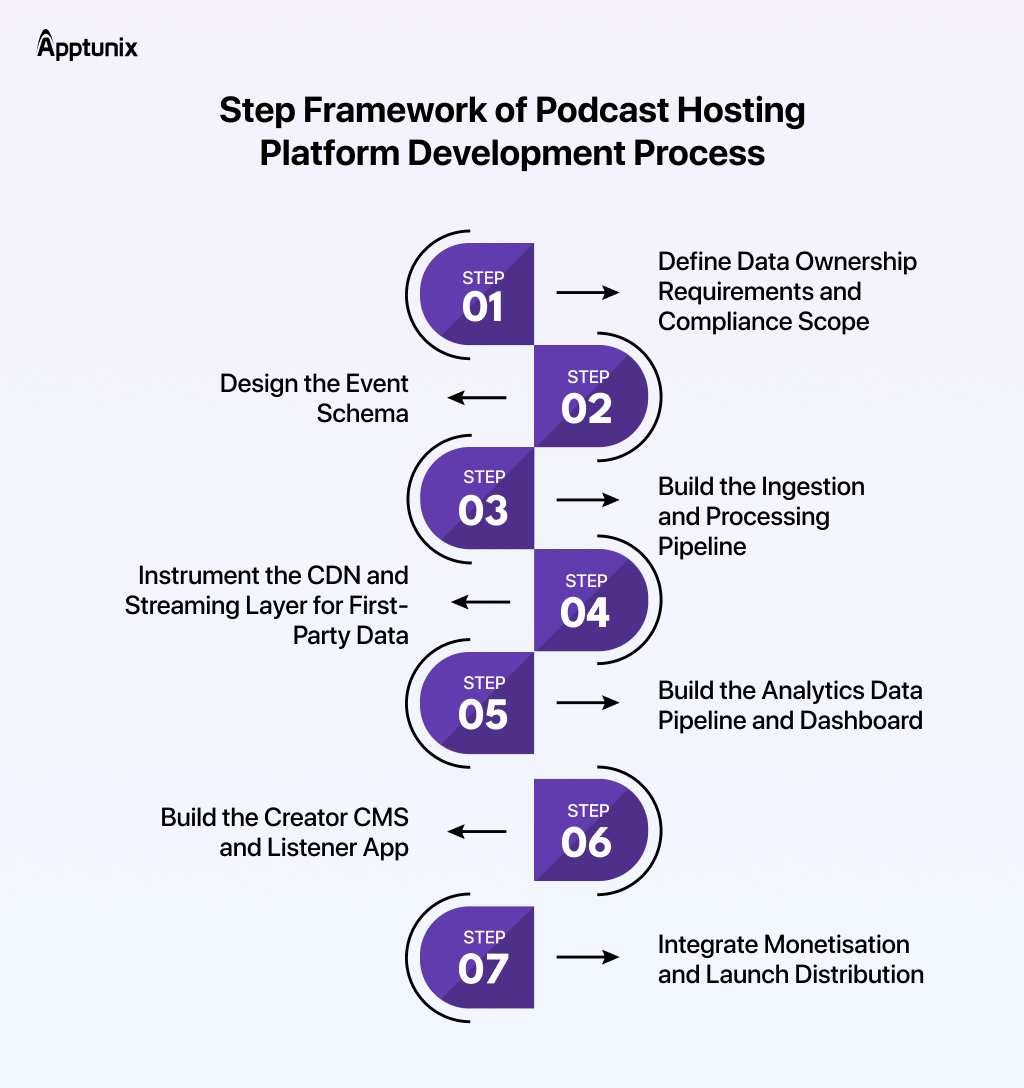
Before any architecture decision, we map your data requirements. Which listener attributes will you collect? Under what consent framework (GDPR, CCPA, COPPA)? Who are the downstream consumers of the data, internal analytics, external ad networks, and CDP? This step determines your data model and shapes every subsequent infrastructure decision.
Define a comprehensive listener event taxonomy, including which events to capture, the properties associated with each event, and how they map to anonymous and authenticated listeners. A well-designed event schema at this stage prevents costly retroactive migrations later. The schema must be forward-compatible, designed to accommodate future event types like chapter-level engagement, transcript interaction, or cross-device listening.
Stand up the audio processing pipeline first. This is the blocking dependency for everything else.
Here’s a smoother and more professional version:
Content should be transcoded, securely stored, and made stream-ready before implementing the CMS or analytics. From day one, adopt a queue-based architecture, as synchronous transcoding during uploads does not scale efficiently beyond approximately 50 concurrent uploads.
Event data is collected across multiple touchpoints, including the CDN edge, player SDK, and server side. Triple-source instrumentation ensures completeness, CDN logs catch events that player SDKs miss (background playback, CarPlay, smart speaker), while server-side events fill gaps from ad blockers. This is what makes the podcast audience analytics layer accurate at scale.
Raw events flow from Kafka into your data warehouse via a streaming ETL job. Aggregation jobs run on a configurable schedule (real-time, hourly, daily). The analytics API layer serves pre-computed metrics to the creator dashboard and exposes raw segments to downstream systems via REST or GraphQL API.
With the data infrastructure in place, build the creator-facing CMS and the listener-facing app. These are the visible surfaces of the platform, episode scheduling, show management, playback UX. For enterprise podcast platforms, the CMS must support multi-user roles (producer, editor, publisher, analytics viewer) with granular permissions.
Connect the ad server, subscription billing, and distribution APIs. Run QA across all RSS feed destinations, validate dynamic ad insertion on all supported player environments, and conduct load testing on the streaming layer before launch. For white label podcast platforms, this step includes brand deployment and custom domain configuration for each network client.
The right stack for a podcast hosting platform with analytics depends on scale, team capability, and cloud preference. Below is the reference architecture used for mid-to-large scale deployments.
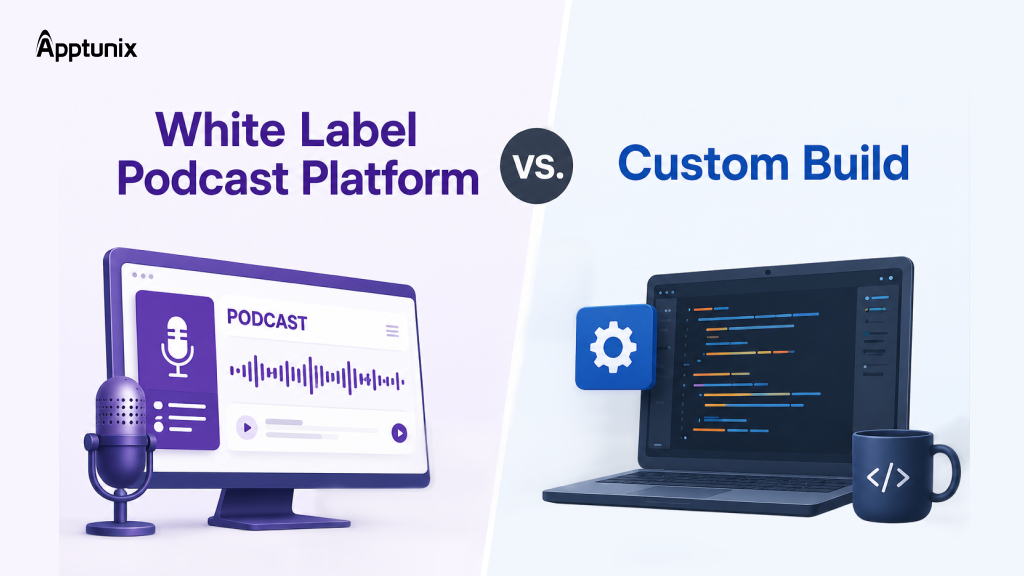
Before comparing the two approaches, it’s important to understand that there is no one-size-fits-all solution. The right choice depends on where your business is today and where you plan to take it in the future.
Businesses choose a white-label podcast platform to launch quickly with minimal development effort. It provides a ready-made foundation, allowing you to brand the platform as your own while reducing both time-to-market and initial investment.
A Fully Custom Podcast Platform, on the other hand, is built entirely around your business requirements. It offers complete ownership of your technology, user data, features, and infrastructure, making it the ideal choice for organizations planning to scale, innovate, and differentiate in a competitive market.
The comparison below breaks down the key differences between a White Label Podcast Platform and Custom Podcast Platform Development, helping you identify the solution that best aligns with your business objectives, technical requirements, and long-term growth strategy.
For most enterprise podcast platform use cases, where first-party data, compliance requirements, and network-level analytics are non-negotiable, a fully custom build or a custom-extended white label architecture is the right answer. A white label podcast platform built on a third-party hosting layer still surrenders raw listener data to the underlying infrastructure vendor.
Development cost for a custom podcast hosting platform varies by scope. Below are the realistic investment ranges for three common build profiles in the US market.
The largest cost variable in podcast platform development is the analytics data pipeline. Platforms built without a properly designed event schema and warehouse layer cost 30–50% more to retrofit analytics capabilities after launch than those that design for data from the start.
A successful podcast platform goes beyond hosting audio, it empowers creators, engages listeners, and drives sustainable business growth. From seamless content management and intelligent audience analytics to monetization, security, and enterprise integrations, every feature should work together to deliver a scalable and future-ready podcasting experience. Below are the essential capabilities that power a modern podcast platform.
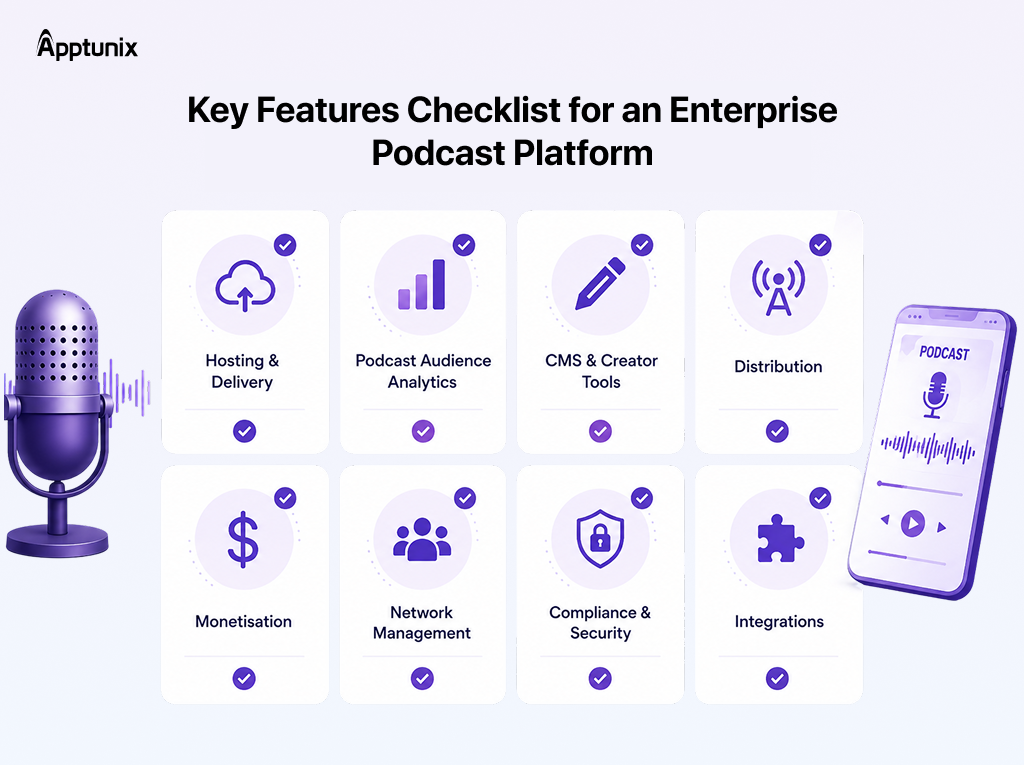
Three structural shifts in the US podcast market are accelerating the move toward custom podcast platform development.
The shift from host-read sponsorships to programmatic audio buys is accelerating. Programmatic buyers require verified listener segments, not platform-reported estimates. Publishers with first-party audience data from a custom podcast analytics platform can enter direct data deals with DSPs that managed platform users cannot access.
Multiple policy changes at major streaming platforms between 2023 and 2025 reduced publisher access to listener data, altered royalty structures, and in some cases removed shows without appeal mechanisms. The risk of building an audience on infrastructure you do not control is no longer theoretical.
Enterprise content teams publishing internal communications audio, earnings call recordings, investor relations content, or HIPAA-adjacent healthcare programming cannot use consumer podcast platforms. They require SSO integration, role-based access, audit logs, and private cloud deployment options, capabilities available only through enterprise podcast platform development.
Building a podcast hosting platform with full audience data ownership is an infrastructure project, an analytics engineering project, and a product development project simultaneously. Most development firms handle one layer well. The integration across all three is where platforms fail in production.
Apptunix brings 12+ years of enterprise software and mobile app development experience, with a delivery track record across OTT streaming platforms, media applications, and enterprise content systems in the US market. Our team of 300+ engineers has shipped podcast software development and streaming platform projects for media networks, creator economy platforms, and enterprise content teams.
What we bring to podcast platform development engagements:
Q 1.What is the difference between a podcast hosting platform and a podcast analytics platform?
A podcasting service will host your audio content, and provide the files to listening applications through CDN and RSS. A podcast analytics platform records the interactions of all listeners and allows you to query and act on that engagement. A complete, custom podcast hosting and analytics platform integrates both infrastructure that you own, meaning you capture listener event data as it happens, store it in your data warehouse, and don’t have to pass it through a third-party vendor.
Q 2.How long does it take to build a custom podcast hosting platform?
The launch of an MVP level podcast streaming platform would take anywhere between 4-6 months from the inception of the project. The time it takes to create a full-featured enterprise podcast platform that incorporates mobile apps, a content management system, ad insertion and network management software is usually 7-9 months. The analytics pipeline complexity and the number of third-party integrations needed are the main drivers of Timeline.
Q 3.Can I own 100% of my listener data on a custom platform?
Yes. With your own podcast hosting platform on your own cloud (AWS, GCP, Azure), all events that listeners interact with, play events, completion rates, geographic signals, device data, and more, can be stored in your own data warehouse, without a vendor in the middle. Access to export, access and retention policy, and downstream use is under your control.
Q 4.What makes an enterprise podcast platform different from a standard podcast hosting platform?
An enterprise podcast hosting platform provides features that a consumer podcast platform won’t have: a single sign-on (SSO), integration with LDAP, role-based access control and granular permissions, private and internal podcast hosting, compliance controls (HIPAA, SOC 2, FedRAMP based on use case), a network-level analytics dashboard across multiple shows and content teams, and a podcast audit log.
Q 5.What is a white label podcast platform and when does it make sense?
A white label podcast platform is a platform that is custom built and can be rebranded and licensed to multiple clients, as is generally required with podcast production companies, podcast media companies that host as a service, or SaaS companies that enter the podcast vertical. It’s logical when you have to support several publisher clients from a single infrastructure, and have your own branding and data controls.
Q 6.What is a white label podcast platform and when does it make sense?
A white label podcast platform is a platform that is custom built and can be rebranded and licensed to multiple clients, as is generally required with podcast production companies, podcast media companies that host as a service, or SaaS companies that enter the podcast vertical. It’s logical when you have to support several publisher clients from a single infrastructure, and have your own branding and data controls.
Q 7.How much does podcast hosting platform development cost for a US-based media company?
Podcast hosting platform development for a US-based media company typically costs $50,000–$250,000+, depending on project complexity and business requirements.
Pricing varies based on AI features, analytics, content management, scalability, and integrations.
Custom branding, enterprise security, and multi-platform distribution also influence the total investment.
Ongoing maintenance, cloud hosting, and feature upgrades should be included in the overall budget.
Get the weekly updates on the newest brand stories, business models and technology right in your inbox.
Book your consultation with us.
Book your consultation with us.


One Central, The offices 3, Level 3, DWTC, Sheikh Zayed Road, Dubai
+971 50 782 1690


Offer Ends Soon
Get a quick expert response in under 5 minutes.