How Much Does Procurement Software Development Actually Cost in 2026?
90 Views 15 min May 14, 2026

Arohi Singh is a technology content strategist at Apptunix, where she writes about software and app development across industries, from on-demand and logistics to fintech, healthcare, and applied AI. With over 5 years of experience, she works closely with Apptunix’s engineers, product managers, and solution architects to turn real project insights into clear, decision-ready guidance for founders and business leaders. Her writing focuses on what matters before you build: market context, feature trade-offs, realistic costs, and compliance considerations

Fuel is the backbone of every business that moves, but refuelling systems are still stuck in the past. Have you noticed how every basic service, including groceries, food, and even EV charging, is now coming to your door?
Consumers expect convenience, and businesses are racing to deliver it. But there’s one industry rising faster than anyone expected: “on-demand fuel delivery”. And that’s exactly why entrepreneurs are researching fuel delivery app development costs more than ever before. Depending on the features, compliance requirements, and business model, fuel delivery app development costs can range from $18,000 and $200,000+.
The demand is driven by a real business problem. Every minute a commercial vehicle waits at a fuel station, companies lose money. A quicker solution is desperately needed across sectors such as emergency services, transportation, and construction. And investors are recognizing this huge untapped opportunity.
That’s where on-demand fuel delivery app development is creating a real revolution. With just a mobile app, users can request fuel anytime, anywhere, and get it delivered directly to their vehicle. Now, there are no queues, no downtime, and no hassles.
This model is already gaining incredible traction in the USA, UAE, India, and Canada. Analysts predict that the mobile fuel delivery market will reach $11.93 billion by 2030.
Fuel delivery app development is not just a trending business. It’s the next goldmine in mobility commerce, with recurring revenue, low competition, and fast scalability. However, before stepping in, you must clearly understand the cost of developing a fuel delivery app. What features matter, and how to build safely within compliance standards.
Let’s get started!
Early movers in emerging markets often capture the most significant gains. Here are four compelling reasons to invest in an on-demand fuel delivery app development now:
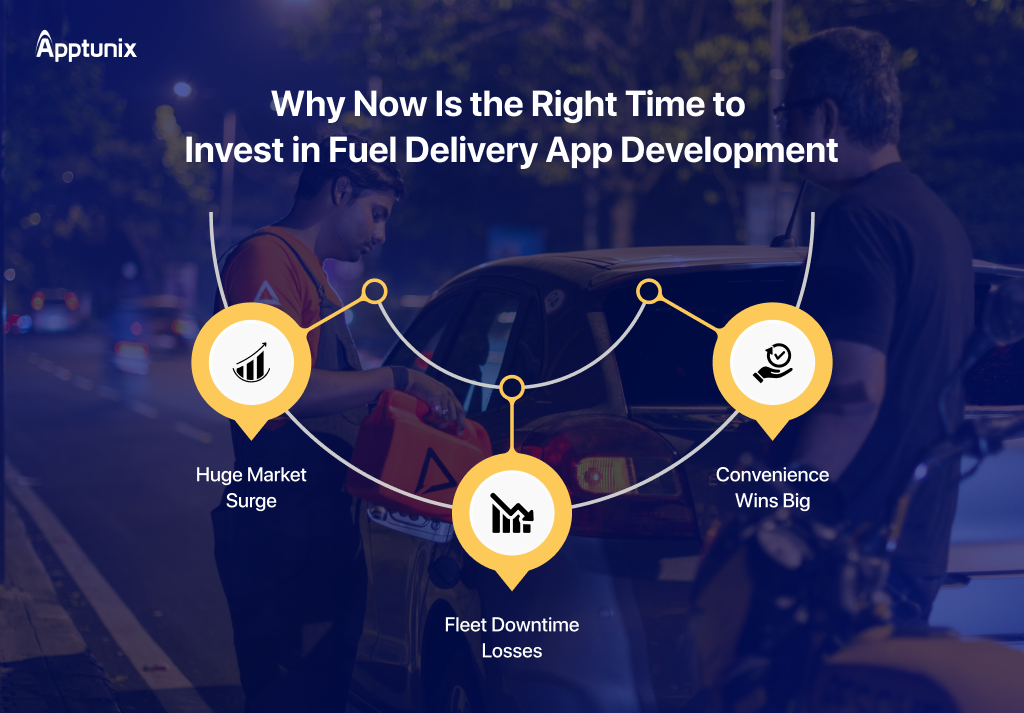
1. Huge Market SurgeThe mobile fuel delivery market is projected to grow from $ 5.84 billion in 2025 to $11.93 billion by 2035. This indicates sustained demand and space for multiple winners. By investing in a fuel delivery platform now, you capture an early advantage and stake your claim before the market fills up.
2. Fleet Downtime LossesCommercial fleets face high downtime costs. Unplanned downtime often costs fleets an average of $760 per hour. Reducing refuelling delays directly increases margin. A mobile solution that brings fuel to the vehicle means your business becomes the productivity-saver fleets will pay for again and again.
3. Convenience Wins BigConsumers and business buyers now favour services that deliver to them, not the other way around. Reports show that users and fleets alike gravitate toward fuel delivery app features such as scheduling, real-time tracking, and driverless refuelling.
This shift makes mobile fuel delivery platforms a strategic infrastructure investment rather than a niche novelty.
Now we’ll dive into the exact fuel delivery app development cost. So you can see where and how to invest your budget for maximum return.
The fuel delivery app development cost typically falls between $18,000 and $200,000+. It clearly depends on how ambitious your product vision is. A lean MVP that validates demand can launch in 5–12 weeks. A fully-engineered on-demand fuel delivery app development solution (similar to CAFU or Booster) may take 6–9 months.
What surprises most founders is the revenue velocity. Fuel delivery platforms with subscription or fleet partnerships often recover development investment within months, not years. Because users stick when convenience becomes a habit.
If your goal is speed-to-market, start small. If your aim is category leadership, structure your investment with long-term scaling in mind.
Here’s a quick breakdown that reflects global pricing reality:
Next, let’s break down what actually drives fuel delivery app pricing. So you know exactly where every dollar goes and how to invest smarter.
Understanding what shapes the fuel delivery app development cost helps you invest smartly. Here are eight major factors that define the pricing structure of any on-demand fuel delivery app development project.
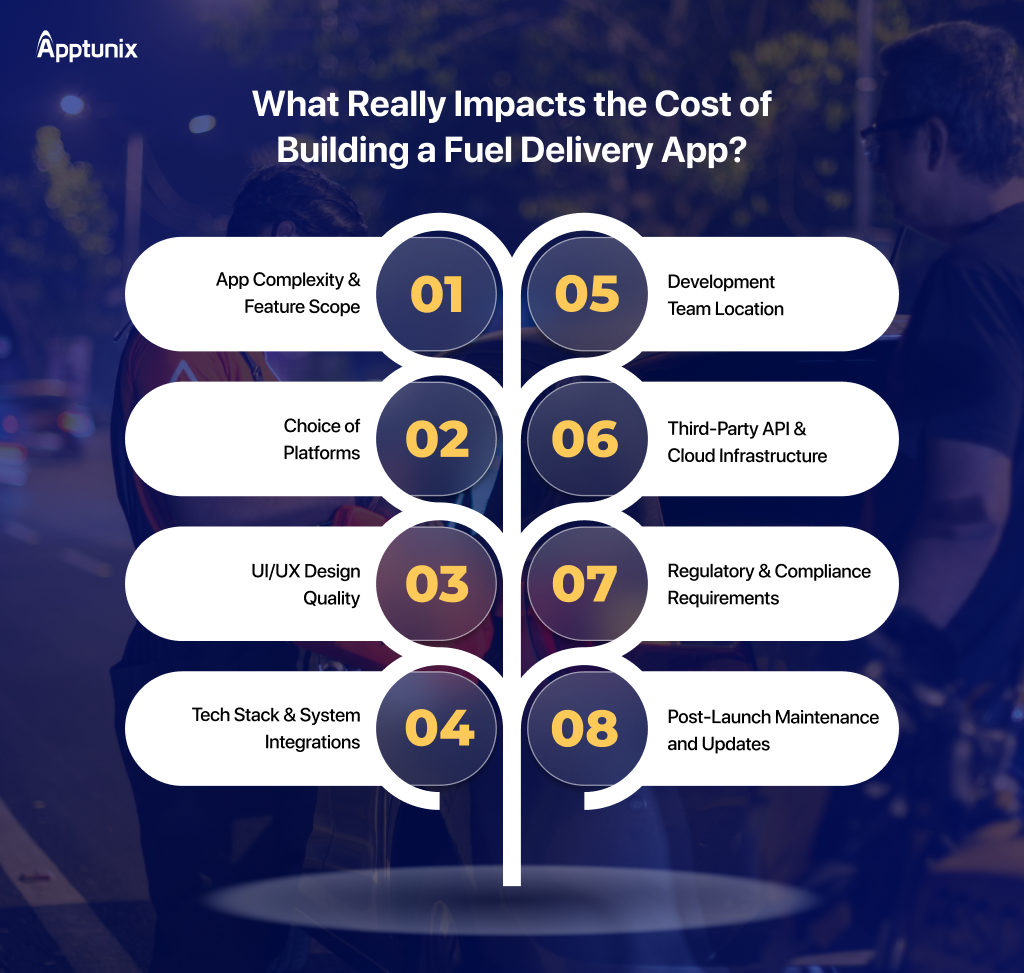
1. App Complexity & Feature ScopeThe broader the feature list, the higher the on-demand fuel delivery app cost. A basic MVP covers simple ordering, GPS location, pricing display, and payments. But advanced apps require fleet analytics, automated dispatch, route optimization, driver behaviour tracking, and IoT-based fuel level monitoring.
These features require additional hours and expertise. Complexity directly shapes cost because every added function increases development, testing, and integration effort.
2. Choice of PlatformsWhether you build for Android, iOS, or both heavily impacts the final budget. Native Android/iOS development costs more because each platform requires separate code. Cross-platform development with Flutter or React Native reduces mobile app development cost for fuel delivery, but may compromise performance when dealing with heavy logistics modules. The right decision depends on the target audience, speed to market, and scalability goals.
3. UI/UX Design QualityDesign determines the perception of reliability in a high-risk category like fuel delivery. Clean navigation, delivery tracking maps, real-time truck visibility, and smooth ordering screens require strong UX engineering. Premium UI elements such as animations, 3D location visualization, and personalized dashboards increase costs.
However, well-designed interfaces improve customer retention and reduce support costs, making this investment strategically beneficial.
4. Tech Stack & System IntegrationsThe technology stack used in the fuel delivery app has a major impact on overall development time and cost in the long run. Integrations with IoT fuel sensors, telematics systems, ERP tools, and advanced mapping APIs require expert backend engineering. The more integrations, the higher the overall fuel delivery software development cost. Choosing a scalable stack early prevents expensive architectural changes later.
5. Development Team LocationCosts vary significantly based on where the fuel delivery app development company is located. US, UK, and Europe-based developers charge higher rates, while India or UAE-based teams offer more cost-efficient models without reducing quality. The level of experience and structure of the team also influences price.
6. Third-Party API & Cloud InfrastructureFuel delivery apps require external services like SMS notifications, payment gateways, mapping, identity verification, and cloud hosting. Each integration has setup and recurring usage fees that affect the overall cost of fuel delivery app development.
The higher the order volume, the higher the cloud and server costs. Scalable infrastructure selection will guarantee performance without spending overboard.
7. Regulatory & Compliance RequirementsFuel delivery companies operate under stringent safety regulations and rules governing the handling of hazardous materials. There are further complications in complying with regional transportation laws, certification processes, secure data encryption, and insurance documentation.
These regulatory considerations affect the pricing breakdown of the fuel delivery app, necessitating more testing and third-party audits. Despite the high cost of compliance, it is essential for licensing and market confidence.
8. Post-Launch Maintenance and UpdatesThe cost of development is not an upfront investment alone. Maintenance is a never-ending budget line item, generally 15%-20% of the initial development price per year. This includes essential bug fixes, continuous updates to ensure operating system compatibility, security patches, and iterative feature enhancements based on user feedback.
A robust maintenance plan is vital to ensure the app remains functional and secure in an evolving technological and regulatory landscape.
Now that you know what shapes the cost. Let’s see how you can strategically minimize fuel delivery app development cost without compromising on quality.
The aim of reducing the fuel delivery app development cost is not about cutting corners, but about making smart investments. The following are some practical measures that can enable you to maximize your budget:
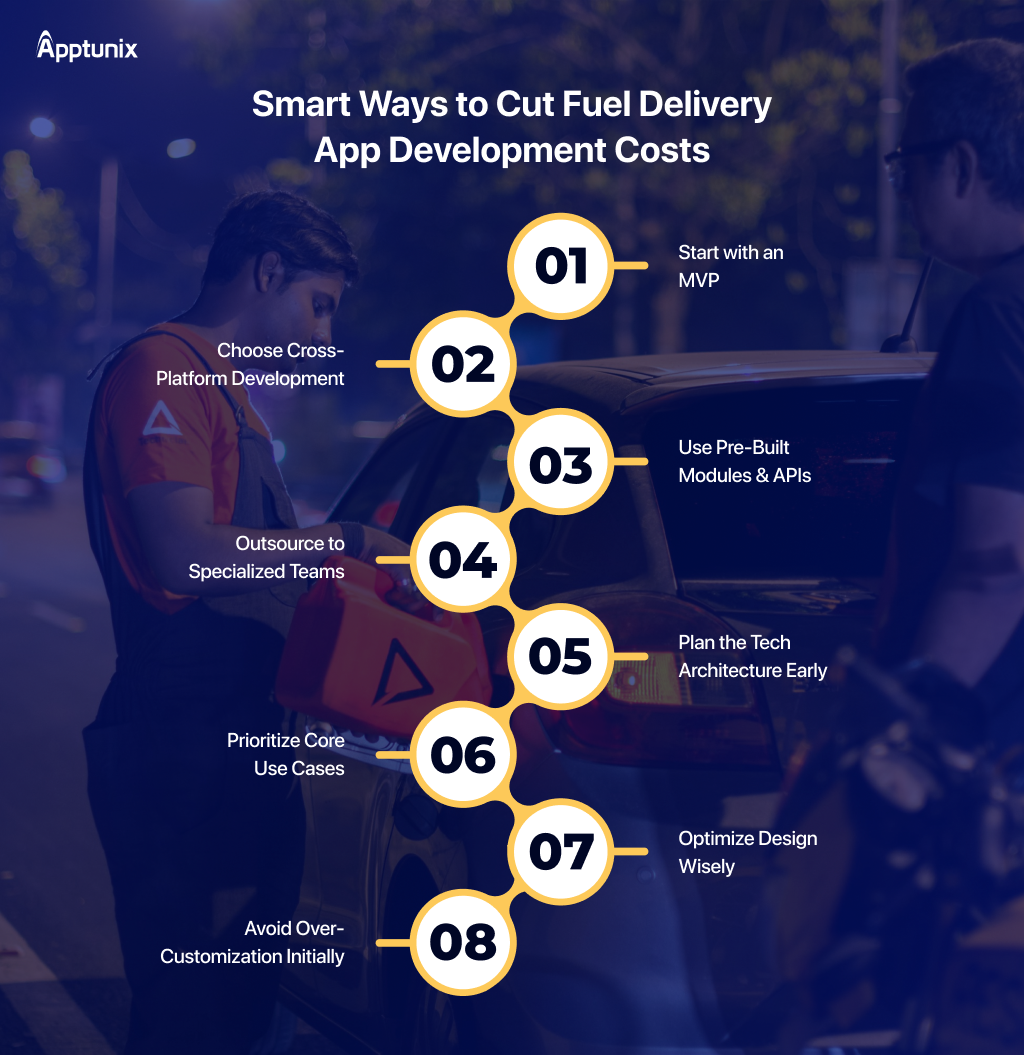
1. Start with an MVPLaunching a Minimum Viable Product helps validate demand before full investment. Rather than building every feature at once, start with essential fuel delivery app features. Some essential features like registration, GPS-based ordering, delivery tracking, payments, and order history.
This reduces the initial on-demand fuel delivery app cost and allows real user feedback to shape future updates.
2. Choose Cross-Platform DevelopmentBuilding a single app that runs on both iOS and Android significantly lowers the cost of mobile app development for fuel delivery. Frameworks like React Native and Flutter help reduce duplicate code and testing time. Unless you need high-performance native features or complex IoT automation, cross-platform offers a faster launch and better ROI.
3. Use Pre-Built Modules & APIsIntegrate existing mapping systems, payment gateways, and dispatch modules instead of building all components from scratch. Pre-built solutions cut down engineering time by as much as 40%. Thereby lowering the overall cost of developing a fuel delivery app.
This approach accelerates time-to-market and achieves enterprise-level functionality at a lower price.
4. Outsource to Specialized TeamsPartnering with an experienced fuel delivery app development company helps avoid costly trial-and-error development. Skilled teams already understand compliance, logistics, routing automation, and scalability architecture. Outsourcing also minimizes infrastructure costs and delivers predictable pricing compared to maintaining a large in-house team.
5. Plan the Tech Architecture EarlyPoor architecture causes expensive rewrites later. Selecting the right fuel delivery app tech stack, server environment, and database structure upfront reduces future technical debt. Scalable architecture allows smooth feature expansion, avoiding major redesign expenses as order volumes grow.
6. Prioritize Core Use CasesNot every fancy feature drives revenue. Identify core business functions that impact customer acquisition, retention, and monetization. Choosing clarity over clutter helps reduce the on-demand fuel delivery app development budget while improving usability and overall performance.
7. Optimize Design WiselyA visually polished UX/UI is important, but building it in phases keeps costs stable. Use proven design systems early, then gradually add micro-interactions and personalization. This approach lowers upfront design cost and spreads investment over multiple updates.
8. Avoid Over-Customization InitiallyCustomization is costly. Enterprise automation, such as AI-based dispatching or predictive vehicle routing, can be implemented after the app becomes popular. The gradual development in phases keeps the project financially sustainable. It also ensures that investment in each area is tied to quantifiable growth.
A clear roadmap reduces risk and keeps your fuel delivery app development cost predictable.
Follow these six focused stages to build a fuel delivery app that helps you in moving from idea to revenue, while protecting margin.
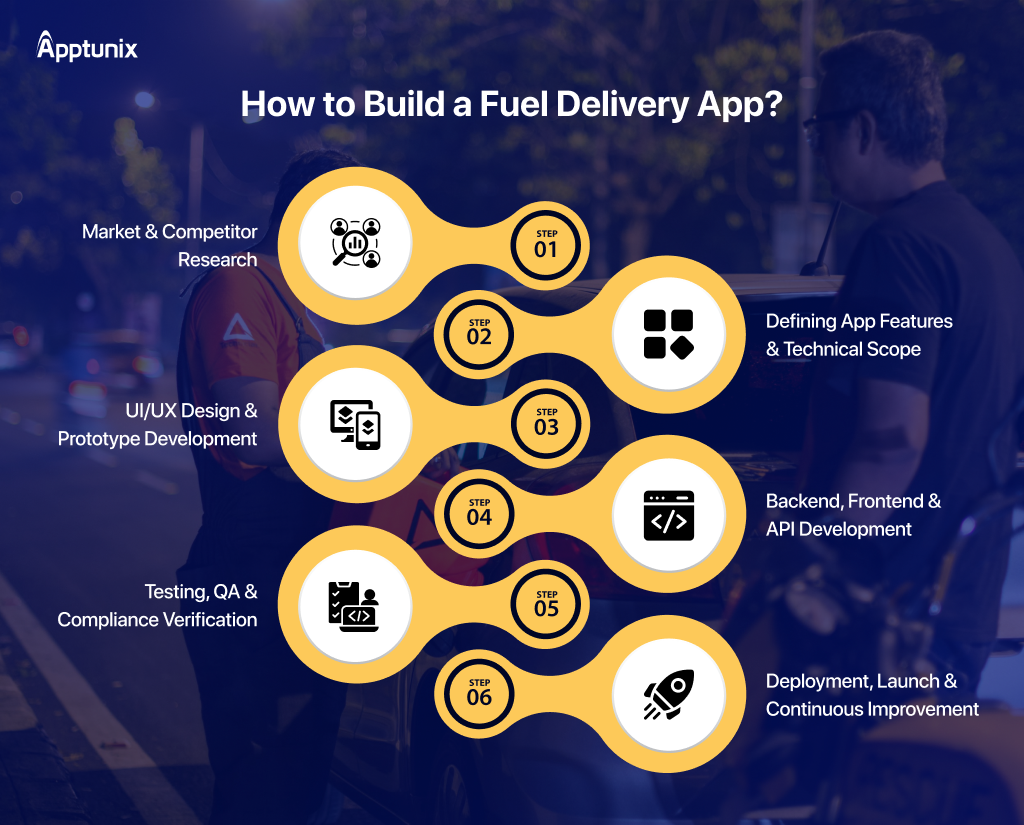
1. Market & Competitor ResearchThe journey begins with understanding market demand and competitive gaps. Research shapes the core vision and prevents guesswork during development. It identifies the right customer problems and validates feature priorities. This stage usually costs around 5%- 10% of the total budget, depending on the depth and geography.
A strong research foundation avoids expensive corrections later and sets up a profitable roadmap.
2. Defining App Features & Technical ScopeAfter research, teams finalize essential features, tech stack, and platform decisions. Clear scoping protects budgets and eliminates vague expectations that trigger rework. It aligns the product with real market needs rather than assumptions.
This step generally adds $4,000–$10,000 to the overall fuel delivery app development cost. A well-planned scope keeps the timeline predictable and the product future-ready.
3. UI/UX Design & Prototype DevelopmentDesign shapes real user interactions and decides how customers experience the app. Interactive prototypes display the full interface before writing code, allowing refinement without waste.
Better UX means higher retention and fewer redesign costs post-launch. On average, this phase ranges $5,000–$15,000, depending on complexity and screens. Investing here reduces risk and builds trust with early users.
4. Backend, Frontend & API DevelopmentThis is where engineering turns vision into reality. Our Android & iOS app developers build secure backend architecture, real-time fuel tracking, payments, dispatcher dashboard, and fleet management systems. Stable frontend ensures smooth functionality across iOS, Android, and web.
Depending on the features, this core phase costs $20,000–$60,000 and has the greatest impact on performance. A strong architecture saves massive scaling costs later.
5. Testing, QA & Compliance VerificationRigorous testing ensures stability, accuracy, and regulatory safety before launch. The team examines performance under load, fuel pricing systems, payment reliability, and GPS precision. Fixing issues here is far cheaper than correcting live failures. QA generally costs $6,000–$18,000, depending on automation level and platforms. Quality testing protects brand reputation and reduces costly post-launch maintenance.
6. Deployment, Launch & Continuous ImprovementThe final phase includes deployment to app stores, backend monitoring, and integrating user feedback for upgrades. Post-launch optimization maintains performance and supports scaling. Businesses often plan a monthly support model to ensure smooth operations.
Launch and improvements usually require 10%-12% of the total budget, depending on update cycles. Smart optimization enhances lifetime value and keeps operating costs efficient.
Building a fuel delivery app in 2026 requires a balance of features, scalability, and operational security. Given below are the must-have fuel delivery app development features that would enable entrepreneurs to make a wise investment.
The customer application defines the first impression and directly impacts acquisition and retention.
1. Quick Registration & Secure Profile SetupUsers register using mobile OTP, email, or social login for instant onboarding. Smooth authentication builds trust and increases conversions. This feature typically contributes around 5%–7% to the total cost due to security and encryption layers.
2. Fuel Ordering & Delivery SchedulingCustomers choose fuel type, quantity, location, and preferred time slot. The scheduling logic needs reliability and real-time validations. This adds nearly 7%–10% to the fuel delivery app development cost.
3. Real-Time GPS Tracking of TankersLive vehicle movement visibility increases trust and reduces support requests. Implementing accurate tracking requires advanced map APIs and optimization, influencing 8%–12% of the total cost.
4. Multiple Payment Methods & Digital InvoicingSeamless payments through cards, wallets, or net banking with auto-generated receipts. Heavy security protocols are needed for PCI compliance. This contributes 6%–9% of the development cost.
5. Ratings & Review SystemThe Ratings and Review system directly tracks driver and vendor performance, crucial for accountability and continuous improvement. This is a low-complexity but essential feature, contributing an estimated 2%–4% to the overall development cost.
The driver panel ensures smooth delivery operations and efficiency in logistics.
1. Smart Route Optimization & Turn-by-Turn NavigationDrivers receive optimized delivery routes to reduce delays and fuel losses. Requires complex mapping algorithms and contributes 10%–14% to the total cost.
2. Job Queue & Delivery Workflow ManagementDrivers view assigned orders, schedule deliveries, verify deliveries, and update status. Strong UX here helps avoid operational errors and accounts for 6%–8% of costs.
3. Fuel Metering Integration & Barcode ScanningAutomated reading of fuel quantity and secure delivery verification using IoT and barcode scans. High-complexity integration that impacts 10%–15% of the development budget.
4. Safety Compliance & Digital ChecklistMandatory regulatory checks, tanker pressure validation, and emergency protocols. Designed to reduce legal risk, influencing 5%–7% of app development costs.
5. Earnings DashboardDrivers track completed orders and payout cycles. Low complexity but necessary, contributing 3%–5%.
The admin panel controls the business engine and manages every operational aspect.
1. Order & Delivery Lifecycle ManagementThis feature lets admins monitor every order from request to fulfillment and assign drivers instantly. It enables smooth coordination between customers, fleets, and route planning. High complexity due to multiple data layers, accounting for 10%–14% of the total cost.
2. Dynamic Pricing & Fuel Rate ControlAdmins configure pricing rules based on location, demand, time, and fuel type, including tax adjustments. Real-time automation ensures higher margins without manual effort. Precision is crucial to profitability, contributing 6%–9% to development cost.
3. Analytics Dashboard & BI ReportingReal-time insights into revenue, delivery performance, fuel usage, and customer behaviour. Requires advanced data visualization and adds 8%–12% to the total project cost.
4. Driver and Fleet Management ControlsAdmins verify licenses, track fleet operations, manage insurance documents, and optimize productivity through performance logs. It improves safety and decreases operational liabilities. This feature contributes roughly 4%–6% of the total development cost.
5. Offers, Promo Codes & Subscription ControlsManage coupon rules, loyalty plans, corporate subscriptions, and prepaid credits from a single dashboard. Helps grow repeat business and lifetime value. This module adds around 3%–5% of the project budget.
Designed for enterprises such as logistics fleets and construction companies.
1. Bulk Order Management & Contract PricingAllows businesses to place high-volume orders, manage multiple locations, and negotiate enterprise-level contract rates. This feature increases operational efficiency and reduces fuel wastage. Adds multi-layer billing complexity, influencing 6%–9% cost of the overall fuel delivery app development cost.
2. Invoice & Automated Billing EngineAuto-generates GST and tax-compliant invoices, manages settlements, and syncs with ERP and accounting tools. Eliminates manual paperwork and billing disputes for corporate clients. Requires precise accounting rules, contributing 5%–8%.
3. Subscription & Credit-based Billing CyclesCustom plans for fleets enable recurring payments and automated monthly usage settlements under prepaid or postpaid models. Drives stable revenue and improves customer lifetime value. Complexity in payment logic accounts for 3%–5% of the total cost.
4. Fuel Consumption & Usage Performance DashboardTracks consumption trends across vehicles, enabling fleet owners to reduce misuse, optimize routes, and increase profit. Real-time report generation supports data-backed fleet planning. Adds around 4%–6% to fuel delivery app development cost.
Security and compliance significantly influence fuel delivery app development cost due to the handling of hazardous materials and financial regulations.
End-to-end encryption, PCI-DSS certified payment security, role-based access control, and compliance with petroleum logistics regulations are mandatory. Insurance and legal workflows protect against high-risk operational liabilities. These components typically account for 8%–12% of the total project cost but save enterprises millions in downtime, regulatory fines, and lawsuits.
Turning an app into a revenue engine means much more than ordering and delivery. For a successful on-demand fuel delivery solution, you must layer smart business models, recurring income streams, and enterprise contracts.
Below are proven strategies to help you build a maximized business from your fuel delivery app development.
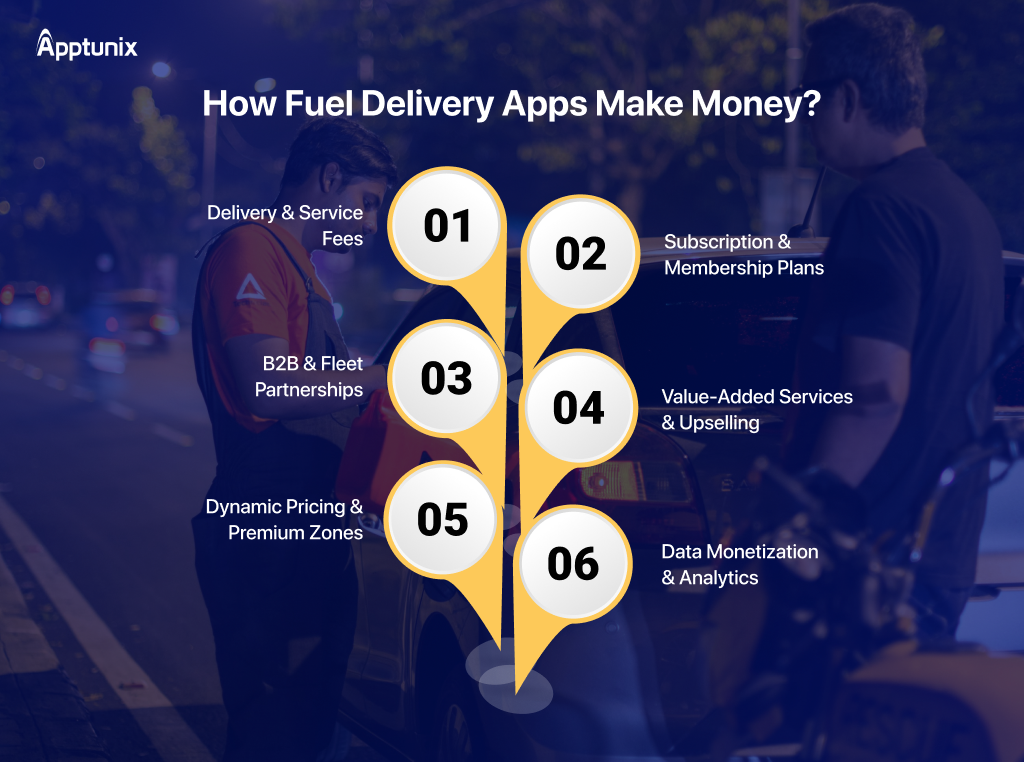
1. Delivery & Service FeesThis is the foundational revenue stream. When a user orders fuel, the app charges a delivery or service fee in addition to the fuel cost. A fuel delivery app like CAFU in UAE uses this model: customers pay a premium for convenience and location-based refuelling.
For your app, ensure the pricing covers logistics, driver costs, and asset maintenance. Over time, you may reduce the fee or bundle it into subscriptions.
2. Subscription & Membership PlansRecurring revenue creates stability. CAFU offers subscription plans that give users unlimited or priority deliveries for a flat monthly fee.
This model works especially well for fleets or high-frequency users. By combining your fuel delivery app features with loyalty perks, you increase lifetime value and improve budgeting predictability.
3. B2B & Fleet PartnershipsFleets spend big on downtime. That’s how a Fuel delivery app like Booster built its business by partnering with large companies and office campuses.
You develop a platform that services fleets, logistics companies, and regional depots. The margins here can be significantly higher than consumer orders because contracts are larger and repeatable. Your fuel delivery software development should support bulk ordering, automated invoicing, and fleet dashboards to capture this revenue stream.
4. Value-Added Services & UpsellingBeyond fuel, you can offer other vehicle-related services like oil change, car washes, EV charging, and on-site inspections. Yoshi in the US blends fuel delivery with maintenance services.
Bundling services increases average order value and deepens your brand position. Incorporate add-ons into your fuel delivery management system so the app becomes the single point for multiple vehicle needs.
5. Dynamic Pricing & Premium ZonesDemand peaks during rush hours or in remote areas allow premium pricing. Your app can adjust delivery fees based on time, location, or urgency. CAFU already uses dynamic service pricing for convenience levels.
When you build your fuel delivery app development cost roadmap, include systems that support price flexibility. This unlocks higher margins without major additional investment.
6. Data Monetization & AnalyticsOver time, your platform collects rich operational and behavioural data: fuel trends, route efficiency, and user patterns. You can offer analytics, benchmarking tools, or industry reports to fleet clients. This turns your app from a service into a strategic asset. If you embed advanced analytics during your fuel delivery app tech stack stage, you create a long-term monetization stream that scales with usage.
Choosing the right development partner can make or break your on-demand fuel delivery venture. At Apptunix, we bring more than a decade of expertise in building market-ready solutions worldwide. We combine AI-driven automation, cloud scalability, and enterprise-grade security to engineer high-performance digital products.
What sets us apart?
. Proven Expertise in On-Demand MobilityApptunix is the #1 on-demand app development company with over 12+ years of industry experience. We build revenue-driven, fuel delivery app development solutions trusted by global logistics brands. Our platforms are designed for performance, operational control, and expansion into multiple regions.
. Custom Solutions Built for Your Business ModelEvery fuel delivery business is different.
That’s why we design tailor-made solutions aligned with your operations and scaling goals. Whether MVP or enterprise platform, we optimize your fuel delivery app development cost and help you enter the market faster.
. Faster Go-to-Market with Pre-Built ComponentsWe use reusable modules, real-time GPS, route optimization, secure payments, and fleet logistics. This saves on development time and budget stress, while upholding quality standards.
. Scalable Architecture for Long-Term GrowthOur solutions support large fleets, multi-city deployment, IoT fuel metering, and real-time dispatch. This guarantees your product scales smoothly as demand grows. This eliminates the need for expensive reconstruction later, directly helping you maintain and grow your profit margin.
. Security, Compliance & Enterprise-Grade StabilityFuel delivery requires strict adherence to safety and regulatory requirements. We integrate role-based access, encrypted data flow, audit controls, and region-specific compliance.
This protects your platform, your users, and your brand reputation.
. Transparent Pricing & End-to-End PartnershipWith Apptunix, you receive clear timelines, real budgets, and measurable outcomes. No hidden costs. No complexity. Just honest, predictable delivery aligned with growth goals.
With Apptunix, you build a sustainable digital business. Let’s book a free consultation and receive a personalized fuel delivery app pricing breakdown based on your model and goals.
Q 1.What is the average cost range to build a fully functional on-demand fuel delivery app?
A fully functional on-demand fuel delivery app development costs between $18,000 and $200,000+. Indeed, this is an approximate cost that heavily relies on app complexity, the number of panels, feature set, compliance requirements, and hardware integrations.
Q 2.How long does it take to develop an on-demand fuel delivery app?
Generally, it takes up to 3-5 months to develop a basic on-demand fuel delivery app. It involves planning, designing, and core development for the customer, driver, and admin panel. A high-complexity fuel delivery management system with advanced B2B features may take up to 7-10 months.
Q 3.What features are mandatory for the Driver App to ensure HAZMAT compliance and safety?
A professional fuel delivery driver app must include essential HAZMAT-compliant features. These include:
Q 4.What monetization strategies work for fuel delivery apps like CAFU or Yoshi?
Successful fuel delivery apps use multiple revenue streams. Popular models include delivery fees per order, subscription or membership plans, tiered fleet packages, enterprise contract pricing, and commission on fuel markup. Many, like CAFU, earn from vehicle services & add-on maintenance, while Yoshi also uses recurring subscription plans.
Q 5.Is it more profitable to launch targeting B2B fleets or individual consumers first, and how does that change the cost?
Launching with B2B fleets is more profitable initially due to bulk orders, predictable recurring revenue, and lower customer acquisition costs. It also reduces operational expenses and logistics complexity. B2C requires higher marketing expenditure and large-scale delivery networks but offers long-term scale.
Q 6.What are the critical recurring maintenance and operational costs after launching the app?
Post-launch costs include server hosting, platform monitoring, periodic feature upgrades, regulatory compliance renewal, cloud infrastructure, customer support, and fuel hardware servicing. Businesses should allocate 15–20% of annual development costs for maintenance.
Q 7.How does hiring a specialized on-demand app development company minimize risk and ensure regulatory compliance?
A specialized development partner understands complex fuel logistics, HAZMAT compliance, IoT fuel hardware integration, government approvals, and legal safety standards. They help avoid costly mistakes, accelerate launch timelines, and ensure the platform meets regulatory requirements.
Q 8.How do I choose the right on-demand app development company for my fuel business?
Look for proven domain expertise, real case studies, scalable architecture capabilities, and strong post-launch support. Evaluate:
Q 9.Can a fuel delivery app support both consumer and commercial fleet models?
Yes. Modern fuel delivery apps support dual-model operations. The customer app caters to individual users, while the fleet/merchant panel is used for bulk orders, scheduling, automated subscription delivery, and invoicing. The hybrid models guarantee faster growth and diversified revenue streams. Businesses can start with one model and scale to both when demand increases.
Q 10.Which technology stack is recommended for building a high-performance, multi-city fuel delivery platform?
A robust fuel delivery platform needs a scalable and secure tech stack to support real-time operations and multi-city expansion:
(4 ratings, average: 5.00 out of 5)
Get the weekly updates on the newest brand stories, business models and technology right in your inbox.
Arohi Singh is a technology content strategist at Apptunix, where she writes about software and app development across industries, from on-demand and logistics to fintech, healthcare, and applied AI. With over 5 years of experience, she works closely with Apptunix’s engineers, product managers, and solution architects to turn real project insights into clear, decision-ready guidance for founders and business leaders. Her writing focuses on what matters before you build: market context, feature trade-offs, realistic costs, and compliance considerations
Book your consultation with us.
Book your consultation with us.


One Central, The offices 3, Level 3, DWTC, Sheikh Zayed Road, Dubai
+971 50 782 1690