
Compliance-Ready Software Development in Saudi Arabia: Laws, Standards and Best Practices
39 Views 12 min July 15, 2026

With over 20+ years of experience in driving global digital initiatives, Nikhil Bansal is the CEO & Director of Apptunix. He specializes in orchestrating large-scale digital transformations, enterprise-grade software solutions, and high-level business strategies that redefine industry standards. Nikhil is known for his ability to bridge the gap between complex business challenges and innovative technology, helping Fortune 500 companies and startups alike achieve sustainable growth. A visionary leader, he empowers enterprises to navigate the digital landscape with agile, ROI-focused models and future-ready business strategies.
ScienceDirect stated that 700+ healthcare organizations worldwide are targeted by cybercriminals every year, with nearly 2 breaches per day.
The healthcare industry faces a high risk, with over 50% of organizations lacking confidence in their ability to detect breaches.
This shows how healthcare organizations are under pressure to protect sensitive patient data while accelerating digital transformation.
All digital products process medical data, be it an EHR solution or a telehealth system. That is why such platforms are to be subject to high standards of compliance or face serious financial consequences and reputational losses.
This is where HIPAA compliant software development services come into play.
Ignoring a single security gap in the healthcare industry can expose PHI (Protected Health Information).
This can lead to costly breaches, legal consequences, and loss of patient trust, even though many healthcare organizations do not understand what true HIPAA compliance looks like in today’s modern software development environment.
Are you one of them? If yes, it’s never too late. In this blog, we break down everything you need to know about HIPAA compliance requirements for software.
Let’s get started!
HIPAA ensures software securely handles electronic protected health information by meeting US legal standards for privacy and security. The technology requires technical safeguards like
This assists the platform in safeguarding data integrity and confidentiality and avoiding unauthorized access. It addresses all the healthcare software development life cycles, including design to post-launch support.
HIPAA software development compliance prevents unauthorized access, breaches, or cybercriminals from accessing patient data.
The key aspects of HIPAA software development services are mentioned below:
To protect the patient’s trust, avoid legal risks, and ensure safe digital healthcare operations, healthcare software must follow these practices.
Being a healthcare enterprise, understanding HIPAA rules is crucial to defining how patient data is handled. Before investing a single dollar, let’s learn about the four main rules that make a secure and compliant platform.
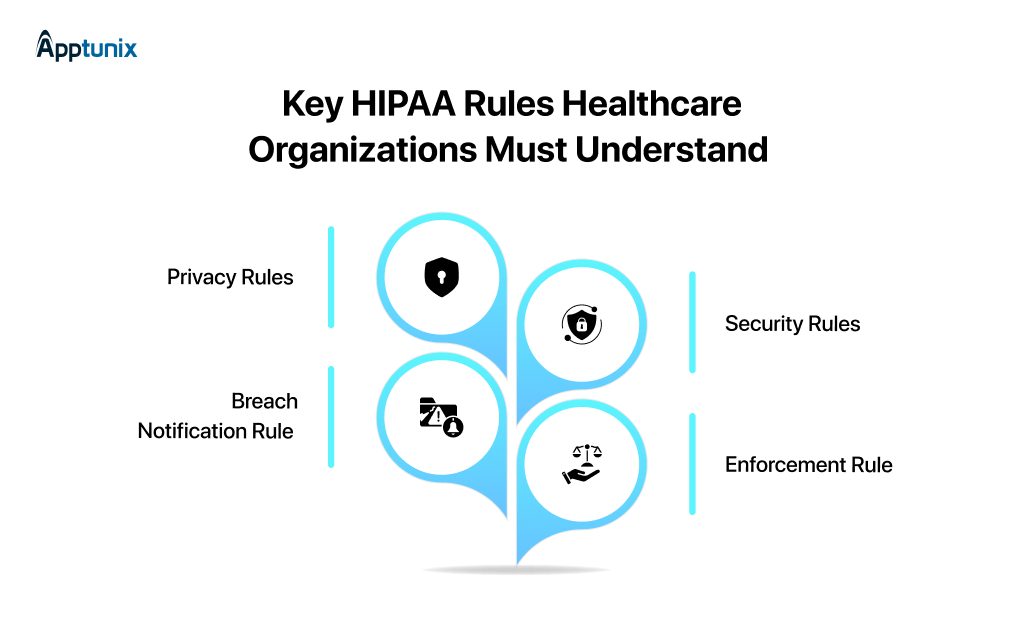
1:Privacy RulesThis rule controls access to patient data. It focuses on how PHI is collected and shared.
Importance of Privacy Rules in Healthcare Software:
-> Only authorized users can access patient data
-> Patients have control over how their data is used
-> Data sharing must follow strict consent guidelines
2:Security RuleSecurity helps the system protect digital health information. It ensures that the electronic patient data is safe from breaches or unauthorized access.
Importance of Security Rules in Healthcare Software:
-> Use strong data encryption in healthcare apps
-> Implement patient data security measures
-> Restrict access with role-based permissions
-> Continuously monitor systems for threats
3:Breach Notification RuleThis rule responds to data breaches. It is important since whenever a data breach occurs, it notifies affected individuals within a defined time.
Importance of Breach Notification Rules in Healthcare Software:
-> Track system activity with audit logs
-> Detect and report breaches quickly
-> Have a response plan in place
4:Enforcement RuleEnforcement rules lead to penalties for non-compliance. It outlines the penalties for failing to meet HIPAA standards.
Importance of Enforcement Rule in Healthcare Software:
-> Non-compliance can result in heavy fines
-> It can damage your reputation and patient trust
-> Investing in compliance reduces long-term risks
So, these are the four rules that you must understand. Now, it’s time to examine the checklists for HIPAA compliant software development.
HIPAA compliant software development is imperative to protect sensitive patient data and avoid legal risks. From data encryption to compliance testing, get to know practical checklists for healthcare software development that you should consider before building the software.
HIPAA compliance requirements for software are as follows:
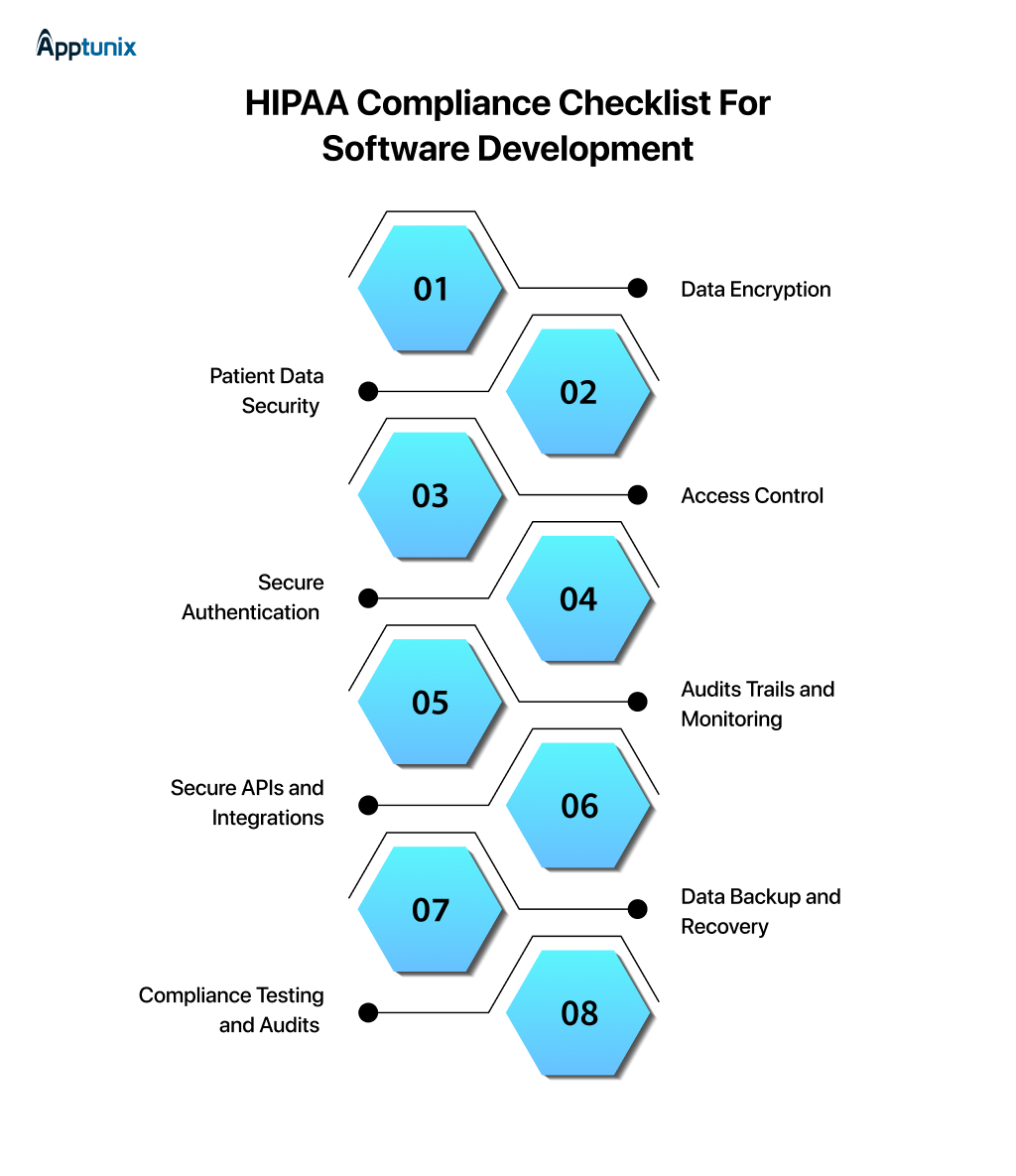
1:Data EncryptionApart from basic encryption, you should ensure the use of industry-approved standards like AES-256 to meet compliance expectations and avoid vulnerabilities.
2:Patient Data SecurityDuring the development, adopt a “data minimization” approach (only collect and store what is necessary). This reduces exposure and compliance risks.
3:Access ControlYou should frequently review and update access control to prevent privilege creep, especially in growing healthcare teams.
4:Secure AuthenticationConsider adaptive authentication methods that adjust security requirements based on user behavior and risk levels.
5:Audits Trails and MonitoringIn healthcare software development, detailed audit logs improve security and serve as critical evidence during compliance audits and investigations.
6:Secure APIs and IntegrationsYou should verify whether the external vendors sign BAAs (Business Associate Agreements) or not. This is imperative to ensure shared compliance responsibility.
7:Data Backup and RecoveryThe recovery process is critical; as a result, you should test the process periodically to ensure data integrity or availability. Ensure that the data can be restored quickly.
8:Compliance Testing and AuditsRemember, ongoing compliance is key. Schedule periodic audits post-launch to stay aligned with evolving security standards.
You now understand HIPAA compliant software development checklists. Now it’s time to examine the features of HIPAA software development.
The core of healthcare software development should be built around its strong security and data protection capabilities to be HIPAA compliant. Not only does it protect PHI, but it also makes your system compliant and scalable. The 10 HIPAA compliant features in healthcare apps are as follows:
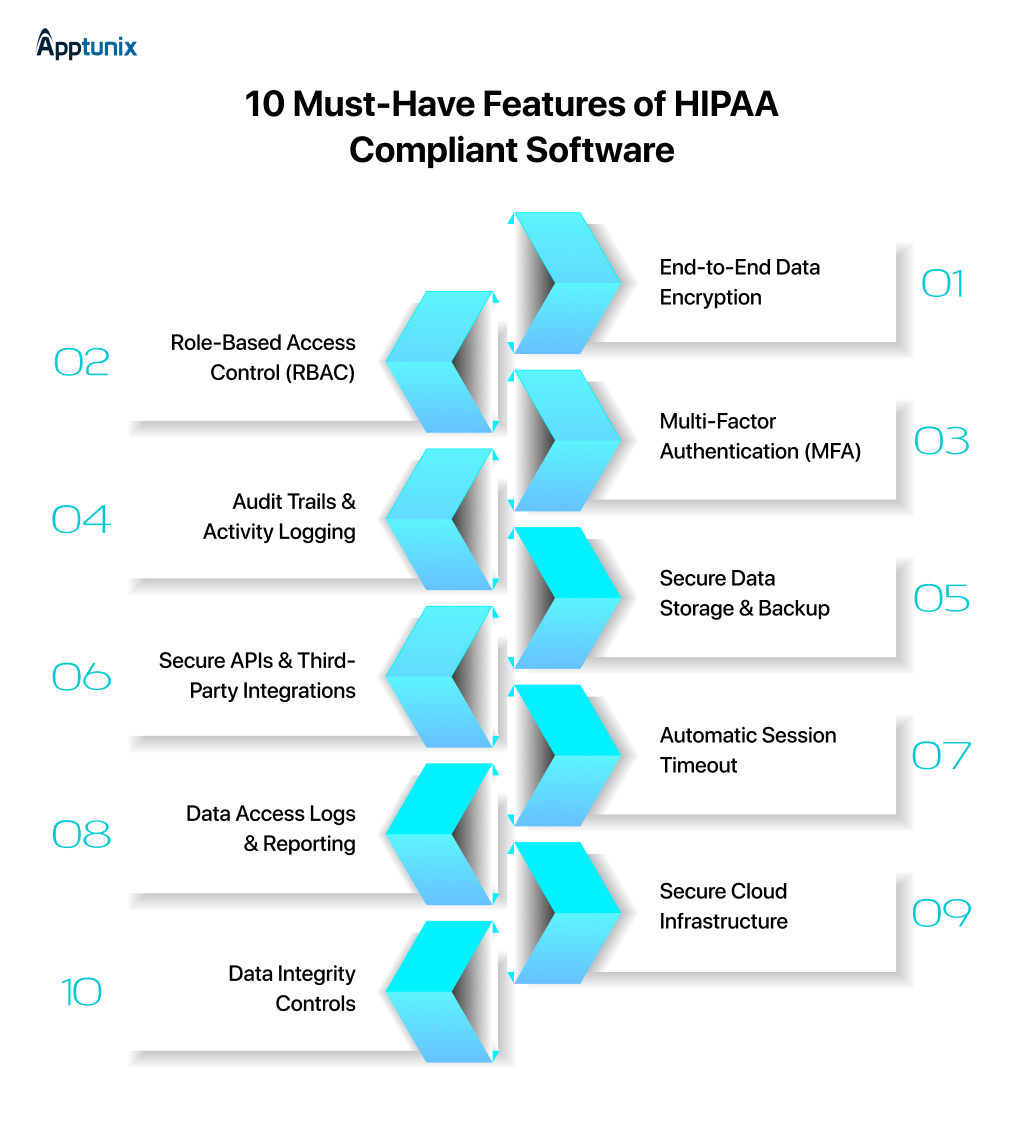
1:End-to-End Data EncryptionData encryption secures confidential patient information when storing and transmitting. It helps healthcare organizations to avoid unauthorized access and secure data stored in the devices and servers.
2:Role-Based Access Control (RBAC)Restrict system access based on user roles like healthcare professionals, staff, or administrators. This feature enables users to only get the information that is needed in their line of work, which eventually minimizes the chances of internal data leakage.
3:Multi-Factor Authentication (MFA)Adds an extra layer of security beyond passwords by requiring additional authentication. It reduces the chances of unauthorized access to a healthcare system even if the logging credentials are compromised.
4:Audit Trails & Activity LoggingTracks all user and system activities within the software. It’s essential for several reasons, like monitoring access, identifying suspicious behavior, and supporting compliance audits.
5:Secure Data Storage & BackupEnsures patient data is stored in secure environments with regular backups. It enables reliable storage and backup systems that help healthcare organizations to recover data quickly after experiencing cyberattacks.
6:Secure APIs & Third-Party IntegrationsLeads to better and safer communication between systems like EHRs, payment gateways, or any other third-party tool. Securing APIs is crucial to preventing vulnerabilities since healthcare software relies on integrations.
7:Automatic Session TimeoutAutomatically logs users out after a period of inactivity to prevent cyber fraud. It plays a crucial role in shared or clinical environments where systems may be left unattended.
8:Data Access Logs & ReportingProvides detailed reports on who, when, and for what purpose someone accesses the data. This helps in improving transparency and leads healthcare organizations to demonstrate compliance during audits.
9:Secure Cloud InfrastructureEmploys HIPAA compliant cloud services to store and manage data. The appropriate selection of the cloud environment provides the necessary scalability with high levels of security and compliance.
10:Data Integrity ControlsMake sure that patient data is not changed or interfered with without permission. The accuracy of data in healthcare is extremely important, and any slight alteration can affect patient care and outcomes.
Let’s examine the steps to build HIPAA compliant healthcare software now.
In 2026, you will require a proper, structured approach to get secure healthcare app development solutions. Doing this means integrating security and scalability from the beginning. From analyzing requirements to doing maintenance, follow the 8 steps for HIPAA compliant software development mentioned below:
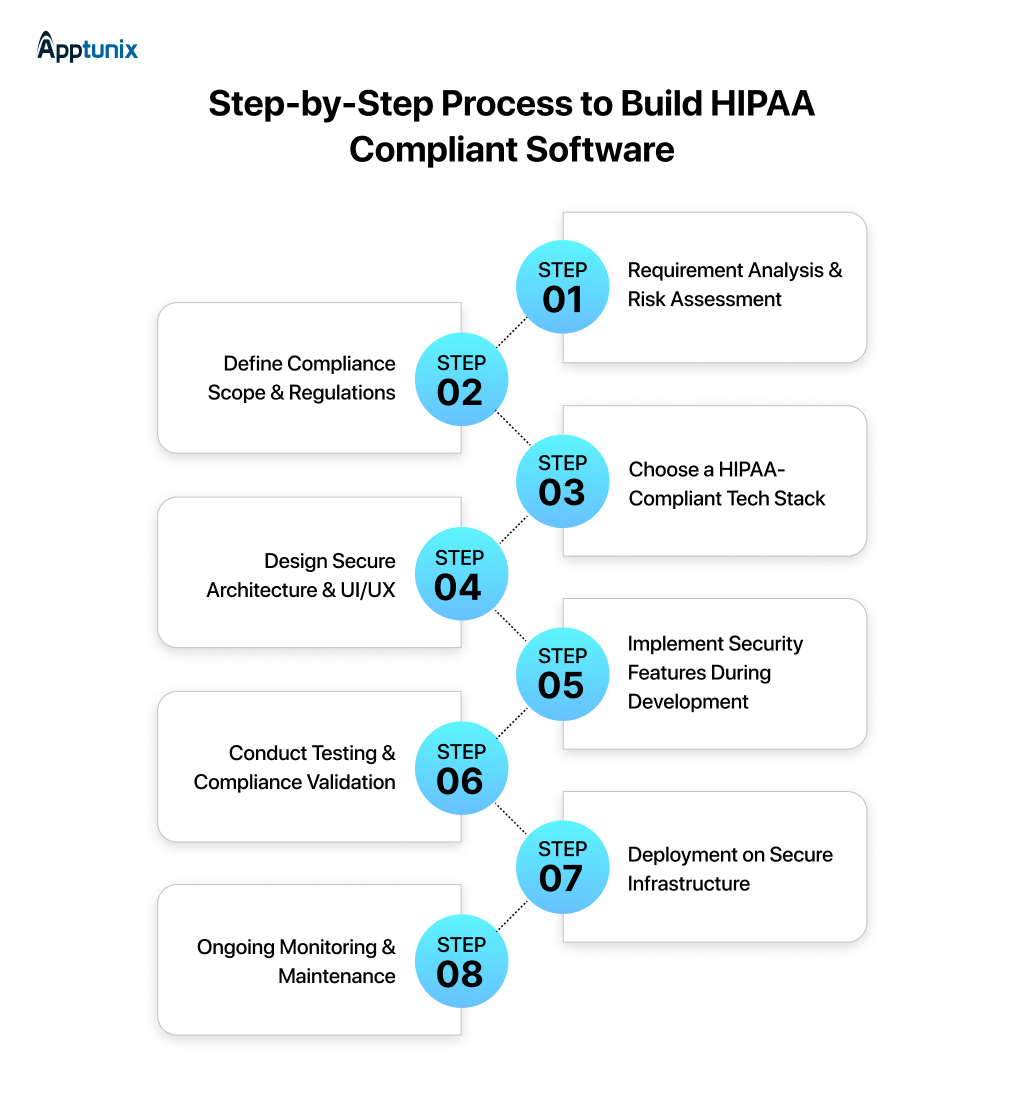
Step 1:Requirement Analysis & Risk AssessmentAs a healthcare enterprise, you must define several essential things in the initial phase, which include
Apart from that, you should also identify potential risks early to plan the right security and compliance measures from the very beginning.
Step 2:Define Compliance Scope & RegulationsOnce you’re sure of the requirement analysis, you should understand which HIPAA rules apply to your software and business model.
Defining the compliance scope ensures your development strategy aligns with legal requirements and avoids costly compliance gaps later.
Step 3:Choose a HIPAA-Compliant Tech StackPicking the right tech stack as per HIPAA compliant software development is a must. Choose
Choosing the right tech reduces vulnerabilities and simplifies long-term compliance management.
Step 4:Design Secure Architecture & UI/UXDesigning the application is an imperative development phase that influences the success of the platform. Leading UI/UX designers create a healthcare system that prioritizes data protection and secure workflows.
Go for the best design because a well-designed system ensures usability for healthcare experts and strong backend security.
Step 5:Implement Security Features During DevelopmentDuring this phase, top healthcare software developers start building the frontend and backend infrastructure with coding. They integrate
The HIPAA software development team embeds security during development to minimize risks and ensure compliance is built into the core system.
Step 6:Conduct Testing & Compliance ValidationOnce the developers are done with coding, the QA team starts performing
The team conducts testing to identify and fix issues before launching the system. This ensures your software meets HIPAA standards.
Step 7:Deployment on Secure InfrastructureWhen the team is done with testing, it’s time to launch your software on HIPAA-compliant hosting or cloud environments.
The deployment process must be secured to ensure data protection continues beyond software development.
Step 8:Ongoing Monitoring & MaintenanceThe team continuously monitors factors after launching the software, which include
HIPAA compliance is an ongoing process, so it needs regular updates and audits to stay compliant over time.
You understand the HIPAA software development process that outlines how your healthcare software should be built. Now, in the next section, you will understand what you must carefully evaluate to ensure real-world compliance.

Mobile healthcare applications work within dynamic environments, and factors such as device usage, network conditions, and third-party integrations may present risks not typical of regular development practices.
Here are the factors that you must consider:
The cost to build a HIPAA compliant app ranges from $40,000 to $500,000+, depending on the app and feature complexity.
Basic compliant healthcare software development costs start from $40,000 and can go up to $80,000+, depending on the app requirements. On the other hand, mid-level app costs range from $80,000 to $200,000+.
However, a complex healthcare app comes with advanced AI features and high technologies used that can go up to $500,000.
Examine the table to understand the estimated cost based on complexity and its timeline:
The other factors that influence HIPAA compliant app development include:
Compared to the standard digital solutions, healthcare software requires extra investment in
As a healthcare organization, you should know these cost layers to plan better and avoid unexpected expenses.
Creating HIPAA compliant software does not only mean integrating security features; it’s also about overcoming challenges that can be practical and operational. Challenges can impact both compliance and app usability, so you should overcome them. Here are the five common challenges and their solutions that you should understand before integrating the technology:
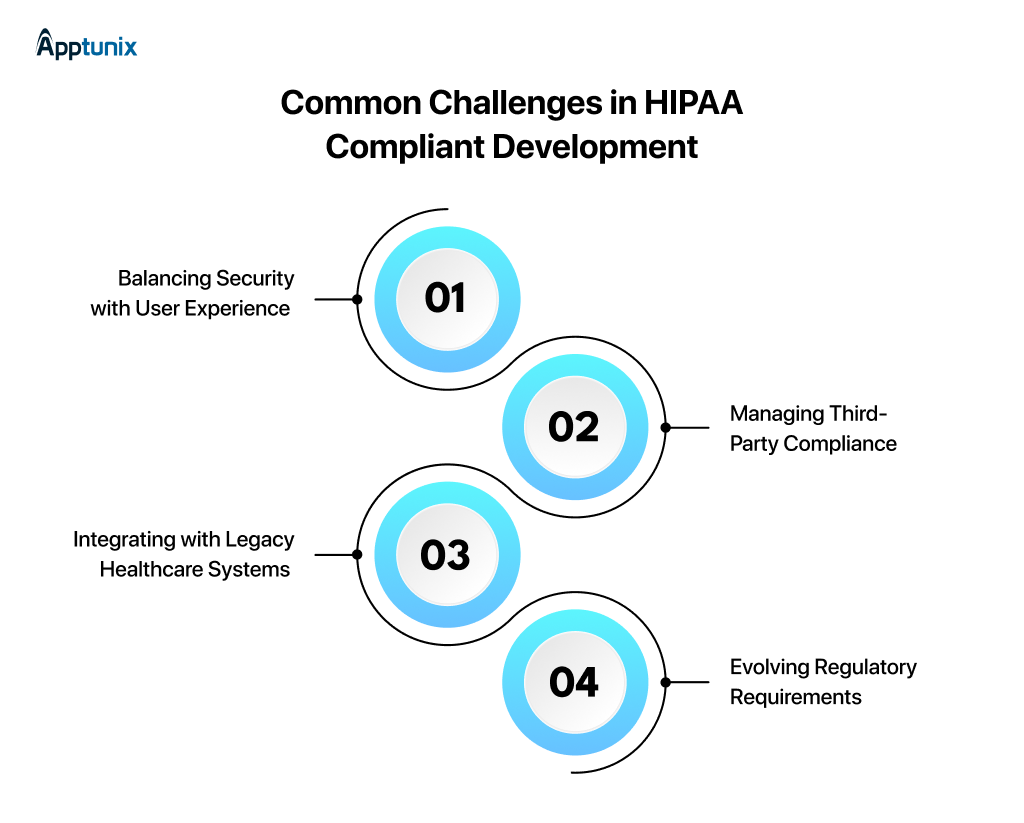
Problem: Indeed, uncompromising security measures complicate workflows that make healthcare systems a bit difficult to use for patients and providers. Such an approach reduces adoption and efficiency.
Solution: To resolve this issue, you should design intuitive interfaces with streamlined authentication. This allows strong security measures to integrate seamlessly without affecting user workflows or app usability.
Problem: Once you integrate third-party APIs or tools, it increases the chances of exposing patient data if vendors do not meet HIPAA standards. This leads to high compliance and security risk.
Solution: Sign business associate agreements, evaluate vendors, and continuously monitor integrations to tackle this. Doing this will ensure your system’s third-party services remain compliant with HIPAA requirements.
Problem: For an outdated system, integrating modern security standards is a bit complicated. This increases the vulnerability risk during system communication and data exchange.
Solution: Follow strategies like gradual modernization and the use of secure middleware and APIs to integrate legacy systems while maintaining data security and confirming compatibility with updated compliance standards.
Problem: HIPAA security standards evolve over time, which makes it a challenge for healthcare enterprises to maintain continuous compliance without frequent system updates.
Solution: Implement continuous monitoring, proactive updates, and regular compliance audits. This will ensure your healthcare system stays aligned with the latest regulatory requirements.
Being a healthcare organization, you must keep in mind that HIPAA compliance is not a single task. It involves more than mere implementation and requires an active strategy. The following are the best practices that can guide you in achieving HIPAA compliance in the most optimal manner, with long-term data security and efficient operation:
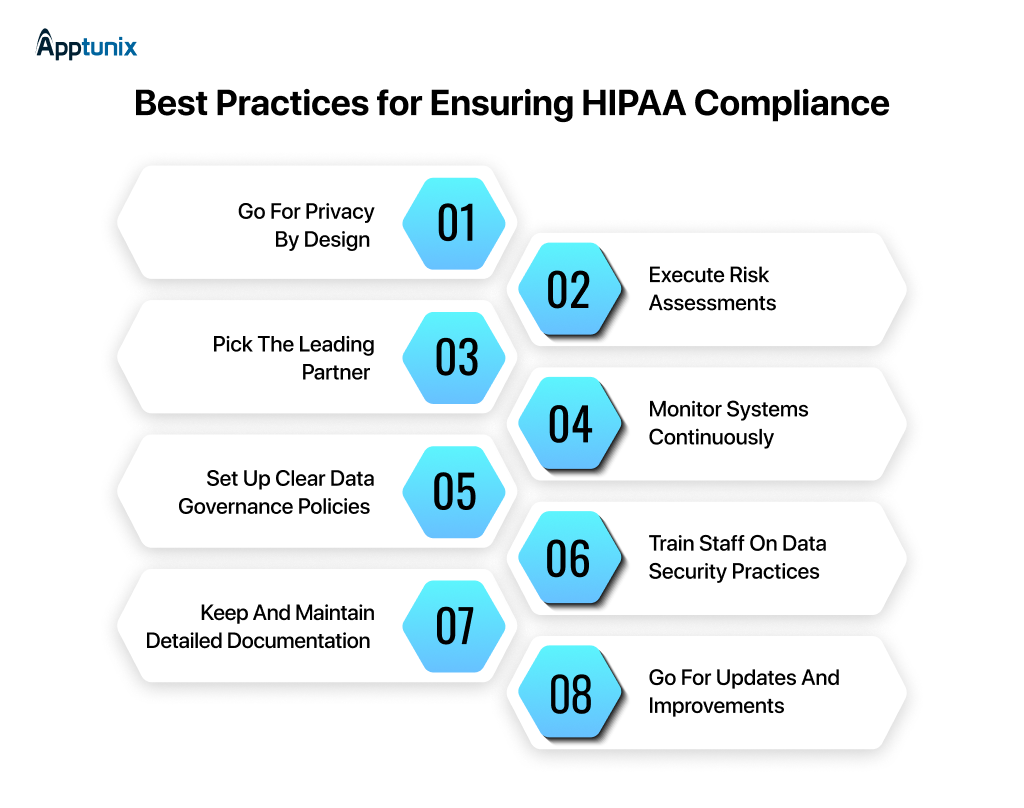
1:Go for Privacy by DesignTo reduce risks and avoid costly redesign, adopt a privacy by design approach. Develop compliance into your system from the initial planning stage instead of integrating it later.
2:Execute Risk AssessmentsRegular risk assessments will help you identify and evaluate potential vulnerabilities in your system. Detecting the issue early will help you prevent data breaches and ensure ongoing compliance.
3:Pick the Leading PartnerHiring a third-party partner should be your priority. Make sure you work with the right HIPAA compliant software development company that follows HIPAA standards and signs the appropriate agreements.
4:Monitor Systems ContinuouslyYou must track software activity, anomalies, and access patterns in real-time to detect any suspicious activity or behavior before it turns into a major obstacle.
5:Set Up Clear Data Governance PoliciesTo ensure HIPAA compliance, you must establish clear data governance policies by defining how patient data is collected, stored, accessed, and shared. This will ensure consistency and minimize the risk of misuse.
6:Train Staff on Data Security PracticesIndeed, human errors are one of the biggest reasons behind experiencing major breaches and fraud. As a result, train your staff so that they can understand how to handle sensitive healthcare data.
7:Keep and Maintain Detailed DocumentationHealthcare enterprises should keep records of compliance measures, audits, and policies. Keeping proper documentation is crucial for audits and demonstrates accountability.
8:Go for Updates and ImprovementsAs you have read above, compliance standards evolve over time, so your software should be too, right? To keep the standard, go for regular updates that ensure your systems remain secure and aligned with current regulations.
So this is how you ensure optimal HIPAA compliance in your healthcare system. Now, before wrapping up this detailed guide on HIPAA compliant software development, examine the current trends that are going on in the market for HIPAA healthcare systems.
With evolving healthcare technology, HIPAA-compliant software increases leverage of advanced innovations to power up security, improve interoperability, and enable proactive compliance in today’s advanced digital healthcare world. Below are the 3 main future trends in HIPAA compliant software development, along with great examples:
In 2026, a secure system is the ultimate goal for healthcare or even other industries.
It means HIPAA software development services are no longer an option but an imperative need for healthcare professionals and organizations aiming to protect patient data and build trust.
However, before investing a single amount, you have to understand compliance rules to implement secure features and follow best practices. Every step is crucial to ensure long-term success.
To achieve true compliance, you need the right strategy, expertise, and execution. So, how will you achieve? Well, this is where partnering with an experienced HIPAA compliant software development company comes into action.
Global leaders like Apptunix specialize in developing secure and fully compliant healthcare solutions by focusing on HIPAA regulations.
So what are you waiting for? Connect with us today and get top professionals who build reliable and HIPAA compliant products for your healthcare enterprise.
Q 1.How long does it take to build HIPAA Compliant software for healthcare organizations?
On average, it takes 2-8 months or even more, depending on the platform’s complexity. A basic HIPAA compliant system takes 2-3 months to build from scratch; a mid-level system takes between 3-6 months; however, complex HIPAA-compliant software for healthcare takes up to 8 months or even longer.
Q 2.How much does HIPAA compliant software development cost?
As of 2026, the cost to build a HIPAA compliant app ranges from $20,000 to $200,000+, depending on the app and feature complexity.
Basic: $40,000-$80,000+
Mid Level: $80,000-$200,000+
Advanced: $200,000-$500,000+
Q 3.Do I need a HIPAA compliant cloud provider for my healthcare application?
Absolutely, you need a HIPAA-compliant cloud provider because using this allows your platform to store or process patient data. It guarantees several things, like data encryption, secure infrastructure, access controls, and compliance regulations. Moreover, the cloud provider also leads to a business associate agreement to share responsibility.
Q 4.How to build HIPAA compliant software for healthcare organizations?
HIPAA-focused secure healthcare app development steps include
Q 5.How to hire HIPAA compliant developers?
The best way to hire HIPAA compliant developers are as follows:
Q 6.What makes software HIPAA compliant?
The best way to make software HIPAA compliant is to design it to protect PHI (Protected Health Information) through strong security and privacy measures. Moreover, it includes
Get the weekly updates on the newest brand stories, business models and technology right in your inbox.
With over 20+ years of experience in driving global digital initiatives, Nikhil Bansal is the CEO & Director of Apptunix. He specializes in orchestrating large-scale digital transformations, enterprise-grade software solutions, and high-level business strategies that redefine industry standards. Nikhil is known for his ability to bridge the gap between complex business challenges and innovative technology, helping Fortune 500 companies and startups alike achieve sustainable growth. A visionary leader, he empowers enterprises to navigate the digital landscape with agile, ROI-focused models and future-ready business strategies.
39 Views 12 min July 15, 2026

133 Views 12 min June 26, 2026

257 Views 12 min June 9, 2026
Book your consultation with us.
Book your consultation with us.


One Central, The offices 3, Level 3, DWTC, Sheikh Zayed Road, Dubai
+971 50 782 1690


Offer Ends Soon
Get a quick expert response in under 5 minutes.