Fleet Management Software Development: Cost, Features, Process & AI Guide for Enterprise Fleets
91 Views 10 min June 24, 2026

With over 20+ years of experience in driving global digital initiatives, Nikhil Bansal is the CEO & Director of Apptunix. He specializes in orchestrating large-scale digital transformations, enterprise-grade software solutions, and high-level business strategies that redefine industry standards. Nikhil is known for his ability to bridge the gap between complex business challenges and innovative technology, helping Fortune 500 companies and startups alike achieve sustainable growth. A visionary leader, he empowers enterprises to navigate the digital landscape with agile, ROI-focused models and future-ready business strategies.
What if you could predict machine failures before they happen?
Or test a business decision without real-world risk?
That’s exactly what digital twins make possible.
Businesses today are shifting from reactive to predictive operations. At the center of this shift is digital twin app development. A technology that mirrors real-world assets in a virtual environment. It enables companies to simulate and streamline performance in real time.
Rather than speculating how a new process might perform, you can build a digital twin app that mimics every variable in real time. The market for digital twins will reach nearly $149.81 billion worldwide by 2030. This breakthrough growth serves as a powerful catalyst. It is reshaping the fundamental dynamics of enterprise agility and long-term expansion.
This is where partnering with a reliable Digital Twin mobile app development company becomes critical. The right team doesn’t just build software. They turn complicated setups into smart, connected digital networks that update instantly.
No matter whether you’re optimizing a production line or a smart city, you need a roadmap. In this guide, we’ll pull back the curtain on the entire process to develop a digital twin app. Technical blueprints and actual costs will be discussed. At the end, you’ll know how to leverage virtual insights for a competitive edge.
Let’s get started.
Imagine having a live digital replica of a machine, factory, supply chain, or even an entire city. That’s the core idea behind digital twin technology. It creates a virtual replica of a physical object or system using real-time data, sensors, AI, and cloud connectivity.
But this is not just another visualization tool. A digital twin continuously learns from the real environment. It updates itself, predicts issues, and helps businesses make faster decisions with fewer surprises.
That’s why industries are investing heavily in digital twin development and advanced digital twin software development solutions.
You’ve probably already seen digital twins in action without realizing it.
The bottom line: A simulation is a snapshot in time. An IoT dashboard shows data but doesn’t model the system. A digital twin does both and keeps learning.
Let’s be honest, building a digital twin is a complex data-synchronization challenge. To move from a static model to a living asset, the digital twin implementation process must follow a strict hierarchy of data and physics.
Here is the high-performance framework for how to create a digital twin app:
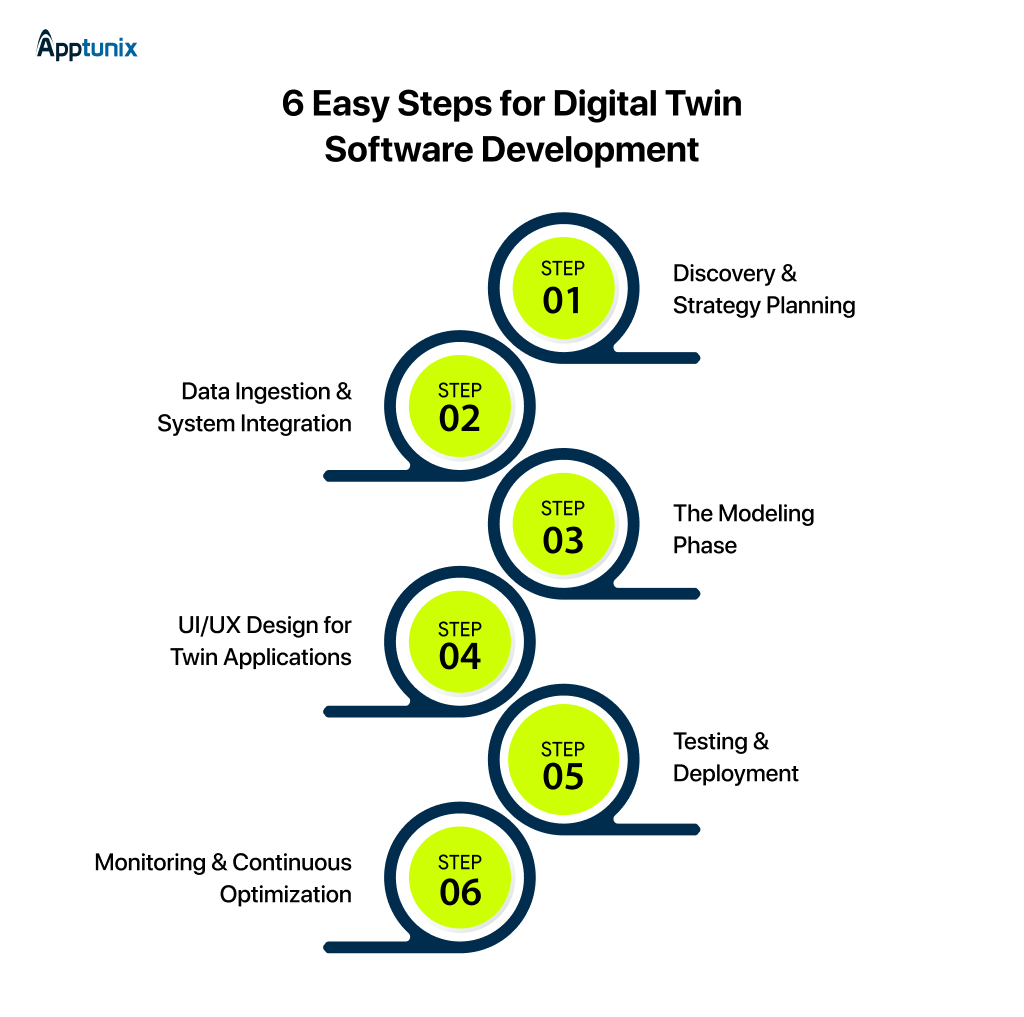
Step 1. Discovery & Strategy PlanningEvery successful digital twin development project starts with a business problem, not technology.
Before writing a single line of code, development teams identify:
For example, a manufacturing company may want predictive maintenance capabilities. A logistics business may focus on fleet optimization. The use case shapes the entire architecture. Without clear planning, even technically advanced systems fail to deliver meaningful business value.
Step 2. Data Ingestion & System IntegrationThis stage connects physical assets with digital systems. By using IoT sensors, APIs, cloud platforms, ERP systems, SCADA systems, and edge devices. This is the backbone of IoT digital twin development.
The goal is simple. Create uninterrupted communication between the physical and virtual environments. Strong integration improves accuracy, automation, and system intelligence. This is what powers advanced real-time digital twin systems across industries.
Step 3. The Modeling PhaseOnce the data infrastructure is ready, developers begin creating the digital representation itself.
This stage defines how the twin behaves, responds, and evolves over time.
Depending on the project, the model may include:
This phase combines engineering models with live data to build a digital twin app for complex industrial environments.
The goal is not only visual accuracy. The real goal is operational accuracy.
Step 4. UI/UX Design for Twin ApplicationsA digital twin platform should simplify complex information, not overwhelm users. That’s why intuitive dashboards and clean interfaces matter.
During this phase, teams design:
Modern digital twin platform development also focuses heavily on mobile accessibility and role-based user experiences.
Step 5. Testing & DeploymentThe system is subjected to extensive testing prior to launch. To ensure that it meets performance, synchronization, scalability, and security requirements.
Since real-time digital twin systems process continuous live data, even small delays can impact decision-making. Most companies start with a pilot deployment, then scale out the platform across the operations.
Step 6. Monitoring & Continuous OptimizationDigital twins are consistently evolving after deployment. Businesses monitor performance, retrain AI models, and improve system efficiency over time.
This ongoing optimization is one of the biggest benefits of digital twin app development for enterprises. The platform keeps learning from live data, helping businesses improve operations, reduce costs, and make smarter long-term decisions.
Now that the process is clear, let’s look at the essential features that define a high-performing digital twin application.
Choosing the right technology stack is one of the most consequential decisions in digital twin software development. Here’s what enterprise-grade implementations actually use in 2026:
The success of any digital twin app development project depends heavily on the platform’s features. Strong functionality improves operational visibility, prediction accuracy, and business efficiency.
To build a digital twin app, enterprises should prioritize these core platform features:
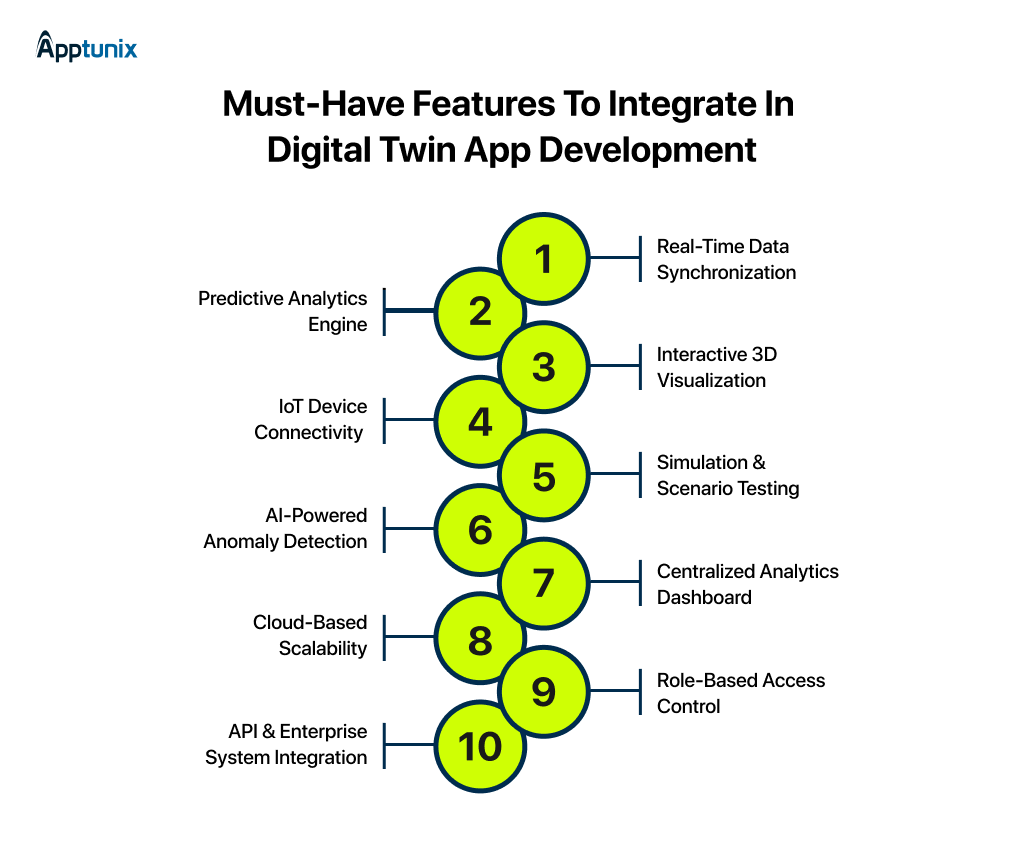
1. Real-Time Data SynchronizationA digital twin should reflect live operational conditions instantly. Real-time synchronization helps businesses monitor assets continuously and respond faster to unexpected issues. This feature is essential for accurate real-time digital twin systems and smarter operational decision-making.
2. Predictive Analytics EnginePredictive analytics turns raw data into future insights. It helps companies detect failures before they happen, reducing downtime and maintenance costs. That’s why industrial digital twin development is escalating across manufacturing and energy sectors.
3. Interactive 3D VisualizationPeople make faster decisions when information feels easy to understand. Clear dashboards simplify complex operational data through visual reports, alerts, and monitoring panels. During digital twin platform development, user experience matters just as much as backend engineering.
4. IoT Device ConnectivityWithout IoT integration, a digital twin cannot stay connected to physical assets. Strong sensor connectivity ensures continuous data flow between machines and the virtual environment. This capability powers scalable IoT digital twin development across industries.
5. Simulation & Scenario TestingSimulation features help teams evaluate operational changes, production adjustments, or resource planning safely. This is one of the biggest advantages of advanced digital twin technology in enterprise environments.
6. AI-Powered Anomaly DetectionSometimes, the smallest glitch can hide in a mountain of data. This feature uses machine learning to “sniff out” irregularities that a human eye would simply miss. It’s a core part of custom digital twin development services aimed at high-precision manufacturing or energy management. This acts as a 24/7 digital sentry that flags risks before they escalate into disasters.
7. Centralized Analytics DashboardA cluttered interface slows decision-making. A centralized dashboard brings operational data, alerts, and performance insights into one view. This improves usability during digital twin platform development and supports faster business responses.
8. Cloud-Based ScalabilityYour software should grow as your fleet expands. Cloud integration ensures your digital twin platform development handles one asset or ten thousand. It offers the flexibility needed to scale across different global regions without friction.
9. Role-Based Access ControlIn the enterprise world, data security is everything. You don’t want a floor operator seeing the same financial projections as the CFO. Granular permissions ensure that your “digital shadow” stays protected. This gives people exactly the information they need to do their jobs, nothing more, nothing less.
10. API & Enterprise System IntegrationA digital twin should work smoothly with existing business systems. API integrations connect ERP, CRM, and industrial software into one ecosystem. This improves automation and creates more connected custom digital twin development services for enterprises.
Building these features is one thing; seeing them in action is another. Let’s look at how specific industries are actually moving the needle with this tech.
Digital twins are no longer a concept for science fiction. Companies now create a digital twin application to solve complex business puzzles. Let’s look at how leading brands are putting this tech to work.
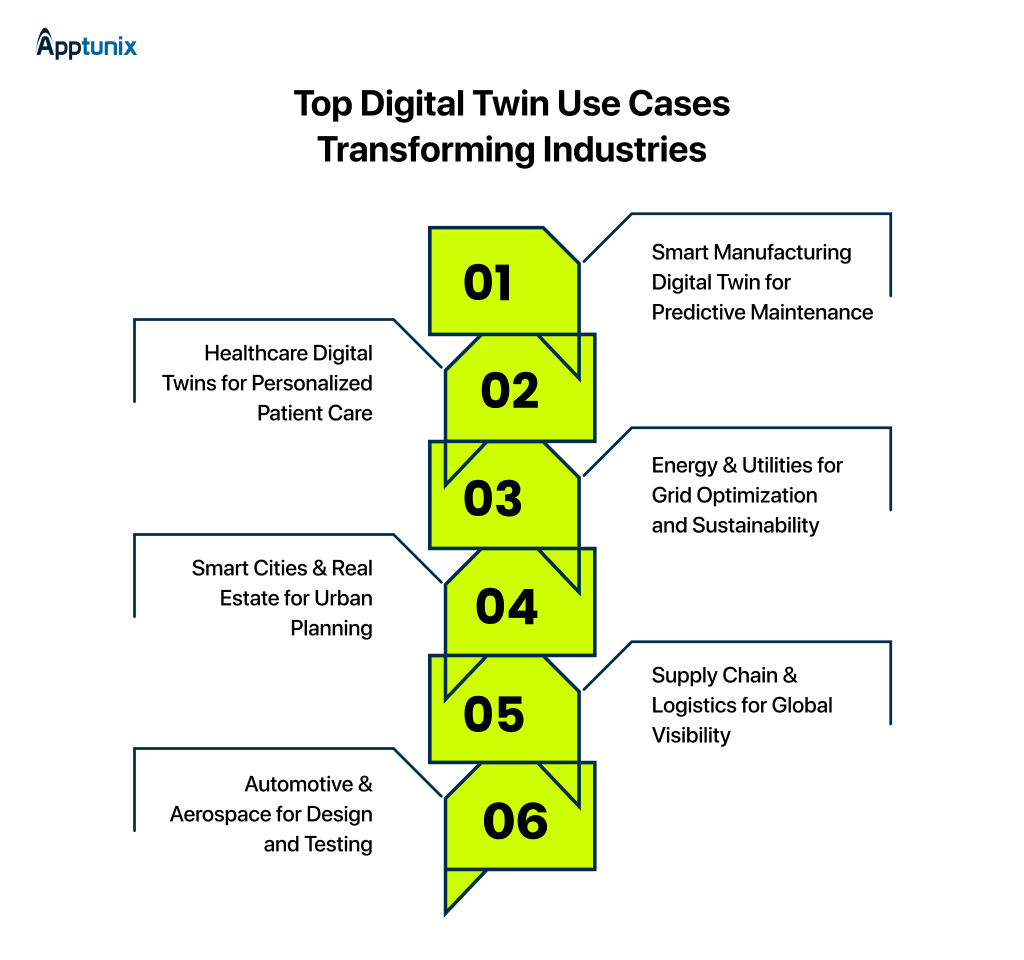
In the world of Industry 5.0, downtime is a profit killer. Manufacturers use industrial digital twin development to replicate entire assembly lines.
Siemens, for instance, uses twins to simulate production processes before they start. This helps them identify bottlenecks and predict machinery failure. It ensures the factory floor remains productive, efficient, and surprisingly predictable.
Researchers at Johns Hopkins created personalized heart digital twins to treat arrhythmias. The first FDA-approved digital twin application in cardiac care.
That’s the shift happening in healthcare. Imagine a virtual version of a human organ. Healthcare providers are using digital twin technology to model patient hearts or lungs. GE Healthcare uses these virtual models to simulate how a patient might react to specific treatments. It allows doctors to practice surgeries in a risk-free digital environment. This leads to better outcomes and highly personalized medical care.
Energy companies use digital twins to monitor power grids, turbines, and utility infrastructure continuously. Live performance tracking helps teams detect inefficiencies early and prevent unexpected failures. This is driving demand for scalable real-time digital twin systems across energy-intensive industries.
Cities are using digital twins to manage traffic, public infrastructure, water systems, and urban planning more effectively. In real estate, digital replicas help monitor building performance and energy consumption. This growing adoption is pushing large-scale digital twin platform development across urban ecosystems.
Global shipping is often a chaotic black box. Supply chain leaders use IoT digital twin development to track goods across oceans in real time.
DHL uses digital twins of their warehouses to optimize layout and picking paths. This visibility reduces delays and helps companies pivot when global trade routes are suddenly disrupted. It brings order to the chaos.
Automotive and aerospace companies use digital twins during product design, testing, and maintenance stages. Engineers can simulate real-world conditions before manufacturing begins, reducing risk and development costs. This approach has become a major growth driver for advanced digital twin IoT app development initiatives.
Estimating the cost to develop a digital twin app requires considering more than just software coding. You are investing in a synchronized ecosystem of data, hardware, and logic. In 2026, the cost of developing a digital twin app depends on how much “intelligence” you need and how many assets you’re connecting.
To give you a realistic roadmap, we’ve broken down the investment:

Most budget surprises in digital twin development don’t come from the software itself. When planning how to build a digital twin app, the real costs lie underneath.
Here are the five factors that move the needle most:
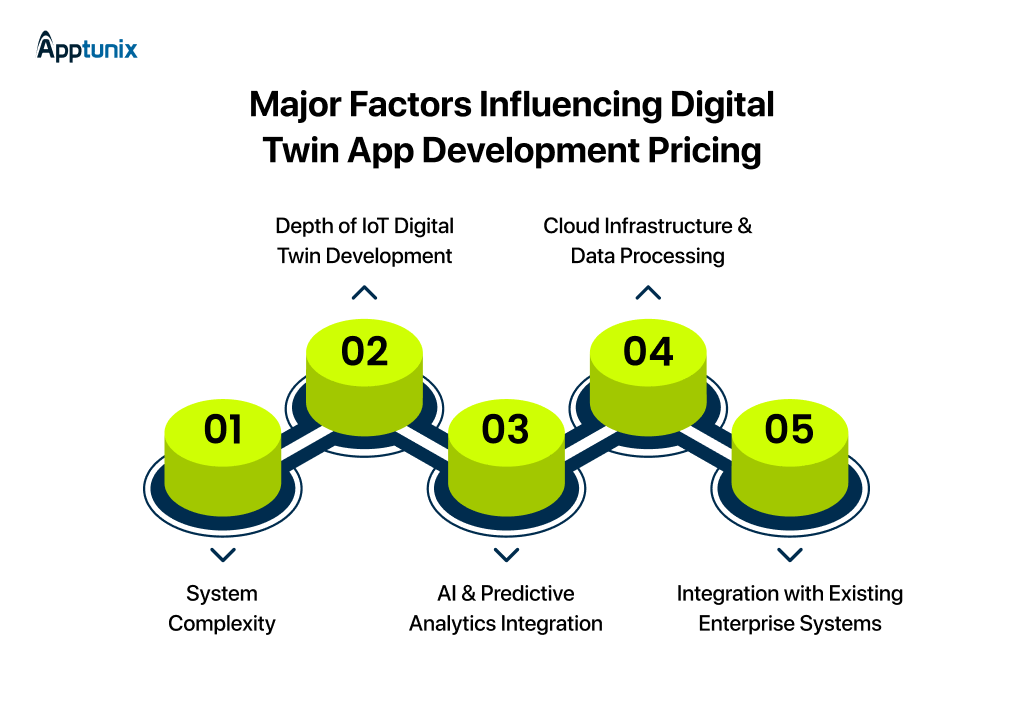
1. System ComplexityThe underlying structure of your model dictates the initial investment. A simple 2D dashboard is affordable, but a high-fidelity, physics-based digital twin architecture requires intensive engineering. The more “layers” of reality you replicate, the higher the development hours and cost it takes.
2. Depth of IoT Digital Twin DevelopmentYour budget scales with the number of connected assets. Integrating thousands of sensors for IoT digital twin development involves complex data ingestion pipelines. Costs rise when developers must build custom connectors for legacy industrial equipment that lacks modern APIs.
3. AI & Predictive Analytics IntegrationBasic twins show you what is happening; advanced ones show what will happen. Adding AI-driven “What-If” scenarios or generative design features requires hiring specialized digital twin developers. This intelligence layer is often the most expensive but delivers the highest ROI.
4. Cloud Infrastructure & Data ProcessingDigital twins continuously process live operational data. That requires scalable and secure cloud environments.
Businesses managing large datasets often spend more on cloud storage, processing power, and edge computing. During digital twin platform development, infrastructure decisions heavily influence long-term operating costs.
5. Integration with Existing Enterprise SystemsMost companies already use ERP, CRM, or industrial management software. Connecting these systems takes additional development effort and testing. Custom integrations are often one of the biggest cost drivers in modern digital twin development projects.
Most companies don’t struggle with ideas. They struggle with execution. A digital twin may look impressive in a demo, but if it can’t fit into real operations, it quickly becomes another expensive experiment.
That’s why businesses choose Apptunix.
We approach how to build a digital twin app from the ground level. We study how your teams work, where delays happen, and what’s slowing decisions down. Then we build systems around those realities. Not assumptions.
Our strength comes from combining deep technical expertise with years of delivering scalable digital transformation services. So when operators, engineers, or managers use your platform, it feels intuitive from day one.
Because the future doesn’t belong to businesses collecting more data.
It belongs to businesses finally using it intelligently.

Q 1.What is digital twin app development?
Digital twin app development is the process of creating a synchronized virtual counterpart of a physical asset, system, or process. By integrating real-time data from IoT sensors, developers build a “digital mirror” that allows businesses to simulate scenarios, monitor performance, and predict failures before they occur in the real world.
Q 2.How much does it cost to develop a digital twin app in 2026?
In 2026, the cost to develop a digital twin app typically ranges from $40,000 to over $300,000. A basic pilot for a single asset usually sits between $40k and $75k, while complex enterprise digital twin solutions with AI-driven predictive analytics and global scaling can easily exceed the $300,000 mark.
Q 3.How long does digital twin app development take?
The timeline for digital twin software development varies by complexity. A standard Proof of Concept (PoC) takes about 3 to 4 months. However, a full-scale industrial digital twin development project, including deep IoT integration and 3D modeling, generally requires 6 to 12 months to reach a production-ready state.
Q 4.What technology stack is used in digital twin software development?
A modern digital twin architecture relies on a robust stack:
Q 5.Is digital twin development suitable for small businesses?
Yes, digital twin development is increasingly accessible for small businesses through “Lean” models. Instead of twinning an entire factory, small firms often focus on a single high-value asset. Using custom digital twin development services to solve one specific bottleneck allows smaller players to gain a massive ROI without enterprise-level spending.
Q 6.What are the biggest benefits of digital twin technology for enterprises?
The benefits of digital twin technology for enterprises center on operational certainty:
(5 ratings, average: 5.00 out of 5)
Get the weekly updates on the newest brand stories, business models and technology right in your inbox.
With over 20+ years of experience in driving global digital initiatives, Nikhil Bansal is the CEO & Director of Apptunix. He specializes in orchestrating large-scale digital transformations, enterprise-grade software solutions, and high-level business strategies that redefine industry standards. Nikhil is known for his ability to bridge the gap between complex business challenges and innovative technology, helping Fortune 500 companies and startups alike achieve sustainable growth. A visionary leader, he empowers enterprises to navigate the digital landscape with agile, ROI-focused models and future-ready business strategies.
91 Views 10 min June 24, 2026

96 Views 10 min June 22, 2026
106 Views 10 min June 19, 2026
Book your consultation with us.
Book your consultation with us.


One Central, The offices 3, Level 3, DWTC, Sheikh Zayed Road, Dubai
+971 50 782 1690


Offer Ends Soon
Get a quick expert response in under 5 minutes.