10 Best Construction Project Management Software & How To Build Your Own?
46 Views 13 min August 27, 2026

Reena Bhagat, the CTO and Head of AI at Apptunix, is a seasoned technology strategist with a deep-rooted expertise in emerging technologies. With a focus on AI/ML integration, product engineering, cloud management, she leads the technical vision for high-performance SaaS infrastructures. Reena is recognized for building secure, scalable, and decentralized systems that solve real-world complexities. Her passion lies in leveraging data science and future-tech to create resilient digital products, making her a trusted authority for organizations looking to lead in the age of intelligent automation.
Custom fleet management software becomes more cost-effective as fleet size, operational complexity, and compliance requirements increase.
Real-time GPS tracking, dispatch management, predictive maintenance, and compliance automation form the foundation of modern fleet platforms.
AI is already helping fleets reduce fuel costs, prevent breakdowns, optimize routes, and improve driver safety.
Successful fleet systems rely on seamless integration with telematics devices, ELDs, dashcams, fuel cards, and mobile apps.
A structured development process—from discovery and architecture to deployment and support—is critical for long-term success.
For fleets managing 500+ vehicles, custom-built solutions often deliver greater scalability, flexibility, and ROI than off-the-shelf software.
For organisations managing large vehicle fleets, there are challenges that generic software solutions cannot solve. As the fleet expands, disconnected dispatching systems, limited visibility, and rising fuel costs, and compliance requirements create operational challenges. This is why enterprises are increasingly investing in custom fleet management software development to build systems tailored to their workflows, drivers, assets, and reporting requirements.
Fleet management software connects GPS hardware in each vehicle to a central operations dashboard. Fleet managers see vehicle location, speed, and status across the entire fleet in real time. Trip history is recorded automatically. Maintenance scheduling runs against actual vehicle condition rather than calendar estimates. Compliance documentation generates itself.
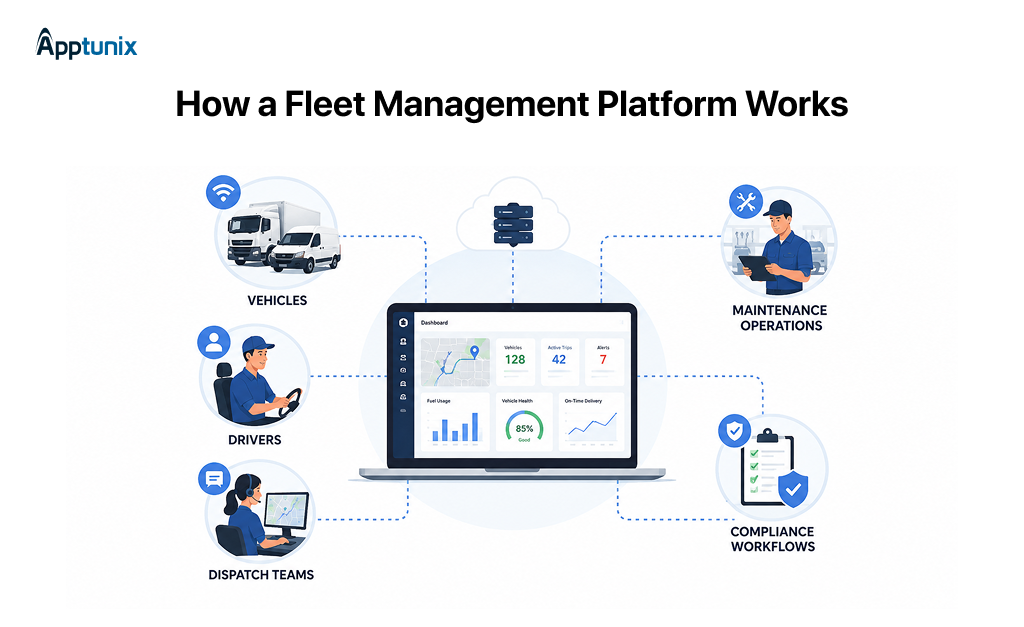
Modern platforms go further than basic tracking. AI-powered predictive maintenance catches faults before drivers notice them. Route algorithms reduce fuel costs by identifying paths human dispatchers wouldn’t find manually. Driver behavior scoring surfaces safety risks without requiring someone to review every dashboard by hand. The analytics layer turns raw vehicle data into decisions.
The US fleet management market is projected to grow from $11.34 billion in 2025 to $17.63 billion by 2030, at a CAGR of 9.2%. North America holds the largest regional share globally at 38.6% of the fleet management software market.
Three very different user types interact with the same platform every day. Fleet managers need aggregate visibility. Drivers need route guidance and job details. Maintenance teams need fault alerts and service schedules. Custom fleet management application development makes it possible to build the right experience for all three without compromise.
Before investing in custom software, it’s important to understand the fundamentals of fleet operations and the business value fleet technology delivers. Our guide on how fleet management works and its key business benefits breaks down the core concepts and advantages for growing fleet businesses.
Fleet management software is built around different operational needs, from tracking vehicles to managing maintenance, drivers, fuel, and compliance. The correct type of software depends on fleet size, vehicle type, and the workflows businesses need to automate.
For businesses with complex workflows, custom fleet management software can combine multiple modules into one system rather than relying on disconnected tools.
Feature selection in fleet management application development should follow operational priority, not a feature checklist. These are the modules that matter most for enterprise-scale US fleet operations.
This is the foundation, as without it, nothing else works. Location data updates every 30 seconds or faster. Geofencing alerts trigger when vehicles cross particular boundaries, such as customer sites, restricted areas, or state boundaries. Route replay helps in reviewing what actually happened on completed trips for compliance and dispute resolution. This module anchors every other capability in the platform.
This is where the fuel savings come from. A carefully constructed management system shows traffic conditions, delivery time windows, vehicle capacity limits, and driver hours into the routing algorithm at the same time. When conditions change mid-route, there is no need for dispatcher intervention as the system reroutes automatically. For a fleet of 500 vehicles, a slight 10% improvement in route efficiency compounds into major annual savings.
This module serves two purposes at once by tracking and scoring harsh braking, rapid acceleration, speeding, and phone usage automatically. Fleet managers see behavior patterns across the entire team, and individual drivers get particular, actionable feedback rather than generic safety reminders. AI-powered monitoring systems that use dashcams can decrease accident rates by 25% to 40%, leading to lower liability costs.
Service alerts based on mileage, engine hours, and diagnostic codes from OBD-II readers replace guesswork with condition-based scheduling. A vehicle showing early brake wear gets scheduled before it becomes a roadside breakdown. Predictive maintenance built into the platform also connects to the dispatch module, so a vehicle flagged for service doesn’t get assigned to a long-haul run the next morning.
Fuel management software connects GPS data, driver behavior scores, idle time logs, and fuel card transactions into a single analytics view. Fleet managers can see exactly which drivers, routes, and vehicle types are driving fuel waste. AI-driven fuel management across factors like route planning, speed optimization, and tire pressure monitoring can reduce fuel costs by 10% to 15%.
For US fleets, this module is non-negotiable. Hours of Service tracking, ELD data logging, Driver Vehicle Inspection Reports, and FMCSA safety score reporting are all handled inside the platform. Custom development means the compliance module can accommodate your specific driver classifications, route types, and reporting cadence rather than forcing your operation into a generic template.
Vehicle management software development that ignores the end user experience creates platforms that people work around rather than with. Fleet managers need aggregate data and exception alerts. Drivers need a clean mobile app with route guidance, job details, and check-in functionality. Maintenance teams need fault queues, service history, and parts availability. All three views run on the same underlying data, built in a single vehicle management software development project.
Fleet management software development services follow a structured process. Each phase builds directly on the last. Skipping or compressing phases is the most common reason enterprise fleet projects run over budget or miss requirements.
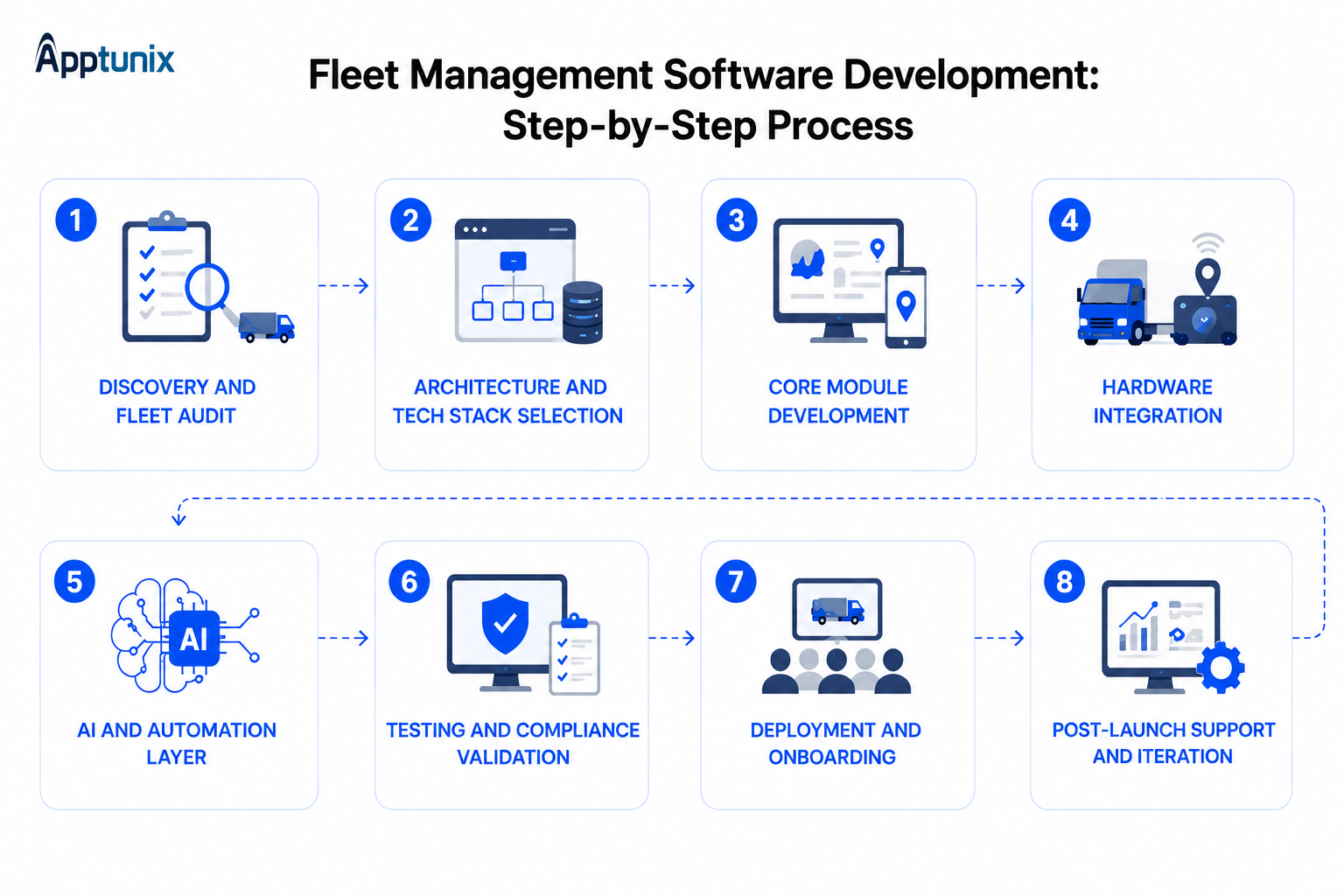
1 Discovery and fleet audit:Discovery and fleet audit: The process starts with a thorough understanding of the existing operation. This covers current systems and their limitations, data sources (GPS devices, fuel cards, ELD hardware), dispatch workflows, compliance requirements, and integration points with ERP or TMS platforms. A clear discovery phase prevents scope changes mid-development.
2 Architecture and tech stack selection:Based on discovery findings, the development team designs the system architecture: backend stack, database selection, real-time data layer, GPS API integration strategy, and mobile framework choice. For enterprise fleets, scalability and data security are non-negotiable architectural requirements from day one.
3 Core module development:GPS tracking, the dispatch management system, the driver app, and the admin dashboard are built and tested in phases. Phased delivery means operational teams can start using core functionality while advanced modules are still in development, reducing the transition period.
4 Hardware integration:OBD-II units, ELD devices, dash cameras, and third-party telematics APIs are connected and validated. Data pipelines are tested under realistic fleet conditions before the platform goes live.
5 AI and automation layer:Predictive maintenance models are trained on historical vehicle data. Route optimization algorithms are calibrated against actual fleet routes. Driver behavior scoring logic is configured for your specific policies and risk tolerances.
6 Testing and compliance validation:Load testing at fleet scale, FMCSA compliance checks, and a full security audit are completed before deployment. For a 500+ vehicle fleet, data volume and concurrent user load need to be tested at realistic peaks, not theoretical averages.
7 Deployment and onboarding:A phased rollout minimizes operational disruption. Driver training, dispatcher onboarding, and maintenance team setup happen in parallel with the technical deployment. Integration with existing ERP or TMS is validated in a staging environment before go-live.
8 Post-launch support and iteration:Performance monitoring, feature expansion, and model retraining are ongoing. Fleet needs evolve as operations scale and regulations change. Post-launch support from the development team ensures the platform stays current without requiring a full rebuild.
Fleet management software is only as effective as the data it gets. But the software works as a central command centre, where the actual insights come from hardware and connected devices installed across the fleet.
These connected technologies are what enable modern fleet operations to function efficiently. From telematics and GPS tracking to AI-powered monitoring systems, businesses increasingly rely on a combination of hardware and software to improve visibility, safety, and operational performance.
To understand how these innovations are transforming the industry, explore the top fleet management technologies driving business growth today.
AI in fleet management software is not a future-state conversation. Most of what matters is already deployable. The distinction worth making is between what is production-ready today and what is on the near-term roadmap. Explore how AI in logistics and transportation operations improve forecasting, route planning, and operational efficiency.
Off-the-shelf fleet management software only functions effectively when operations are simple. But once the fleet grows, operational complexity follows. Managing hundreds or thousands of vehicles across multiple locations, keeping coordination between drivers, and ensuring compliance, while keeping costs under control, needs much more than any generic set of features.
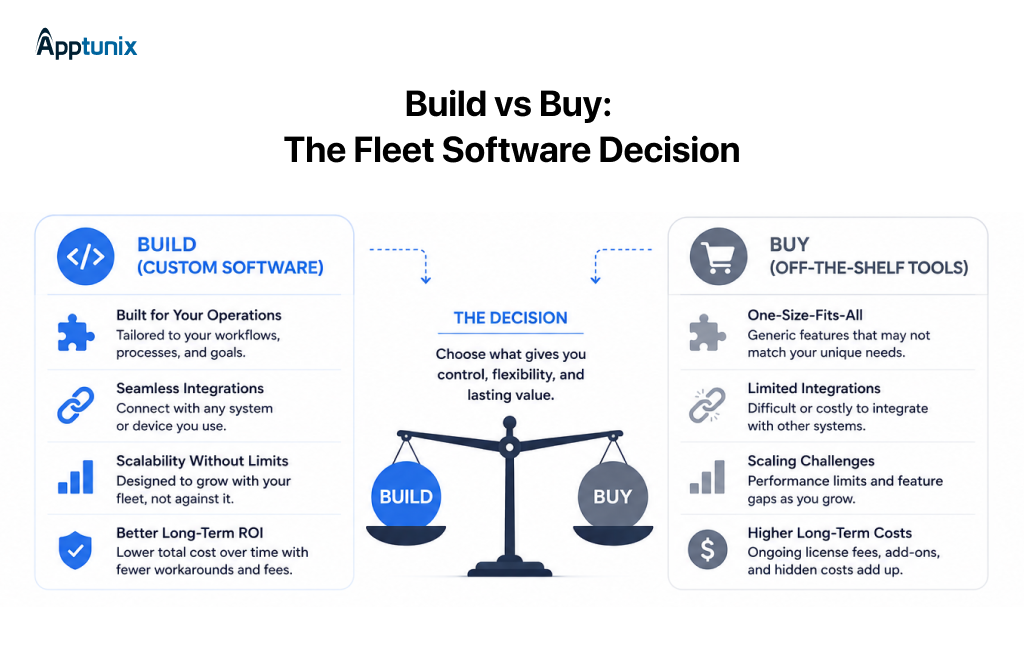
This is where most fleet operators eventually find themselves in trouble and feel the need to outgrow generic software.
In many organizations, operations such as dispatching, vehicle tracking, driver management, and reporting operate in different systems. This causes teams to switch between platforms, update information manually, and resolve communication gaps.
Lack of integration in fleets assigned for multiple routes, delivery schedules, and service regions can delay decision-making and cause operational friction. Here comes the need for a custom dispatch management system that brings everything under one place, from allowing dispatchers to view drivers’ availability, vehicle status, route updates, to compliance information, all under a single dashboard.
Fuel is one of the largest operating expenses for any fleet business. Yet many organisations struggle to understand exactly why fuel costs fluctuate from month to month.
Most standard fleet solutions can show overall fuel spend, but they lack the deeper insights needed to identify the cause. Is it the issue of staying idle for most of the time, mismanaged route planning, rash driving tendencies, or maybe vehicle inefficiencies?
Compliance is rarely a challenge until an audit approaches.
Fleet operators have to manage a growing list of regulatory requirements, which includes:
Mostly off-the-shelf tools provide only basic compliance functionality, which may not entirely support businesses across multiple states, vehicle classes, or particular transportation environments.
This causes teams to spend most of their time preparing reports, authenticating records, and filling compliance gaps manually. Whereas fleet management software development services provide custom fleet management software that can automate most of these tasks, reducing manual burden while maintaining audit readiness year-round.
Monitoring driver performance becomes increasingly difficult as the fleet scales. What works for a fleet of 20 vehicles quickly becomes unsustainable for a fleet of 500.
Fleet platforms usually collect drivers’ data, but depending solely on data doesn’t impact improving performance. The tough spot is turning that data into actionable insights, which managers can further use for coaching, safety measures, and performance improvements.
Custom-built driver management modules connect behavior data directly to dispatch assignments, performance reviews, and insurance reporting.
Most fleet maintenance packages still focus on fixed service intervals based on dates or mileage. While this seems simple to manage, this approach doesn’t always reflect the actual condition of the vehicle.
Two vehicles with the same mileage can experience different levels of wear and tear depending on the road conditions, load capacity, driving behaviour, and operating conditions.
Fleet management software development company infuses modern telematics and OBD-Ⅱ to make maintenance decisions based on real-time vehicle health rather than calculated assumptions. Custom fleet management software can monitor performance indicators every time, helping maintenance teams to figure out issues early, narrow down unplanned downtime, and stretch vehicle lifespan without overspending on servicing costs.
The right answer depends entirely on the complexity of your operation. Here is a direct comparison.
Off-the-shelf fleet management tools work well for smaller operations with standard workflows and no complex integration requirements. Once a fleet crosses 500 vehicles and starts operating across multiple states, compliance jurisdictions, or needs the dispatch management system to integrate with an existing TMS or ERP, the limitations of packaged tools become operational liabilities. At that point, custom fleet management software development becomes the more cost-effective choice over a three-to-five-year horizon.
For organizations managing broader transportation operations, fleet platforms are often part of a larger logistics ecosystem that includes dispatch, route planning, warehouse coordination, and delivery management. Explore how custom logistics software development solutions help unify these workflows across the supply chain.
Pricing for custom fleet management software development varies based on the scope of the platform, the complexity of integrations, and the team building it.
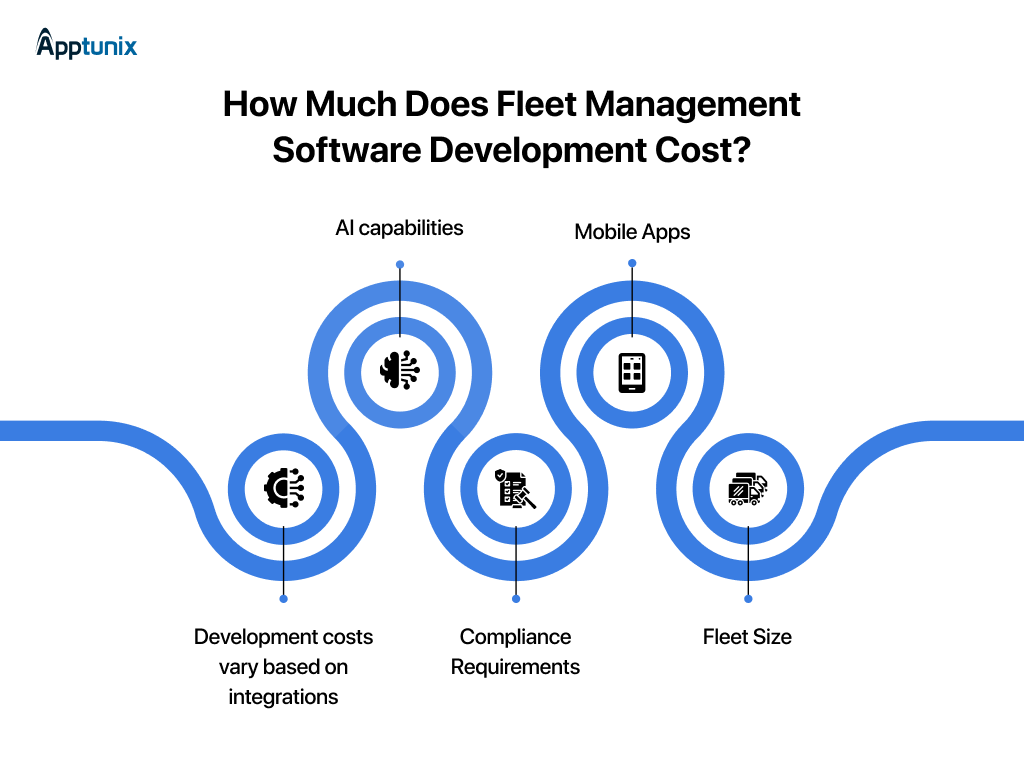
The average range for custom fleet management software development lies between $40,000 to $350,000+. Below is the list that reflects US market rates and applies to full-cycle development engagements.
Apptunix is a digital transformation and product development company that offers fleet management software development services, here distinction matters for us. You’re not getting a team that fills headcount or delivers code to a spec and hands it over. You get a partner that works through the problem with you from discovery to launch and stays involved as the platform evolves.
From fleet audit and architecture design through to post-launch support and model iteration, Apptunix handles the full development lifecycle. Fleet management app development at enterprise scale requires coordination across GPS hardware, mobile applications, compliance systems, and AI layers. Managing that from multiple vendors introduces risk. A single development partner removes it.
Apptunix builds fleet management software for US-based operations. That means FMCSA compliance, ELD mandates, HOS regulations, and DVIR requirements are part of the development process, not an afterthought added during QA. The compliance module is designed for American fleet operations from the first line of code.
Predictive maintenance models, AI-driven dispatch management software, and driver behavior scoring systems require both machine learning expertise and strong mobile application development. Apptunix brings both under one roof, which means the AI layer integrates cleanly with the driver app and dispatch dashboard rather than sitting as a disconnected analytics bolt-on.
Apptunix has built software for transportation, logistics, and field operations businesses. Understanding the operational context, not just the technical requirements, is what separates functional fleet software from fleet software that actually gets used.
Off-the-shelf fleet tools solve simple problems. Running 500 or more vehicles across shifting routes, compliance windows, and real-time conditions is not a simple problem.
Custom fleet management software development gives operations teams a platform that fits the way their fleet actually works, not a vendor’s approximation of it. The GPS tracking, dispatch logic, compliance modules, and AI layers all connect inside one system built specifically for your scale and your workflows.
The companies investing in custom builds today are not doing it because it is the cheaper short-term option. They are doing it because it is the option that does not run out of capability when the fleet grows.
If you are evaluating whether a custom build is the right call for your operation, Apptunix can walk you through what that looks like from discovery to deployment.
Q 1.What is fleet management software development?
Fleet management software development is the process of building a custom platform that connects GPS tracking, vehicle diagnostics, dispatch operations, compliance management, and driver monitoring into a single system. Unlike off-the-shelf solutions, it is tailored to a company’s specific workflows and operational needs.
Q 2.How long does it take to build custom fleet management software?
Development timelines depend on project complexity. A basic MVP can take 3–5 months, while enterprise-grade platforms with AI capabilities, compliance modules, and third-party integrations typically require 8–12 months.
Q 3.What is a dispatch management system?
A dispatch management system helps fleet operators assign vehicles and drivers, optimize routes, track deliveries, and communicate in real time. It works alongside GPS tracking, driver availability, and compliance data to improve operational efficiency.
Q 4.How much does fleet management software development cost?
Fleet management software development can range from $40,000 for a basic solution to $350,000+ for an enterprise platform with AI features, hardware integrations, and advanced compliance capabilities. Costs vary based on features, integrations, and scalability requirements.
Q 5.Should I build or buy fleet management software?
Off-the-shelf software is suitable for smaller fleets with standard requirements. Custom fleet management software development is often a better choice for large fleets that need specialized workflows, advanced integrations, stronger compliance controls, and long-term scalability.
Q 6.What devices integrate with fleet management software?
Fleet management software commonly integrates with OBD-II and telematics units, Electronic Logging Devices (ELDs), dash cameras, fuel cards, RFID scanners, and driver-facing mobile apps. These integrations provide real-time data for tracking, compliance, maintenance, and fleet optimization.
Get the weekly updates on the newest brand stories, business models and technology right in your inbox.
Reena Bhagat, the CTO and Head of AI at Apptunix, is a seasoned technology strategist with a deep-rooted expertise in emerging technologies. With a focus on AI/ML integration, product engineering, cloud management, she leads the technical vision for high-performance SaaS infrastructures. Reena is recognized for building secure, scalable, and decentralized systems that solve real-world complexities. Her passion lies in leveraging data science and future-tech to create resilient digital products, making her a trusted authority for organizations looking to lead in the age of intelligent automation.
46 Views 13 min August 27, 2026

214 Views 13 min June 22, 2026

246 Views 13 min June 19, 2026
Book your consultation with us.
Book your consultation with us.


One Central, The offices 3, Level 3, DWTC, Sheikh Zayed Road, Dubai
+971 50 782 1690