
10 Best Construction Project Management Software & How To Build Your Own?
47 Views 9 min August 27, 2026

With over 20+ years of experience in driving global digital initiatives, Nikhil Bansal is the CEO & Director of Apptunix. He specializes in orchestrating large-scale digital transformations, enterprise-grade software solutions, and high-level business strategies that redefine industry standards. Nikhil is known for his ability to bridge the gap between complex business challenges and innovative technology, helping Fortune 500 companies and startups alike achieve sustainable growth. A visionary leader, he empowers enterprises to navigate the digital landscape with agile, ROI-focused models and future-ready business strategies.
Let’s imagine a scenario where you spend months or thousands of dollars developing a P2E (play-to-earn) game, launching with a promising token economy, and attracting a wave of early users. All of this only to watch player activity decline, token values crash, and the community disappear in a short interval.
This is not a fictional story, but it’s today’s reality.
Blockchain technology has reshaped gaming by enabling digital asset ownership, player rewards, and decentralized ecosystems. It made P2E games popular and one of the most talked-about segments in the Web3 ecosystem.
Indeed, a handful of projects managed to succeed in P2E game development, building sustainable communities and thriving economies. But there are countless other game projects that failed to survive beyond their first year.
According to CoinDesk, over 90% of Web3 games failed. But why do they fail? Let’s find out.

P2E games definitely transformed the gaming industry by allowing players to earn real-world value through gameplay. Such game concepts attract millions of users, investors, and startups eager to capitalize on the growing Web 3 ecosystem.
Even then, P2E games attract millions of customers, but despite the initial excitement, a significant number of P2E games struggle to maintain momentum and often fail within their first year.
As of 2026, blockchain games account for 29% of the total Web 3 industry, highlighting continued interest in the sector.
The reason behind the failure is not the segment but the investors themselves, for not focusing on basic things while creating the game or beyond.
Here are the 6 big reasons why most P2E games fail:
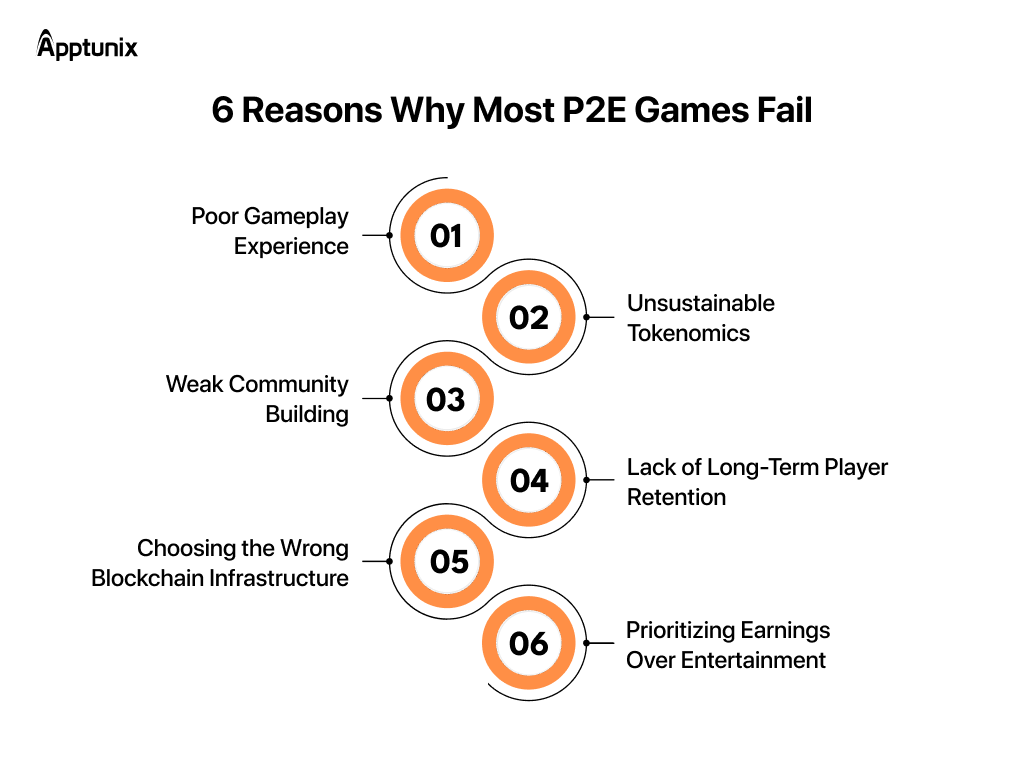
1:Poor Gameplay ExperienceMost P2E games focus heavily on rewards and blockchain features, neglecting gameplay, which is the most important part. Undoubtedly, the game’s primary purpose is to generate revenue, but players remain engaged only if it is genuinely enjoyable and engaging.
2:Unsustainable TokenomicsIf the game gives tokens faster, players want to buy; if not, engagement drops. Poorly designed token economies lead to excessive token supply and declining value. Less valuable rewards enable players to lose motivation to participate, causing the game ecosystem to weaken.
3:Weak Community BuildingP2E games that fail to communicate with players, gather feedback, and encourage participation often struggle to create trust and retain users. The majority of startups or entrepreneurs fail to do so and eventually do not make a good community for the long-term.
4:Lack of Long-Term Player RetentionThe majority of games attract users after launching to the market, but fail to keep them engaged for the long term. They don’t succeed because they don’t focus on regular updates, new challenges, and fresh content, leading to player activity declines.
5:Choosing the Wrong Blockchain InfrastructurePicking an unsuitable blockchain is also a reason for P2E game failure sometimes. It creates issues such as high transaction fees, slow processing speeds, and scalability limitations. This negatively impacts the users and discourages them from participating.
6:Prioritizing Earnings Over EntertainmentFocusing on earning or neglecting entertainment is one of the biggest mistakes in P2E game development. Indeed, earning is the priority, but you can’t ignore that sustainable success comes from building an enjoyable game in which earning opportunities complement the experience.
A successful play-to-earn game development requires more than blockchain technology and reward system integration. Most of the startups or entrepreneurs enter the market with strong ideas but make unwanted mistakes that affect player engagement, token value, and long-term sustainability.
Analyze the table below that highlights some of the most common mistakes that you should avoid during blockchain game development:
Creating a P2E or Web3 gaming platform in 2026 demands more than incorporating blockchain technology and digital assets. You should follow a strategic approach that prioritizes gameplay, player retention, and sustainable economies from day one.
A global game development company follows these 10 steps to successfully launch a P2E game in 2026:
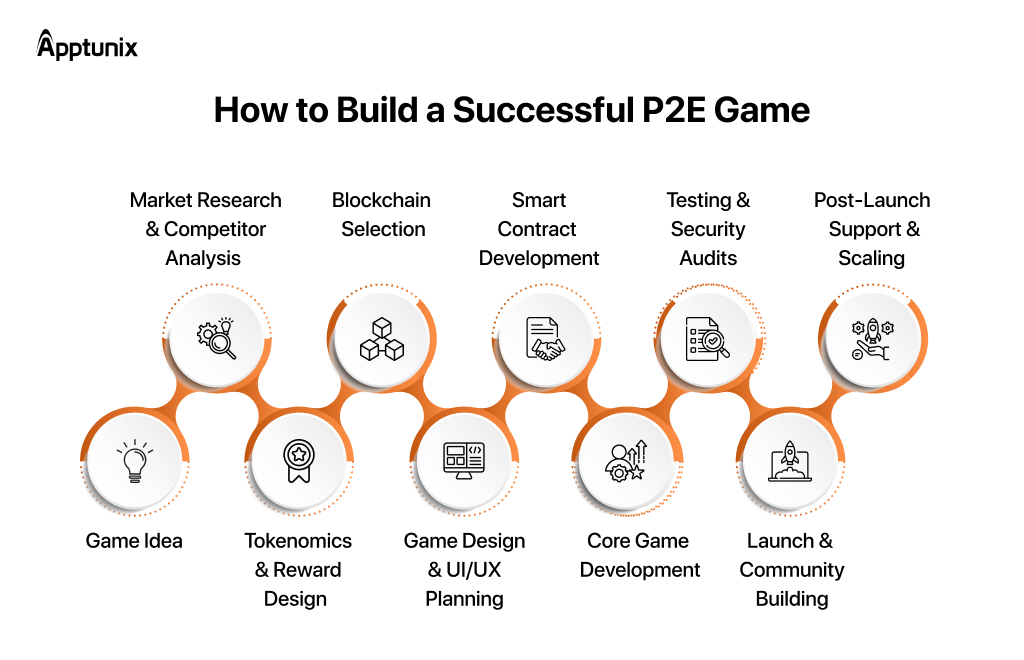
Step 1:Define the Game Concept and Business ModelYou must have a clear vision in the initial phase of every successful P2E game. Define the game concept and business model, which involves
In this phase, the goal is to plan to develop a game that players enjoy first and earn money later.
Step 2:Conduct Market and Competitor ResearchTo identify market opportunities and avoid common mistakes for game failures, your team must analyze successful and failed P2E projects before development begins.
Doing this will help you validate the concept, understand player expectations, and uncover features that can provide a competitive advantage in today’s digital marketplace. Most importantly, conducting market and competitor research enables you to refine your monetization strategy, target the right audience, and build a game that addresses real market demand.
Step 3:Design Sustainable TokenomicsOnce you and your development team are done with competitor research, focus on tokenomics, which is the foundation of every P2E ecosystem. P2E game developers carefully design token supply, reward mechanisms, staking models, and NFR utility.
They also design token burning strategies to maintain a healthy balance between supply and demand. Remember, a well-designed token economy helps in encouraging player participation, preserving asset value, and supporting the long-term sustainability of the game’s ecosystem.
Step 4:Choose the Right Blockchain NetworkAfter designing the sustainable tokenomics, it’s time to pick a blockchain network that aligns with your project goals. In this phase, factors such as scalability, security, interoperability, transaction speed, and gas fees are evaluated to ensure a seamless user experience and future growth potential.
Picking the right blockchain is essential because it significantly impacts game performance, player satisfaction, and the ability to scale as the user base grows over time.
Step 5:Create Game Design and User ExperienceCreating game design and user experience are the most important parts of P2E game development because at this stage, the development team builds gameplay mechanics, character progression systems, reward structures, levels, and user journeys.
In this phase, the focus is on crafting engaging experiences that encourage players to return regularly, regardless of earning opportunities. A well-designed game boosts player retention, satisfaction, and engagement.
Step 6:Develop Smart Contracts and Blockchain FeaturesOnce the game’s architecture is done, P2E game developers create smart contracts for token management, NFT ownership, rewards distribution, marketplace transactions, and governance functions. The development team also integrates
The integration ensures seamless interactions between players, digital assets, and the blockchain ecosystem. Apart from that, the team also prioritizes security and transparency throughout development.
Step 7:Build Core Game FeaturesIn this phase, the development team integrates key P2E features into the game, which basically include
You can create a complete gaming ecosystem by integrating these features. This streamlines asset management, enhances player interaction, and contributes to a more immersive gaming experience.
Step 8:Perform Testing and Security AuditsThe game can be tested extensively to determine the bugs, performance issues, and any vulnerabilities. The QA team provides auditing of the smart contracts, optimization of gameplay, and stress testing of blockchain integrations to guarantee stability and security.
Testing and security audits prepare the game for real-world use, ensuring it performs at peak efficiency and remains secure.
Step 9:Launch, Acquire Users, and Build CommunityIn this step, the development team actually launches the game. A successful launch involves more than just releasing the game. They work closely with marketing and community managers to
Making these efforts helps the game strengthen community loyalty, increase player engagement, and drive sustainable growth for the gaming ecosystem.
Step 10:Monitor, Optimize, and ScaleAfter successfully launching the game, a reputable game development firm always gives post-launch support for long-term growth. Under this phase, the development team continuously analyzes player behavior, token performance, retention metrics, and community feedback to introduce new features, content updates, and adjustments that keep the game new and fresh.
So these were the 10 steps for play-to-earn game development. Now it’s time to discover the key features of a successful P2E game.
Building a successful play-to-earn game depends on more than just rewarding players. Modern P2E games require a combination of gaming, blockchain, and community-focused features to attract, engage, and retain users.
Let’s find out the 10 core features that contribute to building a successful P2E game in 2026:
Crafting a Web3 gaming platform is one thing, but making the game successful is another. Indeed, factors like NFTs, blockchain technology, and appealing token rewards attract initial interest; however, the long-term success depends on delivering value to users beyond earning opportunities.
The factors that really drive success for Web3 game development services include:
So this is how you make your P2E game successful. Now, let’s find out the cost of developing a P2E game in 2026.
The cost to build a P2E game is $30,000 to $300,000, depending on the game’s functionalities. A basic P2E game with only core features costs less than an advanced P2E game with high-end features and functionality.
Examine the cost comparison between basic, mid-level, and complex P2E games in 2026:
Apart from feature integration, several more factors influence overall P2E game development cost, which are as follows:
Before wrapping up, understand the key tips that will help you pick the right development agency in 2026.
Picking the right P2E development services provider is the most imperative decision for your project’s success. It’s important because it can help you create a secure, scalable, and engaging gaming ecosystem, and most importantly, avoid costly development mistakes.
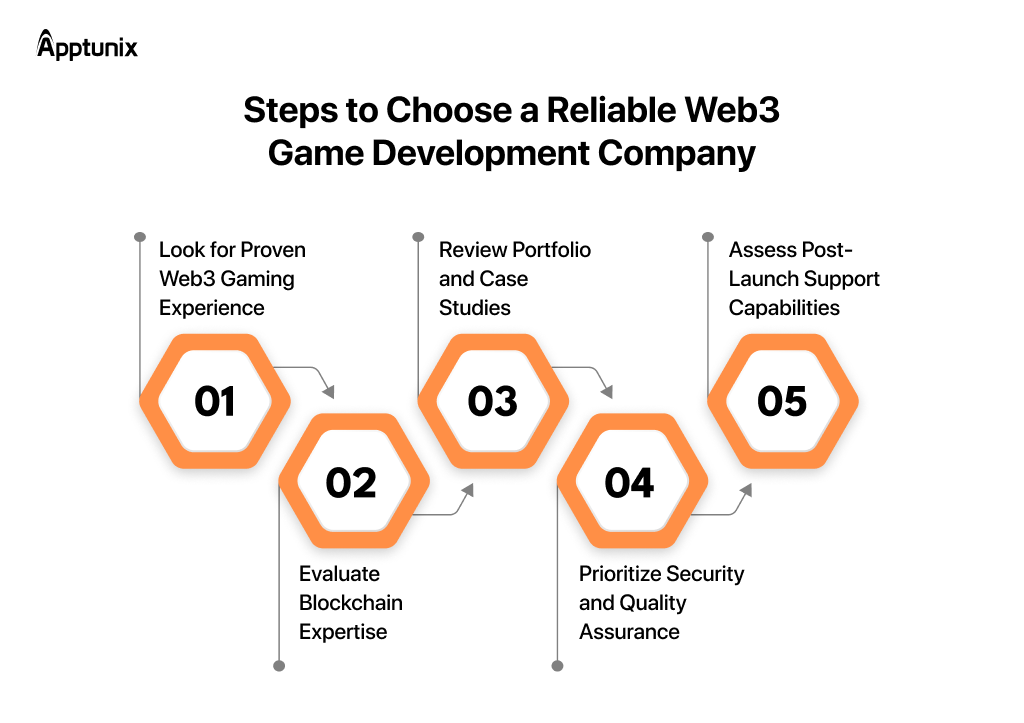
Partner with a company that has experience in developing Web3, NFT, and P2E games because not every game development agency knows the intricacies of blockchain gaming. Partnering with the right company will ensure that you are better equipped to handle industry-specific challenges.
Go for a reliable partner that has strong expertise in tokenomics, NFT integration, wallet connectivity, smart contract development, and blockchain infrastructure. If the company understands these, then pick it because it helps in developing a secure and scalable Web 3 game.
You should examine previous projects to understand valuable insights into a company’s technical capabilities, design quality, and industry experience. If the company has built several P2E games earlier or has a strong portfolio, then they have the ability to deliver successful gaming solutions.
Don’t overlook security and compliance because Web3 games involve digital assets and blockchain transactions. Find out if the company follows rigorous testing processes, smart contract audits, and security best practices throughout development.
Launching the game is only the beginning. The ideal development partner should offer ongoing maintenance, feature enhancements, and performance optimization. They must offer technical support to help your platform grow over time.
The data indicates that P2E games have created exciting opportunities for both players and businesses. However, success requires more than simply integrating blockchain technology and reward systems.
In P2E game development, every element like sustainable tokenomics, engaging gameplay, strong community building, secure infrastructure, etc., plays a significant role in long-term growth.
With the right development strategy and by avoiding common mistakes, businesses can create a P2E game that attracts users, retains players, and creates lasting value in an increasingly competitive market.
Today, entrepreneurs who succeed in developing a successful P2E game generally prioritize player experience over short-term profits. You can do this by partnering with a leading Web3 game development firm like Apptunix.
Having the right partner like Apptunix can help you build a new P2E game from scratch or transform an existing gaming concept into a Web3 experience. Parenting with Apptunix helps you start planning strategically and launch a game that thrives in the evolving blockchain gaming landscape.
Q 1.Should startups build a P2E game in 2026?
Yes, 2026 can be a great time for startups to build a P2E game as blockchain gaming continues to grow. However, success depends on delivering engaging gameplay, sustainable tokenomics, and a strong player community rather than focusing only on rewards.
Q 2.How to build a successful P2E game
Creating a successful P2E game in 2026 requires the right development approach based on users and market demand. The process to build a P2E game include
Q 3.What features should a P2E game have?
The key features of a P2E game include secure wallet integration, NFT-based in-game assets, a reward system, an NFT marketplace, player profiles, progress tracking, competitive gameplay, cross-platform compatibility, advanced security governance features, and more.
Get the weekly updates on the newest brand stories, business models and technology right in your inbox.
With over 20+ years of experience in driving global digital initiatives, Nikhil Bansal is the CEO & Director of Apptunix. He specializes in orchestrating large-scale digital transformations, enterprise-grade software solutions, and high-level business strategies that redefine industry standards. Nikhil is known for his ability to bridge the gap between complex business challenges and innovative technology, helping Fortune 500 companies and startups alike achieve sustainable growth. A visionary leader, he empowers enterprises to navigate the digital landscape with agile, ROI-focused models and future-ready business strategies.
47 Views 9 min August 27, 2026

195 Views 9 min June 24, 2026

247 Views 9 min June 19, 2026
Book your consultation with us.
Book your consultation with us.


One Central, The offices 3, Level 3, DWTC, Sheikh Zayed Road, Dubai
+971 50 782 1690