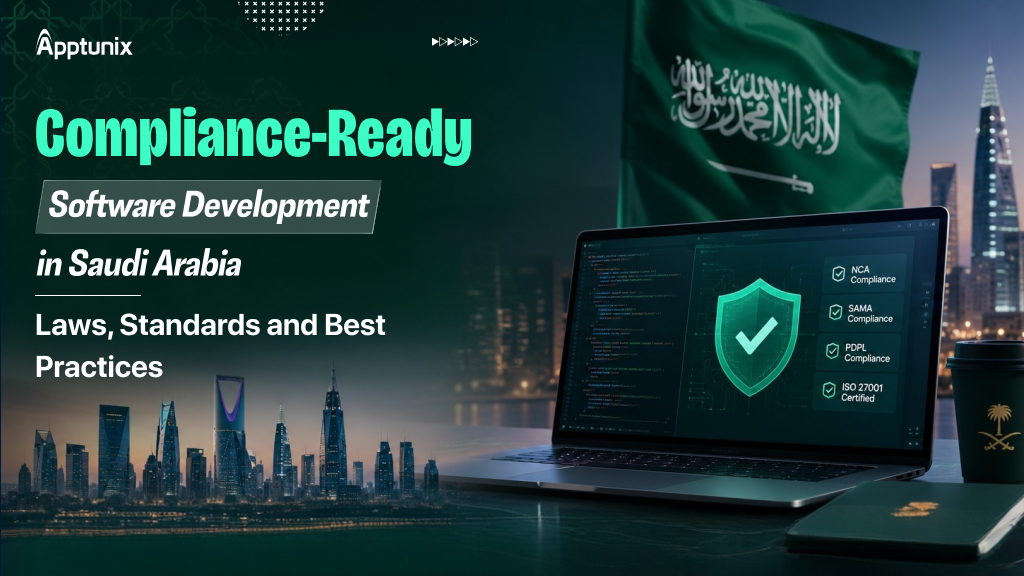
Compliance-Ready Software Development in Saudi Arabia: Laws, Standards and Best Practices
66 Views 6 min July 15, 2026

Arohi Singh is a technology content strategist at Apptunix, where she writes about software and app development across industries, from on-demand and logistics to fintech, healthcare, and applied AI. With over 5 years of experience, she works closely with Apptunix’s engineers, product managers, and solution architects to turn real project insights into clear, decision-ready guidance for founders and business leaders. Her writing focuses on what matters before you build: market context, feature trade-offs, realistic costs, and compliance considerations

So you’ve decided to start a business in Saudi Arabia. Smart move.
The Kingdom is booming right now, and the opportunities are massive.
But let me guess: you’re probably wondering where to even begin, right? Trust me, I get it. A few years ago, setting up a business here meant drowning in paperwork and running between government offices.
Not anymore.
Thanks to Saudi Vision 2030, Saudi Arabia has completely transformed how businesses get registered. Everything’s digital and faster now. And honestly? It’s way easier than you’d think. But here’s the catch: you still need to know the process. The portals, requirements, and every little detail that can save you weeks of headaches.
That’s exactly what this article is for. I’m going to walk you through every single step to register a business in Saudi Arabia 2026.
Ready? Let’s get started.

Starting a business in Saudi Arabia is much more than paperwork. It’s a bold step toward your dreams, your family’s future, and your community’s growth. If you’re reading this, you’re likely asking: How do I register a business in Saudi Arabia in 2026? Let’s check it in detail.
Choosing the right business structure is the foundation of your company. It affects ownership, liability, taxes, scalability, and even how investors see you. In Saudi Arabia, this step should never be rushed.
The most common structure is the Limited Liability Company (LLC). It is popular because it protects personal assets and allows flexible ownership. Many small and mid-sized businesses choose this option. If you plan to grow steadily, an LLC offers the right balance.
For larger ventures, especially those planning to raise capital, a Joint Stock Company (JSC) may be suitable. However, it comes with stricter regulations and reporting requirements.
If you are expanding an existing foreign business, you can register a branch office. This allows you to operate under the parent company’s name but limits local independence.
Saudi nationals may also opt for sole proprietorships, though liability is higher.
Each structure has different capital requirements, governance rules, and compliance obligations. Choosing incorrectly can lead to tax issues or operational restrictions later. Always align your structure with your long-term business vision.
Your business name is more than branding. In Saudi Arabia, it’s a legal identity that must follow specific rules. The Ministry of Commerce strictly regulates business naming to maintain transparency and cultural alignment.
Your name must be unique. It cannot duplicate an existing registered entity. It must also reflect your business activity clearly. Misleading names are not allowed.
Certain words are restricted. Religious terms, government references, or offensive language will result in immediate rejection. Foreign words are allowed, but Arabic translation or transliteration may be required.
The name reservation process is done online through the Ministry of Commerce portal. Approval is usually quick, but rejection is common if guidelines aren’t followed carefully.
A smart approach is to shortlist two or three name options in advance. This saves time if your first choice is unavailable.
Remember, changing your business name later involves additional legal steps and fees. Choosing the right name from the beginning ensures smoother registration and stronger brand trust.
In Saudi Arabia, businesses must register for a Tax Identification Number (TIN) through the Zakat, Tax, and Customs Authority (ZATCA). This number is mandatory for tax reporting, invoicing, and compliance.
Once your commercial registration is issued, your company must be enrolled with ZATCA. This links your business to tax obligations such as Zakat, corporate tax, and VAT if applicable.
Without this registration, you cannot legally issue invoices or operate bank accounts smoothly. Delays here can block daily operations.
For VAT-eligible businesses, VAT registration is compulsory once you cross the revenue threshold. Non-compliance leads to penalties.
Think of this step as your business’s financial identity. It ensures the government recognizes your company for taxation and legal reporting.
A commercial registration alone does not permit you to operate. Every business in Saudi Arabia must obtain the correct licenses based on its activity.
Some licenses are general, while others are industry-specific. For example, food businesses need municipal approvals. Tech companies may need cybersecurity compliance. The healthcare, education, and finance sectors have additional regulators.
Licensing is usually handled through the Saudi Business Center and relevant government platforms. In some cases, approvals from multiple authorities are required.
This step often causes delays because entrepreneurs underestimate licensing requirements. Many apply for registration without understanding operational permissions.
Licenses also define where and how you can operate. Online-only businesses may need different approvals than physical outlets.
Always ensure your licensed activity matches your actual operations. Any mismatch can result in fines or suspension.
Licenses must be renewed periodically. Missing renewal deadlines can stop your business legally, even if everything else is in place.
Once licensed, your business must be registered with several government agencies to become fully operational.
First is the Ministry of Commerce, which issues your Commercial Registration (CR). This confirms your business legally exists.
Next is the Ministry of Human Resources and Social Development. Registration here is required if you plan to hire employees. It also connects your business to Saudization policies.
You must also register with the General Organization for Social Insurance (GOSI) for employee social insurance. This applies to Saudi and non-Saudi staff.
Additionally, you’ll need to register your address through the National Address system. This is mandatory for official communication.
Each registration serves a specific purpose. Skipping even one can block future processes like visas, payroll, or government contracts.
Saudi Arabia’s digital systems are efficient, but accuracy matters. Incorrect data can delay approvals across multiple platforms.
Opening a corporate bank account is a critical step and often one of the most time-consuming.
Saudi banks follow strict compliance and due diligence procedures. You’ll need your commercial registration, tax registration, licenses, and ownership documents.
Banks also assess your business activity, shareholders, and expected transaction volumes. This is part of anti-money laundering regulations.
The process can take several weeks. Planning ahead helps avoid operational delays.
A corporate bank account is required for salary payments, supplier transactions, and tax compliance. Personal accounts cannot be used for business activities.
Choosing the right bank matters. Some banks are more startup-friendly, while others specialize in corporate or foreign-owned businesses.
Once opened, ensure your bank details match your registered business information exactly. Even small inconsistencies can cause transaction issues later.
Compliance is not a one-time task. It’s an ongoing responsibility.
Businesses in Saudi Arabia must renew their commercial registration annually. Licenses also have renewal timelines. Missing deadlines can lead to penalties or suspension.
Employment compliance is equally important. Saudization ratios must be maintained. Labor contracts must be registered properly.
Financial records must be accurate and up-to-date. Authorities can audit businesses at any time.
Data protection and cybersecurity compliance are becoming more important, especially for digital businesses.
Ignoring compliance may save time today, but it creates serious risks tomorrow. Many businesses face shutdowns not because of poor performance, but because of regulatory negligence.
Treat compliance as part of your growth strategy, not an afterthought.
Taxation in Saudi Arabia depends on the ownership structure.
Saudi-owned businesses pay Zakat. Foreign-owned entities are subject to corporate income tax. Some companies may be subject to both.
VAT applies if your annual turnover exceeds the threshold. VAT compliance includes registration, invoicing, and periodic filing.
Late filings result in fines. Incorrect filings can trigger audits.
Understanding your tax obligations early helps with pricing, cash flow planning, and long-term sustainability.
Professional tax planning is not optional anymore. It’s a necessity for serious businesses.
Registering a business is only the first step. Building a successful company requires the right digital foundation.
As a top web development company in Saudi Arabia, Apptunix helps businesses go beyond registration. From custom software and mobile app development to digital platforms that meet Saudi compliance standards, we support businesses at every growth stage.
Whether you’re launching a local startup or scaling an enterprise, we build technology that aligns with Saudi regulations, market needs, and future growth.
Our experience working with businesses across industries ensures smoother operations, faster launches, and scalable solutions.
Because in today’s Saudi market, having the right idea is not enough—you need the right execution partner.

Q 1.How much does it cost to register a business in Saudi Arabia?
The cost to register a business in Saudi Arabia depends on your business type, ownership, and activity. For local businesses, basic commercial registration fees usually start from a few hundred SAR. Foreign-owned companies may incur higher costs due to investment licenses and approvals. Additional expenses may include:
Q 2.How long does the business registration process in Saudi Arabia take in 2026?
Thanks to the Saudi Business Center unified portal, the digital issuance of a Commercial Registration can now happen in as little as 180 seconds. However, the “end-to-end” process, including document attestation, bank account opening, and tax registration, usually takes between 3 to 6 weeks.
Q 3.Is a physical office space mandatory for company registration in Saudi Arabia?
Yes. To fully activate your business and obtain a National Address (SPL), you must have a registered office. In 2026, many service-based businesses use verified co-working spaces or virtual offices (Ejar-linked) to meet this requirement.
Q 4.Can a foreigner fully own a business in Saudi Arabia, or is a local partner required?
Yes, foreigners can fully own a business in Saudi Arabia in many sectors. Recent reforms allow 100% foreign ownership without a local partner, subject to approval from the Ministry of Investment. However, some regulated industries still have specific conditions or capital requirements. Ownership eligibility depends on:
Q 5.How to register as a sole trader in Saudi Arabia?
To register as a sole trader in Saudi Arabia, you must be a Saudi or GCC national. The process includes choosing a business activity, reserving a trade name, and issuing a commercial registration through the Ministry of Commerce.
(1 ratings, average: 5.00 out of 5)
Get the weekly updates on the newest brand stories, business models and technology right in your inbox.
Arohi Singh is a technology content strategist at Apptunix, where she writes about software and app development across industries, from on-demand and logistics to fintech, healthcare, and applied AI. With over 5 years of experience, she works closely with Apptunix’s engineers, product managers, and solution architects to turn real project insights into clear, decision-ready guidance for founders and business leaders. Her writing focuses on what matters before you build: market context, feature trade-offs, realistic costs, and compliance considerations
66 Views 6 min July 15, 2026

148 Views 6 min June 26, 2026

284 Views 6 min June 9, 2026
Book your consultation with us.
Book your consultation with us.


One Central, The offices 3, Level 3, DWTC, Sheikh Zayed Road, Dubai
+971 50 782 1690