
How to Hire App Developers in Kuwait: A Complete 2026 Guide
851 Views 17 min February 13, 2026

Reena Bhagat, the CTO and Head of AI at Apptunix, is a seasoned technology strategist with a deep-rooted expertise in emerging technologies. With a focus on AI/ML integration, product engineering, cloud management, she leads the technical vision for high-performance SaaS infrastructures. Reena is recognized for building secure, scalable, and decentralized systems that solve real-world complexities. Her passion lies in leveraging data science and future-tech to create resilient digital products, making her a trusted authority for organizations looking to lead in the age of intelligent automation.

You’ve got the product, you’ve got the vision, and maybe investors lined up, too. But somewhere between your first 10 users and your next 10,000, something quietly breaks, and it’s usually your engineering team.
The deadlines start to slip, and the teams that once shipped features every week are now occupied in endless planning calls. New hires take months to get up to speed, and somewhere in the middle of all this, your best engineers start looking burned out.
This isn’t a people problem; it’s a scaling issue. It’s the one we’ve seen play out across more than 1000 app launches at Apptunix.
We’ve worked with initial-stage founders who have two developers and a dream, and we’ve also worked with growth-stage companies trying to coordinate engineering teams across three time zones. What we have learned is that scaling engineering teams is not about adding more people; it’s about building the right structure at the right time, in a way that doesn’t disrupt what’s already working.
Here’s everything we know from the patterns and signals that tell you it’s time to scale, to the exact approach we use to make it work.
Before we get into the strategies and workflows, let us make sure we are talking about the same thing.
Scaling engineering teams does not simply mean hiring more engineers, but this is the most misunderstood definition of scaling. Founders often think the solution to a slow team is a bigger team. Well, sometimes it’s true, but mostly it’s not.
Engineering teams growth means building a capacity to develop, ship, and maintain your product at a higher volume – without a proportional increase in complexity, bugs, or delivery time. It means growing in a way where every new engineer makes the team more capable, not more chaotic.
This involves three things working together:
When all three are aligned, scaling feels like acceleration. When even one goes missing, scaling gets really difficult. According to the Startup Genome Report, “70% of startups that failed scaled prematurely — before their processes and foundations were ready”. Scaling is not just a growth move. It is a risk if done wrong.
This is the hardest question to answer, because the answer is not a number, but it is a set of conditions. Scale too early, and you are burning a budget on a team that lacks the foundation to absorb growth. Scale too late, and your competitors ship faster while your engineers burn out trying to keep up.
Based on what we’ve observed across 1000+ launches, here are the signals that reliably tell you it is time to scale:
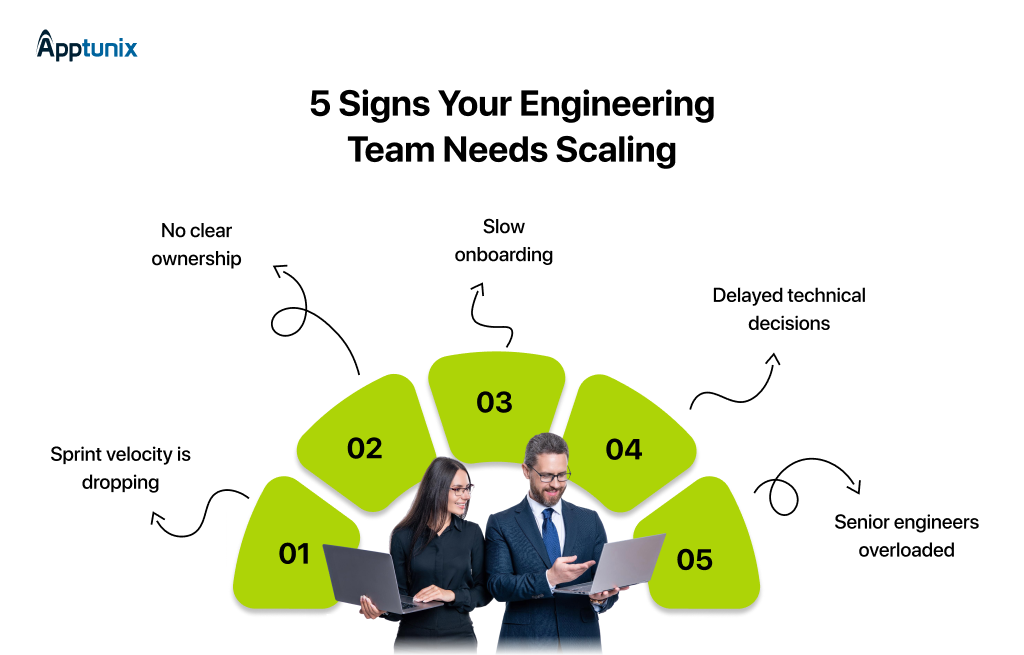
If two or more of these describe your current team, you are not approaching the need to scale. You are already overdue.
Scaling without a foundation is how startups end up with 15-person teams delivering less than their 5-person team used to. Before adding headcount, make sure you have:
These are not nice-to-haves before scaling. They are prerequisites, as without them, every new hire makes your existing problems louder, not quieter.
This is the framework we have built and refined across 1000+ app launches. It is not borrowed from a textbook, but it is what we actually do, and what we have seen repeatedly working across different industries, team sizes, and growth stages.
Every scaling engagement at Apptunix starts with a team audit, not a job description. We analyze where the delivery is slowing down, which work keeps getting delayed, and which responsibilities have no clear owner.
In many cases, teams assume they need more frontend developers when the real issue is missing infrastructure, testing, or release ownership. More often than not, the highest-impact hires are a QA automation engineer or someone focused on platform engineering.
The goal is simple: every new hire should remove friction, not add coordination overhead.
The curious questions that bother most founders are how to hire a dedicated software development team. One of the most overlooked challenges in scaling software engineering teams is weak internal infrastructure.
Platform engineering covers the systems engineering teams rely on every day – deployment pipelines, cloud environments, monitoring, CI/CD workflows, developer tooling, and release processes.
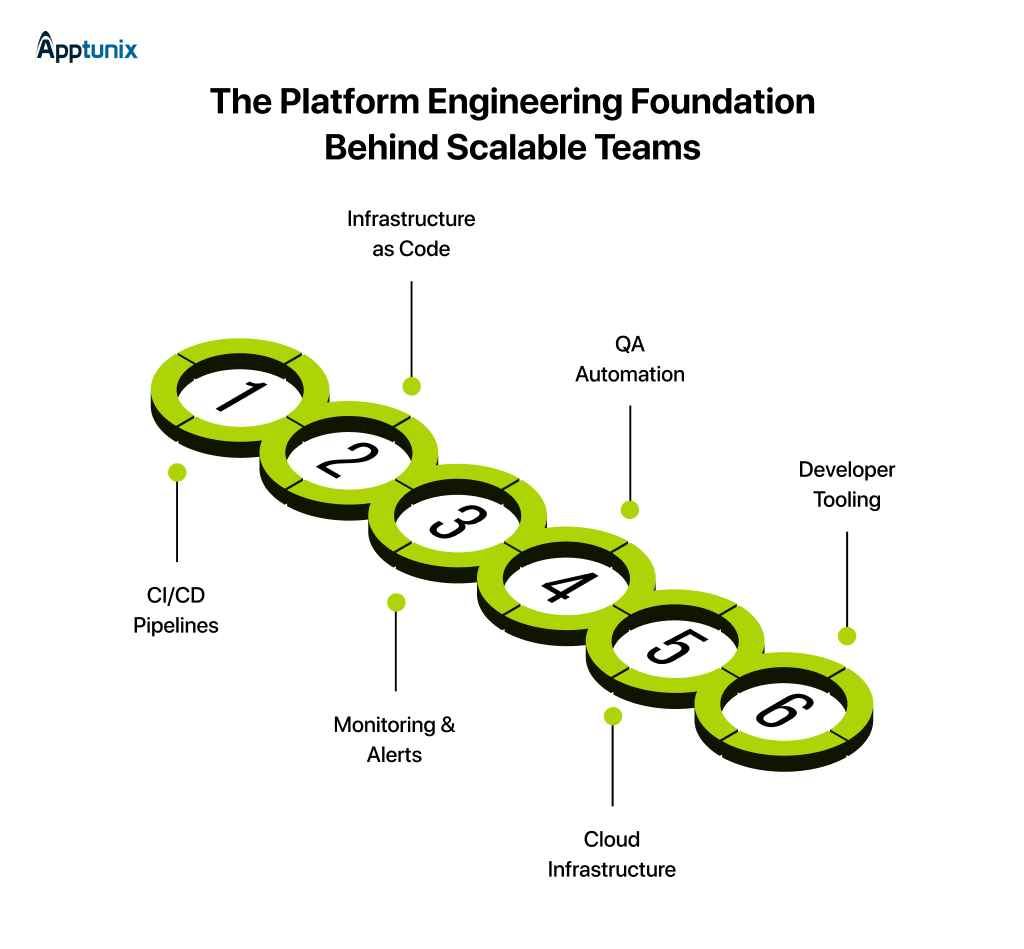
When the platform engineering foundation is strong, new engineers become productive easily. When it is weak, teams spend more time troubleshooting environments and deployments than building features.
Some platform engineering best practices we consistently follow while scaling teams:
One of our clients reduced deployment time from nearly 3 hours to under 10 minutes after investing two weeks into platform engineering before scaling headcount. Every engineer added after that benefited from the same systems.
For scaling enterprise engineering teams efficiently, a strong internal infrastructure becomes a multiplier across the entire organization.
QA automation is usually treated as something teams “fix later.” Across 1000+ launches, we’ve learned that later almost always becomes expensive.
As engineering teams grow, untested code creates release anxiety, slower deployments, and increasing regression issues. Teams lose confidence in shipping quickly because every release feels unpredictable.
That is why we recommend bringing in QA automation engineers early instead of waiting for quality issues to become visible to users.
A strong QA automation engineer does more than test features. They build confidence into the release cycle and help scale large engineering teams to maintain speed without sacrificing stability.
Our recommendation is to hire QA automation engineers by the time the team reaches 8–10 developers. The earlier testing systems are built, the easier scaling becomes later.
One of the biggest scaling engineering teams’ lessons we’ve learned is that communication eventually becomes engineering work.
Small teams rely on conversations. Scaling teams cannot.
Once teams grow across products, locations, or time zones, undocumented decisions start creating delays, duplicate discussions, and onboarding bottlenecks. This becomes one of the biggest challenges of scaling remote engineering teams.
The documentation systems that consistently make the biggest difference:
The best platform engineering teams and scaling remote engineering teams treat documentation as operational infrastructure, not optional process work.
One of the most common mistakes in how to scale engineering teams is hiring too many people too quickly.
Every new engineer adds onboarding load, review cycles, communication overhead, and coordination complexity. Teams that hire aggressively without structure often slow down before they speed up.
Instead of scaling all at once, we scale engineering teams in smaller waves:
This approach creates far more stable long-term growth and avoids the coordination issues that commonly affect scaling large engineering teams’ solution strategies.

AI scaling engineering teams is not about replacing engineers. The most effective teams use AI to reduce repetitive work around testing, reviews, onboarding, and documentation.
Some of the AI scaling engineering teams’ best practices we see working well:
Using AI-assisted code reviews to catch common issues earlier
Generating initial test coverage drafts for faster QA cycles
Creating documentation summaries from existing code and comments
Helping new engineers navigate large codebases faster
The important thing is that AI in product development amplifies existing systems. Teams with strong platform engineering, reliable QA automation, and clear documentation benefit the most from it.
Understanding the challenges is half the battle. Here are four challenges we encounter most consistently, and what works to address them.
More engineers should mean faster output, right? But in practice, it often means the opposite – at least initially.
This happens as every new person adds communication overhead. More reviews, more standups, more context required before decisions are made. If your processes do not scale with your headcount, the team’s energy goes into coordination instead of shipping.
How to fix it
Small things figure out things quickly, as everyone knows what everyone else is doing. It works well when you are a team of 5. But once you cross 15 people, this informal way of working breaks down. As nobody is sure who owns what responsibility, sometimes the same decisions get made twice.
Your most experienced engineers become the go-to person for everything, which means they are always busy, and everyone else is waiting.
How to fix it
Here’s a simple guide to how we structure engineering teams at different sizes:
The standard playbook – post a job, interview, offer, and stop working as you scale. The best engineers have options, and they are not sitting on LinkedIn waiting for your job ad.
How to fix it
As teams grow, the gap between what engineering is building and what the business expects tends to widen.
The product defines features that engineering says will take three times as long. Sales makes promises to clients based on a roadmap that engineering never agreed to. Leadership changes priorities without understanding the technical cost. Here, nobody is exactly wrong, but everyone ends up frustrated.
How to fix it:
Sometimes you do not have six months to scale carefully. You have a launch deadline, a fundraising closing, or a competitor moving faster. Here is how we help clients scale quickly without the usual damage.
When speed is the constraint, waiting 3 to 4 months for a full-time hire to start is not an option. Bringing in experienced engineers from a development partner like Apptunix compresses this timeline significantly.
The difference from standard contractor hiring is how the engagement works. As there are multiple benefits of IT staff augmentation services, our engineers join your sprint cycles, your communication channels, and your codebase from day one. They are expected to contribute meaningful work in their first week, not spend two months onboarding.
When scaling quickly, most teams hire for what feels urgent rather than what is actually slowing them down. They bring in more frontend engineers when the real problem is a broken QA process letting bugs into production every sprint.
Before any fast-scale engagement, we identify the single biggest constraint on the team’s output. This often surprises clients. But addressing the actual bottleneck first means every hire after it has a much bigger impact.
For companies scaling to 30 or more engineers, building a small dedicated platform engineering team of 2 or 3 people before you feel the need is one of the best investments you can make. Their job is to make every other engineer more productive through better pipelines, better tooling, and a better developer experience.
How quickly new engineers become productive is one of the biggest variables in how fast the team actually accelerates. Companies with a structured onboarding programme get new engineers contributing in 5 to 7 days. Companies without one typically take 3 to 4 weeks.
At scale, that difference compounds. If you are adding 5 engineers a month, the gap between a one-week and four-week ramp-up is equivalent to having 3 extra engineers on the team permanently.
Remote engineering teams are the norm now. The talent pool is global, the cost advantages are real, and a lot of engineers prefer working this way. But the challenges of scaling remote engineering teams are specific enough to deserve their own section.
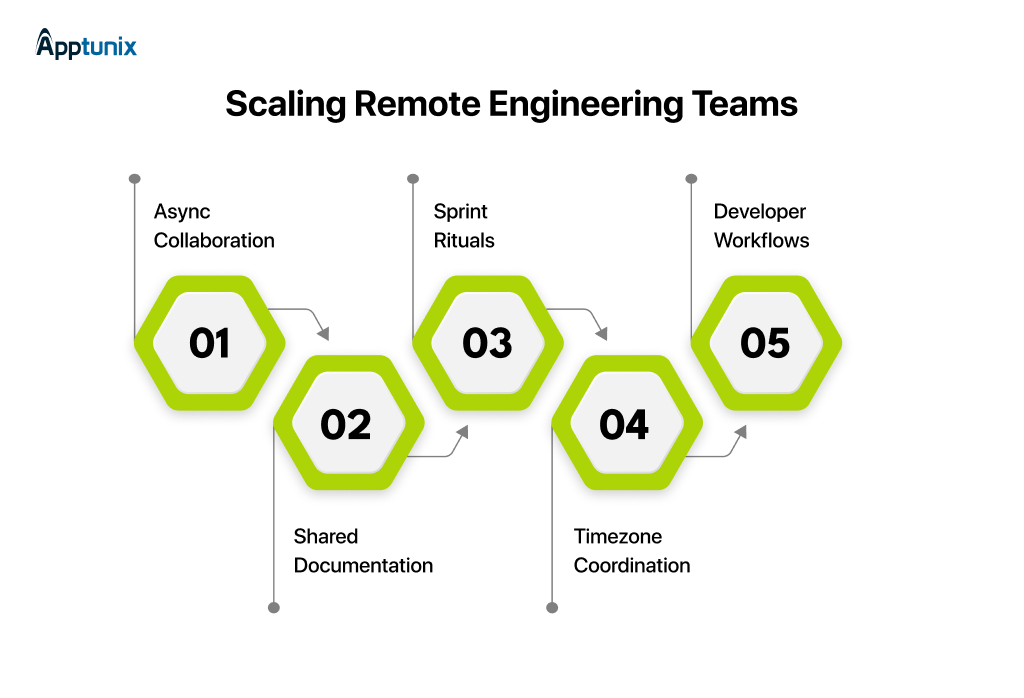
The best remote engineering teams we work with are not the ones with the best timezone overlap. They are the ones with the best documentation. When everything important is written down and accessible, the timezone matters far less.
Here is what the framework looks like in practice, drawn from the kinds of engagements we run regularly at Apptunix.
A fintech client came to us four months before a hard deadline with a 3-person team and a product that still had significant work left. Every deployment required one specific engineer and took about two hours to complete.
We spent the first two weeks on platform engineering before recommending a single new hire. We automated their deployment pipeline, set up proper test environments, and built the foundation for QA automation. Then we scaled the team from 3 to 8 with clearly defined roles.
They hit their deadline. Deployments that used to take two hours now take eight minutes. New engineers ramped up in under a week instead of the month it had previously been taking.
A health-tech company came to us with a team of 6 engineers who were moving fast but shipping broken code regularly. User complaints were rising. Production bugs were happening every week.
The problem was no QA automation at all. Every release was manually tested and incomplete by engineers who were already behind on feature work. We built their entire QA automation layer from scratch, created proper test coverage across the product over three sprints, and restructured how releases were handled.
Within six weeks, their production bug rate dropped by more than 60%. The same team was releasing more frequently and with far more confidence than before.
A B2B SaaS client came to us after two failed attempts at scaling their product. Every time new developers joined, the same problems came back. Features that had already been built were breaking. New work was conflicting with decisions made months earlier. Nobody was doing anything wrong, but they just had no shared understanding of how the product was supposed to work.
The root cause was simple. Nothing was written down. No record of how the system was structured, no explanation of why certain decisions had been made, no guide for how new work should be approached.
Before we wrote a single line of new code, we spent three weeks documenting the existing product, how it was built, why key decisions had been made, and how new features should be planned before anyone started building them.
After that, the foundation was in place, and with a clear understanding of Saas business model, the product started moving forward instead of in circles. Features stayed fixed. New work stopped undoing old work. The client finally had a codebase that a growing team could build on top of confidently.
We have spent most of this blog on what to do. Here is a concise list of what not to do, drawn directly from patterns we see repeat across clients.
->Hiring engineers before the codebase is stable
New engineers inherit whatever state the codebase is in. If it is poorly structured, they will spend their first months fighting it instead of contributing to it.
->Treating QA automation as something to add later
Later almost never comes. The teams that say they will add it when they have more time are the same ones calling us a year later with a serious quality problem.
->Promoting your best engineer into management before they are ready
Strong technical skills do not automatically translate into management ability. Doing this without genuine interest from the engineer and proper support gives you a reluctant manager and costs you a great builder.
->Scaling a remote team without documentation infrastructure
A remote engineering team cannot run on Slack threads and memory. Written documentation is not a nice habit for remote teams. It is the operating system.
->Measuring effort instead of output
More engineers in more meetings does not mean more products being shipped. Track how often you ship, how quickly you fix problems, and how long features take from idea to production.
->Skipping planning when you are under time pressure
The teams that skip written planning when deadlines are tight are the ones that end up rebuilding the same thing twice. A short plan reviewed before work starts catches more problems than weeks of unplanned development.
Every lesson in this blog came from a real product. A real deadline. A real codebase that had to keep working while the team around it grew. Not from theory but from actually being inside the build, making the technical calls, and seeing firsthand what holds up at scale and what quietly falls apart.
Across 1000+ app launches in fintech, health-tech, SaaS, and e-commerce, the same pattern shows up every time. The products that scale well are not the ones with the biggest teams. They are the ones where the right foundations were put in place early — the platform engineering layer, the QA coverage, the architecture decisions made with growth in mind, before the pressure of scaling made all of that harder to fix.
That is the work we do at Apptunix. Not just building features, but building products that are ready for what comes after launch.
When you bring Apptunix in, you are not starting from scratch with a team that needs context. You are working with people who have already built a version of this problem before and know exactly where it gets hard.

The teams that scale well are not the ones that hire the most people the fastest. But they are the ones that built the right foundation first, then the platform engineering layer, the QA coverage, the documentation, the structure, and then scale on top of it.
Every lesson came from a product we actually built. A deadline we actually had to hit. A codebase that had to keep working while everything around it grew. If your team is showing any of the signs covered here, the answer is not more engineers. It is the right foundations, built in the right order.
That is what Apptunix does. And after 1000+ launches, we know exactly where to start.
Q 1.What does scaling engineering teams mean?
It means growing your development team in a way that lets you build and ship more without things getting proportionally slower or more error-prone. People, systems, and processes all need to grow together. Adding headcount alone rarely works.
Q 2.What are the best practices for scaling engineering teams?
Audit team gaps before hiring, build your platform engineering foundation before adding headcount, bring in QA automation early, build a documentation culture, and scale in small validated steps. Companies that treat these as one connected system scale faster than those focused on headcount alone.
Q 3.How do you scale engineering teams quickly without losing quality?
Invest two to three weeks in platform engineering and QA automation before you start hiring. This means every engineer you add after can be productive almost immediately. Staff augmentation from an experienced development partner is also significantly faster than traditional hiring, because engineers can be contributing within their first week.
Q 4.What is the biggest challenge when scaling remote engineering teams?
The biggest challenge is documentation. Remote teams depend on written communication to function well, and teams without that habit find that every new hire creates a drag on senior engineers who have to transfer knowledge verbally. Treat documentation as core infrastructure and build it before you scale.
Q 5.When should a startup build a platform engineering team?
Assign a platform engineering owner before your team reaches 15 engineers. Build a small, dedicated platform engineering team before you reach 30. Waiting until after these points means your infrastructure debt is already slowing the team down, and fixing it retroactively is harder and more expensive.
Q 6.How important is a QA automation engineer when scaling?
Extremely important and almost always underestimated. A QA automation engineer builds the test coverage that lets the whole team ship confidently and quickly. Teams that bring this role in early accumulate far less technical debt and spend far less time on regressions than teams that treat QA as an afterthought.
Q 7.How do you structure engineering teams for scaling?
The structure that scales best is small, autonomous groups, each owning a defined product area with a clear lead and the ability to ship independently. Flat structures where everyone owns everything work with 5 people and break at 20. As teams grow, clear ownership, proper management layers, and a dedicated platform engineering team are what keep delivery moving.
Q 8.What role does AI play in scaling engineering teams?
AI tools are genuinely useful for scaled engineering teams — for code review, generating test coverage, drafting documentation, and helping new engineers navigate large codebases. The teams that get the most out of AI are those with strong foundations already in place. AI amplifies good processes. It does not replace the need for them.
Get the weekly updates on the newest brand stories, business models and technology right in your inbox.
Reena Bhagat, the CTO and Head of AI at Apptunix, is a seasoned technology strategist with a deep-rooted expertise in emerging technologies. With a focus on AI/ML integration, product engineering, cloud management, she leads the technical vision for high-performance SaaS infrastructures. Reena is recognized for building secure, scalable, and decentralized systems that solve real-world complexities. Her passion lies in leveraging data science and future-tech to create resilient digital products, making her a trusted authority for organizations looking to lead in the age of intelligent automation.
851 Views 17 min February 13, 2026

522 Views 17 min February 10, 2026
![How to Hire Mobile App Developers in UK: Costs, Tips & Top Agencies [2026]](https://media.apptunix.com/wp-content/uploads/sites/3/2026/02/09113338/Frame-97.jpg)
808 Views 17 min February 9, 2026
Book your consultation with us.
Book your consultation with us.


One Central, The offices 3, Level 3, DWTC, Sheikh Zayed Road, Dubai
+971 50 782 1690