10 Best Construction Project Management Software & How To Build Your Own?
47 Views 12 min August 27, 2026

Reena Bhagat, the CTO and Head of AI at Apptunix, is a seasoned technology strategist with a deep-rooted expertise in emerging technologies. With a focus on AI/ML integration, product engineering, cloud management, she leads the technical vision for high-performance SaaS infrastructures. Reena is recognized for building secure, scalable, and decentralized systems that solve real-world complexities. Her passion lies in leveraging data science and future-tech to create resilient digital products, making her a trusted authority for organizations looking to lead in the age of intelligent automation.
Ask any plant manager what keeps them up at 2 a.m. It is rarely a strategy. It is the machine that quits without warning, halting an entire line.
That single fear is why industrial IoT app development has moved from a nice-to-have to a boardroom priority. Connected machines no longer just run. They report, predict, and protect your bottom line.
This is no longer an experiment at the edges of operations. The global industrial IoT market is projected to reach roughly $ 2,430.21 billion by 2035. That scale reflects a deeper shift, where the factories pulling ahead are the ones treating their data as an asset, not as exhaust.
And that is precisely where the pressure builds. The technology is proven, the returns are documented, yet the path from idea to working application remains unclear for most leaders.
That is what this guide fixes. We will walk through how to build an industrial IoT app from the ground up, the features that actually matter, and real cost ranges for 2026.
You will also learn what separates a capable industrial IoT app development company from an expensive mistake.
Let’s start where every smart build begins.
Industrial IoT app development is the process of building software that connects machines, sensors, industrial equipment, and business systems into a single intelligent ecosystem. The software collects data in real time, analyzes it, and turns it into actionable insights.
Instead of reacting to problems after they occur, manufacturers can identify issues early, improve efficiency, and make faster decisions.
This is the foundation of modern industrial IoT software development and a key driver behind Industry 5.0 initiatives worldwide.
A simplified workflow looks like this:
For example, if a production machine starts vibrating beyond normal thresholds, the system can immediately notify maintenance teams before a costly breakdown occurs.
This is why many manufacturers invest in custom industrial IoT software development rather than relying on generic platforms. Every factory has unique workflows, machine configurations, compliance requirements, and reporting needs.
Many people use IoT and IIoT interchangeably. They are related, but they serve very different purposes.
So technology is its own thing. The bigger question is why everyone wants it right now.
Five critical pressures are forcing manufacturers to adopt industrial IoT software development now. Here’s what’s driving the rush:
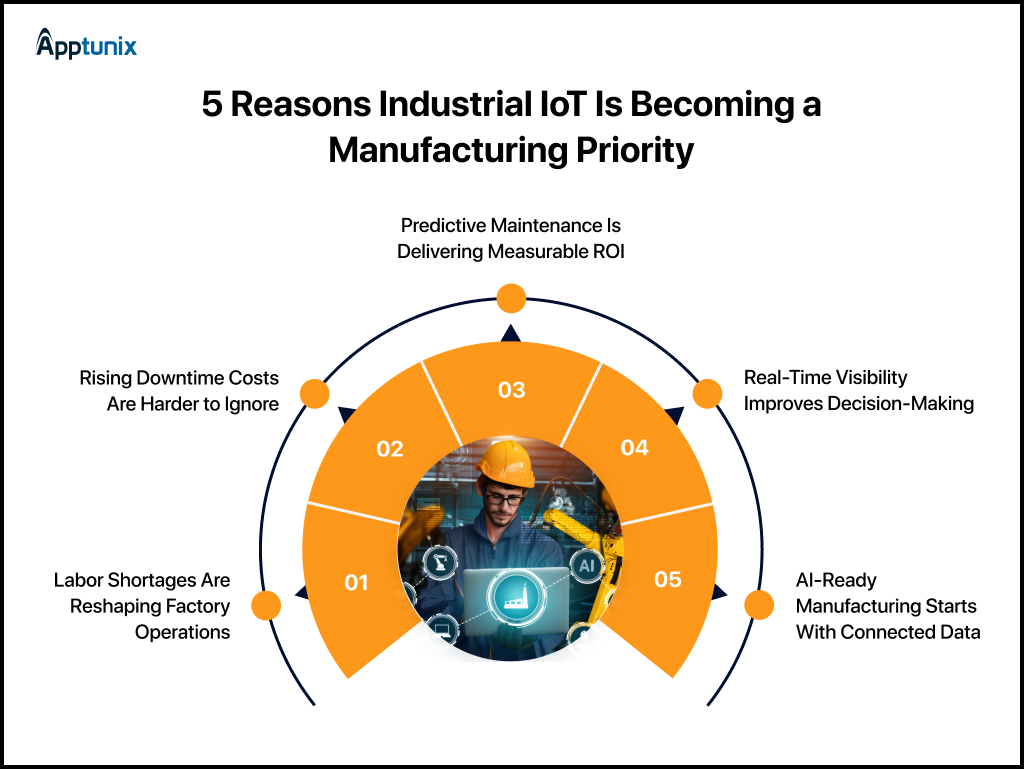
1. Labor ShortagesThe US manufacturing sector faces 2.1 million unfilled jobs by 2030. Aging workers leave while young workers don’t fill the gap. IIoT app development automates monitoring tasks, reducing dependency on manual inspections. One sensor can replace three technicians.
2. Rising Downtime CostsUnplanned downtime is one of the most expensive problems in manufacturing.
Recent industry analysis shows that unexpected equipment failures cost major global manufacturers up to $1.4 trillion annually. Every minute of downtime can affect production schedules, customer commitments, and revenue generation. Tailored factory floor software drastically reduces these losses by catching line anomalies early.
This is why businesses increasingly build industrial IoT applications that continuously monitor equipment performance.
3. Predictive MaintenanceThe global market for predictive maintenance software is scaling rapidly, expected to cross $17.11 billion. Modern industrial asset monitoring software continuously processes vibration, temperature, and pressure metrics. This lets engineering teams schedule targeted repairs long before a catastrophic mechanical failure freezes the production line.
4. Real-Time Visibility50% of manufacturers cite efficiency and productivity improvements as their primary IoT investment driver. Without real-time data, you’re guessing. Industrial IoT application development gives you live dashboards showing OEE, machine health, and production bottlenecks instantly.
5. AI-Ready ManufacturingAI-powered industrial IoT and AI in manufacturing software are the fastest-growing segments. 54% use IoT for quality inspection with 97.2% defect detection accuracy. Edge computing in manufacturing enables real-time AI decisions without cloud latency.
Knowing the financial return makes an investment logical. Transforming that logic into a physical software platform requires a strict execution blueprint.
A successful Industrial IoT solution is never built by simply connecting sensors to machines.
Many projects fail because businesses jump into development without understanding operational requirements or infrastructure limitations. The most successful industrial IoT app development projects follow a structured process that ensures measurable business outcomes.
If you’re planning to invest in industrial IoT software development, here’s how the process typically unfolds.
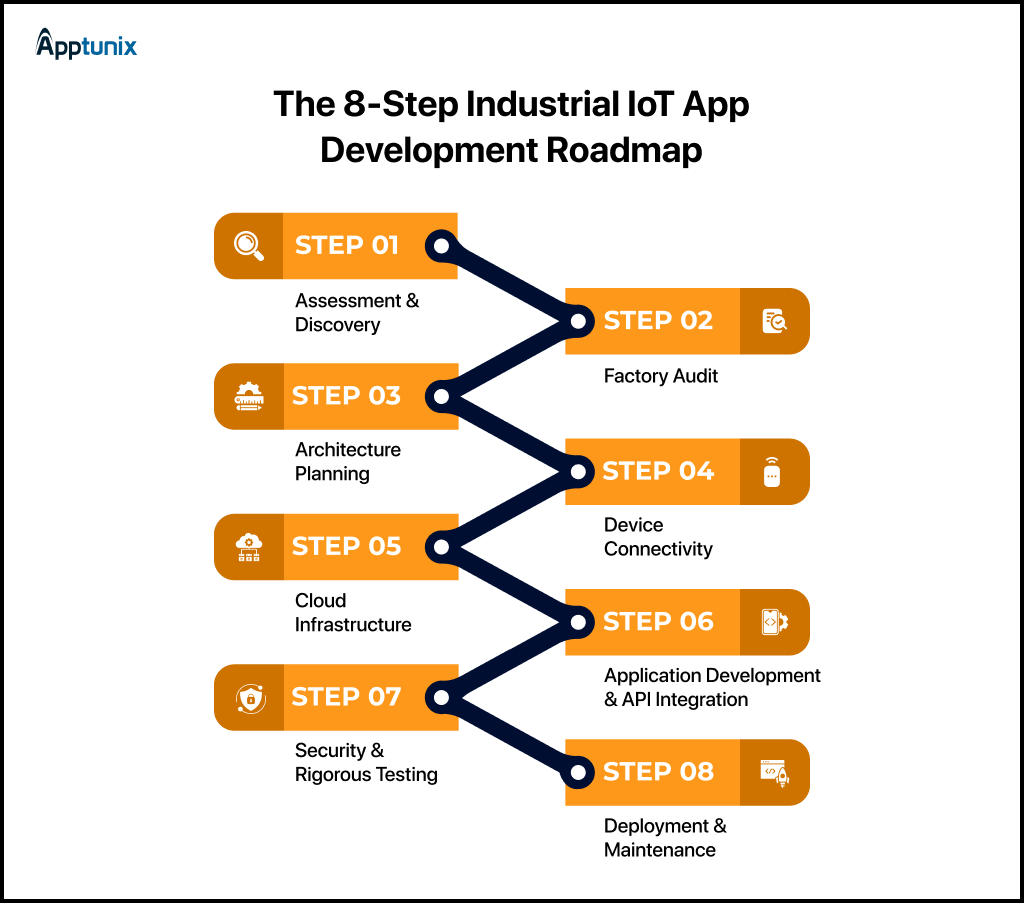
Step 1: Assessment & DiscoveryEvery successful project starts with asking the right questions.
Before writing a single line of code, stakeholders must identify:
For example, are you trying to reduce downtime? Improve production visibility? Monitor equipment remotely?
The answers shape every decision that follows. Skipping this stage often results in collecting large amounts of data without a clear business purpose.
Step 2: Factory AuditNo two manufacturing environments are identical. A detailed factory audit maps out what already exists on your shop floor. Many facilities operate equipment from multiple generations. Some machines support modern connectivity, while older units require retrofitting with external sensors. Identifying these hardware realities early prevents costly integration surprises later.
Step 3: Architecture PlanningOnce requirements are clear, the technical foundation can be designed.
This stage defines how data will move across the entire Industrial IoT ecosystem.
Key decisions include:
A well-designed architecture ensures the solution can support future growth without requiring a complete rebuild. This is particularly important for organizations pursuing long-term Industry 5.0 software development initiatives.
Step 4: Device ConnectivityThis is where physical machinery and digital networks finally meet. Sensors, industrial equipment, gateways, and controllers are integrated into a unified ecosystem.
Common frameworks include MQTT, OPC UA, and Modbus. Reliable data transmission is critical here. If devices transmit inaccurate telemetry, every downstream analytics report becomes useless.
Step 5: Cloud InfrastructureOnce machine data flows, it needs a secure environment for processing. Robust cloud infrastructure provides the backbone for real-time production monitoring software.
However, cloud storage alone is not enough. Leveraging edge computing in manufacturing handles time-sensitive alerts locally. This smart balance improves system performance while reducing data latency.
Step 6: Application Development & API IntegrationNow the actual industrial IoT software development takes physical shape. This phase transforms raw machine data into actionable insights.
A typical IIoT app development project includes:
At the same time, APIs connect the solution with existing enterprise systems such as:
This integration eliminates data silos and creates a connected digital ecosystem.
For organizations pursuing custom industrial IoT software development, this stage ensures workflows align perfectly with operational needs.
Step 7: Security & Rigorous TestingBefore going live, every single component undergoes exhaustive performance and load testing.
Security requires absolute, zero-compromise validation. Industrial networks are frequent targets for cyber threats. A rigid testing phase catches critical vulnerabilities before they ever touch live production lines.
Step 8: Freemium Models: Deployment & MaintenanceFinal deployment is not the finish line. Once live, engineers monitor system performance and deploy regular software patches. Device lifecycles must be managed actively. As your operational needs evolve, this scalable platform can expand to support additional manufacturing facilities.
A solid process gets you a working app. The right features of an industrial IoT app decide whether anyone actually uses it.
An enterprise-grade industrial IoT application requires specialized features built for high-stress manufacturing environments. Standard software components will fail under industrial workloads.
Here are the twelve non-negotiable capabilities your custom system must include.
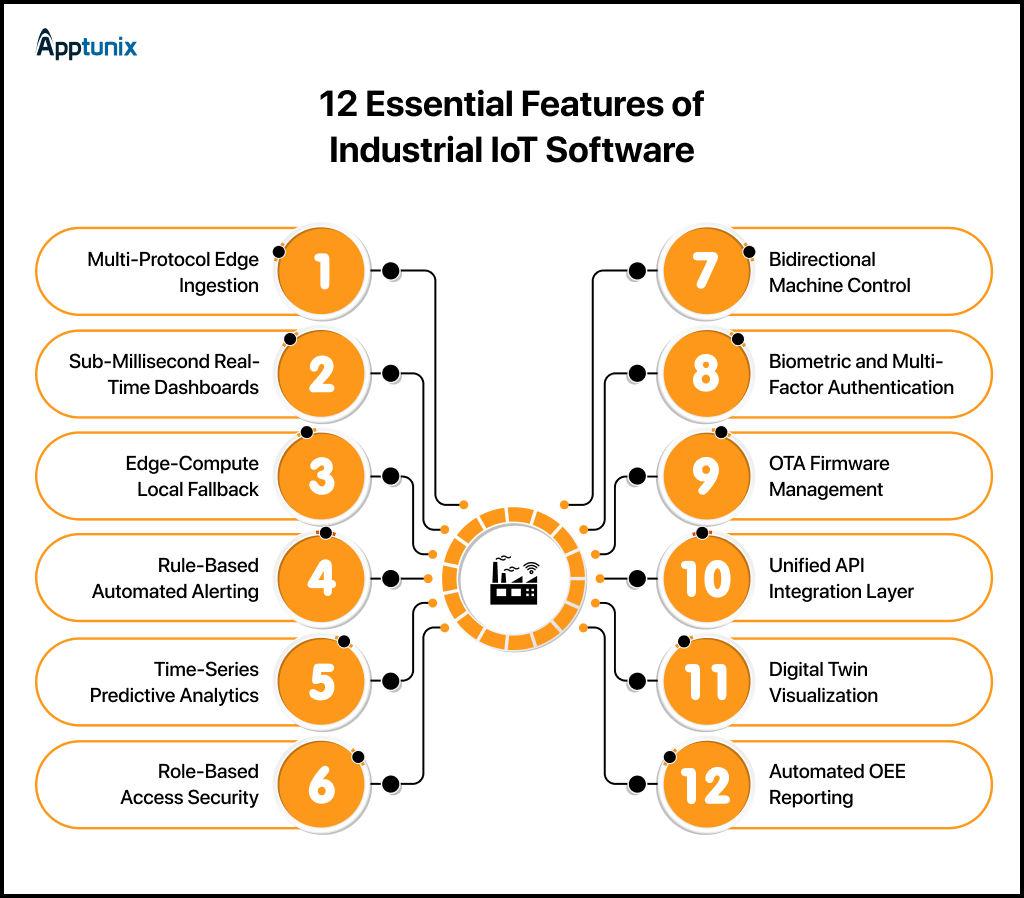
1. Multi-Protocol Edge IngestionFactory floors run on conflicting legacy machinery protocols. The software must ingest Modbus, Profinet, and OPC UA data streams seamlessly. It normalizes this raw telemetry at the edge instantly.
2. Sub-Millisecond Real-Time DashboardsOperators require immediate operational visibility. This feature updates line metrics in less than a second. It eliminates data lag so teams can spot production bottlenecks instantly.
3. Edge-Compute Local FallbackNetwork connections drop unpredictably on factory floors. Local edge computing ensures data collection and critical alerts keep running. The system syncs with the cloud automatically when the connection returns.
4. Rule-Based Automated AlertingMachine anomalies require instant operational intervention. The software monitors sensor thresholds continuously. It dispatches SMS or mobile push notifications directly to floor mechanics when variations occur.
5. Time-Series Predictive AnalyticsIndustrial machinery creates massive volumes of sequential data. Specialized time-series engines store millions of data points smoothly. Machine learning models analyze these trends to predict physical parts degradation.
6. Role-Based Access SecurityIndustrial environments demand strict data protection protocols. Role-based access control ensures users only view data and functions relevant to their responsibilities. This strengthens security, improves compliance, and minimizes the risk of unauthorized access to sensitive operational systems.
7. Bidirectional Machine ControlTrue industrial automation software does more than read data. It securely transmits optimization commands back to PLCs. This enables remote calibration adjustments without physical operator intervention.
8. Biometric and Multi-Factor AuthenticationCyber threats target critical manufacturing infrastructure frequently. The app requires biometric verification or hardware tokens for access. This strict layer prevents unauthorized changes to machinery configurations.
9. OTA Firmware ManagementDeploying software updates manually across thousands of shop floor sensors is impossible. This feature pushes secure over-the-air firmware upgrades simultaneously. It ensures continuous protection without production downtime.
10. Unified API Integration LayerData must move freely across enterprise tech stacks. Built-in RESTful or GraphQL APIs link your IoT platform directly. This connects real-time floor data into existing ERP and MES networks.
11. Digital Twin VisualizationDigital twin software development enables manufacturers to create virtual replicas of physical assets, machines, or production lines. These digital models help simulate performance, test operational changes, identify inefficiencies, and evaluate potential outcomes. It maps real-time telemetry onto 3D machine schematics.
12. Automated OEE ReportingCalculating Overall Equipment Effectiveness manually takes hours. The application tracks availability, performance, and quality automatically. It generates clean compliance and productivity reports for executive review.
Features look good on a slide. Here’s what they look like running on a real factory floor.
Deploying custom industrial IoT solutions is no longer a speculative technology play. Across diverse vertical markets, enterprise leaders use target-built frameworks to secure macro efficiency gains.
Here are some of the most impactful industry applications driving Industrial IoT adoption in 2026.
Manufacturing remains the largest adopter of industrial IoT application development solutions. Many factories now use predictive maintenance using IoT to identify potential equipment failures before they impact production. Combined with automated quality control and energy monitoring, Industrial IoT helps improve throughput, reduce waste, and support broader Industry 5.0 software development initiatives.
Automotive manufacturers operate highly automated production environments where efficiency and precision are critical. Industrial IoT platforms enable real-time monitoring of assembly lines, robotic systems, and production equipment.
Companies such as BMW and Mercedes-Benz have expanded smart factory initiatives to improve production visibility and reduce operational disruptions. Through IIoT app development, automotive manufacturers gain better process control, and improved production planning across facilities.
The oil and gas sector relies heavily on remote asset monitoring and operational safety. Industrial IoT solutions help organizations monitor pipelines, drilling equipment, storage facilities, and field operations in real time. Sensors continuously track pressure, temperature, and equipment conditions to prevent failures and improve compliance.
Many companies investing in custom industrial IoT software development use connected systems to reduce downtime. And it also assists in improving asset reliability across geographically distributed operations.
Mining companies use industrial IoT solutions to improve safety and asset utilization.
Connected sensors track equipment health, environmental conditions, and worker safety metrics in real time. Predictive maintenance programs help reduce unplanned equipment failures, while remote monitoring minimizes operational risks in hazardous environments.
Supply chain efficiency increasingly depends on real-time data. Industrial IoT enables organizations to track inventory, monitor warehouse conditions, manage fleet operations, and improve shipment visibility. Connected devices provide continuous updates on asset locations and inventory movement. These capabilities make industrial IoT software development an important investment for modern logistics ecosystems.
Pharmaceutical manufacturers operate under strict quality and regulatory requirements. Industrial IoT systems help monitor production environments, equipment performance, storage conditions, and product quality throughout the manufacturing process. Continuous monitoring helps ensure regulatory compliance while reducing the risk of product contamination or quality failures.
Food processing companies use Industrial IoT to maintain product quality, improve traceability, and monitor critical production conditions. Industrial IoT applications also help identify contamination risks and support food safety compliance. As demand for transparency grows, many organizations are investing in industrial IoT app development solutions. To improve operational visibility and strengthen quality assurance processes across the supply chain.
Seeing these systems active in modern facilities sparks innovation. Bringing these use cases to life requires a robust modern technology stack.
A successful Industrial IoT platform is much more than a dashboard connected to sensors.
Behind every smart factory application is a carefully selected technology stack that enables devices to communicate and insights to be generated in real time.
The table below highlights the core technologies commonly used to develop industrial IoT apps:
Choosing the correct technical stack minimizes system lag. Next, we must evaluate the industrial IoT app development cost in 2026.
Building an Industrial IoT platform involves far more than connecting machines and collecting data. The architecture, integrations, security framework, analytics capabilities, and long-term scalability all influence the investment required.
This naturally leads to the next question:
What budget should manufacturers plan for when investing in Industrial IoT software?
The answer depends on the scope of the solution, the number of connected assets, integration requirements, and the level of intelligence built into the platform.
For example, a production monitoring solution for a single facility requires a very different investment than a multi-plant ecosystem powered by predictive analytics, digital twins, and AI-driven automation.
In 2026, most Industrial IoT initiatives fall between $50,000 and $500,000+, with costs increasing as complexity, connectivity, and business requirements grow.
Understanding where your project falls within that range starts with understanding the scope of the implementation.
While project scope matters, several technical and business factors ultimately determine the cost to develop industrial IoT software. These five parameters directly dictate your total industrial IoT app development cost. Come check!
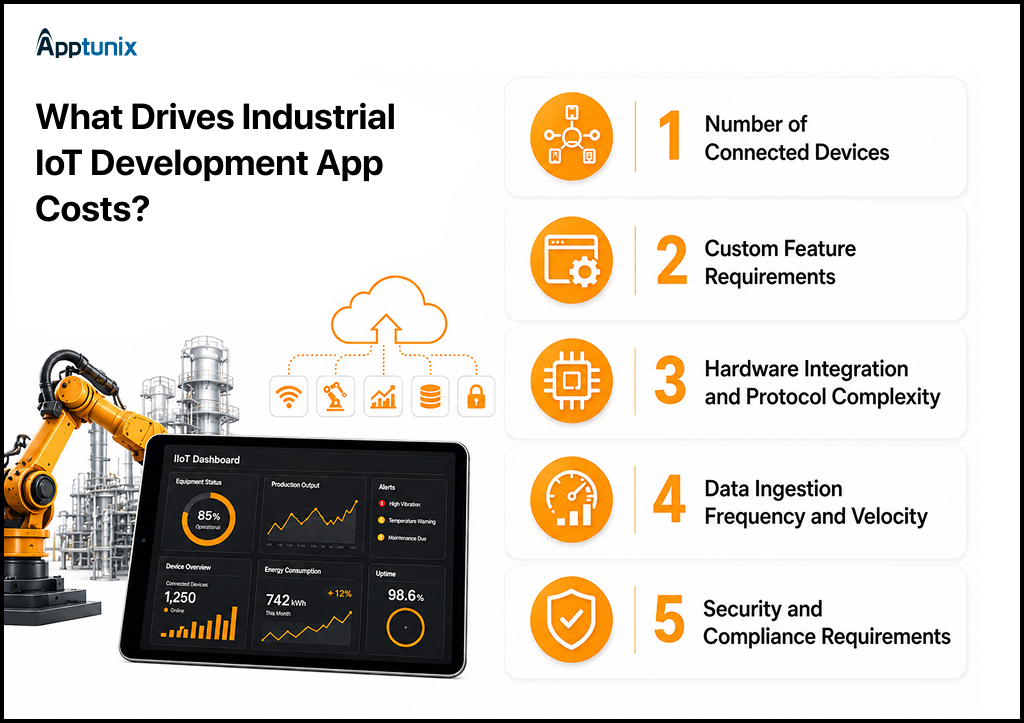
1. Number of Connected DevicesThe more machines, sensors, and gateways involved, the more effort is required for integration, device management, and ongoing monitoring. A deployment connecting 50 assets differs significantly from one managing thousands of industrial devices.
2. Custom Feature RequirementsFeatures such as real-time production monitoring, predictive maintenance using IoT, and AI-driven analytics increase development effort. More advanced functionality requires additional engineering, testing, and infrastructure resources.
3. Hardware Integration and Protocol ComplexityConnecting modern machinery with built-in protocols is fast and highly cost-effective. However, old legacy systems require custom hardware retrofitting. Normalizing diverse data streams across mismatched machine generations increases your final industrial IoT software development budget significantly.
4. Data Ingestion Frequency and VelocityA platform tracking machine metrics hourly uses minimal network bandwidth. Conversely, high-frequency predictive maintenance models process thousands of vibrations every second. Capturing massive real-time streams requires specialized time-series infrastructure, driving up cloud and storage costs.
5. Security and Compliance RequirementsStandard web software uses basic user login forms. Industrial automation platforms require zero-compromise end-to-end data encryption, unique device certificates, and strict access rules. Implementing rigorous enterprise security protocols naturally extends the engineering timeline and development costs.
Industrial IoT projects look straightforward on paper. You connect machines, collect data, and generate insights. In reality, the journey is much more complex. Manufacturers face legacy equipment, disconnected systems, and security concerns. There is growing pressure to improve efficiency without disrupting production.
The real challenge is not collecting more data. It is turning that data into meaningful business outcomes. This is where the right technology partner makes a difference.
At Apptunix, our industrial IoT app development services focus on real operational challenges. We help businesses create connected ecosystems. Our platforms bring machines, people, and processes together seamlessly.
We build every solution to support your measurable goals. This includes production monitoring, predictive maintenance, and enterprise integrations.
Our teams work closely with your stakeholders. We understand your existing workflows, identify bottlenecks, and design highly scalable architectures. These systems evolve easily as your business needs change over time.
You might be exploring your first Industrial IoT initiative. You could also be expanding an existing Industry 5.0 strategy. Either way, our core focus remains exactly the same. We build future-ready solutions that deliver long-term value.
Q 1.How much does industrial IoT app development cost in 2026?
Most projects fall between $50,000 and $500,000+. A single-facility monitoring app typically runs $50,000 to $100,000, while a multi-plant deployment with digital twins and industrial AI can exceed $500,000. Final cost depends on device count, custom features, hardware complexity, data velocity, and security requirements.
Q 2.How long does it take to build an industrial IoT app?
A single-facility solution usually takes 3 to 5 months. Predictive maintenance with ERP integration runs 6 to 9 months, and a multi-plant, AI-driven rollout can take 9 to 15+ months.
Q 3.What is the difference between IoT and Industrial IoT (IIoT)?
IoT focuses on consumer devices such as smart watches, smart homes, and connected appliances. Industrial IoT (IIoT) is designed for industrial environments like factories, warehouses, and production facilities. The biggest difference is reliability. While a smart home device failure may be inconvenient, an IIoT system failure can impact production, safety, and revenue.
Q 4.How does an IoT application help reduce manufacturing downtime?
An IoT application continuously monitors machines, sensors, and production equipment in real time. It can detect unusual behavior, performance issues, or early signs of failure before a breakdown occurs. This allows maintenance teams to take action proactively, reducing unexpected downtime, preventing costly disruptions, and improving overall equipment reliability.
Q 5.Is custom industrial IoT software better than an off-the-shelf platform?
Custom development is preferred when a factory has unique workflows, mixed machine generations, specific compliance needs, or deep ERP/MES integration requirements that generic platforms cannot meet.
Q 6.What are the hidden ongoing maintenance and cloud scaling costs of an IoT application?
Beyond initial development, businesses should plan for ongoing costs such as:
Q 7.What are the biggest challenges in Industrial IoT implementation, and how can businesses overcome them?
The most common Industrial IoT challenges include legacy system integration, cybersecurity risks, data management, scalability, and user adoption. Businesses can overcome these issues by starting with a clear roadmap, choosing scalable technologies, prioritizing security from day one, and working with experienced Industrial IoT development partners.
Q 8.How do I choose the right Industrial IoT app development company for my project?
Choose an Industrial IoT development partner that:
(3 ratings, average: 5.00 out of 5)
Get the weekly updates on the newest brand stories, business models and technology right in your inbox.
Reena Bhagat, the CTO and Head of AI at Apptunix, is a seasoned technology strategist with a deep-rooted expertise in emerging technologies. With a focus on AI/ML integration, product engineering, cloud management, she leads the technical vision for high-performance SaaS infrastructures. Reena is recognized for building secure, scalable, and decentralized systems that solve real-world complexities. Her passion lies in leveraging data science and future-tech to create resilient digital products, making her a trusted authority for organizations looking to lead in the age of intelligent automation.
47 Views 12 min August 27, 2026
195 Views 12 min June 24, 2026

214 Views 12 min June 22, 2026
Book your consultation with us.
Book your consultation with us.


One Central, The offices 3, Level 3, DWTC, Sheikh Zayed Road, Dubai
+971 50 782 1690