Smart City App Development: Connecting Citizens, Infrastructure, and Data
26 Views 10 min July 24, 2026
Reena Bhagat, the CTO and Head of AI at Apptunix, is a seasoned technology strategist with a deep-rooted expertise in emerging technologies. With a focus on AI/ML integration, product engineering, cloud management, she leads the technical vision for high-performance SaaS infrastructures. Reena is recognized for building secure, scalable, and decentralized systems that solve real-world complexities. Her passion lies in leveraging data science and future-tech to create resilient digital products, making her a trusted authority for organizations looking to lead in the age of intelligent automation.
In 1999, Kevin Ashton coined the term “Internet of Things” (IoT); however, businesses started adopting it in the mid-2010s. From a simple idea to connecting everyday devices to make life smarter and more convenient, this is how IoT comes into the market.
Refers to a network of connected devices like wearables, industrial sensors, thermostats, etc., IoT exchanges data in real-time, making smart objects.
To provide a convenient user experience to users, businesses across industries like manufacturing, healthcare, logistics, retail, etc., started investing in IoT app development services worldwide.
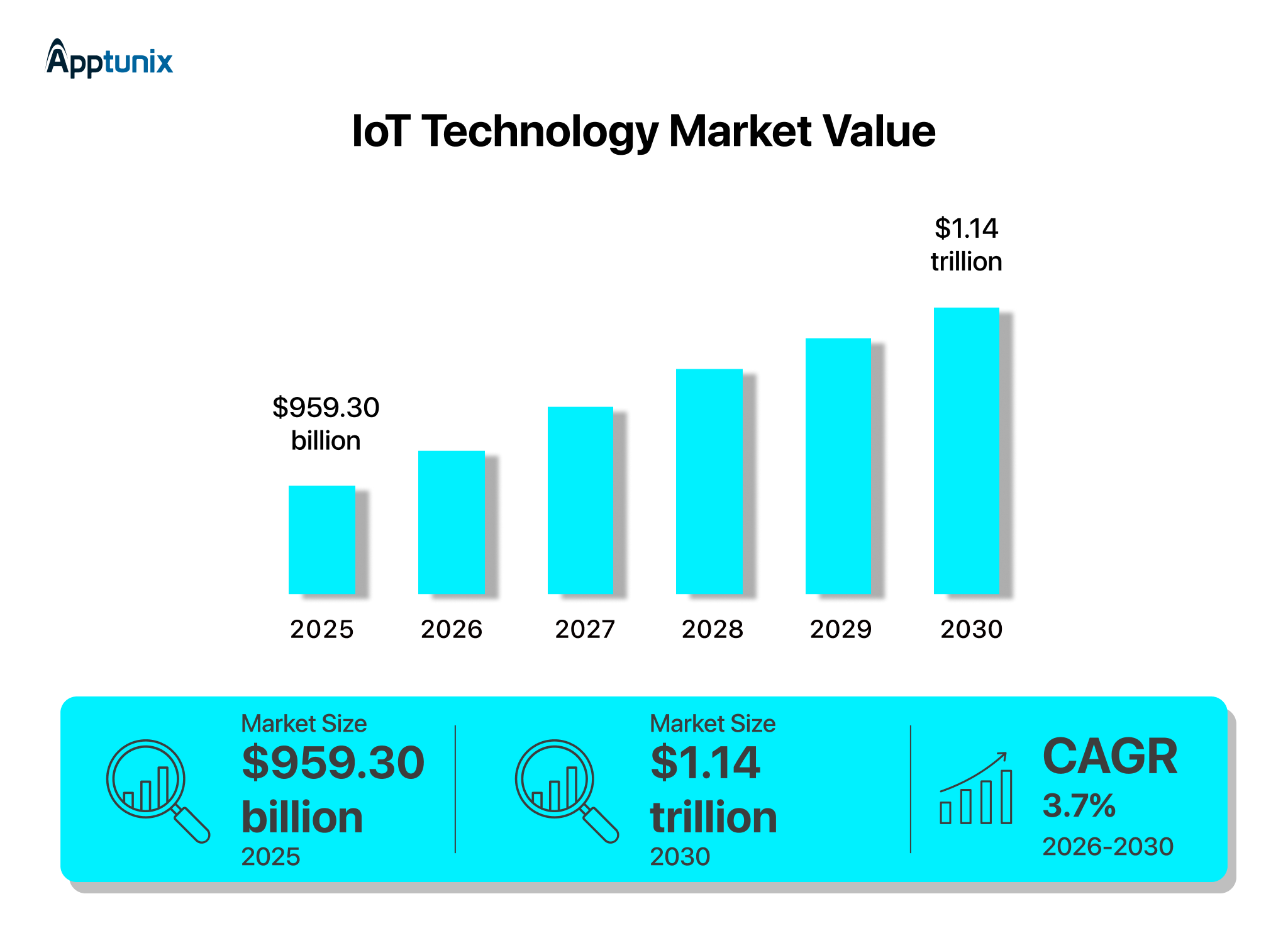
This leads the IoT technology market to reach a market size of $1.14 trillion by 2030, with a CAGR of 3.7% between 2026 and 2030.
But the main question is, how much does IoT app development cost in 2026? Well, it depends on features, complexity, integrations, and other factors.
In this detailed guide, we break down everything you need to know about the cost to develop an IoT app and plan your budget effectively.
Let’s get started by having a clear understanding of IoT apps first!
It’s the process of designing, developing, and deploying digital systems that connect physical devices like sensors, wearables, machines, etc., to the cloud, allowing them to gather, exchange, and act on data.
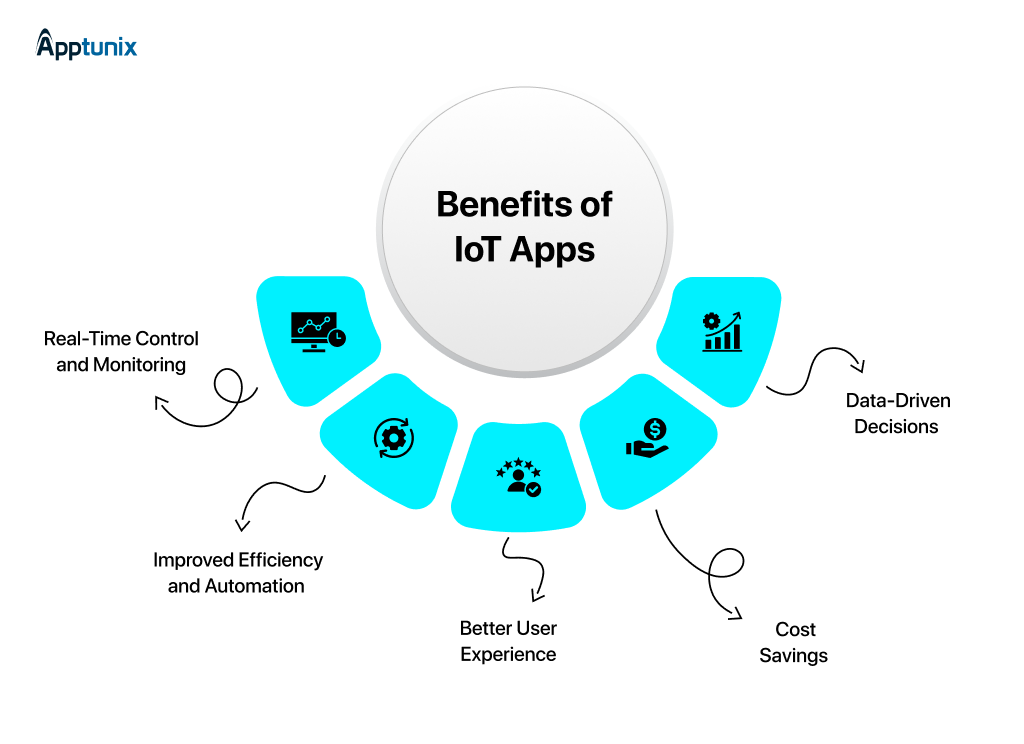
In other words, IoT connects smart devices like sensors to the internet. IoT-integrated solutions collect, monitor, and manage real-time data and allow users and businesses to control devices remotely and make smarter data-driven decisions.
IoT apps offer numerous benefits to users and businesses across industries, which include
As of 2026, the cost to develop an IoT app ranges between $20,000 and $160,000 based on app complexity, feature integration, and timeline.
For basic IoT app development, you may invest $20,000 and $30,000 only because such application types contain core or basic features. Such solutions are designed to solve a specific problem with minimal functionality, serving as an MVP.
MVP stands for minimum viable product, which is made with just enough features to satisfy early users and validate the product idea with less effort. It helps businesses to
The biggest examples of MVP are Amazon and Airbnb. They also started as an MVP and later scaled the application by integrating advanced features and technologies as the business started experiencing growth.
On the other hand, mid-level applications are built with all core features but also include some advanced features that offer a more engaging user experience and higher interactivity. This caters to a broader audience. The cost to build a mid-level IoT app ranges from $30,000 to $60,000 in 2026.
However, an advanced IoT app development cost can go up to $160,000 or even more. An advanced/complex app requires high-end performance, robust security, and advanced functionality that can generally be used by enterprises or large businesses.
An advanced IoT app includes features such as
Analyze the table to get clarity on the development cost:
The cost to build an IoT app directly depends on the development timeline. This means the more time developers take to integrate the features and functionalities, the better the quality but the higher the price, unlike an app with a shorter timeline but limited scalability and growth.
Example: A complex app takes 8-9 months to build but gives high performance.
You have three choices to build an IoT-powered app: either hire freelance developers or partner with mid-level or top-tier agencies. The costs of hiring them are different. Hiring a freelancer is more affordable than hiring an IoT app development company. Examine the table to understand the cost differences:
The IoT mobile app development cost estimate is different for different regions. For example, hiring developers to build an IoT app in the USA is more expensive than developing the same level of application in the Middle East and South Asian countries like India. Analyze the table to discover the region-wise IoT software development cost:
The cost to hire IoT app developers depends on their experience and expertise level. A junior app developer with less experience and expertise demands less money than a senior developer with years of experience and high expertise. Analyze the table below to understand hourly rates of hiring IoT experts:
Now, you understand the cost, but what factors really influence the cost? Well, let’s find this in the next section.
Custom IoT app development pricing varies based on several aspects, such as the complexity of the app, features, integrations, and so on. Before investing, you have to understand every single factor to ensure the estimated project cost is correct. The top 10 IoT development pricing factors include:
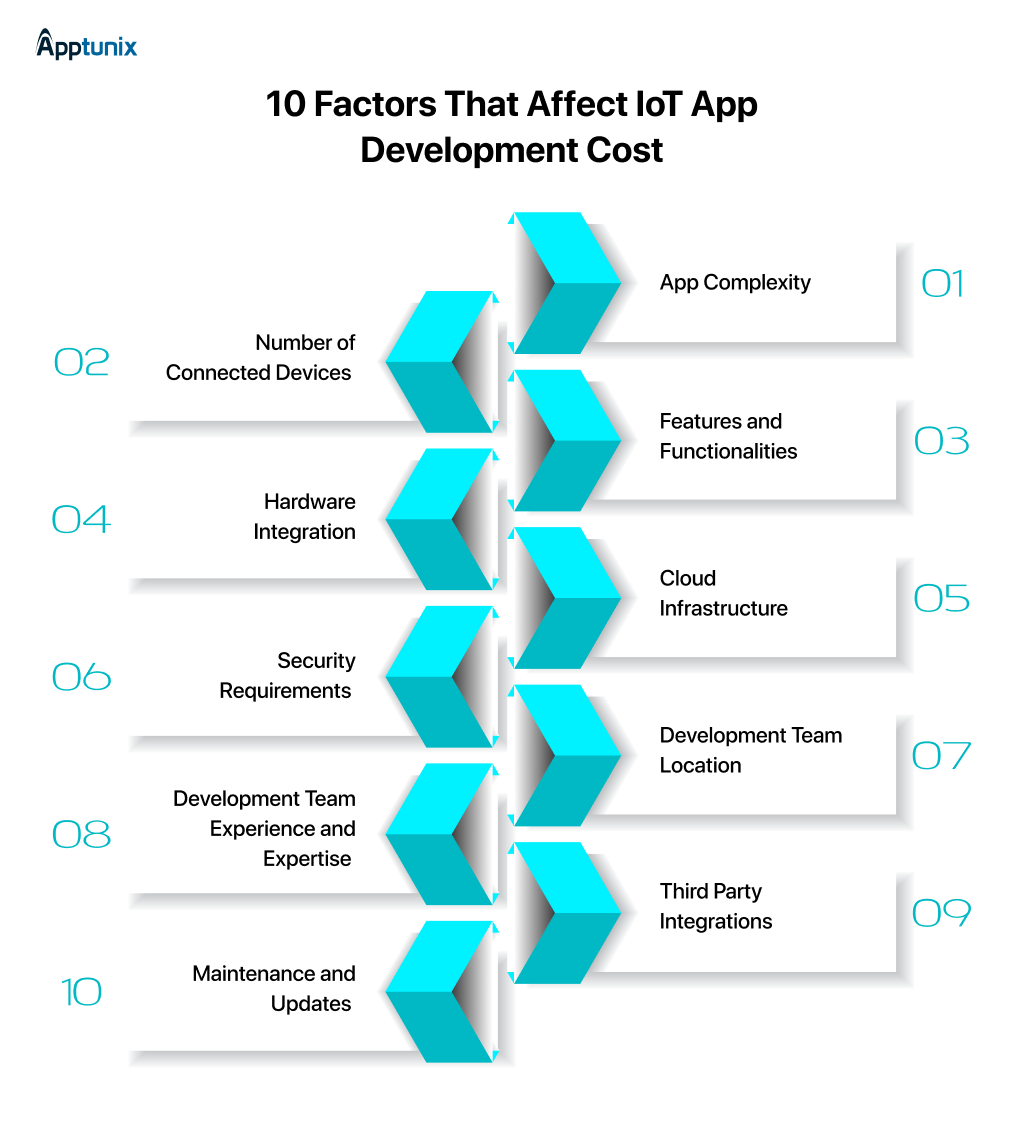
1:App ComplexityThe app complexity is the core factor influencing development time and cost. Simple applications that come with dashboards are cheaper, whereas advanced applications that involve automation, AI, and other related technologies demand expertise and time, which can make the project very expensive.
2:Number of Connected DevicesThe more devices that are connected to your IoT application, the higher the cost that will be incurred since every device needs to be integrated, tested, and data handled. This demands more development time and effort, increasing overall development cost.
3:Features and FunctionalitiesThe complexity of the features influences the cost. For example, adding future-ready features like real-time tracking, advanced analytics, and automation increases cost. The more features your IoT app has, the more development time, testing, and resources it requires.
4:Hardware IntegrationIoT is connected to hardware (sensors and smart devices), which brings up more cost. The smooth integration between software and hardware demands additional efforts and time in development, testing, and maintenance.
5:Cloud InfrastructureIntegrating cloud services is crucial for storing and processing IoT data. Offshore IoT app development cost depends on data volume, server usage, and real-time processing needs. The higher the scalability and performance requirements, the more cloud expenses the app requires.
6:Security RequirementsSecurity is to be integrated to handle IoT apps’ sensitive data. To achieve that, developers implement encryption, APIs, and authentication systems that require additional effort and expertise, increasing overall app development costs.
7:Development Team LocationThe app development team’s location also impacts the cost. For example, hiring app developers in the USA or Western European countries like the UK charges higher rates. On the other hand, regions like India offer cost-effective solutions without sacrificing quality.
8:Development Team Experience and ExpertiseApp developers’ expertise and experience heavily affect the pricing. A highly professional expert demands more money but delivers faster and higher-quality results, which saves money in the long run by reducing technical debt, rework, and bug fixes.
9:Third-Party IntegrationsThird-party integrations like payment gateways, APIs, or analytics tools influence the cost to develop an IoT app. Every single integration requires setup, testing, and licensing fees that increase development time and expenses.
10:Maintenance and UpdatesThe cost is also influenced by post-launch support and maintenance, such as bug fixes and performance optimization. Since IoT apps have to be monitored and upgraded to remain secure and functional, maintenance is considered as a major factor influencing the cost of developing IoT apps.
From manufacturing to healthcare, IoT apps can be developed for multiple industries to enhance business efficiency. However, each industry requires different requirements, complexity levels, features, or integration, leading to different pricing.
Examine the table to understand industries that build IoT apps, along with cost and key use cases:
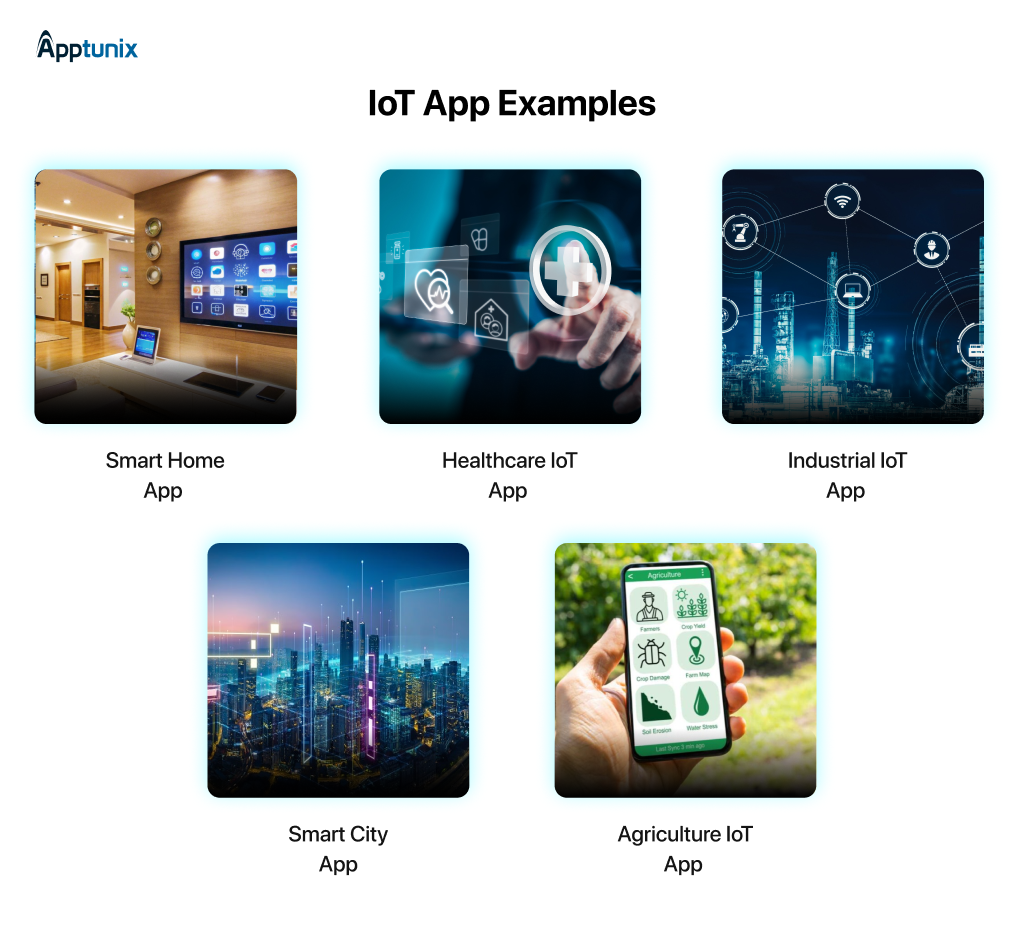
The real estate or property management industry builds smart home apps to allow users to remotely control connected devices like
Smart home app development requires less complexity but demands device integration and real-time responsiveness.
The healthcare industry also builds IoT apps to connect wearable devices to monitor health metrics, which include
Apart from that, these apps require strong security due to sensitive data and compliance requirements.
From manufacturing to logistics, industries develop IoT apps for monitoring, automation, and predictive maintenance. They also require
IoT apps handle large-scale data and require high scalability, which makes such solutions more complex or expensive.
Smart city apps manage infrastructure, which includes
Such digital solutions contain multiple integrations and large datasets, increasing development complexity and expense.
Entrepreneurs who run agriculture businesses also build IoT apps that help farmers monitor
Agriculture IoT apps provide automation and real-time insights, offering moderate complexity and cost compared to other industries.
Multiple features of an IoT app enable device connectivity, real-time data, and automation. Every single feature adds some expenses to the overall app development cost, depending on its complexity and use. Here are the key IoT app features with cost breakdown:

IoT app development steps include everything from research and development to deployment and maintenance. Each step takes a different time, resources, and budget. Analyze the table to understand the development phases with cost estimation:
Now, before wrapping up this detailed guide on iOS app development cost, discover the tips to budget and reduce the pricing.
Understand proper budgeting tips to control costs while building IoT-powered applications. To reduce the cost, below are the strategic steps that will help you spend in the right areas without overspending or compromising quality.
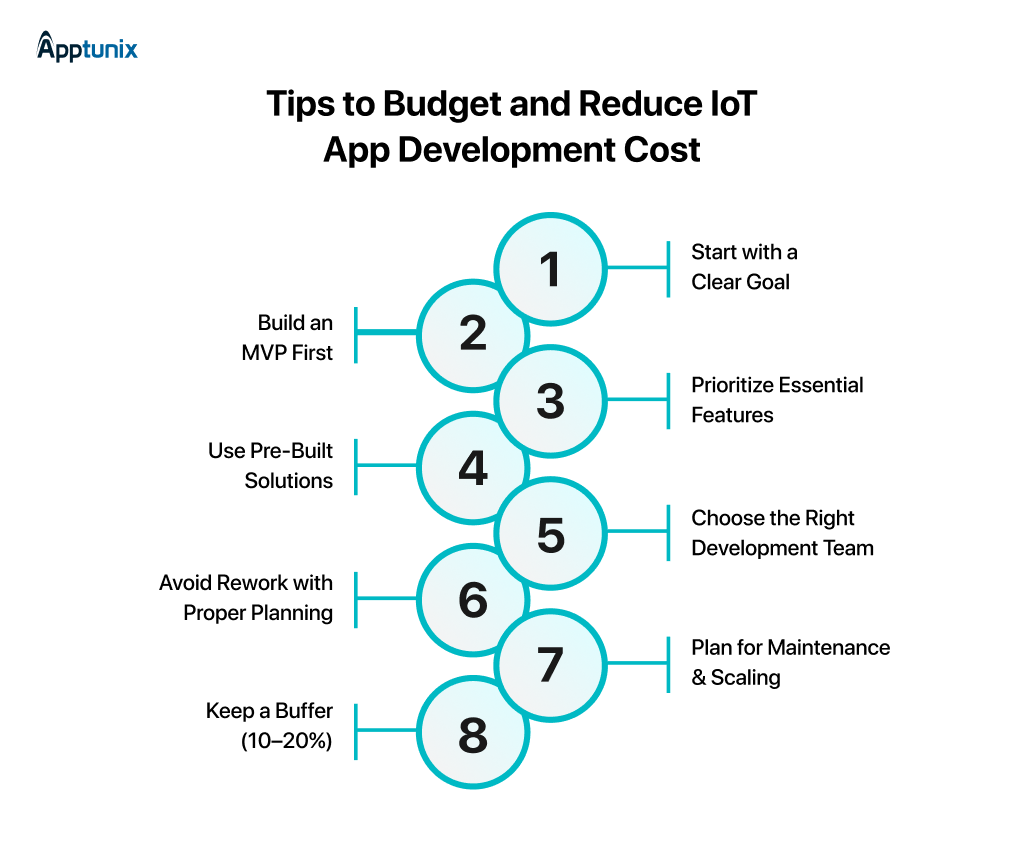
1:Start with a Clear GoalBudget your project by defining your application purpose, target users, and core functionality from the start.
Clear goals are crucial to reduce unnecessary features, avoid confusion, and ensure your money is spent on something that delivers real business value.
2:Build an MVP FirstA minimum viable product is the best way to start, since it only includes core features and can easily scale as the business grows.
It reduces initial costs and allows you to launch your product faster and validate your app idea before investing a large amount of money.
3:Prioritize Essential FeaturesYou can reduce the cost by focusing on must-have features that solve the core problem. Avoid adding advanced functionalities early, as they increase costs.
Later, you can scale and add features based on user feedback and demand, so first, prioritize the key features.
4:Use Pre-Built SolutionsSave money or improve your budgeting by leveraging existing tools like APIs and cloud platforms rather than building a solution from scratch.
Ready-made or white-label solutions save development time, reduce costs, and ensure performance.
5:Choose the Right IoT App Development AgencyGo with a team that has relevant IoT app development experience and a strong portfolio.
Undoubtedly, more professional and skilled developers charge more but reduce errors, improve app quality, and save long-term costs with efficient development.
6:Avoid Rework with Proper PlanningYou have to invest time in planning, documentation, and architectural design.
It reduces errors, prevents costly rework, and ensures smooth execution throughout the IoT app development lifecycle, even after launching the application.
7:Plan for Maintenance & ScalingIoT apps require ongoing updates, monitoring, and scalability, so start planning in your initial phase to face sudden expenses.
Save money for post-launch maintenance and future expansion to ensure long-term performance, security, and growth.
8:Keep a Buffer (10-20%)To have a seamless budget without facing any issues during the development phase, always set aside an extra 10-20% of your budget for unexpected expenses.
It will help you manage risks, handle changes, and avoid financial stress during the development process.
If you’re a manufacturing company, logistics enterprise, automotive firm, or smart city planner, it’s a must to build an IoT app integrating your business-focused features. Your investment depends on your business scalability and goals.
You can build a solution that delivers real value without overspending by understanding cost factors and planning wisely.
Remember, the key is to start smart, prioritize essentials, and scale gradually.
However, you can’t succeed without choosing the right IoT app development company because it makes all the difference.
Choose a partner like Apptunix that has years of experience and deep expertise in developing future-ready and secure IoT solutions that suit your business or industry requirements.
Apptunix is the perfect choice for you, whether you start from scratch or refine your idea. The company’s world-class development team can turn your vision into a high-performing IoT application.
So what are you waiting for? Partner with Apptunix and monitor and automate your business operations.

Q 1.How much does it cost to build an IoT app?
The cost to develop an IoT app ranges between $20,000 and $160,000, depending on the project’s complexity and the industry type you belong to. For example, if you build a complex IoT app for your manufacturing business, it will cost you more than building a smart home app.
Q 2.What factors affect IoT app development cost?
The core factors that influence IoT app development services cost include:
Q 3.How long does it take to build an IoT app?
On average, the timeline ranges from 2 months to 8 months or even more, depending on the app complexity and the development team’s experience and expertise. For example, a basic IoT app can be developed within 2-3 months, but an advanced app for large businesses takes up to 8 months.
Q 4.Is IoT app development expensive?
Yes, IoT app development services are expensive if you build for large industries like manufacturing, logistics, and automotive. It costs $30,000 to $200,000 for such industries. However, smart home apps, or agriculture smart apps, are less expensive.
(1 ratings, average: 5.00 out of 5)
Get the weekly updates on the newest brand stories, business models and technology right in your inbox.
Reena Bhagat, the CTO and Head of AI at Apptunix, is a seasoned technology strategist with a deep-rooted expertise in emerging technologies. With a focus on AI/ML integration, product engineering, cloud management, she leads the technical vision for high-performance SaaS infrastructures. Reena is recognized for building secure, scalable, and decentralized systems that solve real-world complexities. Her passion lies in leveraging data science and future-tech to create resilient digital products, making her a trusted authority for organizations looking to lead in the age of intelligent automation.
26 Views 10 min July 24, 2026
25 Views 10 min July 17, 2026
127 Views 10 min June 25, 2026
Book your consultation with us.
Book your consultation with us.


One Central, The offices 3, Level 3, DWTC, Sheikh Zayed Road, Dubai
+971 50 782 1690


Offer Ends Soon
Get a quick expert response in under 5 minutes.