Platforms like Dubai Trade and Logistics already show how digital-first operations in Dubai reduce costs and improve visibility. Therefore, for both startups and large corporations, investing in logistics software is crucial for achieving speed, transparency, and global competitiveness.
Why Dubai Businesses Need Logistics Software?
Come check the reason here:
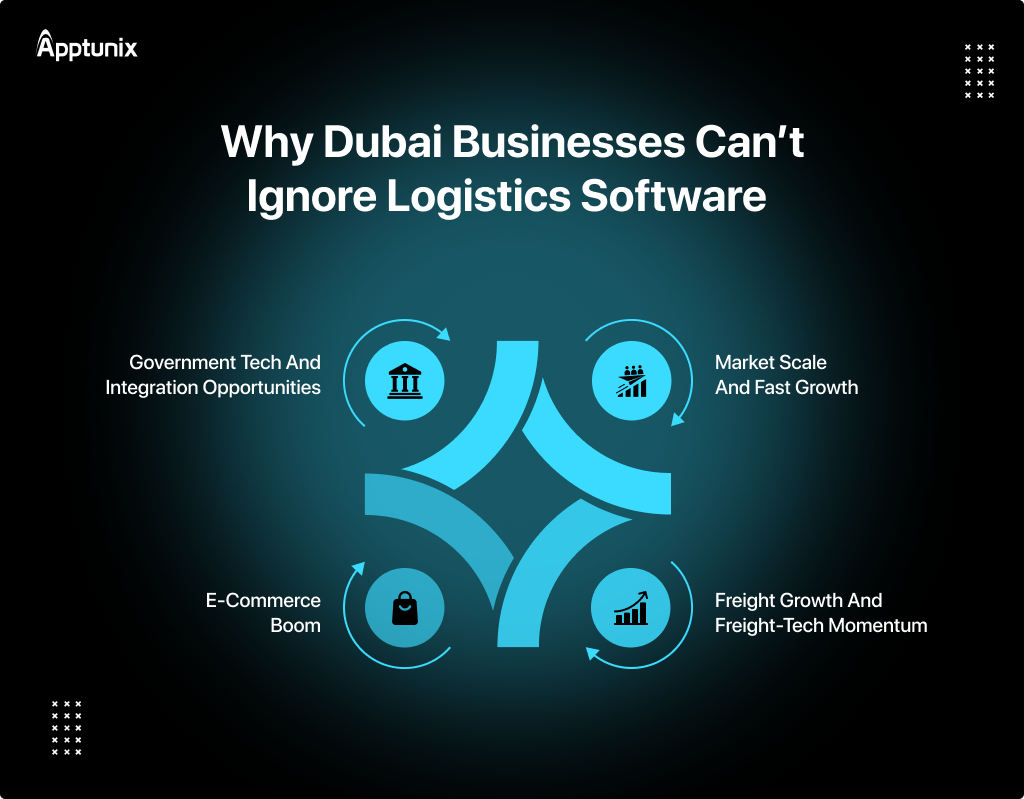
1. Market scale and fast growth
The UAE’s logistics market is massive, valued at USD 54.5 billion in 2024 and projected to hit USD 95.2 billion by 2033. With this scale, traditional manual systems are a bottleneck.
For example, DP World’s CARGOES platform speeds up freight movement while lowering errors with AI-driven supply chain visibility. Companies that stick with outdated systems run the risk of losing business to operators who prioritize digitalization.
2. Freight growth and freight-tech momentum
Freight forwarding in the UAE is expected to reach USD 30.2 billion by 2030. This development is fueled by cross-border trade and mega ports such as Jebel Ali.
Examples include Trukkin. A freight system in Dubai that uses AI matching and online payments to connect shippers and thousands of truckers in the GCC.
Businesses that invest in custom freight and TMS software today will reap cost benefits, accelerated turnaround times, and enhanced customer loyalty.
3. E-commerce boom
E-commerce is booming throughout the UAE, resulting in immense pressure on last-mile delivery. Delivery on the same day or next day is no longer a perk but an expectation.
Reports show that 70% of consumers in the UAE would like to work with companies that provide fast delivery services. Competitors like Talabat and Noon Express are leading the way with real-time delivery tracking, route optimization, and integrated driver apps.
To stay on the market where speed equals retention, businesses need to invest in logistics app development.
4. Government tech and integration opportunities
The government of the UAE is an active facilitator of digital trade. Dubai Trade simplifies import-export processes by digitizing customs clearance, invoices, and payments. Meanwhile, Logisty, the new logistics platform of Dubai Customs, has enabled businesses to combine compliance and trade paperwork in real time. Those who are integrating with these systems enjoy faster clearance, reduced delays, and lower costs.
Startups that build logistics solutions capable of plugging into these platforms will stay compliant and unlock operational speed that manual systems can’t deliver.
With logistics software becoming the backbone of modern trade in the UAE, the question every founder eventually asks is the same: “How much will it cost me to build logistics software in Dubai?”
Also Read: How to Build a Logistics Management Software
How Much Does Logistics Software Development Cost in Dubai?
Here’s the truth: There’s no single price tag.
Building logistics software in Dubai is a bit like building a port terminal; its cost depends on scale, sophistication, and integration needs. Startups may need a simple last-mile delivery app, while enterprises often invest in AI-powered, multi-module systems integrated with Dubai Trade, free zones, and customs platforms.
On average, logistics software development cost in Dubai ranges from AED 110,000 – AED 917,000+, based on requirements.
According to Dubai Customs, the revenue for smart logistics solutions is set to reach AED 55 billion by 2030 in the UAE economy. This is why logistics software is not viewed as an expense for businesses here, but as an investment when it comes to growth, efficiency, and compliance.
Instead of drowning you in abstract numbers, let’s break down the cost so you can benchmark where your project fits.
| Complexity Level |
Estimated Cost (AED) |
Estimated Cost (USD) |
Development Time |
Key Features |
| Simple App |
AED 110,000 – AED 183,500 |
$30,000 – $50,000 |
3 – 5 months |
GPS tracking, basic fleet management, driver app, and admin panel |
| Moderate App |
AED 183,500 – AED 293,600 |
$50,000 – $80,000 |
5 – 8 months |
Warehouse & inventory, real-time delivery tracking, route optimization, customer app |
| Complex App |
AED293600- AED367000 |
$80,000 – $100,000 |
8 – 12 months |
TMS + WMS integration, multi-region support, AI analytics, IoT fleet monitoring |
| Enterprise-Grade |
AED 367,000 – AED 917,000+ |
$100,000 – $250,000+ |
12 – 18 months |
AI forecasting, blockchain traceability, ERP/Dubai Trade integration, smart contracts, predictive maintenance |
What Factors Affect Logistics Software Development Cost in Dubai?
If you’re wondering why one logistics software project in Dubai costs AED 80,000 while another easily crosses AED 500,000, the answer lies in the factors driving the cost.
Each project is unique, but the following elements consistently shape the budget of logistics software development in Dubai.
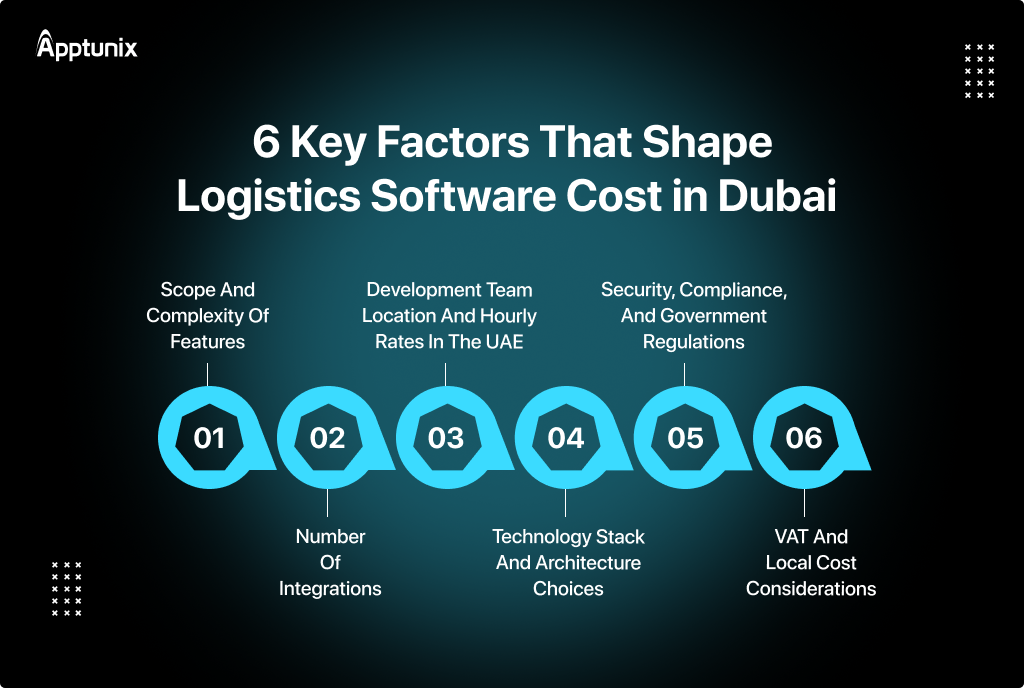
1. Scope and Complexity of Features
The scope of features has the biggest impact on logistics software development cost in Dubai.
- A very basic installation with order management, GPS tracking, and a simple admin page is relatively affordable.
- But if you want advanced functionalities like AI-powered route optimisation, real-time fleet tracking, geofencing, and predictive analytics, the cost quickly rises.
- However, if you choose to incorporate modules for warehouse automation, IoT sensors, or load-balancing algorithms, the budget goes up even further.
Consider this: a courier company might be fine with standard order tracking, but a 3PL enterprise handling multi-country shipments will need a more complex system. The more advanced the features, the greater the cost, but also the greater the return on efficiency.
2. Number of Integrations
Modern logistics software doesn’t work in isolation. It needs to integrate with existing systems like ERPs, CRMs, and payment gateways. In Dubai, companies often require Dubai Trade integration to handle customs clearance and trade documentation. Each of these integrations adds layers of development and testing.
- ERP systems like SAP or Oracle need seamless data syncs.
- Payment gateways must support AED and multi-currency settlements.
- Dubai Trade integration requires certified APIs and government compliance.
Every integration not only adds upfront cost but also ongoing maintenance. So when calculating the cost to develop a logistics app in Dubai, always factor in the number and complexity of integrations required.
3. Development Team Location and Hourly Rates in the UAE
The location of your development team is another critical cost driver. Hiring developers within the UAE often comes at higher hourly rates, typically between $50–$150 per hour. While this ensures better alignment with local regulations and business culture, it does increase costs.
Conversely, offshore teams can provide more competitive prices, although you will require excellent project management to overcome communication barriers. Many companies now choose a hybrid approach: a core UAE-based team for strategy and compliance, supported by offshore developers for execution.
4. Technology Stack and Architecture Choices
The budget is hugely impacted by the technology stack you choose.
- The development of a basic monolithic structure is quicker and less expensive, but it is less scalable.
- Although microservices and cloud-native designs are more expensive initially, they are better at managing extensive logistics operations.
- Complexity and cost are also increased by sophisticated tools like AI-based analytics, IoT device integration, and real-time data streaming (Kafka, Redis).
Your choice should align with your growth goals. If you’re building software for a last-mile delivery startup in Dubai, you may not need enterprise-grade architecture from day one. But for a freight forwarding giant, it’s non-negotiable.
5. Security, Compliance, and Government Regulations
Dubai has strict regulations when it comes to data protection and trade compliance. The UAE’s Personal Data Protection Law (PDPL) and international standards like ISO 27001 often apply to logistics platforms. Meeting these requirements means additional cost for:
- Encryption protocols
- Role-based access controls
- Audit logs and secure APIs
- Compliance testing with Dubai Trade and customs
While this adds to the logistics management system cost in Dubai, it’s essential. Non-compliance can lead to delays, fines, or even suspension of operations.
6. VAT and Local Cost Considerations
Finally, don’t forget local financial rules. In the UAE, a 5% VAT applies to most software development services. Businesses operating within Dubai must also account for licensing fees, free-zone regulations, and often the added cost of Arabic/English bilingual support for their apps.
These may seem like smaller expenses, but together they influence the overall average cost of logistics software development in Dubai.

Cost Breakdown of Different Types of Logistics Software in Dubai
Not all logistics companies in Dubai need the same type of software. A courier startup will prioritize last-mile delivery apps, while a freight forwarding business may need a marketplace platform with Dubai Trade integration. Each type of software comes with its own development complexity and cost structure.
Below, we break down the average logistics software development cost in Dubai based on the most common types of logistics solutions.
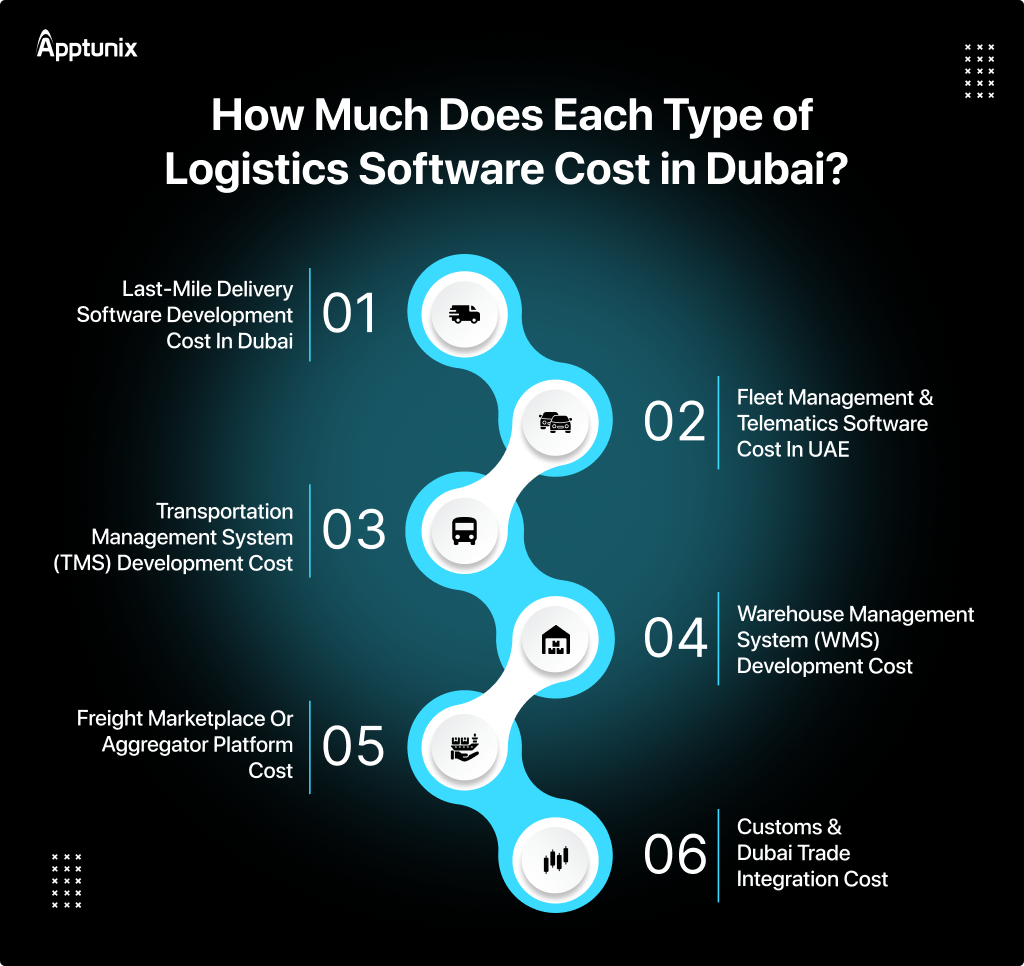
1. Last-Mile Delivery Software Development Cost in Dubai
Last-mile delivery is at the heart of Dubai’s booming e-commerce and on-demand economy. These apps typically include customer booking apps, driver apps, live GPS tracking, dispatch algorithms, and payment gateways.
- Basic Version: AED 120,000 – AED 180,000 (USD 32,500 – 49,000)
- Advanced Version (AI-based route optimization, geofencing, analytics): AED 250,000 – AED 400,000 (USD 68,000 – 109,000)
This makes last-mile delivery one of the most in-demand and often costlier forms of logistics software development in Dubai.
2. Fleet Management & Telematics Software Cost in UAE
For businesses managing large fleets of trucks, vans, or bikes, fleet management software ensures operational efficiency and compliance. Key features include vehicle tracking, driver performance monitoring, fuel management, and telematics integrations.
- Basic Fleet System: AED 150,000 – AED 220,000 (USD 41,000 – 60,000)
- Enterprise-Grade (IoT sensors, predictive maintenance, advanced telematics): AED 350,000 – AED 500,000 (USD 95,000 – 136,000)
Investing in this type of solution helps reduce operational costs and improve real-time visibility crucial for logistics providers in the UAE.
3. Transportation Management System (TMS) Development Cost
A Transportation Management System (TMS) is ideal for freight forwarders and large-scale logistics operators in Dubai who need shipment planning, carrier selection, freight auditing, and route optimization.
- Mid-Tier TMS: AED 200,000 – AED 300,000 (USD 54,500 – 82,000)
- Full-Scale TMS with AI forecasting & integrations: AED 450,000 – AED 650,000 (USD 123,000 – 177,000)
TMS software development cost in Dubai largely depends on the number of integrations with ERPs, Dubai Trade, and customs systems.
4. Warehouse Management System (WMS) Development Cost
With Dubai positioning itself as a global logistics hub, warehouse management systems (WMS) are critical for efficiency. These platforms manage inventory, picking/packing, barcode scanning, and automated workflows.
- Basic WMS: AED 180,000 – AED 250,000 (USD 49,000 – 68,000)
- Advanced WMS (IoT sensors, robotics, AI-driven demand planning): AED 400,000 – AED 600,000 (USD 109,000 – 163,500)
Companies handling high-volume imports/exports at Jebel Ali Free Zone or Dubai South often require enterprise-grade WMS solutions with multi-warehouse support.
5. Freight Marketplace or Aggregator Platform Cost
Dubai’s freight ecosystem is evolving fast, with demand for digital freight marketplaces where shippers and carriers can connect. These platforms include real-time pricing, bidding systems, booking management, and tracking modules.
- Startup-Level Freight Marketplace: AED 250,000 – AED 350,000 (USD 68,000 – 95,000)
- Enterprise-Grade (multi-country support, AI pricing, Dubai Trade integration): AED 500,000 – AED 800,000 (USD 136,000 – 218,000)
This is one of the highest-cost logistics software projects in Dubai, but it offers a strong ROI by enabling companies to monetize transactions at scale.
6. Customs & Dubai Trade Integration Cost
For companies engaged in cross-border trade, Dubai Trade integration is often mandatory. This ensures smooth customs clearance, digital documentation, and regulatory compliance.
- Basic Customs/Dubai Trade API Integration: AED 60,000 – AED 100,000 (USD 16,300 – 27,000)
- Advanced Compliance + Multi-Module Integration: AED 150,000 – AED 250,000 (USD 41,000 – 68,000)
While this may not be a standalone system, the cost to integrate customs solutions in Dubai must be factored into the total project budget.
Logistics Software Development Models in Dubai and Their Cost
When planning an AI in logistics app development in Dubai, the model you choose directly impacts cost, quality, and speed. Some businesses prefer local UAE development companies for their market expertise, while others opt for hybrid or offshore models to optimize budgets.
You also need to decide whether to go for a custom-built logistics platform or a ready-made SaaS solution. Let’s break down the average logistics software development cost in Dubai for each model.
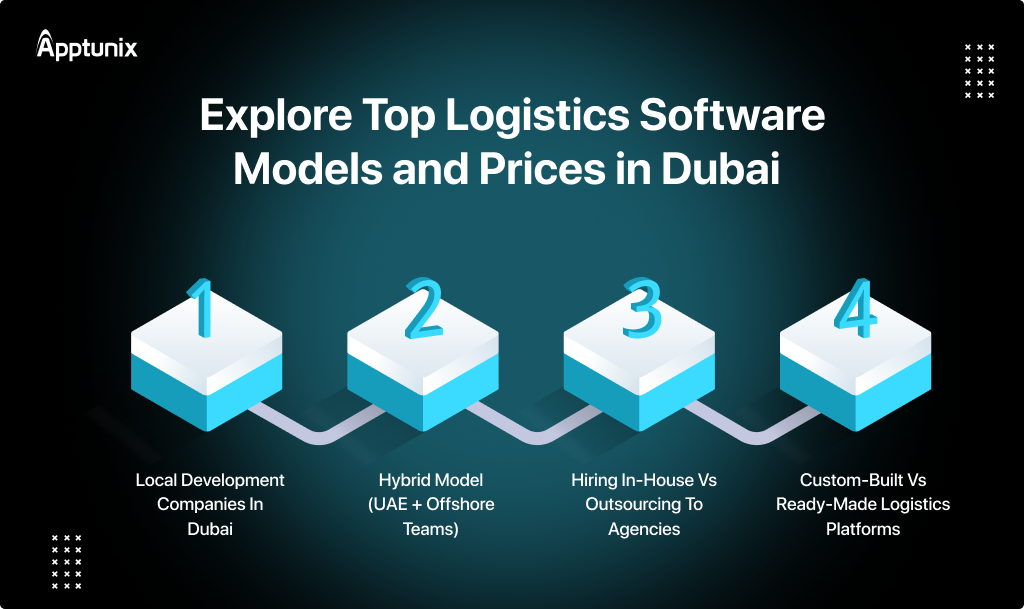
1. Local Development Companies in Dubai
Hiring a Dubai-based software development company ensures compliance with UAE regulations, better communication, and access to domain experts. However, it comes at a premium.
- Average Hourly Rate in Dubai: AED 180 – AED 300 per hour
- Mid-Sized Project (4–6 months): AED 350,000 – AED 550,000
- Enterprise-Level Project (8–12 months): AED 800,000 – AED 1.2M+
While costlier, local development provides peace of mind through local support, NDA compliance, and faster iterations.
2. Hybrid Model (UAE + Offshore Teams)
Many logistics companies in Dubai adopt a hybrid model: strategy, UI/UX, and compliance are handled locally in the UAE, while coding and development are outsourced to offshore teams (India, Eastern Europe, etc.).
- Average Hourly Rate Mix: AED 100 – AED 180 per hour
- Mid-Sized Hybrid Project: AED 250,000 – AED 400,000
- Enterprise-Level Hybrid Project: AED 600,000 – AED 900,000
This approach balances quality, compliance, and cost-efficiency, making it one of the most popular choices for logistics startups in Dubai.
3. Hiring In-House vs Outsourcing to Agencies
Another big decision for logistics companies is whether to hire an in-house team or outsource to a software agency.
- In-House Team Setup (5–7 members, yearly salaries): AED 1.5M – AED 2.2M annually
- Outsourcing to Agency (project-based): AED 300,000 – AED 700,000 depending on scope
For startups and SMEs in Dubai, outsourcing is usually more cost-effective, while large enterprises with continuous needs may benefit from in-house teams.
4. Custom-Built vs Ready-Made Logistics Platforms
The final choice is between building a custom logistics platform or adopting a ready-made SaaS solution.
- Custom-Built Logistics Software in Dubai: AED 400,000 – AED 1M+ (depending on features like AI routing, telematics, Dubai Trade integration)
- Ready-Made SaaS Platforms (subscription): AED 5,000 – AED 15,000 per month
Custom platforms provide scalability and branding freedom, while SaaS models are best for companies looking for quick deployment and lower upfront costs.
Timeline of Logistics Software Development in Dubai and Its Cost Impact
When planning logistics software development in Dubai, understanding the timeline is just as important as the budget. How fast you want your solution deployed directly influences cost, quality, and scalability.
From a lean MVP to a full-feature enterprise platform, each timeline comes with trade-offs that every business owner and logistics manager must consider.
1. MVP Development Timeline (3–4 Months)
For startups and SMEs looking to launch quickly, building a Minimum Viable Product (MVP) is the fastest route.
- Typical Features: Basic fleet tracking, driver and customer apps, order management, and admin dashboard.
- Development Timeline: 3–4 months
- Average Cost in Dubai: AED 120,000 – AED 250,000
MVPs are ideal for testing the market, getting early customer feedback, and iterating rapidly. They offer a lower upfront cost while providing a functional logistics solution.
2. Full-Feature Enterprise Platform Timeline (6–12+ Months)
For larger logistics companies or enterprises, a full-feature platform provides advanced analytics, AI route optimization, IoT telematics, warehouse management, and Dubai Trade integration.
- Development Timeline: 6–12+ months
- Average Cost in Dubai: AED 450,000 – AED 1,000,000+
A full-scale solution takes longer due to intricate integrations, multi-module development, and rigorous testing. Although the expenditure is greater, the ROI is huge concerning operational efficiency, compliance, and scalability.
Having an understanding of timelines and their associated costs keeps you realistic in your planning. Subsequently, we will discuss the non-obvious logistics software development costs in Dubai that go unnoticed but are indispensable for budgeting effectively.
Hidden Costs of Logistics Software Development in Dubai You Can’t Ignore
When planning logistics software development in Dubai, the initial development cost is only part of the story. Many businesses underestimate the hidden expenses that appear during or after the project. Ignoring these costs can derail budgets and affect ROI. Understanding them helps you plan more accurately and avoid surprises.
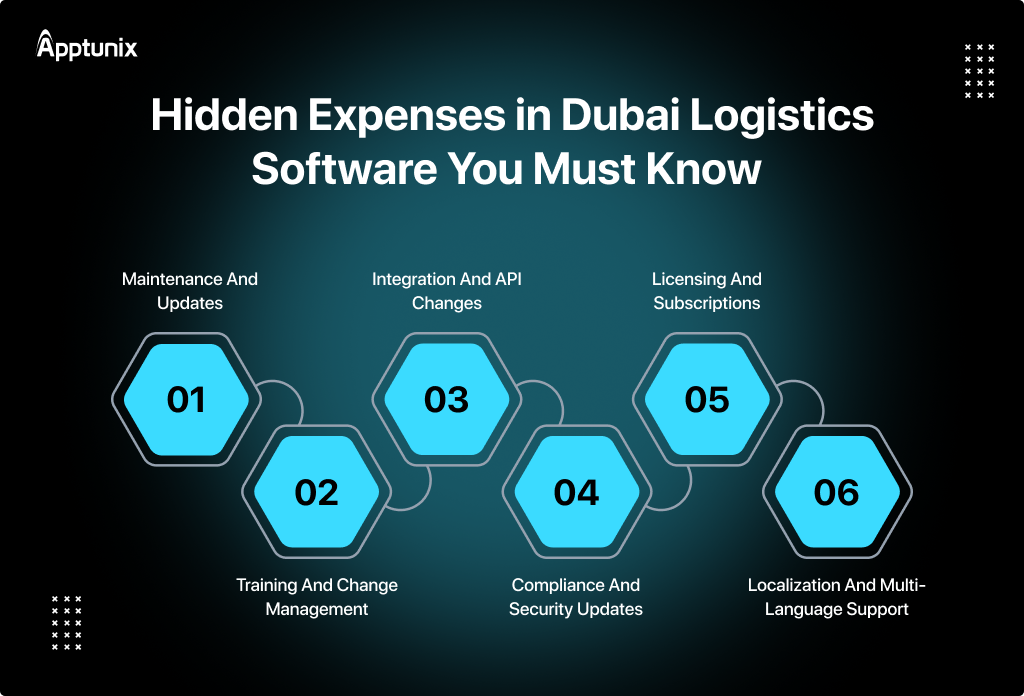
1. Maintenance and Updates
Software is never truly “done.” After launch, ongoing maintenance, bug fixes, and feature updates are required to keep the system reliable and secure.
- Average Maintenance Cost in Dubai: AED 50,000 – AED 150,000 annually, depending on software complexity
- Complex platforms with AI, IoT, or multi-module setups cost more
Regular updates ensure compliance with UAE regulations, optimize performance, and keep users satisfied.
2. Integration and API Changes
Even after deployment, APIs and third-party integrations often change. Dubai Trade, payment gateways, or ERP systems may require updates or recertification.
- Typical Cost: AED 20,000 – AED 60,000 per major integration update
- Additional testing and QA may be needed for each change
Planning for these costs prevents unexpected disruptions in fleet management, TMS, or last-mile delivery operations.
3. Licensing and Subscriptions
Some logistics solutions depend on licensed software, mapping tools, or cloud services:
- Cloud hosting, Google Maps API, IoT platform subscriptions, and analytics tools
- Average Annual Cost: AED 30,000 – AED 100,000 depending on scale and usage
Skipping these ongoing fees can lead to downtime or incomplete functionality, affecting supply chain efficiency in the UAE.
4. Training and Change Management
Even the best logistics software fails without proper team adoption. Training drivers, warehouse staff, and dispatchers is essential:
- Estimated Cost: AED 15,000 – AED 50,000 per year
- Includes user manuals, workshops, and support for multiple teams
Businesses that skip training risk low adoption, slower ROI, and higher operational errors.
5. Compliance and Security Updates
Dubai’s regulatory landscape is evolving rapidly. Staying compliant with PDPL, ISO 27001, and customs regulations requires regular security audits and system updates:
- Estimated Cost: AED 25,000 – AED 80,000 annually
- Covers encryption upgrades, audit logs, and risk mitigation
Investing in compliance protects your business from fines and operational delays.
6. Localization and Multi-Language Support
If your logistics software targets the Middle East market, Arabic support is essential. This includes UI, reports, customer-facing apps, and notifications:
- Estimated Cost: AED 20,000 – AED 40,000
- Multi-language updates must be included in ongoing maintenance plans
Proper localization improves user experience and market reach in the UAE.
Now that you know the hidden costs, it becomes simpler to make smarter investment decisions. The next step is selecting the right logistics software development partner in Dubai.

How to Choose the Right Logistics Software Development Partner in Dubai
Selecting the right logistics software development company in Dubai UAE can make or break your project. The ideal vendor not only delivers the software on time but also understands local regulations, Dubai Trade, and RTA integration. This guarantees your platform runs smoothly in the UAE market.
Here are the six key factors to consider when hiring a development company:
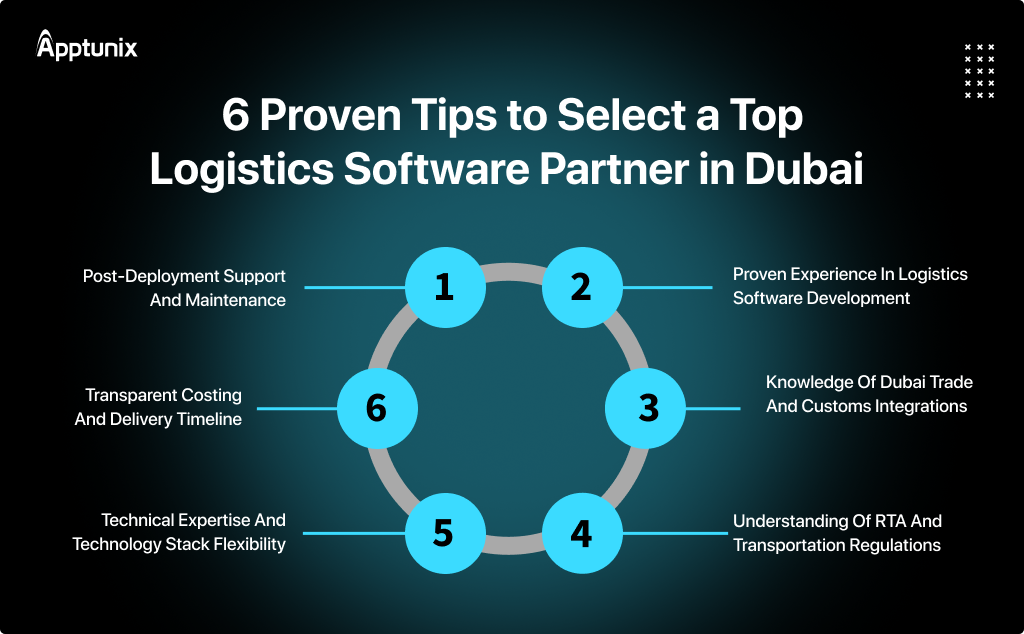
1. Proven Experience in Logistics Software Development
Verify if the vendor boasts a robust portfolio of logistics software in Dubai or the UAE. Established companies know how complex fleet management, TMS, WMS, and last-mile delivery apps are, and can provide more than code insights.
A partner with prior success can foresee pitfalls, recommend cost-effective features, and guarantee your software complies with industry standards.
2. Knowledge of Dubai Trade and Customs Integrations
Dubai Trade integration is vital for cross-border and freight-forwarding logistics.
Select a partner that understands Dubai Trade APIs, customs processes, and regulatory requirements, since this reduces delays and errors. Local integration-experienced vendors can manage documentation, automate customs verification, and minimize operational bottlenecks.
3. Understanding of RTA and Transportation Regulations
For transportation and fleet management software, expertise in RTA guidelines, vehicle licensing, and driver compliance is essential.
A vendor from the UAE will know real-time tracking necessities, route laws, and traffic conditions so that your logistics software runs legally and smoothly. This also minimizes the chance of penalties or service disruptions.
4. Technical Expertise and Technology Stack Flexibility
A trustworthy partner should showcase experience with contemporary technology stacks, ranging from cloud-based systems to artificial intelligence, Internet of Things, and microservices. Supporting customization of features, API integration, and system scaling is important for scalability in the future.
A vendor with flexible technology choices ensures that your logistics platform stays relevant and affordable in the long run.
5. Transparent Costing and Delivery Timeline
Transparency of cost breakdown, milestones, and delivery timeline is critical. A seasoned UAE vendor will present a transparent AED-based budget for various stages: MVP, full-featured software, integrations, and maintenance.
Understanding these figures in advance enables companies to make investment plans correctly. It also prevents surprise expenses in the development of logistics software in Dubai.
6. Post-Deployment Support and Maintenance
Software isn’t complete at launch. Your provider must include support, updates, and employee training.
Seek a partner that offers maintenance packages and can keep pace with the changes in regulations in Dubai. Make sure it also handles Dubai Trade or RTA releases without a hiccup. This allows for the sustainability and consistency of your logistics platform.
Why Choose Apptunix for Your Logistics Software Development in Dubai?
Developing logistics software in Dubai needs a partner who has expertise in technology and the logistics landscape in the region. As a trusted logistics software development company in Dubai, Apptunix has earned a proven track record of delivering excellence. We help UAE businesses thrive with scalable, secure, and future-ready logistics solutions that drive real results.
We have a long history of integrating with Dubai Trade and RTA systems. Apptunix team is ensuring your platform is compliant with all regulatory needs while automating customs, transport, and fleet operations. From last-mile apps to full-fledged TMS, WMS, and freight marketplaces, we build solutions for your specific business requirements.
At Apptunix, we integrate cutting-edge technology such as AI, IoT, and cloud computing with a client-centric methodology. We offer transparent AED-based costing, clear timelines, and end-to-end support so that you have no surprises during or after development.
Partnering with Apptunix comes with collaborating with a team that not only develops your software but also enables your business to minimize costs. We help you in increasing efficiency and expanding in Dubai’s dynamic logistics industry.
Ready to transform your logistics operations? Apptunix is your trusted partner for Mobile app development in Dubai and across the UAE.