Vibe Coding vs Professional Development: Which One Should Your Business Actually Bet On?
14 Views 10 min September 30, 2026

Reena Bhagat, the CTO and Head of AI at Apptunix, is a seasoned technology strategist with a deep-rooted expertise in emerging technologies. With a focus on AI/ML integration, product engineering, cloud management, she leads the technical vision for high-performance SaaS infrastructures. Reena is recognized for building secure, scalable, and decentralized systems that solve real-world complexities. Her passion lies in leveraging data science and future-tech to create resilient digital products, making her a trusted authority for organizations looking to lead in the age of intelligent automation.
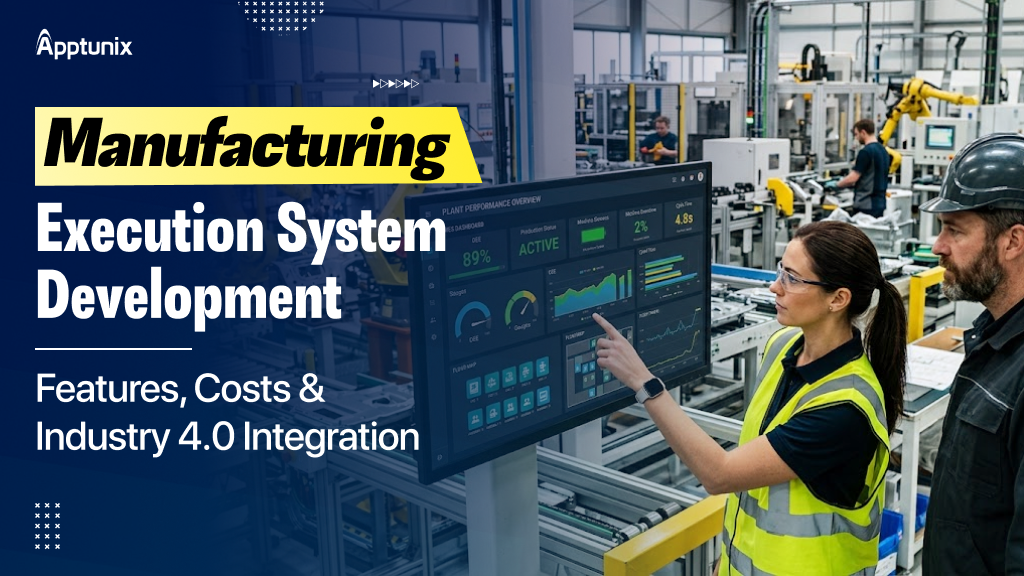
When a critical machine fails at an automotive plant, every minute of downtime can cost thousands of dollars. Yet many manufacturers still rely on spreadsheets, paper logs, and disconnected systems to manage production.
That is the brutal cost of manual tracking. It is why factories are racing to digitize. In fact, the global Manufacturing Execution System (MES) market is projected to hit $23.9 billion by 2028 (MarketsandMarkets).
Modern manufacturing cannot survive with isolated machinery. You need a bridge between the chaotic shop floor and your high-level business systems.
This guide outlines how to build a custom MES. We will cover non-negotiable features and deployment costs in 2026. But first, let’s look at how an MES actually runs a shift.

An MES is real-time shop floor software that monitors, tracks, documents, and controls production from raw materials to finished goods. As one of the most critical custom software solutions for manufacturers, an MES bridges the gap between operational data and business decision-making.
While your ERP handles the business, MES handles execution by capturing live data from machines, operators, sensors, and workstations for instant action.
This closed-loop control makes custom MES development a critical manufacturing investment.
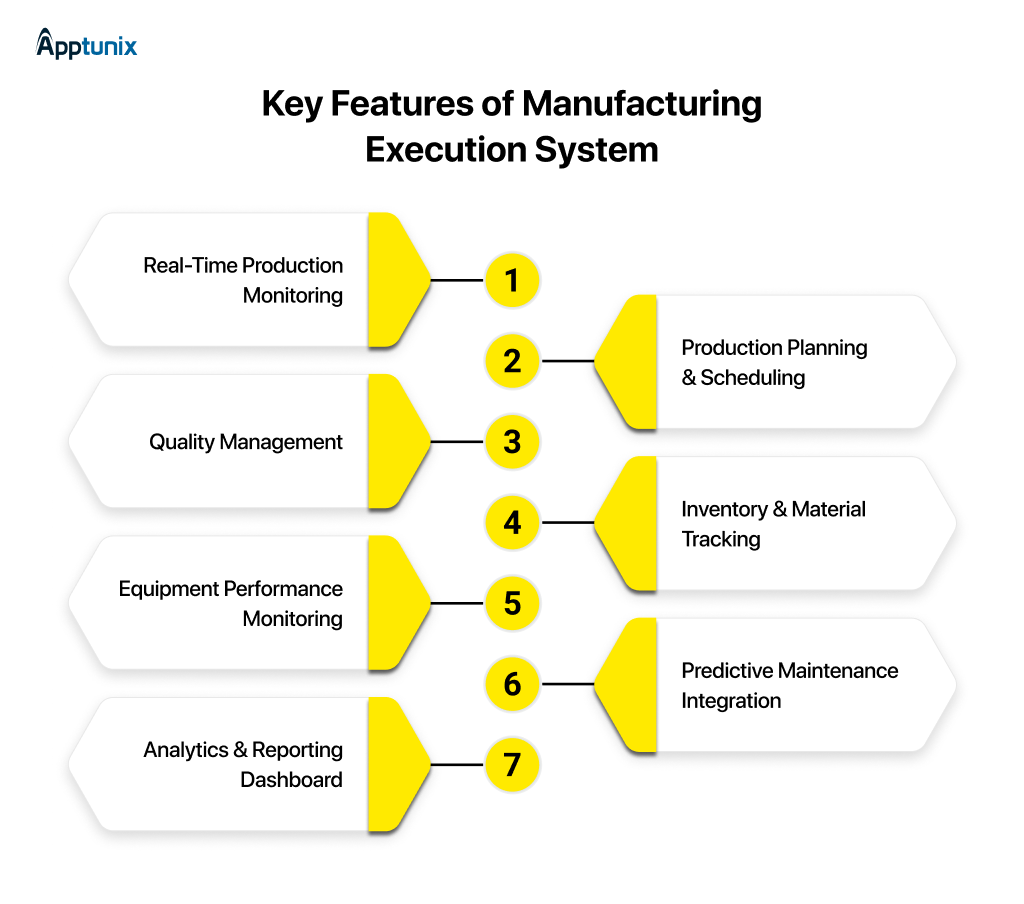
Modern manufacturers increasingly combine MES with Industrial IoT solutions to collect machine-level data in real time. Here are the top 7 core components that an MES should have.
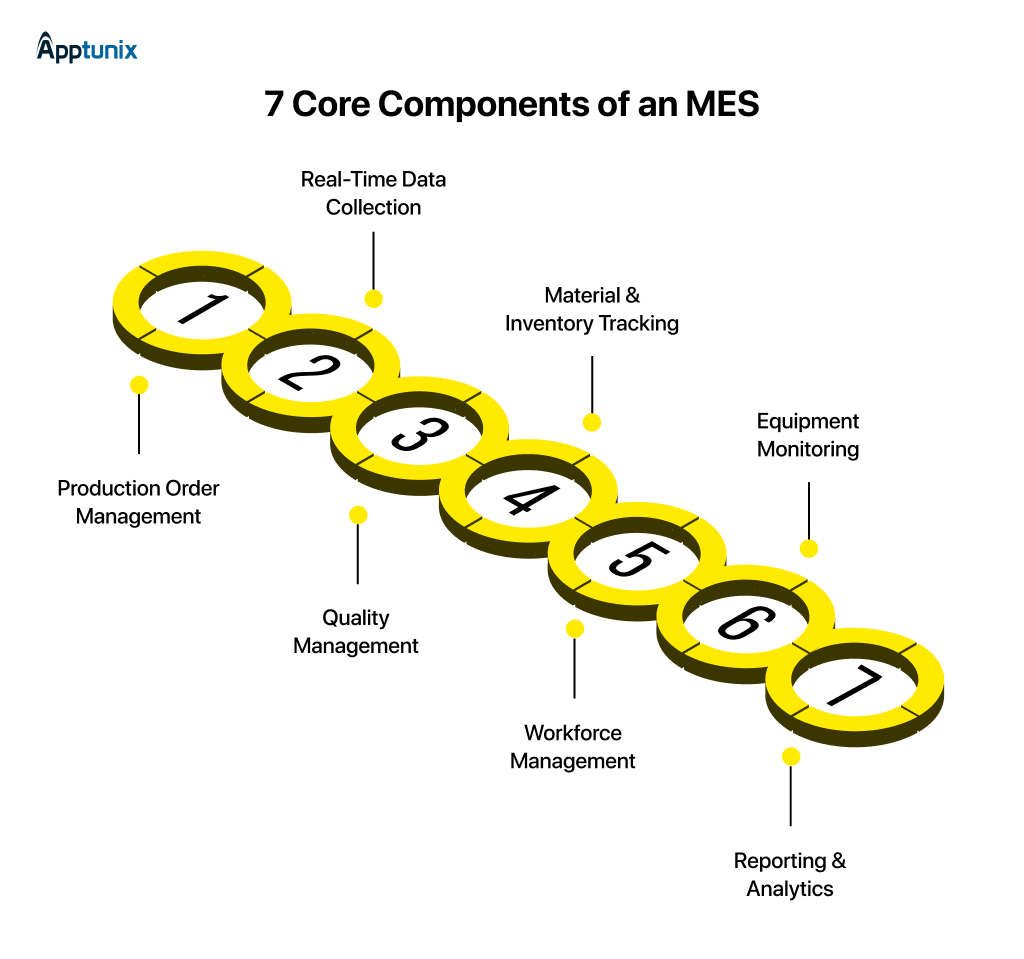
The depth of each component depends on your operation. That’s exactly why more manufacturers are choosing custom MES development over off-the-shelf products.
Data gaps lead to guesswork on the line. It’s no wonder 78% of manufacturers rank real-time visibility as their top operational priority (Deloitte).
But you don’t get that clarity from a basic, out-of-the-box template. It takes a strategic approach to custom manufacturing software development solutions.
Here is the clean, 7-step process to take your facility from messy paper logs to absolute shop-floor control.
Every MES project that fails does so for the same reason. The wrong problems got solved.
Requirement analysis prevents that. The goal is to understand how production actually works, not how it looks on paper.
This phase covers:
The output is a Business Requirements Document (BRD) and a prioritized feature backlog.
Once requirements are finalized, the technical blueprint starts to be designed. This is where the long-term health of the MES is determined.
Architecture decisions at this stage include:
For Industry 4.0 manufacturers, the architecture needs to be cloud-native and edge-ready. A poorly designed architecture doesn’t reveal its problems until you’re deep into production use.
Shop-floor software operates in conditions most enterprise tools never face. Loud environments. Gloved hands. Screens at machine height. Operators who need to act on an alert in seconds.
Good MES UI/UX focuses on:
A UI that looks clean in a design review but fails on the floor creates adoption problems that no training can fix.
The backend is the MES engine; everything the operator sees is powered by what’s built here.
Key development areas include:
Agile sprints with regular reviews work well here. Real-world operational nuances surface during development. Performance, security, and scalability need to be built in from day one.
Integration is where MES complexity peaks. It’s also where the real operational value gets unlocked.
An MES that can’t talk to the ERP creates blind spots between planning and execution. An MES that can’t read machines is guessing. So, both IoT and ERP solutions are essential.
Common integration points include:
Legacy equipment is the hardest part. Older machines without digital outputs often need hardware gateways or custom PLC programming before they can send data at all.
Testing an MES isn’t like testing a standard app. Production environments have zero tolerance for errors, latency, or unexpected downtime.
Testing happens across three layers:
For regulated industries (pharmaceutical, medical device, food & beverage), validation must also meet GAMP 5 guidelines and IQ/OQ/PQ protocol requirements.
Going live on a running production floor carries real operational risk. Production can’t stop. Errors have immediate consequences.
Phased deployment is the standard approach:
Post-deployment support is not optional. As processes change and equipment evolves, the MES must keep pace. A structured enhancement roadmap should be planned from day one.
It mostly depends on the Scope and complexity of the MES. The estimated total cost to build a Manufacturing Execution System for any company ranges from USD $50,000 to $500,000+.
Here’s a realistic investment range based on scope:
div style=”overflow-x: auto; -webkit-overflow-scrolling: touch;”>
| MES Scope & Complexity | Estimated Investment in USD | Timeline in Months |
|---|---|---|
| Core MES (single plant, basic integration) | $50,000 – $150,000 | 4–6 months |
| Mid-range MES (multi-line, ERP + IoT integration) | $150,000 – $350,000 | 6–10 months |
| Enterprise MES (multi-plant, advanced analytics, AI) | $350,000 – $500,000+ | 10–18 months |
A bloated software stack won’t help operators on the floor. To drive real efficiency, you need a lean system focused entirely on specific, must-have MES features. Here are the non-negotiables.
This is the question every Operations Manager and CTO eventually asks. Here’s the honest answer.
| Feature | Custom MES | Ready-Made MES |
|---|---|---|
| Scalability | Built to scale exactly with your operations and volumes | Constrained by vendor architecture decisions |
| Flexibility | Adapts to your processes | You adapt your processes to fit the software |
| Integration | Built for your specific ERP, machines, and systems | Standard connectors only; custom work is expensive |
| Cost | Higher upfront investment; lower long-term total cost | Lower upfront licensing and upgrade costs compound over time |
| Long-Term ROI | Strong (full ownership, no per-user fees, competitive edge) | Moderate (vendor price increases and upgrade dependencies) |
Off-the-shelf platforms like Siemens Opcenter, Rockwell FactoryTalk, or SAP ME make sense in specific situations. Highly standardized processes. Simple integration needs. Tight timelines with a limited budget.
But custom Manufacturing Execution System Development becomes the clear choice with these specific issues:
It’s a common corporate trap: trying to run a shop floor using accounting software. While your ERP manages the business balance sheet, it cannot handle the split-second realities of manufacturing automation software.
Here is why mixing up these two systems stalls production lines.
MES receives production orders from ERP. It executes those orders on the floor and sends completion data, quality records, and material consumption figures back to ERP. The business system plans. The execution system delivers. Actual results flow back automatically.
Without MES, ERP is planning based on assumptions. With MES, it’s planning based on verified production reality.
Comparison Table
| Factors | MES | ERP |
|---|---|---|
| Operational Level | Shop-floor execution | Business planning |
| Time Horizon | Seconds to shifts | Days to quarters |
| Data Source | Machines, sensors, operators | Business transactions |
| Primary User | Plant Managers, Operators, Quality Teams | Finance, Supply Chain, Executives |
| Core Value | Real-time control and traceability | Business process integration |
An MES isn’t one-size-fits-all. While every factory wants less downtime, certain sectors face strict regulations or complex tracking that make Manufacturing Execution System development non-negotiable.
Here is who needs it most.
Automotive floors run on tight margins and tighter schedules. VIN-level traceability, IATF 16949 compliance, and just-in-time delivery coordination are non-negotiable.
MES handles defect containment, end-of-line testing integration, and real-time OEE across high-volume lines. Every minute of unplanned downtime has a measurable cost here.
Pharma MES is among the most compliance-heavy in any industry. FDA 21 CFR Part 11, EU GMP, batch genealogy, and electronic batch records (eBR) are required.
Off-the-shelf platforms frequently fall short on computerized system validation (CSV). Custom MES built for pharma closes those gaps and holds up under regulatory scrutiny.
Full ingredient-to-shelf traceability is the baseline. FSMA, HACCP, and allergen management requirements add more complexity on top.
The industry benchmark tracing any retail product back to its source ingredient in under two hours is only achievable with MES. Manual records can’t meet that standard.
PCB assembly tracking, component traceability down to tape reel level, AOI system integration, yield analysis by placement machine, and IPC quality standards drive electronics MES requirements.
When you can pinpoint yield loss to a specific component supplier lot, you recover high costs in high-volume production.
Continuous process environments need batch genealogy, hazardous material handling records, and emissions tracking. Deep SCADA integration is typically required. Generic MES platforms aren’t built for this level of process control connectivity.
AS9100, first article inspection (FAI) records, serialized traceability, and ITAR compliance make aerospace MES some of the most complex development work in the industry.
The cost of non-conformance, financially and from a safety standpoint, makes the MES investment case clear.
Isolated machinery won’t build a smart factory. That disconnect is why Industry 4.0 investments will add $3.7 trillion globally. Modern Manufacturing Execution System development links this tech directly into your floor logic.
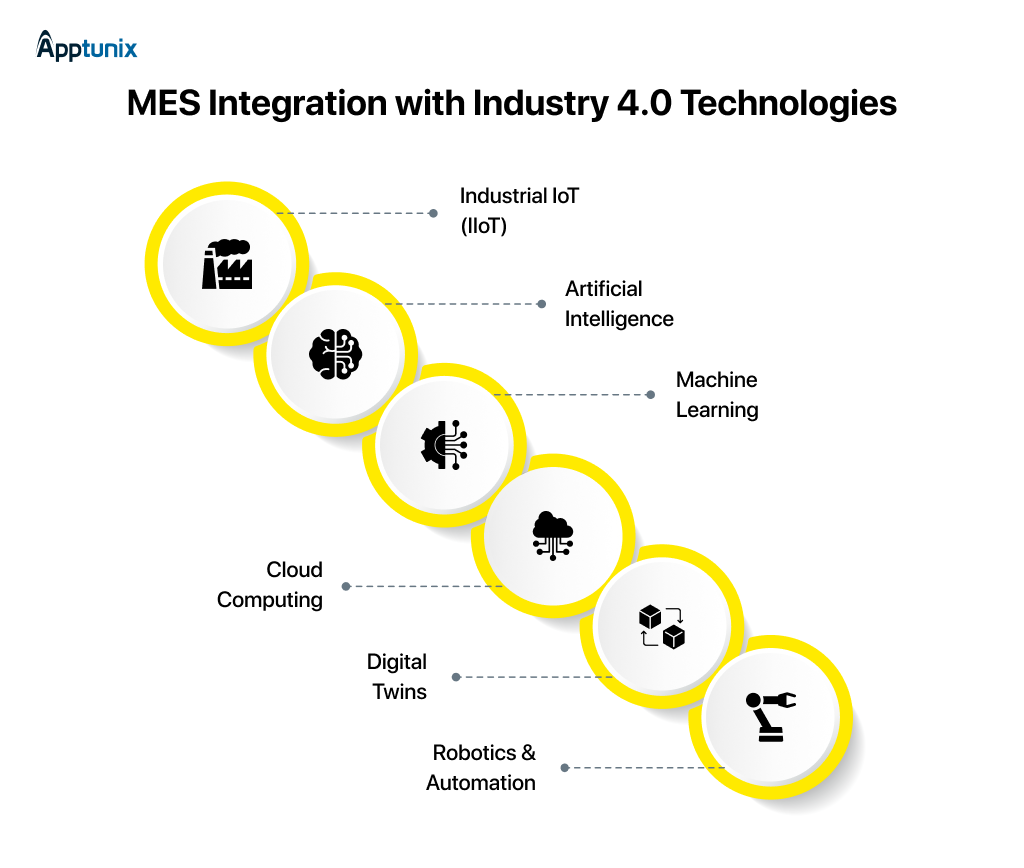
IIoT sensors in equipment, conveyors, environmental systems, and utilities feed continuous data streams into the MES. Without that live machine telemetry, OEE tracking, predictive maintenance, energy monitoring, and process optimization are all impossible.
The IIoT-MES connection is what turns a factory into a data-generating operation.
AI embedded in an MES platform enables intelligent production scheduling that optimizes across multiple constraints simultaneously. It enables automated defect detection through vision system integration.
It powers demand-driven production sequencing. AI in manufacturing moves MES from a passive data recorder to an active decision-support engine.
ML models trained on historical MES data find patterns that no human analyst would spot. Correlations between process parameters and defect rates. Early equipment failure signatures.
As these models run against live production data, their predictions improve continuously, making the MES smarter with every shift that runs.
Cloud-hosted MES platforms give multi-site manufacturers a single dashboard view across all facilities. Infrastructure scales elastically during production peaks without manual intervention.
Supply chain partners can access real-time production data where collaboration requires it. And for manufacturers who don’t want to manage on-premise server infrastructure, Cloud engineering for software development dramatically reduces IT burden.
A digital twin is a virtual replica of your production line or facility, synchronized live with MES data. Manufacturers use digital twins to simulate production changes, test scheduling decisions, and model bottleneck scenarios before touching anything on the physical floor.
The risk and cost of operational changes drop significantly when you can run them virtually first.
MES is the orchestration layer for cobots and automated guided vehicles on the smart factory floor. Work instructions, material delivery triggers, and quality verification steps are automatically dispatched to robotic systems through MES integration.
The result is fully automated production workflows with complete digital traceability attached to every action.
Rigid systems are the primary enemy of progress; 62% of manufacturing executives cite legacy software constraints as their biggest transformation barrier (McKinsey). Modern manufacturing software development finally shatters that deadlock.
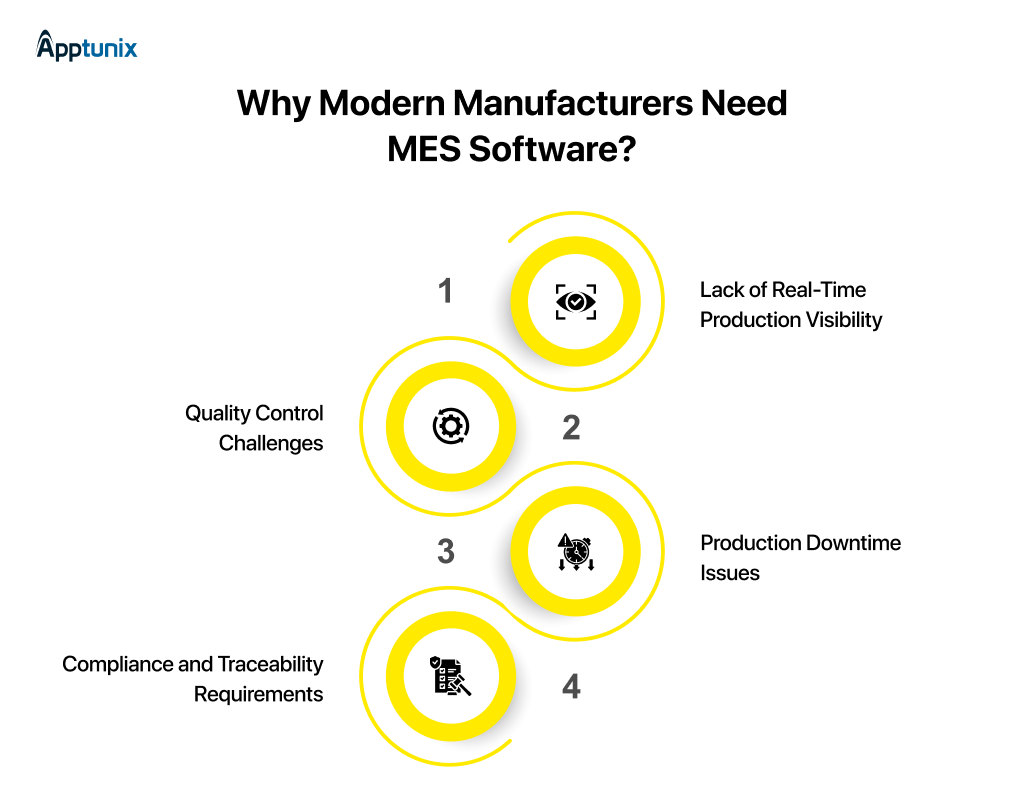
Manual data means you’re finding out about problems hours after they’ve already cost you money. Custom MES software provides live dashboards, giving teams instant visibility whether they’re on the shop floor or managing remotely.
Paper records and infrequent manual checks can’t prevent defective products from leaving the line. MES builds automated quality gates directly into the workflow, capturing real-time data and typically cutting quality-related costs by 15–25% in the first year.
With unplanned downtime averaging $50,000 an hour, waiting for a machine to break is a massive financial risk. MES tracks OEE (Overall Equipment Effectiveness) and uses predictive maintenance to flag issues like vibration or temperature shifts before the line stops.
Meeting strict regulations (like ISO, FDA, or IATF standards) with paper logs is a liability. MES creates an automated, end-to-end digital thread from raw materials to final shipment, turning hours of stressful audit prep into a three-second search.
Building a smart factory isn’t about buying generic software; it’s about digitizing your actual floor logic. Rigid, off-the-shelf tools force you to compromise your workflows, risking costly downtime and lost throughput.
At Apptunix, we eliminate those blind spots. We specialize in Custom manufacturing Development services for Industry 4.0 Manufacturers, engineering scalable platforms that sync your shop floor with your business systems. From forced legacy migrations to multi-site integration, we deliver the real-time visibility you need.
Ready to take absolute control of your data? Connect with Apptunix today for tailored MES Software Development for Smart Factories that protects your margins.
Q 1.What is Manufacturing Execution System (MES) development?
MES development is the process of designing, building, and deploying custom software that monitors and controls manufacturing operations in real time. It covers requirements analysis, system architecture, integration with ERP and shop-floor equipment, testing, deployment, and ongoing support.
Q 2.How long does custom MES development take?
A focused single-plant MES typically takes 4–6 months to develop and deploy. Multi-plant or enterprise-scale platforms with advanced integrations and analytics can take 10–18 months. Timeline depends on integration complexity, the number of features required, and how many production lines are included in scope.
Q 3.What is the difference between MES and ERP?
ERP handles business-level operations, orders, procurement, finance, and high-level production planning. MES handles shop-floor execution, real-time tracking, quality control, machine monitoring, and operator management. They’re complementary: ERP plans, MES executes, and results flow back to ERP automatically.
Q 4.Is custom MES development worth it over off-the-shelf solutions?
For manufacturers with specialized processes, complex integrations, or multi-site operations, custom MES typically delivers stronger long-term ROI. It fits your operation exactly, eliminates ongoing licensing fees, and gives you competitive differentiation that packaged software can’t provide.
Q 5.Which industries benefit most from MES software?
Automotive, pharmaceutical, food & beverage, electronics, chemical, and aerospace & defence manufacturers see the strongest MES ROI. These industries operate under demanding regulatory compliance requirements, complex traceability needs, and high-volume production environments where real-time visibility directly impacts the bottom line.
Q 6.Can MES integrate with our existing ERP?
Yes. Experienced MES development companies build integration with all major ERP platforms. SAP, Oracle, Microsoft Dynamics, Infor, and others. Integration capability is one of the most critical factors when evaluating any MES development partner.
Q 7.How much does MES development cost?
Investment ranges from around $50,000 for a core single-plant system to $500,000 or more for enterprise-scale multi-plant platforms with AI and advanced analytics. An accurate estimate is only possible after a proper requirements analysis. Any company quoting a fixed price before understanding your operation is one to approach with caution.
Q 8.What is Industry 4.0, and how does MES relate to it?
Industry 4.0 is the integration of IoT, AI, cloud computing, robotics, and advanced analytics into manufacturing operations. MES is the software layer that connects and coordinates all of those technologies on the shop floor, making Industry 4.0 a working operational reality rather than a strategy presentation.
Get the weekly updates on the newest brand stories, business models and technology right in your inbox.
Reena Bhagat, the CTO and Head of AI at Apptunix, is a seasoned technology strategist with a deep-rooted expertise in emerging technologies. With a focus on AI/ML integration, product engineering, cloud management, she leads the technical vision for high-performance SaaS infrastructures. Reena is recognized for building secure, scalable, and decentralized systems that solve real-world complexities. Her passion lies in leveraging data science and future-tech to create resilient digital products, making her a trusted authority for organizations looking to lead in the age of intelligent automation.
14 Views 10 min September 30, 2026
21 Views 10 min September 21, 2026

49 Views 10 min September 16, 2026
Book your consultation with us.
Book your consultation with us.


One Central, The offices 3, Level 3, DWTC, Sheikh Zayed Road, Dubai
+971 50 782 1690