AI in Saudi Arabia Healthcare: Use Cases & Current Regulatory Landscape
10 Views 16 min July 31, 2026

Reena Bhagat, the CTO and Head of AI at Apptunix, is a seasoned technology strategist with a deep-rooted expertise in emerging technologies. With a focus on AI/ML integration, product engineering, cloud management, she leads the technical vision for high-performance SaaS infrastructures. Reena is recognized for building secure, scalable, and decentralized systems that solve real-world complexities. Her passion lies in leveraging data science and future-tech to create resilient digital products, making her a trusted authority for organizations looking to lead in the age of intelligent automation.
The oil and gas industry runs on risk. Equipment fails. Prices swing. Pipelines age.
When something goes wrong on an offshore rig, you are not just looking at a repair bill. You are looking at hundreds of thousands of dollars lost every single day the operation is down.
For years, the industry’s response to this was mostly reactive: wait for a problem, fix it, move on. Companies that are still running operations the old way are quietly falling behind.
That is where predictive analytics in oil and gas comes in!
Oil and gas companies are now using AI, machine learning, and real-time data to predict problems before they happen, optimize production around the clock, and make smarter decisions faster than ever.
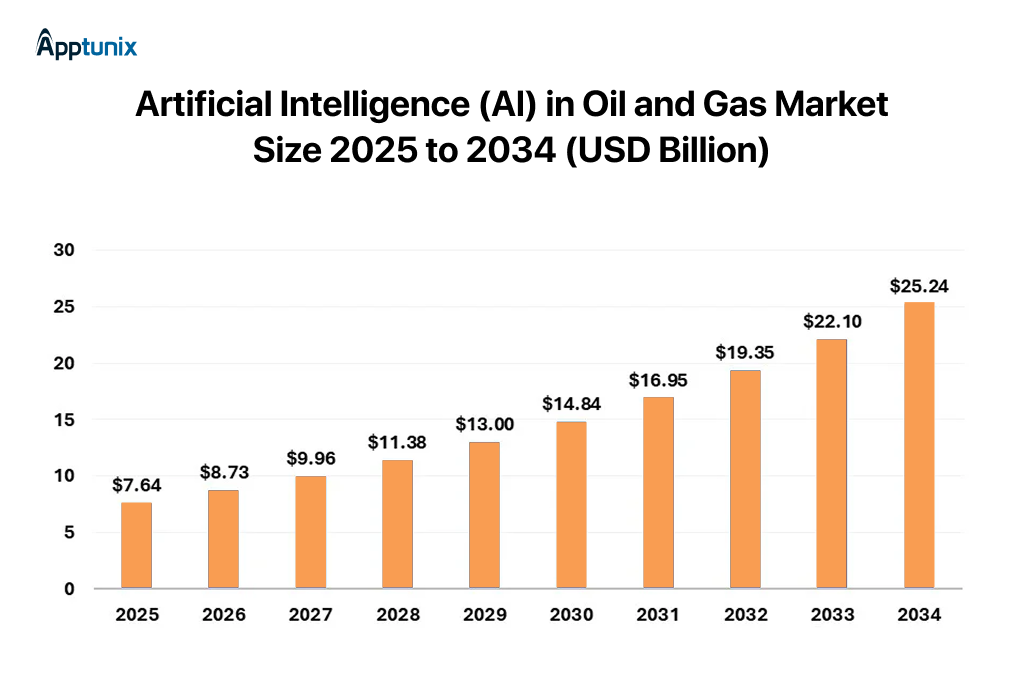
This is not a future trend. It is happening right now, and the ROI numbers are hard to ignore. The AI market in oil and gas is growing at 14.2% CAGR and is expected to hit $25 billion by 2034.
In this blog, we will break down everything you need to know about predictive analytics in oil and gas, from what it actually means to the biggest use cases driving value today.
Predictive analytics is exactly what it sounds like. Instead of reacting to problems after they happen, you use data to predict what is going to happen next and act before it does.
In the oil and gas industry, that means feeding huge amounts of data through machine learning models and AI algorithms to answer questions like:
Traditional analytics tells you what happened and why. Predictive analytics tells you what is going to happen, so you can do something about it before it costs you.
Data serves as the essential element that establishes a strong foundation for effective oil and gas data analytics systems. The modern system receives multiple data streams which originate from various sources in simultaneous fashion. The Internet of Things sensors, which manufacturers install inside their devices, monitor equipment temperature, pressure, vibration, and flow measurements throughout the day. The SCADA system provides continuous field monitoring and operational control capabilities. Drilling facilities produce three types of data: logs, directional surveys, and downhole measurements. The maintenance records contain complete information on failures and repairs from previous years. All of this information is fed into machine learning models, which analyze patterns that appear before problems begin to emerge.
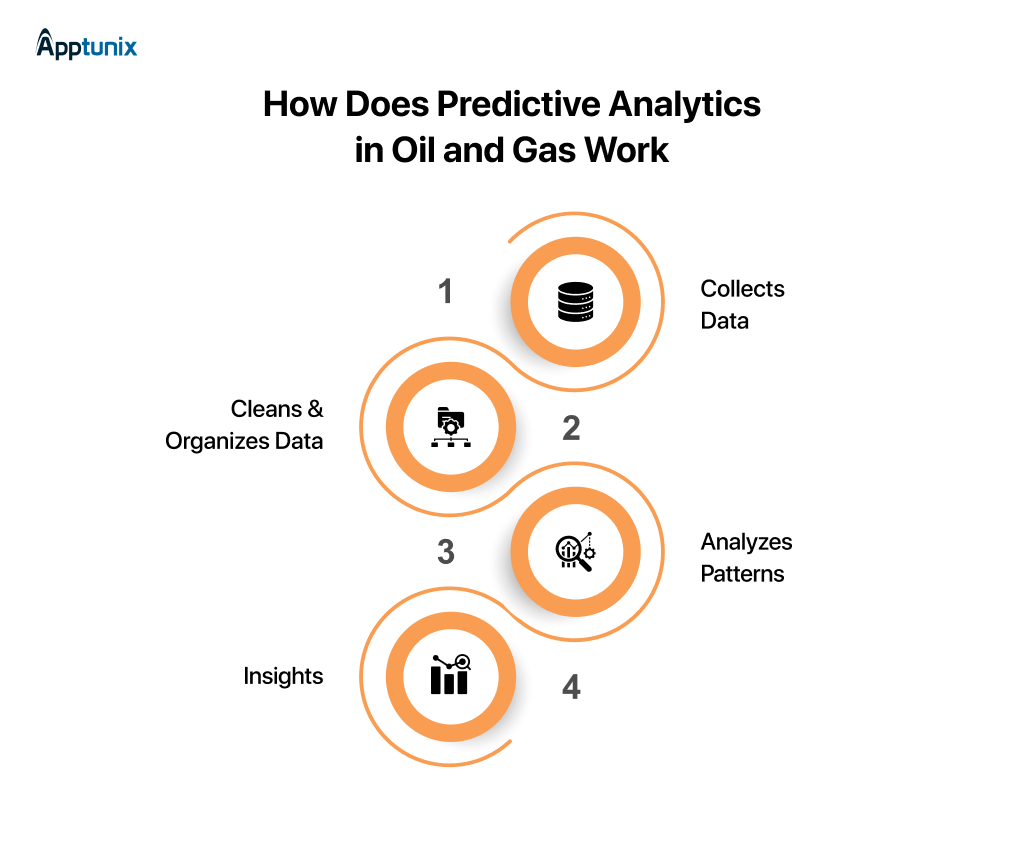
The trained models operate continuously in the background, generating alerts and recommendations via real-time dashboards that operations teams can use in their work. The simple solution brings about a major transformation. You create a scheduled maintenance window that prevents equipment breakdowns instead of waiting for problems to occur. The transition from reactive to predictive measures brings organizations benefits exceeding a million dollars.
Several forces are pushing predictive analytics in oil and gas and hiring AI app development services. Here’s why-
Organizations that operate offshore experience unplanned downtime for 27 days each year, and each day of downtime results in a financial loss of $ 1.37 million. The equipment remains nonoperational, resulting in a financial loss of approximately $ 37 million per platform each year. The implementation of predictive technologies enables organizations to achieve a 30 percent decrease in unplanned downtime, which results in substantial cost savings.
The global AI in oil and gas market was valued at around $7.64 billion in 2025 and is expected to reach $25.24 billion by 2034, growing at a CAGR of 14.2%. The operators show their most profitable return on investment through their spending on predictive maintenance, which makes up 37.6% of their total expenditures.
The majority of the world’s oil and gas infrastructure, which includes pipelines, offshore platforms, and refineries, has been operational for more than its original design lifespan since it was constructed several decades ago. The established inspection timetable fails to identify the gradual deterioration that sensors and machine learning technology can monitor throughout their operational period.
The market does not give you time to be slow. Price volatility means operators need to adjust production strategies and cost structures quickly. Machine learning in oil and gas enables that kind of dynamic decision-making. Quarterly planning cycles simply cannot keep up anymore.
Regulatory pressure is only getting tighter. Environmental compliance, methane emissions monitoring, spill prevention, and worker safety standards. The list grows every year. Digital transformation in oil and gas gives operators the real-time monitoring granularity needed to stay compliant before problems turn into violations.
And here is a number that probably tells the whole story: According to McKinsey, advanced analytics in oil and gas has delivered returns of 30 to 50 times the investment when implemented effectively.
Most offshore platforms are currently operating at only around 77% of their maximum utilization. That gap is where predictive analytics lives.
Predictive analytics creates value at every stage of the oil and gas value chain. Here are the use cases delivering the most measurable impact right now.
If there is one use case that defines the ROI of AI in the oil and gas industry, it is predictive maintenance.
The old way of doing maintenance in oil and gas was either reactive (fix it when it breaks) or preventive (replace it on a schedule, whether it needs it or not). Both approaches waste money. Reactive maintenance causes expensive unplanned downtime. Preventive maintenance replaces components that still have good life left in them.
Predictive maintenance in oil and gas solves both problems at once.
Drilling rigs need to identify three specific equipment problems, which include bit wear, seal failure, and bearing degradation, at their earliest point for their maintenance schedule needs. Continuous health monitoring for compressors and turbines enables operations to run longer between maintenance requirements while decreasing the chances of complete system breakdowns. The system enables operators to track pipeline corrosion and metal fatigue at specific locations, which would remain hidden until scheduled inspections occur many years later.
The results back this up. Studies indicate that predictive maintenance can reduce downtime by up to 83% in large-scale operations. Offshore facilities typically spend around $2 billion annually maintaining roughly 50,000 assets.
Drilling a well costs tens of millions of dollars. Getting it wrong is not just expensive; it can derail an exploration program for years.
Machine learning powered analytics enable upstream oil and gas operations to make better drilling decisions. AI systems now analyze 3D seismic volumes to identify structural and stratigraphic features, which used to require human interpretation through expert judgment. Seismic interpretation now operates through AI systems, which analyze 3D seismic volumes to identify structural and stratigraphic features more rapidly than any human interpreter team.
The results show up in the numbers. AI systems have helped improve exploration success rates by approximately 17% through better seismic data analysis. Reservoir models that integrate seismic data, well logs, production history, and pressure data help operators optimize well placement, completion designs, and recovery strategies, often without drilling additional wells.
Production optimization is a moving target. Wells decline over time. Reservoir pressure shifts. Facility constraints change. Market conditions evolve. Managing all of those variables manually across dozens or hundreds of wells is simply beyond human capacity at the speed required.
Real-time production optimization platforms use machine learning models to recommend adjustments that keep output high and costs low, covering everything from artificial lift settings to choke positions to separator pressures.
Over 200 AI systems were deployed in active production wells in 2023 alone, and those deployments increased oil recovery rates by an average of 12% across smart fields. A 3 to 5% efficiency improvement running continuously year over year compounds into enormous cumulative value.
The complete operations of oil and gas systems depend on pipelines, which function as their circulatory system, and any pipeline failure leads to total operational, financial, environmental, and reputational damage.
The existing leak detection methods fail to provide complete coverage, and they also take too long to address leaks. The monitoring system uses AI to monitor pipelines through pressure transient data, flow measurements, acoustic sensing, and satellite imagery to identify abnormalities in real time. The machine learning models enable the identification of normal operational behavior and initial leak patterns, which helps decrease both false alarms and actual incident detection failures.
AI systems have already helped refineries achieve a 25% decrease in unplanned downtime. More than 1100 offshore rigs currently operate AI-based equipment health monitoring systems. The year 2023 saw 180 North American and Middle Eastern upstream operations adopt AI-based tools for real-time anomaly detection, which processed 2 billion daily data points through AI algorithms across drilling activities.
The midstream and downstream sections of the oil and gas industry use downstream analytics to predict customer demand while they optimize supply chain operations from production sites to market destinations. The fuel demand forecasting utilizes machine learning models trained with historical demand data, weather patterns, macroeconomic signals, and logistics data, which achieves better forecasting accuracy than traditional models. The solution enables refiners and distributors to determine inventory placement, minimize storage expenses, schedule maintenance during periods of low demand, and handle emergencies with quickness.
In logistics, predictive models optimize shipping routes, terminal throughput, and fleet utilization, cutting transportation costs while improving delivery reliability.
The benefits of predictive analytics in the oil and gas industry go way beyond “we saved some money on maintenance.” Here is the real picture, with numbers to back it up.
Unplanned shutdowns are the single biggest cost driver in oil and gas operations. Predictive analytics flips the script entirely. Instead of scrambling to respond when something breaks at the worst possible time, your team schedules a fix during a planned window before the failure even happens.
The result? Companies that adopt predictive analytics in oil and gas reduce unplanned downtime events by 25 to 30% in year one alone. On offshore platforms that average $1.37 million per lost day, that is not a marginal improvement. That is a fundamental change in how your operation runs.
Right now, a lot of maintenance spending in the oil and gas industry is either too early or too late. You are either replacing parts that still have years of life in them, or you are calling in emergency crews at emergency rates to fix something that just failed.
Predictive maintenance in oil and gas changes entirely. The models tell you precisely when a component needs attention based on real-time equipment health, not a calendar. You only spend when you actually need to, and you never get caught off guard. That kind of precision in maintenance planning adds up to serious cost savings across a large asset base.
When you maintain assets based on their actual condition rather than a fixed schedule, they hold up better over time. This is not a theory. Companies that have implemented AI-powered predictive maintenance have extended equipment life cycles by an average of 18%, which directly reduces capital expenditure on replacements. Over a portfolio of aging assets, that number becomes significant very quickly.
One of the less talked-about benefits of oil and gas data analytics is the speed it injects into decision-making. When operations teams have real-time dashboards surfacing AI-generated recommendations, they are not waiting on manual reports or gut-feel calls. They act on data, immediately.
The scale of this impact is clear when you look at what major operators have achieved. Chevron credited AI initiatives with approximately $900 million in operational savings over three years. That kind of result does not come from a single use case. It comes from better, faster decisions being made consistently across the entire operation.
Fewer equipment failures naturally mean fewer safety incidents. But predictive analytics in oil and gas takes this further. Earlier anomaly detection in pipelines means a potential spill gets caught before it becomes an environmental event. Healthier equipment means workers in the field are exposed to fewer hazardous conditions. Predictable operations create a safer environment across the board, which also protects your company from regulatory and reputational risk.
Everything above feeds into this one. Operators that deploy AI-powered predictive analytics do not just reduce problems. They actively run better. Real-time production optimization keeps output high and costs low simultaneously. The data consistently shows a 15% improvement in overall production efficiency for companies that make this shift, and that is a number that compounds year over year.
No technology comes without hurdles, and predictive analytics in oil and gas is no exception. Companies that acknowledge these challenges upfront and plan for them are the ones that actually get to the ROI. The ones that skip this step are the ones that end up with expensive pilots that never scale.
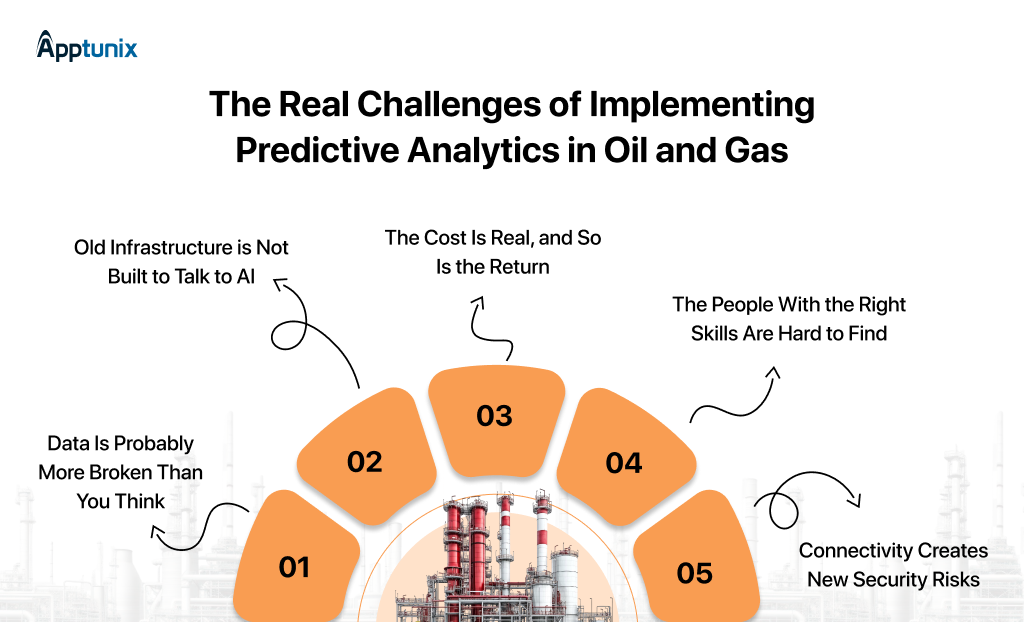
This is the challenge that kills more predictive analytics projects than anything else. Machine learning in oil and gas is only as good as the data it learns from. And in most oil and gas organizations, that data is scattered across dozens of disconnected systems, SCADA platforms, ERP tools, CMMS databases, historian archives, each with different formats, different timestamps, missing values, and no consistent standard.
Before you build a single model, you need to fix this. Centralizing and cleaning your operational data is not glamorous work, but it is the foundation that everything else depends on. Skipping it is like building a rig on sand.
A lot of the operational technology running oil and gas assets today, pumps, compressors, pipeline systems, was designed and installed before anyone imagined connecting it to a cloud analytics platform. It does not have native data outputs. It does not integrate cleanly with modern software. Getting that equipment to communicate with a data analytics for oil and gas platform requires real engineering work, sensor retrofits, edge computing layers, and careful integration between operational technology and information technology systems.
This is solvable. But it takes time and investment, and it needs to be scoped honestly before a project begins.
Implementing a genuine oil and gas predictive analytics solution is not cheap. Depending on scope and asset complexity, an average AI project in upstream or midstream operations can require an initial investment anywhere from $500,000 to over $5 million. That is not a number to gloss over.
What is also true is that the ROI on predictive analytics in oil and gas, when implemented well, is among the strongest in enterprise technology. McKinsey has documented returns of 30 to 50 times investment in the most effective deployments. The math works. But you need to go in with a clear-eyed understanding of what the upfront commitment actually looks like.
Only 27% of oil and gas firms have access to in-house AI engineers or data scientists. That is a significant constraint. The combination of machine learning expertise and actual oil and gas operational knowledge is genuinely rare. You need people who understand both the algorithm and the asset.
This is exactly why partnering with a technology provider that brings both capabilities together matters so much. Trying to build everything in-house from scratch is slow, expensive, and high-risk when that internal talent base does not yet exist.
Every new connection between an operational system and a cloud analytics platform is a potential entry point for a cyberattack. The oil and gas sector reported over 1,800 cyber intrusion attempts targeting AI-enabled platforms in 2023 alone. As digital transformation in oil and gas accelerates and more drilling rigs, pipelines, and production assets become connected, the cybersecurity stakes go up proportionally.
This is not a reason to avoid the technology. It is a reason to build your cybersecurity strategy before you deploy it, not after.
You do not need to understand every technical detail to benefit from this. But knowing what is under the hood helps you ask the right questions and make better decisions about implementation. Here are the core technologies driving data analytics for oil and gas today.
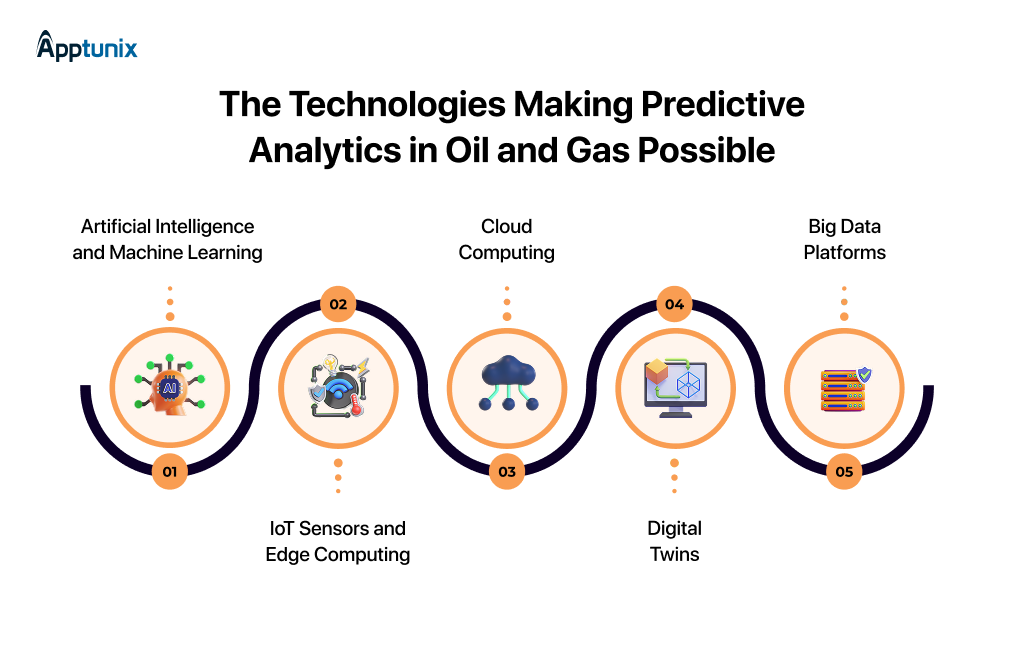
AI and machine learning are what turn raw operational data into predictions that actually mean something. Techniques like anomaly detection, time-series forecasting, and computer vision are being applied across every segment of oil and gas operations, from reservoir modeling to refinery optimization. Machine learning in oil and gas alone accounted for nearly 49.2% of the entire AI and ML oil and gas market in 2025. That concentration in ML tells you where operators are finding the most consistent, scalable value.
You cannot predict what you cannot see. IoT sensors embedded in equipment are what generate the continuous real-time data streams that machine learning models depend on. The cost of industrial sensors has fallen dramatically in recent years, which means it is now economically practical to instrument assets that had no monitoring capability before. Edge computing adds another layer by processing data locally on the asset before it is transmitted, which reduces bandwidth requirements, cuts latency, and keeps critical data flowing even in remote or offshore environments where connectivity is limited.
Oil and gas operations generate enormous volumes of data every single day. Storing, processing, and running analytics on that data at scale requires cloud infrastructure. Modern cloud platforms offer purpose-built services for time-series data, ML model training and deployment, and real-time analytics dashboards. They also enable oil and gas predictive analytics solutions to scale from a single facility pilot to a full enterprise deployment without rebuilding the architecture from scratch.
A digital twin is a real-time virtual replica of a physical asset. It mirrors the actual operating state of a compressor, a well, or an entire production platform in real time, and it lets you simulate scenarios, test configurations, and model failure modes before you touch anything in the real world.
For AI-based predictive maintenance for oil rigs, digital twins are a game-changer. Your maintenance team can visualize exactly how equipment health is trending, simulate what happens if a particular component degrades further, and validate the best intervention approach, all before sending anyone into the field. That capability removes a huge amount of uncertainty from maintenance decision-making and makes every intervention more precise.
All of the above technologies depend on one thing: a solid data foundation. Big data platforms handle the ingestion, storage, and processing of the structured and unstructured data that oil and gas operations produce at scale. The more effectively your organization breaks down data silos and centralizes operational data into a unified platform, the more accurate, reliable, and actionable your oil and gas data analytics output becomes. This is the infrastructure layer that separates organizations running effective AI programs from those running expensive experiments.
Implementation fails most often not because the technology does not work, but because the organizational and data foundations are not in place first. Here is a practical roadmap.
Start with the problem you want to solve, not the technology you want to deploy. Is the goal to reduce unplanned downtime? Lower maintenance costs? Improve production efficiency? Specific, measurable objectives shape every decision that follows.
Audit what data you have, where it lives, how reliable it is, and what gaps exist. Build the data infrastructure before you start building models. This is the step that most implementation failures skip or rush.
The choice of platform should be driven by your technical requirements, data environment, and internal capabilities. Be skeptical of vendor claims that do not account for the complexity of your specific data environment.
This is where data scientists work alongside engineers, operators, and reliability specialists who understand what the data actually means in practice. A vibration anomaly model built without rotating equipment expertise will generate too many false positives to be useful.
The best analytics platform does nothing if operations teams cannot access insights through the systems they already use. Integration with SCADA dashboards, CMMS work order systems, and ERP platforms is what turns predictions into operational action.
Predictive models are not a set-and-forget solution. Equipment behavior changes over time. Models need to be monitored for performance degradation and periodically retrained. Build this ongoing overhead into your planning from the start, and create a clear path to scale successful pilots across your broader asset portfolio.
Building a real predictive analytics capability in oil and gas takes more than off-the-shelf software. It takes a team that understands both the technology and the operational realities of the industry, and knows how to bring them together into something that actually works in the field.

Apptunix is an offshore product engineering company with a strong track record in AI, machine learning, and enterprise software development. We work with energy and industrial clients across the globe, with a dedicated presence in Dubai that puts us close to the heart of the Middle East oil and gas market.
Our Dubai office positions us directly within one of the world’s most active oil and gas regions. The Middle East accounts for nearly 31% of global oil production, and the push toward digital transformation in oil and gas across the GCC is accelerating fast. Being on the ground here means we understand the regulatory environment, the infrastructure realities, and the operational culture that shapes how predictive analytics solutions need to be built and deployed in this region. We are not advising from a distance. We are right here.
Our team brings together data scientists, AI engineers, IoT specialists, and industry domain experts to deliver oil and gas predictive analytics solutions that are built around your assets, your data, and your goals, not around a generic product template.
We build AI-powered predictive maintenance systems that monitor equipment health in real time and surface calibrated alerts for your specific failure modes. We develop real-time data analytics dashboards that give operations teams a unified view of asset health, production performance, and risk indicators, both in the control room and out in the field.
One of our energy sector clients was dealing with recurring unplanned shutdowns on critical rotating equipment, with maintenance teams constantly in reactive mode and no visibility into failure patterns across their asset base. Apptunix built a custom predictive maintenance platform that integrated sensor data from their existing operational technology, trained ML models on three years of historical failure and maintenance records, and delivered a real-time dashboard that flagged at-risk assets with enough lead time to plan interventions properly.
Within the first operating year, the client reduced unplanned downtime events significantly, cut emergency maintenance callouts, and shifted their entire maintenance operation from reactive to predictive. The data-driven decision-making capability they built in that first phase became the foundation for a broader digital transformation in oil and gas across their portfolio.
Most technology projects fail not because of bad technology but because no single partner owns the full process. Apptunix does. We take responsibility, from the initial data assessment and strategy phase through model development, system integration, deployment, and ongoing optimization. You get one accountable team from start to finish, not a chain of vendors pointing at each other when something does not work.
Every engagement starts with defined, measurable business outcomes. Reduction in unplanned downtime, maintenance cost savings, and production efficiency targets. We agree on those numbers upfront, and we build toward them. That is what makes the difference between an expensive pilot and a solution that delivers real ROI.
The oil and gas companies that will define the next decade of industry performance are not necessarily the ones sitting on the best reserves. They are the ones most intelligently connecting operational data to decision-making.
Predictive analytics in oil and gas has moved from experimental to essential. Over 92% of oil and gas enterprises worldwide have either started investing in AI or plan to do so. The use cases are proven, the ROI is documented, and the technology is mature.
What separates companies that capture the value from those that do not is execution. The right data foundations, the right models, and the right partner to bring it all together into something that actually works in the field.
The window to gain a first-mover advantage is still open. But it is not open forever.
Looking to implement predictive analytics in your oil and gas operations? Apptunix helps energy companies build AI-powered solutions designed for real-world performance. Let us turn your operational data into measurable ROI.
Q 1.What is predictive analytics in oil and gas and how does it work?
Predictive analytics in oil and gas uses AI, machine learning, and real-time sensor data to forecast equipment failures and operational risks before they happen. It continuously monitors asset health, spots patterns in live and historical data, and alerts your team early enough to act. Instead of reacting to problems, you prevent them.
Q 2.What are the most valuable oil and gas data analytics use cases right now?
The highest-ROI oil and gas data analytics use cases are predictive maintenance, production optimization, pipeline leak detection, reservoir modeling, and downstream demand forecasting. Predictive maintenance consistently tops the list because a single avoided failure can save up to $750,000 and prevent days of costly unplanned downtime.
Q 3.How is machine learning in oil and gas different from traditional data analysis?
Traditional analysis tells you what happened. Machine learning in oil and gas tells you what is going to happen next. It identifies complex patterns across thousands of variables simultaneously and keeps getting more accurate as new data comes in. No traditional analytics model can do that at the same speed or scale.
Q 4.What does digital transformation in oil and gas actually look like on the ground?
It looks like real-time dashboards showing live equipment health, automated failure alerts before breakdowns occur, and maintenance teams planning work based on actual asset condition rather than a fixed calendar. Digital transformation in oil and gas is less about the technology and more about how it changes decisions made every single day.
Q 5.Is AI in the oil and gas industry only relevant for large operators?
Not anymore. While large operators grabbed the early headlines, mid-size and independent companies are increasingly adopting AI in the oil and gas industry through modular, scalable solutions. The smartest approach is starting with one focused use case like predictive maintenance, proving the ROI, and expanding from there.
Q 6.What ROI can companies realistically expect from oil and gas predictive analytics solutions?
McKinsey has documented returns of 30 to 50 times the investment on advanced analytics in oil and gas. Operators typically report 25 to 30% reductions in unplanned downtime, 18% longer equipment life cycles, and up to 15% production efficiency gains. Chevron credited roughly $900 million in savings over three years to AI initiatives alone.
Q 7.What are the biggest barriers to adopting data analytics for oil and gas operations?
The three most common barriers are poor data quality, legacy system integration, and a shortage of AI talent. Only 27% of oil and gas firms currently have in-house data science capability. Partnering with an experienced oil and gas technology provider is the fastest way to overcome all three without building everything from scratch internally.
Q 8.How does Apptunix build predictive analytics solutions for oil and gas companies?
Apptunix starts with your business objectives, not the technology. We audit your data environment, identify your highest-impact use cases, then build custom oil and gas predictive analytics solutions around your specific assets and infrastructure. Our team owns the full process from strategy through deployment and ongoing optimization, so you never have to stitch together multiple vendors to get a working solution.
Get the weekly updates on the newest brand stories, business models and technology right in your inbox.
Reena Bhagat, the CTO and Head of AI at Apptunix, is a seasoned technology strategist with a deep-rooted expertise in emerging technologies. With a focus on AI/ML integration, product engineering, cloud management, she leads the technical vision for high-performance SaaS infrastructures. Reena is recognized for building secure, scalable, and decentralized systems that solve real-world complexities. Her passion lies in leveraging data science and future-tech to create resilient digital products, making her a trusted authority for organizations looking to lead in the age of intelligent automation.
10 Views 16 min July 31, 2026

47 Views 16 min July 21, 2026
97 Views 16 min July 2, 2026
Book your consultation with us.
Book your consultation with us.


One Central, The offices 3, Level 3, DWTC, Sheikh Zayed Road, Dubai
+971 50 782 1690


Offer Ends Soon
Get a quick expert response in under 5 minutes.