
Compliance-Ready Software Development in Saudi Arabia: Laws, Standards and Best Practices
38 Views 8 min July 15, 2026

With over 20+ years of experience in driving global digital initiatives, Nikhil Bansal is the CEO & Director of Apptunix. He specializes in orchestrating large-scale digital transformations, enterprise-grade software solutions, and high-level business strategies that redefine industry standards. Nikhil is known for his ability to bridge the gap between complex business challenges and innovative technology, helping Fortune 500 companies and startups alike achieve sustainable growth. A visionary leader, he empowers enterprises to navigate the digital landscape with agile, ROI-focused models and future-ready business strategies.
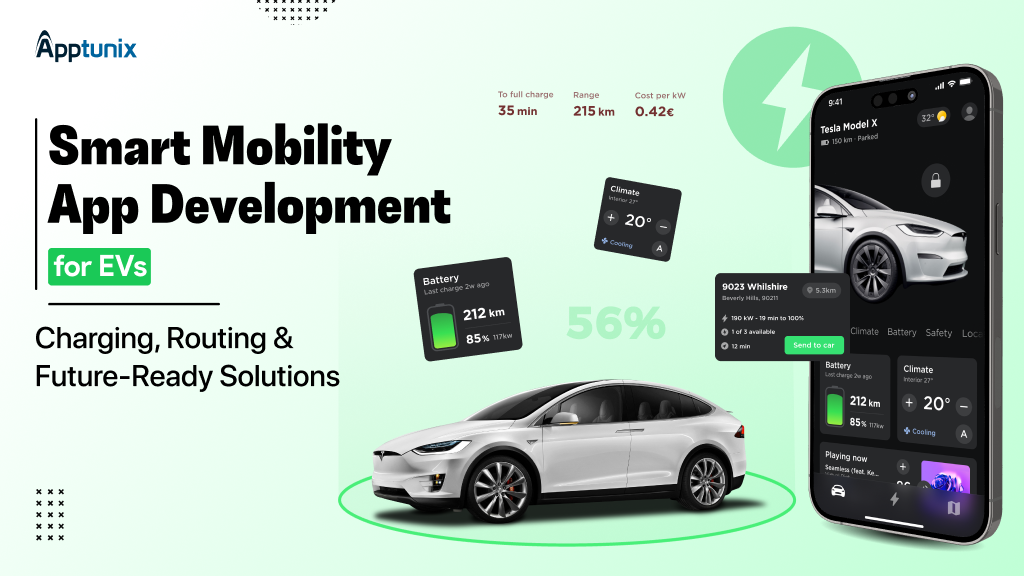
Before, the majority of electric vehicle owners constantly worried about charging station availability, their car’s battery range, and unexpected detours when they plan a road trip. But now the time has changed with smart mobility app development for EVs, charging, and routing.
Travelling long distances in an EV has become quite normal today. What once looked complex is now becoming seamless as smart mobility apps guide drivers with real-time insights, ensuring smoother and more confident trips.
They are reshaping how people experience EVs by locating nearby charging stations and optimizing routes based on battery levels, traffic, and road conditions. This enhances the driving experience but also supports the growing EV ecosystem by eliminating range anxiety and improving overall efficiency.
In 2026, the revenue of the electric vehicle market stands at $996.3 billion. This high demand for EVs continues to rise, so businesses are rapidly investing in advanced mobility technologies to stay competitive in 2026 and beyond.
However, the question is, how to build a smart mobility app? Well, this blog will guide you through the development process, features to integrate, and pricing for future-ready mobile app development solutions in 2026.
So let’s get into it!
Smart mobility app development involves developing a digital tool that enables EVs to optimize their travel.
It incorporates features like GPS, live information, and smart algorithms for an improved driving experience, charging access, and navigation.
Smart mobility applications are developed to make transportation easier by linking users, vehicles, and infrastructure on a single platform. They offer features like
This makes travel smarter, faster, and more convenient for EV users.
EV charging and routing solutions help drivers locate charging stations in the vicinity and verify station availability and route accordingly, based on battery range. This means no range anxiety and no jerky driving.
Smart mobility apps also enable the EV ecosystem by linking drivers to
They encourage EV adoption by making electric mobility more reliable, accessible, and user-friendly.
Smart mobility solutions for EVs integrate key features like intelligent routing, real-time data, and seamless integrations to enhance the overall user experience. Let’s find out the five main smart mobility and EV charging app features in 2026:
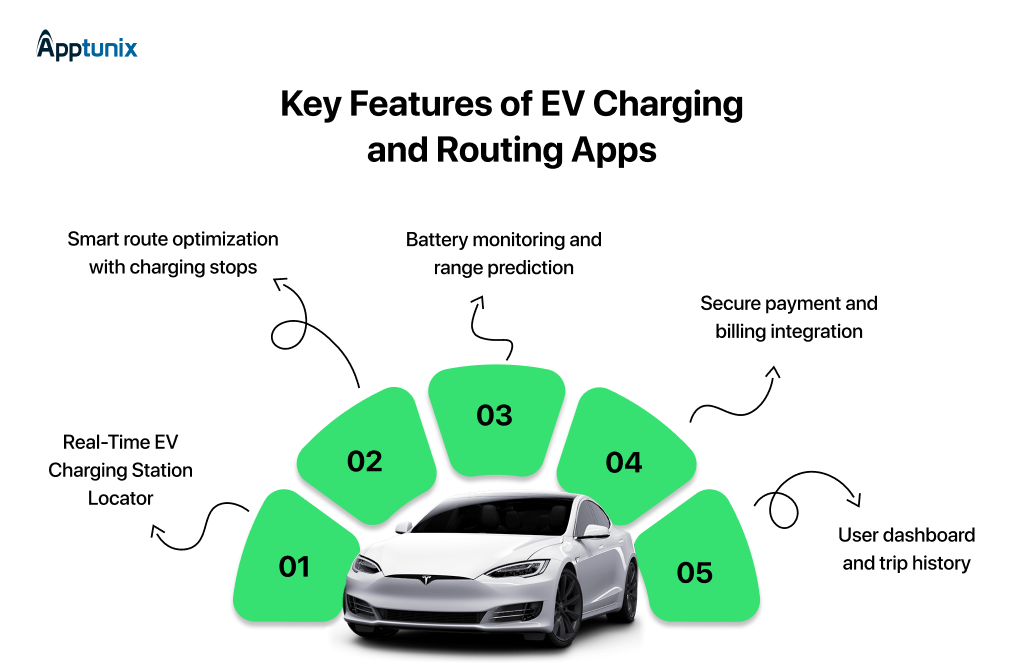
1:Real-Time EV Charging Station LocatorIt helps users find nearby EV charging stations using GPS and live data.
This charging station locator allows drivers to make quick decisions and avoid unnecessary delays during traveling by showing station availability, pricing, connector types, and distance.
2:Smart Route Optimization with Charging StopsSmart mobility and electric vehicle charging solutions provide the most efficient routes based on traffic conditions, availability of batteries, and location of charging stations.
It automatically plots the best route it can, it optimizes the charging stops, and it guarantees a smooth trip with no disturbing or unexpected obstacles.
3:Battery Monitoring and Range PredictionThe battery monitoring and range prediction features allow drivers to check battery status in real-time. It predicts the range based on driving habits, traffic, and road conditions.
Provides information to the drivers on how far they can go and when they can refuel, which ultimately improves trip planning and efficiency.
4:Secure Payment and Billing IntegrationEV charging station applications provide a safe payment and billing system, allowing customers to pay for charges directly from the app.
It offers various payment options, creates virtual invoices, and secures transactions. This ensures that users have a smooth and convenient charging experience.
5:User Dashboard and Trip HistoryThe dashboard feature is useful to gain insights into charging sessions, past trips, energy use, and pricing.
This allows them to monitor their consumption, manage their expenses, and determine their usage to optimize their driving experience.
Well, a routing or EV charging app operates by combining intelligent algorithms, real-time data, and seamless integrations. The system gives charging recommendations and delivers accurate navigation by analyzing multiple data points.
Such digital solutions for EVs, charging, or routing ensure a smooth and efficient driving experience. Let’s find out how a real-time EV charging station app works:
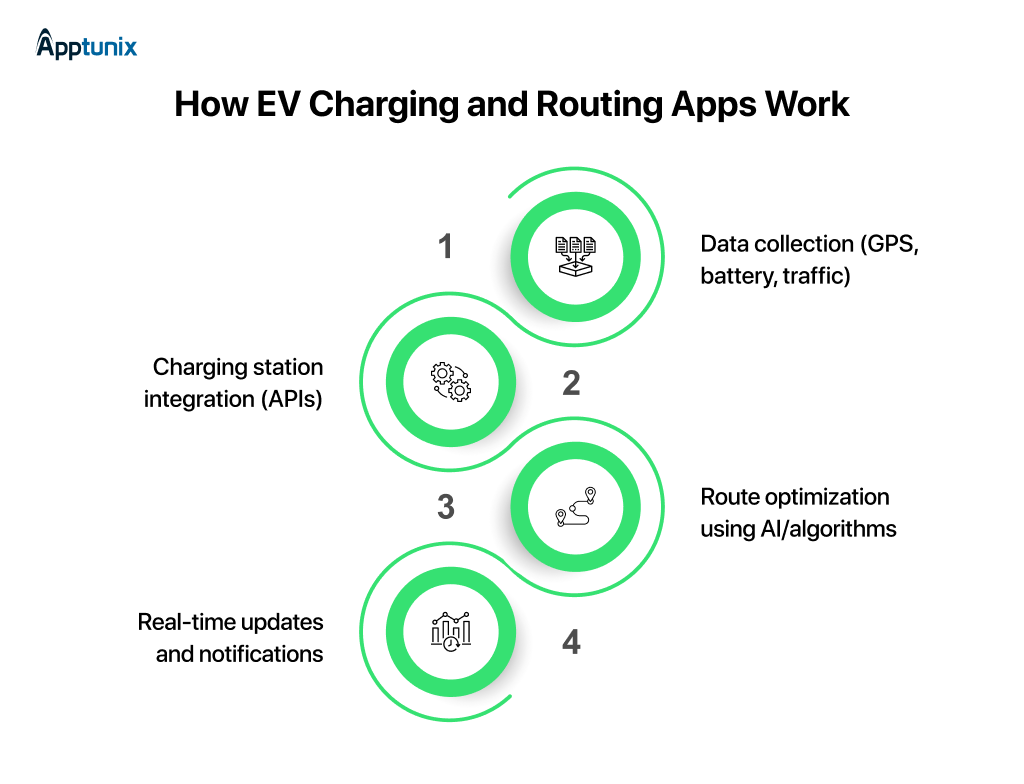
#1:Data CollectionSmart mobility or EV charging apps collect real-time data from various sources like
Data collection basically forms the foundation for accurate decision-making and route planning.
#2:Charging Station IntegrationSmart mobility solutions for EVs integrate with multiple station networks using APIs to fetch live information about
Charging station integration ensures users always have access to updated and reliable charging options.
#3:Route Optimization Using AI/AlgorithmsMobility solutions for electric vehicles also use advanced algorithms that analyze distance and battery range. They analyze
Such apps identify optimal charging stops, helping users avoid delays and complete their journey without interruptions.
#4:Real-time Updates and NotificationsElectric vehicle charging solutions continuously provide users with updates whenever there is a change in
Real-time notifications help drivers make quick decisions and adapt their routes as needed during the journey.
From user needs to technology integration, electric vehicle app development demands a structured approach to successfully launch the application. Every single process plays a major role in ensuring the application delivers a seamless and reliable experience to users.
EV charging app development steps include:
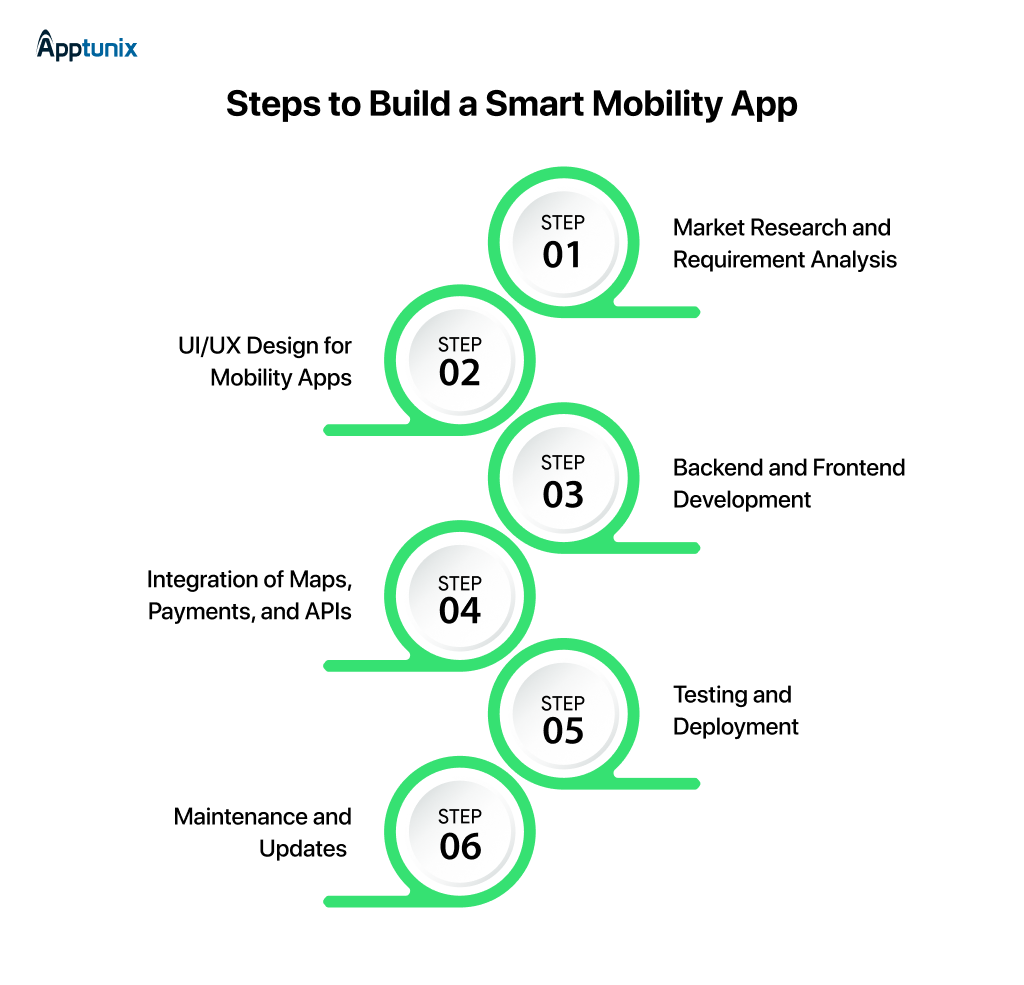
Step 1:Market Research and Requirement AnalysisRequirements analysis and market research are the foundation of the entire development process. It involves
In this phase, you should be clear with your application requirements since it will help you define the application’s functionality, goals, and overall roadmap.
Step 2:UI/UX Design for Mobility AppsOnce you and your EV app development company are done with the roadmap of your application, they design a simple and intuitive solution for user engagement. Designers focus on
A seamless UI/UX design goal is to ensure users can quickly access features like routes, charging stations, and payments without confusion.
Step 3:Backend and Frontend DevelopmentBackend and frontend development involve developing the core functionality of the application.
The frontend handles what users see and interact with within the application. On the other hand, the backend manages servers, data, and system logic. Together, they both ensure the application runs smoothly and efficiently.
Step 4:Integration of Maps, Payments, and APIsIntegrating payments or APIs that make the application fully functional is crucial. Top smart mobility app developers integrate imperative services like
It ultimately enhances usability and provides real-time, accurate information.
Step 5:Testing and DeploymentOnce the EV navigation app development team is done with third-party integrations, it’s time to test before launching it. They generally test for
This helps in identifying and fixing bugs or issues. Once the team ensures that everything is optimized, the app is ready to deploy on platforms like the Play Store and App Store for users.
Step 6:Maintenance and UpdatesThis is the last phase that is, of course, followed by developers after launching the application. Regular updates and maintenance are necessary to keep the app running smoothly. This includes
To build a high-performing smart mobility app for EVs, developers require a combination of modern technologies that ensure scalability and real-time data processing, along with high performance. Choosing the right app frameworks for iOS and Android helps deliver accurate routing, seamless integrations, and a smooth user experience.
As of 2026, the EV charging and smart mobility app development costs range between $20,000 and $300,000 based on project complexity and feature integration.
The pricing ranges from very low to high because the application can be developed in three tiers: a basic application, a mid-level application, or a highly complex solution.
Examine the different app complexities with estimated project costs and timelines:
The cost and timeline of EV app development depend on several technical and business factors. Understanding these helps you plan better, control your budget, and build a scalable EV solution. The factors include
Well, there are several ways to save money during EV charging app development. Let’s get a brief of all:
Start with an MVP and launch with only essential features, and add other features later as the user base grows.
Pick the right cross-platform frameworks like React Native or Flutter, and launch the app on both Android and iOS from a single codebase.
Always go for third-party APIs instead of developing from scratch to save money.
Don’t integrate useless features; choose features wisely. Pick features based on user needs and business goals, and customize them later as business needs change.
Do not forget to choose a scalable cloud infrastructure to avoid future rework.
Pick the right smart mobility app development company with high experience and expertise. This is good for long-term cost savings.
Testing can be expensive if the QC team finds costly fixes. So plan proper testing early and reduce costly fixes later.
Pick the best UI/UX designer who designs the best application initially, and avoid unnecessary redesign efforts later.
It’s a fact that smart mobility app development for EVs, charging, or routing is reshaping how businesses and users interact with electric vehicles. Such solutions are making EV adoption more practical and efficient by offering features like intelligent routing, real-time tracking, and seamless integrations.
Investing in smart mobility solutions in 2026 is the smart move as the demand for sustainable transportation is growing rapidly. Investing in this infrastructure is not an option, but it’s a strategic move for future growth.
However, you can’t invest in mobility solutions for electric vehicles from anywhere; you have to choose a reliable app development company like Apptunix.
Known for offering complete mobility solutions, Apptunix ensures you get a scalable and high-performance app tailored to your business needs. The company provides everything you need, from ideation to deployment.
So what are you waiting for? Turn your EV app development vision into a reliable and market-ready solution now and generate money like never before.
Q 1.How to build an EV charging app?
The steps that you must include to build smart mobility solutions for EVs are as follows:
Q 2.How much does it cost to develop an EV charging app?
As of 2026, EV charging app development costs range from $20,000 to $300,000+ for basic, mid-level, and complex app solutions.
MVP/Basic App: $20,000-$40,000
Mid-Level App: $20,000-$120,000
Advanced App: $120,000-$300,000
Q 3.What are the features of smart mobility apps for electric vehicles?
The core EV charging app features include
This ensures efficient navigation, seamless charging and an overall improved EV driving experience.
Q 4.What is EV route planning and charging app development?
EV route planning and charging app development involves creating apps that help users find charging stations, plan efficient routes based on battery range, and access real-time updates. These apps ensure smooth, reliable, and optimized electric vehicle journeys.
Q 5.What are the benefits of smart mobility solutions for EVs?
Smart mobility solutions improve navigation, reduce range anxiety, and enhance charging accessibility. They offer real-time insights, optimize routes, support efficient energy use, and deliver a seamless driving experience, making electric vehicles more practical and user-friendly.
(2 ratings, average: 5.00 out of 5)
Get the weekly updates on the newest brand stories, business models and technology right in your inbox.
With over 20+ years of experience in driving global digital initiatives, Nikhil Bansal is the CEO & Director of Apptunix. He specializes in orchestrating large-scale digital transformations, enterprise-grade software solutions, and high-level business strategies that redefine industry standards. Nikhil is known for his ability to bridge the gap between complex business challenges and innovative technology, helping Fortune 500 companies and startups alike achieve sustainable growth. A visionary leader, he empowers enterprises to navigate the digital landscape with agile, ROI-focused models and future-ready business strategies.
38 Views 8 min July 15, 2026

128 Views 8 min June 26, 2026

248 Views 8 min June 9, 2026
Book your consultation with us.
Book your consultation with us.


One Central, The offices 3, Level 3, DWTC, Sheikh Zayed Road, Dubai
+971 50 782 1690


Offer Ends Soon
Get a quick expert response in under 5 minutes.