
Compliance-Ready Software Development in Saudi Arabia: Laws, Standards and Best Practices
83 Views 10 min July 15, 2026

Nishant Saini is a business researcher and content strategist specializing in ROI analysis for the tech, SaaS, and digital-first industries. With a knack for breaking down complex, jargon-heavy technical concepts, he transforms intricate data into clear, actionable insights that help founders, businesses, and investors make confident scaling decisions.
Nishant’s expertise spans business research, SEO, product guides, thought leadership, and brand storytelling. By blending deep technical research with a modern, conversational tone, he creates high-impact content that builds trust and drives engagement.
Core Expertise:
Tech & SaaS: Mobile apps, digital products, and AI-driven automation.
Strategic Content: Product explainers, comparison guides, and home networking/connected devices.
ROI-Focused Writing: Simplifying complex systems into user-friendly, high-conversion assets.
The benefits of outsourcing web development are measurable. You get lower development costs, faster launch cycles, and access to specialized talent your local market may not offer. You also gain structured quality assurance, elastic team capacity, and the operational headroom to stay focused on growth. Whether you are a seed-stage startup or a scaling enterprise, outsourcing web development gives you a delivery infrastructure that is ready on day one.
Here is a number that puts the conversation in context about IT outsourcing. Global IT outsourcing is growing toward $1.22 trillion by 2030 (Grand View Research). North America alone accounts for more than 32% of that demand. The primary drivers? Cost efficiency, specialized skills, and faster delivery on digital products.
This is not a trend driven by budget pressure alone. It reflects a structural shift in how companies build software. Businesses across fintech, healthcare, retail, and logistics are choosing outsourcing as a deliberate engineering strategy.
If you are evaluating whether to outsource web development, this guide covers the key benefits of outsourcing web development. It also helps businesses reduce costs, access specialized expertise, accelerate development, and scale efficiently.
Before examining the benefits, it helps to define exactly what the model involves. Web development outsourcing is often conflated with general IT outsourcing. That confusion leads to poor vendor selection.
Outsourcing web development means hiring an external team to design, build, and maintain your website or digital product. Instead of recruiting and managing internal staff, you partner with a specialized web development outsourcing company. They own the technical execution. You retain strategic direction and business ownership.
What that typically includes:
The key distinction: web development outsourcing is scoped specifically to web-based products. Your partner handles delivery accountability. You handle growth priorities.
If you are looking into outsourcing mobile app development, discover the benefits, costs, and factors that can impact your decision.
Now that you know what it means, let us get into exactly why it works so well.
Knowing the benefits is one thing. Understanding why outsourcing website development makes sense for your business right now is another. These three reasons are driving more companies to outsource website development this year, and they are hard to ignore.
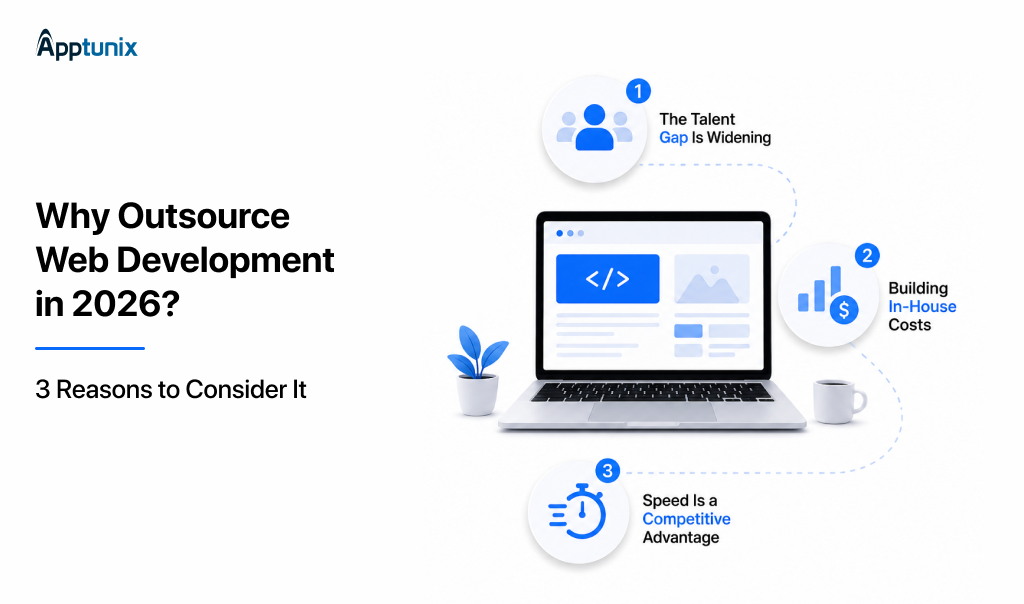
Demand for US tech talent is set to hit 7.1 million jobs by 2034, up from 6 million in 2023. At the same time, 70% of technical workers had multiple job offers when they accepted their last role. Local hiring means competing in that market every single time. Salaries go up. Timelines stretch. Qualified developers go elsewhere.
Outsourcing removes that constraint entirely. You access vetted, skilled talent from a global pool. Fast.
The real cost of an in-house developer runs 1.3 to 1.5 times their base salary. That includes benefits, payroll taxes, equipment, licenses, and management overhead. A developer earning $130,000 annually costs your business $170,000–$195,000 per year in real terms. Deloitte also confirms that nearly 90% of tech leaders still report hiring and retaining developers as a major challenge, even after high-profile industry layoffs.
The company that ships first wins. Every month spent hiring is a month your competitors are gaining ground.
Outsourcing compresses your development timeline. You launch, iterate faster, and scale faster. For proof, see how outsourcing accelerates mobile and web delivery.
The benefits of outsourcing web development extend well beyond cost reduction. Companies that make this shift gain faster launch cycles, access to specialist talent, and delivery systems built through years of real-world projects. Here are the ten advantages of outsourcing website development. 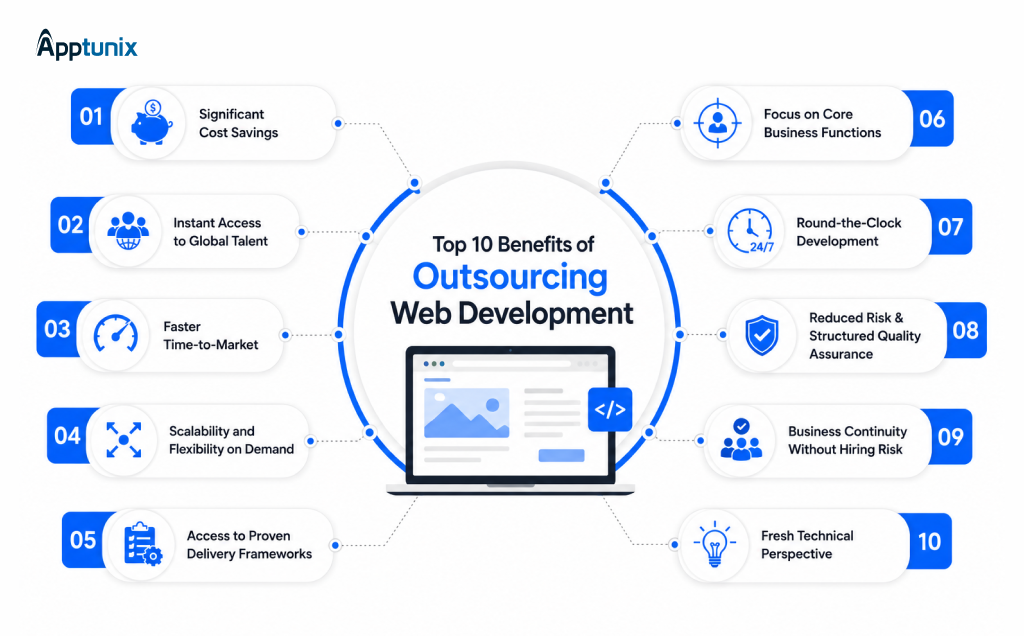
Cost savings are the most frequently cited reason businesses start exploring outsourcing. And the numbers are more compelling than most expect.
In-house development costs far more than the salary line shows. Recruitment fees, onboarding, employee benefits, software licenses, and office overhead all compound on top of base compensation.
Outsourcing web development changes that equation immediately. Web developer rates vary meaningfully by region:
| Region | Average Hourly Rate |
|---|---|
| North America | $100–$250/hr |
| Western Europe | $80–$200/hr |
| Eastern Europe | $30–$70/hr |
| Latin America | $35–$75/hr |
| India & Southeast Asia | $25–$60/hr |
Note: Rate ranges vary by region, project scope, tech stack, and team seniority.
Companies using offshore web development services save 30–60% compared to in-house teams. That difference adds up to tens of thousands of dollars on long projects.
Your local hiring market is not the whole market. It just feels that way when you are constrained to it.
Niche technical skills are unevenly distributed across geographies. Skills like microservices architecture, real-time data pipelines, AI-integrated applications, and advanced API ecosystems are hard to find locally. One of the most practical benefits of outsourcing web development is that geography stops being a hiring constraint. You can source the specific specialist your project requires, wherever they are based.
Consider a healthcare company needing a HIPAA-compliant patient portal built on a React and Node.js stack with real-time scheduling. That combination of domain knowledge and technical depth may simply not exist within a reasonable commute. An established offshore development company with cross-industry experience can assemble that team in days.
That breadth of exposure, across industries, tech stacks, and project types, directly improves the technical decisions made on your project.
Recruiting and onboarding an in-house developer takes two to four months at minimum. That is before a single line of code is written.
An outsourced team can be briefed, aligned on requirements, and actively building within days of contract signing.
For a retail company trying to launch ahead of a peak season, or a startup racing a competitor to market, that two-to-four-month difference is not a minor convenience. It is a compounding competitive gap that widens the longer it is ignored.
Product timelines are rarely linear.
A launch phase needs ten developers. A post-launch maintenance phase needs two. An outsourced team adapts to that rhythm without friction. You adjust resources based on project phase, budget shifts, or changing business priorities. No permanent overhead from full-time hires you no longer need.
This built-in flexibility is especially valuable for:
Established outsourcing partners do not just supply developers. They bring the operational infrastructure around development.
That includes sprint management, QA protocols, code review processes, security frameworks, and deployment pipelines. All of it is already tested and functioning. When you work with an experienced web development outsourcing company, you are not building those systems from scratch. You are plugging into frameworks refined across hundreds of client projects.
An agency that has shipped fifty e-commerce platforms has already solved the architectural edge cases your team would spend weeks working through on a first build. That accumulated operational maturity reduces risk, compresses delivery timelines, and lifts quality from the first sprint.

Leadership attention is finite. Every hour your team spends managing web development is an hour not spent on strategy, customer relationships, or revenue generation.
Outsourcing web development returns that focus. Technical execution is handed off to specialists who are accountable for delivery. Your team directs energy toward the decisions that actually compound over time.
Businesses that maintain this separation between core competency and technical execution consistently outperform those that try to own every function internally.
Time zone differences are often treated as a coordination challenge. Managed well, they function as a delivery accelerator.
A US-based product company working with a team in Eastern Europe or Southeast Asia regularly starts the workday with completed pull requests, resolved support tickets, and features ready for review. For mission-critical applications, that continuous coverage means your product is never idle, waiting for business hours to resume.
A logistics platform handling real-time shipment data benefits directly from 24-hour monitoring and response coverage. An in-house team working a single shift simply cannot match that.
Every development project carries risk. What outsourcing web development changes is how that risk is distributed and governed.
Established outsourcing companies bring:
All of it comes as part of standard delivery. Risk is shared and governed by contract, not absorbed entirely by your business.
They have already navigated the security gaps, integration failures, and scope misalignments that derail first-time builds. Your project benefits from that hard-won experience without having to generate it internally.
In-house hiring takes two to four months at minimum. If a developer leaves mid-project, that clock resets entirely. Your roadmap stalls while the market absorbs your time.
Outsourcing removes that exposure. The vendor manages staffing, backfills gaps, and keeps delivery moving. Your project does not depend on any single hire staying put.
What this looks like in practice:
For a fintech company shipping a compliance-critical portal within a fixed window, eliminating that hiring risk is often the deciding factor between meeting a deadline and missing it.
Internal teams build habits. They default to familiar patterns and tools. That consistency is valuable. It also creates blind spots.
An experienced outsourcing partner brings perspective from dozens of industries, tech stacks, and project types. That breadth produces better architectural decisions from day one.
A team that has built data-intensive platforms across three verticals brings pattern recognition your first-time internal build simply cannot match. They have already encountered the edge cases that slow down teams working in a narrower context.
The result:
For a fintech company needing to ship a regulatory-compliant customer portal within a defined compliance window, eliminating the hiring delay is not a secondary benefit. It is often the deciding factor between meeting the deadline and missing it entirely.
Whether you want to outsource SaaS development or build a complex custom platform, experienced external partners consistently expand the quality ceiling. They have seen what works across contexts you have not yet encountered.
These ten advantages of outsourcing web development make a strong case on their own. Once you decide to outsource, the next question is which model fits your business best. Here is a clear breakdown of your options.

Not every outsourcing model suits every business. The right structure depends on your budget, timeline, and how closely you want to collaborate with your outsourcing partner. Understanding the different types of web development outsourcing services helps you avoid mismatches and choose the model that actually delivers.
Choosing the right model matters. Here is a breakdown to help you decide.
| Model | Description | Developer Rate Range |
|---|---|---|
| Onshore | Same country | $90–$250/hr |
| Nearshore | Adjacent regions, similar time zones | $30–$75/hr |
| Offshore | Distant countries, different time zones | $18–$65/hr |
Note: Rate ranges vary by project scope, tech stack, and team seniority.
A full-time team works exclusively on your project. They operate as an extension of your internal team. Best for long-term product development where consistency matters.
Individual specialists join your existing team. They fill specific skill gaps. Best for short-term capacity boosts or niche technical needs.
The vendor owns the project end-to-end. From discovery through deployment and support. Best for businesses with a clear vision but limited internal capacity.
See top software development outsourcing companies to find the right full-cycle partner.
With the right model identified, the next logical question is how much all of this will cost you in 2026.
You have seen the benefits of outsourcing web development. Now, let us put them head-to-head against in-house development. This comparison gives you a clear, honest picture. It helps you choose the model that fits your business right now.
Both models can work. But they are not equal in every situation. The right choice depends on your budget, timeline, and growth goals.
| Factor | Outsourcing | In-House |
|---|---|---|
| Cost | 30–60% lower than in-house | High overhead: salaries, benefits, equipment |
| Time-to-Hire | The team is ready within days | 2–4 months to recruit and onboard |
| Scalability | Scale up or down on demand | Slow and expensive to scale |
| Talent Access | Global pool of vetted specialists | Limited to your local market |
| Risk | Shared with vendor, backed by contract | The company absorbs all project risk |
| Quality Assurance | Built-in QA frameworks from day one | Requires internal QA setup and investment |
| Flexibility | Adjust resources by project phase | Fixed team size, fixed cost |
| Speed to Market | Faster launch, no ramp-up delays | Slower delivery due to hiring timelines |
Cost: The real cost of an in-house developer consistently runs 1.3 to 1.5 times their base salary. Outsourcing eliminates most of that overhead while maintaining delivery accountability.
Talent: Local markets cannot reliably supply niche skills in AI integration, real-time systems, or specialized compliance environments. Outsourcing removes the geographic constraint entirely.
Risk: In-house development places all project risk on your business. Established outsourcing partners distribute risk through contracts, SLAs, and documented QA and escalation processes.
Flexibility: In-house structures are rigid by design. Fixed headcount, fixed cost. Outsourcing adapts to how your business actually operates across project phases.

The honest answer: cost depends on three variables. Project scope, geographic model, and engagement structure. Here is a practical breakdown.
| Pricing Model | Best For | How It Works |
|---|---|---|
| Fixed Price | Short-term, well-defined projects | Set price agreed upfront for defined scope |
| Time & Materials | Evolving or exploratory projects | Pay for actual hours and resources used |
| Dedicated Team | Long-term product development | Monthly retainer for an exclusive, dedicated team |
For a full cost breakdown, see this guide on web app development costs.
Quick tip: Always add a 15–20% contingency buffer to your budget. Scope changes happen. A buffer keeps your project on track and your partnership strong.
Now that you have a full picture of the costs and models, the only thing left is choosing who to build with.

Understanding the benefits of outsourcing web development is one thing. Having a partner with the track record to deliver on them consistently is another. Here, Apptunix comes into the game.
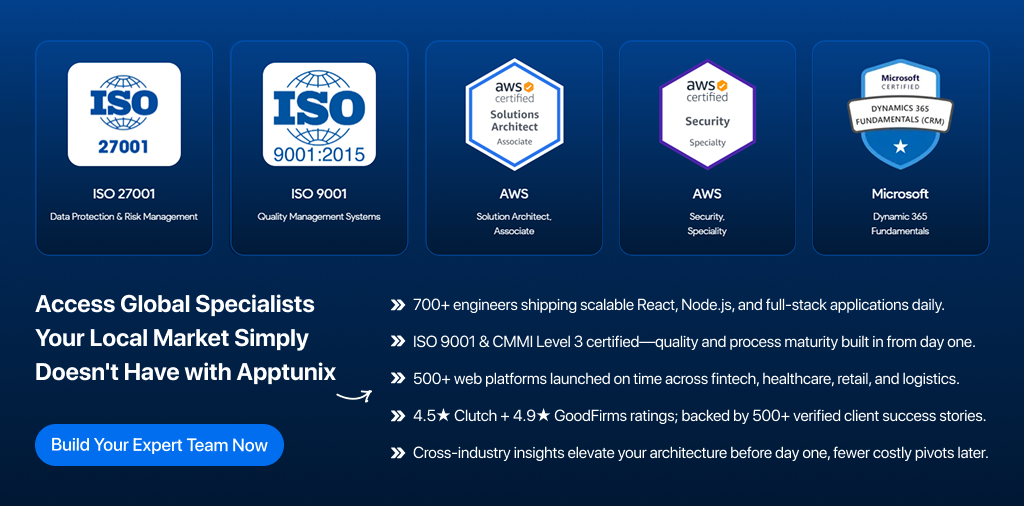
The client’s rating is 4.5 stars on Clutch and 4.9 stars on GoodFirms based on verified project reviews. Apptunix holds ISO 9001 and CMMI Level 3 certification. Both are independent indicators of process maturity and delivery consistency. We approach every engagement as a long-term partnership, not a transactional handoff.
The wrong outsourcing partner costs you time, budget, and momentum that is difficult to recover. The right one builds alongside you with full accountability for what gets shipped.
Partner with Apptunix and get a web development team that starts fast, delivers cleanly, and stays invested through every phase of your growth. Request your free consultation today.
Q 1.What are the key benefits of outsourcing web development?
The top benefits are cost savings, access to global talent, and faster delivery. You also get on-demand scalability, built-in QA, and round-the-clock development. Outsourcing frees your internal team to focus on growth. It is a strategic tool, not just a cost-cutting move.
Q 2.Is software product development outsourcing safe?
Yes, when proper safeguards are in place. Always sign an NDA before sharing project details. Ensure contracts specify IP ownership and data handling. Reputable offshore web development companies follow strict security policies. They protect your intellectual property by contract.
Q 3.How do I choose the right web development outsourcing partner?
Check their portfolio for similar projects. Read client reviews on Clutch and GoodFirms. Evaluate communication quality and time zone compatibility. Ask how they handle scope changes and technical blockers. Look for transparency in pricing and process.
Q 4.What is the difference between offshore, nearshore, and onshore outsourcing?
“Offshore” means teams in distant countries like India. It offers the highest cost savings. Nearshore means teams in nearby regions with overlapping time zones. It balances cost and collaboration. Onshore means teams in your own country. It offers the easiest communication but the highest cost.
Q 5.How long does outsourcing web development typically take?
A simple website can take four to eight weeks. A custom web application typically takes three to six months. Enterprise SaaS platforms can take six to twelve months or more. Clear milestones and detailed requirements keep timelines accurate.
Q 6.What is the difference between outsourcing and staff augmentation?
Outsourcing delegates an entire project to an external team. They own delivery outcomes. Staff augmentation adds individual specialists to your existing team. You manage them directly. Both access external talent. The difference is who owns accountability.
Q 7.What types of web development projects are best suited for outsourcing?
Outsourcing works well for projects needing niche skills unavailable locally. It is ideal for time-sensitive launches, scalable product development, SaaS platforms, and custom web apps. See how SaaS outsourcing delivers specific advantages for product companies.
Q 8.How do I protect my intellectual property when outsourcing web development?
Sign a comprehensive NDA before sharing any project details. Ensure contracts assign IP ownership to you as the client. Verify your partner uses access controls and encrypted environments. Request references and confirm their IP protection track record in practice.
Get the weekly updates on the newest brand stories, business models and technology right in your inbox.
Nishant Saini is a business researcher and content strategist specializing in ROI analysis for the tech, SaaS, and digital-first industries. With a knack for breaking down complex, jargon-heavy technical concepts, he transforms intricate data into clear, actionable insights that help founders, businesses, and investors make confident scaling decisions.
Nishant’s expertise spans business research, SEO, product guides, thought leadership, and brand storytelling. By blending deep technical research with a modern, conversational tone, he creates high-impact content that builds trust and drives engagement.
Core Expertise:
Tech & SaaS: Mobile apps, digital products, and AI-driven automation.
Strategic Content: Product explainers, comparison guides, and home networking/connected devices.
ROI-Focused Writing: Simplifying complex systems into user-friendly, high-conversion assets.
83 Views 10 min July 15, 2026

167 Views 10 min June 26, 2026

310 Views 10 min June 9, 2026
Book your consultation with us.
Book your consultation with us.


One Central, The offices 3, Level 3, DWTC, Sheikh Zayed Road, Dubai
+971 50 782 1690